• Home
  • Mission
  • Federalist Papers
  • Foundation
  • U.S. Constitution
  • Bill of Rights

Federalist Press | Defending Liberty — Informing America

Breaking News and Political Commentary

  • All Stories
  • Economy
  • Elections
  • Entitlement
  • Ethics
  • Foreign
  • Gender
  • Religion
  • Sci-Tech

Let’s Be Honest: Young Black Men are Trapped in the Blue City Crossfire

September 9, 2025 By Editor Leave a Comment

By James Thompson

America’s homicide crisis is escalating (despite Democrat attempts to skew crime numbers), and young Black men remain trapped in a grossly outsized cycle of violence and victimization that far exceeds their share of the general population.

Black American men ages 15–34 account for just 5% of the U.S. population, yet they suffer homicide rates more than six times the national average.

In 2023, federal data show Black Americans were killed at a rate of 21.3 per 100,000, compared to just 3.2 per 100,000 for White Americans. Firearm homicides alone hit nearly 27.5 per 100,000 Black residents—a staggering figure that dwarfs those of every other racial group.

Why?

The tragedy is not just in the numbers, but in the lived reality. In Chicago, Baltimore, Philadelphia, and scores of other Democrat-run “Blue Cities,” shootings are measured in dozens per weekend. The overwhelming majority of both offenders and victims are young Black men. And despite public perception, the violence is overwhelmingly intraracial (Balck-on-Black): about 63% of violent crimes against Black victims are committed by other Black offenders, according to the National Crime Victimization Survey. Contrary to what many legacy media outlets claim, very few are committed by police.

A Cycle Rooted in Poverty and Family Instability

Researchers point to a web of interconnected drivers: segregated, under-resourced neighborhoods, failing public schools, and high rates of single-parent households. In 2023, nearly half of Black children lived with a single parent, compared to about one in five White children. Critics argue that decades of welfare policy discouraged family stability, and that “marriage penalties” in tax and welfare benefit systems risk making poor families worse off if they legally wed.

The result is a generation of boys too often raised without consistent male role models, in neighborhoods where crime networks wield more influence than families, schools or churches. As one Chicago pastor put it recently: “We’re asking young men to build a life on quicksand.”

Violence Beyond the Black Community

The violence does not remain contained. The shocking murder of Iryna Zarutska, a 23-year-old Ukrainian refugee fatally stabbed on Charlotte’s light rail a few days ago drew national headlines and underscored broader anxieties about crime crossing racial lines. Hispanic and Asian communities in urban centers are also reporting rising victimization rates, though the overall pattern remains heavily concentrated within racial groups themselves.

What Works—and What Doesn’t

While political debates rage over policing, incarceration, and gun laws, researchers have quietly identified interventions that consistently save lives.

  • Focused deterrence strategies, such as the Group Violence Intervention model, have cut homicides sharply in cities that apply them with fidelity. These programs zero in on the small networks responsible for the majority of shootings, pairing swift enforcement with real offers of services and escape routes.
  • Youth interventions like Chicago’s Becoming a Man program have shown remarkable results, reducing violent-crime arrests by more than a third through cognitive-behavioral therapy and mentoring.
  • High-dosage tutoring and strong schools in disadvantaged areas attack the root of intergenerational poverty by raising achievement and keeping at-risk youth connected to opportunity.
  • Mobility programs that help families move into safer, higher-opportunity neighborhoods when children are young have lasting effects, producing higher adult earnings and more stable families.

These approaches stand in contrast to broad “tough on crime” sweeps that often criminalize entire communities while missing the small, tightly connected groups who actually drive the violence.

A National Responsibility

The cost of inaction is measured in human lives and lost futures. Every weekend, headlines announce the toll: “12 shot, 3 killed overnight” in many cities. Each figure represents not just a victim, but a family torn apart, a neighborhood further traumatized, and a society that has failed to deliver equal safety and opportunity.

If America is serious about addressing its most urgent public safety crisis, it must confront the uncomfortable truth: a small share of the population, disproportionately young Black men, bear the brunt of the nation’s violence epidemic–as perpetrators and victims.

Breaking that cycle will require more than policing alone. It demands rebuilding families, repairing schools, reforming welfare policies, and investing in proven strategies that offer young men a path to middle-class stability rather than early graves.

Until then, the “normal” American life—safe streets, good schools, stable families—will remain out of reach for too many of those who need it most.

President Donald Trump is launching a sweeping policing of troubled cities with federal assets in the hope of reducing crime and saving lives. His foray into Washington, D.C. with a federal presence has yielded fantastic results, sparing the lives of many young Black American men. However, Democrats are boisterously against such efforts, screaming in the streets that they are happy with the status quo in their war-torn cities, and that Trump is a fascist dictator to seek peace and safety in our cities. We expect to see the effort expanded to many Blue Cities in the next few months, and when Trump succeeds, we will see what can be done for the young Black men and their families who live to make a change.


James Thompson is an author and ghostwriter, and a political analyst.

Sponsored by BasicInfo123 — simple bite-sized guides for life, money, civics, and more—because some stuff school just didn’t cover.

Filed Under: Bias, Crime, Economy, Elections, Entitlement, Ethics

NY Appeals Court Throws Out Trump Civil Fraud Penalty

August 21, 2025 By Editor Leave a Comment

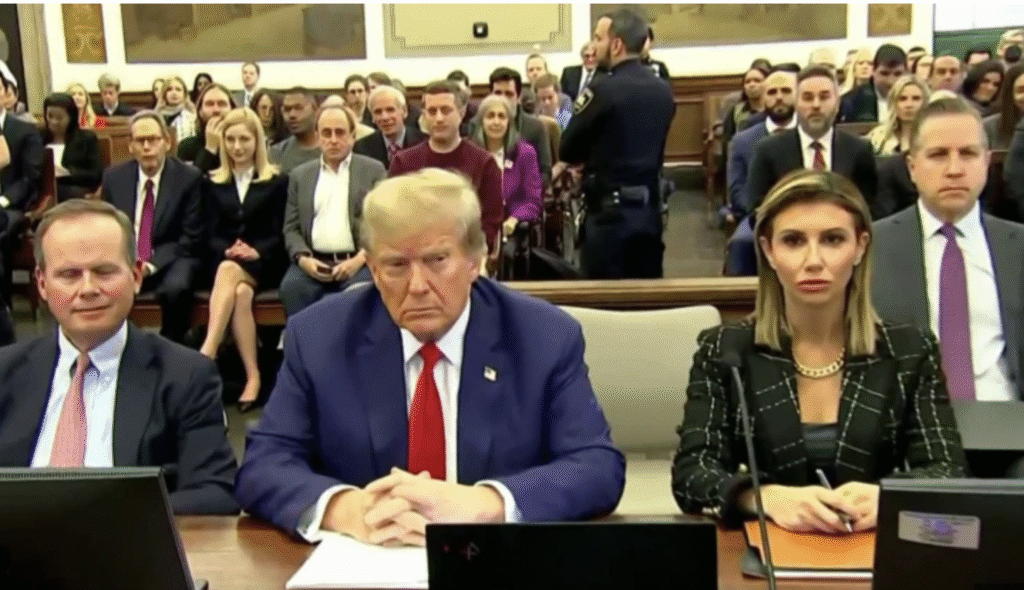
New York — A five‑judge panel of New York’s Appellate Division (First Department) has thrown out the massive monetary penalty imposed on President Donald Trump in the state’s civil fraud case, finding the disgorgement order “excessive” under the Eighth Amendment. The ruling, issued Thursday, strikingly reshapes the case that had ballooned to more than $515 million with interest, and leaves a clear path for further appeals to New York’s highest court.

What the court decided

  • Disgorgement/monetary penalty: Vacated in its entirety as an excessive fine. The court concluded that directing Trump and co‑defendants to pay nearly half a billion dollars violated the U.S. Constitution’s Excessive Fines Clause.
  • Injunctive relief: The panel indicated that certain behavior‑modifying injunctions aimed at corporate practices were appropriate, even as it rejected the money judgment. (Those bans and monitorships had been paused during the appeal.)
  • Next steps: The decision keeps the door open for additional review—by the New York Court of Appeals—while dissolving the immediate threat of collection on the disgorgement. Trump’s previously posted $175 million bond forestalled collection while the appeal was pending.

How we got here

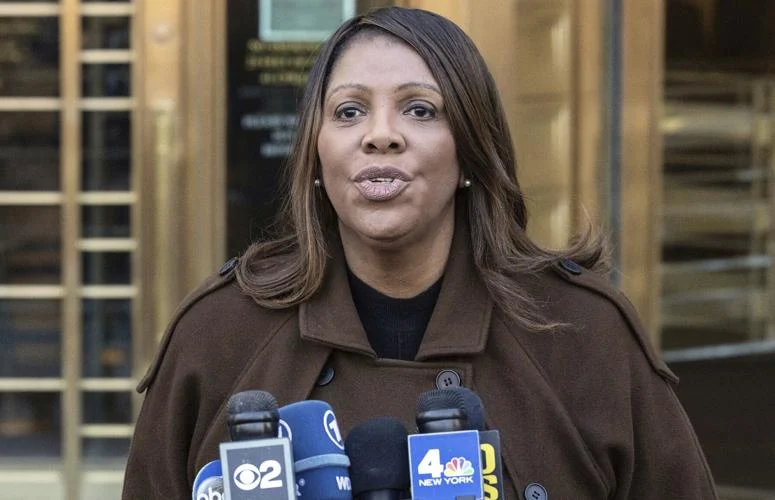
New York Attorney General Letitia James sued in 2022 under Executive Law § 63(12), a powerful state statute often used to police “repeated fraudulent or illegal acts.” After a bench trial, Justice Arthur Engoron found Trump had inflated asset values and, in early 2024, imposed a penalty initially pegged around $355 million, which with interest swelled above $515 million; he also ordered leadership bans and other injunctive remedies.

New York State Attorney General Letitia James campaigned on promise to take down President Trump by any means necessary.

Trump appealed, arguing that (1) no lender lost money, (2) the Attorney General stretched § 63(12) beyond its proper scope, (3) the disgorgement was unauthorized or disproportionate, and (4) the penalty violated the Eighth Amendment. Several Republican‑led states filed amicus briefs supporting the excessive‑fines argument.

Today’s ruling—after an unusually long deliberation period for the First Department—adopts the excessive‑fines critique and erases the money judgment. (Reporting earlier this week highlighted how rare such internal divisions and delays are for this court.)

Why the Excessive Fines Clause matters here

The Excessive Fines Clause applies to state actions, including civil sanctions, via Timbs v. Indiana (2019). In Timbs, the U.S. Supreme Court unanimously held that states cannot impose grossly disproportionate financial penalties. That constitutional guardrail now anchors the appeals court’s conclusion that New York’s disgorgement order went too far.

Critics’ case: why many call the lawsuit a “sham”

From the outset, critics argued that New York brought a politicized, victim‑less fraud case: lenders were sophisticated, performed their own valuations, were repaid, and did not complain of losses; yet the state sought a sweeping corporate death‑penalty‑style remedy. Business‑law commentators warned the case, if upheld, would chill private enterprise by punishing negotiations that harmed no counterparties. Today’s ruling vindicates the core of that critique by rejecting the most punitive financial sanction as unconstitutional.

Republican attorneys general likewise contended that using § 63(12) to extract a massive disgorgement where no consumer injury was shown transformed the statute into a blunt political instrument. Their filings emphasized that punishment must be proportional and tied to demonstrable harms—principles the appellate court’s decision echoes.

What still stands—and what could come next

  • Fraud findings & injunctions: The court signaled that targeted injunctive relief to constrain business practices can remain—a point the Attorney General will lean on as she considers next steps. (Any renewed attempt at monetary sanctions would face strict proportionality limits.)
  • Further appeals: Either side can seek leave to appeal to the New York Court of Appeals. Given the stakes—for Trump, for the AG’s office, and for the future use of § 63(12)—a petition is highly likely.
  • Broader impact: The ruling will shape how New York (and other states) deploy civil‑fraud statutes in high‑profile business cases. It underscores that even civil “disgorgement” risks crossing into punitive territory barred by the Eighth Amendment—especially where the record shows no concrete losses to counterparties.

Bottom line

The appeals court didn’t just trim Trump’s penalty—it wiped out the money judgment as unconstitutional, dramatically undercutting the theory that justified the case’s most severe sanction. For supporters of the President, this outcome supports the view that the New York proceeding was overreaching and political. For state regulators, it’s a sobering reminder that civil enforcement powers meet constitutional limits, and that large “disgorgements” must be tied to real harms and calibrated to pass Eighth Amendment scrutiny.
Filed Under: Bias, Elections, Ethics

Who Took the FireAid $100 Million? Dem Front Groups

July 23, 2025 By Editor Leave a Comment

Circling the News has looked into the disposition of the FireAid funds, and has discovered that most of the money has ended up in the hands of democratic party front organizations, absorbed to support many leftist causes, instead of helping victims of the L.A. fires.
FireAid, a two‑venue benefit concert held on January 30, 2025, at Inglewood’s Intuit Dome and Kia Forum, raised over $100 million for the victims of the Eaton and Palisades fires in Los Angeles. The event featured megastars like Billie Eilish, Lady Gaga, and U2—who even pledged $1 million—while Steve and Connie Ballmer matched donations dollar for dollar.

The Annenberg Foundation was designated to oversee distribution of the proceeds via a newly formed 501(c)(3) dubbed FireAid.

The missing money

  • By July 2025—six months post-concert—investigative reporter Sue Pascoe (editor of Circling the News), found no evidence that funds had gone directly to fire survivors.
  • When pressed, the Annenberg Foundation and Clippers’ spokesperson Chris Wallace stated that all funds were allocated to nonprofits serving impacted communities, but none were provided as direct cash grants to individuals.
  • The community council in Pacific Palisades pushed back: of the nearly 120 nonprofits awarded money, only three served Palisades directly—Kehillat Israel, Chabad of Palisades, and Palisades High School—with no transparency on grant sizes or outcomes.

Where has the money gone?

  • Phase 1 (February 2025): $50 million distributed across 120+ nonprofits—a wide range of leftist organizations and causes (food, housing, arts, mental health, animal welfare, etc.)—but with no indication of any impact in hard-hit neighborhoods like Palisades.
  • Phase 2 (early summer 2025): $25 million allocated to longer-term programs—mental health, environmental remediation, sustainable rebuilding—again routed entirely via leftist nonprofits.
  • Phase 3: Still open for nonprofit applications; no direct individual aid has been announced.

Voices from the frontlines

  • Pascoe quotes a distraught reader: “I’ve never seen any fire aid money… There’s 12,000 people… homes gone. Those people probably wanna know where the money is.”
  • The Pacific Palisades Community Council demanded a full accounting—grant-by-grant, dollar amounts, and whether any funds reached victims directly—pressuring Annenberg and FireAid for transparency.

What’s at stake?

  1. Transparency: Donors—including Ballmers and artists—gave believing relief would hit families’ pockets. Yet there’s no public record of distributions, amounts, or recipients.
  2. Accountability: The failure to track how leftist nonprofit partners used the money raises the risk of funds being diverted to general left-wing causes or bureaucratic overhead (CEO salaries, donations to DNC), instead of victims.
  3. Public trust: Allegations accuse that funds were simply “laundered through democratic party front organizations.” What is clear is the heavy reliance on nonprofits without visible community oversight.

The bottom line

Over $100 million was raised in good faith to aid Los Angeles fire victims. Yet by mid‑2025:

  • No direct cash support has been confirmed to individual victims of the fires.
  • A small number of left-leaning nonprofits in severely affected areas have been revealed to have received grants—with no breakdown of dollar amounts or reported impact.
  • The remainder of funds is funneled into broader democrat community and infrastructure projects, at the discretion of FireAid advisors.

What happens next?

  • The Pacific Palisades Community Council is demanding a full financial breakdown—including all grants, matched funds, and direct aid—as of May 2025.
  • More investigative pressure from reporters like Pascoe, community groups, and possibly legal scrutiny may force public disclosure.
  • If answers continue to stall, donors may call for independent audits or even legal action to ensure intended recipients aren’t forgotten.

James Thompson is an author and ghostwriter, and a political analyst.

Filed Under: Bias, Crime, Elections, Entitlement, Ethics

Trump’s Big Beautiful Bill Passes Congress in Landmark Victory

July 3, 2025 By Editor Leave a Comment

In a stunning and historic move, Congress has just passed President Donald J. Trump’s long-awaited Big Beautiful Bill, delivering a major legislative win for his administration and a decisive step toward fulfilling key promises of his second term. The bill, touted by President Trump as “the most beautiful piece of legislation our nation has ever seen,” passed both chambers after weeks of intense debate and negotiation.

What’s in the Bill?

The Big Beautiful Bill is sweeping in scope. Among its most significant provisions:

  • Border Security and Immigration Reform: The bill allocates record funding for the completion of the southern border wall, bolsters border patrol forces, and implements stricter measures to prevent illegal immigration while streamlining legal immigration for merit-based applicants.
  • Tax Relief: It introduces further tax cuts aimed at middle-class families and small businesses, building on the success of the 2017 Tax Cuts and Jobs Act.
  • Energy Independence: The bill rolls back excessive regulations on domestic energy production, supporting American oil, gas, and coal industries while expanding incentives for clean nuclear and next-generation technologies.
  • Restoration of Law and Order: It provides significant funding for law enforcement and first responders, with provisions aimed at reducing violent crime in major cities.

A Hard-Fought Victory

Passage of the bill was far from certain. Democrats mounted fierce opposition, criticizing the bill as being too focused on Trump’s campaign priorities. Yet in the end, a coalition of Republicans and moderate Democrats, responding to public pressure for action on border security, inflation relief, and national security, propelled the bill across the finish line.

Speaker of the House, who had initially wavered, ultimately praised the final product: “This is a bill that puts Americans first. It strengthens our economy, secures our borders, and supports our communities.”

Senate Majority Leader echoed the sentiment: “We’ve delivered on what the American people asked for: safety, prosperity, and common-sense governance.”

Trump’s Reaction

President Trump, speaking from the White House Rose Garden moments after the vote, hailed the legislation as “a win for all Americans” and “proof that when we put America First, nothing can stop us.”

He added: “This Big Beautiful Bill is going to make our country stronger, safer, richer, and greater than ever before. I want to thank Congress for working together, despite differences, to do what’s right for our people.”

The Road Ahead

The Big Beautiful Bill now heads to President Trump’s desk, where he is expected to sign it into law within days. Implementation will begin immediately, with federal agencies already preparing to roll out new programs and allocate funding according to the bill’s provisions.

Critics, including progressive lawmakers and left-wing media outlets, have vowed legal challenges to portions of the bill, particularly those related to immigration enforcement and energy policy. However, the Trump administration appears confident that the law will withstand scrutiny.

For now, the passage of the Big Beautiful Bill marks a pivotal moment in the Trump presidency—one that supporters are calling a defining achievement and a major step in delivering on the promises that brought him to the White House once again.

James Thompson is an author and ghostwriter, and a political analyst.

Filed Under: Economy, Elections, Entitlement, Ethics, Foreign, Gender

Jamie Lee Curtis Wept Over Kanye’s Antisemitism—But Where Is Her Outrage Now?

June 4, 2025 By Editor Leave a Comment

By James Thompson | June 4, 2025

Jamie Lee Curtis addresses her online response to Kanye West’s antisemitic posts on social media, saying West’s posts were “just abhorrent.”

In 2022, actress Jamie Lee Curtis became a viral symbol of righteous outrage after rapper Kanye West posted a now-infamous tweet threatening to go “death con 3 on JEWISH PEOPLE.” Although the ‘threat’ was a hollow, big-mouth pronouncement that West was going to expose unfair treatment by Jewish music industry people, the Oscar winner condemned the comment as “abhorrent,” linking it to the atrocities of the Holocaust, and even broke into tears during a televised interview. At the time, Curtis’s response was praised as a courageous stand against hate.

But today, amid a tsunami of antisemitic harassment and violence—largely coming from far-left movements cloaked in anti-Zionist rhetoric—Curtis has been notably silent.

Across America, Jewish students are being harassed, threatened, and even physically attacked on college campuses. At pro-Palestine/Hamas rallies chants like “death to the Jews” and “Hitler was right” have been caught on camera. Jewish students at schools like Columbia, NYU, and UC Berkeley have reported needing security escorts, hiding in libraries, and being locked out of their dorms—simply for being Jewish.

Yet, Jamie Lee Curtis, along with many other left-leaning celebrities who loudly denounced Kanye West, now says nothing.

“Silence isn’t neutrality—it’s complicity,” said Noah Silverman, a Jewish student at UCLA. “When celebrities speak out against antisemitism only when it comes from the right, it tells us that our safety is conditional. If the threat comes from the ‘wrong kind’ of oppressor, it doesn’t matter.”

This glaring double standard has not gone unnoticed. Critics accuse Curtis and others in Hollywood of moral grandstanding when it suits their left-leaning narrative—but failing to call out hate when it emerges from within their own ideological circles.

“The left has built an entire identity around inclusivity, tolerance, and human rights,” said Bari Weiss, founder of The Free Press. “But when Jewish lives are threatened by people waving socialist flags instead of Confederate ones, suddenly the moral clarity vanishes.”

Curtis has continued posting regularly on social media about various progressive causes—climate change, women’s rights (although nothing about men in women’s sports), LGBTQ+ advocacy—but has made no public comment about the surge in antisemitic incidents tied to recent pro-Palestinian protests. Her silence has sparked backlash, especially from Jewish activists who once applauded her principled stand against Kanye West.

“The hypocrisy is staggering,” said Jonathan Feldman, an analyst at the Jewish Policy Institute. “Jamie Lee Curtis cried on live television over a tweet. But when Jewish college students are hiding from mobs, she can’t spare even a sentence?”

To be clear, no one is suggesting that all criticism of the state of Israel is antisemitic. But when protests devolve into calls for genocide and physical violence against Jewish individuals—when Jewish identity itself becomes the target—celebrities who previously championed “never again” owe the public more than silence.

Selective outrage isn’t justice. It’s performance. It looks like tacit approval.

And for those like Curtis, whose voice carries influence, that silence speaks volumes.


James Thompson is an author and ghostwriter, and a political analyst.

Filed Under: Bias, Elections, Entitlement, Foreign, Religion

$4.7 trillion in untraceable Treasury payments

May 25, 2025 By Editor Leave a Comment

Nearly one-third of Treasury payments a year lack proper identification codes, Treasury Secretary Scott Bessent testified to Congress

By Deirdre Heavey

Earlier this year, Elon Musk’s Department of Government Efficiency (DOGE) uncovered $4.7 trillion in untraceable Treasury Department payments. 

Prior to the discovery, Treasury Account Symbol (TAS) identification codes were optional for $4.7 trillion in Treasury Department payments, so they were often left blank and were untraceable. The field is now required to increase “insight into where the money is actually going,” the Treasury Department and DOGE announced in February. 

“Of the 1.5 billion payments that we send out every year, they are required to have a TAS, a Treasury Account Symbol. We discovered that more than one third of those payments did not have a TAS number,” Treasury Secretary Scott Bessent said before the House Appropriations Subcommittee on Financial Services and General Government earlier this month. 

Fox News Digital asked Republican senators on Capitol Hill to respond to the approximately 500,000 in untraceable payments made by the Treasury Department each year. 

“I’m not surprised at all, unfortunately,” Sen. Roger Marshall, R-Kansas, said before adding, “They were leaving complete fields undone when they were filling out their financials, so this is a common theme. I’m not surprised.”

Sen. Eric Schmitt, R-Missouri, called for an investigation into where those payments actually went. 

“There’s so much waste. There’s so much fraud, There’s so much abuse in our government,” Schmitt told Fox News Digital. “I’m glad there was a laser-like focus on it. We ought to make many of those reforms permanent, but there probably ought to be some investigations here about where this money actually went. I mean this is taxpayer money. People work hard.”

Donald Trump and Elon Musk

President Donald Trump and Elon Musk have worked to eliminate waste, fraud and abuse through the Department of Government Efficiency (DOGE).  (Jeff Bottari/Zuffa LLC)

After DOGE and the Treasury Department uncovered $4.7 trillion in untraceable funds, Marshall and Sen. Rick Scott of Florida introduced a bill in March requiring the Treasury Department to track all payments. 

The Locating Every Disbursement in Government Expenditure Records (LEDGER) Act seeks to increase transparency in how the Treasury Department spends taxpayer money. 

“When you hear about this story that they didn’t know where the money was going, it makes you mad because this is somebody’s money, this is taxpayers’ money when we have almost $37 trillion in debt, so this makes no sense at all,” Scott said. 

Elon Musk in "tech" shirt

Elon Musk shows off his t-shirt reading “Tech Support” while speaking at the first cabinet meeting hosted by President Donald Trump, at the White House in Washington, D.C., Feb. 26, 2025. (REUTERS/Brian Snyder)

The Congressional Budget projects that interest payments on America’s national debt will total $952 billion in fiscal year 2025. That’s $102 billion more than the United States’ defense budget at $850 billion. 

“We paid out more last year on our debt, $36 trillion in debt, with $950 billion in interest going to bondholders all over the world, including in China. That $950 billion didn’t go to build a bridge or an F-35. We paid more on the interest on debt than we did to fund our military,” said Sen. Dan Sullivan, R-Alaska. 

“That is an inflection point that when most countries hit, you look at history, that’s when great powers start to decline. So we have to get those savings.”

Filed Under: Crime, Economy, Elections, Entitlement, Ethics

“Forced to Comply: The Lasting Consequences of America’s COVID Vaccine Mandates”

May 21, 2025 By Editor Leave a Comment

By James Thompson

In the aftermath of the COVID-19 pandemic, the American public is only beginning to reckon with the social, political, and personal costs of what most now view as an era of coercive overreach by the Democrat federal government and its media allies. One of the most striking recent reversals has come from Dilbert creator Scott Adams, who—after years of vehemently defending aggressive vaccination policies—has admitted, in the shadow of a personal cancer diagnosis, that the government-led push to vaccinate every American “at all costs” was deeply misguided.

Adams has acknowledged that those who refused the vaccine—the so-called “anti-vaxxers” vilified by pundits and politicians alike—are now enjoying the benefit of natural immunity, unburdened by the vaccine-related side effects that have become a topic of growing scientific concern. “They were right,” Adams said, noting that natural immunity, which was largely dismissed by officials early in the pandemic, has proven to be effective. “The smartest, happiest people are the ones who didn’t get the vaccination and are still alive.”

This statement reflects a larger shift in public sentiment, as millions who were fired, ostracized, banned from travel, forced to close their businesses, forced to stay home from school, or denied hospital visits with dying relatives begin to demand answers—and accountability.

A Mandate, Not a Choice

Under the Biden administration, vaccine mandates swept through the federal government, the military, public schools, hospitals, and large corporations. President Biden himself declared in July 2021: “You’re not going to get COVID if you have these vaccinations.” That bold promise, however, did not hold. Biden contracted COVID multiple times despite being vaccinated and boosted, undermining the very narrative his administration used to justify its draconian policies.

President Joe Biden received one of many COVID-19 vaccinations

The White House, in conjunction with the CDC and mainstream media, created a culture of forced compliance. Americans were not merely encouraged to get vaccinated—they were compelled. In Orwellian fashion, objectors were ridiculed as science-deniers, conspiracy theorists, or threats to public safety. Democratic leaders across the country echoed the federal position, with cities like New York and Los Angeles enacting some of the strictest vaccine mandates in the world, including forced mask wearing and six-foot personal bubble zones in public–which were entirely without scientific basis.

But the real-world consequences were far from hypothetical. Teachers were fired. Nurses who worked through the height of the pandemic were terminated. Business closed permanently. Military personnel were discharged. Students were barred from campuses. Families were separated from loved ones in their final moments. Freedom of movement and association—basic rights in any free society—were suspended indefinitely in the name of safety. Leftists, drunk with their new-found power, ruled with jack-booted thuggery, destroying the lives of millions of Americans in the process.

Media Complicity and the Censorship Machine

Much of this was aided and abetted by a compliant press corps. Networks like CBS, NBC, ABC, CNBC, CNN and MSNBC rarely challenged the official narrative. Tech platforms like Facebook and Twitter throttled dissenting voices, deplatformed doctors, and labeled emerging science as “misinformation”—even when those claims were later validated. Dissent became dangerous, and speech was tightly policed.

Public trust eroded further as vaccine efficacy became increasingly unclear. The original promise of complete protection gave way to a shifting goalpost: fewer symptoms, fewer hospitalizations. And with that shift came the creeping realization that the public had been misled.

The Human Cost

The Biden administration’s mandates exacted a steep toll. Americans who dared question the prevailing orthodoxy were not only widely shamed, but often economically ruined. Many are still trying to rebuild.

Some justice is slowly being served. President Donald Trump has made efforts to reinstate military personnel discharged for refusing the vaccine, acknowledging the injustice. But these are small reparations for a crisis of trust that cut deep into the fabric of American life.

A Lesson for the Future

The pandemic response revealed the ease with which government with totalitarian leanings and media institutions could exert massive control over the lives of everyday Americans. What was marketed as “science” often functioned as mere ideology. And those who asked inconvenient questions were not engaged—they were erased.

As figures like Scott Adams reflect on their own role in enabling these draconian, Big Brother policies, a larger question remains: Will there be accountability? Who will we see being perp-walked on television for their unconstitutional betrayals of the American people? And will Americans ever again be allowed to question authority without being crushed by it?

In the end, COVID-19 may be remembered not only for the virus itself—but for the way it exposed the easy willingness of a government to seize control, and the cost of a media complex that cheered it on. The left should be held to account for everything they did to the American people, and at a minimum, should never be afforded even a modicum of trust by their victims.


James Thompson is an author and ghostwriter, and a political analyst.

Filed Under: Elections, Ethics, Sci-Tech

Gas Prices Plunge as Trump’s Return Spurs Energy Boom, Economic Ripple Effects

May 15, 2025 By Editor Leave a Comment

May 15, 2025 — Washington, D.C.

In a dramatic shift from trends seen in recent years, gasoline and oil prices are tumbling across the United States, with some regions now reporting prices at nearly half of what they were on the day President Joe Biden left office. The reversal comes on the heels of former President Donald Trump’s return to the White House for a second term, ushering in sweeping changes to energy policy and geopolitical strategy.

From Boom to Bust and Back Again

During Trump’s first term (2017–2021), the United States experienced a surge in domestic energy production. The administration’s aggressive deregulatory approach and expanded drilling incentives led to historically low gasoline prices, with the national average often hovering around $2 per gallon. The U.S. briefly became a net exporter of oil and natural gas, and the term “American energy independence” became a political catchphrase.

That dynamic shifted sharply under President Biden. Prioritizing climate change mitigation, the Biden administration curtailed domestic fossil fuel production through executive orders, leasing restrictions, and support for renewable alternatives. While supporters applauded the environmental emphasis, critics pointed to rapidly rising energy costs, supply chain disruptions, and surging inflation as direct consequences.

By mid-2022, average U.S. gasoline prices had climbed above $5 per gallon in some states, driven by both policy decisions and global factors such as the war in Ukraine. These price hikes strained household budgets and increased the cost of transporting goods—one of several drivers behind persistent inflation.

A New Energy Landscape in 2025

Since taking office in January 2025, President Trump has rapidly reversed many of his predecessor’s energy policies. Executive orders reopened federal lands to oil and gas drilling, streamlined permitting processes, and greenlit major pipeline projects previously stalled or canceled.

The response from the energy sector was swift. U.S. oil output surged to record levels by May, and gasoline prices began dropping accordingly. As of this week, the national average price for a gallon of regular unleaded gasoline stands at $2.39—down from $4.71 five months ago. In some Southern and Midwestern states, prices have dropped below $2 per gallon.

Economists note that this decline is not only easing pressure on consumers but also helping to lower transportation and manufacturing costs across industries. “Energy is the lifeblood of the economy,” said Dr. Laura Chen, an economist at the Heritage Foundation. “When fuel costs fall, virtually every sector benefits—especially food, shipping, and retail.”

Geopolitical Impacts: Strength at Home and Abroad

Trump’s assertive diplomacy is also being felt on the international stage. In a surprise visit to Saudi Arabia earlier this week, President Trump secured a new multi-nation agreement to increase oil output and stabilize prices. The deal includes cooperation from Gulf states and a tentative framework for easing tensions in the Red Sea corridor.

Analysts say the agreement not only boosts global supply but also undermines adversarial regimes that rely heavily on high oil revenues to fund aggression.

“Russia, Iran, and others use oil money to prop up their economies and fund military campaigns,” said former U.S. Ambassador to Israel David Friedman. “When energy prices fall, their ability to project power shrinks. This is economic deterrence in action.”

The economic and strategic benefits of lower oil prices are expected to continue in the months ahead. Inflation, which had remained stubborn through 2024, has already begun to decline, with the Consumer Price Index showing a 0.4% decrease in April—the first monthly drop in over two years.

The Road Ahead

While critics warn of environmental consequences and question the long-term viability of fossil fuel reliance, Trump supporters argue that renewed energy production is key to restoring economic stability and global strength.

“America is back in control of its energy future,” said the White House Press Secretary in a briefing Tuesday. “We’re putting American jobs, American security, and American families first.”

As oil rigs come back online and gas stations reflect lower prices, the political and economic narrative surrounding U.S. energy policy is once again shifting—with major implications for inflation, international stability, and everyday life.


James Thompson is an author and ghostwriter, and a political analyst.

Filed Under: Economy, Elections

Unmasked: Biden and Dems Lied about Border

April 29, 2025 By Editor Leave a Comment

Over the past four years the United States experienced an unprecedented surge in illegal immigration across its southern border, as President Joe Biden’s administration dismantled many of the prior administration’s stringent border security measures. Despite repeated assurances to the American people that “the border is secure,” tens of millions of unvetted migrants entered the nation under Biden’s watch, or . . . invitation, straining resources and fueling a national debate about the rule of law, sovereignty, and public safety.

Shortly after taking office in January 2021, President Biden reversed key Trump-era policies that had effectively halted illegal immigration. Among these were killing the “Remain in Mexico” policy (officially known as the Migrant Protection Protocols), the halting of border wall construction, and the suspension of Title 42, a public health order that allowed for rapid expulsion of illegal entrants during the COVID-19 pandemic.

Biden signs dozens of Executive Orders overturning Trump’s border security efforts

At the same time, Biden and his top officials, including Department of Homeland Security Secretary Alejandro Mayorkas, publicly insisted that the southern border was “closed” and “secure.” In March 2021, Mayorkas stated, “The border is secure. The border is closed,” even as apprehension numbers surged to record highs.

President Biden himself echoed this sentiment. In January 2023, he declared, “I think the border is secure,” during remarks to the press, despite more than 2 million migrant encounters being reported in fiscal year 2022 alone. Of course, Democrats view illegal aliens as future Democrat voters, as Biden’s ‘Freudian slip’ referring to mass immigration influx of ‘Hispanic voters’ on May 9, 2024 indicated.

Prominent Democratic leaders rallied behind this narrative. Senator Chuck Schumer (D-NY) emphasized in November 2022, “We need immigrants… We have a population that is not reproducing on its own with the same level that it used to. We need a path to citizenship.” Meanwhile, House Minority Leader Hakeem Jeffries (D-NY) insisted, “There is no crisis at the southern border that Republicans would have you believe.”

Facing growing public concern, the Biden administration shifted its messaging, claiming that the only way to fix the “challenges” at the border was through new legislation. In February 2024, Biden stated during a speech, “We need Congress to act. We need a comprehensive immigration reform that will once and for all fix this broken system.”

However, critics pointed out that the proposed “fixes” in Democratic-sponsored legislation would essentially codify the mass influx of illegal aliens, providing expedited paths to citizenship and offering extensive protections for individuals who entered the country unlawfully.

The contrast with the Trump administration’s record could not be more stark. Upon entering office in 2017, President Donald Trump swiftly enacted executive orders to ramp up border security, reinstate and expand detention facilities, build hundreds of miles of new border wall, and negotiate agreements with Mexico and Central American countries to stem the flow of migrants.

President Trump visits border wall as it is being constructed

Illegal crossings plummeted during Trump’s tenure. By mid-2020, with policies like “Remain in Mexico” firmly in place and aggressive enforcement measures underway, the southern border saw some of the lowest levels of illegal migration in decades.

As Trump returned to the White House for his second term in 2025, he wasted no time reinstating his proven policies. Within weeks, construction on the border wall resumed at an accelerated pace, and diplomatic efforts reestablished cooperative security agreements with neighboring nations. The “catch and release” practices that had flourished under Biden were once again halted, and apprehended illegal immigrants were swiftly processed and removed.

Border Patrol data for early 2025 already shows a dramatic decrease in illegal crossings, able to be counted on fingers, demonstrating that decisive leadership and enforcement can reestablish control of the border quickly and effectively.

In short, the Biden administration’s policies opened the floodgates to millions of unvetted foreigners entering the United States, even as officials insisted the border was “secure.” In contrast, President Trump’s border policies – both in his first and second terms – demonstrated that a strong, lawful approach can effectively safeguard the nation’s sovereignty.

Now, as President Trump seeks to return all of those illegal aliens to their countries of origin, Democrats are fighting in the courts and in the streets to stop him.


James Thompson is an author and ghostwriter, and a political analyst.

Filed Under: Bias, Elections, Entitlement, Foreign

Dems Oppose Americans on Every Issue

April 18, 2025 By Editor Leave a Comment

Out of Step: How the Democratic Party always chooses what hurts Americans

By James Thompson | April 18, 2025

In today’s hyper-partisan political climate, Americans of all stripes are seeking leaders who stand for common-sense values, personal freedom, and public safety. Yet again and again, the Democratic Party finds itself not just outside the mainstream, but in open opposition to it. On issue after issue, from border security to gender ideology, Democrats continue to champion extreme or minority viewpoints that alienate the average American.

What issues? Below are twenty-one areas where Democratic policies consistently conflict with the will of the people.

1. Transgender Athletes in Women’s Sports
While the majority of Americans believe biological males should not compete in women’s sports, the Democratic Party insists on pushing for full inclusion regardless of fairness or safety concerns. Even as female athletes speak out, they are dismissed or silenced by party leaders who equate disagreement with discrimination.

2. Drag Performances in Schools
Events featuring drag performers reading to children in schools and libraries have drawn nationwide backlash, yet Democratic politicians double down in support. Parents who voice concern are labeled intolerant, even as they advocate for age-appropriate environments.

3. School Choice
Despite overwhelming support across racial and socioeconomic lines for school choice and charter programs, Democrats have opposed these initiatives, often bowing to pressure from powerful teachers’ unions that fear losing influence over the public education system.

4. Gun Rights
While gun control remains a Democratic priority, most Americans continue to support the constitutional right to bear arms for self-defense and enforcement of constitutional rights. Instead of addressing crime at its roots, Democrats target law-abiding gun owners with restrictions that have little effect on actual violence. In fact, most gun violence is committed by those who support the Democratic Party–so perhaps the best answer is to limit their access to weapons.

5. Border Security
Vast swaths of the country support strong border enforcement. But Democrats have pushed back against nearly every effort to secure our borders—from opposing the border wall to undercutting ICE and defunding enforcement programs. They clearly want illegal aliens to flood our nation, most likely because a permanent underclass tends to keep their policies alive.

6. Sanctuary Cities
Democratic-run cities have declared themselves “sanctuaries” for illegal immigrants, openly flouting federal law. These policies have been directly linked to increased crime, yet the party continues to protect even criminal non-citizens from deportation.

7. Welfare for Illegal Immigrants
At a time when many American citizens struggle to access housing and healthcare, Democrats fight to expand welfare, education, and even housing benefits for those in the country illegally.

8. Voter ID Laws
Over 75% of Americans support requiring photo ID to vote. Democrats oppose such laws, claiming voter suppression, yet they cannot explain why something required for everyday life—banking, flying, buying alcohol—should be off-limits at the ballot box. They clearly believe that illegal votes are keeping them in office, and fight vigorously to keep them voting.

9. Radical Education Curricula
From critical race theory to gender ideology, Democratic-backed curricula have left many parents shocked at what their children are being taught by public schools. Rather than engaging parents, Democrats brand them as domestic threats, sicking the FBI on them as terrorists, when they push back.

10. Anti-Israel Sentiment
Support for Israel used to be bipartisan, but Democratic voices have grown increasingly critical—even sympathetic to terror groups like Hamas. While Israel defends its citizens, Democrats focus on condemning its military responses to attacks across its border. Large liberal universities are no longer subtle in their support of terror groups, and allow their Jewish students to be threatened and attacked daily

11. Defunding the Police
Major Democratic cities embraced defund-the-police rhetoric, only to experience spikes in violent crime. Despite public backlash, party activists and politicians continue to call for police abolition.

12. Abortion Funding
Even Americans who support abortion rights usually oppose using taxpayer dollars to fund it–especially late-term abortion. Democrats have pushed to remove long-standing restrictions like the Hyde Amendment, placing the burden on all taxpayers to fund abortions.

13. Court Packing
Rather than respecting the judiciary’s independence, Democrats propose expanding the Supreme Court when rulings don’t go their way—a move that most Americans view as a blatant power grab.

14. Anti-Free Speech Legislation
Democrats increasingly advocate for laws that criminalize what they term “hate speech,” raising alarms about First Amendment violations. Americans overwhelmingly value free speech, even when it’s offensive. This movement is nothing more than an attempt to silence any opinions that oppose Democrats’ neo-Marxist views and positions.

15. Transgender Policies in Schools
Mandating gender-neutral bathrooms, pronoun use, and juvenile transitions without parental consent has become a cornerstone of Democratic policy in schools—deeply concerning to parents whose rights are being stripped by the party at every turn.

16. Soft-on-Crime Policies
From eliminating cash bail to downgrading felonies, Democrats have supported criminal justice reforms that result in dangerous offenders being released back onto the streets, sometimes multiple times a week.

17. Immigration Enforcement
Democrats have fought to limit deportations and dismantle immigration enforcement, portraying even criminal deportees as ‘victims.’ This has led to numerous tragedies that could have been prevented through lawful enforcement. Yet, the party speaks out only for illegals, including criminals, gang members, and assassins, remaining silent about their victims.

18. Favoring Illegal Criminals Over Victims
Too often, Democrats appear more concerned with the treatment of illegal aliens who commit crimes than with the justice owed to their victims. Families devastated by crimes committed by illegal immigrants are left with no answers while Democratic politicians grandstand on protecting offenders.

19. Economic Nationalism
Democrats have uniformly rejected tariffs and other economic policies that aim to strengthen American industry, after they facilitated the death of American industry. Their policies left the U.S. overly dependent on foreign manufacturing, including steel, pharmaceutical, rare earth metals, and microcircuits, and vulnerable to global instability.

20. Attacks on Parental Rights
From education to healthcare, Democrats increasingly push policies that erode the role of parents in making decisions for their children, replacing them with state or bureaucratic oversight. Their ‘Great Society’ policies of the 1960s destroyed the American black family, and now they are trying to use the same tactics to destroy all traditional families ala Marxist techniques.

21. Rejection of Moderation
Polling shows even Democratic voters wish their party would adopt more moderate stances on these unpopular, and anti-American policies. Yet the leadership seems intent on appeasing radical activists rather than governing from the center.

Americans want safe neighborhoods, a good economy, fair elections, strong borders, and the freedom to raise their families according to their traditional American values. The Democratic Party, once the self-proclaimed voice of working-class Americans, has been exposed as the party of fringe ideologies, bureaucratic overreach, and misplaced priorities. Until the party realigns with the mainstream, it will continue to lose the trust of those it claims to represent.


James Thompson is an author and ghostwriter, and a political analyst.

Filed Under: Bias, Crime, Economy, Elections, Entitlement, Ethics, Gender, Religion

Pro-Palestine-Anti-Israel Terrorist behind Attack on Penn. Gov. Shapiro

April 16, 2025 By Editor Leave a Comment

Arson Attack on Pennsylvania Governor’s Residence Raises Concerns Over Leftist Antisemitism and Political Violence

By James Thompson | April 16, 2025

Admitted suspect is 38-year-old Cody Allen Balmer of Penbrook, Pennsylvania

In the early hours of April 13, 2025, Pennsylvania Governor Josh Shapiro, his family, and guests were forced to evacuate their official residence in Harrisburg after an arson attack caused significant damage to the historic mansion. The incident occurred shortly after the family had celebrated the first night of Passover.

The suspect, 38-year-old Cody Allen Balmer of Penbrook, Pennsylvania, was apprehended and charged with multiple felonies, including attempted murder, aggravated arson, burglary, and terrorism. Balmer scaled the mansion’s fence, broke a window with a hammer, and threw Molotov cocktails into the residence, igniting fires in the dining and piano rooms. Governor Shapiro, his family, and their pets were awakened and rushed out of the mansion by state troopers, and escaped unharmed. ​

During police interviews, Balmer confessed to the attack, citing anger over Governor Shapiro’s support for Israel amid the ongoing Gaza conflict. He expressed a desire to physically harm the governor for his pro-Israel stance, stating he intended to beat Shapiro with his hammer if he had encountered him. A police search of Balmer’s living quarters revealed that he is enamored of the Leftist Argentine Marxist revolutionary, Che Guevara.

Pennsylvania governor’s mansion is left burnt and destroyed, looking like a Tesla dealership

Authorities are further investigating the motive behind the attack, including the stated antisemitic intent, given that Governor Shapiro is Jewish and the attack occurred during Passover. While no hate crime charges have been filed yet, Dauphin County District Attorney Fran Chardo indicated that Balmer’s statements about Palestine could be used as evidence that he targeted Shapiro because of his faith. ​

Balmer has a history of mental health issues and prior legal troubles, including domestic abuse charges from 2023. His mother reported that he struggled with bipolar disorder and schizophrenia and had gone off his medication. ​

Governor Shapiro condemned the attack, emphasizing his commitment to public service and his faith. He stated, “No one will deter me or my family or any Pennsylvanian from celebrating their faith openly and proudly.” ​

The incident has sparked discussions about the rise in political violence of the Left, and widespread antisemitic riots and harmful acts in the United States. It underscores the need for vigilance and a comprehensive approach to addressing leftist hate-fueled violence.​

Balmer remains in custody without bail, with a preliminary hearing scheduled for April 23. The investigation continues as authorities seek to understand the full scope and further motivation behind the attack.


James Thompson is an author and ghostwriter, and a political analyst.

Filed Under: Bias, Crime, Elections, Foreign

America’s Debt Crisis: How Interest on the National Debt Is Devouring Our Budget

April 15, 2025 By Editor Leave a Comment

By James Thompson | April 15, 2025


Why is President Trump enlisting the help of the world’s smartest people to cut fraud, waste abuse, corruption, and overspending? With Democrats taking to the streets in violence chanting “HANDS OFF,” we should take a moment to observe the issues related to spending and debt.

The United States is facing a mounting financial crisis—not from a war, a natural disaster, or a market collapse—but from the very thing that’s supposed to sustain it: the national budget. With the national debt now surpassing $34 trillion, the country is paying more in interest on its debt each year than on critical public services such as defense, education, or infrastructure.

To understand the severity of this situation, imagine a typical American family making $75,000 a year. Now imagine they’ve accumulated over $430,000 in credit card debt—more than five times their annual income. Each year, they must pay nearly $10,000 just in interest to avoid default. That $10,000 doesn’t reduce the principal; it simply keeps the creditors at bay.

This is America’s reality on a much larger scale.

The Interest Bill Is Surging

In fiscal year 2024, the federal government spent over $870 billion just on interest payments. According to projections from the Congressional Budget Office (CBO), interest on the debt will soon surpass $1 trillion per year—making it the single largest line item in the federal budget by the early 2030s, ahead of defense and Medicare.

These payments don’t improve roads, build schools, or provide health care. They’re simply the cost of past borrowing. And just like a family stuck in a cycle of making minimum payments on their credit card debt each month, the nation is increasingly unable to afford anything beyond its debt obligations.

What Got Us Here?

The national debt has grown as the federal government has spent more that it takes in–year after year, for decades. Major drivers include:

  • Uncontrolled spending on entitlements and social programs, without corresponding revenue increases.
  • Wars and defense expenditures funded through borrowing rather than tax hikes.
  • Emergency responses, such as COVID-19 stimulus packages, that were initially necessary in the short term, but piled on out of habit thereafter, adding trillions to the debt.

And now, with interest rates significantly higher than they were before Biden inflation hit so hard, those debts are now much more expensive to maintain.

Why It Matters

Paying so much of the federal budget on interest reduces the government’s ability to invest in the future. It’s the equivalent of a family cutting their food, health care, and college savings just to make minimum payments on their cards. Where did all of the borrowed money go? Frivolous spending–usually pork belly projects to purchase your vote for politicians bringing home the bacon. Over time, this creates:

  • Reduced government flexibility in responding to emergencies.
  • Less public investment in innovation, infrastructure, and education.
  • Higher borrowing costs as investors demand more interest to lend to a financially strained nation.
  • Risk of fiscal crisis, where the government either defaults or must resort to drastic spending cuts and tax increases.

The Family Analogy: A Closer Look

Let’s revisit the metaphor.

U.S. GovernmentTypical American Family
Revenue: ~$4.9 trillion/yearIncome: $75,000/year
Debt: $34+ trillionCredit card debt: $430,000+
Annual interest: ~$870 billionAnnual interest: ~$10,000
Surplus/Deficit: ~$1.7 trillionSpending exceeds income by 35%

Just like a family in this situation would need to drastically cut spending, increase income, or both—so too must the federal government consider its fiscal trajectory.

What Can Be Done?

Fixing the debt crisis isn’t easy, but experts propose several paths forward:

  • Entitlement reform: Restructuring Social Security and Medicare to remain solvent without bankrupting the budget.
  • Spending caps and balanced budget amendments: Forcing fiscal discipline through legislation.
  • Tax reform: Closing loopholes and broadening the tax base without necessarily raising rates.
  • Economic growth: Encouraging policies that increase productivity and GDP, thereby improving the debt-to-GDP ratio.

However, all of these require political courage and bipartisan cooperation—both in short supply.

The Bottom Line

The U.S. isn’t broke . . . yet—but it’s acting like a maxed-out household living off borrowed money and barely keeping up with the interest payments. Without a course correction, Americans will soon see more of their tax dollars go toward paying for yesterday’s decisions rather than building tomorrow’s prosperity, or even funding today’s necessitites.

In the end, just as no family can indefinitely survive by paying interest on an ever-growing credit card balance, neither can a nation. Unlike the family that spent its future money on drunken foolishness, the government can’t file for bankruptcy protection.

James Thompson is an author and ghostwriter, and a political analyst.

Filed Under: Economy, Elections, Entitlement

Prices and Inflation Already Down Under Trump

April 15, 2025 By Editor Leave a Comment

From Inflation Surge to Economic Shift: Analyzing the Transition from Biden to Trump

By James Thompson, Financial Correspondent
April 15, 2025

The United States experienced significant inflationary pressures during President Joe Biden’s tenure, with the annual inflation rate peaking at 9.1% in June 2022—the highest in over four decades. This surge was attributed to expansive fiscal policies, including the $780 billion so-called “Inflation Reduction Act,” which was nothing more than a money grab for Democrat party climate change and healthcare groups. The boondoggle did nothing to curb inflation, of course, and in fact, flooded the money supply, causing soaring inflation.

In addition to this problem, Biden and the Democrats passed the $1.9 trillion American Rescue Plan, which injected way too much liquidity into the economy. This influx of funds, coupled with supply chain disruptions and labor shortages, strained the supply-demand balance, leading to price surges.​ Additionally, energy policies emphasizing a transition to ‘renewable’ sources and away from solid sources led to reduced investments in traditional energy sectors, contributing to decreased domestic oil production, and influencing fuel prices, and by extension, transportation and goods costs.​ Pretty much every policy implemented by Biden and the Democrats lit a torch to the American economy, burning it nearly to the ground.

Upon assuming office on January 20, President Donald Trump implemented a series of policies aimed at curbing inflation and reducing consumer prices. Notably, he signed executive orders to expand domestic fossil fuel production by lifting restrictions on drilling in Alaska and offshore areas, promoting the “Drill, Baby, Drill” initiative. In the first few weeks of his second term, President Trump signed scores of Executive Orders aimed at eliminating or reducing the economic roadblocks inserted by Biden. These measures are largely aimed to increase energy supply, thus lowering fuel costs. ​

As a direct result of President Trump’s economic polices, already in March 2025, the Consumer Price Index (CPI) rose by only 2.4% year-over-year, down from just 2.8% in February, marking the lowest rate since September 2021. This rapid decline is largely attributed to a significant drop in fuel prices, following the administration’s energy policies.

Initial indicators suggest a significant cooling in inflation, but the depth and long-term effects of Biden’s destructive policies remain uncertain. The interplay between domestic initiatives and global economic dynamics will be crucial in determining the sustained trajectory of inflation and overall economic health.​

James Thompson is an author and ghostwriter, and a political analyst.

Filed Under: Economy, Elections

The Rise of 80-20 Issues: How One-Sided Politics is Reshaping America’s Future

April 14, 2025 By Editor Leave a Comment

By James Thompson

In today’s hyper-polarized political landscape, the divide between parties isn’t just a matter of opinion—it’s often a matter of math. Increasingly, a number of political issues have become what analysts call “80-20 issues,” meaning approximately 80% of the public, or one party, supports a position while the other party opposes or only weakly supports it. These disparities are not only deepening the divide between left and right—they’re reshaping the political map and defining a new battleground of ideas, accountability, and truth.

These issues often have overwhelming public support or clear practical benefits, yet face resistance largely rooted in ideology, special interests, or identity politics. The result is a political gridlock in which one side is perceived as fighting for common sense reform, while the other is seen as obstructing progress—even when doing so goes against the will of their own constituents.

The 80-20 Issues: A Brief Overview

While the full list evolves with current events, here is a summary of approximately 20 major 80-20 issues that reflect the growing one-sidedness in American politics:

  1. Border security and enforcement – Supported by a wide swath of Americans, yet increasingly blocked by Democratic leadership. Trump shut down the border to illegal crossings, and Biden opened it widely, allowing tens of millions of unvetted, military aged men to enter. He claimed it would require an act of congress to close it. Now Trump has closed the border. Democrats have flooded the courts to keep brutal gang enforcers on our streets.
  2. Parental rights in education – Parents want a say in their children’s curricula, but progressive policies often aim to minimize parental input.
  3. School choice – Strong bipartisan support nationally, but consistently opposed by teachers’ unions and their Democratic allies.
  4. Government waste and fraud reform (DOGE) – Broadly favored by Americans, yet Democrats have fought transparency and trimming of bureaucracy.
  5. Voter ID laws – Supported by around 75-80% of Americans, but still mischaracterized by many on the left as discriminatory.
  6. Energy independence – A majority favor policies that promote U.S. oil and gas alongside renewables, while progressive Democrats push for abrupt transitions.
  7. Police funding and public safety – Most Americans want effective, well-funded police forces. “Defund the police” rhetoric persists on the left.
  8. Free speech on college campuses – Conservatives and moderates favor open dialogue, while left-wing administrators often suppress dissenting views.
  9. Biological gender recognition in sports – Common-sense legislation on gender divisions in athletics is supported by majorities, yet dismissed as “anti-trans” by leftist activists.
  10. Term limits for Congress – Supported overwhelmingly by Americans, yet opposed by career politicians, especially those entrenched in Democratic power.
  11. Criminal justice for violent offenders – The public demands tougher sentencing for repeat violent criminals, while many progressive DAs release them to our streets with minimal consequences.
  12. Opposition to child gender transition surgeries – Widely seen as harmful by the public, but aggressively supported by the radical left.
  13. Protection of religious freedoms – Often trampled in favor of progressive causes. Christians are violently endangered by leftist groups, and the trend is global.
  14. Election integrity – From ballot chain-of-custody to mail-in vote security, the public supports safeguards; most Democrats oppose these measures, claiming minorities aren’t bright enough to comply with voting requirements.
  15. Transparency in public schools – Parents want to know what’s being taught, but teachers’ unions and Democratic boards frequently resist disclosure.
  16. Opposition to ESG mandates – Most Americans are wary of politicizing investments, while Democrats push ESG as a corporate and social standard.
  17. Gun rights for law-abiding citizens – While supporting background checks, the public largely supports the right to bear arms, while Democrat politicians oppose the constitutional right, and Democratic states increasingly pass restrictive laws.
  18. Merit-based college admissions – Supported by a majority of Americans, yet affirmative action and equity quotas persist in left-leaning institutions.
  19. Balanced federal budget – A growing national concern, but federal Democrats continue pushing massive spending bills with no offset.
  20. Free speech online and elsewhere – Many fear government collusion with social media companies to suppress dissenting voices—an effort exposed in the Twitter Files, with most censorship aligning with Democratic interests.

Fringe Support and Controversial Alignments

While these core issues dominate headlines, fringe developments further expose the Democratic Party’s vulnerability to radical influences. Take for example:

  • The Mangione Assassination: Some Democratic circles have shown sympathy for David Mangione, the man who murdered a private sector CEO over corporate policies—a shocking alignment with vigilante justice under the guise of activism. Approximately half of the Democratic party says violence, and even assassination, is a valid form of political activity.
  • Support for Hamas: Factions within the Democratic Party, particularly in activist and academic spheres, have expressed explicit support for Hamas—a U.S.-designated terrorist organization. OUr universities have become petri dishes for anti-Israel and Jewish hatred. This stance alienates the broader American public and Jewish community and contradicts U.S. foreign policy and humanitarian values.
  • Opposition to Cleaning Up Government Waste: Perhaps most baffling is the resistance from Democratic lawmakers and party members to anti-corruption initiatives, such as the Department of Government Efficiency (DOGE). Measures that root out fraud, waste, corruption and abuse—often bipartisan goals—have been dismissed as partisan attacks simply because they originated under Trump-era initiatives or figures like Elon Musk.

The Consequences

These issues create a political dynamic in which one party claims the mantle of reason, reform, and accountability—while the other increasingly appears captured by special interests, radical ideology, or a desire to oppose for opposition’s sake.

This 80-20 split isn’t just a political talking point; it’s a warning sign. When one party begins to routinely resist overwhelmingly supported policies, the result is disillusionment, voter apathy, and the rise of independent or populist alternatives. We are seeing it in daily polling, moving further toward traditional, conservative values–especially among young men, and anyone who hasn’t been indoctrinated by the university experience

Whether America can recalibrate remains to be seen. But one thing is clear: the 80-20 issues aren’t going away. In fact, they may be the key fault lines that determine the nation’s future political alignment—and its willingness to restore common sense in the halls of power. For those on the Left who are wondering why their power and influence have eroded so quickly–this is it.

James Thompson is an author and ghostwriter, and a political analyst.

Filed Under: Economy, Elections, Entitlement, Ethics, Gender, Religion

Left-wing movie director Oliver Stone rips Democrats’ ‘lying’ Russiagate probe against Trump

April 6, 2025 By Editor Leave a Comment

Stone: “I hate what they did with Russiagate, I really do”

Left-wing movie director Oliver Stone slammed Democrats for weaponizing federal law enforcement and “lying” in their attempts to charge the president with Russian collusion during the 2016 election.   

Stone, meanwhile, applauded President Donald Trump for taking steps to find out what really happened, adding that he is “absolutely” right that the federal government has been weaponized to attack political opponents.

Trump recently signed a new executive order directing the FBI to immediately declassify files concerning Crossfire Hurricane, the initial investigation launched in 2016 that sought information on whether members of the Trump campaign were colluding with the Russians to undermine the election. The president has also taken steps to go after the law firms involved in the scandal, including by suspending the security clearances for their attorneys and barring them from entering any federal buildings. 

Left-wing movie director Oliver Stone slammed Democrats for weaponizing federal law enforcement and “lying” in their attempts to charge the president with Russian collusion during the 2016 election.   

Stone, meanwhile, applauded President Donald Trump for taking steps to find out what really happened, adding that he is “absolutely” right that the federal government has been weaponized to attack political opponents.

Trump recently signed a new executive order directing the FBI to immediately declassify files concerning Crossfire Hurricane, the initial investigation launched in 2016 that sought information on whether members of the Trump campaign were colluding with the Russians to undermine the election. The president has also taken steps to go after the law firms involved in the scandal, including by suspending the security clearances for their attorneys and barring them from entering any federal buildings. 

“Russiagate – we paid for it,” Stone said. “I applaud [what Trump is doing], and I hate what they did with Russiagate, I really do. I think it’s – again, the lying, the lying, the lying, and selling that to the American people.”

When asked if he felt Trump was right about there being weaponization of the federal government against conservatives, Stone responded: “There was.”

Stone, who has produced several documentaries supporting Russian narratives about Ukraine, added that the underlying premise behind Russiagate – that Russia is a nefarious actor – is wrong and “un-American.”

“They are potentially our best partners, as are the Chinese. I mean, we have this mentality that they’re the enemy,” Stone said. “That’s all been inculcated by propaganda. If you go out there to China, and you go out to Russia, you don’t hear that kind of vituperative dialogue.”

Trump/Putin split

Russia President Putin and President Trump (Getty Images)

However, while Stone said he agreed with Trump’s approach to taking on those involved with Russiagate, he did lament the president’s attacks on pro-Palestinian protesters over alleged antisemitism.  

“I don’t like this new thing about censorship coming from Trump,” said Stone. “Against the anti – what he calls ‘antisemitic news’ – I mean, I don’t agree. I don’t know where he’s coming from, and it’s not what he promised.”

By Alec Schemmel

Filed Under: Bias, Crime, Elections

JONATHAN TURLEY: Biden DOJ behind even the Times in pursuing alleged Hunter corruption

April 6, 2025 By Editor Leave a Comment

Biden DOJ was full of Sgt. Schultzes when it came to obvious corruption

By Jonathan Turley

For years, some of us have written about the Biden family’s multimillion-dollar influence-peddling operation and the Justice Department’s refusal to charge Hunter Biden with being an unregistered foreign agent. Now, years later, The New York Times has found evidence suggesting that the former president’s son was acting as a foreign agent as early as the Obama administration, when his father was vice president.

Last August, the New York Times ran a story about Hunter Biden seeking help from the government for his client, the Ukrainian energy company Burisma. A recent follow-up story had damaging new details:

Hunter Biden sought assistance from the U.S. government for a potentially lucrative energy project in Italy while his father was vice president, according to newly released records and interviews.

The records, which the Biden administration had withheld for years, indicate that Hunter Biden wrote at least one letter to the U.S. ambassador to Italy in 2016 seeking assistance for the Ukrainian gas company Burisma, where he was a board member…

The State Department did not release the actual text of the letter.

That is precisely what many of us have been writing about in asking why Hunter Biden was not charged with being an unregistered foreign agent, as Paul Manafort, Bob Menendez and others were under similar circumstances.

Hunter Biden NY Post laptop illustration

(Hunter Biden’s scandalous laptop was falsely dismissed as Russian disinformation.)

The Foreign Agents Registration Act (FARA) covers anyone acting as “agent of a foreign principal,” including but not limited to (1) attempting to influence federal officials or the public on domestic or foreign policy or the political or public interests in favor of a foreign country; (2) collecting or disbursing money and or other things of value within the United States; or (3) representing the interests of the foreign principal before U.S. Government officials or agencies.

It is sweeping. So is the definition of what a “foreign principal” encompasses, including “a foreign government, a foreign political party, any person outside the United States (except U.S. citizens who are domiciled within the United States), and any entity organized under the laws of a foreign country or having its principal place of business in a foreign country.”

As I previously wrote, Special Counsel Robert Mueller seemed to charge by the gross under the act. He hit a line of Trump associates with such allegations from Manafort to Michael Flynn to George Papadopoulos to Rick Gates. The Justice Department used FARA to conduct searches on the homes and files of former Trump counsel Rudy Giuliani, Republican attorney Victoria Toensing and others.

Joe Biden, Hunter Biden

President Joe Biden and his son, Hunter. (Getty Images)

However, the Justice Department and Special Counsel David Weiss seemed to tie themselves into knots to avoid tripping the wire on FARA even as it discussed Hunter Biden’s work for foreign clients.

The government also resisted FOIA requests from the Times and other media. More from the above article:

The request was initially filed under the Freedom of Information Act, or FOIA, in June 2021. After nearly eight months, the State Department had not released any records, and The Times sued. About 18 months later, the department moved to close the case after releasing thousands of pages of records — none of which shed light on Hunter Biden’s outreach to the U.S. government.

The Times challenged the thoroughness of the search, noting that the department had failed to produce responsive records contained in a cache of files connected to a laptop that Mr. Biden had abandoned at a Delaware repair shop. The department resumed the search and periodic productions, but had produced few documents related to Mr. Biden until the week after his father ended his re-election campaign and endorsed Vice President Harris for the Democratic nomination.

Now we have a copy of a key letter from Hunter Biden that gives us an insight into the evidence buried for years:

The State Department last week released a letter he wrote while his father was serving as vice president in which he sought assistance from the U.S. government for the Ukrainian energy company Burisma.

In the previously unpublished June 2016 letter on Burisma letterhead to the U.S. ambassador to Italy, Mr. Biden requested “support and guidance” in arranging a meeting with an Italian official to resolve regulatory hurdles to geothermal energy projects Burisma was pursuing in the Tuscany region…

The letter requested help arranging a meeting between Burisma officials and Enrico Rossi, the president of the Tuscany regional government at the time, “to introduce geothermal projects led by Burisma Group, to highlight their social and economic benefits for local communities and develop a common action plan that would lead to further development of the Tuscany Region.”

How could any Justice Department official, let alone a special counsel, read that letter and not see the glaring disconnect between the handling of the case involving Joe Biden’s son and others like Manafort?

Paul Manafort, Donald Trump

Former Trump campaign chairman Paul Manafort and Former President Donald Trump. (Getty Images)

The letter references a trip on which Hunter Biden, as was his pattern, used official travel with his father to make these business connections. The letter mentions meeting a key ambassador on Air Force Two as he seeks assistance for his client.

The ambassador then sent a follow-up letter saying he knew the president of Tuscany and identified a Commerce Department official working at the U.S. embassy who could help “see where our interests may overlap.”

It was another example of alleged influence peddling through his father and work for a foreign client in lobbying the government.

During this period, the Justice Department seemed to be on a hair-trigger for FARA charges. Yet, when it came to Hunter Biden, the entire department seemed composed of legal Sgt. Schultzes.

Many in the media attacked those of us who have been writing about this corruption stretching back to the Obama administration. Many simply insisted that there was no evidence, while taking no steps to find out. While the media was unrelenting in investigating Trump allegations of Russian collusion and business improprieties, it took a largely passive stance in pursuing this story.

Even The New York Times, which can be credited with pursuing this FOIA information, did comparably little with the ample evidence of corruption by the Bidens in securing millions through influence peddling.

What remains is a corruption scandal involving not only what the Bidens did but also what the Justice Department did not do over this extended period. It appears to heed the advice not of whistleblowers but politicians like former Sen. Claire McCaskill (D-Mo.) that “everybody needs to back off” the influence-peddling story.

Of course, Joe Biden ultimately broke his repeated promise not to pardon his son. What was most notable, however, was that not only did he pardon him for any crimes from human trafficking to tax evasion but also for a period running from Jan. 1, 2014 to Dec. 1, 2024.

This letter explains why such a sweeping, extended pardon was needed. Yet, in the end, the greatest indictment from this scandal was of the Justice Department itself.


Jonathan Turley is a Fox News Media contributor and the Shapiro Professor of Public Interest Law at George Washington University. He is the author of “The Indispensable Right: Free Speech in an Age of Rage” (Simon & Schuster, June 18, 2024).

Filed Under: Bias, Crime, Elections, Ethics, Foreign

The Human Cost of the Southern Border Crisis: Trafficking, Exploitation, and the U.S. Demand

March 26, 2025 By Editor Leave a Comment

The U.S.–Mexico border continues to be a focal point in the ongoing crises of human and drug trafficking, as transnational criminal organizations exploit vulnerable populations and fuel dangerous markets within the United States. While political debates often center around national security, the most devastating costs are borne by the individuals who are trafficked—many of whom suffer unspeakable abuse both during their journey and after arriving in the United States.

A Dangerous Journey: The Human Toll of Trafficking

Every year, thousands of migrants, including women and children, are smuggled across the southern U.S. border. Many do not arrive willingly. Instead, they fall victim to sophisticated trafficking networks that promise safety and opportunity but deliver exploitation, violence, and enslavement.

Sexual exploitation is one of the most pervasive and horrifying realities for trafficked women and girls. Victims are often raped repeatedly during the journey by smugglers—known as coyotes—or sold into sex trafficking rings operating in both Mexico and the U.S. Some are forced to take contraceptives before the journey because rape is expected. Once in the U.S., many are forced into prostitution under threats to their families back home.

Children are not spared. Unaccompanied minors are particularly vulnerable to forced labor, abuse in detention centers, or being handed over to traffickers posing as relatives. Some are recruited into gangs or compelled to work under exploitative conditions in agriculture, construction, or illicit economies.

For many, the border is just the beginning of a longer cycle of abuse.

A Market for Misery: What Happens After Arrival

Once trafficked individuals arrive in the U.S., they often vanish into underground networks. Some end up in illegal massage parlors, domestic servitude, or sweatshops, where they work under threats of deportation, violence, or harm to loved ones. Many don’t speak English and are unaware of their rights, making them easy to control.

In states with large migrant labor forces, such as California, Texas, and Florida, trafficked people are often exploited in farms, factories, and restaurants. Their wages are withheld, identification documents confiscated, and movements monitored.

Psychological trauma is pervasive. Victims frequently suffer from PTSD, depression, anxiety, and substance abuse—often a result of forced drug use or attempts to cope with ongoing abuse. Without support systems, many are retraumatized and trapped in cycles of poverty and exploitation.

The Drug Trade: A Parallel Tragedy

Alongside human trafficking, drug trafficking surges across the southern border. Fentanyl—up to 50 times stronger than heroin—has become the leading cause of overdose deaths in the U.S., often smuggled in small, hard-to-detect quantities through legal border crossings by mules or hidden in vehicles.

The same cartels trafficking people are deeply involved in narcotics. Sometimes, the two crises intersect: human mules—including minors—are forced to carry drugs into the U.S., often without knowledge of what they’re transporting. If caught, they face criminal charges. If successful, they remain indebted to the cartels, who continue to exploit them.

Who’s Buying? The U.S. Demand for Illicit Goods and Labor

The trafficking crisis is not just a foreign issue—it’s fed by American demand.

The sex trade thrives in every major U.S. city, from New York to Los Angeles. Online platforms, underground brothels, and illegal massage parlors generate billions in profit annually. Many of the women involved are not there by choice.

The drug epidemic is also homegrown. From prescription opioid dependency to street fentanyl, the demand for narcotics keeps traffickers in business. U.S. consumers spent over $150 billion on illegal drugs in a recent year, fueling the cartels’ operations.

And in sectors where cheap labor is in demand—agriculture, hospitality, food service—undocumented and trafficked workers are routinely employed. Many businesses turn a blind eye to exploitation or benefit from labor arrangements that wouldn’t hold up under scrutiny.

The Hidden Cost: A Broken System and Broken Lives

The systems meant to protect trafficked individuals often fail them. Shelters and legal services are underfunded, and immigration proceedings can take years. Some survivors are deported, returning to the same dangerous conditions they fled. Others remain in hiding, unable to access medical care or education, fearful of law enforcement and immigration authorities.

Efforts to address the crisis—such as increased border enforcement, stricter immigration policies, and anti-trafficking laws—have been uneven and politically charged. Without a coordinated approach that includes disrupting trafficking networks, reducing U.S. demand, and supporting survivors, the cycle will continue.

More Than a Border Crisis

What’s unfolding at the southern U.S. border is not just a geopolitical issue—it’s a humanitarian catastrophe.

Behind every statistic is a human being: a young girl forced into sex work, a teenager carrying fentanyl across the desert, a father trapped in debt bondage on a farm. And behind every act of trafficking is a buyer—someone in the U.S. willing to pay for cheap drugs, sex, or labor, regardless of the cost to another person’s life.

Until both supply and demand are addressed, the crisis will persist—hidden in plain sight, leaving shattered lives on both sides of the border. This is why President Donald Trump has been so determined to close the border to illicit traffickers, and the sooner all Americans realize the problems that accompany an open border, the quicker all of the victims will receive relief.

If you or someone you know is a victim of trafficking, call the National Human Trafficking Hotline at 1-888-373-7888 or text “HELP” to 233733.


By James Thompson. James Thompson is an author and ghostwriter, and a political analyst.

Filed Under: Crime, Economy, Elections, Entitlement, Ethics, Foreign

Kash Patel Confirmed by Senate and Sworn in as New FBI Director

February 21, 2025 By Editor Leave a Comment

The U.S. Senate confirmed Kashyap “Kash” Patel as the new Director of the Federal Bureau of Investigation (FBI). The 51-49 vote, largely along party lines, reflects deep divisions over Patel’s appointment. Patel was sworn in by Attorney General Pam Bondi.

Patel promised to be transparent with Americans and restore faith in the bureau when he takes over, following years of political weaponization by the left.

“The American people deserve an FBI that is transparent, accountable, and committed to justice. The politicalization of our justice system has eroded public trust—but that ends today. My mission as Director is clear: let good cops be cops—and rebuild trust in the FBI. Working alongside the dedicated men and women of the Bureau and our partners, we will rebuild an FBI the American people can be proud of. And to those who seek to harm Americans—consider this your warning. We will hunt you down in every corner of this planet. Mission First. America Always. Let’s get to work,” Patel wrote on X.

Patel, 44, brings a diverse background in law enforcement and national security to his new role. He began his legal career as a public defender in Miami-Dade County, Florida, representing clients in cases ranging from murder to drug trafficking. Later, he served as a federal public defender in the Southern District of Florida.

Transitioning to prosecution, Patel joined the National Security Division of the U.S. Department of Justice in 2013 as a terrorism prosecutor.

During President Donald Trump’s first term, Patel held several key positions, including senior counsel for counterterrorism on the House Intelligence Committee and senior director of the Counterterrorism Directorate at the National Security Council. He was instrumental in challenging investigations into alleged Russian interference in the 2016 election and played a significant role in drafting the 2018 Nunes memo, which criticized the FBI’s surveillance practices.

Patel’s nomination has been met with both praise and criticism. Supporters, such as the National Police Association, commend his commitment to transparency and accountability in law enforcement. New York Post Critics, however, express concern over his perceived political biases and past promotion of conspiracy theories. Senator Dick Durbin voiced fears that Patel’s leadership could politicize the FBI and undermine its integrity. Too late.

In his first address to FBI personnel, Director Patel outlined his priorities, emphasizing the need to restore public trust and ensure the bureau operates without political influence. He pledged to focus on pressing issues such as counterterrorism, cyber threats, and public corruption. Patel also highlighted the importance of collaboration with other law enforcement agencies to effectively combat crime and protect national security.

As he assumes leadership, Patel faces the challenge of uniting a bureau that has been at the center of political controversies in recent years. His tenure will be closely watched by both supporters and detractors, as the FBI continues its mission to uphold and enforce the laws of the United States.

By James Thompson. James Thompson is an author and ghostwriter, and a political analyst.

Filed Under: Crime, Elections

DHS ‘Claws Back’ $80 Million from NYC Misdirected for Luxury Migrant Hotels

February 12, 2025 By Editor Leave a Comment

In a recent development, the Department of Homeland Security (DHS), under the leadership of Secretary Kristi Noem, has retracted over $80 million in funding previously mis-allocated to New York City for migrant housing and services. This decision follows an internal investigation that led to the termination of four Federal Emergency Management Agency (FEMA) employees, including the agency’s Chief Financial Officer, for unauthorized and extravagant payments to luxury hotels accommodating migrants.

The controversy began when Elon Musk, head of the Department of Government Efficiency (DOGE), alleged that FEMA had unlawfully allocated $59 million to New York City for housing migrants in luxury accommodations. Musk correctly claimed that this expenditure violated federal law and contradicted a presidential executive order.

In response, Secretary Noem announced the immediate termination of the four FEMA employees involved, stating, “I have clawed back the full payment that FEMA deep state activists unilaterally gave to New York City migrant hotels.” She emphasized that under her leadership, DHS will not permit actions that compromise the safety or interests of the American people.

New York City officials expressed surprise and concern over the funding revocation. Mayor Eric Adams and Comptroller Brad Lander described the move as “highway robbery” and are considering legal action to recover the funds. They argue that the majority of the funds were designated for essential migrant services, with only a portion allocated for hotel accommodations.

This incident has intensified tensions between the federal government and New York City, a self-proclaimed ‘Sanctuary City,’ especially in light of the city’s ongoing efforts to manage a significant influx of migrants. The situation also highlights broader debates about the allocation and oversight of federal funds designated for migrant assistance.

By James Thompson. James Thompson is an author and ghostwriter, and a political analyst.

Filed Under: Crime, Elections, Entitlement, Ethics

Trump Saves TikTok Day Before He’s Sworn In

January 19, 2025 By Editor Leave a Comment

ART OF THE DEAL – TikTok begins restoring service after Trump vows Day 1 executive order / makes pro-America promise

TikTok CEO thanks Trump for ‘commitment’ to keeping app available as ban looms

TikTok said it was in the process of restoring operations in the U.S. Sunday, after President-elect Trump promised to issue an executive order to extend TikTok operations on Inauguration Day. 

Some U.S. users reported being able to regain access to the app following Saturday’s blackout. 

Trump wrote on TRUTH Social that he is “asking companies not to let TikTok stay dark!” 

“I will issue an executive order on Monday to extend the period of time before the law’s prohibitions take effect, so that we can make a deal to protect our national security,” the president-elect continued. “The order will also confirm that there will be no liability for any company that helped keep TikTok from going dark before my order.”

“Americans deserve to see our exciting Inauguration on Monday, as well as other events and conversations,” Trump said.

Trump is expected to be sworn in around noon ET Monday at the U.S. Capitol, officially taking office as the 47th president. 

His Sunday post did not clarify how soon the extension would take effect or specify how long it would last. 

As for the proposed national security deal, Trump said he would like “the United States to have a 50% ownership position in a joint venture.” 

“By doing this, we save TikTok, keep it in good hands and allow it to [stay] up. Without U.S. approval, there is no TikTok. With our approval, it is worth hundreds of billions of dollars – maybe trillions,” Trump wrote. “Therefore, my initial thought is a joint venture between the current owners and/or new owners whereby the U.S. gets a 50% ownership in a joint venture set up between the U.S. and whichever purchase we so choose.” 

TikTok’s account on X dedicated to releasing policy updates posted a statement later Sunday saying: “In agreement with our service providers, TikTok is in the process of restoring service.” 

“We thank President Trump for providing the necessary clarity and assurance to our service providers that they will face no penalties providing TikTok to over 170 million Americans and allowing over 7 million small businesses to thrive,” the statement said. “It’s a strong stand for the First Amendment and against arbitrary censorship. We will work with President Trump on a long-term solution that keeps TikTok in the United States.” 

Apple and Google’s app stores no longer had the TikTok app available as of 10:50 p.m. EST Saturday. President Biden signed a bipartisan law last spring mandating that TikTok’s China-based parent company, ByteDance, sell the platform by Sunday or else the platform would be banned in the United States.

The following pop-up message appeared for users who tried to access the TikTok app earlier Sunday: “Sorry, TikTok isn’t available right now. A law banning TikTok has been enacted in the U.S. Unfortunately, that means you can’t use TikTok for now.” 

“We are fortunate that President Trump has indicated that he will work with us on a solution to reinstate TikTok once he takes office. Please stay tuned!” the message added. 

Earlier Sunday, Trump issued a two-word message on TRUTH Social: “SAVE TIKTOK!”

Instead of utilizing the nine-month grace period to sell TikTok to an approved buyer, ByteDance, as well as TikTok, sued. 

The law was upheld Friday by the U.S. Supreme Court, which pointed to national security risks due to the app’s connection to China. 

Trump previously indicated that he must “review” the ban before choosing a course of action and that he’d “most likely” grant TikTok a 90-day extension from the Jan. 19 deadline. 

Under the law, the sitting president can extend the deadline by 90 days if a sale is in progress. ByteDance has previously rebuffed the idea of selling TikTok. 

In a video posted on Friday, TikTok CEO Shou Zi Chew praised Trump for his “commitment to work with us to find a solution that keeps TikTok available in the United States. This is a strong stand for the First Amendment and against arbitrary censorship.”

Alexandra Koch, Bradford Betz, Landon Mion and Brie Stimson contributed to this report.

Filed Under: All Stories, Economy, Elections, Entitlement, Ethics, Foreign, Gender, Religion, Sci-Tech

« Previous Page
Next Page »

Federalist Press Dispatch

Get breaking political news, investigations, and uncensored analysis delivered directly to your inbox.

Please wait...

Thank you for subscribing to the Federalist Press Dispatch.

Get free info to help your life

Get free info to help your life

Simple bite-sized guides for life, money, civics, and more . . . because some stuff school just didn’t cover.

Brit Axton Mysteries Series

Brit Axton Mysteries Series

Brit Axton Mysteries is a series of young adult adventure novels that lead young Brit Axton and her friends on whirlwind adventures to uncover hidden secrets and long lost treasures.

Byrna Non-lethal Self Protection

Byrna Non-lethal Self Protection

Byrna offers non-lethal self protection at an affordable price. Watch the short video, or click to learn more!

Understanding Cryptocurrency: Essentials for Building Wealth in Digital Currency

Understanding Cryptocurrency: Essentials for Building Wealth in Digital Currency

Understanding Cryptocurrency serves as a definitive guide for novice investors looking to understand the world of cryptocurrency and harness its potential for financial growth and prosperity.

Real Estate Wealth Strategies During High Inflation

Real Estate Wealth Strategies During High Inflation

Real Estate Wealth Strategies During High Inflation is a comprehensive guide on navigating the real estate market, offering strategies and insights for successful investing, during high inflation and interest rates.

Follow us

  • parler
  • welcome-widgets-menus
  • facebook
  • envato

Privacy Policy

Terms of Service

Economy

The Left’s Poverty Industry Nobody Wants to Talk About

‘Rules for Radicals’ and the Socialist March Through America’s Institutions

Stephen Colbert’s Final Curtain: When Late Night Became Political Therapy Instead of Comedy

Elections

The SPLC and the Profits of Division

Europe Is Finally Learning the Lesson Trump Tried to Teach

Trump Was Right To Ask — Georgia’s Election Questions Didn’t Disappear, They Got Louder

Foreign

Trump’s Big Beautiful Bill Passes Congress in Landmark Victory

Trump’s Decisive Strike: Ending Iran’s Nuclear Threat and Exposing Decades of Diplomatic Failure

BREAKING: President Trump Orders Devastating Airstrikes on Iran’s Nuclear Weapons Facilities in Historic Preemptive Strike

Crime

Trump Was Right To Ask — Georgia’s Election Questions Didn’t Disappear, They Got Louder

How Many More Victims of Lethal Compassion?

‘Rules for Radicals’ and the Socialist March Through America’s Institutions

Science Tech

UFO Disclosure Has Crossed the Line From Fringe to Official Reality

Trump Administration Releases Second UFO Tranche — and One File Contains 209 Reports Near a Secret U.S. Facility

Fed Appeals Court Judge Stayed Silent for Decades. Now Witnesses Beginning to Talk.

Reader Responses

  • Linda Livaudais on Trump’s UFO Disclosure Has Changed the Conversation — But Not Yet Answered the Biggest Question
  • T059736 on Trump and Musk Announce Plans to Shut Down USAID
  • C.Josef.D on ‘Pay to Play’ at Clinton Foundation Under Investigation
  • John D Cole on Biden Says ‘You ain’t black’ If You Don’t Vote for Him
  • Ed on U.S. Attorney Huber Moving to Indict Clintons and Others

Copyright © 2026 by Federalist Press · All rights reserved · Website design by RoadRunner CRM · Content Wiriting by GhostWriter · Log in