• Home
  • Mission
  • Federalist Papers
  • Foundation
  • U.S. Constitution
  • Bill of Rights

Federalist Press | Defending Liberty — Informing America

Breaking News and Political Commentary

  • All Stories
  • Economy
  • Elections
  • Entitlement
  • Ethics
  • Foreign
  • Gender
  • Religion
  • Sci-Tech

Kamala Harris Wants to “Save Democracy” by Rewriting It

May 16, 2026 By Editor Leave a Comment

Vice President Kamala Harris and the modern Democratic Party have finally stopped pretending. They have no fealty to the Constitution. It is fine when it serves their purposes. It is an obstacle to be surmounted when it doesn’t. Period.

For years, Americans were told that concerns about court-packing, eliminating the Electoral College, weakening the Senate filibuster, federalizing elections, and restructuring the constitutional system were merely paranoid conservative fantasies. Now, leading Democrats openly discuss them as if they are moral necessities.

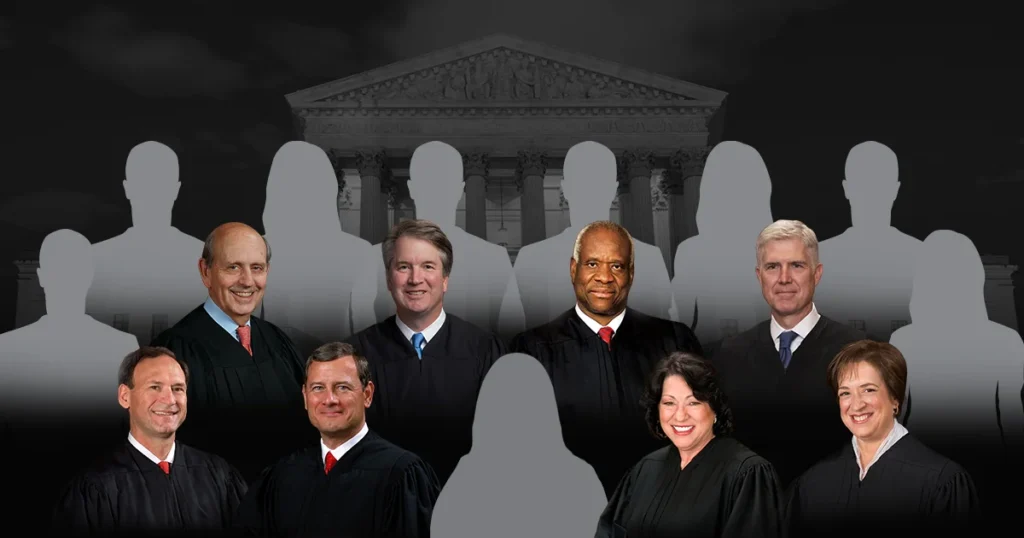
Harris is again signaling support for “fundamentally transforming” the Supreme Court and other core American institutions in ways critics say would permanently tilt the balance of power toward Democrats. Among the proposals being discussed by the Left are expanding the Supreme Court, diminishing the Electoral College, and altering the constitutional structure that has restrained pure majoritarian rule since the founding of the Republic.

This is a fair example of what we can expect if democrats make good on their threats.

Naturally, all of this is being done in the name of “protecting democracy.” That phrase should now trigger immediate skepticism in every American mind. Because when modern progressives say “democracy,” they increasingly mean a system in which their side permanently governs and constitutional barriers preventing that outcome are dismantled one by one.

The Supreme Court is not malfunctioning because Democrats suddenly discovered constitutional principle. It is malfunctioning, in their view, because they do not currently control it.

The Electoral College is not suddenly illegitimate because it violates the Constitution. It is illegitimate, they argue, because it prevents California and New York from effectively choosing every president forever.

The Senate filibuster was not an assault on democracy when Democrats used it repeatedly. It became an assault on democracy the moment Republicans started winning elections and confirming judges.

This is not reform. It is escalation.

And if the Left truly believes court-packing is such a wonderful idea, perhaps Republicans should grant their wish immediately. Seriously.

Let Republicans expand the Court by four seats tomorrow morning. Let a Republican president fill every one of them with originalist constitutional scholars under the exact same “democracy-saving” logic Democrats have been promoting for years.

Something remarkable would happen almost instantly: Democrats would suddenly rediscover the sacred importance of constitutional norms, institutional stability, judicial independence, and the dangers of authoritarian overreach.

Funny how that works.

The truth is that most Americans instinctively understand why court-packing is dangerous. Once one side expands the Court for political advantage, the other side retaliates. Then the next administration expands it again. Eventually the Supreme Court becomes little more than a fluctuating super-legislature whose size changes every election cycle.

At that point, the Constitution no longer restrains power. Power simply rewrites the rules whenever it can.

The Founders designed the American system specifically to prevent this kind of raw factional domination. The Electoral College, equal Senate representation, judicial independence, and separated powers were not historical accidents. They were deliberate safeguards against exactly the kind of centralized political monopoly many modern activists now openly desire.

Alexander Hamilton warned about it. James Madison warned about it. And history repeatedly confirms it.

Nations rarely lose their republics in one dramatic moment. More often, political factions slowly convince the public that long-standing constitutional restraints are “outdated,” “undemocratic,” or obstacles to “progress.” Once those restraints are weakened, power consolidates quickly.

That is why critics are calling Harris’s proposals “institutional arson.”

Because the issue is not whether Republicans or Democrats temporarily benefit. The issue is whether America remains a constitutional republic governed by durable rules that apply to everyone equally, or whether it becomes a system where whichever party gains temporary power simply restructures institutions until opposition becomes nearly impossible.

Ironically, many of the same people warning that Donald Trump represents a “threat to democracy” are simultaneously advocating structural changes that would permanently weaken political opposition and centralize ideological control.

Americans should notice the contradiction.

If Democrats truly believe court-packing, Electoral College abolition, and institutional restructuring are legitimate tools of governance, they should have no objection whatsoever if Republicans use those same tools first.

But somehow, everyone already knows how that conversation would go. And that tells you everything you need to know.

Filed Under: Featured, Bias, Crime, Elections, Entitlement, Ethics, Gender

There Is No Constitutional Requirement to Shut Down the Government

May 12, 2026 By Editor Leave a Comment

Why Should America Shut Down Because Democrats Refuse to Fund ICE?

For decades, Americans have been subjected to the same tired political ritual: Congressional Democrats fail to pass another bloated spending package, the media declares a “government shutdown crisis,” blames Republicans, and ordinary citizens are told to panic while Washington politicians point fingers at one another.

But beneath all the manufactured hysteria lies a simple constitutional truth that few in Washington want the public to fully understand:

There is no constitutional requirement to shut down the United States government simply because Congress cannot agree on a massive omnibus spending bill.

Government shutdowns are not acts of God. They are political choices.

And increasingly, they are being weaponized by Democrats willing to inflict economic pain, administrative chaos, and public fear in order to force Americans to accept policies the public increasingly reject — particularly on immigration and border enforcement.

Most Americans do not realize that government shutdowns are not explicitly mandated by the Constitution. In fact, for much of modern American history, temporary funding gaps did not automatically trigger massive federal closures. The modern shutdown regime largely originated from legal opinions issued during the Carter administration by Attorney General Benjamin Civiletti, who adopted an extremely strict interpretation of the Antideficiency Act in 1980 and 1981. What Americans now experience as a “government shutdown crisis” is therefore not purely constitutional — it is largely the product of later bureaucratic and legal interpretation.

At the center of the current standoff is funding for ICE and broader immigration enforcement operations. Many Democrats have spent years demonizing immigration officers, opposing deportation efforts, defending sanctuary jurisdictions, and resisting meaningful border security measures even as tens of millions of illegal crossings have strained cities, schools, hospitals, and law enforcement resources across the country.

I.C.E. arrests dozens of illegal immigrants as democrats howl

Now, as another shutdown threat looms, Americans are once again being told that unless Congress caves to Leftist open-borders demands, the federal government must partially close its doors.

Why?

Why should Americans suffer because one political party refuses to support enforcement of existing immigration law? Law that Democrats voted for. Law that Schumer and Biden vociferously supported . . . before they needed replacement democrat voters.

Why should Border Patrol agents, ICE personnel, military families, federal workers, travelers, and small businesses become collateral damage in an ideological battle over policies designed to discourage deportation and weaken immigration enforcement?

The Constitution does not require this political hostage-taking. There are no Supreme Court rulings that demand the government be shut down and workers go unpaid in the absence of a spending bill. It is merely tradition, NOT LAW

In reality, essential government functions continue during shutdowns anyway. Military operations continue. Air traffic control continues. Social Security payments largely continue. Federal law enforcement continues. Border agents often continue working, although many without paychecks while Democrats continue holding press conferences.

The “shutdown apocalypse” narrative has always been exaggerated, for democrat political leverage. Most news and media carry to narrative’s water to assist democrats in their blackmail tactics.

And the American people are growing tired of being used as pawns in Washington’s endless theater.

What makes the current fight especially revealing is that it exposes a deeper political calculation many Americans have long suspected: that mass illegal immigration is no longer viewed by some political leaders as a crisis to solve, but as a long-term political strategy to reshape the electorate and expand dependency on government systems.

Whether one agrees with that assessment or not, the perception exists because Democrats consistently oppose nearly every serious effort to tighten border enforcement while simultaneously demanding ever-expanding taxpayer support systems for illegal entrants already inside the country while resisting every effort to deport illegals.

Americans are noticing. And they are asking legitimate questions.

If Congress truly cannot avoid shutdowns, then perhaps lawmakers themselves should finally bear some of the consequences they routinely impose on everyone else.

Senators, including John Kennedy and Majority Leader John Thune have floated proposals to suspend congressional pay during shutdowns. That should only be the beginning.

No congressional salaries during shutdowns.

No taxpayer-funded travel.

No luxury congressional recesses.

No congressional medical care.

No omnibus bills dropped on the public at midnight.

No exemptions for the political class while ordinary Americans absorb the uncertainty and disruption.

If ICE agents and military personnel can work without guaranteed pay during political standoffs, senators and representatives should not continue collecting salaries and luxury taxpayer-funded benefits while manufacturing the crisis.

Washington’s shutdown culture persists because politicians experience very little personal consequence from creating chaos.

That must change.

The American people are exhausted by the manipulation, the fearmongering, the Left’s lies, and the endless manufactured emergencies. Government exists to serve the nation — not to hold it hostage every fiscal year in pursuit of ideological demands that most citizens never voted for in the first place.

There is no constitutional requirement to shut down the government.

But there may soon be a political requirement to hold accountable the people who keep threatening to do it.

The Federalist Press smiles while daydreaming about temporary incarceration for any member of congress who votes against funding the government.

Filed Under: Crime, Elections, Entitlement, Ethics, Featured, Foreign

Supreme Court Redistricting Shockwave May Have Just Changed the 2026 Midterms

May 11, 2026 By Editor Leave a Comment

A political earthquake is rippling across America after a series of court rulings handed Republicans one of the biggest structural victories in modern congressional politics.

Over the weekend, the U.S. Supreme Court allowed Alabama to move forward with new congressional maps that favor Republicans, while the Virginia Supreme Court simultaneously struck down a Democrat-backed redistricting scheme that could have delivered four additional House seats to Democrats.

Taken together, the rulings may fundamentally alter the balance of power heading into the 2026 midterms.

For months, Democrats and media analysts assumed Republicans would suffer the traditional “midterm collapse” that typically strikes the president’s party. But suddenly, that assumption is in serious doubt.

The real story is not merely about district lines.

It is about the collapse of a decades-long legal regime that allowed courts, bureaucrats, and activist organizations to heavily influence how congressional districts were drawn across America.

The turning point came in the Supreme Court’s recent Louisiana v. Callais decision, which sharply narrowed the use of race-based redistricting mandates under the Voting Rights Act. The Court signaled that states possess broad authority to draw districts without being forced into highly engineered “majority-minority” configurations that critics argue often prioritized race over geography, communities, or traditional representation.

Republicans hailed the decision as a return to constitutional neutrality and a rejection of race-based political engineering.

Democrats reacted with panic.

Almost immediately, Republican-led states began exploring aggressive redistricting opportunities in Alabama, Tennessee, Florida, and elsewhere.

Meanwhile, Democrats suffered a devastating setback in Virginia after the state supreme court invalidated a controversial Democratic-backed referendum and congressional map that critics described as a naked partisan gerrymander disguised as “fairness reform.” Analysts estimated the proposed map could have handed Democrats as many as four additional congressional seats.

Now even mainstream analysts are sounding alarms.

CNN data analyst Harry Enten warned this week that the new redistricting landscape could become a “nightmare” scenario for Democrats.

The implications are enormous.

Republicans currently hold only a razor-thin House majority. Yet with favorable new maps emerging in multiple states, Democrats may now need to win the national congressional vote by several percentage points simply to reclaim control of the House.

And beneath the legal arguments lies a deeper political reality that much of the corporate press refuses to admit:

Many Americans are growing tired of institutions using race, identity politics, and judicial intervention to manipulate electoral outcomes.

For years, voters were told that questioning redistricting practices amounted to “attacking democracy.” But increasingly, Americans are recognizing that both parties gerrymander whenever given the opportunity. The difference now is that the Supreme Court appears less willing to permit race-based constitutional theories to dominate the process.

That shift could reshape American politics for years.

The media will frame these rulings as partisan Republican victories — and politically, they certainly are.

But the larger story may be that the Supreme Court is slowly dismantling an era in which unelected judges and activist groups exercised enormous influence over the structure of American elections themselves.

And if this redistricting wave continues through the summer, the political establishment may soon discover that the 2026 midterms are no longer unfolding on the battlefield Democrats expected.

Filed Under: Featured, Elections, Entitlement, Ethics

The “Authoritarian” Narrative vs. Reality: Why Trump’s Positions Are Historically Mainstream

May 7, 2026 By Editor Leave a Comment

For nearly a decade, Americans have been told that Donald Trump represents an unprecedented authoritarian threat to the republic.

The language has been relentless:

  • Fascist
  • Dictator
  • Nazi
  • Extremist
  • Threat to democracy

The accusations are repeated so often in media and political circles that many Americans have stopped questioning them. But when one steps away from the rhetoric and examines the actual policy positions involved, a different picture emerges.

On issue after issue, many of Donald Trump’s core stances are not historically radical at all. In fact, they are remarkably moderate and traditional.

1. Border Enforcement

For decades, both parties supported strong border enforcement.

Presidents from Eisenhower to Obama:

  • expanded border security,
  • increased deportations,
  • and emphasized national sovereignty.

Even prominent Democrats once argued that uncontrolled borders undermine wages, strain public systems, and weaken national cohesion. President Obama was dubbed the “deporter and chief” because he deported millions of illegal aliens during his tenure. Speeches by all democratic leaders going back 40 years stress the importance of closed national borders.

Trump’s position, that a nation has the right and duty to control its borders, is not historically extreme. It is historically normal.

2. Merit-Based Immigration

Trump has repeatedly argued for immigration systems that prioritize:

  • skills,
  • economic contribution,
  • and national interest.

That model is used by numerous, if not all countries around the world, including Canada and Australia.

Supporting legal immigration while demanding enforcement and structure is not authoritarian. It is standard statecraft.

3. Opposition to Endless Wars

One of Trump’s defining positions has been skepticism toward prolonged foreign military interventions.

He criticized:

  • nation-building,
  • open-ended wars,
  • and interventionist policies embraced by both parties for decades.

Whether one agrees or not, anti-interventionism is not fascism. In many ways, it reflects older American traditions of restraint and strategic realism.

The three-week attack on Iran to prevent its development of nuclear weapons is a master class in how to conduct a pinpoint military action without getting bogged down in a foreign quagmire.

4. Energy Independence

Trump’s support for domestic oil production, pipeline infrastructure, and energy self-sufficiency was framed by critics as reckless nationalism. But energy independence has long been viewed by policymakers as a matter of:

  • economic stability,
  • lower consumer costs,
  • and national security.

Again, this is not a radical historical position.

5. Opposition to Crime and Disorder

As open borders and degradation of blue cities has led to steep increases in crime, Trump’s calls for:

  • stronger policing,
  • tougher prosecution of violent crime,
  • and safer cities

These were always bipartisan political staples. Today, such positions are increasingly framed as authoritarian by democrat leaders, liberal media, and commentators. But historically, public order has been considered one of the most basic responsibilities of government. President Trump offered to restore peace and civility in these cities by employing the National Guard. We watched as democrats resisted his efforts, but reaped the rewards, as in the case of Washington C.C., where crime fell remarkably.

President Trump invites Communist Mayor of New York Mamdani to Oval Office to discuss methods of improving the lives of citizens.

6. Protection of Free Speech

Ironically, one of Trump’s strongest themes has been opposition to:

  • censorship,
  • deplatforming,
  • and institutional suppression of dissenting views.

His supporters argue that major institutions increasingly attempt to narrow acceptable public discourse. Defending broader speech protections, even offensive or controversial speech, is rooted deeply in American constitutional tradition, and was the darling of the Left until conservatives began voicing the virtues of traditional values.

7. Opposition to Bureaucratic Expansion

Trump’s repeated criticism of unelected bureaucrats, entrenched bureaucracies, and administrative overreach is often portrayed as an attack on institutions themselves.

But skepticism toward concentrated federal power has long existed across the political spectrum—for hundreds of years. Most Americans historically viewed excessive bureaucracy as a threat to democratic accountability.

8. America-First Economic Policy

Tariffs, industrial protection, and economic nationalism are frequently portrayed as extremist ideas today. Yet throughout American history, leaders from both parties used tariffs and industrial policy to protect domestic production and strategic industries.

Trump’s economic nationalism may be somewhat controversial, mainly because it has been ignored for many decades, but it is not historically unprecedented.

9. Judicial Originalism

Trump’s judicial appointments emphasize:

  • textualism,
  • constitutional originalism,
  • and limits on judicial activism.

Critics strongly oppose many resulting rulings, but interpreting the Constitution according to its original meaning is not authoritarianism. It is a longstanding legal philosophy embraced by most constitutional scholars and jurists. Only Leftists claim the Constitution to be a “living” document, meaning malleable to the desired results of the Left.

10. Religious Liberty

Trump has consistently aligned himself with:

  • religious liberty protections,
  • conscience rights,
  • and public accommodation of faith traditions.

These positions reflect traditional American debates about:

  • free exercise,
  • pluralism,
  • and the role of religion in public life.

Again, these are not fringe ideas in American history.

11. Parental Rights in Generally, and in Education

Support for parental rights over their children vs. the state’s right to supervise and indoctrinate them has only recently arisen as an issue. Traditionally, parents had all the rights, as long as they were not placeing their children in unreasonable danger.

Educational oversight, curriculum transparency, and local control in education has become one of the defining cultural issues of the past several years as the Left has pushed to overtake parental rights.

Yet historically, American education was deeply local and parent-driven. Opposition to centralized educational authority is hardly a novel or authoritarian impulse.

12. Election Integrity

Trump’s rhetoric around elections has been among the most controversial aspects of his political career.

But concerns over election security itself are not new. For years, politicians from both parties supported:

  • voter ID laws,
  • ballot safeguards,
  • and anti-fraud measures.

The debate is not whether elections should be secure. It is how best to secure them while maintaining broad access. The requirement of a voter I.D. is nothing new, and democratic harping that such a requirement will disenfranchise “many” liberal voters who lack the capacity to obtain an I.D. are nonsense.

13. Opposition to Ideological Enforcement

Many Americans increasingly feel pressured by:

  • corporate ideological mandates,
  • speech codes,
  • social media conformity,
  • and institutional activism.

Trump’s political appeal often stems less from ideology itself than from opposition to perceived coercion.

His supporters view him not as an authoritarian figure, but as a disruptive reaction against institutional pressure and cultural rigidity.

14. Skepticism Toward Globalization

Trump’s criticism of global trade structures, outsourcing, and transnational institutions is frequently mocked as backward nationalism.

But skepticism toward globalization emerged across the political spectrum long before Trump entered politics. As a result of globalism, many millions of Americans experienced:

  • industrial decline,
  • wage stagnation,
  • and economic displacement

Trump’s desire to re-establish an industrial base in the U.S. reflects his understanding that outsourcing the production of key products puts America at the mercy of foreign interests, and in many cases, America’s competitors, or even its enemies.

15. National Sovereignty

At the core of Trump’s worldview is a simple principle: The United States should prioritize its own national interests.

Critics often frame this as dangerous nationalism. Supporters view it as the basic responsibility of any elected government.

Historically speaking, nation-states asserting sovereignty is not unusual. It is the global norm.

The Power of Political Labeling

None of this means Trump is beyond criticism. He is polarizing, confrontational, and frequently inflammatory in tone.

Reasonable people can strongly disagree with:

  • his rhetoric,
  • his conduct,
  • or many of his policies.

But there is an important distinction between opposing a politician, and redefining traditional political positions as extremist simply because they are politically inconvenient.

That distinction matters. Because once ordinary disagreement is routinely described as fascism or authoritarianism, language itself loses meaning.

The Bigger Picture

Much of the modern political conflict in America is not simply about Trump himself. It is about two competing visions of the country:

  • one favoring stronger national identity, local control, borders, tradition, and constitutional restraint;
  • the other emphasizing Leftist technocratic governance, global integration, institutional management, and unhealthy cultural change.

Those are substantial political disagreements. But they are not evidence that President Trump and political conservatives have abandoned democracy. In fact, it IS democracy, as its been understood and practiced for 250 years in America.

The repeated portrayal of Donald Trump as uniquely authoritarian relies less on historical comparison than on extreme political rhetoric.

When many of his actual positions are examined individually, they are not revolutionary departures from American tradition. In most cases, they are positions that large numbers of Americans, including Democrats in recent eras, once openly supported themselves.

That does not make Trump perfect necessarily, but it does make the constant attempt to frame ordinary political disagreement as extremism increasingly difficult to take seriously.

Filed Under: Bias, Economy, Elections, Entitlement, Ethics, Featured

May Day in America: A Radical Tradition Returns—and Raises Hard Questions

May 3, 2026 By Editor Leave a Comment

Pres. Joe Biden delivered his ‘Battle for the Soul of the Nation’ speech where he falsely accused that “Donald Trump and the MAGA Republicans represent an extremism that threatens the very foundations of our republic.”

What is May Day? May 1 has always meant more than a date on the calendar.

Internationally, May Day grew out of labor activism in the late 19th century. Over time, in many parts of the world, it became associated with socialist and communist movements, mass demonstrations, and political messaging about class, power, revolution and the role of the state.

Due to its constitutional form of government which guarantees personal and financial liberty to its citizens, the United States largely kept its distance from that legacy. Of late, that distance is narrowing.

From Labor Holiday to Political Signal

This year’s May Day events are not small or isolated. Reports point to large, coordinated demonstrations across the country, backed by networks of advocacy groups with significant budgets and infrastructure.

Supporters describe this as democratic participation—people organizing around issues regarding wages, housing, immigration, and healthcare.

Clear-eyed observers see something else: a return of ideas that have a long, contentious history—ideas about restructuring the economy, redistributing power, and expanding the role of centralized authority.

Whatever one’s view, May Day in America is no longer just about labor. It has become a signal of where the democrat party intends to take the nation.

The Historical Record That Shapes the Debate

Any serious discussion of May Day’s modern meaning runs into history.

In the 20th century, regimes that adopted Marxist-Leninist systems promised equality and liberation. In practice, those systems produced:

  • Concentrated political power
  • Lethal restrictions on dissent and press
  • State control over major sectors of the economy
  • Economic dislocation and, in most cases, severe human suffering

Those outcomes are nearly identical everywhere. They are part of the record, and they inform why most Americans are wary when modern movements invoke similar language about sweeping economic transformation.

The core tension is familiar:

How much power should be centralized in pursuit of equality—and what guardrails prevent that power from being abused?

What Today’s Activism Is Arguing

Contemporary May Day activism tends to focus on a set of recurring themes:

  • Wage stagnation and cost of living
  • Housing affordability
  • Healthcare access
  • Immigration and labor protections
  • The influence of large corporations

These concerns are real and widely debated. Made real by the prior policies actions of the democrat party. Democrats propose policies and legislation to ‘repair’ problems, and the repairs invariably lead to greater problems for citizens. Democrats them point the finger of blame at republicans for those outcomes, enabled by a Leftist national press and waves of Leftist ‘experts,’ and propose additional remedies, which lead to more severe problems. We have seen dozens of these cycles in the past 80 years, like sewage being flushed down a toilet, drawing the nation deeper and ever deeper into fiscal, social, moral and political waste. We are up to our necks in it.

Still, activists and pundits push for more fundamental changes to the system they are intentionally breaking: public or collective ownership in key sectors, expansive redistribution, and a major shift in the balance of power between labor and capital, and the way the team lines are drawn. Under their rubric, everyone turns out to be labor, until the revolution is well underway, then nearly everyone turns out to be ‘rich,’ subjecting them to the wrath and rape of the new leadership.

That’s where critics draw lines, arguing that Leftist demands of redistribution of wealth and power echo earlier and recurring theories about organizing society primarily around class and collective outcomes–a few elite leaders rule over the masses of subjects. It’s the same BS, recycled with new false promises.

Institutions, Incentives, and Influence

The growth of large-scale protest movements also raises questions about how they are organized and amplified. Major demonstrations require:

  • Funding and staffing
  • Communications and media strategy
  • Logistics and supplies for tens of thousands
  • Legal and political coordination

In the U.S., those resources often come from a mix of nonprofits, advocacy organizations, unions, and ‘philanthropic’ foundations. Supporters view this as normal civic engagement. Realists ask why funding is coming from globalist billionaires with communist, socialist and The Communist Party of China (CPC/CCP).

The same debate extends to American institutions that influence public conversation:

  • Education: Schools and universities are central to how ideas are introduced and debated. Results demonstrate that most campuses have become ideologically Left.
  • Media: Coverage choices and framing can elevate certain narratives over others. Most television programming and Hollywood films promote woke, anti-God, anti-American, anti-family, anti-white agendas.
  • Labor organizations: Unions exist to play a significant role in advocating for workers and shaping policy. In practice they have supported democrats and other Leftists who undermine constitutional liberties.

Why the Skepticism Persists

Skepticism toward modern May Day activism often comes down to three concerns:

1. Concentration of Power

Even well-intentioned policies can concentrate authority. The question is whether institutions are designed with sufficient checks to prevent overreach. All policy decisions must be governed by the overriding question, At whose expense will this action operate?

2. Tradeoffs and Outcomes

Policies that expand public control invariably affect incentives, investment, and growth. The balance between equity and dynamism always bears in the direction of the Left accumulating more wealth and power.

3. Pluralism vs. Uniformity

A diverse society contains competing values and preferences. The concern is whether sweeping, system-wide changes leave room for that diversity—or push toward uniform solutions, concentrating power and wealth in the left.

A Constitutional Framework

The United States has historically navigated these tensions through a framework that emphasizes:

  • Individual rights
  • Separation of powers
  • Federalism (state and local variation)
  • A mixed economy with both public and private roles

That framework evolved over time, but recent debates about more regulation, social programs, and market structure have abandoned those valued principles that transformed America from a weak agricultural countryside to the strongest, wealthiest, and most benevolent nation in world history.

Yet, American democrats choose to worship at the altar of May Day activism is the latest chapter of redistribution of wealth and power, or government authorized stealing.

What Comes Next

The renewed prominence of May Day in the U.S. suggests a deeper shift: economic questions are once again at the center of political life.

Ideas about equality, equity, fairness, and opportunity were asked and answered in our constitution. That’s how America became the richest, strongest nation in the world so quickly, and why we hold at bay the evil totalitarian governments who constantly seek to expand their borders so they can steal the resources of their neighbors to fund their sinking Marxist economies.

Filed Under: All Stories, Bias, Crime, Economy, Elections, Entitlement, Ethics, Featured

“All Animals Are Equal”: How Orwell’s ‘Animal Farm’ Exposed the Lie at the Heart of Collectivism

May 1, 2026 By Editor Leave a Comment

George Orwell didn’t write Animal Farm as a children’s story.

He wrote it as a warning.

A warning about what happens when noble-sounding ideas—equality, fairness, collective good—are placed in the hands of those eager to manipulate them for power.

Today, May Day, when Marxists celebrate communism, Hollywood has released its own version of Animal Farm. As you probably already suspect, it twists the message and warning of Orwell’s work into the opposite, in fine Orwellian style.

Do yourself a favor. Read the book. Pass it on to your kids, and grand kids.

And decades after its publication, the message remains as sharp—and as uncomfortable—as ever.

The Revolution That Was Supposed to Change Everything

At the start of Animal Farm, the animals live under the rule of Mr. Jones, a negligent and exploitative farmer. Inspired by the vision of Old Major, a wise and respected boar, the animals rise up and overthrow human control.

Their goal is simple:

  • Equality
  • Freedom from oppression
  • A system where all animals share in the fruits of their labor

The early days of the revolution are filled with hope. The commandments are clear. The principles are straightforward. The slogan becomes iconic: “All animals are equal.”

For a moment, it works.

The Rise of the Pigs—and the Shift in Power

But revolutions do not remain pure for long.

The pigs—led by Napoleon and Snowball—quickly assume leadership roles, arguing that their intelligence makes them uniquely suited to guide the farm.

At first, this seems reasonable. Then it becomes dangerous. Snowball is eventually driven out. Napoleon consolidates power. The pigs begin to rewrite the rules—not openly, but gradually, subtly, strategically.

The commandments change. Privileges appear. Justifications multiply.

The Machinery of Control

What makes Animal Farm so powerful is not just what happens, but how it happens.

Control is maintained through Language.

Squealer, the regime’s spokesperson, constantly reframes reality:

  • Failures become successes
  • Sacrifices become necessary
  • Contradictions are explained away

Truth is not eliminated. It is reshaped.

Fear

Napoleon uses force to maintain authority, including the use of dogs to intimidate and eliminate opposition. Dissent is not debated. It is crushed.

Memory Manipulation

The animals begin to doubt their own recollections:

  • Were things really better before?
  • Did the commandments always say this?

Over time, reality becomes whatever those in power say it is.

Boxer: The Tragedy of Blind Loyalty

No character embodies the cost of the system more than Boxer, the hardworking horse.

His beliefs are simple:

  • “I will work harder.”
  • “Napoleon is always right.”

He is loyal, strong, and selfless. And he is used.

When Boxer is no longer useful, he is sold, despite everything he has given. His fate is one of the most devastating moments in the book. Because it reveals the truth: In a system built on control, loyalty is not rewarded. It is exploited.

The Final Transformation

By the end of the novel, the pigs have fully adopted the behavior of the humans they once overthrew. They walk on two legs. They drink, trade, and negotiate with former enemies.

And, in true elite style, the final commandment reads: “All animals are equal, but some animals are more equal than others.”

The revolution is complete. Not in success—but in betrayal.

The Message Orwell Wanted You to See

Animal Farm is not subtle. It is a direct critique of collectivist systems that promise equality but concentrate power.

It shows how:

  • Ideals are weaponized
  • Leadership becomes domination
  • Language is used to obscure and twist truth
  • Systems built on “the collective” end up serving only a few

The book’s message is not that fairness is bad. Diversity? Equity? Inclusion? All great ideals. But they are never the goal.

Unchecked power, justified in the name of fairness, becomes the main goal entirely.

Why This Story Still Matters Today

Animal Farm endures because its lessons are not confined to a single time or place. It speaks to a recurring pattern:

  • A movement promises justice
  • Power becomes centralized
  • Dissent is discouraged
  • Reality is reshaped

And over time, the system begins to resemble what it once opposed.

The Challenge of Modern Adaptations

When works like Animal Farm are adapted for modern audiences, they often undergo ‘reinterpretation.’

Themes are softened. Characters are reshaped. Endings are adjusted to fit contemporary sensibilities. Hollywood is run by Marxists, so guess what Marxists have done to “reshape” the message of Animal Farm?”

If the sharper edges are removed, the consequences diluted, then the story risks becoming something it was never meant to be. Not a critique of a soul crushing political philosophy, but a parable stripped of its caution.

The Bottom Line

George Orwell wrote Animal Farm to expose a truth that is easy to ignore and difficult to confront:

Power, once concentrated, rarely serves everyone equally, no matter what it promises at the beginning.

That is the lesson. And it is a lesson worth preserving, especially when it becomes inconvenient.

Hollywood’s twisted new message in its Animal Farm movie, released today, May Day, the special day on which the world’s Marxists celebrate communism, entirely misses the truths of Orwell’s book of the same name. Shame on you Hollywood. Again.

Filed Under: Bias, Economy, Elections, Entitlement, Featured

May Day in America: A Radical Marxist Tradition Reemerges

May 1, 2026 By Editor Leave a Comment

May 1 has long carried meaning far beyond the calendar.

Known internationally as May Day, it began as a labor movement commemoration in the late 19th century, tied to the fight for workers’ rights. But over time, in much of the world, it became deeply associated with socialist and communist movements, state power, and ‘revolutionary’ politics.

For decades, Americans largely kept their distance from tat legacy. As today’s democrat party embracing Marxism, that distance appears to be shrinking.

A Holiday with a Complicated History

In countries shaped by communist regimes, May Day was not just a celebration, it was a demonstration of power.

Mass parades. Coordinated messaging. Displays of unity under centralized authority. Yes, we saw Soviet missiles paraded in the streets of Moscow as a reminder that the decadence of individualism would soon be crushed by the collective powers.

Behind those displays, history tells a dark story.

The 20th century saw the rise of regimes that embraced Marxist ideology, from the Soviet Union to Maoist China, to Eastern Europe and beyond. The results, widely documented, included:

  • Economic collapse
  • Political repression
  • Suppression of dissent
  • Widespread human suffering on a massive scale, including the death of 100,000,000 people

The promise was equality and liberation.

The reality was control and coercion.

That legacy still shapes how most Americans view May Day today.

A New Wave of Activism

In 2026, May Day has taken on renewed significance in the United States.

According to recent reporting, hundreds of organizations, collectively generating billions in revenue, have organized thousands of protests across the nation tied to the day’s themes.

The scale is notable:

  • Nationwide coordination
  • Large coalitions of advocacy groups
  • Messaging focused on economic ‘justice,’ labor rights, immigration, and social policy

Supporters describe this as grassroots mobilization. Critics see something more structured, and more ideological.

The Debate Over Modern Movements

The core question is not whether people have a right to protest. They do. The question is what ideas and goals are driving these movements, and where those ideas lead.

Some activists openly embrace frameworks rooted in Marxist and socialist thought, particularly in critiques of:

  • Capitalism
  • Wealth distribution
  • Corporate power
  • Traditional economic structures

Others reject those labels entirely, framing their goals as pragmatic reforms. But the overlap in language, goals, and organizing strategies has sparked a broader national debate:

Are these movements pushing reform—or a deeper transformation of the American system?

Follow the Structure

One of the more striking elements of modern activism is its level of organization. Large-scale demonstrations do not happen spontaneously. They require:

  • Funding
  • Infrastructure
  • Communication networks
  • Coordinated messaging

Reports highlighting the financial scale of some participating organizations have raised questions about:

  • How these groups are funded
  • How resources are allocated
  • Whether their agendas align with the broader public

These are the kinds of questions that should be asked of any large, influential movement.

Why the Pushback Exists

Skepticism toward May Day activism in the U.S. is not simply about policy disagreements. It is rooted in historical memory. Many Americans associate Marxism not with theory, but with outcomes:

  • Centralized control over economic life
  • Oppression and reduced individual autonomy
  • Political systems that suppressed opposition

That history makes some wary of any movement that appears to draw inspiration, even indirectly, from those ideas.

A Country Built on a Different Model

The United States was founded on a different set of assumptions.

  • Individual rights over collective identity
  • Families as the foundational unit of society
  • Very limited government over centralized control
  • Market-driven opportunity over state-directed outcomes

Those principles have been debated, refined, and challenged over time, but they remain foundational, and have catapulted America to the most powerful, wealthy, and benevolent nation in the world, ever.

Movements that call for sweeping structural change inevitably raise questions about how far those principles should be altered, or whether they should be replaced altogether.

The Meaning of May Day Today

For some Americans, May Day is a call to action; an opportunity to advocate for workers, fairness, and reform.

However, these calls are obviously farcical, because workers and fairness have been strongly represented in our constitutional republic, elevating all American citizens through adherence to our constitutional principles of individual freedom and the individual pursuit of life, liberty and happiness.

What is the Left demanding? What is their aim? Redistribute wealth, which is to steal the wealth of those who have worked hard and risked all, and give it to those who sit around and complain. They hate corporations, and demand that their wealth be confiscated and given to lazy people. Of course, corporations are owned by collectives of hard working Americans, whose retirement plans have funded corporate enterprises, the returns on which will fund retirement. The anti-corporate, anti-liberty howlings of the Marxist Left are preposterous to everyday Americans, and if given their way, would reduce America to the status of a third world wasteland.

Filed Under: Entitlement, Economy, Elections, Featured, Foreign

School Choice Is Winning — And the Education Establishment Knows It

April 30, 2026 By Editor Leave a Comment

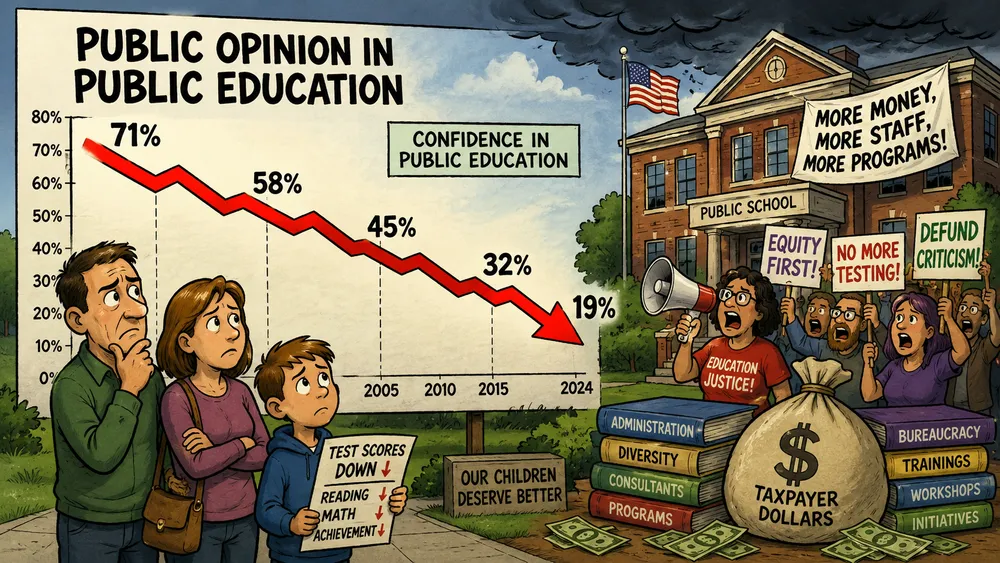
For decades, American families were told they had no real say in their children’s education. They were told to just leave everything to the ‘experts.’

You went to the school assigned to you. You accepted whatever curriculum was offered. You trusted a system that, in many parts of the country, has produced steeply declining performance, frustrated parents, and myriad students left behind.
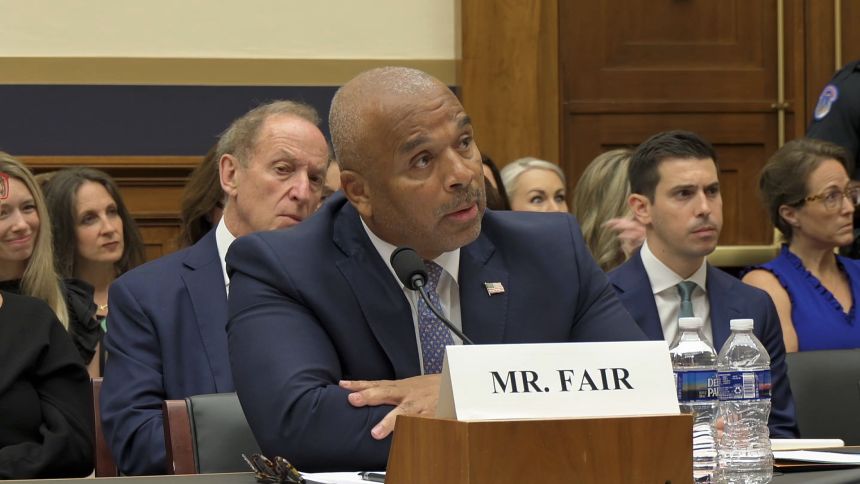
That model is now being challenged—and the reaction from the education establishment has been swift, loud, and deeply revealing.

Because in states like Arizona, the rules have changed.

A System Finally Forced to Compete

Arizona, for example, has emerged as a national leader in school choice, implementing programs that allow education funding to follow the student instead of being locked into a specific school or district.

Families now have real options:

  • Public schools
  • Charter schools
  • Private institutions
  • Homeschooling programs

Each child carries with them a portion of education funding, and that money goes wherever the family decides. That simple shift has introduced something that has long been absent in public education: Competition and Accountability.

Public schools are no longer guaranteed funding simply because they exist. They have to earn it. They have to compete for available dollars. They have to do do better than the competition to receive the funding.

And that changes everything.

Why Parents Are Embracing It

The appeal of school choice is not theoretical. It is practical, immediate, and deeply personal.

Parents are choosing schools based on:

  • Academic performance
  • Safety
  • Discipline
  • Values
  • Individual student needs

For families who have felt trapped in underperforming districts, the ability to leave is more than a policy change—it is a lifeline. And once families experience that freedom, they rarely want to go back.

The Resistance: A System That Doesn’t Want to Change

Despite growing support, school choice faces fierce opposition from entrenched interests that have long shaped American education. Critics of CHOICE argue that these programs threaten public schools, divert funding, and create uneven outcomes.

But behind those arguments is a deeper reality: School choice disrupts a system that has operated for decades with limited competition and guaranteed funding.

When funding follows students, institutions that once operated without pressure or accountability are suddenly forced to respond—to parents, to outcomes, and to alternatives.

That is not a small shift. It is a fundamental one.

The Performance Problem No One Can Ignore

Across the country, there are school systems, particularly in large urban areas, that have struggled for years with:

  • Low proficiency rates
  • Graduation gaps
  • Safety concerns
  • Declining public confidence

These issues did not appear overnight, and they have not been resolved by maintaining the status quo. They developed over decades as teachers’ unions fought for more money for less work, and the right essentially replace students’ parents in matters of values. They have foisted woke, Marxist, and anti-religious curricula on students, and parents who showed up at the principal’s office or school board meetings were often placed on FBI terror watch lists.

School choice does not claim to solve every problem. But it does introduce a mechanism that public systems have lacked: The ability for families to leave.

And when families can leave, systems must adapt, or risk losing relevance, and funding.

The Accountability Divide

One of the sharpest lines in the debate is over accountability. Supporters of school choice argue that:

  • Parents are the ultimate accountability mechanism
  • Schools that fail to meet expectations lose students

Critics counter that:

  • Public funds require consistent oversight
  • Not all alternatives are held to the same standards

Both arguments carry weight. But the current system raises its own question: What accountability exists when families have no realistic alternative?

A Shift in Power

At its core, school choice is about more than education policy. It is about power. For generations, decisions about education have largely been made at the institutional level, by districts, boards, and administrators.

School choice shifts that power outward to families. And that redistribution is at the heart of the conflict. Because when parents gain control over where funding goes, long-standing structures are forced to compete, adapt, and justify their performance in ways they never had to before. Public schools struggle fiercely to remain relevant in the face of competition. The socialist malaise of the public education system has rendered public schools and teachers undesirable, and in many case, abhorrent.

The Stakes Going Forward

The expansion of school choice is not slowing down. More states are exploring similar models, and more families are demanding options. The topic has become political in that democrats fight against choice, be the power that is being redirected to parents is essentially that curated by the Left over the decades.

Now, the debate is no longer about whether school choice exists. It does. And it is thriving, as are the students who are attending the best schools at no cost to them.

Public schools and teachers’ unions fight against school choice in Arizona.

It is really about how far it will go, and how the existing system will respond. So, will public schools evolve and compete? Will policymakers refine these programs to address legitimate concerns?
Or will the divide deepen as quality of choice spreads, and the stagnant decline of public schools digs in?

The Bottom Line

School choice is not a fringe idea anymore. It is a centrist, growing movement that is forcing a national conversation about how education works, and who it is meant to serve. Families, or teachers’ unions?

For supporters, it represents long-overdue accountability and freedom. For critics, it raises serious concerns about equity, funding, and oversight.

But one thing is certain: The days of a one-size-fits-all education system are coming to an end.

And the fight over what replaces it is only just beginning.

Filed Under: Featured, Bias, Entitlement, Gender, Religion

The Left’s Deadly Rhetoric

April 27, 2026 By Editor Leave a Comment

When Words Become Weapons: Violence Follows

The attempted attack on President Trump and members of his administration at the White House Correspondents’ Dinner should be a national wake-up call.

Cole Tomas Allen, a 31-year-old teacher from Torrance, California, armed himself, positioned himself near one of the most heavily protected events in America, and moved rapidly within range of the President of the United States with deadly intent. Why did he do it? It is becoming rather clear.

Allen’s handwritten Manifesto tells us why he did it. “And I am no longer willing to permit a pedophile, rapist, and traitor to coat my hands with his crimes.”

Where did he learn that our president is a pedophile, rapist, and traitor?

Disinformation campaigns from Democrat leaders.

Hakeem Jeffries calls on democrats to wage “Maximum Warfare, Everywhere, all the Time,” the day before Cole Allen attempted the assassination on President Trump.

For years, the political temperature in this country has been turned up to a dangerous level by leaders on the Left. President Donald J. Trump and those associated with him have not simply been criticized—they have been described, repeatedly, as existential threats to the nation, to democracy, even to the future itself. They are daily called fascists, Nazis, racists, and a real threat to American democracy. The Left has recently begun to attack President Trump on charges of being a “pedophile, rapist, and traitor,” as reflected in the shooter’s manifesto.

That kind of language is not ordinary political disagreement. It is escalation. Violent escalation.

And escalation has consequences. Three attempts on the president’s life, the assassination of Charlie Kirk, the attempted assassination of Brett Kavanaugh, and many others, including a democrat who tried to kill many of the republican congressmen as they took the baseball field.

Joe Biden:

“Donald Trump and the MAGA republicans represent an extremism that threatens the very foundations of our republic. . . . As I stand here tonight, equality and democracy are under assault. . . . MAGA forses are determined to take this country backwards, backwards to an America where there is no right to choose, no right to privacy, no right to contraception, no right to marry who you love. They promote authoritarian leaders, and they fan the flames of political violence that are a threat for our personal rights, to the pursuit of justice, to the rule of law, to the very soul of this country.”

Sen. Chris Murphy:

“We’re at war right now, to save this country. So you have to be willing to do whatever is necessary to save the country.”

Hakeem Jeffries:

“Republican policies are doing violence to the American people.”

Nancy Pelosi:

“He’s such a vile creature. He’s the worst thing on the face of the earth.”

When public figures are portrayed as uniquely dangerous or contemptible, even inhuman, when the message—implicit or explicit—is that the stakes are so high that normal rules no longer apply, it creates a moral gray zone that unstable individuals can step into. In their minds, they are no longer acting recklessly. They are acting with purpose. Unfortunately, high percentages of those on the Left are becoming emotionally and mentally unstable, as a direct result of purposefully ginned-up rhetoric against those not of their party and Marxist ideals and goals.

This should alarm everyone. Because the pattern is becoming harder to ignore. It is in our face, daily.

What’s the problem? This is how civil wars start. Violence begets violence. Those who fail at the ballot box cannot seize power from the winners by arresting and imprisoning them. They cannot gin up their base to take extreme actions, even assassinations as in the case of Trump and Charlie Kirk, without invoking an ‘equal and opposite reaction’ from those are are being hunted like Soviet dissidents.

Trump and his supporters have exercised tremendous self-restraint over the past ten years, as the Left has vilified them, arrested them, imprisoned them, and killed them. The Left cannot expect such restraint to always win the day. Their violence will eventually produce the inevitable reaction, and that will be a very sad day in history.

In the days leading up to the attack, even the entertainment world dipped into rhetoric that, at best, trivializes the idea of violence. Late-night host Jimmy Kimmel drew backlash after referring to Melania Trump as an “expectant widow” in a monologue just two days before the attack.

This is what normalization looks like. This is how widespread violence is born, and transforms into a national crisis.

Kimmel’s violent rhetoric against the president and his supports is typical of the Left. Not a single statement. Not a single joke. But a steady drumbeat of vitriolic language that strips away restraint, that frames political opponents as something more than opponents—something to be feared, rejected, and, in the worst cases, confronted violently.

And when that drumbeat is constant, it only takes one person to hear it the wrong way.

A serious country should be willing to ask a serious question: What kind of climate makes that step easier to justify in someone’s mind?

This is not about silencing criticism. It is about recognizing that words carry weight—especially when repeated, amplified, and stripped of nuance and humanity.

A political culture that thrives on outrage and absolutism does not stay contained in television studios, social media feeds, or campaign speeches. It seeps outward, like a seething plague.

And sometimes, it shows up at the doors of a ballroom where the President of the United States is speaking, or at his golf course, or at a rally, or a college amphitheater.

If the investigation confirms that the suspect was motivated, even in part, by the belief that he was confronting something larger than himself, something described in the Left’s constant drumbeat of hyperbole, then we are not just dealing with an isolated act. We are dealing with a warning. We are dealing with a civil war that is percolating in the bowels of the American Left.

The question now is whether anyone is willing to hear it. Is there anything that we can do to put the brakes on this runaway train?

Filed Under: Bias, Crime, Elections, Entitlement, Ethics

Another Attempt on the President’s Life—the Manifesto, and Vitriolic Rhetoric We Keep Ignoring

April 26, 2026 By Editor Leave a Comment

When Words Become Weapons: The Climate That Precedes Actual Violence

The attempted attack on President Trump and members of his administration at the White House Correspondents’ Dinner should be a national wake-up call.

Cole Tomas Allen, a 31-year-old man and teacher from Torrance, California, armed himself, positioned himself near one of the most heavily protected events in America, and moved rapidly within range of the President of the United States with deadly intent. Why did he do it? It is becoming rather clear.

Cole Allen’s Manifesto in part:

“And I am no longer willing to permit a pedophile, rapist, and traitor to coat my hands with his crimes.

“I would still go through most everyone here to get to the targets if it were absolutely necessary (on the basis that most people chose to attend a speech by a pedophile, rapist, and traitor, and are thus complicit) but I really hope it doesn’t come to that. . . .

“Turning the other cheek is for when you yourself are oppressed. I’m not the person raped in a detention camp. I’m not the fisherman executed without trial. I’m not a schoolkid blown up or a child starved or a teenage girl abused by the many criminals in this administration. . . .

“I need whoever thinks this way to take a couple minutes and realize that the world isn’t about them. Do you think that when I see someone raped or murdered or abused, I should walk on by because it would be “inconvenient” for people who aren’t the victim? . . .

“Oh and if anyone is curious is how doing something like feels: it’s awful. I want to throw up; I want to cry for all the things I wanted to do and never will, for all the people whose trust this betrays; I experience rage thinking about everything this administration has done. . . .”

This didn’t happen in a vacuum.

For years, the political temperature in this country has been turned up to a dangerous level by leaders on the Left. President Donald J. Trump and those associated with him have not simply been criticized—they have been described, repeatedly, as existential threats to the nation, to democracy, even to the future itself. They are daily called fascists, Nazis, racists, and a real threat to American democracy. The Left has recently begun to attack President Trump on charges of being a “pedophile, rapist, and traitor,” as reflected in the shooter’s manifesto.

That kind of language is not ordinary political disagreement. It is escalation. Violent escalation.

And escalation has consequences.

When public figures are portrayed as uniquely dangerous or contemptible, even inhuman, when the message—implicit or explicit—is that the stakes are so high that normal rules no longer apply, it creates a moral gray zone that unstable individuals can step into. In their minds, they are no longer acting recklessly. They are acting with purpose. Unfortunately, high percentages of those on the Left are becoming emotionally and mentally unstable, as a direct result of purposefully ginned-up rhetoric against those not of their party and Marxist ideals and goals.

This should alarm everyone. Because the pattern is becoming harder to ignore. It is in our face, daily.

What’s the problem? This is how civil wars start. Violence begets violence. Those who fail at the ballot box cannot seize power from the winners by arresting and imprisoning them. They cannot gin up their base to take extreme actions, even assassinations as in the case of Trump and Charlie Kirk, without invoking an ‘equal and opposite reaction’ from those are are being hunted like Soviet dissidents.

Trump and his supporters have exercised tremendous self-restraint over the past ten years, as the Left has vilified them, arrested them, imprisoned them, and killed them. The Left cannot expect such restraint to always win the day. Their violence will eventually produce the inevitable reaction, and that will be a very sad day in history.

In the days leading up to the attack, even the entertainment world dipped into rhetoric that, at best, trivializes the idea of violence. Late-night host Jimmy Kimmel drew backlash after referring to Melania Trump as an “expectant widow” in a monologue just two days before the attack.

This is what normalization looks like. This is how widespread violence is born, and transforms into a national crisis.

Kimmel’s violent rhetoric against the president and his supports is typical of the Left. Not a single statement. Not a single joke. But a steady drumbeat of vitriolic language that strips away restraint, that frames political opponents as something more than opponents—something to be feared, rejected, and, in the worst cases, confronted violently.

And when that drumbeat is constant, it only takes one person to hear it the wrong way.

A serious country should be willing to ask a serious question: What kind of climate makes that step easier to justify in someone’s mind?

This is not about silencing criticism. It is about recognizing that words carry weight—especially when repeated, amplified, and stripped of nuance and humanity.

A political culture that thrives on outrage and absolutism does not stay contained in television studios, social media feeds, or campaign speeches. It seeps outward, like a seething plague.

And sometimes, it shows up at the doors of a ballroom where the President of the United States is speaking, or at his golf course, or at a rally, or a college amphitheater.

If the investigation confirms that the suspect was motivated, even in part, by the belief that he was confronting something larger than himself, something described in the Left’s constant drumbeat of hyperbole, then we are not just dealing with an isolated act. We are dealing with a warning. We are dealing with a civil war that is percolating in the bowels of the American Left.

The question now is whether anyone is willing to hear it. Is there anything that we can do to put the brakes on this runaway train?

Filed Under: Bias, Crime, Elections, Entitlement, Ethics

Did AOC Really Say Republicans Want to “Rig Elections” by Allowing Only U.S. Citizens to Vote?

April 26, 2026 By Editor Leave a Comment

A viral quote circulating widely on social media claims that Representative Alexandria Ocasio-Cortez declared that Republicans are “trying to rig elections by only allowing U.S. citizens to vote.” The statement has sparked outrage, confusion, and debate across political circles.

But did she actually say it?

As of now, there is no verifiable record of Ocasio-Cortez making that exact statement in any official speech, interview, or public post. The quote appears to be a reworded version of broader arguments she and other Democrats have made regarding voting laws and election policy.

Ocasio-Cortez has been a vocal critic of Republican-backed election reforms, particularly those targeting fraud, and requiring involving voter identification requirements and restrictions on mail-in voting. In multiple instances, she has argued that such measures can suppress voter participation and disproportionately affect minorities and women, whom she declares have little ability to obtain government issued ID . . . for unclear reasons.

However, that falls a little short of explicitly stating that requiring U.S. citizenship to vote is, in itself, an attempt to “rig” elections.

Under federal law, only U.S. citizens are permitted to vote in federal elections. The political disagreement centers not on whether citizenship should be required (Democrats avoid the issue), but on how voting laws are structured and enforced at the state level.

So why is this quote spreading? In today’s media environment, complex political positions are often reduced to simplified soundbites. Statements about “voter suppression” or “election integrity” can easily be reframed in ways that inflame public reaction, especially when shared rapidly across social media platforms.

That appears to be what happened here. The viral quote takes a broader political argument and condenses it into a provocative line that, while accurately reflecting the position of Ocasio-Cortez and and Left, does not accurately reflect any confirmed statement made by her specifically.

That doesn’t mean the underlying debate is any less significant. Questions surrounding election integrity, voter access, and the balance between security and participation remain at the center of American political discourse. Republicans have consistently argued that stronger safeguards are necessary to ensure fair elections, while Democrats have warned that those policies will definitely restrict legitimate voters.

Of course, those who claim that minorities and women are incapable of obtaining valid IDs have failed entirely to produce any evidence of that claim. In fact, polls that ask minorities if they have valid government issued IDs consistently reveal that no one finds obstacles in obtain them.

Non-citizens cannot vote, and that is the law. Roadblocks to illegals voting are more than justified.

We who seek to remain informed and involved, whatever our political leanings may be, might well wonder–if there are American adults who have so little ability that they find obtaining a government issued ID an insurmountable task, perhaps they are better off sitting out the big decisions that affect out nation so profoundly. Perhaps they are easily manipulated and gullible. Perhaps that is exactly why the Left wants them to vote.

Filed Under: Bias, Elections, Entitlement, Ethics, Foreign

White House Dinner Shooting Suspect Identified as California Teacher and Game Developer Cole Tomas Allen

April 26, 2026 By Editor Leave a Comment

Authorities have identified the suspect in Saturday night’s shooting at the White House Correspondents’ Dinner as Cole Tomas Allen, a 31-year-old man from Torrance, California, whose background appears to combine elite technical education, teaching work, and independent video game development.

Allen, who was taken into custody after opening fire and shooting a Secret Service agent near a security checkpoint at the Washington Hilton, is now at the center of a fast-moving federal investigation into what officials are treating as a serious attack on one of the most heavily protected political events in the country.

The annual White House Correspondents’ Dinner had drawn President Donald J. Trump, First Lady Melania Trump, Vice President JD Vance, cabinet officials, lawmakers, media figures, and other high-profile guests when the shooting disrupted the evening and forced a rapid Secret Service evacuation.

According to early reports, Allen was armed with a shotgun, a handgun, and knives when he attempted to breach the event’s security perimeter. A law enforcement officer was struck during the incident but was reportedly protected by body armor and survived.

What makes the case especially alarming is that Allen was reportedly staying at the Washington Hilton itself, the same hotel hosting the dinner. Given the hotel’s high-profile role in the event and the likelihood that rooms were sold out well in advance, investigators are expected to examine when Allen booked his stay, how long he had been planning the trip, and whether his presence at the hotel was part of a deliberate plan to position himself close to the event.

Allen’s background does not fit the profile of a common street criminal. Reports describe him as a highly educated California man with a bachelor’s degree in mechanical engineering from Caltech and a master’s degree in computer science from California State University, Dominguez Hills. He reportedly worked part-time as a teacher or tutor with C2 Education and had been recognized by the company’s Torrance office as a “Teacher of the Month.”

He was also reportedly involved in shooter game development, a detail that is already drawing attention because of the violent nature of the alleged attack and the technical planning that may have been involved. At this stage, however, authorities have not publicly connected his game-development background to the shooting itself.

Investigators are now searching for answers to the most important question: why?

Early indications suggest Allen may have been targeting President Trump and members of the Trump administration, but authorities have not yet released a definitive motive. Federal investigators are reportedly reviewing electronic devices, social media activity, personal writings, travel history, and communications with associates.

One reported political motivation clue is a 2024 donation through ActBlue connected to Kamala Harris’s presidential campaign. That alone does not establish motive, but it will almost certainly intensify scrutiny of Allen’s political views, online activity, and possible ideological radicalization.

The attack comes at a time of rising concern about political violence in America, particularly against conservative leaders and public figures. Whether Allen acted out of personal grievance, ideological hostility, mental instability, or some combination of factors remains unknown. But the apparent planning involved—traveling across the country with weapons by train (less security than air), staying at the event hotel, suggests this was not a spontaneous outburst.

Authorities currently believe Allen acted alone, but that question remains under investigation. His home in Southern California has reportedly been searched, and officials are expected to continue combing through digital evidence in the coming days.

For now, Cole Tomas Allen is no longer an unknown face in the crowd. He is the accused gunman in one of the most serious security breaches in recent memory—an attack that could have turned a Washington media dinner into a national tragedy.

The country now waits for investigators to answer the central question: what drove a highly educated California teacher and game developer to allegedly carry weapons into the orbit of the president of the United States? To many, the answer is already clear.

Filed Under: Bias, Crime, Entitlement, Ethics

The Faces of Domestic Terrorism: A Wave of Self-Radicalized Islamist Attacks in America

March 13, 2026 By Editor Leave a Comment

By James Thompson

In the wake of U.S. military strikes against Iran, a series of violent incidents across the United States has raised renewed concerns among many security analysts about the resurgence of self-radicalized Islamist terrorism.

Within a matter of days, multiple attacks and attempted attacks unfolded in different parts of the country: a synagogue assault in Michigan, a deadly shooting at a military training program in Virginia, an Islamist motivated attack in Texas, and an attempted bombing in New York City involving homemade explosives.

At first glance the incidents appear unrelated. They occurred in different states, involved different suspects, and targeted different victims. Yet investigators say a closer look reveals a disturbing common thread: several of the suspects appear to have embraced jihadist ideology and were inspired by propaganda associated with the Islamic State and similar extremist movements.

The pattern reflects a phenomenon that counterterrorism experts have warned about for years—the rise of self-activated Islamist extremists who act independently, but draw ideological inspiration from global jihadist movements.

The most alarming recent plot unfolded in New York City.

On March 7, two young men—18-year-old Emir Balat and 19-year-old Ibrahim Kayumi—were arrested after allegedly throwing improvised explosive devices into a crowd near Gracie Mansion, the official residence of the city’s mayor. Authorities say the devices were real bombs packed with volatile explosive material and metal fragments capable of causing serious injury or death to large crowds of. bystanders.

The attack occurred during a protest outside the mayor’s residence. According to federal investigators, the two suspects had constructed multiple improvised explosive devices and transported them across state lines before throwing them toward the crowd.

Emir Balat and Ibrahim Kayumi were seen throwing improvised explosive devices into a crowd near Gracie Mansion.

Fortunately, the bombs failed to detonate fully, and no one was killed.

The criminal complaint alleges that the two men had consumed ISIS propaganda online and openly expressed admiration for the terrorist organization. Investigators say one of the suspects stated he hoped to carry out an attack “bigger” than the Boston Marathon bombing.

Authorities believe the pair were not formally directed by ISIS leadership, but had been self-radicalized through online extremist content, a pathway that has become increasingly common in recent years.

While the New York plot was foiled, violence elsewhere in the country proved deadly.

In Virginia, a gunman opened fire inside a Reserve Officers’ Training Corps classroom at Old Dominion University, killing a retired military instructor and injuring two others. Investigators quickly discovered that the suspect had previously been convicted for supporting ISIS and had spent time in federal prison.

The choice of target, an American military training program, appeared deliberate. According to investigators, the attack was framed by the suspect as retaliation against the United States and its military actions overseas.

Mohamed Jalloh carried out a shooting at Old Dominion University on Thursday that killed 1 person and injured 2 others. The shooter is dead, officials said.

For counterterrorism officials, the symbolism is unmistakable: a jihadist sympathizer targeting representatives of the U.S. armed forces.

Another attack occurred in West Bloomfield Township, Michigan, where a man drove a truck into a synagogue complex that included a preschool and community center. More than one hundred children were inside the building at the time.

Armed security personnel prevented the attacker from entering the facility, stopping what authorities believe could have been a catastrophic mass-casualty attack.

Ayman Mohamad Ghazali, a 41-year-old Lebanon-born naturalized U.S. citizen, has been identified by the Department of Homeland Security as the suspect behind the attack on Temple Israel synagogue in West Bloomfield, Michigan

Investigators later revealed that the suspect had expressed anger about Israeli and American actions in Iran and the region. Authorities believe the synagogue was deliberately chosen as an antisemitic target of the terrorists rage.

Meanwhile, authorities in Texas are still investigating a mass shooting that witnesses say involved extremist Islamic ideology.

Texas gunman Ndiaga Diagne, a Senegalese immigrant-turned US citizen was wearing a sweatshirt that said ‘Property of Allah,’ and a shirt with an Iranian flag design.

Taken together, the incidents illustrate the continuing evolution of jihadist terrorism inside Western countries.

Unlike the large, centrally planned attacks associated with al-Qaeda in the early 2000s, today’s extremist violence is often decentralized. Groups like ISIS have spent years cultivating sympathizers and extremist reactionaries around the world to act independently, using whatever weapons are available, and targeting civilians, government facilities, or military personnel.

This strategy requires no direct command structure. Instead, individuals radicalized online interpret global events—wars, military strikes, or political conflicts—as personal calls to action.

Security analysts say moments of geopolitical tension can act as powerful catalysts for this process.

The recent escalation involving Iran has dominated global media and online discourse. Extremist propaganda channels have already begun portraying the conflict as evidence of a broader war between Islam and the West, a narrative designed to provoke retaliation by Islamist sympathizers abroad. For individuals already consuming radical content, that messaging can serve as a trigger.

At the same time, investigators caution against assuming that the recent attacks were coordinated or directed by a single organization. There is currently no evidence that the suspects communicated with one another or operated as part of a structured network. Instead, the emerging picture appears to be one of parallel radicalization.

This decentralized threat presents a major challenge for law enforcement. Traditional intelligence methods are designed to detect organized conspiracies, not individuals who radicalize quietly online and act alone.

For that reason, officials say the greatest danger may come not from large terrorist networks but from isolated individuals who decide, sometimes suddenly, to turn mistaken ideology into violence.

As investigators continue to examine the recent incidents, security agencies across the nation have quietly increased protection around synagogues, government buildings, military facilities, and public events.

This has become quite difficult in the wake of Democratic Party efforts to leave the American people vulnerable to such attacks by defunding the Department of Homeland Security at such a critical time.

Whether the recent attacks represent the beginning of a broader wave, or merely a troubling cluster of isolated incidents, remains uncertain. What is becoming increasingly clear is that global conflicts can have immediate domestic consequences.

In an era of instant communication and online radicalization, the ideological battlefields of the Middle East no longer remain confined overseas. Now, their echoes are heard in American cities.

The government must shift its strategies to combat this development in its effort to protect American citizens from the violence that accompanies Islamist propaganda.


James Thompson is an author and ghostwriter, and a political analyst.


Sponsored by BasicInfo123 — simple bite-sized guides for life, money, civics, and more—because some stuff school just didn’t cover.

Filed Under: Bias, Crime, Elections, Entitlement, Ethics, Foreign, Gender, Religion

The Myth of the “Mandatory” Government Shutdown

February 12, 2026 By Editor Leave a Comment

Government Shutdowns Aren’t Inevitable — They’re a Choice (for now)

by James Thompson, J.D.

As Congress battles over federal spending—particularly funding for U.S. Immigration and Customs Enforcement (ICE) within the Department of Homeland Security (DHS)—Americans are once again warned that failure to pass a budget will “shut down the government.”

That phrase is repeated as though it were constitutional doctrine. It isn’t.

A government shutdown is not an unavoidable command of the Constitution. It is the product of executive interpretation—one that has never been definitively tested in court. And perhaps it’s time we reconsider it.

The Constitution Does Not Require Administrative Paralysis

Article I of the Constitution states that no money shall be drawn from the Treasury except through appropriations made by law. That is a vital check on executive power.

But it does not say that if Congress fails to pass a budget on time, the executive branch must cease functioning.

The modern shutdown framework largely stems from interpretations of the Antideficiency Act, reinforced by opinions issued in the 1980s by the Office of Legal Counsel (OLC) within the Department of Justice.

Those opinions concluded that agencies must halt “non-essential” activities during a funding lapse.

But OLC memos are not Supreme Court rulings.
And the issue has never been squarely resolved by the Supreme Court of the United States.

What we call a “shutdown” today is not a constitutional inevitability. It is a policy practice built on executive guidance.

Even During Shutdowns, the Government Doesn’t Actually Shut Down

Consider ICE and DHS—the very agencies at the center of today’s negotiations.

When appropriations lapse, immigration enforcement continues. Border Patrol continues. National security functions continue. Law enforcement continues. Why? Because those functions are deemed “excepted” for the safety of human life and protection of property.

In other words, the most critical sovereign functions of government continue regardless of funding disputes.

What shuts down are regulatory offices, administrative processing, parks, and large swaths of civilian bureaucracy. The government contracts. It does not collapse.

Shutdowns Are Political Leverage

Let’s be candid: shutdowns create pressure. They generate headlines. They force urgency. They create a bludgeon that Democrats use (leveraged by a complicit media) to force political concessions from Republicans.

But urgency is not the same thing as legal necessity. Congress has already authorized DHS. It has already authorized ICE. These agencies do not cease to exist when legislators miss a deadline.

The real question is whether a temporary lapse in appropriations requires the executive branch to halt lawful operations—or whether government could continue at prior funding levels until Congress resolves its dispute.

There is nothing in the Constitution that demands administrative paralysis.

What a Shutdown Really Means for Americans

If funding lapses:

  • ICE enforcement continues.
  • Border security continues.
  • Military operations continue.
  • Mandatory spending programs continue.

What stops are many administrative functions that directly affect citizens and businesses—permits, processing, federal contracts, and civil services.

Federal employees are furloughed. Contractors lose income. The public absorbs the disruption. All because lawmakers failed to agree.

Time to Rethink the Assumption

The idea that “government must shut down” has hardened into political folklore. But it rests on executive interpretation—not constitutional command.

One could imagine alternative frameworks:

  • Automatic continuing resolutions at prior-year levels
  • Spending caps triggered without halting operations
  • Tiered funding that preserves continuity

Other democracies manage budget impasses without deliberately suspending visible governance.

Perhaps we should ask why ours cannot. Budget negotiations—especially those involving ICE and border enforcement—are serious matters. Congress absolutely controls the purse.

But the American people should not be collateral damage in a political standoff. A shutdown is not destiny. It is a choice. And choices can be reconsidered.

Of course, in the event of a shutdown, it would be an excellent opportunity for the president to permanently furlough 80% of the non-military federal employees and finally DRAIN THE SWAMP!


James Thompson is an author and ghostwriter, and a political analyst.


Sponsored by BasicInfo123 — simple bite-sized guides for life, money, civics, and more—because some stuff school just didn’t cover.

Filed Under: Economy, Elections, Entitlement

YOU’RE FIRED! It’s Time to Pull the Plug and Drain the Swamp

October 3, 2025 By Editor Leave a Comment

By James Thompson.

Washington, D.C. has long been home to a bloated and entrenched bureaucracy, dominated by career Democrats who have turned federal agencies into their own political strongholds. For decades, the Democratic Party has enjoyed near-total loyalty from the vast majority of federal employees, with their paychecks consistently recycled back into Democrat campaign coffers. Polling has shown that very few Republicans are employed in the federal government, cementing the perception that Washington’s bureaucracy is not neutral, but rather an arm of the Democrat machine.

This is the “swamp” that President Donald Trump warned the American people about when he first ran for the White House. And he was right. The swamp has spent decades growing unchecked, protecting its own interests, and working against the very principles of accountability and limited government that our republic was founded upon.

Now, with President Trump back in office and the Democrats once again showing their true colors by shutting down the government—refusing to pass the continuing resolution despite it being forwarded more than a dozen times—the opportunity is clearer than ever. The Democrats’ reckless obstruction proves that their priorities are not with the American people, but with defending their entrenched power in Washington.

For President Trump, this shutdown is not a crisis—it is an opportunity. A chance to finally deliver on his signature promise to drain the swamp.

Unlike past presidents, Trump has the political courage and public mandate to take bold action. He now has both the justification and the authority to slash the size of government, shut down unnecessary agencies, and cut loose the hundreds of thousands of federal employees who are not only failing to pull their weight but who actively work against the values of freedom, limited government, and constitutional integrity.

Massive cuts to the federal bureaucracy would not only restore balance and accountability, but they would also break the stranglehold that one political party has on Washington’s administrative state. Why should hardworking American taxpayers continue funding federal employees who openly funnel money, power, and influence to the Democratic Party—employees who serve the Party’s agenda rather than the people’s?

For decades, the swamp has been a hidden fourth branch of government—unelected, unaccountable, and overwhelmingly partisan. It is a system that has been weaponized against conservatives, against reform, and against the will of the voters. President Trump has this once-in-a-generation opportunity to put an end to this corruption.

Now is the time for President Trump to pull the plug to drain the swamp. By making swift and massive cuts to the federal workforce, he can finally dismantle the Democrat machine that has strangled Washington for decades. Doing so will not only fulfill his campaign promise, but will also restore the government to what it was always meant to be: a servant of the people, not a master.

If President Trump acts decisively now, while the government is shut down and he alone wields the power to ax the federal agencies and workforce, history will remember him as the man who broke the back of the bureaucratic elite and restored power to the American people.

DRAIN THE SWAMP!


James Thompson is an author and ghostwriter, and a political analyst.


Sponsored by BasicInfo123 — simple bite-sized guides for life, money, civics, and more—because some stuff school just didn’t cover.

Filed Under: Economy, Elections, Entitlement, Ethics, Gender

Let’s Be Honest: Young Black Men are Trapped in the Blue City Crossfire

September 9, 2025 By Editor Leave a Comment

By James Thompson

America’s homicide crisis is escalating (despite Democrat attempts to skew crime numbers), and young Black men remain trapped in a grossly outsized cycle of violence and victimization that far exceeds their share of the general population.

Black American men ages 15–34 account for just 5% of the U.S. population, yet they suffer homicide rates more than six times the national average.

In 2023, federal data show Black Americans were killed at a rate of 21.3 per 100,000, compared to just 3.2 per 100,000 for White Americans. Firearm homicides alone hit nearly 27.5 per 100,000 Black residents—a staggering figure that dwarfs those of every other racial group.

Why?

The tragedy is not just in the numbers, but in the lived reality. In Chicago, Baltimore, Philadelphia, and scores of other Democrat-run “Blue Cities,” shootings are measured in dozens per weekend. The overwhelming majority of both offenders and victims are young Black men. And despite public perception, the violence is overwhelmingly intraracial (Balck-on-Black): about 63% of violent crimes against Black victims are committed by other Black offenders, according to the National Crime Victimization Survey. Contrary to what many legacy media outlets claim, very few are committed by police.

A Cycle Rooted in Poverty and Family Instability

Researchers point to a web of interconnected drivers: segregated, under-resourced neighborhoods, failing public schools, and high rates of single-parent households. In 2023, nearly half of Black children lived with a single parent, compared to about one in five White children. Critics argue that decades of welfare policy discouraged family stability, and that “marriage penalties” in tax and welfare benefit systems risk making poor families worse off if they legally wed.

The result is a generation of boys too often raised without consistent male role models, in neighborhoods where crime networks wield more influence than families, schools or churches. As one Chicago pastor put it recently: “We’re asking young men to build a life on quicksand.”

Violence Beyond the Black Community

The violence does not remain contained. The shocking murder of Iryna Zarutska, a 23-year-old Ukrainian refugee fatally stabbed on Charlotte’s light rail a few days ago drew national headlines and underscored broader anxieties about crime crossing racial lines. Hispanic and Asian communities in urban centers are also reporting rising victimization rates, though the overall pattern remains heavily concentrated within racial groups themselves.

What Works—and What Doesn’t

While political debates rage over policing, incarceration, and gun laws, researchers have quietly identified interventions that consistently save lives.

  • Focused deterrence strategies, such as the Group Violence Intervention model, have cut homicides sharply in cities that apply them with fidelity. These programs zero in on the small networks responsible for the majority of shootings, pairing swift enforcement with real offers of services and escape routes.
  • Youth interventions like Chicago’s Becoming a Man program have shown remarkable results, reducing violent-crime arrests by more than a third through cognitive-behavioral therapy and mentoring.
  • High-dosage tutoring and strong schools in disadvantaged areas attack the root of intergenerational poverty by raising achievement and keeping at-risk youth connected to opportunity.
  • Mobility programs that help families move into safer, higher-opportunity neighborhoods when children are young have lasting effects, producing higher adult earnings and more stable families.

These approaches stand in contrast to broad “tough on crime” sweeps that often criminalize entire communities while missing the small, tightly connected groups who actually drive the violence.

A National Responsibility

The cost of inaction is measured in human lives and lost futures. Every weekend, headlines announce the toll: “12 shot, 3 killed overnight” in many cities. Each figure represents not just a victim, but a family torn apart, a neighborhood further traumatized, and a society that has failed to deliver equal safety and opportunity.

If America is serious about addressing its most urgent public safety crisis, it must confront the uncomfortable truth: a small share of the population, disproportionately young Black men, bear the brunt of the nation’s violence epidemic–as perpetrators and victims.

Breaking that cycle will require more than policing alone. It demands rebuilding families, repairing schools, reforming welfare policies, and investing in proven strategies that offer young men a path to middle-class stability rather than early graves.

Until then, the “normal” American life—safe streets, good schools, stable families—will remain out of reach for too many of those who need it most.

President Donald Trump is launching a sweeping policing of troubled cities with federal assets in the hope of reducing crime and saving lives. His foray into Washington, D.C. with a federal presence has yielded fantastic results, sparing the lives of many young Black American men. However, Democrats are boisterously against such efforts, screaming in the streets that they are happy with the status quo in their war-torn cities, and that Trump is a fascist dictator to seek peace and safety in our cities. We expect to see the effort expanded to many Blue Cities in the next few months, and when Trump succeeds, we will see what can be done for the young Black men and their families who live to make a change.


James Thompson is an author and ghostwriter, and a political analyst.

Sponsored by BasicInfo123 — simple bite-sized guides for life, money, civics, and more—because some stuff school just didn’t cover.

Filed Under: Bias, Crime, Economy, Elections, Entitlement, Ethics

Who Took the FireAid $100 Million? Dem Front Groups

July 23, 2025 By Editor Leave a Comment

Circling the News has looked into the disposition of the FireAid funds, and has discovered that most of the money has ended up in the hands of democratic party front organizations, absorbed to support many leftist causes, instead of helping victims of the L.A. fires.

FireAid, a two‑venue benefit concert held on January 30, 2025, at Inglewood’s Intuit Dome and Kia Forum, raised over $100 million for the victims of the Eaton and Palisades fires in Los Angeles. The event featured megastars like Billie Eilish, Lady Gaga, and U2—who even pledged $1 million—while Steve and Connie Ballmer matched donations dollar for dollar.

The Annenberg Foundation was designated to oversee distribution of the proceeds via a newly formed 501(c)(3) dubbed FireAid.

The missing money

  • By July 2025—six months post-concert—investigative reporter Sue Pascoe (editor of Circling the News), found no evidence that funds had gone directly to fire survivors.
  • When pressed, the Annenberg Foundation and Clippers’ spokesperson Chris Wallace stated that all funds were allocated to nonprofits serving impacted communities, but none were provided as direct cash grants to individuals.
  • The community council in Pacific Palisades pushed back: of the nearly 120 nonprofits awarded money, only three served Palisades directly—Kehillat Israel, Chabad of Palisades, and Palisades High School—with no transparency on grant sizes or outcomes.

Where has the money gone?

  • Phase 1 (February 2025): $50 million distributed across 120+ nonprofits—a wide range of leftist organizations and causes (food, housing, arts, mental health, animal welfare, etc.)—but with no indication of any impact in hard-hit neighborhoods like Palisades.
  • Phase 2 (early summer 2025): $25 million allocated to longer-term programs—mental health, environmental remediation, sustainable rebuilding—again routed entirely via leftist nonprofits.
  • Phase 3: Still open for nonprofit applications; no direct individual aid has been announced.

Voices from the frontlines

  • Pascoe quotes a distraught reader: “I’ve never seen any fire aid money… There’s 12,000 people… homes gone. Those people probably wanna know where the money is.”
  • The Pacific Palisades Community Council demanded a full accounting—grant-by-grant, dollar amounts, and whether any funds reached victims directly—pressuring Annenberg and FireAid for transparency.

What’s at stake?

  1. Transparency: Donors—including Ballmers and artists—gave believing relief would hit families’ pockets. Yet there’s no public record of distributions, amounts, or recipients.
  2. Accountability: The failure to track how leftist nonprofit partners used the money raises the risk of funds being diverted to general left-wing causes or bureaucratic overhead (CEO salaries, donations to DNC), instead of victims.
  3. Public trust: Allegations accuse that funds were simply “laundered through democratic party front organizations.” What is clear is the heavy reliance on nonprofits without visible community oversight.

The bottom line

Over $100 million was raised in good faith to aid Los Angeles fire victims. Yet by mid‑2025:

  • No direct cash support has been confirmed to individual victims of the fires.
  • A small number of left-leaning nonprofits in severely affected areas have been revealed to have received grants—with no breakdown of dollar amounts or reported impact.
  • The remainder of funds is funneled into broader democrat community and infrastructure projects, at the discretion of FireAid advisors.

What happens next?

  • The Pacific Palisades Community Council is demanding a full financial breakdown—including all grants, matched funds, and direct aid—as of May 2025.
  • More investigative pressure from reporters like Pascoe, community groups, and possibly legal scrutiny may force public disclosure.
  • If answers continue to stall, donors may call for independent audits or even legal action to ensure intended recipients aren’t forgotten.

James Thompson is an author and ghostwriter, and a political analyst.

Filed Under: Bias, Crime, Elections, Entitlement, Ethics

Trump’s Big Beautiful Bill Passes Congress in Landmark Victory

July 3, 2025 By Editor Leave a Comment

In a stunning and historic move, Congress has just passed President Donald J. Trump’s long-awaited Big Beautiful Bill, delivering a major legislative win for his administration and a decisive step toward fulfilling key promises of his second term. The bill, touted by President Trump as “the most beautiful piece of legislation our nation has ever seen,” passed both chambers after weeks of intense debate and negotiation.

What’s in the Bill?

The Big Beautiful Bill is sweeping in scope. Among its most significant provisions:

  • Border Security and Immigration Reform: The bill allocates record funding for the completion of the southern border wall, bolsters border patrol forces, and implements stricter measures to prevent illegal immigration while streamlining legal immigration for merit-based applicants.
  • Tax Relief: It introduces further tax cuts aimed at middle-class families and small businesses, building on the success of the 2017 Tax Cuts and Jobs Act.
  • Energy Independence: The bill rolls back excessive regulations on domestic energy production, supporting American oil, gas, and coal industries while expanding incentives for clean nuclear and next-generation technologies.
  • Restoration of Law and Order: It provides significant funding for law enforcement and first responders, with provisions aimed at reducing violent crime in major cities.

A Hard-Fought Victory

Passage of the bill was far from certain. Democrats mounted fierce opposition, criticizing the bill as being too focused on Trump’s campaign priorities. Yet in the end, a coalition of Republicans and moderate Democrats, responding to public pressure for action on border security, inflation relief, and national security, propelled the bill across the finish line.

Speaker of the House, who had initially wavered, ultimately praised the final product: “This is a bill that puts Americans first. It strengthens our economy, secures our borders, and supports our communities.”

Senate Majority Leader echoed the sentiment: “We’ve delivered on what the American people asked for: safety, prosperity, and common-sense governance.”

Trump’s Reaction

President Trump, speaking from the White House Rose Garden moments after the vote, hailed the legislation as “a win for all Americans” and “proof that when we put America First, nothing can stop us.”

He added: “This Big Beautiful Bill is going to make our country stronger, safer, richer, and greater than ever before. I want to thank Congress for working together, despite differences, to do what’s right for our people.”

The Road Ahead

The Big Beautiful Bill now heads to President Trump’s desk, where he is expected to sign it into law within days. Implementation will begin immediately, with federal agencies already preparing to roll out new programs and allocate funding according to the bill’s provisions.

Critics, including progressive lawmakers and left-wing media outlets, have vowed legal challenges to portions of the bill, particularly those related to immigration enforcement and energy policy. However, the Trump administration appears confident that the law will withstand scrutiny.

For now, the passage of the Big Beautiful Bill marks a pivotal moment in the Trump presidency—one that supporters are calling a defining achievement and a major step in delivering on the promises that brought him to the White House once again.

James Thompson is an author and ghostwriter, and a political analyst.

Filed Under: Economy, Elections, Entitlement, Ethics, Foreign, Gender

Jamie Lee Curtis Wept Over Kanye’s Antisemitism—But Where Is Her Outrage Now?

June 4, 2025 By Editor Leave a Comment

By James Thompson | June 4, 2025

Jamie Lee Curtis addresses her online response to Kanye West’s antisemitic posts on social media, saying West’s posts were “just abhorrent.”

In 2022, actress Jamie Lee Curtis became a viral symbol of righteous outrage after rapper Kanye West posted a now-infamous tweet threatening to go “death con 3 on JEWISH PEOPLE.” Although the ‘threat’ was a hollow, big-mouth pronouncement that West was going to expose unfair treatment by Jewish music industry people, the Oscar winner condemned the comment as “abhorrent,” linking it to the atrocities of the Holocaust, and even broke into tears during a televised interview. At the time, Curtis’s response was praised as a courageous stand against hate.

But today, amid a tsunami of antisemitic harassment and violence—largely coming from far-left movements cloaked in anti-Zionist rhetoric—Curtis has been notably silent.

Across America, Jewish students are being harassed, threatened, and even physically attacked on college campuses. At pro-Palestine/Hamas rallies chants like “death to the Jews” and “Hitler was right” have been caught on camera. Jewish students at schools like Columbia, NYU, and UC Berkeley have reported needing security escorts, hiding in libraries, and being locked out of their dorms—simply for being Jewish.

Yet, Jamie Lee Curtis, along with many other left-leaning celebrities who loudly denounced Kanye West, now says nothing.

“Silence isn’t neutrality—it’s complicity,” said Noah Silverman, a Jewish student at UCLA. “When celebrities speak out against antisemitism only when it comes from the right, it tells us that our safety is conditional. If the threat comes from the ‘wrong kind’ of oppressor, it doesn’t matter.”

This glaring double standard has not gone unnoticed. Critics accuse Curtis and others in Hollywood of moral grandstanding when it suits their left-leaning narrative—but failing to call out hate when it emerges from within their own ideological circles.

“The left has built an entire identity around inclusivity, tolerance, and human rights,” said Bari Weiss, founder of The Free Press. “But when Jewish lives are threatened by people waving socialist flags instead of Confederate ones, suddenly the moral clarity vanishes.”

Curtis has continued posting regularly on social media about various progressive causes—climate change, women’s rights (although nothing about men in women’s sports), LGBTQ+ advocacy—but has made no public comment about the surge in antisemitic incidents tied to recent pro-Palestinian protests. Her silence has sparked backlash, especially from Jewish activists who once applauded her principled stand against Kanye West.

“The hypocrisy is staggering,” said Jonathan Feldman, an analyst at the Jewish Policy Institute. “Jamie Lee Curtis cried on live television over a tweet. But when Jewish college students are hiding from mobs, she can’t spare even a sentence?”

To be clear, no one is suggesting that all criticism of the state of Israel is antisemitic. But when protests devolve into calls for genocide and physical violence against Jewish individuals—when Jewish identity itself becomes the target—celebrities who previously championed “never again” owe the public more than silence.

Selective outrage isn’t justice. It’s performance. It looks like tacit approval.

And for those like Curtis, whose voice carries influence, that silence speaks volumes.


James Thompson is an author and ghostwriter, and a political analyst.

Filed Under: Bias, Elections, Entitlement, Foreign, Religion

$4.7 trillion in untraceable Treasury payments

May 25, 2025 By Editor Leave a Comment

Nearly one-third of Treasury payments a year lack proper identification codes, Treasury Secretary Scott Bessent testified to Congress

By Deirdre Heavey

Earlier this year, Elon Musk’s Department of Government Efficiency (DOGE) uncovered $4.7 trillion in untraceable Treasury Department payments. 

Prior to the discovery, Treasury Account Symbol (TAS) identification codes were optional for $4.7 trillion in Treasury Department payments, so they were often left blank and were untraceable. The field is now required to increase “insight into where the money is actually going,” the Treasury Department and DOGE announced in February. 

“Of the 1.5 billion payments that we send out every year, they are required to have a TAS, a Treasury Account Symbol. We discovered that more than one third of those payments did not have a TAS number,” Treasury Secretary Scott Bessent said before the House Appropriations Subcommittee on Financial Services and General Government earlier this month. 

Fox News Digital asked Republican senators on Capitol Hill to respond to the approximately 500,000 in untraceable payments made by the Treasury Department each year. 

“I’m not surprised at all, unfortunately,” Sen. Roger Marshall, R-Kansas, said before adding, “They were leaving complete fields undone when they were filling out their financials, so this is a common theme. I’m not surprised.”

Sen. Eric Schmitt, R-Missouri, called for an investigation into where those payments actually went. 

“There’s so much waste. There’s so much fraud, There’s so much abuse in our government,” Schmitt told Fox News Digital. “I’m glad there was a laser-like focus on it. We ought to make many of those reforms permanent, but there probably ought to be some investigations here about where this money actually went. I mean this is taxpayer money. People work hard.”

Donald Trump and Elon Musk

President Donald Trump and Elon Musk have worked to eliminate waste, fraud and abuse through the Department of Government Efficiency (DOGE).  (Jeff Bottari/Zuffa LLC)

After DOGE and the Treasury Department uncovered $4.7 trillion in untraceable funds, Marshall and Sen. Rick Scott of Florida introduced a bill in March requiring the Treasury Department to track all payments. 

The Locating Every Disbursement in Government Expenditure Records (LEDGER) Act seeks to increase transparency in how the Treasury Department spends taxpayer money. 

“When you hear about this story that they didn’t know where the money was going, it makes you mad because this is somebody’s money, this is taxpayers’ money when we have almost $37 trillion in debt, so this makes no sense at all,” Scott said. 

Elon Musk in "tech" shirt

Elon Musk shows off his t-shirt reading “Tech Support” while speaking at the first cabinet meeting hosted by President Donald Trump, at the White House in Washington, D.C., Feb. 26, 2025. (REUTERS/Brian Snyder)

The Congressional Budget projects that interest payments on America’s national debt will total $952 billion in fiscal year 2025. That’s $102 billion more than the United States’ defense budget at $850 billion. 

“We paid out more last year on our debt, $36 trillion in debt, with $950 billion in interest going to bondholders all over the world, including in China. That $950 billion didn’t go to build a bridge or an F-35. We paid more on the interest on debt than we did to fund our military,” said Sen. Dan Sullivan, R-Alaska. 

“That is an inflection point that when most countries hit, you look at history, that’s when great powers start to decline. So we have to get those savings.”

Filed Under: Crime, Economy, Elections, Entitlement, Ethics

Next Page »

Federalist Press Dispatch

Get breaking political news, investigations, and uncensored analysis delivered directly to your inbox.

Please wait...

Thank you for subscribing to the Federalist Press Dispatch.

Get free info to help your life

Get free info to help your life

Simple bite-sized guides for life, money, civics, and more . . . because some stuff school just didn’t cover.

Brit Axton Mysteries Series

Brit Axton Mysteries Series

Brit Axton Mysteries is a series of young adult adventure novels that lead young Brit Axton and her friends on whirlwind adventures to uncover hidden secrets and long lost treasures.

Byrna Non-lethal Self Protection

Byrna Non-lethal Self Protection

Byrna offers non-lethal self protection at an affordable price. Watch the short video, or click to learn more!

Understanding Cryptocurrency: Essentials for Building Wealth in Digital Currency

Understanding Cryptocurrency: Essentials for Building Wealth in Digital Currency

Understanding Cryptocurrency serves as a definitive guide for novice investors looking to understand the world of cryptocurrency and harness its potential for financial growth and prosperity.

Real Estate Wealth Strategies During High Inflation

Real Estate Wealth Strategies During High Inflation

Real Estate Wealth Strategies During High Inflation is a comprehensive guide on navigating the real estate market, offering strategies and insights for successful investing, during high inflation and interest rates.

Follow us

  • parler
  • welcome-widgets-menus
  • facebook
  • envato

Privacy Policy

Terms of Service

Economy

Tens of Billions Lost: Inside the Expanding Web of Dem Government Fraud From Minnesota to California

The Myth of the “Mandatory” Government Shutdown

YOU’RE FIRED! It’s Time to Pull the Plug and Drain the Swamp

Elections

Virginia Supreme Court Blows Up Democrat Power Grab Over Congressional Maps

The “Authoritarian” Narrative vs. Reality: Why Trump’s Positions Are Historically Mainstream

Election Autopsy: What Yesterday’s Results Revealed

Foreign

Pro-Palestine-Anti-Israel Terrorist behind Attack on Penn. Gov. Shapiro

JONATHAN TURLEY: Biden DOJ behind even the Times in pursuing alleged Hunter corruption

The Human Cost of the Southern Border Crisis: Trafficking, Exploitation, and the U.S. Demand

Crime

After the Gunfire: What Comes Next for a Nation on Edge

Tens of Billions Lost: Inside the Expanding Web of Dem Government Fraud From Minnesota to California

How Did This Happen? The Security Breakdown That Put the President Within Reach

Science Tech

Trump’s Decisive Strike: Ending Iran’s Nuclear Threat and Exposing Decades of Diplomatic Failure

Unlocking the Unseen: UAP Propulsion, Hidden Fields, and the Dimensional Fabric of Reality

“Forced to Comply: The Lasting Consequences of America’s COVID Vaccine Mandates”

Reader Responses

  • Linda Livaudais on Trump’s UFO Disclosure Has Changed the Conversation — But Not Yet Answered the Biggest Question
  • T059736 on Trump and Musk Announce Plans to Shut Down USAID
  • C.Josef.D on ‘Pay to Play’ at Clinton Foundation Under Investigation
  • John D Cole on Biden Says ‘You ain’t black’ If You Don’t Vote for Him
  • Ed on U.S. Attorney Huber Moving to Indict Clintons and Others

Copyright © 2026 by Federalist Press · All rights reserved · Website design by RoadRunner CRM · Content Wiriting by GhostWriter · Log in