
What is May Day? May 1 has always meant more than a date on the calendar.
Internationally, May Day grew out of labor activism in the late 19th century. Over time, in many parts of the world, it became associated with socialist and communist movements, mass demonstrations, and political messaging about class, power, revolution and the role of the state.
Due to its constitutional form of government which guarantees personal and financial liberty to its citizens, the United States largely kept its distance from that legacy. Of late, that distance is narrowing.
From Labor Holiday to Political Signal
This year’s May Day events are not small or isolated. Reports point to large, coordinated demonstrations across the country, backed by networks of advocacy groups with significant budgets and infrastructure.
Supporters describe this as democratic participation—people organizing around issues regarding wages, housing, immigration, and healthcare.
Clear-eyed observers see something else: a return of ideas that have a long, contentious history—ideas about restructuring the economy, redistributing power, and expanding the role of centralized authority.
Whatever one’s view, May Day in America is no longer just about labor. It has become a signal of where the democrat party intends to take the nation.
The Historical Record That Shapes the Debate
Any serious discussion of May Day’s modern meaning runs into history.
In the 20th century, regimes that adopted Marxist-Leninist systems promised equality and liberation. In practice, those systems produced:
- Concentrated political power
- Lethal restrictions on dissent and press
- State control over major sectors of the economy
- Economic dislocation and, in most cases, severe human suffering
Those outcomes are nearly identical everywhere. They are part of the record, and they inform why most Americans are wary when modern movements invoke similar language about sweeping economic transformation.
The core tension is familiar:
How much power should be centralized in pursuit of equality—and what guardrails prevent that power from being abused?
What Today’s Activism Is Arguing
Contemporary May Day activism tends to focus on a set of recurring themes:
- Wage stagnation and cost of living
- Housing affordability
- Healthcare access
- Immigration and labor protections
- The influence of large corporations
These concerns are real and widely debated. Made real by the prior policies actions of the democrat party. Democrats propose policies and legislation to ‘repair’ problems, and the repairs invariably lead to greater problems for citizens. Democrats them point the finger of blame at republicans for those outcomes, enabled by a Leftist national press and waves of Leftist ‘experts,’ and propose additional remedies, which lead to more severe problems. We have seen dozens of these cycles in the past 80 years, like sewage being flushed down a toilet, drawing the nation deeper and ever deeper into fiscal, social, moral and political waste. We are up to our necks in it.
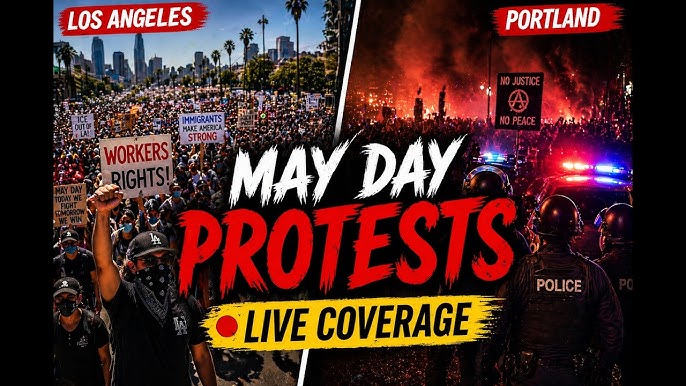
Still, activists and pundits push for more fundamental changes to the system they are intentionally breaking: public or collective ownership in key sectors, expansive redistribution, and a major shift in the balance of power between labor and capital, and the way the team lines are drawn. Under their rubric, everyone turns out to be labor, until the revolution is well underway, then nearly everyone turns out to be ‘rich,’ subjecting them to the wrath and rape of the new leadership.
That’s where critics draw lines, arguing that Leftist demands of redistribution of wealth and power echo earlier and recurring theories about organizing society primarily around class and collective outcomes–a few elite leaders rule over the masses of subjects. It’s the same BS, recycled with new false promises.
Institutions, Incentives, and Influence
The growth of large-scale protest movements also raises questions about how they are organized and amplified. Major demonstrations require:
- Funding and staffing
- Communications and media strategy
- Logistics and supplies for tens of thousands
- Legal and political coordination
In the U.S., those resources often come from a mix of nonprofits, advocacy organizations, unions, and ‘philanthropic’ foundations. Supporters view this as normal civic engagement. Realists ask why funding is coming from globalist billionaires with communist, socialist and The Communist Party of China (CPC/CCP).
The same debate extends to American institutions that influence public conversation:
- Education: Schools and universities are central to how ideas are introduced and debated. Results demonstrate that most campuses have become ideologically Left.
- Media: Coverage choices and framing can elevate certain narratives over others. Most television programming and Hollywood films promote woke, anti-God, anti-American, anti-family, anti-white agendas.
- Labor organizations: Unions exist to play a significant role in advocating for workers and shaping policy. In practice they have supported democrats and other Leftists who undermine constitutional liberties.
Why the Skepticism Persists
Skepticism toward modern May Day activism often comes down to three concerns:
1. Concentration of Power
Even well-intentioned policies can concentrate authority. The question is whether institutions are designed with sufficient checks to prevent overreach. All policy decisions must be governed by the overriding question, At whose expense will this action operate?
2. Tradeoffs and Outcomes
Policies that expand public control invariably affect incentives, investment, and growth. The balance between equity and dynamism always bears in the direction of the Left accumulating more wealth and power.
3. Pluralism vs. Uniformity
A diverse society contains competing values and preferences. The concern is whether sweeping, system-wide changes leave room for that diversity—or push toward uniform solutions, concentrating power and wealth in the left.
A Constitutional Framework
The United States has historically navigated these tensions through a framework that emphasizes:
- Individual rights
- Separation of powers
- Federalism (state and local variation)
- A mixed economy with both public and private roles
That framework evolved over time, but recent debates about more regulation, social programs, and market structure have abandoned those valued principles that transformed America from a weak agricultural countryside to the strongest, wealthiest, and most benevolent nation in world history.
Yet, American democrats choose to worship at the altar of May Day activism is the latest chapter of redistribution of wealth and power, or government authorized stealing.
What Comes Next
The renewed prominence of May Day in the U.S. suggests a deeper shift: economic questions are once again at the center of political life.
Ideas about equality, equity, fairness, and opportunity were asked and answered in our constitution. That’s how America became the richest, strongest nation in the world so quickly, and why we hold at bay the evil totalitarian governments who constantly seek to expand their borders so they can steal the resources of their neighbors to fund their sinking Marxist economies.
Leave a Reply