• Home
  • Mission
  • Federalist Papers
  • Foundation
  • U.S. Constitution
  • Bill of Rights

Federalist Press | Defending Liberty — Informing America

Breaking News and Political Commentary

  • All Stories
  • Economy
  • Elections
  • Entitlement
  • Ethics
  • Foreign
  • Gender
  • Religion
  • Sci-Tech

Do Liberal Women View Lindsay Clancy Murders Akin to Late Term Abortions?

August 29, 2026 By Editor Leave a Comment

As the Lindsay Clancy jury deliberates, hundreds of supporters dressed in pink have turned a horrific triple killing into a national debate over motherhood, mental illness—and criminal responsibility

Three children are dead. Their mother killed them. Those two facts are not disputed by either side in a Massachusetts courtroom.

Cora Clancy was five years old. Her brother Dawson was three. Their baby brother, Callan, was eight months old. On January 24, 2023, their mother, Lindsay Clancy, strangled all three children with exercise bands in the basement of the family’s Duxbury home after she sent her husband to pick up medication and takeout food. After murdering her three children, Clancy then attempted to kill herself, ultimately leaving herself paralyzed.

What the jury must decide is something considerably more complicated: Was Lindsay Clancy legally responsible for what she did?

After five weeks of testimony, the case went to a Plymouth Superior Court jury Thursday. The panel deliberated for several hours Thursday and approximately seven more Friday without reaching a verdict. Jurors requested to examine prescription medications and the knife involved in Clancy’s suicide attempt before being dismissed for the weekend. Deliberations resume Monday morning.

The jury has five potential outcomes before it: first-degree murder, second-degree murder, manslaughter, outright acquittal, or a finding that Clancy was not criminally responsible because of mental illness. A first-degree murder conviction could result in life imprisonment without parole; a finding of no criminal responsibility could result in confinement in a psychiatric institution rather than prison.

The defense: This was psychosis, not murder in the legal sense

Nobody seriously disputes that Clancy was suffering psychologically before the killings.

She had sought psychiatric treatment, experienced suicidal thoughts, contacted crisis resources and underwent hospitalization. Her defense maintains that she developed postpartum psychosis following the birth of Callan and was subjected to an ineffective and excessive succession of psychiatric medications. Defense experts testified that she was psychotic when she killed her children and therefore incapable of appreciating the wrongfulness of what she was doing.

Defense attorney Kevin Reddington consequently isn’t asking the jury to believe someone else killed Cora, Dawson and Callan. He acknowledges that Clancy did it. His contention is that mental disease had so profoundly destroyed her rational capacity that Massachusetts law cannot hold her criminally responsible.

That could be a legitimate legal defense, and it deserves to be considered on the evidence rather than dismissed because the crime is horrifying.

But prosecutors have presented a profoundly different interpretation.

Prosecutors say there was planning

The prosecution contends Clancy was depressed and psychologically troubled but not psychotic to the degree required to eliminate criminal responsibility.

Prosecutors emphasize the sequence preceding the killings. Clancy sent her husband Patrick awayt from the house to obtain medication for one of the children and collect dinner. While he was away, she had the opportunity she needed to kill the children. She strangled them individually with exercise bands before attempting suicide.

Prosecution experts also challenged Clancy’s subsequent account that she heard a voice directing her to kill the children. Forensic psychologist Kirk Heilbrun testified that he doubted she was suffering an acute psychotic episode and concluded that she understood the wrongfulness of her conduct. Other prosecution experts pointed to inconsistencies in her descriptions of what happened.

That conflict—not whether Clancy killed her children—is the case the jury is deciding.

Then came the women in pink

Outside the courthouse, however, something unusual happened.

Hundreds of Clancy supporters assembled wearing bright pink. Associated Press reporters estimated approximately 300 women and a few men participated in one demonstration. Shirts carried messages including “Believe,” “She Needed Help” and “Peace For Lindsay.” Some supporters traveled considerable distances to attend.

These supporters have said nothing about Cora, Dawson and Callan in this extraordinary public spectacle.

Whatever ultimately happened inside Lindsay Clancy’s mind, three human beings incapable of defending themselves were brutally murdered. The oldest had barely begun school. The youngest had lived only eight months.

A society can demand better psychiatric treatment for mothers while remembering their murdered children. Those propositions do not conflict.

When the accused becomes the symbol

The unsettling feature of the demonstrations is not concern about postpartum psychosis. That concern is legitimate and potentially lifesaving. The uncomfortable question is why the person who killed three children became the visual centerpiece of the movement.

There are countless women who have suffered postpartum depression and psychosis without killing anyone. Their experiences deserve attention. So do women who recognized frightening symptoms and sought emergency intervention, families who protected mothers and babies during psychiatric crises, and physicians attempting to recognize an uncommon but extremely dangerous condition.

Making Clancy herself the symbol creates an unavoidable moral ambiguity.

One recent commentary from the political left demonstrates how far that reframing can go. Left Voice, a self-described revolutionary socialist publication, published an essay with the remarkable headline “In the Trial of Lindsay Clancy, Capitalism Is the Guilty Party.” Its authors argued that the capitalist healthcare system—not Clancy—was the true guilty party.

That is no longer simply an argument that mental illness can eliminate legal responsibility. It relocates moral responsibility from the individual who performed a murderous act onto “the system.” It echoes Luigi Mangione shooting United Healthcare CEO Brian Thompson in the back, and the large cast of young liberal supporters of that “heroic” act of murder.

And that deserves examination.

Compassion cannot require forgetting the victims

Mental illness is real. Postpartum psychosis is real. A human being suffering a genuine psychotic break may be incapable of understanding reality in a way that fundamentally changes criminal responsibility. American law has recognized versions of that principle for generations.

The jury, not demonstrators, commentators or politicians, must determine whether the evidence proves that happened here. But compassion for a mentally ill defendant need not require the moral displacement of her victims.

There is something deeply uncomfortable about seeing hundreds of people assembling around the person who admittedly murdered three defenseless children while the children’s names risk becoming secondary characters in their own deaths.

Cora. Dawson. Callan. They were not abstractions in a debate about America’s healthcare system. They were children. Beloved by their decimated father and extended family members.

Is there a broader cultural question?

The spectacle also raises a difficult cultural question that extends beyond this particular defendant.

Modern political debate increasingly frames traditional obligations through the vocabulary of autonomy. Marriage can be discussed primarily in terms of personal fulfillment. Pregnancy becomes a question of bodily autonomy. Parenthood is frequently discussed in terms of its economic and psychological burdens. Abortion politics, particularly regarding later stages of pregnancy, places the competing moral claims of mother and unborn child at the center of an intense national disagreement.

The Clancy case is legally and morally different from abortion, and it would be inaccurate to claim that the women outside the courthouse necessarily connect the two.

Nevertheless, a conservative cultural critique can legitimately ask whether something happens to a society when the language of adult autonomy consistently becomes louder than the language of obligation toward dependent children.

That is a philosophical question, not evidence concerning Clancy’s guilt.

But this case makes the question difficult to avoid.

Now twelve jurors must decide

The jury of nine women and three men has already spent more than ten hours examining an enormous record developed during five weeks of testimony. Their early requests for prescription medications suggest, although we should not speculate too far, that they are carefully considering the medical evidence central to Clancy’s defense.

They return Monday. Their responsibility is narrower than America’s. They must determine Lindsay Clancy’s criminal responsibility under Massachusetts law.

The rest of us confront a different question. Can we acknowledge severe mental illness without romanticizing the person who commits an atrocity? Can we identify failures in psychiatric medicine without automatically transferring responsibility from individuals to institutions? Can we have compassion for a desperately ill mother while reserving our deepest compassion for three children whose lives were taken from them?

We should be capable of all three. Whatever verdict eventually comes from Plymouth Superior Court, one fact should never become obscured by pink shirts, political ideology, psychiatric terminology or television cameras.

Cora Clancy was five. Dawson was three. Callan was eight months old. They deserve to remain at the center of this story.

Filed Under: Crime, Ethics, Featured, Gender, Sci-Tech

For What Possible Reason? The Political Movement That Opposes the People

August 24, 2026 By Editor Leave a Comment

There is a question Americans ought to ask whenever they encounter a political position that seems, at first glance, difficult to understand: What principle connects it to the other positions being advanced at the same time? Taken separately, arguments over illegal immigration, voter identification, gun ownership, government fraud, taxation, regulation and the growth of the federal bureaucracy can appear to be unrelated disputes.

Taken together, however, they illuminate one of the oldest disagreements in American political life: whether government exists primarily to protect the liberty and sovereignty of the individual citizen, or whether increasingly consequential decisions should be entrusted to an expanding administrative state.

What Possible Reason for an Open Border?

Consider the border. A sovereign country has both the authority and responsibility to decide who may enter, who may remain, and who may become a citizen. What obligation does the federal government have to the existing citizenry when immigration occurs illegally or at a scale that strains housing, schools, hospitals, public assistance and law enforcement? Immigration policy is not merely a discussion about the people seeking admission. It is mainly a question about the government’s responsibilities to the people who already constitute the nation. Those people ARE the government.

The Democrats oppose controlling our borders. For what possible reason? They oppose removing illegal aliens. For what possible reason?

What Possible Reason to Oppose Election Integrity?

The same fundamental question arises in election administration. Americans can reasonably disagree about precisely which safeguards provide the best combination of ballot access and election security. But the objective itself should be overwhelmingly shared: every eligible citizen should be able to vote, every lawful vote should be counted, and unlawful votes should not be counted. Requirements such as voter identification, accurate voter rolls, auditable election procedures and effective citizenship verification should therefore be evaluated according to whether they accomplish those objectives without improperly disenfranchising qualified voters. Election integrity should not belong to Republicans or Democrats. Confidence in legitimate elections is infrastructure for the republic itself. Yet, Democrats oppose election integrity at every step. For what possible reason?

What Possible Reason to Oppose Gun Ownership?

Then there is the Second Amendment. The Constitution does not merely mention firearms as an incidental matter of public policy; it expressly protects a right of the people to keep and bear arms. Americans should recognize the deeper philosophical question underlying the debate. A society in which peaceful citizens possess enforceable rights independent of government is fundamentally different from one in which government decides which privileges citizens may exercise. The distinction between a right and government-granted permission is central to the American constitutional experiment. The right to keep and bear arms exists before, during and after the existence of the federal government, and the government has no ability to “infringe” that right. For what possible reason would Democrats seek to restrict or eliminate that right?

What Possible Reason to Oppose Ending Government Fraud?

Perhaps nowhere should political agreement be easier to achieve than in the effort to eliminate waste, fraud and abuse from government.

Whether the amount ultimately uncovered is billions or hundreds of billions of dollars, every dollar fraudulently obtained from government originated with taxpayers or public borrowing. A fraudulent Medicaid payment, fictitious government contractor, nonexistent beneficiary, corrupt grant recipient or improperly obtained federal benefit is not free money. Someone earned the money that government collected, and future taxpayers must ultimately service the debt incurred when government spends money it does not have.

That should make aggressive auditing one of the least partisan propositions imaginable. It is not. Democrats oppose ending government fraud at every step, and their abhorrent treatment of DOGE and Elon Musk are clear evidence of their disdain.

If investigators identify apparent fraud, investigate it. If an audit discovers payments going to ineligible recipients, stop them. If government databases contain glaring inconsistencies, reconcile them. If contractors are billing taxpayers for services never performed, prosecute the responsible parties where the evidence warrants it. If an agency cannot satisfactorily account for enormous amounts of public money, require it to do so.

After all, a government confident in its integrity should welcome serious auditing because an audit that disproves an allegation is valuable too.

The Answer

There is one common answer to each of these simple questions. Who could possibly oppose doing what is best for the American people, rather than what is best for unvetted foreigners, election fraudsters, Leftist politicians with totalitarian desires, and financial fraudsters?

Those who benefit, is the common answer.

Democrats benefit from a permanent underclass, who will vote against America’s interest to elect politicians who promise massive benefits and cash for little effort.

Democrats benefit from promoting and defending those involved in election fraud, because those illegal votes are nearly 100% cast for Democrats.

Democrats are always engaged in anti-Second Amendment activities, because they, like every wanna-be totalitarian government that preceded them have trouble taking away American rights if American’s are armed.

Democrats oppose investigating and prosecuting fraud because it is their operatives who engage in it, funneling billions to friendly recipients, and many millions of those ill-gotten dollars end up in Democrat campaigns coffers.

I challenge anyone to offer sound reasons why these conclusions are not true. There is no other possible reason for Democrats to take these harmful and foolish positions.

Filed Under: Bias, Crime, Economy, Elections, Entitlement, Ethics, Featured, Foreign, Gender

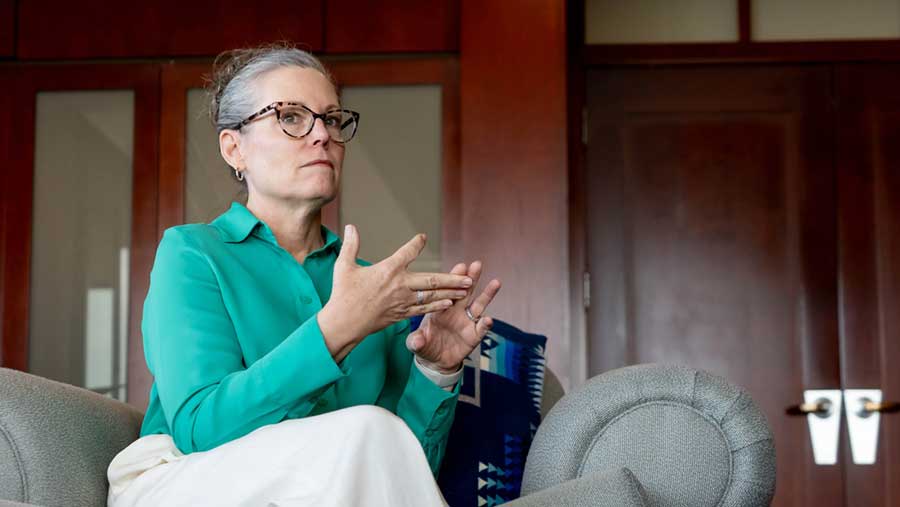
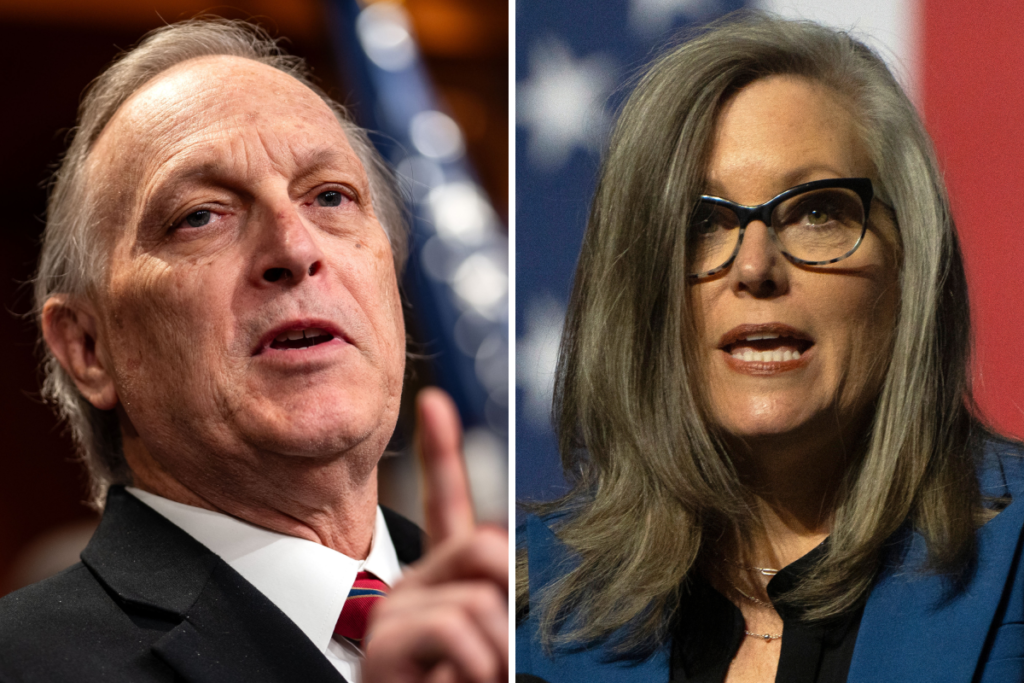
No Debate, No AG Interview: What Is AZ Gov Katie Hobbs Hiding?

August 20, 2026 By Editor Leave a Comment

Arizona’s governor won’t debate Rep. Andy Biggs. She won’t sit for interviews requested by investigators examining pay-to-play schemes. Meanwhile, her campaign is spending heavily to falsely define her opponent without facing him.

Arizona voters are being asked to give Katie Hobbs another four years as governor. Why would they do such a foolish thing?

It is remarkable how many questions the governor appears unwilling to answer, even in the traditional forums where politicians are expected to answer them.

Hobbs has announced that she will not debate Republican gubernatorial nominee Andy Biggs before November’s election. She similarly refused to debate Republican Kari Lake during her successful 2022 campaign and has not participated in a televised political debate since 2018.

Hobbs is no stranger to controversy over institutional conflicts. During the 2022 gubernatorial election against Kari Lake, Hobbs simultaneously served as Arizona’s Secretary of State—the state’s chief elections officer—and Democratic nominee for governor. Hobbs rejected calls to recuse herself from election duties, and ultimately certified the very questionable election declaring herself the winner.

Hobbs refuses to submit submitted to a formal interview requested months ago by investigators working for Arizona Attorney General Kris Mayes—a fellow Democrat and close friend of Hobbs—who is conducting a criminal investigation into allegations of a pay-to-play scheme involving one of Hobbs’ major political benefactors.

Rep. Andy Biggs will attend debate vs. sitting Arizona governor Katie Hobbs whether she shows up or not.

Hobbs says she is cooperating with the Attorney General’s Office, but Mayes reports that Hobbs is refusing to sit with criminal investigators for an interview.

After two years for stonewalling investigators, Arizona voters are entitled to wonder why obtaining straightforward answers has proved so difficult.

The $400,000 Question

At the center of the controversy is Sunshine Residential Homes, a company providing group-home services for children in Arizona’s foster-care system.

The basic chronology is not a partisan invention. Sunshine and its leadership made more than $400,000 in political contributions benefiting Hobbs, her inaugural operation and the Arizona Democratic Party during 2022 and 2023. Sunshine previously had little history of political giving.

Then came the state money. After Hobbs became governor, her Department of Child Safety approved a substantial special increase in the rate paid to Sunshine for caring for foster children, worth millions of dollars.

Other providers seeking increases had been turned down. And yes, Sunshine got one.

The resulting increase ultimately took its rate from approximately $140 to $234 per bed, according to Capitol Media Services—a rise of more than 60 percent.

That combination—large political contributions followed by favorable specific government treatment worth many millions of dollars—was sufficiently troubling that it eventually triggered multiple investigations.

It presents exactly the kind of circumstances that investigators exist to examine.

Three Investigations—and Two Years Later, Still No Answer

Attorney General Mayes opened her investigation in June 2024. That means Arizona has now entered the third year of an investigation involving its sitting governor.

And Mayes isn’t the only prosecutor looking at the matter. Republican Maricopa County Attorney Rachel Mitchell has conducted a separate investigation, and the Arizona House retained outside attorney Justin Smith to conduct an independent inquiry for lawmakers. That is important because criticism of Mayes’ handling of the investigation has inevitably been complicated by politics. Mayes and Hobbs are both Democrats, and are closely aligned.

The extraordinary duration of the investigation, and Mayes’ inability or unwillingness to say whether investigators will actually get the governor into an interview room, naturally invites scrutiny.

In April, Mayes publicly confirmed that investigators are seeking to interview Hobbs. “Our investigators are prepared to do that interview,” Mayes said at the time, calling it appropriate to ensure that the investigation was thorough.

Months passed. No interview.

Although earlier this month, Mayes insisted that “no one can blow off the Attorney General’s office,” Hobbs has done exactly that. Despite numerous invitations and demands by prosecutors for interviews, Hobbs has refused each and every opportunity to tell her side of the public corruption story.

Last week, Hobbs told KTAR that her office remains in discussions with Mayes’ office about the request but offered no explanation for why she has not simply sat down and answered investigators’ questions. That is difficult, if not impossible, to understand.

If the governor had nothing to do with Sunshine’s favorable treatment, as she maintains, why has arranging an interview with investigators required months of “negotiation”? The answer becomes more obvious with each passing week.

In reality, a criminal investigation involving a sitting governor cannot simply drift through an election indefinitely. Either the evidence supports her story in the criminal investigation, or it doesn’t. And after more than two years, Arizona deserves answers.

Even worse, Hobbs Vetoed a Contract-Transparency Bill

There is another awkward chapter in the Gov Hobbs criminal investigation saga.

Republican state Sen. T.J. Shope proposed legislation requiring companies seeking state contracts and grants to disclose certain political donations, gifts and financial connections involving the governor and her political network.

Hobbs vetoed that legislation in June.

Politically, the optics are extraordinary. A governor under criminal investigation over allegations involving political contributions and a lucrative state arrangement vetoes legislation specifically designed to expose relationships between political contributions and state contracts.

Arizona taxpayers should not have to work this hard to discover who is giving politicians money while simultaneously seeking taxpayer-funded business.

Hobbs Won’t Debate Biggs Either

Against that backdrop comes Hobbs’ other refusal. She won’t debate her opponent, Rep. Andy Biggs.

Hobs likewise refused to debate Kari Lake in 2022. She also refused to debate her Democratic primary opponent that year. Her last televised political debate was reportedly in October 2018.

Biggs, meanwhile, has committed to appearing at the October Clean Elections debate whether Hobbs shows up or not.

Arizona voters deserve better than dueling television commercials.

Hobbs’ “23 Percent Tax” Attack Is a Lie

Hobbs has instead gone aggressively negative against Biggs, particularly with advertisements claiming he wants to impose a 23 percent sales tax that would make groceries, gasoline, rent and other necessities 23 percent “more expensive.”

The truth is that Biggs has discussed replacing federal income and payroll taxes with a national consumption tax.

Its central premise is to abolish federal individual income taxes, payroll taxes and several other federal taxes and replace that revenue with a simple, across the board consumption tax.

Of course, that is merely restructuring the manner in which federal taxes are levied and collected. It does not add any tax.

A gubernatorial debate would be an excellent place for Hobbs to challenge Biggs on that, and for Biggs to react to a few of the allegations against Hobbs. She has chosen not to debate him—likely, for that very reason.

Arizona Really Does Have an Affordability Problem

There is one criticism of Hobbs that doesn’t require exaggeration. Arizona has become painfully expensive.

A 2026 Common Sense Institute analysis ranked Arizona 45th among the 50 states and Washington, D.C., for affordability, down sharply from 2019. Arizona PBS reported the study as placing the state seventh-least-affordable nationally. Housing is the largest problem: CSI estimates that only about 42 percent of Arizona households could afford the monthly mortgage on an average-priced home under conventional affordability standards, compared with 66 percent in 2019.

Much of Arizona’s housing-price explosion began during the pandemic and the Biden inflation mistakes. Hobbs touted and even embraced those democratic party policies, and now seeks to escape her responsibility for the affordability crisis in Arizona.

Again, that sounds like an excellent debate question.

Arizona Deserves Answers Before November

Arizona voters shouldn’t have to choose their governor first, and receive answers about the governor’s criminal investigations afterward.

They deserve to know why a company and its principals suddenly became major political benefactors and subsequently received unusually favorable state treatment, resulting in millions of dollars in benefits.

They deserve to know whether anyone in the Governor’s Office influenced that decision They deserve to know what Mayes’ investigators found after spending more than two years examining it They deserve to know why Hobbs still has not sat for the interview investigators requested months ago.

And they deserve to see their governor stand across from the man seeking her job and answer questions without handlers, campaign advertisements, or carefully controlled events separating the candidates.

Hobbs says she has nothing to hide. Andy Biggs says he is prepared to debate. Kris Mayes says nobody can blow off the Attorney General.

Excellent.

Then there should be a remarkably simple solution to all three controversies: Answer the investigators. Debate the opponent. And let Arizona voters hear the answers before they cast their ballots.

Filed Under: Bias, Crime, Economy, Elections, Ethics, Featured, Foreign, Gender

The Fang Fang Files: Democrats Covered Up Eric Swalwell Affair with Chinese Communist Intelligence Officer

August 18, 2026 By Editor Leave a Comment

Newly declassified FBI records reveal an intimate relationship, a years-long counterintelligence investigation, suspected foreign campaign contributions, and disturbing questions about Chinese efforts to cultivate rising American politicians.

Rep. Eric Swalwell (D) and “Best Friend” Sen. Ruben Gallego (D) in the hot seat after traveling to Doha on several Qatar-sponsored trips, and being caught in extramarital affairs.

For nearly six years, Americans have heard two dramatically different versions of the Eric Swalwell–Christine Fang story.

One version portrayed it largely as partisan gossip: a rising California Democrat encountered a Chinese woman active in Bay Area politics.

Newly declassified FBI records reveal that abbreviated version as a lie.

According to records released yesterday, Swalwell acknowledged to FBI investigators that he had engaged in what he described as “physical relations” with Christine Fang—better known as Fang Fang—on a “handful of occasions.” The disclosure provides an important fact that was absent from the original public reporting when the controversy erupted in 2020. Fang Fang would show up at Swalwell’s rooms “wearing no panties,” and the security team was under instruction to allow her in.

Chinese honeypot Fang Fang solicited illegal campaign donations for Eric Swalwell and placed Chinese spies in his office, FBI found

More importantly, the documents illuminate the concerning breadth of the FBI’s concerns about Fang herself and about Chinese Intelligence efforts to cultivate relationships with American politicians.

The FBI investigation ran from 2014 through 2017 under the code name “Freshman Fifteen.” Investigators examined suspected foreign-source campaign contributions, congressional internships and Fang’s relationships with American political figures.

Swalwell was never criminally charged by Biden’s DOJ and a House Ethics Committee investigation ended without disciplinary action against him.

This Was About Much More Than Sex

Federal investigators believed Fang was associated with China’s intelligence apparatus and were sufficiently interested in her activities that the FBI at one point attempted to develop her as an intelligence source.

The FBI discovered the Swalwell relationship during that effort. Investigators eventually concluded that Fang could not be trusted as a source.

The documents also provide additional information concerning Fang’s political activities. Investigators examined campaign contributions and internships in Swalwell’s congressional office, finding that she was planting female Chinese Intelligence operatives on Swalwell’s staff in exchange for political contributions.

Of course, foreign nationals are prohibited from contributing to American federal campaigns for an obvious reason: Americans, not foreign governments or foreign nationals, are supposed to choose and influence America’s political leadership.

And the broader question remains unavoidable:

How did a woman under FBI counterintelligence scrutiny for suspected connections to America’s principal geopolitical adversary obtain such extraordinary access to a rising member of Congress?

China’s Influence Operations Are Not Hypothetical

The larger story is Communist China’s patient approach to cultivating political influence inside the United States. Intelligence operations rarely begin with a stranger walking into a congressman’s office and requesting classified documents.

They begin with relationships. Access. Introductions. Fundraisers. Friendships. Political assistance. Personal vulnerabilities.

And sometimes, sex.

An intelligence service does not necessarily need its target to become a conscious spy. Simply establishing access to an ambitious politician can produce information about personalities, relationships, political networks, schedules, vulnerabilities and future opportunities.

That is why the original Fang story was significant even before these new documents appeared.

The original 2020 Axios investigation reported that U.S. intelligence officials believed Fang participated in a Chinese political-influence operation targeting promising American politicians. She assisted Swalwell’s fundraising efforts and helped place interns in his congressional office.

Today’s declassified records provide considerably more context about just how close the relationship became.

Then Swalwell Joined the Intelligence Committee

The chronology makes the episode especially uncomfortable. Swalwell entered Congress in 2013 and subsequently served on the House Permanent Select Committee on Intelligence beginning in 2015.

Members of that committee oversee extraordinarily sensitive national-security matters involving the CIA, NSA, covert activities, foreign intelligence operations and threats posed by adversarial governments—including China.

Counterintelligence is supposed to identify vulnerabilities before classified information is compromised.

Imagine reversing the political parties and changing only one country.

Suppose a Republican member of the House Intelligence Committee admitted having repeated sexual encounters with a woman whom the FBI suspected of connections to Russian intelligence. Would Washington dismiss questions about that relationship as partisan politics?

Would journalists consider the matter unworthy of aggressive investigation? Would congressional leaders insist there was nothing interesting to see because GOP prosecutors ultimately filed no espionage charges?

Americans can answer those questions for themselves.

The “Freshman Fifteen” Investigation

The newly disclosed existence and scope of the FBI investigation deserve particular attention.

According to the newly reported documents, “Freshman Fifteen” operated from approximately 2014 through 2017 and examined Fang’s activities surrounding American politicians, including suspected campaign-finance activity.

Investigators reportedly believed Fang herself may have violated federal laws governing foreign political contributions. Reporting on the records says investigators believed she understood the prohibition against foreign nationals contributing to American campaigns and examined whether American intermediaries had been used instead.

Fang departed the United States in 2015. The FBI dropped its investigation. But Americans should understand that “not charged” is not synonymous with “nothing happened.”

The newly released records demonstrate that the FBI considered the situation sufficiently serious to conduct a multiyear counterintelligence investigation.

Why Didn’t Americans Know?

That brings us to perhaps the most important question raised by the entire release. Why did Americans have to wait until 2026 to learn so much of this?

When the Fang controversy became public in 2020, Americans did not have the investigative record now available. It was essentially covered up by the Deep State FBI. They received fragments of the story through anonymous intelligence sources, partisan arguments, and carefully worded political responses.

The FBI knew substantially more. Investigators had interviewed Swalwell. They knew the nature of his personal relationship with Fang. They had investigated Fang’s political activities. They had examined suspected campaign-finance issues. They had attempted to assess her intelligence connections.

Yet the public remained largely in the dark about the underlying investigative material. Only conservative news outlets like Fox News provided the public coverage of the outrageous behavior of Rep. Swalwell, and later, his “Best Friend,” Sen. Ruben Gallego of Arizona.

National-security investigations legitimately require secrecy while they are underway. Sources and methods must be protected. Active counterintelligence operations cannot simply be published on the Internet. But an investigation that concluded years ago raises a different question.

At what point does protecting legitimate national-security information become protecting Washington from embarrassment? That question deserves an answer.

What About Ruben Gallego?

The release has also renewed attention on Sen. Ruben Gallego (D) because of his extraordinarily close political and personal relationship with Swalwell. Gallego and Swalwell were exceptionally close, by their own admission.

Gallego served as national chairman of Swalwell’s short-lived 2020 presidential campaign. The two traveled together often, on foreign junkets paid for by foreign countries. They were congressional roommates, and maintained a close friendship. Swalwell has reportedly described Gallego as his “best friend in the world.”

That makes questions about what Gallego knew politically interesting. Recent revelations about Galleo’s extra-marital affairs are likewise deeply disturbing, particularly when discussing allegations involving national security.

When prominent politicians campaign together, travel together, live together, have affairs at the same time, and publicly defend one another, reporters are perfectly entitled to ask what each knew about controversies surrounding the other.

Patriotism Should Not Be Partisan

There is a principle here that should transcend political affiliation. China conducts sophisticated intelligence, cyber, economic and political-influence operations against the United States. American intelligence officials under Republican and Democratic administrations alike have repeatedly warned about their scale.

Protecting America from foreign influence therefore cannot depend upon which letter follows a politician’s name.

If a Republican develops an intimate relationship with someone suspected of connections to Russian intelligence, investigate it. If a Democrat develops an intimate relationship with someone suspected of connections to Chinese intelligence, investigate it.

If foreign campaign contributions appear to be entering American elections through intermediaries, investigate them.

If foreign operatives are cultivating young American politicians whom they believe may someday become governors, senators, presidential candidates or members of sensitive congressional committees, expose those operations.

National loyalty should come before party loyalty.

The Fang Fang Story Is No Longer a Punchline

For years, “Fang Fang” became a punchline in partisan political arguments.

The newly released records demonstrate why it never should have been. Foreign intelligence services cultivating American politicians is serious business.

Sexual relationships can create counterintelligence vulnerabilities. Foreign campaign money is prohibited for a reason. Access to congressional offices matters. Access to congressional personnel matters. And access to politicians who later oversee America’s intelligence agencies matters enormously.

The FBI investigated Christine Fang for suspected connections to Chinese intelligence personnel and political-influence activities. Investigators examined suspected foreign-source campaign contributions and congressional internships. And Swalwell acknowledged an intimate relationship with Fang on a “handful of occasions” during the period when his political career was rapidly ascending toward one of the most sensitive committees in Congress.

Americans deserved to know those facts. They deserved to know them years ago. And that leaves Washington with questions that cannot be dismissed simply by pointing out that no prosecution resulted:

What exactly happened? Who knew about it? What did the FBI conclude about China’s operation? And why did the American people have to wait more than a decade to see so much of the underlying record?

The American press and Democratic leadership did everything they could to hide the story, and lied about the facts for over 10 years while they boosted Swalwell’s political career. That is why the American people are only learning about it today.

Filed Under: Bias, Crime, Economy, Elections, Entitlement, Ethics, Featured, Foreign, Gender

Envy Is the Fuel of Socialism

July 28, 2026 By Editor Leave a Comment

Social media has created a generation taught to compare, covet, and consume. Socialism arrives promising to satisfy desires that only hard work and free enterprise can sustainably provide.

One of the most destructive cultural developments of the past twenty years has received remarkably little attention. It is not merely the rise of social media, but the rise of manufactured envy. Platforms that began as a way for families and friends to stay connected have evolved into global competitions where millions of people display carefully edited versions of their lives.

Filters erase imperfections. Luxury vacations become routine. Exotic automobiles, designer clothing, expensive homes, private jets, and seemingly effortless wealth fill endless scrolling feeds.

For many users, especially young people, the result is not inspiration—it is comparison. And comparison, left unchecked, often becomes envy.

Researchers have found that social media encourages upward social comparison, particularly among younger users, increasing dissatisfaction with their own circumstances and amplifying the “fear of missing out.” Social media companies profit from that emotion. Influencers profit from it. Advertisers profit from it. Increasingly, politicians do as well.

Every successful political movement appeals to deeply rooted human emotions. Some appeal to hope. Others appeal to patriotism or fear. Socialism has historically found its greatest appeal in resentment and envy. Its message is deceptively simple: someone else has more than you. Someone else lives in the house you wish you owned, drives the car you wish you could afford, and enjoys a lifestyle you have been taught to believe you deserve.

Rather than asking how successful people created their prosperity, socialism asks a different question: Why should they have it at all?

Former British Prime Minister Margaret Thatcher understood this tendency better than most. She famously observed, “The problem with socialism is that eventually you run out of other people’s money.” She also noted that socialism often appears less interested in making the poor wealthier than in making the wealthy poorer. In fact, history repeatedly demonstrates that many redistributive political movements spend far more time discussing how wealth should be divided than how wealth is actually created.

Social media has fundamentally altered the psychology of younger generations. Previous generations compared themselves primarily to neighbors, classmates, or coworkers. Today’s young adults compare themselves every waking hour to celebrities, entrepreneurs, professional athletes, entertainers, and social media influencers whose carefully curated lives bear little resemblance to reality. Algorithms continuously feed users images of people who appear richer, happier, more attractive, and more successful than themselves. It should surprise no one that many young Americans conclude they are somehow falling behind.

What rarely appears on Instagram, TikTok, or YouTube are the years of sacrifice that almost always precede genuine success. Viewers seldom see the entrepreneur who mortgaged his home three times before building a successful business, the contractor who worked nights and weekends for twenty years, the physician who endured a decade of education and residency, or the investor who quietly accumulated wealth through disciplined saving and decades of compound growth.

Social media compresses decades of effort into a thirty-second highlight reel. Success appears effortless. Wealth appears instantaneous. Luxury appears normal rather than exceptional. When the hard work disappears from the story, redistributing someone else’s success begins to seem perfectly reasonable.

It is therefore not surprising that socialism has gained renewed popularity among many younger Americans. Surveys have shown that younger generations express more favorable attitudes toward socialism than their parents and grandparents. There are many reasons for this. Housing prices have risen dramatically. College tuition has exploded. Student debt burdens millions of graduates. Economic mobility often feels more difficult than it did for previous generations. These concerns are genuine and deserve serious attention. Yet social media magnifies those frustrations by presenting extraordinary lifestyles as though they are ordinary expectations. The emotional response creates fertile ground for politicians promising to solve inequality by expanding government and redistributing wealth.

Within today’s Democratic Party, that message has become increasingly prominent. Self-described democratic socialists now occupy influential positions within the party, while others advocate policies that would significantly expand federal control over healthcare, education, housing, energy, taxation, and wealth redistribution. Supporters argue these programs create greater fairness and economic security. Critics respond that every new entitlement, regulation, or subsidy eventually raises the same unavoidable question: At whose expense?

Government creates no wealth of its own. Every benefit it provides must first be financed through taxation, borrowing, inflation, or future generations who will eventually be asked to pay today’s bills.

America has never promised equal outcomes. It has promised equal opportunity under the law. Those are profoundly different ideas. Free societies inevitably produce different results because individuals make different choices, possess different talents, assume different risks, and devote different levels of effort to different pursuits.

Capitalism rewards innovation, investment, entrepreneurship, and productive labor. Socialism increasingly looks to political power to redistribute what others have already created. History offers countless examples of that experiment, and the results have consistently included slower economic growth, diminished innovation, expanding government control, and declining personal freedom.

The proper response to seeing another person’s success has never been resentment. It should be curiosity. How did they build it? What sacrifices did they make? What risks did they assume? What can I learn from their example? Those questions built the American economy. They inspired generations of immigrants, entrepreneurs, inventors, and workers who transformed modest beginnings into remarkable success stories. Envy has never built a civilization. Innovation has. Discipline has. Entrepreneurship has. Personal responsibility has.

Social media will continue rewarding appearances, and politicians will continue rewarding promises. But neither can repeal economic reality. A nation that teaches its young people to covet what others possess rather than encouraging them to build prosperity for themselves risks replacing ambition with resentment. The American Dream was never that government would guarantee every citizen the lifestyle of an internet influencer. It was that every citizen would remain free to pursue success through talent, perseverance, innovation, prudent risk-taking, and hard work.

That dream remains worth defending. Perhaps the first step is teaching the next generation not to ask, “Why do they have more than I do?” but instead, “What can I build?”

Filed Under: Entitlement, Bias, Crime, Economy, Elections, Ethics, Featured, Gender

The National Opportunity Corps: A Second Chance for America’s Lost Generation

July 9, 2026 By Editor Leave a Comment

Instead of condemning millions of young Americans to dependency, crime, or dead-end lives, America should offer them something far more powerful: opportunity.

For decades, Americans have argued over who deserves the blame for our nation’s growing social and educational crisis. Politicians blame one another. Teachers blame parents. Parents blame schools. Schools blame society.

Meanwhile, millions of young Americans quietly slip through the cracks.

Some graduate from high school unable to write a coherent paragraph, balance a checkbook, explain the Constitution, or calculate compound interest. Others leave school with little preparation for careers that can provide a solid middle-class life. Many never graduate at all.

The tragedy extends far beyond academics.

America faces severe shortages of electricians, plumbers, welders, HVAC technicians, heavy equipment operators, mechanics, construction workers, and countless other skilled professionals. At the same time, many young adults struggle to find stable careers that offer dignity, purpose, and economic independence.

These two problems should not exist simultaneously. Yet they do.

Rather than spending another generation arguing over who created the crisis, perhaps it is finally time to build a solution worthy of the American people. America should establish a National Opportunity Corps.

Not another welfare program. Not another bureaucracy. Not a military draft. A voluntary national institution dedicated to rebuilding lives and rebuilding America.

A Second Chance

Every American deserves an opportunity to succeed. Not everyone receives one. Some young people grow up in excellent schools with supportive families and strong communities. Others do not.

Some are raised by parents who teach discipline, responsibility, financial literacy, and the value of hard work. Others reach adulthood having never learned these basic life skills.

The National Opportunity Corps would not ask why someone fell behind. It would simply ask: “Are you willing to work for a better future?”

If the answer is yes, America should meet that determination with opportunity.

Education That Actually Prepares People for Life

Participants between roughly eighteen and thirty years old could voluntarily enroll for eighteen to twenty-four months. During that time they would receive housing, meals, healthcare, uniforms, and a modest living allowance.

More importantly, they would receive an education focused on practical success rather than political fashion. Participants would study:

  • English composition and communication
  • Mathematics and practical problem solving
  • American history
  • Constitutional government and civics
  • Economics and free enterprise
  • Financial literacy
  • Budgeting
  • Investing
  • Retirement planning
  • Entrepreneurship
  • Interview skills
  • Leadership
  • Personal responsibility

Many Americans finish twelve years of public education without ever learning how mortgages work, how investments grow over time, or how to build wealth through disciplined saving. These subjects should not be optional. They should form the foundation of adult life.

Learn a Trade. Build a Future.

Classroom education would occupy only part of each day. The remainder would be devoted to learning marketable skills through apprenticeships supervised by experienced professionals.

Participants could pursue nationally recognized certifications in fields including:

  • Plumbing
  • Electrical work
  • HVAC
  • Carpentry
  • Welding
  • Diesel mechanics
  • Aviation maintenance
  • Heavy equipment operation
  • Construction management
  • Manufacturing
  • Cybersecurity
  • Information technology

America does not merely need more college graduates. It desperately needs more highly skilled workers. Many trades now provide incomes that exceed those of countless four-year college graduates while requiring little or no student debt.

Building America While Building Character

The National Opportunity Corps should not exist solely inside classrooms. Participants should help rebuild America itself.

Working alongside engineers, contractors, conservation specialists, and veterans’ organizations, corps members could restore public lands, assist communities recovering from natural disasters, improve parks and trails, rehabilitate housing, and undertake infrastructure projects that strengthen the nation.

Such work teaches far more than technical skills. It teaches pride. Responsibility. Teamwork. Leadership.

These are qualities that cannot be downloaded from a smartphone. They must be learned through experience.

Rewarding Success

One of the most innovative features of the National Opportunity Corps should be its savings program.

Rather than paying participants large weekly wages, much of their compensation would be deposited automatically into an investment account held in trust throughout their enrollment. When they graduate successfully, they would receive those accumulated funds.

For many graduates, this could mean leaving the program with enough money to purchase professional tools, secure housing, begin college, launch a small business, or make a down payment on a first home.

Instead of graduating into debt, they would graduate with assets. That single difference could alter the trajectory of an entire lifetime.

A Program That Pays for Itself

Critics will undoubtedly ask how America can afford such a program. The better question is: How can America afford not it?

Every year taxpayers spend enormous sums addressing the consequences of educational failure, chronic unemployment, addiction, crime, incarceration, homelessness, and long-term dependency.

Transforming even a fraction of those lives into productive careers would reduce future public costs while increasing tax revenue, economic growth, and civic stability.

This is not merely compassionate. It is fiscally prudent.

Restoring the American Dream

For generations, the American Dream rested upon a simple promise. If you were willing to work hard, learn useful skills, obey the law, and take responsibility for your own future, success remained within reach.

That promise has become more difficult for many Americans to realize. The answer is not to lower expectations. Nor is it to convince young Americans that government can redistribute prosperity.

The answer is to restore the institutions that help people create prosperity for themselves. Opportunity. Education. Discipline. Responsibility. Meaningful work.

Those principles built the strongest middle class in human history. They can do so again.

A Challenge Worth Accepting

President Donald Trump has often spoken about restoring American manufacturing, rebuilding the skilled trades, revitalizing forgotten communities, and renewing national pride. He has also talked about the tragedy of children growing up in fatherless homes, and of generational poverty.

The National Opportunity Corps would advance each of those goals. It would strengthen the workforce. Reduce dependency. Address skilled labor shortages. Revitalize communities.

And most importantly, it would give countless young Americans something many have never truly been offered: A genuine second chance.

America has never suffered from a shortage of talent. It has sometimes suffered from a shortage of opportunity. The National Opportunity Corps would help bridge that gap.

Not by promising equal outcomes. But by ensuring that every American willing to work, learn, and persevere has another chance to build a productive, independent, and meaningful life.

That is not merely good public policy. It is an investment in the future of the Republic itself.

President Donald J. Trump — please consider a program like this to provide many millions of young Americans with the opportunity to reset their lives, and climb out of the rut that decades of foolish Washington policies have thrust them into.


James Thompson is an author and well known ghostwriter, and a political analyst.

Filed Under: Featured, Crime, Economy, Elections, Entitlement, Gender, Sci-Tech

Europe Is Finally Learning the Lesson Trump Tried to Teach

June 8, 2026 By Editor Leave a Comment

For years, political leaders across Europe dismissed concerns about mass migration as fearmongering. They called opponents of mass migration xenophobic, racist, and worse. Citizens who questioned the pace of immigration were labeled reactionaries.

Border enforcement was portrayed as intolerance. Calls for assimilation were dismissed as outdated nationalism.

Now, reality is forcing a reassessment.

Across Europe, governments that once embraced large-scale migration are tightening border controls, increasing deportations, restricting asylum policies, and openly acknowledging social tensions that many citizens have been discussing for years.

The shift is remarkable because it echoes a warning Donald Trump delivered long before it became politically fashionable: A nation without borders eventually struggles to remain a nation.

The issue is not whether immigration can benefit a country. Throughout history, immigration has helped fuel economic growth, innovation, and cultural vitality. The issue is scale. The issue is speed. The issue is whether newcomers can be successfully integrated into the civic, legal, and cultural framework of the receiving nation.

When migration occurs faster than assimilation, problems emerge. Housing shortages intensify. Schools become strained. Healthcare systems face insurmountable new pressure. Infrastructure falls behind population growth. Wages for some lower-skilled workers come under pressure. Social trust declines. And political polarization accelerates.

Many European leaders now find themselves confronting realities that voters noticed years ago. The debate is increasingly less about race or ethnicity and more about governance.

Can a nation absorb large numbers of newcomers while maintaining social cohesion? Can welfare systems remain sustainable when populations grow rapidly and high numbers of newcomers are injected as recipients of public benefits? Can democratic institutions function effectively when citizens lose confidence that their governments control their own borders?

These questions are no longer confined to conservative circles. They are becoming mainstream concerns.

Another concern increasingly raised by European citizens involves public safety and the failure of some governments to confront uncomfortable realities surrounding certain migrant crime patterns. Over the past decade, several European countries have been rocked by highly publicized grooming-gang and sexual-exploitation scandals, particularly in the United Kingdom, where authorities were widely criticized for failing to act aggressively enough against organized abuse networks.

Similar debates have emerged in Germany, Sweden, France, and other nations following incidents of sexual violence involving recent migrants or asylum seekers. Most immigrants are law-abiding people seeking better lives, but critics argue that political leaders too often suppressed discussion of these crimes out of fear of appearing intolerant. The result, they contend, has been a breakdown of public trust and a growing demand that governments place the safety of their own citizens above political sensitivities.

Many Middle-Eastern groups of immigrants have continued their native practices of abusing and raping women in their new host nations, grooming impressionable young European women for lives of abuse and prostitution.

There is another aspect of mass migration that receives far less attention. The people who leave developing nations are often among the most ambitious, capable, entrepreneurial, educated, and determined members of their societies. Economists have long referred to this phenomenon as “brain drain.” While wealthy nations may gain workers, professionals, and future taxpayers, poorer nations often lose many of the very people most capable of building businesses, creating jobs, strengthening institutions, and improving living conditions for those left behind. If the goal is truly to help struggling nations prosper, one must at least ask whether encouraging the permanent departure of their most productive citizens is always the best solution.

In many cases, the long-term answer to poverty may not be moving millions of people from poor countries to wealthy countries. It may be helping nations develop the conditions necessary for prosperity where people already live—stable governments, secure property rights, functioning legal systems, economic freedom, educational opportunity, and public safety. The countries that lose their most capable citizens often need them the most.

The United States faces many of the same challenges. The southern border experienced historically high levels of illegal immigration during the Biden administration. Local governments across the country have struggled with housing shortages, school enrollment pressures, public-assistance costs, and the practical challenges of accommodating large numbers of new arrivals.

Reasonable people can debate the exact scale of these effects. What is becoming harder to debate is whether unlimited migration is a workable long-term policy.

Every nation has a right to determine who enters, under what conditions, and in what numbers. That principle is not extremism. It is sovereignty.

Critics often portray border enforcement as hostility toward immigrants. But nations can be both welcoming and selective. They can support legal immigration while opposing illegal immigration. They can show compassion while insisting on order. They can remain open to newcomers while preserving the institutions, values, and social trust that made them attractive destinations in the first place.

Perhaps the most important lesson emerging from Europe is that citizens eventually demand reality. Political slogans can delay that reckoning. Media narratives can obscure it. Government programs can temporarily mask it.

But reality always arrives.

The debate over immigration is not fundamentally about compassion versus cruelty. It is about whether leaders are willing to balance compassion with responsibility. A country that cannot control its borders eventually discovers that it cannot effectively control many other things either.

Europe appears to be learning that lesson. The question now is whether America will learn it as well.

Filed Under: Crime, Bias, Economy, Elections, Entitlement, Featured, Foreign, Gender

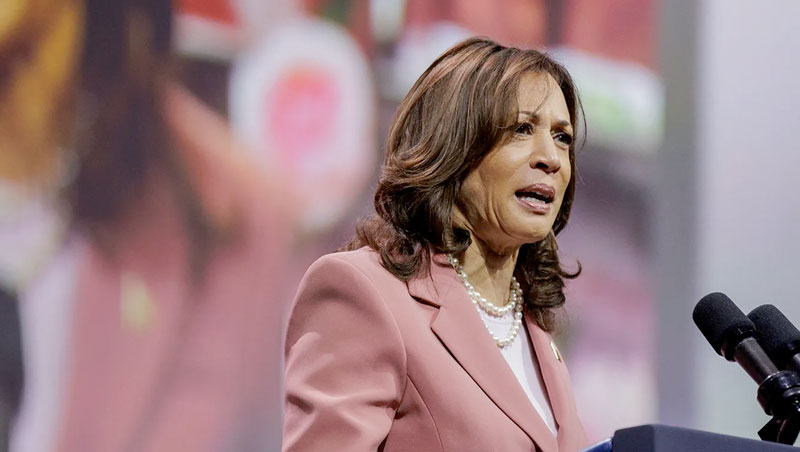
Kamala Harris Wants to “Save Democracy” by Rewriting It

May 16, 2026 By Editor Leave a Comment

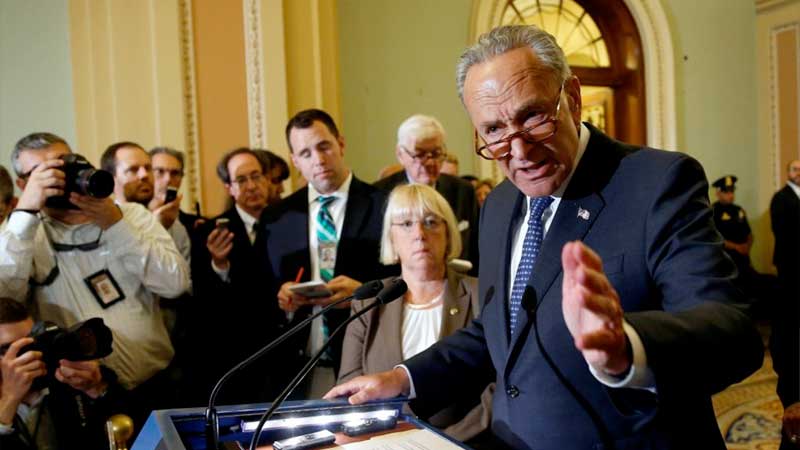
Vice President Kamala Harris and the modern Democratic Party have finally stopped pretending. They have no fealty to the Constitution. It is fine when it serves their purposes. It is an obstacle to be surmounted when it doesn’t. Period.

For years, Americans were told that concerns about court-packing, eliminating the Electoral College, weakening the Senate filibuster, federalizing elections, and restructuring the constitutional system were merely paranoid conservative fantasies. Now, leading Democrats openly discuss them as if they are moral necessities.

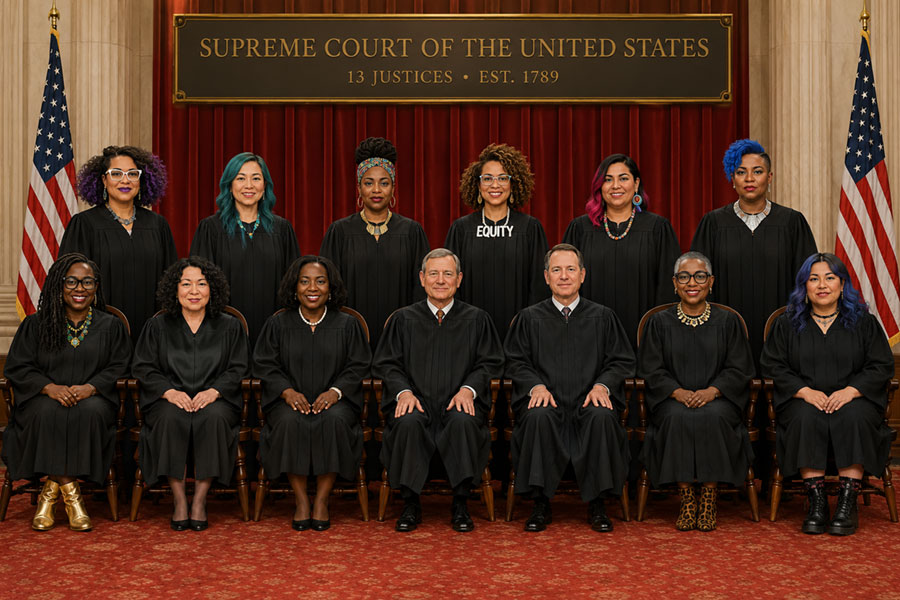
Harris is again signaling support for “fundamentally transforming” the Supreme Court and other core American institutions in ways critics say would permanently tilt the balance of power toward Democrats. Among the proposals being discussed by the Left are expanding the Supreme Court, diminishing the Electoral College, and altering the constitutional structure that has restrained pure majoritarian rule since the founding of the Republic.

This is a fair example of what we can expect if democrats make good on their threats.

Naturally, all of this is being done in the name of “protecting democracy.” That phrase should now trigger immediate skepticism in every American mind. Because when modern progressives say “democracy,” they increasingly mean a system in which their side permanently governs and constitutional barriers preventing that outcome are dismantled one by one.

The Supreme Court is not malfunctioning because Democrats suddenly discovered constitutional principle. It is malfunctioning, in their view, because they do not currently control it.

The Electoral College is not suddenly illegitimate because it violates the Constitution. It is illegitimate, they argue, because it prevents California and New York from effectively choosing every president forever.

The Senate filibuster was not an assault on democracy when Democrats used it repeatedly. It became an assault on democracy the moment Republicans started winning elections and confirming judges.

This is not reform. It is escalation.

And if the Left truly believes court-packing is such a wonderful idea, perhaps Republicans should grant their wish immediately. Seriously.

Let Republicans expand the Court by four seats tomorrow morning. Let a Republican president fill every one of them with originalist constitutional scholars under the exact same “democracy-saving” logic Democrats have been promoting for years.

Something remarkable would happen almost instantly: Democrats would suddenly rediscover the sacred importance of constitutional norms, institutional stability, judicial independence, and the dangers of authoritarian overreach.

Funny how that works.

The truth is that most Americans instinctively understand why court-packing is dangerous. Once one side expands the Court for political advantage, the other side retaliates. Then the next administration expands it again. Eventually the Supreme Court becomes little more than a fluctuating super-legislature whose size changes every election cycle.

At that point, the Constitution no longer restrains power. Power simply rewrites the rules whenever it can.

The Founders designed the American system specifically to prevent this kind of raw factional domination. The Electoral College, equal Senate representation, judicial independence, and separated powers were not historical accidents. They were deliberate safeguards against exactly the kind of centralized political monopoly many modern activists now openly desire.

Alexander Hamilton warned about it. James Madison warned about it. And history repeatedly confirms it.

Nations rarely lose their republics in one dramatic moment. More often, political factions slowly convince the public that long-standing constitutional restraints are “outdated,” “undemocratic,” or obstacles to “progress.” Once those restraints are weakened, power consolidates quickly.

That is why critics are calling Harris’s proposals “institutional arson.”

Because the issue is not whether Republicans or Democrats temporarily benefit. The issue is whether America remains a constitutional republic governed by durable rules that apply to everyone equally, or whether it becomes a system where whichever party gains temporary power simply restructures institutions until opposition becomes nearly impossible.

Ironically, many of the same people warning that Donald Trump represents a “threat to democracy” are simultaneously advocating structural changes that would permanently weaken political opposition and centralize ideological control.

Americans should notice the contradiction.

If Democrats truly believe court-packing, Electoral College abolition, and institutional restructuring are legitimate tools of governance, they should have no objection whatsoever if Republicans use those same tools first.

But somehow, everyone already knows how that conversation would go. And that tells you everything you need to know.

Filed Under: Featured, Bias, Crime, Elections, Entitlement, Ethics, Gender

California Democrat Mayor Pleads Guilty in Explosive Chinese Foreign Agent Case

May 11, 2026 By Editor Leave a Comment

One of the most disturbing stories of foreign infiltration in American politics just exploded into public view — and the corporate media will likely do everything possible to bury it.

Eileen Wang, the Democrat mayor of Arcadia, California, has agreed to plead guilty to acting as an illegal foreign agent for the Chinese Communist Party, according to the U.S. Department of Justice.

Let that sink in.

A sitting American mayor — an elected official entrusted with public authority inside the United States — admitted to secretly advancing the interests of a hostile foreign government tied directly to the Chinese Communist Party.

According to federal prosecutors, Wang and her former fiancé, Yaoning “Mike” Sun, operated a Chinese-language media platform that published propaganda approved and directed by officials connected to the People’s Republic of China. Prosecutors say the operation promoted CCP narratives inside the United States while concealing the foreign relationship from the American public.

The case is not some vague accusation from political opponents. It is a federal criminal prosecution backed by a plea agreement.

The Justice Department states that Wang has agreed to plead guilty to acting as an illegal foreign agent — a felony carrying a potential prison sentence of up to ten years.

Even more alarming is the broader context surrounding the case.

Her former campaign adviser and fiancé, Yaoning “Mike” Sun, was already sentenced to federal prison after admitting he operated on behalf of the Chinese government while helping cultivate political influence in California. Prosecutors described efforts to promote pro-Beijing propaganda and assist politicians viewed as favorable to CCP interests.

This is exactly the kind of foreign infiltration Americans were warned about for years — and routinely told not to worry about.

For decades, establishment politicians and media commentators dismissed concerns about CCP influence as paranoia or “xenophobia.” Americans who warned about Chinese political operations were mocked as conspiracy theorists.

Now a California Democrat mayor is pleading guilty in federal court.

The pattern is becoming impossible to ignore.

From the Eric Swalwell controversy involving a Chinese intelligence-linked operative, to the longtime questions surrounding Chinese influence networks in California politics, to New York officials accused of improper foreign relationships, Americans are watching a deeply troubling trend emerge: powerful Democratic political circles repeatedly appearing vulnerable to CCP cultivation and influence operations.

And the danger goes far beyond one local politician.

The CCP does not think in election cycles. It thinks in decades.

China’s strategy has long focused on quietly building influence inside universities, media organizations, corporations, local governments, and political networks across the West. The goal is not necessarily dramatic espionage. Often it is subtler: shaping narratives, cultivating sympathetic officials, discouraging criticism of Beijing, and slowly normalizing pro-CCP positions inside American institutions.

That is what makes the Arcadia case so significant. This was not a spy thriller involving stolen missile secrets. It was influence warfare. And influence warfare may be the CCP’s most successful weapon against the United States.

Americans should ask themselves a very uncomfortable question: If federal prosecutors had uncovered a Republican mayor secretly coordinating propaganda activities with Russian government officials, would the media treat this as a local curiosity — or as the scandal of the decade?

Because when the foreign influence operation involves Communist China and Democratic political networks, the national media suddenly becomes remarkably restrained.

But ordinary Americans are noticing. And they are increasingly realizing that the greatest threats to American sovereignty may not always arrive with tanks or missiles.

Sometimes they arrive through political relationships, media influence, and elected officials who quietly begin serving interests that are not America’s own.

Filed Under: Featured, Crime, Elections, Ethics, Foreign, Gender

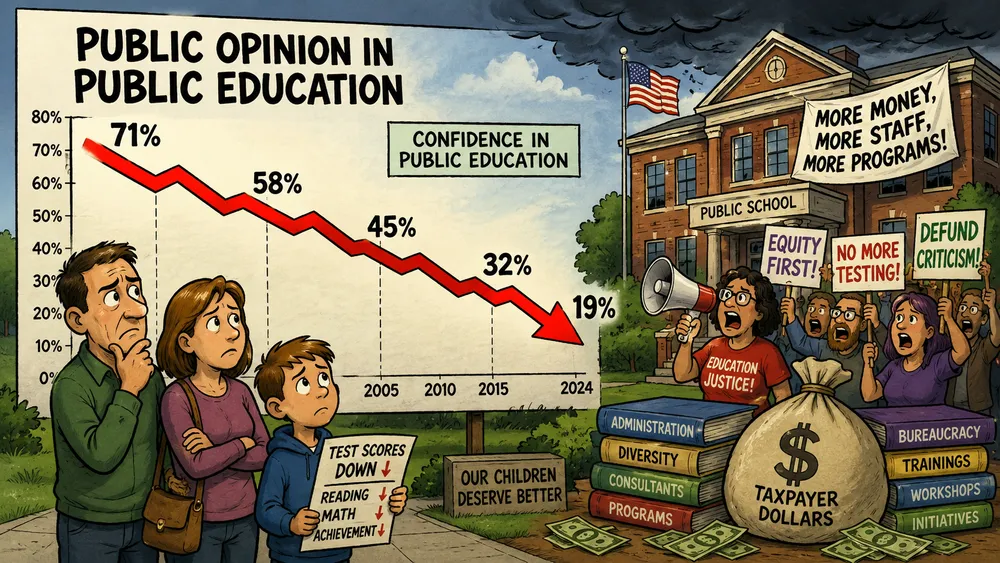
School Choice Is Winning — And the Education Establishment Knows It

April 30, 2026 By Editor Leave a Comment

For decades, American families were told they had no real say in their children’s education. They were told to just leave everything to the ‘experts.’

You went to the school assigned to you. You accepted whatever curriculum was offered. You trusted a system that, in many parts of the country, has produced steeply declining performance, frustrated parents, and myriad students left behind.

That model is now being challenged—and the reaction from the education establishment has been swift, loud, and deeply revealing.

Because in states like Arizona, the rules have changed.

A System Finally Forced to Compete

Arizona, for example, has emerged as a national leader in school choice, implementing programs that allow education funding to follow the student instead of being locked into a specific school or district.

Families now have real options:

  • Public schools
  • Charter schools
  • Private institutions
  • Homeschooling programs

Each child carries with them a portion of education funding, and that money goes wherever the family decides. That simple shift has introduced something that has long been absent in public education: Competition and Accountability.

Public schools are no longer guaranteed funding simply because they exist. They have to earn it. They have to compete for available dollars. They have to do do better than the competition to receive the funding.

And that changes everything.

Why Parents Are Embracing It

The appeal of school choice is not theoretical. It is practical, immediate, and deeply personal.

Parents are choosing schools based on:

  • Academic performance
  • Safety
  • Discipline
  • Values
  • Individual student needs

For families who have felt trapped in underperforming districts, the ability to leave is more than a policy change—it is a lifeline. And once families experience that freedom, they rarely want to go back.

The Resistance: A System That Doesn’t Want to Change

Despite growing support, school choice faces fierce opposition from entrenched interests that have long shaped American education. Critics of CHOICE argue that these programs threaten public schools, divert funding, and create uneven outcomes.

But behind those arguments is a deeper reality: School choice disrupts a system that has operated for decades with limited competition and guaranteed funding.

When funding follows students, institutions that once operated without pressure or accountability are suddenly forced to respond—to parents, to outcomes, and to alternatives.

That is not a small shift. It is a fundamental one.

The Performance Problem No One Can Ignore

Across the country, there are school systems, particularly in large urban areas, that have struggled for years with:

  • Low proficiency rates
  • Graduation gaps
  • Safety concerns
  • Declining public confidence

These issues did not appear overnight, and they have not been resolved by maintaining the status quo. They developed over decades as teachers’ unions fought for more money for less work, and the right essentially replace students’ parents in matters of values. They have foisted woke, Marxist, and anti-religious curricula on students, and parents who showed up at the principal’s office or school board meetings were often placed on FBI terror watch lists.

School choice does not claim to solve every problem. But it does introduce a mechanism that public systems have lacked: The ability for families to leave.

And when families can leave, systems must adapt, or risk losing relevance, and funding.

The Accountability Divide

One of the sharpest lines in the debate is over accountability. Supporters of school choice argue that:

  • Parents are the ultimate accountability mechanism
  • Schools that fail to meet expectations lose students

Critics counter that:

  • Public funds require consistent oversight
  • Not all alternatives are held to the same standards

Both arguments carry weight. But the current system raises its own question: What accountability exists when families have no realistic alternative?

A Shift in Power

At its core, school choice is about more than education policy. It is about power. For generations, decisions about education have largely been made at the institutional level, by districts, boards, and administrators.

School choice shifts that power outward to families. And that redistribution is at the heart of the conflict. Because when parents gain control over where funding goes, long-standing structures are forced to compete, adapt, and justify their performance in ways they never had to before. Public schools struggle fiercely to remain relevant in the face of competition. The socialist malaise of the public education system has rendered public schools and teachers undesirable, and in many case, abhorrent.

The Stakes Going Forward

The expansion of school choice is not slowing down. More states are exploring similar models, and more families are demanding options. The topic has become political in that democrats fight against choice, be the power that is being redirected to parents is essentially that curated by the Left over the decades.

Now, the debate is no longer about whether school choice exists. It does. And it is thriving, as are the students who are attending the best schools at no cost to them.

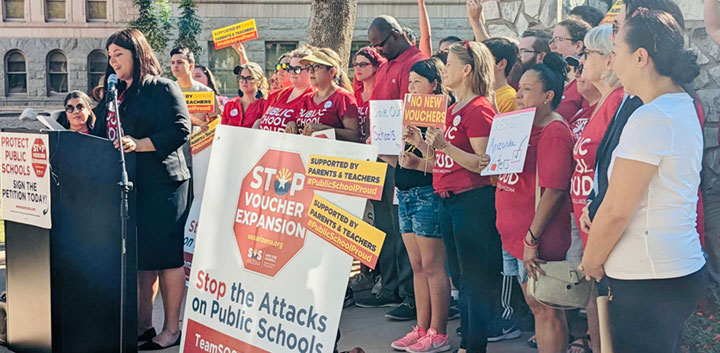
Public schools and teachers’ unions fight against school choice in Arizona.

It is really about how far it will go, and how the existing system will respond. So, will public schools evolve and compete? Will policymakers refine these programs to address legitimate concerns?
Or will the divide deepen as quality of choice spreads, and the stagnant decline of public schools digs in?

The Bottom Line

School choice is not a fringe idea anymore. It is a centrist, growing movement that is forcing a national conversation about how education works, and who it is meant to serve. Families, or teachers’ unions?

For supporters, it represents long-overdue accountability and freedom. For critics, it raises serious concerns about equity, funding, and oversight.

But one thing is certain: The days of a one-size-fits-all education system are coming to an end.

And the fight over what replaces it is only just beginning.

Filed Under: Featured, Bias, Entitlement, Gender, Religion

The Faces of Domestic Terrorism: A Wave of Self-Radicalized Islamist Attacks in America

March 13, 2026 By Editor Leave a Comment

By James Thompson

In the wake of U.S. military strikes against Iran, a series of violent incidents across the United States has raised renewed concerns among many security analysts about the resurgence of self-radicalized Islamist terrorism.

Within a matter of days, multiple attacks and attempted attacks unfolded in different parts of the country: a synagogue assault in Michigan, a deadly shooting at a military training program in Virginia, an Islamist motivated attack in Texas, and an attempted bombing in New York City involving homemade explosives.

At first glance the incidents appear unrelated. They occurred in different states, involved different suspects, and targeted different victims. Yet investigators say a closer look reveals a disturbing common thread: several of the suspects appear to have embraced jihadist ideology and were inspired by propaganda associated with the Islamic State and similar extremist movements.

The pattern reflects a phenomenon that counterterrorism experts have warned about for years—the rise of self-activated Islamist extremists who act independently, but draw ideological inspiration from global jihadist movements.

The most alarming recent plot unfolded in New York City.

On March 7, two young men—18-year-old Emir Balat and 19-year-old Ibrahim Kayumi—were arrested after allegedly throwing improvised explosive devices into a crowd near Gracie Mansion, the official residence of the city’s mayor. Authorities say the devices were real bombs packed with volatile explosive material and metal fragments capable of causing serious injury or death to large crowds of. bystanders.

The attack occurred during a protest outside the mayor’s residence. According to federal investigators, the two suspects had constructed multiple improvised explosive devices and transported them across state lines before throwing them toward the crowd.

Emir Balat and Ibrahim Kayumi were seen throwing improvised explosive devices into a crowd near Gracie Mansion.

Fortunately, the bombs failed to detonate fully, and no one was killed.

The criminal complaint alleges that the two men had consumed ISIS propaganda online and openly expressed admiration for the terrorist organization. Investigators say one of the suspects stated he hoped to carry out an attack “bigger” than the Boston Marathon bombing.

Authorities believe the pair were not formally directed by ISIS leadership, but had been self-radicalized through online extremist content, a pathway that has become increasingly common in recent years.

While the New York plot was foiled, violence elsewhere in the country proved deadly.

In Virginia, a gunman opened fire inside a Reserve Officers’ Training Corps classroom at Old Dominion University, killing a retired military instructor and injuring two others. Investigators quickly discovered that the suspect had previously been convicted for supporting ISIS and had spent time in federal prison.

The choice of target, an American military training program, appeared deliberate. According to investigators, the attack was framed by the suspect as retaliation against the United States and its military actions overseas.

Mohamed Jalloh carried out a shooting at Old Dominion University on Thursday that killed 1 person and injured 2 others. The shooter is dead, officials said.

For counterterrorism officials, the symbolism is unmistakable: a jihadist sympathizer targeting representatives of the U.S. armed forces.

Another attack occurred in West Bloomfield Township, Michigan, where a man drove a truck into a synagogue complex that included a preschool and community center. More than one hundred children were inside the building at the time.

Armed security personnel prevented the attacker from entering the facility, stopping what authorities believe could have been a catastrophic mass-casualty attack.

Ayman Mohamad Ghazali, a 41-year-old Lebanon-born naturalized U.S. citizen, has been identified by the Department of Homeland Security as the suspect behind the attack on Temple Israel synagogue in West Bloomfield, Michigan

Investigators later revealed that the suspect had expressed anger about Israeli and American actions in Iran and the region. Authorities believe the synagogue was deliberately chosen as an antisemitic target of the terrorists rage.

Meanwhile, authorities in Texas are still investigating a mass shooting that witnesses say involved extremist Islamic ideology.

Texas gunman Ndiaga Diagne, a Senegalese immigrant-turned US citizen was wearing a sweatshirt that said ‘Property of Allah,’ and a shirt with an Iranian flag design.

Taken together, the incidents illustrate the continuing evolution of jihadist terrorism inside Western countries.

Unlike the large, centrally planned attacks associated with al-Qaeda in the early 2000s, today’s extremist violence is often decentralized. Groups like ISIS have spent years cultivating sympathizers and extremist reactionaries around the world to act independently, using whatever weapons are available, and targeting civilians, government facilities, or military personnel.

This strategy requires no direct command structure. Instead, individuals radicalized online interpret global events—wars, military strikes, or political conflicts—as personal calls to action.

Security analysts say moments of geopolitical tension can act as powerful catalysts for this process.

The recent escalation involving Iran has dominated global media and online discourse. Extremist propaganda channels have already begun portraying the conflict as evidence of a broader war between Islam and the West, a narrative designed to provoke retaliation by Islamist sympathizers abroad. For individuals already consuming radical content, that messaging can serve as a trigger.

At the same time, investigators caution against assuming that the recent attacks were coordinated or directed by a single organization. There is currently no evidence that the suspects communicated with one another or operated as part of a structured network. Instead, the emerging picture appears to be one of parallel radicalization.

This decentralized threat presents a major challenge for law enforcement. Traditional intelligence methods are designed to detect organized conspiracies, not individuals who radicalize quietly online and act alone.

For that reason, officials say the greatest danger may come not from large terrorist networks but from isolated individuals who decide, sometimes suddenly, to turn mistaken ideology into violence.

As investigators continue to examine the recent incidents, security agencies across the nation have quietly increased protection around synagogues, government buildings, military facilities, and public events.

This has become quite difficult in the wake of Democratic Party efforts to leave the American people vulnerable to such attacks by defunding the Department of Homeland Security at such a critical time.

Whether the recent attacks represent the beginning of a broader wave, or merely a troubling cluster of isolated incidents, remains uncertain. What is becoming increasingly clear is that global conflicts can have immediate domestic consequences.

In an era of instant communication and online radicalization, the ideological battlefields of the Middle East no longer remain confined overseas. Now, their echoes are heard in American cities.

The government must shift its strategies to combat this development in its effort to protect American citizens from the violence that accompanies Islamist propaganda.


James Thompson is an author and ghostwriter, and a political analyst.


Sponsored by BasicInfo123 — simple bite-sized guides for life, money, civics, and more—because some stuff school just didn’t cover.

Filed Under: Bias, Crime, Elections, Entitlement, Ethics, Foreign, Gender, Religion

YOU’RE FIRED! It’s Time to Pull the Plug and Drain the Swamp

October 3, 2025 By Editor Leave a Comment

By James Thompson.

Washington, D.C. has long been home to a bloated and entrenched bureaucracy, dominated by career Democrats who have turned federal agencies into their own political strongholds. For decades, the Democratic Party has enjoyed near-total loyalty from the vast majority of federal employees, with their paychecks consistently recycled back into Democrat campaign coffers. Polling has shown that very few Republicans are employed in the federal government, cementing the perception that Washington’s bureaucracy is not neutral, but rather an arm of the Democrat machine.

This is the “swamp” that President Donald Trump warned the American people about when he first ran for the White House. And he was right. The swamp has spent decades growing unchecked, protecting its own interests, and working against the very principles of accountability and limited government that our republic was founded upon.

Now, with President Trump back in office and the Democrats once again showing their true colors by shutting down the government—refusing to pass the continuing resolution despite it being forwarded more than a dozen times—the opportunity is clearer than ever. The Democrats’ reckless obstruction proves that their priorities are not with the American people, but with defending their entrenched power in Washington.

For President Trump, this shutdown is not a crisis—it is an opportunity. A chance to finally deliver on his signature promise to drain the swamp.

Unlike past presidents, Trump has the political courage and public mandate to take bold action. He now has both the justification and the authority to slash the size of government, shut down unnecessary agencies, and cut loose the hundreds of thousands of federal employees who are not only failing to pull their weight but who actively work against the values of freedom, limited government, and constitutional integrity.

Massive cuts to the federal bureaucracy would not only restore balance and accountability, but they would also break the stranglehold that one political party has on Washington’s administrative state. Why should hardworking American taxpayers continue funding federal employees who openly funnel money, power, and influence to the Democratic Party—employees who serve the Party’s agenda rather than the people’s?

For decades, the swamp has been a hidden fourth branch of government—unelected, unaccountable, and overwhelmingly partisan. It is a system that has been weaponized against conservatives, against reform, and against the will of the voters. President Trump has this once-in-a-generation opportunity to put an end to this corruption.

Now is the time for President Trump to pull the plug to drain the swamp. By making swift and massive cuts to the federal workforce, he can finally dismantle the Democrat machine that has strangled Washington for decades. Doing so will not only fulfill his campaign promise, but will also restore the government to what it was always meant to be: a servant of the people, not a master.

If President Trump acts decisively now, while the government is shut down and he alone wields the power to ax the federal agencies and workforce, history will remember him as the man who broke the back of the bureaucratic elite and restored power to the American people.

DRAIN THE SWAMP!


James Thompson is an author and ghostwriter, and a political analyst.


Sponsored by BasicInfo123 — simple bite-sized guides for life, money, civics, and more—because some stuff school just didn’t cover.

Filed Under: Economy, Elections, Entitlement, Ethics, Gender

The Assassination of Charlie Kirk: How Leftist Propaganda Fueled a Tragic Attack on a Centrist Voice

September 13, 2025 By Editor Leave a Comment

By James Thompson

The shocking assassination of civil rights leader Charlie Kirk by a young man radicalized by online Antifa rhetoric has reignited national debate about the power of incendiary political propaganda. For years, Kirk was smeared by elements of the far-left as a “fascist” or “white supremacist”—labels that bore no resemblance to his real philosophy, which was firmly rooted in traditional, centrist American values.

These misrepresentations were not harmless exaggerations. They were dangerous falsehoods designed to vilify mainstream conservatism, strip it of legitimacy and humanity, and justify violence against its proponents. See our article of April 22, 2025: Perhaps Biden was Right: Domestic Terrorism is the Greatest Threat. The tragedy of Kirk’s murder illustrates the deadly consequences of such rhetoric, which transforms political opponents into enemies to be destroyed rather than fellow citizens to be debated.

A Champion of Civil Debate and Free Speech

Charlie Kirk, founder of Turning Point USA, spent much of his short career on college campuses across America. With his “Change My Mind” and “Prove Me Wrong” tours, he invited young people to challenge him openly on issues ranging from economics to morality. His aim was never to silence others but to encourage robust dialogue—a hallmark of democratic society and a direct inheritance of the constitutional republic America was founded upon.

Far from being a “fascist,” Kirk’s public work was the opposite: he celebrated free speech, personal liberty, and the power of persuasion. The eagerness with which he welcomed opposition demonstrated not a hunger for domination, but a deep belief that truth and common sense could withstand scrutiny.

Core Philosophies Rooted in American Tradition

Though vilified by his opponents, Kirk consistently championed positions that align not with extremism, but with the longstanding mainstream beliefs of the American people. Among them:

  1. Free Speech for All – Advocacy against censorship and “cancel culture.”
  2. Religious Liberty – Defense of the right to live according to Judeo-Christian moral convictions.
  3. Constitutional Government – Emphasis on checks and balances, limited government, and federalism.
  4. Individual Responsibility – Belief that citizens thrive when accountable for their choices.
  5. Equal Opportunity – Opposition to racial quotas and identity politics in favor of merit-based advancement.
  6. Rule of Law – Support for strong but fair law enforcement and judicial integrity.
  7. Second Amendment Rights – Defense of lawful gun ownership as a safeguard of liberty.
  8. Economic Freedom – Promotion of free markets, entrepreneurship, and opportunity.
  9. Fiscal Responsibility – Opposition to reckless federal spending and unsustainable debt.
  10. Strong Families – Recognition of the family unit as foundational to a healthy society.
  11. Educational Choice – Support for school choice and parental rights in education.
  12. National Sovereignty – Belief in secure borders and fair, orderly immigration.
  13. Care for the Vulnerable – Advocacy for policies protecting the unborn, the elderly, and the disabled.
  14. Patriotism – Promotion of national pride and civic responsibility.
  15. International Prudence – Advocacy of strong defense while opposing reckless foreign entanglements.

Each of these positions sits comfortably within the center of American political tradition, reflecting beliefs held by a broad swath of average citizens across all generations. None are extremist; all flow from the founding principles of liberty, justice, and ordered self-government. See our recent articles: The Rise of 80-20 Issues: How One-Sided Politics is Reshaping America’s Future; Dems Oppose Americans on Every Issue.

The Lies That Fueled Violence

Despite these centrist convictions, Kirk was relentlessly branded a “fascist” by leftist activists. In truth, fascism is defined by authoritarianism, suppression of dissent, and subordination of individual liberty to the state—values directly opposed to Kirk’s. The smear was not an accident. It was a tactic, designed to portray ordinary conservative Americans as dangerous enemies.

By equating constitutional centrism with extremism, the radical Left justified its own growing radicalism. The tragic result was a young man radicalized into believing that silencing Charlie Kirk with violence was somehow righteous.

The 80/20 America: Most Agree With Kirk’s Positions

Kirk’s centrist philosophy was not fringe—it reflected what poll after poll shows are the views of the overwhelming majority of Americans. On issue after issue, about 80 percent of the country agrees with the positions he championed, while only 20 percent embrace the radical alternatives. Examples include:

  • Free Speech: Roughly 80% of Americans believe political correctness has gone too far and that open debate is essential to democracy.
  • School Choice: A large majority supports giving parents the right to choose their children’s schools, including charter and private options.
  • Border Security: About three-quarters of Americans believe the southern border must be secured and immigration laws enforced.
  • Religious Freedom: Most Americans agree people should not be forced to abandon their faith convictions in the public square.
  • Police and Law Enforcement: Around 80% reject “defund the police” rhetoric, supporting law enforcement while calling for fairness and accountability.
  • National Pride: Polling shows most Americans are proud of their country and want history taught honestly, without erasing its achievements.
  • Fiscal Responsibility: Americans overwhelmingly believe Washington spends too much and risks saddling future generations with unsustainable debt.

These are not “extremist” views—they are the mainstream. The radicals who sought to demonize Kirk were attacking not just him, but the broad consensus of the American people.

Charlie Kirk pictured with his wife and children

A Warning for America

The assassination of Charlie Kirk is not just the loss of one man; it is a warning for the nation. When political disagreement is replaced with slander and demonization, society begins a descent into tribalism and violence—even Civil War. The campaign to portray Kirk—and by extension, many millions of traditional conservatives—as “fascists” has now borne its poisonous fruit. Every Leftist with “fascist” and “Hitler” on their lips has hands dripping with the blood of Charlie Kirk.

If America is to remain free, which has been in question recently, citizens must reject the lies that pit neighbor against neighbor. We must restore the principle that disagreement does not make one an enemy, and that violence is never an acceptable substitute for persuasion. Violence begets violence, and a downward spiral quickly ensues into civil war—something this republic barely survived not so long ago.

Charlie Kirk’s life’s work was to prove that truth can stand on its own, that free people debating in good faith can arrive at better understanding. To honor his legacy, Americans must recommit to civil discourse, resist the radical fringe, and defend the traditional centrist values that have held the Republic together since its founding.


James Thompson is an author and ghostwriter, and a political analyst.


Sponsored by BasicInfo123 — simple bite-sized guides for life, money, civics, and more—because some stuff school just didn’t cover.

Filed Under: Bias, Crime, Ethics, Gender, Religion

Charlie Kirk Killed at event at Utah Valley University

September 10, 2025 By Editor Leave a Comment

Lethal shots fired at a Charlie Kirk event at Utah Valley University, Orem, Utah. Kirk was shot in throat.

President Donald Trump confirmed Kirk’s death in a post on Truth Social.

“The Great, and even Legendary, Charlie Kirk, is dead. No one understood or had the Heart of the Youth in the United States of America better than Charlie. He was loved and admired by ALL, especially me, and now, he is no longer with us,” Trump wrote. “Melania and my Sympathies go out to his beautiful wife Erika, and family. Charlie, we love you!”

Conservative speaker and host assassinated by a gunman at an event at Utah Valley University, in Orem, Utah.

Police are investigating now, and the shooting suspect is NOT in custody.

The campus is on lockdown.

President Trump wrote on social media: “We must all pray for Charlie Kirk, who has been shot. A great guy from top to bottom. GOD BLESS HIM!”

In a statement on X, Vice President J.D. Vance wrote: “Say a prayer for Charlie Kirk, a genuinely good guy and a young father.”

Kirk is in critical condition at a hospital after being shot Wednesday at a Utah event, a law enforcement official told The Associated Press.

Video posted from the event appeared to show Kirk being shot as he spoke to the crowd from under a white pop-up tent. After the shot, the crowd dispersed, with onlookers shouting “Run, run, run!”

See video>

Charlie Kirk has just been shot! WTH!

I have had my beef with @charliekirk11 and have my concerns with TPUSA but I would never wish this on him.

We are at war people.

Pray for him! pic.twitter.com/jpMSR6SXpU

— Morgan Ariel (@itsmorganariel) September 10, 2025


A suspect is in custody, according to a UVU alert sent to students. The campus has been evacuated.

“A single shot was fired on campus toward a visiting speaker. Police are investigating now, suspect in custody,” an alert from UVU said.

https://www.tiktok.com/@cooperutah/video/7548536180225084727

An older man was arrested and taken into police custody. His name was not immediately released. It appears that he is not the shooter.

FBI and ATF agents are on the scene, according to Attorney General Pam Bondi.

President Donald Trump posted on social media: “We must all pray for Charlie Kirk, who has been shot. A great guy from top to bottom. GOD BLESS HIM!” 

FBI Director Kash Patel said the agency “stands in full support of the ongoing response and investigation.”

Utah Sen. Mike Lee said he is “tracking the situation at Utah Valley University closely.”

“Please join me in praying for Charlie Kirk and the students gathered there,” he said on social media.

Kirk had been scheduled to appear at Utah Valley University on Wednesday as part of his American Comeback Tour, with another stop at Utah State University later this month. His appearances have drawn protests and petitions from student groups critical of his views.

In a since-deleted post on Kirk’s social media just hours before the attack, the conservative firebrand wrote: “WE. ARE. SO. BACK. Utah Valley University is FIRED UP and READY for the first stop back on the American Comeback Tour.”

The Fall 2025 leg of the tour began at the Orem, Utah university and is “a nationwide campus tour aimed at equipping students with the tools to push back against leftwing indoctrination in academia and reclaim their right to free speech.” 

Filed Under: Bias, Crime, Elections, Ethics, Gender, Religion

Trump’s Big Beautiful Bill Passes Congress in Landmark Victory

July 3, 2025 By Editor Leave a Comment

In a stunning and historic move, Congress has just passed President Donald J. Trump’s long-awaited Big Beautiful Bill, delivering a major legislative win for his administration and a decisive step toward fulfilling key promises of his second term. The bill, touted by President Trump as “the most beautiful piece of legislation our nation has ever seen,” passed both chambers after weeks of intense debate and negotiation.

What’s in the Bill?

The Big Beautiful Bill is sweeping in scope. Among its most significant provisions:

  • Border Security and Immigration Reform: The bill allocates record funding for the completion of the southern border wall, bolsters border patrol forces, and implements stricter measures to prevent illegal immigration while streamlining legal immigration for merit-based applicants.
  • Tax Relief: It introduces further tax cuts aimed at middle-class families and small businesses, building on the success of the 2017 Tax Cuts and Jobs Act.
  • Energy Independence: The bill rolls back excessive regulations on domestic energy production, supporting American oil, gas, and coal industries while expanding incentives for clean nuclear and next-generation technologies.
  • Restoration of Law and Order: It provides significant funding for law enforcement and first responders, with provisions aimed at reducing violent crime in major cities.

A Hard-Fought Victory

Passage of the bill was far from certain. Democrats mounted fierce opposition, criticizing the bill as being too focused on Trump’s campaign priorities. Yet in the end, a coalition of Republicans and moderate Democrats, responding to public pressure for action on border security, inflation relief, and national security, propelled the bill across the finish line.

Speaker of the House, who had initially wavered, ultimately praised the final product: “This is a bill that puts Americans first. It strengthens our economy, secures our borders, and supports our communities.”

Senate Majority Leader echoed the sentiment: “We’ve delivered on what the American people asked for: safety, prosperity, and common-sense governance.”

Trump’s Reaction

President Trump, speaking from the White House Rose Garden moments after the vote, hailed the legislation as “a win for all Americans” and “proof that when we put America First, nothing can stop us.”

He added: “This Big Beautiful Bill is going to make our country stronger, safer, richer, and greater than ever before. I want to thank Congress for working together, despite differences, to do what’s right for our people.”

The Road Ahead

The Big Beautiful Bill now heads to President Trump’s desk, where he is expected to sign it into law within days. Implementation will begin immediately, with federal agencies already preparing to roll out new programs and allocate funding according to the bill’s provisions.

Critics, including progressive lawmakers and left-wing media outlets, have vowed legal challenges to portions of the bill, particularly those related to immigration enforcement and energy policy. However, the Trump administration appears confident that the law will withstand scrutiny.

For now, the passage of the Big Beautiful Bill marks a pivotal moment in the Trump presidency—one that supporters are calling a defining achievement and a major step in delivering on the promises that brought him to the White House once again.

James Thompson is an author and ghostwriter, and a political analyst.

Filed Under: Economy, Elections, Entitlement, Ethics, Foreign, Gender

Dems Oppose Americans on Every Issue

April 18, 2025 By Editor Leave a Comment

Out of Step: How the Democratic Party always chooses what hurts Americans

By James Thompson | April 18, 2025

In today’s hyper-partisan political climate, Americans of all stripes are seeking leaders who stand for common-sense values, personal freedom, and public safety. Yet again and again, the Democratic Party finds itself not just outside the mainstream, but in open opposition to it. On issue after issue, from border security to gender ideology, Democrats continue to champion extreme or minority viewpoints that alienate the average American.

What issues? Below are twenty-one areas where Democratic policies consistently conflict with the will of the people.

1. Transgender Athletes in Women’s Sports
While the majority of Americans believe biological males should not compete in women’s sports, the Democratic Party insists on pushing for full inclusion regardless of fairness or safety concerns. Even as female athletes speak out, they are dismissed or silenced by party leaders who equate disagreement with discrimination.

2. Drag Performances in Schools
Events featuring drag performers reading to children in schools and libraries have drawn nationwide backlash, yet Democratic politicians double down in support. Parents who voice concern are labeled intolerant, even as they advocate for age-appropriate environments.

3. School Choice
Despite overwhelming support across racial and socioeconomic lines for school choice and charter programs, Democrats have opposed these initiatives, often bowing to pressure from powerful teachers’ unions that fear losing influence over the public education system.

4. Gun Rights
While gun control remains a Democratic priority, most Americans continue to support the constitutional right to bear arms for self-defense and enforcement of constitutional rights. Instead of addressing crime at its roots, Democrats target law-abiding gun owners with restrictions that have little effect on actual violence. In fact, most gun violence is committed by those who support the Democratic Party–so perhaps the best answer is to limit their access to weapons.

5. Border Security
Vast swaths of the country support strong border enforcement. But Democrats have pushed back against nearly every effort to secure our borders—from opposing the border wall to undercutting ICE and defunding enforcement programs. They clearly want illegal aliens to flood our nation, most likely because a permanent underclass tends to keep their policies alive.

6. Sanctuary Cities
Democratic-run cities have declared themselves “sanctuaries” for illegal immigrants, openly flouting federal law. These policies have been directly linked to increased crime, yet the party continues to protect even criminal non-citizens from deportation.

7. Welfare for Illegal Immigrants
At a time when many American citizens struggle to access housing and healthcare, Democrats fight to expand welfare, education, and even housing benefits for those in the country illegally.

8. Voter ID Laws
Over 75% of Americans support requiring photo ID to vote. Democrats oppose such laws, claiming voter suppression, yet they cannot explain why something required for everyday life—banking, flying, buying alcohol—should be off-limits at the ballot box. They clearly believe that illegal votes are keeping them in office, and fight vigorously to keep them voting.

9. Radical Education Curricula
From critical race theory to gender ideology, Democratic-backed curricula have left many parents shocked at what their children are being taught by public schools. Rather than engaging parents, Democrats brand them as domestic threats, sicking the FBI on them as terrorists, when they push back.

10. Anti-Israel Sentiment
Support for Israel used to be bipartisan, but Democratic voices have grown increasingly critical—even sympathetic to terror groups like Hamas. While Israel defends its citizens, Democrats focus on condemning its military responses to attacks across its border. Large liberal universities are no longer subtle in their support of terror groups, and allow their Jewish students to be threatened and attacked daily

11. Defunding the Police
Major Democratic cities embraced defund-the-police rhetoric, only to experience spikes in violent crime. Despite public backlash, party activists and politicians continue to call for police abolition.

12. Abortion Funding
Even Americans who support abortion rights usually oppose using taxpayer dollars to fund it–especially late-term abortion. Democrats have pushed to remove long-standing restrictions like the Hyde Amendment, placing the burden on all taxpayers to fund abortions.

13. Court Packing
Rather than respecting the judiciary’s independence, Democrats propose expanding the Supreme Court when rulings don’t go their way—a move that most Americans view as a blatant power grab.

14. Anti-Free Speech Legislation
Democrats increasingly advocate for laws that criminalize what they term “hate speech,” raising alarms about First Amendment violations. Americans overwhelmingly value free speech, even when it’s offensive. This movement is nothing more than an attempt to silence any opinions that oppose Democrats’ neo-Marxist views and positions.

15. Transgender Policies in Schools
Mandating gender-neutral bathrooms, pronoun use, and juvenile transitions without parental consent has become a cornerstone of Democratic policy in schools—deeply concerning to parents whose rights are being stripped by the party at every turn.

16. Soft-on-Crime Policies
From eliminating cash bail to downgrading felonies, Democrats have supported criminal justice reforms that result in dangerous offenders being released back onto the streets, sometimes multiple times a week.

17. Immigration Enforcement
Democrats have fought to limit deportations and dismantle immigration enforcement, portraying even criminal deportees as ‘victims.’ This has led to numerous tragedies that could have been prevented through lawful enforcement. Yet, the party speaks out only for illegals, including criminals, gang members, and assassins, remaining silent about their victims.

18. Favoring Illegal Criminals Over Victims
Too often, Democrats appear more concerned with the treatment of illegal aliens who commit crimes than with the justice owed to their victims. Families devastated by crimes committed by illegal immigrants are left with no answers while Democratic politicians grandstand on protecting offenders.

19. Economic Nationalism
Democrats have uniformly rejected tariffs and other economic policies that aim to strengthen American industry, after they facilitated the death of American industry. Their policies left the U.S. overly dependent on foreign manufacturing, including steel, pharmaceutical, rare earth metals, and microcircuits, and vulnerable to global instability.

20. Attacks on Parental Rights
From education to healthcare, Democrats increasingly push policies that erode the role of parents in making decisions for their children, replacing them with state or bureaucratic oversight. Their ‘Great Society’ policies of the 1960s destroyed the American black family, and now they are trying to use the same tactics to destroy all traditional families ala Marxist techniques.

21. Rejection of Moderation
Polling shows even Democratic voters wish their party would adopt more moderate stances on these unpopular, and anti-American policies. Yet the leadership seems intent on appeasing radical activists rather than governing from the center.

Americans want safe neighborhoods, a good economy, fair elections, strong borders, and the freedom to raise their families according to their traditional American values. The Democratic Party, once the self-proclaimed voice of working-class Americans, has been exposed as the party of fringe ideologies, bureaucratic overreach, and misplaced priorities. Until the party realigns with the mainstream, it will continue to lose the trust of those it claims to represent.


James Thompson is an author and ghostwriter, and a political analyst.

Filed Under: Bias, Crime, Economy, Elections, Entitlement, Ethics, Gender, Religion

The Rise of 80-20 Issues: How One-Sided Politics is Reshaping America’s Future

April 14, 2025 By Editor Leave a Comment

By James Thompson

In today’s hyper-polarized political landscape, the divide between parties isn’t just a matter of opinion—it’s often a matter of math. Increasingly, a number of political issues have become what analysts call “80-20 issues,” meaning approximately 80% of the public, or one party, supports a position while the other party opposes or only weakly supports it. These disparities are not only deepening the divide between left and right—they’re reshaping the political map and defining a new battleground of ideas, accountability, and truth.

These issues often have overwhelming public support or clear practical benefits, yet face resistance largely rooted in ideology, special interests, or identity politics. The result is a political gridlock in which one side is perceived as fighting for common sense reform, while the other is seen as obstructing progress—even when doing so goes against the will of their own constituents.

The 80-20 Issues: A Brief Overview

While the full list evolves with current events, here is a summary of approximately 20 major 80-20 issues that reflect the growing one-sidedness in American politics:

  1. Border security and enforcement – Supported by a wide swath of Americans, yet increasingly blocked by Democratic leadership. Trump shut down the border to illegal crossings, and Biden opened it widely, allowing tens of millions of unvetted, military aged men to enter. He claimed it would require an act of congress to close it. Now Trump has closed the border. Democrats have flooded the courts to keep brutal gang enforcers on our streets.
  2. Parental rights in education – Parents want a say in their children’s curricula, but progressive policies often aim to minimize parental input.
  3. School choice – Strong bipartisan support nationally, but consistently opposed by teachers’ unions and their Democratic allies.
  4. Government waste and fraud reform (DOGE) – Broadly favored by Americans, yet Democrats have fought transparency and trimming of bureaucracy.
  5. Voter ID laws – Supported by around 75-80% of Americans, but still mischaracterized by many on the left as discriminatory.
  6. Energy independence – A majority favor policies that promote U.S. oil and gas alongside renewables, while progressive Democrats push for abrupt transitions.
  7. Police funding and public safety – Most Americans want effective, well-funded police forces. “Defund the police” rhetoric persists on the left.
  8. Free speech on college campuses – Conservatives and moderates favor open dialogue, while left-wing administrators often suppress dissenting views.
  9. Biological gender recognition in sports – Common-sense legislation on gender divisions in athletics is supported by majorities, yet dismissed as “anti-trans” by leftist activists.
  10. Term limits for Congress – Supported overwhelmingly by Americans, yet opposed by career politicians, especially those entrenched in Democratic power.
  11. Criminal justice for violent offenders – The public demands tougher sentencing for repeat violent criminals, while many progressive DAs release them to our streets with minimal consequences.
  12. Opposition to child gender transition surgeries – Widely seen as harmful by the public, but aggressively supported by the radical left.
  13. Protection of religious freedoms – Often trampled in favor of progressive causes. Christians are violently endangered by leftist groups, and the trend is global.
  14. Election integrity – From ballot chain-of-custody to mail-in vote security, the public supports safeguards; most Democrats oppose these measures, claiming minorities aren’t bright enough to comply with voting requirements.
  15. Transparency in public schools – Parents want to know what’s being taught, but teachers’ unions and Democratic boards frequently resist disclosure.
  16. Opposition to ESG mandates – Most Americans are wary of politicizing investments, while Democrats push ESG as a corporate and social standard.
  17. Gun rights for law-abiding citizens – While supporting background checks, the public largely supports the right to bear arms, while Democrat politicians oppose the constitutional right, and Democratic states increasingly pass restrictive laws.
  18. Merit-based college admissions – Supported by a majority of Americans, yet affirmative action and equity quotas persist in left-leaning institutions.
  19. Balanced federal budget – A growing national concern, but federal Democrats continue pushing massive spending bills with no offset.
  20. Free speech online and elsewhere – Many fear government collusion with social media companies to suppress dissenting voices—an effort exposed in the Twitter Files, with most censorship aligning with Democratic interests.

Fringe Support and Controversial Alignments

While these core issues dominate headlines, fringe developments further expose the Democratic Party’s vulnerability to radical influences. Take for example:

  • The Mangione Assassination: Some Democratic circles have shown sympathy for David Mangione, the man who murdered a private sector CEO over corporate policies—a shocking alignment with vigilante justice under the guise of activism. Approximately half of the Democratic party says violence, and even assassination, is a valid form of political activity.
  • Support for Hamas: Factions within the Democratic Party, particularly in activist and academic spheres, have expressed explicit support for Hamas—a U.S.-designated terrorist organization. OUr universities have become petri dishes for anti-Israel and Jewish hatred. This stance alienates the broader American public and Jewish community and contradicts U.S. foreign policy and humanitarian values.
  • Opposition to Cleaning Up Government Waste: Perhaps most baffling is the resistance from Democratic lawmakers and party members to anti-corruption initiatives, such as the Department of Government Efficiency (DOGE). Measures that root out fraud, waste, corruption and abuse—often bipartisan goals—have been dismissed as partisan attacks simply because they originated under Trump-era initiatives or figures like Elon Musk.

The Consequences

These issues create a political dynamic in which one party claims the mantle of reason, reform, and accountability—while the other increasingly appears captured by special interests, radical ideology, or a desire to oppose for opposition’s sake.

This 80-20 split isn’t just a political talking point; it’s a warning sign. When one party begins to routinely resist overwhelmingly supported policies, the result is disillusionment, voter apathy, and the rise of independent or populist alternatives. We are seeing it in daily polling, moving further toward traditional, conservative values–especially among young men, and anyone who hasn’t been indoctrinated by the university experience

Whether America can recalibrate remains to be seen. But one thing is clear: the 80-20 issues aren’t going away. In fact, they may be the key fault lines that determine the nation’s future political alignment—and its willingness to restore common sense in the halls of power. For those on the Left who are wondering why their power and influence have eroded so quickly–this is it.

James Thompson is an author and ghostwriter, and a political analyst.

Filed Under: Economy, Elections, Entitlement, Ethics, Gender, Religion

Trump Saves TikTok Day Before He’s Sworn In

January 19, 2025 By Editor Leave a Comment

ART OF THE DEAL – TikTok begins restoring service after Trump vows Day 1 executive order / makes pro-America promise

TikTok CEO thanks Trump for ‘commitment’ to keeping app available as ban looms

TikTok said it was in the process of restoring operations in the U.S. Sunday, after President-elect Trump promised to issue an executive order to extend TikTok operations on Inauguration Day. 

Some U.S. users reported being able to regain access to the app following Saturday’s blackout. 

Trump wrote on TRUTH Social that he is “asking companies not to let TikTok stay dark!” 

“I will issue an executive order on Monday to extend the period of time before the law’s prohibitions take effect, so that we can make a deal to protect our national security,” the president-elect continued. “The order will also confirm that there will be no liability for any company that helped keep TikTok from going dark before my order.”

“Americans deserve to see our exciting Inauguration on Monday, as well as other events and conversations,” Trump said.

Trump is expected to be sworn in around noon ET Monday at the U.S. Capitol, officially taking office as the 47th president. 

His Sunday post did not clarify how soon the extension would take effect or specify how long it would last. 

As for the proposed national security deal, Trump said he would like “the United States to have a 50% ownership position in a joint venture.” 

“By doing this, we save TikTok, keep it in good hands and allow it to [stay] up. Without U.S. approval, there is no TikTok. With our approval, it is worth hundreds of billions of dollars – maybe trillions,” Trump wrote. “Therefore, my initial thought is a joint venture between the current owners and/or new owners whereby the U.S. gets a 50% ownership in a joint venture set up between the U.S. and whichever purchase we so choose.” 

TikTok’s account on X dedicated to releasing policy updates posted a statement later Sunday saying: “In agreement with our service providers, TikTok is in the process of restoring service.” 

“We thank President Trump for providing the necessary clarity and assurance to our service providers that they will face no penalties providing TikTok to over 170 million Americans and allowing over 7 million small businesses to thrive,” the statement said. “It’s a strong stand for the First Amendment and against arbitrary censorship. We will work with President Trump on a long-term solution that keeps TikTok in the United States.” 

Apple and Google’s app stores no longer had the TikTok app available as of 10:50 p.m. EST Saturday. President Biden signed a bipartisan law last spring mandating that TikTok’s China-based parent company, ByteDance, sell the platform by Sunday or else the platform would be banned in the United States.

The following pop-up message appeared for users who tried to access the TikTok app earlier Sunday: “Sorry, TikTok isn’t available right now. A law banning TikTok has been enacted in the U.S. Unfortunately, that means you can’t use TikTok for now.” 

“We are fortunate that President Trump has indicated that he will work with us on a solution to reinstate TikTok once he takes office. Please stay tuned!” the message added. 

Earlier Sunday, Trump issued a two-word message on TRUTH Social: “SAVE TIKTOK!”

Instead of utilizing the nine-month grace period to sell TikTok to an approved buyer, ByteDance, as well as TikTok, sued. 

The law was upheld Friday by the U.S. Supreme Court, which pointed to national security risks due to the app’s connection to China. 

Trump previously indicated that he must “review” the ban before choosing a course of action and that he’d “most likely” grant TikTok a 90-day extension from the Jan. 19 deadline. 

Under the law, the sitting president can extend the deadline by 90 days if a sale is in progress. ByteDance has previously rebuffed the idea of selling TikTok. 

In a video posted on Friday, TikTok CEO Shou Zi Chew praised Trump for his “commitment to work with us to find a solution that keeps TikTok available in the United States. This is a strong stand for the First Amendment and against arbitrary censorship.”

Alexandra Koch, Bradford Betz, Landon Mion and Brie Stimson contributed to this report.

Filed Under: All Stories, Economy, Elections, Entitlement, Ethics, Foreign, Gender, Religion, Sci-Tech

Meta Fact-checkers May Close Doors

January 16, 2025 By Editor Leave a Comment

Fact-checkers said Meta’s decision will have significant impact on their business operations

Mark Zuckerberg reveals pressure brought by Biden Administration to curtail free speech, and that “fact-checking” led to false narratives prevailing

In a move that will help restore free speech to social media, a network of fact-checkers is set to lose a major source of revenue and may even close shop after Facebook parent company Meta announced it would terminate their contracts and move towards a system closer to X’s Community Notes.

“We don’t have much time left. At this rate, we are done in a few months,” claims Check Your Fact managing editor, Jesse Stiller.

“We were blindsided by this. This was totally unexpected and out of left field for us. We weren’t aware this decision was being considered until Mark dropped the video overnight. We have no idea what the future looks like for the website going forward,” he added.

On January 7, 2025, Meta revealed that it would end its fact-checking program and lift some content moderation policies to “restore free expression” across its platforms, including Facebook and Instagram.

Prior to the announcement, Meta repeatedly stressed they were committed to supporting a long-term independent fact-checking industry to address “misinformation” online.

In an April 2022 blog post, Meta claimed it had built the “largest global fact-checking network of any platform” and contributed more than $100 million to fact-checking programs since 2016.

Meta did not reply when asked how much money it had given to third-party fact-checkers before announcing the end of the program in early January 2025.

According to the company’s website, Meta began prioritizing “additional support and resources” for fact-checkers in early 2020 to combat health “misinformation.”

As part of this initiative, Meta launched a $1 million emergency grant program in partnership with the International Fact-Checking Network (IFCN) to tackle information about the COVID-19 pandemic

IFCN created the CoronaVirusFacts Alliance, in which nearly 100 fact-checking organizations in more than 70 countries produced over 11,000 fact-checks about COVID-19 across 40 languages. Seven fact-checking organization projects specifically focused on vaccine “misinformation.”

In August, Zuckerberg admitted that the Biden White House had pressured Meta to censor some health information during the pandemic.

Zuckerberg told podcast host Joe Rogan in January that members of the Biden administration would “scream” and “curse” at his employees, demanding they take down information, especially during the rollout of the COVID-19 vaccine program.

Meta later gave the IFCN a $1 million “Climate Misinformation Grant.” The grant, in part, provided funding to organizations working to combat “climate misinformation” and supported collaborative partnerships between fact-checkers and “climate experts.”

The company also provided funding for fact-checkers to “increase their capacity to promote reliable information” ahead of the 2022 elections in various countries, including the U.S., Australia, France and India.

In the United States, Meta worked with the following third-party fact-checkers: AFP – Hub, Check Your Fact, Factcheck.org, Lead Stories, PolitiFact, Science Feedback, Reuters Fact Check, TelevisaUnivision, The Dispatch and USA Today.

All 10 of these partners are expected to lose their funding. It is unclear when or if Meta’s changes will affect overseas fact-checkers.

In a recent interview with Fox News Digital, Meta’s chief global affairs officer, Joel Kaplan, claimed that these fact-checkers failed to remain neutral.

“We went to independent, third-party fact-checkers,” Kaplan said. “It has become clear there is too much political bias in what they choose to fact-check because, basically, they get to fact-check whatever they see on the platform.”

Since the pivot away from third-party fact-checking, several of these fact-checking organizations with financial ties to the tech conglomerate have issued statements critical of Zuckerberg and Meta’s claims of political bias.

Previously, these groups were often paid for each published fact-check using Meta’s platforms and tools.

For example, PolitiFact, according to its financial disclosures, earned over five percent of its 2024 revenue from the partnership.

PolitiFact said that the organization, one of the original participants in Meta’s third-party fact-checking program, will be affected by the company’s decision to discontinue it.

They also pointed Fox News Digital to comments made by PolitiFact parent Poynter Institute President Neil Brown, who called Meta’s decision a “disappointing cop-out” that “perpetuates a misunderstanding of its own program.”

“Facts are not censorship. Fact-checkers never censored anything. And Meta always held the cards. It’s time to quit invoking inflammatory and false language in describing the role of journalists and fact-checking,” Brown said.

Lead Stories, a Facebook fact-checker employing several former CNN alumni, told The New York Times that it is now doing a large chunk of its work for TikTok’s parent company, Bytedance. Meta was previously the fact-checker’s primary client.

The company was shocked by Zuckerberg’s announcement, considering Lead Stories signed a new yearlong contract with Meta just three weeks ago. Lead Stories admitted that it would see a drop in revenue after severing ties with Meta—a reality that will result in a “staffing reduction,” according to co-founder Alan Duke.

“Cutting fact-checkers from social platforms is like disbanding your fire department,” he told CNN in early January.

In a statement to Fox News Digital, Kristin Roberts, the chief content officer of Gannet Media (USA Today’s parent company), said, “Fact-based journalism is what USA Today does best.”

“We are the nation’s trusted news source because we provide unbiased and essential content for all people. Truth and facts serve everyone — not the right or the left — and that’s what we will continue to deliver,” she continued.

The company did not provide information on its financial relationship with Meta.

TelevisaUnivision, Lead Stories, Factcheck.org, AFP – Hub, The Dispatch and Science Feedback did not return Fox News Digital’s request for comment.

Reuters declined to comment.

By Nikolas Lanum, Fox News

Filed Under: All Stories, Economy, Elections, Entitlement, Ethics, Foreign, Gender, Religion, Sci-Tech

Pam Bondi Appears Before Senate Committee for Attorney General Confirmation

January 15, 2025 By Editor Leave a Comment

In a highly anticipated hearing, former Florida Attorney General Pam Bondi, President Trump’s nominee for U.S. Attorney General, appeared before the Senate Judiciary Committee this week, seeking confirmation for her new role. Bondi, a staunch conservative known for her vigorous advocacy on issues such as consumer protection and public safety, addressed the committee with clarity and conviction, emphasizing her commitment to uphold the rule of law and protect the rights of American citizens.

Bondi’s stellar track record as Florida’s Attorney General showcased her dedication to fighting against human trafficking, opioid addiction, and fraud. She articulated her vision for a nation where law enforcement is supported and empowered, promising to lead the Department of Justice with integrity and a focus on restoring public trust in the legal system. Committee members noted her extensive experience and her ability to navigate complex legal matters, which they believe will serve her well in this new capacity.

Throughout her testimony, Bondi faced some tough questions from committee members, particularly regarding her stance on controversial issues such as immigration enforcement and criminal justice reform. However, her responses reflected a balanced approach rooted in conservative principles, emphasizing the importance of maintaining law and order while also considering the underlying social issues that contribute to crime.

Supporters of Bondi have rallied behind her nomination, highlighting her unwavering commitment to conservative values and her proven leadership skills. As the Senate prepares to vote on her confirmation, many believe that Bondi’s appointment would mark a significant step toward a more robust and principled Department of Justice, one that prioritizes the safety and security of American families.

The confirmation process will closely be watched, as Bondi’s appointment could signal a shift towards a more aggressive stance on crime and a renewed focus on protecting the rights of victims.

Legal Career

Pam Bondi’s legal career has equipped her with a wealth of experience and a robust skill set that are critical for her role as Attorney General. Serving as Florida’s Attorney General from 2011 to 2019, Bondi handled a wide range of legal issues, including consumer protection, public safety, and criminal justice. Her tenure was marked by significant initiatives against human trafficking and the opioid crisis, demonstrating her ability to tackle pressing societal issues head-on.

Bondi’s experience in the courtroom, both as a prosecutor and in civil litigation, has honed her legal acumen and understanding of the judicial system. This background allows her to navigate complex legal frameworks and advocate effectively for the law. Additionally, her leadership in high-profile cases has provided her with the skills necessary to manage large teams and coordinate across various governmental agencies.

Moreover, Bondi’s strong communication skills and ability to engage with the public have been vital in building trust and transparency within her office. Her commitment to educating citizens about their rights and promoting community safety further illustrates her readiness to lead the Department of Justice.

Overall, Bondi’s extensive legal background, combined with her passion for public service, positions her as a capable candidate for the role of Attorney General, ready to address the challenges facing the nation.

New Challenges

As Pam Bondi steps into her role as U.S. Attorney General, she is likely to encounter several significant challenges. One primary challenge will be navigating the complex political landscape, particularly in a divided Congress. She will need to build bipartisan support for her initiatives while remaining true to her conservative principles, which can be a delicate balancing act.

Another significant challenge will be addressing the ongoing issues of crime and public safety, especially in light of rising concerns over violent crime and drug-related offenses. Bondi must develop effective strategies that not only enforce the law but also foster community trust and cooperation, which is essential for successful law enforcement.

Additionally, Bondi will face scrutiny over her policies concerning immigration and criminal justice reform. Critics may challenge her approaches, demanding transparency and accountability, which could lead to contentious debates. Ensuring that her policies are both effective and fair while managing public expectations will be crucial.

Lastly, the ongoing opioid crisis and its ramifications will require her immediate attention. She will need to implement comprehensive solutions that involve collaboration with states and local authorities, balancing enforcement with treatment and prevention efforts.

Overall, while Bondi’s experience positions her well for the role, these challenges will require her to navigate a complex and often contentious environment.

Watch the full confirmation hearing:

Filed Under: All Stories, Economy, Elections, Entitlement, Ethics, Foreign, Gender, Religion, Sci-Tech

Next Page »

Federalist Press Dispatch

Get breaking political news, investigations, and uncensored analysis delivered directly to your inbox.

Please wait...

Thank you for subscribing to the Federalist Press Dispatch.

Get free info to help your life

Get free info to help your life

Simple bite-sized guides for life, money, civics, and more . . . because some stuff school just didn’t cover.

Brit Axton Mysteries Series

Brit Axton Mysteries Series

Brit Axton Mysteries is a series of young adult adventure novels that lead young Brit Axton and her friends on whirlwind adventures to uncover hidden secrets and long lost treasures.

Byrna Non-lethal Self Protection

Byrna Non-lethal Self Protection

Byrna offers non-lethal self protection at an affordable price. Watch the short video, or click to learn more!

Understanding Cryptocurrency: Essentials for Building Wealth in Digital Currency

Understanding Cryptocurrency: Essentials for Building Wealth in Digital Currency

Understanding Cryptocurrency serves as a definitive guide for novice investors looking to understand the world of cryptocurrency and harness its potential for financial growth and prosperity.

Real Estate Wealth Strategies During High Inflation

Real Estate Wealth Strategies During High Inflation

Real Estate Wealth Strategies During High Inflation is a comprehensive guide on navigating the real estate market, offering strategies and insights for successful investing, during high inflation and interest rates.

Follow us

  • parler
  • welcome-widgets-menus
  • facebook
  • envato

Privacy Policy

Terms of Service

Economy

When Bill Maher Starts Worrying About Socialism, Democrats Should Pay Attention

Democratic Socialists and Democrats: Is there any Difference?

Stop Financing Degrees That Cannot Repay Their Loans

Elections

The Politics of Envy: Why “Tax the Rich” Is an Economic Dead End

When Bill Maher Starts Worrying About Socialism, Democrats Should Pay Attention

Democratic Socialists and Democrats: Is there any Difference?

Foreign

May Day in America: A Radical Marxist Tradition Reemerges

Negotiations Slow, Tensions Rising: Where U.S.–Iran Talks Stand

Did AOC Really Say Republicans Want to “Rig Elections” by Allowing Only U.S. Citizens to Vote?

Crime

When Bill Maher Starts Worrying About Socialism, Democrats Should Pay Attention

Democratic Socialists and Democrats: Is there any Difference?

Envy Is the Fuel of Socialism

Science Tech

Peace Through Strength: Trump Forces Iran into Submission

The Climate Scare Revisited: What Happened to the Predictions?

Trump’s Third UFO File Dump Raises the Stakes Again

Reader Responses

  • Linda Livaudais on Trump’s UFO Disclosure Has Changed the Conversation — But Not Yet Answered the Biggest Question
  • T059736 on Trump and Musk Announce Plans to Shut Down USAID
  • C.Josef.D on ‘Pay to Play’ at Clinton Foundation Under Investigation
  • John D Cole on Biden Says ‘You ain’t black’ If You Don’t Vote for Him
  • Ed on U.S. Attorney Huber Moving to Indict Clintons and Others

Copyright © 2026 by Federalist Press · All rights reserved · Website design by RoadRunner CRM · Content Wiriting by GhostWriter · Log in