• Home
  • Mission
  • Federalist Papers
  • Foundation
  • U.S. Constitution
  • Bill of Rights

Federalist Press | Defending Liberty — Informing America

Breaking News and Political Commentary

  • All Stories
  • Economy
  • Elections
  • Entitlement
  • Ethics
  • Foreign
  • Gender
  • Religion
  • Sci-Tech

Stephen Colbert’s Final Curtain: When Late Night Became Political Therapy Instead of Comedy

May 21, 2026 By Editor Leave a Comment

Tonight marks the end of an era.

After years behind CBS’s iconic desk, Stephen Colbert’s final televised broadcast closes a chapter not merely for one host, but for an entire late-night television model that increasingly drifted from broad comedy into ideological performance.

CBS’s decision was widely reported as financial, not merely political. Industry estimates have placed The Late Show with Stephen Colbert at roughly $100 million per year to produce, with a massive staff reportedly numbering well over 150 and, by some estimates, closer to 200, when writers, producers, technical crews, stage teams, support staff, and network overhead are included. As traditional late-night advertising revenue (a fraction of production costs) and linear-TV audiences have steadily declined, critics argue the economics of maintaining such a sprawling legacy production became increasingly difficult to justify, especially when the broader late-night model no longer commands the captive audience it once did. People have switched it off.

But economics is only part of the story. The deeper issue may be cultural narrowing.

There was a time when late-night television belonged to almost everyone. Johnny Carson could be watched by Republicans, Democrats, blue-collar workers, professors, churchgoers, business owners, and people who simply wanted to laugh before bed. David Letterman, Jay Leno, and others built audiences by mocking absurdity, not relentlessly sorting the country into political tribes.

That changed.

Under Stephen Colbert, The Late Show increasingly evolved into something closer to partisan satire and ideological affirmation. To supporters, however small that audience became, it was sharp political comedy. To critics, it became repetitive anti-Trump monologues, applause-line activism, and a show that often seemed more interested in validating a Leftist political worldview than entertaining a broad national audience.

That distinction matters. Comedy survives on surprise. It weakens when it becomes predictably tribal.

Many Americans who once watched late-night comedy simply stopped seeing themselves in it. Not because they rejected humor, but because they increasingly felt they were being lectured rather than entertained. Lectured by a moron.

And Colbert was not alone. Across much of modern late night, the genre became increasingly political, often aligned culturally and rhetorically with Marxist progressive media and urban-left sensibilities. That may energize loyal viewers. But it also shrinks the tent.

Meanwhile, another model emerged.

Fox News’ Gutfeld!, while airing on cable and not directly identical to network late night, built a large audience by mixing satire, irreverence, cultural commentary, and anti-establishment humor. It has frequently outperformed traditional late-night competitors in total viewers and became one of the clearest signs that audiences still want comedy—just not necessarily ideological conformity dressed up as comedy.

May 21 is Stephen Colbert’s night, and his fellow late-night hosts are ceding the stage to him. Per Variety, Jimmy Fallon is joining Jimmy Kimmel in taking the night of May 21 off in honor of Colbert’s final Late Show, upholding the Strike Force Five solidarity between both hosts, along with Seth Meyers and John Oliver, whose time slots don’t compete with Colbert.

Now, as Colbert exits, the late-night fraternity has rallied around him, with some arguing politics or pressure played a role in his cancellation.

Perhaps. Probably not.

But what cannot be ignored is that legacy late-night television has been under economic and cultural strain for years. Streaming, podcasts, YouTube, short-form media, Gutfeld, and changing entertainment habits have shattered the monopoly these hosts once held.

The bigger question is whether late night lost its audience not because Americans stopped laughing— but because too many hosts stopped trying to make all Americans laugh.

Stephen Colbert is leaving the desk. But the real story may be larger: Late night did not merely lose relevance. It forgot who it was supposed to serve.

Filed Under: Featured, Bias, Economy, Elections, Entitlement

Fed Appeals Court Judge Stayed Silent for Decades. Now Witnesses Beginning to Talk.

May 20, 2026 By Editor Leave a Comment

For generations, Americans who claimed to witness unexplained aerial craft often learned one lesson quickly: Keep your mouth shut.

Pilots whispered. Police officers quietly told family members. Military personnel shared stories only behind closed doors. Farmers, truck drivers, hunters, business owners, judges, ministers and ordinary citizens often buried extraordinary experiences for one reason above all others: ridicule.

If you spoke openly about seeing something in the sky that appeared beyond known human technology, you risked being labeled unstable, attention-seeking, gullible, or worse.

In some professions, people feared reputational harm. In others, they feared losing credibility, advancement, or employment altogether.

That Iron Curtain of Silence may finally be beginning to crack.

As government transparency around UFOs and UAPs has increased, including President Trump’s declassification efforts, military footage releases, congressional hearings, intelligence briefings, and a dramatic shift in public discussion, more serious witnesses appear increasingly willing to recount experiences they once kept to themselves.

One recent example comes from Wyoming.

Richard Barrett, a retired Cheyenne attorney, recently shared an extraordinary experience he says he and his father witnessed in April 1991 while driving home late at night from Gillette. Cowboy State Daily. His father was not an anonymous bystander. He was James E. Barrett, former Wyoming Attorney General and later a judge on the U.S. Court of Appeals for the 10th Circuit.

Barrett now shares that the two men encountered a massive, silent, illuminated craft over Wyoming Highway 59 that appeared far beyond anything they could explain. For years, they stayed quiet.

Why? Because serious people often fear being dismissed as irrational.

That fear was real. But Barrett says the recent government release of UAP-related materials and broader transparency efforts made him feel more comfortable discussing the event publicly after decades of silence.

Richard and James Barrett in 1992. The son and father kept their UFO sighting to themselves for many years. (Courtesy Richard Barrett)

That matters. Not necessarily because one story proves what UFOs are. But because it underscores a larger cultural shift: People who once felt forced into silence now increasingly believe they can speak without immediate mockery.

And that may reveal something important.

Over many years of investigating UFO reports, researchers, journalists, and ordinary citizens have often noticed a common pattern: people frequently admit they know someone they trust — a pilot, veteran, family member, law enforcement officer, neighbor, or friend — who says they witnessed something they could not explain.

Not vague lights. Not distant aircraft. Not obvious weather anomalies. But objects or craft described as silent, accelerating unnaturally, maneuvering sharply, hovering without visible propulsion, or behaving in ways that seemed beyond conventional aviation or human understanding of physics.

Of course, not every story is accurate. Memory can fail. Perception can be flawed. Some sightings later turn out to be military systems, atmospheric effects, drones, balloons, or misidentifications.

But dismissing all witnesses as delusional or unserious has become harder to sustain. Especially when military aviators, radar operators, intelligence personnel, commercial pilots, and highly credible professionals have also stepped forward. Many with video and sensor data evidencing their claims.

For decades, the official culture often leaned toward silence, secrecy, or quiet dismissal. Now transparency, whether driven by presidential pressure, congressional oversight, military acknowledgment, or public demand, is changing that atmosphere.

That is healthy. A free society should not fear testimony.

People should be able to recount what they saw, what they experienced, and what they cannot explain, without automatic ridicule.

That does not mean blind belief. It means open inquiry. Open discussion.

If millions of Americans have witnessed unexplained phenomena, then honest discussion matters. If many stayed silent because of shame, fear, or professional risk, then breaking that silence matters.

And if nearly every family, workplace, church, military unit, or community seems to know someone with an encounter story they never fully told, perhaps the real mystery is not merely what is in the skies. Perhaps it is how many people have been quietly carrying these experiences alone. Shivering in the shadows.

The shadows are lifting. The question now is whether America is finally ready to listen.

Filed Under: Sci-Tech, Featured

Where Are the Handcuffs?

May 20, 2026 By Editor Leave a Comment

Americans are drowning in fraud headlines.

Billions here. Millions there. Phantom clinics. Fake providers. Shell nonprofits. Front companies. Inflated contracts. Dead-end grant money. Pandemic fraud. Medicaid fraud. Unemployment fraud. Public housing abuse. Daycare scandals. Transit boondoggles. Government programs bleeding money with almost no visible accountability.

And yet one question keeps hanging over all of it: Where are the handcuffs?

For years, taxpayers have been told to trust the system — trust the auditors, trust the investigators, trust the inspectors general, trust the agencies, trust the oversight process. But increasingly, the public is watching enormous fraud, waste, and abuse get exposed while very few high-level actors appear to face swift, visible consequences.

DOGE, under Elon Musk’s cost-cutting and oversight mission, helped fuel national scrutiny around federal waste, duplication, improper payments, and bloated systems. That debate reignited a broader question: how much money is being lost not merely to inefficiency, but to outright fraud and abuse? Hundreds of billions . . . at least.
Then came Minnesota.

The sprawling Feeding Our Future fraud case, one of the largest COVID-era fraud schemes in the country, centered on allegations that defendants stole at least $250 million from a federal child nutrition program through fake meal claims, shell entities, and fabricated paperwork, totaling over $10 billion in all. Dozens of people have been charged by the state, and multiple convictions have followed. But what about the others? What about those filmed by reported Nick Shirley? There were obviously hundreds, or thousands, involved in these schemes. Plus the government oversight people who just looked the other way while tax dollars were being drained. That is a felony. Where is the accountability?

California presents another troubling picture.

Investigators and watchdogs have repeatedly uncovered Medi-Cal/Medicaid fraud, hospice fraud, phantom clinics, and organized billing abuse, particularly in sectors where oversight is fragmented and reimbursement pipelines are massive. In some cases, storefront medical operations or loosely monitored service providers have allegedly acted as vehicles for fraudulent billing while vulnerable patients were caught in the middle. These appear to represent many billions in fraud losses.

Meanwhile, the state’s high-speed rail project, once sold as a transformational infrastructure vision, has become a symbol of ballooning cost overruns, delays, contracting questions, and public frustration. Not every over-budget public project is fraud. But when billions disappear into bureaucratic expansion, consultants, redesigns, and shifting deadlines, taxpayers begin asking whether incompetence and lack of accountability can become almost indistinguishable from systemic abuse. Theft. Much of which eventually finds itself in democrat campaign chests.
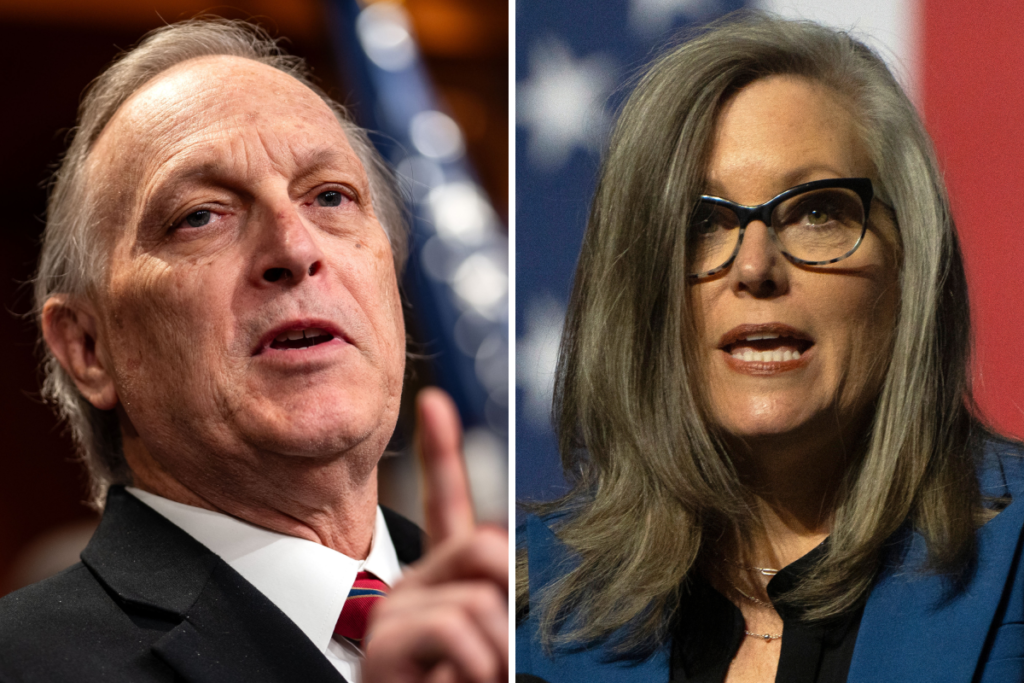
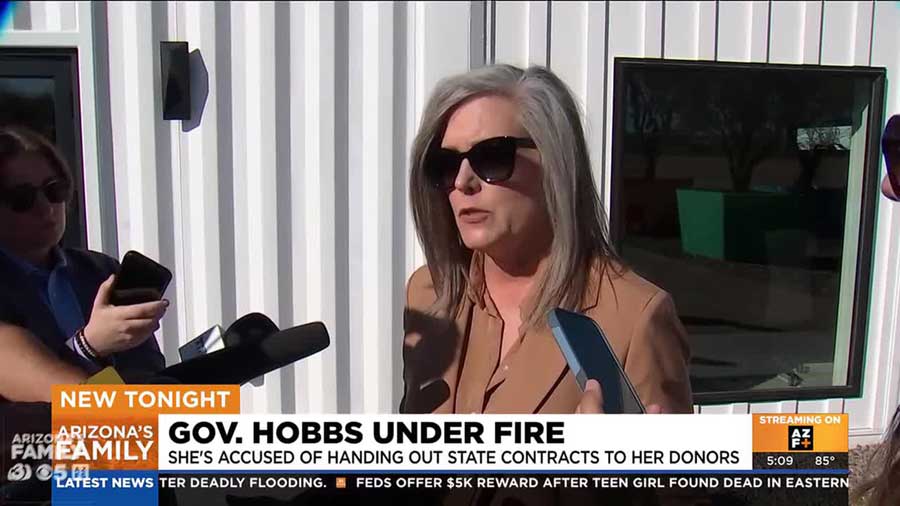
Independent reporting and investigative journalists have also drawn attention to alleged “paper businesses” — daycare facilities, clinics, hospices, nonprofits, and care centers that appeared to function more as billing vehicles than legitimate public-service institutions.

Taken together, they reveal something deeply unsettling: America has become very good at identifying fraud after the fact, and often far less convincing at visibly punishing those responsible.

To be fair, white-collar investigations are slower than street arrests. Fraud cases involve records, subpoenas, forensic accounting, grand juries, plea deals, layered entities, and years of litigation. That is reality.

But public frustration is also reality. When ordinary Americans miss a tax payment, violate a permit, or fall behind on obligations, the system moves swiftly.

When public money vanishes through sprawling networks of democrat shell groups, inflated invoices, fake services, corrupt contracting, or program abuse, accountability often appears slower, quieter, and less visible. A snail’s pace. Where is the justice? That asymmetry is eroding trust.

If America wants citizens to believe the system still works, then accountability cannot remain mostly theoretical. Audits matter. Whistleblowers matter. Investigative journalism matters.

But eventually, prosecutions matter too. We were treated to televised predawn raids on GOP members for contrived ‘crimes’ during the Biden administration. Now that real crimes have been exposed, on a massive scale, where are the raids? The handcuffs? The perp-walks?

When taxpayers repeatedly hear about massive fraud, abuse, and waste, yet rarely see meaningful consequences, they begin asking a simple, dangerous question:

Is government policing corruption… or merely documenting it?

Filed Under: Crime, Elections, Ethics, Featured

Skid Row Vote-Buying Case Exposes How Dems Cheat America’s Election System

May 19, 2026 By Editor Leave a Comment

Brenda Lee Brown Armstrong is not accused of hacking voting machines. She is not accused of stuffing ballot boxes in the dead of night. What federal prosecutors allege is simpler, cruder, and in some ways more alarming: she paid derelict people on Los Angeles’ Skid Row to register to vote and sign ballot petitions. This is a felony.

According to the Department of Justice, Armstrong, 64, of Marina del Rey, also known as “Anika,” worked for years as a paid petition circulator. Prosecutors say she was paid by coordinators for collecting signatures from registered voters on ballot petitions, and that she regularly offered people on Skid Row small payments — usually $2 or $3 — to sign petitions. Starting no later than 2025, the DOJ says, she also began paying some people to complete voter registration forms.

That is not a paperwork mistake. That is a federal election crime. Hundreds, or thousands of federal crimes.

Armstrong has sought a plea deal, and has agreed to plead guilty to one felony count of paying another person to register to vote, a charge carrying up to five years in federal prison.

The most disturbing detail is not merely the cash for signatures and votes. It is the ‘address’ problem. Prosecutors say some homeless individuals did not have an address to place on the forms, and that Armstrong, on hundreds of occasions, provided her own former Los Angeles address. Because California automatically sends vote-by-mail ballots to registered voters, the DOJ warned that ballots in some homeless individuals’ names could potentially be sent to a residence where those individuals did not live or receive mail.

That is the vulnerability. Not every improper registration becomes an illegal vote. Not every suspicious form becomes a counted ballot. Homeless citizens have voting rights, and legitimate outreach to eligible voters is lawful. But paying people to register, supplying questionable addresses, and creating conditions where ballots may be mailed somewhere the voter does not live is exactly the kind of conduct that corrodes public trust in elections . . . for good reason.

The Los Angeles Times reported that federal officials began investigating Armstrong after video circulated by James O’Keefe showing people on Skid Row being paid for signatures. The team captured dozens of violations on camera. First Assistant U.S. Attorney Bill Essayli said, “Once we saw these videos, we went to work.”

This is where the story becomes larger than one woman. California has already seen another recent case in which a Costa Mesa woman pleaded guilty after registering her dog to vote and casting ballots in the dog’s name in prior elections. One ballot was reportedly counted.

Pennsylvania saw another major registration-fraud investigation after officials flagged roughly 2,500 suspicious voter registration applications before the 2024 election. Prosecutors later charged seven people, saying the alleged fraud appeared financially motivated rather than designed to change the election outcome.

Oregon officials also discovered more than 1,700 people had been mistakenly registered without proof of citizenship through DMV errors, with 30 confirmed to have voted, though officials said the cases appeared tied to clerical and system mistakes rather than intentional fraud by the individuals involved.

Georgia also became a flashpoint in the national election-integrity debate after investigators and watchdog groups raised concerns over absentee ballot handling, voter-roll maintenance, and signature-verification procedures following the 2020 election, casting doubt on tens of thousands of ballots in a state that narrowly elected Joe Biden over Donald Trump — just 11,779 votes.

Taken together, these cases do not prove a single nationwide conspiracy. But they do prove something Washington’s election establishment is far too eager to dismiss: the system has weak points, and bad actors can exploit them.

The public is repeatedly told that election fraud is too rare to matter. But that answer misses the point. A republic cannot run on blind trust. It must run on transparent, verifiable, enforceable procedures that make fraud difficult, detection likely, and punishment certain.

If a ballot can be mailed to an address where the voter does not live, that is a problem. If petition circulators are financially rewarded in ways that encourage fake or coerced registrations, that is a problem. If election officials only discover fraud after journalists, whistleblowers, or local clerks raise alarms, that is a problem.

And if officials respond to every concern by accusing citizens of undermining democracy, then they are the ones undermining democracy.

Election integrity is not voter suppression. It is the foundation of consent of the governed.

The Armstrong case should not be buried as a local oddity. It should force every state to examine whether its registration rules, ballot-mailing practices, petition systems, address verification procedures, and voter-roll maintenance are strong enough to withstand abuse.

Because once Americans believe votes can be manufactured, purchased, redirected, or carelessly mailed into the political void, confidence in elections collapses. And when confidence collapses, the legitimacy of government collapses with it.

Filed Under: Featured, Crime, Elections, Ethics

Senate Republicans Go Semi-Nuclear — Again

May 19, 2026 By Editor Leave a Comment

Washington just crossed another procedural Rubicon.

While most headlines focused on the Senate confirming nearly 50 of President Trump’s nominees tied to energy, land management, diplomacy, and executive agencies, the real story was not the nominees themselves.

The real story was how Republicans were able to confirm them.

In one of the most consequential Senate procedural moves in years, Senate Republicans invoked a modified form of the “nuclear option” to weaken the filibuster for large blocs of lower-level executive nominees, allowing confirmations to proceed by simple majority rather than through the Senate’s traditional slow-motion confirmation machinery.

That matters far beyond the fate of a few dozen Trump appointees. It marks yet another step in the decades-long erosion of one of the Senate’s defining characteristics: the minority party’s ability to slow, obstruct, or force compromise through procedural leverage.

The irony, of course, is overwhelming.

For years, Democrats openly threatened to abolish or severely weaken the filibuster whenever it stood in the way of their progressive legislation. Republicans warned such moves would permanently damage Senate norms and unleash escalating retaliation.

Now Republicans themselves are carving out new exceptions to Senate tradition in order to accelerate Trump’s governing agenda. And they are doing it using the exact parliamentary weapon Washington now casually calls the “nuclear option.” Or, at least a watered down version.

The mechanics are arcane but important.

Under traditional Senate procedure, the minority party can effectively delay action by refusing unanimous consent and forcing lengthy procedural votes and debate periods. Breaking that obstruction usually requires 60 votes to invoke cloture and cut off debate.

Before Americans debate yet another erosion of Senate tradition, it is worth remembering that the Senate itself was once fundamentally different. Originally, U.S. senators were chosen by state legislatures under Article I of the Constitution, serving in part as institutional defenders of state sovereignty and as a stabilizing counterweight to the more populist House of Representatives. That changed with the Seventeenth Amendment in 1913, which shifted Senate elections directly to the people. Supporters called it democratic reform; critics argue it transformed the Senate from a reflective body designed to slow sudden political passions and protect federalism into a second popularly elected chamber increasingly responsive to national political movements, donor networks, party machinery, and organized interest groups. In the view of many constitutional traditionalists, the Senate gradually became less of a brake on majoritarian momentum and more of another battlefield where competing factions seek legislative advantage through federal power.

Republicans did not technically eliminate the legislative filibuster this time. Bills still generally require 60 votes to overcome obstruction. But Senate Majority Leader John Thune engineered a precedent change allowing large batches of lower-level executive nominees to move through the chamber under a simple-majority standard rather than the older supermajority framework.

In practical terms, this dramatically speeds up confirmations. Instead of forcing the Senate to grind through nominees one at a time — consuming precious floor time for days or weeks — Republicans can now move blocs of nominees together.

And Democrats are furious. Senate Democrats argue the GOP is destroying institutional guardrails and weakening oversight in order to install Trump loyalists more rapidly throughout the federal government.

Republicans counter that Democrats themselves started this process years ago. They are not wrong.

The modern Senate arms race over the filibuster began in earnest under President Obama. In 2013, then-Senate Majority Leader Harry Reid used the nuclear option to eliminate the 60-vote threshold for most executive branch and lower federal court nominees.

Republicans then expanded the precedent in 2017 to allow Supreme Court nominees to advance by simple majority, clearing the way for Justice Neil Gorsuch. In 2019, Republicans further reduced post-cloture debate time for many nominations.

Now comes the next escalation. Each side insists it is merely responding to abuses committed by the other side first. And in fairness, there is some truth in that claim on both sides.

But the broader institutional trend is unmistakable: The Senate is slowly transforming from a deliberative body built around minority protections into a chamber increasingly governed by raw majoritarian power.

For conservatives, this creates both satisfaction and danger. The satisfaction is obvious. Republican voters elected Trump specifically to reshape the executive branch, dismantle bureaucratic resistance, expand domestic energy production, reverse Biden-era environmental rules, and install officials aligned with his agenda. Delaying confirmations indefinitely through procedural obstruction would effectively nullify election outcomes.

That is the Republican argument. And politically, it is powerful. But there is also danger in normalizing continual rule erosion.

Every time one party weakens Senate procedure to achieve short-term victories, the other party inherits the new precedent later. That is how institutional escalation works in Washington. Temporary tactical advantages eventually become permanent structural changes.

Democrats know this because they started it. Republicans know this because they warned about it.

And yet here we are, again. The most fascinating aspect of the current fight may be the complete inversion of rhetoric. Democrats who once championed weakening the filibuster now defend Senate tradition with almost constitutional reverence.

Republicans who once defended Senate tradition now argue procedural hardball is necessary to overcome obstruction tactics by the Left. Washington’s principles often seem remarkably flexible depending on who controls the majority leader’s office.

Still, Republicans appear to have calculated that the political moment favors action over restraint. And they may be right.

The American public did not elect Donald Trump to watch hundreds of executive branch positions remain vacant while the Senate spends months drowning in obstructionist procedural warfare. Republicans clearly decided voters expect results, not parliamentary nostalgia.

So the Senate has changed again. Not completely. Not yet. But enough to remind Washington of a lesson both parties keep relearning: Once one side uses the nuclear option, the fallout never stays contained for long.

Filed Under: Elections, Ethics, Featured

The Gerrymandering Map Neither Party Wants You to See

May 16, 2026 By Editor Leave a Comment

For years, Americans have been told that gerrymandering is one of the greatest threats to democracy.

But after examining congressional representation state by state against actual presidential voting patterns in the 2024 Trump–Harris election, one uncomfortable reality becomes impossible to ignore:

Both parties benefit from distorted representation.

That may sound obvious. But the modern political narrative rarely admits it. Instead, Americans are usually presented with a cartoonishly simplified version of the issue in which one party is uniquely evil while the other merely seeks “fair maps.”

Reality is more complicated.

Federalist Pres recently compared each state’s congressional delegation against its presidential vote. The logic was intentionally simple and intuitive:

  • If Donald Trump won roughly 60% of a state’s vote, Republicans would be expected to hold roughly 60% of that state’s House seats.
  • If Kamala Harris won roughly 60%, Democrats would be expected to hold roughly 60%.

The interactive map below compares each state’s 2024 Trump–Harris presidential vote share with its current U.S. House delegation. Hover over each state to see whether Republicans or Democrats are overrepresented compared to the statewide vote.

Perfect proportionality is impossible, of course. Geography matters. Urban concentration matters. Small states with one or two House seats naturally produce exaggerated outcomes. But over time, and especially in larger states, representation should at least loosely approximate the electorate.

In many states, it does not. The resulting map was fascinating. And, we note that the most fairly apportioned state is Virginia, which just attempted to make all but one district democrat, blowing through all of the constitutional safeguards to accomplish the task.

As we see, some states strongly overrepresent Republicans compared to statewide voting patterns. Others strongly overrepresent Democrats. And several supposedly “competitive” states are far less balanced than Americans might assume.

The strongest Republican-leaning representation gaps appeared in sparsely populated states like Iowa, Utah, Oklahoma, Arkansas, Nebraska, and Montana, where Republicans hold substantially more congressional power than Trump’s statewide vote percentage alone would predict.

Meanwhile, Democrats enjoy enormous representation advantages in states like Massachusetts, Connecticut, Rhode Island, Hawaii, New Mexico, and Illinois. This is especially true in states with massive populations, like California and New York, where Republican share is merely half of what the presidential outcome would demand. This is an excellent example of why the GOP has recently begun trying to re-balance where it can.

As the map indicates, gerrymandering and structural advantage are not uniquely Republican inventions. They are political tools. Both parties use them whenever possible.

That does not mean the distortions are morally identical or arise from identical causes. In some Democratic states, heavily concentrated urban voting naturally produces overwhelming Democratic delegations. In some Republican states, map drawing and district engineering clearly amplify Republican power. The causes vary.

But the public conversation almost never acknowledges the full picture. Instead, Americans are fed a simplistic morality play by the media in which every Republican district map is sinister “democracy suppression,” while Democratic structural advantages are treated as either accidental or virtuous.

Even more revealing is the selective outrage. When Republican legislatures redraw maps aggressively, national media organizations erupt in fury. When Democratic states produce congressional delegations wildly disconnected from statewide voting balance, the issue often disappears from public conversation entirely.

That inconsistency is precisely why public trust continues collapsing. In the left-leaning media, and in politicians generally.

Most Americans do not expect politics to be perfectly fair. But they do expect honesty, and transparency. And increasingly, they are noticing that the rules seem to change depending on which party benefits, and the angle pitched hardest, or buried entirely, by the media.

The Supreme Court’s recent reluctance to aggressively intervene in partisan gerrymandering cases has only intensified the debate. Critics argue the Court is enabling Republican-controlled legislatures. Supporters counter that courts cannot realistically become permanent national referees for every politically disputed district boundary.

Both arguments contain some truth. However, in recent cases the high courts have ruled consistently against democrat attempts to gerrymander due to their failures to follow the rules. Apportionment is based on federal and state constitutions, and democrats have rushed so quickly to push out republican representation, that they have ignored those laws, resulting in rulings of invalidation.

But perhaps the deeper problem is this: modern Americans increasingly expect election systems to produce outcomes they personally prefer. When they do not, many immediately conclude the system itself is illegitimate. That instinct is dangerous.

The Constitution was never designed to produce mathematically perfect proportional representation. It was designed to balance competing interests, competing regions, competing populations, and competing political factions inside a stable republic. It was created to protect the rights of the minority, as the majority seeks to overwhelm the system with its constant transfer of power and wealth from one group to another. Every time we hear that we should eliminate the electoral college so that the population centered majority may have its way over the minority spread out throughout the nation, for instance, that is exactly what the Constitution was created to prevent. Congressional representation, and its mirrored electoral college, were created to protect those minority rights — to prevent the bare majority (concentrated in urban centers) from pillaging the suburban and rural citizens.

Still, there is a legitimate question lurking underneath the outrage: At what point does aggressive map engineering become so disconnected from voter behavior that representation itself begins losing credibility?

That question should concern everyone — Republicans, Democrats, and Independents alike.

Because once large portions of the public conclude elections are structurally rigged, faith in institutions deteriorates rapidly. And once institutional trust collapses, republics become very difficult to hold together. That is exactly why those who demand a stacking of the Supreme Court should be relegated to the scrapheap of history. They want to transform our representative constitutional republic to a bare-fisted democracy, where the mob rules, and takes what it wants at the expense of the minority.

Ironically, the map we created may accomplish something useful precisely because it does not flatter either side. Republicans can look at it and see states where Democratic power is clearly amplified. Democrats can look at it and see states where Republican power is clearly amplified.

And honest observers can look at it and realize something even more important: The real problem may not simply be gerrymandering itself.

The real problem may be a political culture in which politicians increasingly pursue every possible structural advantage while simultaneously pretending only the other side is doing it.

Filed Under: Bias, Elections, Featured

Kamala Harris Wants to “Save Democracy” by Rewriting It

May 16, 2026 By Editor Leave a Comment

Vice President Kamala Harris and the modern Democratic Party have finally stopped pretending. They have no fealty to the Constitution. It is fine when it serves their purposes. It is an obstacle to be surmounted when it doesn’t. Period.

For years, Americans were told that concerns about court-packing, eliminating the Electoral College, weakening the Senate filibuster, federalizing elections, and restructuring the constitutional system were merely paranoid conservative fantasies. Now, leading Democrats openly discuss them as if they are moral necessities.

Harris is again signaling support for “fundamentally transforming” the Supreme Court and other core American institutions in ways critics say would permanently tilt the balance of power toward Democrats. Among the proposals being discussed by the Left are expanding the Supreme Court, diminishing the Electoral College, and altering the constitutional structure that has restrained pure majoritarian rule since the founding of the Republic.

This is a fair example of what we can expect if democrats make good on their threats.

Naturally, all of this is being done in the name of “protecting democracy.” That phrase should now trigger immediate skepticism in every American mind. Because when modern progressives say “democracy,” they increasingly mean a system in which their side permanently governs and constitutional barriers preventing that outcome are dismantled one by one.

The Supreme Court is not malfunctioning because Democrats suddenly discovered constitutional principle. It is malfunctioning, in their view, because they do not currently control it.

The Electoral College is not suddenly illegitimate because it violates the Constitution. It is illegitimate, they argue, because it prevents California and New York from effectively choosing every president forever.

The Senate filibuster was not an assault on democracy when Democrats used it repeatedly. It became an assault on democracy the moment Republicans started winning elections and confirming judges.

This is not reform. It is escalation.

And if the Left truly believes court-packing is such a wonderful idea, perhaps Republicans should grant their wish immediately. Seriously.

Let Republicans expand the Court by four seats tomorrow morning. Let a Republican president fill every one of them with originalist constitutional scholars under the exact same “democracy-saving” logic Democrats have been promoting for years.

Something remarkable would happen almost instantly: Democrats would suddenly rediscover the sacred importance of constitutional norms, institutional stability, judicial independence, and the dangers of authoritarian overreach.

Funny how that works.

The truth is that most Americans instinctively understand why court-packing is dangerous. Once one side expands the Court for political advantage, the other side retaliates. Then the next administration expands it again. Eventually the Supreme Court becomes little more than a fluctuating super-legislature whose size changes every election cycle.

At that point, the Constitution no longer restrains power. Power simply rewrites the rules whenever it can.

The Founders designed the American system specifically to prevent this kind of raw factional domination. The Electoral College, equal Senate representation, judicial independence, and separated powers were not historical accidents. They were deliberate safeguards against exactly the kind of centralized political monopoly many modern activists now openly desire.

Alexander Hamilton warned about it. James Madison warned about it. And history repeatedly confirms it.

Nations rarely lose their republics in one dramatic moment. More often, political factions slowly convince the public that long-standing constitutional restraints are “outdated,” “undemocratic,” or obstacles to “progress.” Once those restraints are weakened, power consolidates quickly.

That is why critics are calling Harris’s proposals “institutional arson.”

Because the issue is not whether Republicans or Democrats temporarily benefit. The issue is whether America remains a constitutional republic governed by durable rules that apply to everyone equally, or whether it becomes a system where whichever party gains temporary power simply restructures institutions until opposition becomes nearly impossible.

Ironically, many of the same people warning that Donald Trump represents a “threat to democracy” are simultaneously advocating structural changes that would permanently weaken political opposition and centralize ideological control.

Americans should notice the contradiction.

If Democrats truly believe court-packing, Electoral College abolition, and institutional restructuring are legitimate tools of governance, they should have no objection whatsoever if Republicans use those same tools first.

But somehow, everyone already knows how that conversation would go. And that tells you everything you need to know.

Filed Under: Featured, Bias, Crime, Elections, Entitlement, Ethics, Gender

Trump’s ISIS Strike in Nigeria Sends a Message: America Can Still Hunt Terrorists Anywhere

May 16, 2026 By Editor Leave a Comment

Abu-Bilal al-Minuki thought Africa could hide him. He was wrong.

President Donald Trump announced Friday night that U.S. forces, working with the Armed Forces of Nigeria, killed al-Minuki in what he called a “meticulously planned and very complex mission.” Trump described al-Minuki as the second-in-command of ISIS globally and “the most active terrorist in the world.” Fox News reported that Trump said the operation was “flawlessly executed” and that al-Minuki had been helping plan operations targeting Americans.

This was not a symbolic strike against a low-level militant. According to U.S. Africa Command, al-Minuki was the “director of global operations for ISIS,” and multiple terrorists, including other senior ISIS leaders, were killed in the operation. AFRICOM’s initial assessment found no civilian casualties and no U.S. or Nigerian losses.

Nigerian President Bola Tinubu confirmed the strike, saying al-Minuki was killed along with several lieutenants at his compound in the Lake Chad Basin. The Associated Press reported that the Nigerian military described the mission as a “highly complex precision air-land operation” carried out during three hours of darkness without casualties or loss of assets.

That is what seriousness looks like.

For years, Americans have been told that ISIS was “defeated,” that terrorism was yesterday’s war, and that the real work of national security involved managing narratives at home while pretending jihadist networks abroad were fading into irrelevance. But ISIS did not disappear. It adapted. It migrated. It embedded itself across Africa, especially through ISIS West Africa Province and other affiliates operating in Nigeria, the Sahel, and the Lake Chad region.

Al-Minuki was not some obscure figure pulled from the shadows for political theater. In June 2023, the U.S. State Department formally designated Abu Bakr ibn Muhammad ibn Ali al-Mainuki — also known as Abu-Bilal al-Minuki, Abubakar Mainok, and Abor Mainok — as a Specially Designated Global Terrorist and identified him as a leader of ISIS.

The significance of this strike is therefore twofold.

First, it removes a major terrorist commander from the battlefield. AP reported that al-Minuki was viewed as a key figure in ISIS organizing and finance and had been plotting attacks against the United States and U.S. interests.

Second, it signals that the Trump administration is willing to project power into places where terrorist networks believe distance, chaos, weak borders, and corrupt or overwhelmed governments can protect them. That matters.

Africa has become one of the central battlegrounds in the post-caliphate phase of ISIS. After the collapse of the group’s territorial stronghold in Iraq and Syria, ISIS affiliates in Africa became some of the movement’s most active and dangerous branches. Nigeria has been fighting jihadist factions for years, including Boko Haram and ISIS-linked militants, while entire regions have been destabilized by kidnapping, massacres, insurgency, and religious violence.

The Lake Chad Basin is not a footnote. It is one of the world’s most important terror corridors.

The operation also exposes a hard truth many in Washington would rather avoid: counterterrorism is not over. The battlefield has shifted, but the enemy has not given up. ISIS no longer needs a caliphate capital to remain dangerous. It needs financing, propaganda, operational planners, safe havens, and regional affiliates. Al-Minuki reportedly sat near the center of that web.

There are still questions. Some analysts dispute whether al-Minuki was truly the global “number two” in ISIS, and AP noted that his exact rank cannot be independently verified. But even cautious experts acknowledged the strike’s importance. One Nigeria-focused analyst told AP that, if confirmed, the killing would be enormous because it would be the first time security forces had killed someone so highly ranked in ISWAP.

That is the responsible way to read this story: do not exaggerate what cannot yet be independently proven, but do not minimize what is clearly a major counterterrorism success.

The broader message is unmistakable. America does not need endless wars to kill terrorists. It needs intelligence, allies, resolve, and a commander-in-chief willing to authorize decisive action.

This operation appears to have had all four.

For Federalist Press readers, the takeaway is simple: peace through strength is not a slogan. It is a strategy. Terrorists understand power. They understand fear. They understand consequences. And only those.

And today, the world’s jihadist networks have been reminded that if they plot against Americans, there may be nowhere far enough to hide.

Filed Under: Foreign, Featured, Religion, Sci-Tech

Trump’s UFO Disclosure Has Changed the Conversation — But Not Yet Answered the Biggest Question

May 15, 2026 By Editor 1 Comment

Actual site photo with FBI Lab rendered graphic overlay depicting corroborating eyewitness reports from September 2023 of an apparent ellipsoid bronze metallic object materializing out of a bright light in the sky, 130-195 feet in length, and disappearing instantaneously.

For decades, Americans who took UFOs seriously were told they were chasing swamp gas, weather balloons, camera artifacts, or fantasy. That era has ended.

The Trump administration’s first major release of UFO/UAP files does not prove that aliens are visiting earth. It does not settle whether these craft are extraterrestrial, interdimensional, spiritual, military, adversarial, or something even stranger. But it does something historically important: it places the official stamp of the United States government on the fact that the phenomenon itself is real enough to warrant public review.

On May 8, the Department of War announced the initial release of declassified Unidentified Anomalous Phenomena files through the new PURSUE system, describing it as part of a rolling, interagency transparency effort involving the White House, ODNI, DOE, AARO, NASA, the FBI, and intelligence agencies. See released documents and videos> Officials said future releases will continue.

That matters because much of the public has already seen some of these videos, reports, and claims in leaked or fragmented form. The difference now is authentication. A leaked video can be dismissed. A government-hosted archive cannot be waved away so easily.

CBS reported that the first release included 162 files from the FBI, Department of Defense, NASA, and State Department, including eyewitness testimony, photos, videos, and reports reaching back decades. The batch included 120 PDFs, 28 videos, and 14 image files.

The official position remains cautious. The government has not said these objects are alien spacecraft. NASA has said it has no data proving UAP are alien technology, and AARO has maintained that it has found no evidence confirming extraterrestrial technology.

But “no proof of aliens” is not the same thing as “nothing to see here.” To put it in plain terms, the government could have 1,000 hi-resolution videos of hundreds of UFOs, with 3-foot tall gray beings with large black eyes walking out and looking around, and it still would not constitute “proof of aliens,” because there would remain a possibility that it is something else.

What could they be? That remains to be seen. But the government will not call it extraterrestrial without more evidence than videos, and sightings by military personnel.

Retired Rear Adm. Tim Gallaudet, former Oceanographer of the Navy, has become one of the more serious voices pushing the conversation beyond ridicule. In a recent interview, Gallaudet said he has not personally seen an alien, but believes some craft appear to be under “higher order non-human intelligence” control, citing objects that move between ocean and atmosphere without visible disturbance and at speeds far beyond known human technology.

Gallaudet is not a random internet personality. He is a retired admiral, and his comments echo a growing chorus of military pilots, intelligence officials, researchers, and members of Congress who are in a position to argue that the public has not been told the full story.

U.S. Indo-Pacific Command reported UAP that resembles a football-shaped body near Japan.

Still, the first Trump tranche has disappointed some serious UAP researchers. Christopher Mellon, former deputy assistant secretary of defense for intelligence, called the release meaningful but incomplete, warning that “data alone is not disclosure.” DefenseScoop reported that several experts praised the move while criticizing the lack of metadata, context, sensor information, chain of custody, altitude, coordinates, and official analysis.

That is the heart of the matter. The government has released material. It has not yet released the full analytical framework needed to understand it. Nevertheless, this first release is only a tiny fraction of the materials that are yet to come.

For Federalist Press readers, the proper posture is neither gullibility nor reflexive denial. The serious conservative instinct should be this: demand transparency, demand evidence, demand accountability, and resist being managed by institutions that spent decades ridiculing citizens for asking questions they now admit were legitimate.

There is also a deeper cultural and spiritual dimension that continues to arise in the subject. In Worlds Without Number, J.L. Thompson argues that belief in life beyond earth should not be shocking at all to people of faith. The book cites many sources to frame the universe as filled with God’s creations and inhabited worlds.

But Thompson also urges caution. The book does not simply equate UFOs with noble visitors from other planets. It repeatedly warns that the phenomenon includes “high strangeness,” occult-like messages, spiritual confusion, and deceptive possibilities.

That may be the most important distinction in the entire debate. The existence of other worlds does not automatically explain the strange behavior of UAP. Nor does advanced technology automatically imply benevolent motives.

If the objects are foreign technology, the national security implications are enormous. If they are American black-budget systems, then the secrecy problem is enormous. If they are controlled by non-human intelligence, then the implications are civilizational. And if the phenomenon includes a psychological or spiritual component, then the stakes may be even higher than politics.

Trump’s release has not answered those questions. But it has changed the burden of proof.

The question is no longer whether responsible people may discuss UFOs. They can. The question is whether the government will now provide enough serious evidence for the public to separate aircraft, drones, balloons, sensor errors, and hoaxes from the truly unexplained.

Until then, the public should keep watching — carefully, soberly, and without surrendering its judgment to either official denial or internet hysteria.

Filed Under: Sci-Tech, Featured, Religion

There Is No Constitutional Requirement to Shut Down the Government

May 12, 2026 By Editor Leave a Comment

Why Should America Shut Down Because Democrats Refuse to Fund ICE?

For decades, Americans have been subjected to the same tired political ritual: Congressional Democrats fail to pass another bloated spending package, the media declares a “government shutdown crisis,” blames Republicans, and ordinary citizens are told to panic while Washington politicians point fingers at one another.

But beneath all the manufactured hysteria lies a simple constitutional truth that few in Washington want the public to fully understand:

There is no constitutional requirement to shut down the United States government simply because Congress cannot agree on a massive omnibus spending bill.

Government shutdowns are not acts of God. They are political choices.

And increasingly, they are being weaponized by Democrats willing to inflict economic pain, administrative chaos, and public fear in order to force Americans to accept policies the public increasingly reject — particularly on immigration and border enforcement.

Most Americans do not realize that government shutdowns are not explicitly mandated by the Constitution. In fact, for much of modern American history, temporary funding gaps did not automatically trigger massive federal closures. The modern shutdown regime largely originated from legal opinions issued during the Carter administration by Attorney General Benjamin Civiletti, who adopted an extremely strict interpretation of the Antideficiency Act in 1980 and 1981. What Americans now experience as a “government shutdown crisis” is therefore not purely constitutional — it is largely the product of later bureaucratic and legal interpretation.

At the center of the current standoff is funding for ICE and broader immigration enforcement operations. Many Democrats have spent years demonizing immigration officers, opposing deportation efforts, defending sanctuary jurisdictions, and resisting meaningful border security measures even as tens of millions of illegal crossings have strained cities, schools, hospitals, and law enforcement resources across the country.

I.C.E. arrests dozens of illegal immigrants as democrats howl

Now, as another shutdown threat looms, Americans are once again being told that unless Congress caves to Leftist open-borders demands, the federal government must partially close its doors.

Why?

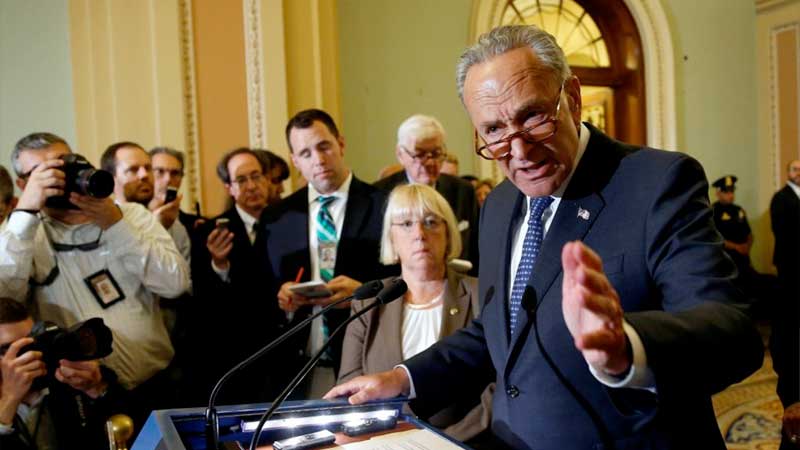
Why should Americans suffer because one political party refuses to support enforcement of existing immigration law? Law that Democrats voted for. Law that Schumer and Biden vociferously supported . . . before they needed replacement democrat voters.

Why should Border Patrol agents, ICE personnel, military families, federal workers, travelers, and small businesses become collateral damage in an ideological battle over policies designed to discourage deportation and weaken immigration enforcement?

The Constitution does not require this political hostage-taking. There are no Supreme Court rulings that demand the government be shut down and workers go unpaid in the absence of a spending bill. It is merely tradition, NOT LAW

In reality, essential government functions continue during shutdowns anyway. Military operations continue. Air traffic control continues. Social Security payments largely continue. Federal law enforcement continues. Border agents often continue working, although many without paychecks while Democrats continue holding press conferences.

The “shutdown apocalypse” narrative has always been exaggerated, for democrat political leverage. Most news and media carry to narrative’s water to assist democrats in their blackmail tactics.

And the American people are growing tired of being used as pawns in Washington’s endless theater.

What makes the current fight especially revealing is that it exposes a deeper political calculation many Americans have long suspected: that mass illegal immigration is no longer viewed by some political leaders as a crisis to solve, but as a long-term political strategy to reshape the electorate and expand dependency on government systems.

Whether one agrees with that assessment or not, the perception exists because Democrats consistently oppose nearly every serious effort to tighten border enforcement while simultaneously demanding ever-expanding taxpayer support systems for illegal entrants already inside the country while resisting every effort to deport illegals.

Americans are noticing. And they are asking legitimate questions.

If Congress truly cannot avoid shutdowns, then perhaps lawmakers themselves should finally bear some of the consequences they routinely impose on everyone else.

Senators, including John Kennedy and Majority Leader John Thune have floated proposals to suspend congressional pay during shutdowns. That should only be the beginning.

No congressional salaries during shutdowns.

No taxpayer-funded travel.

No luxury congressional recesses.

No congressional medical care.

No omnibus bills dropped on the public at midnight.

No exemptions for the political class while ordinary Americans absorb the uncertainty and disruption.

If ICE agents and military personnel can work without guaranteed pay during political standoffs, senators and representatives should not continue collecting salaries and luxury taxpayer-funded benefits while manufacturing the crisis.

Washington’s shutdown culture persists because politicians experience very little personal consequence from creating chaos.

That must change.

The American people are exhausted by the manipulation, the fearmongering, the Left’s lies, and the endless manufactured emergencies. Government exists to serve the nation — not to hold it hostage every fiscal year in pursuit of ideological demands that most citizens never voted for in the first place.

There is no constitutional requirement to shut down the government.

But there may soon be a political requirement to hold accountable the people who keep threatening to do it.

The Federalist Press smiles while daydreaming about temporary incarceration for any member of congress who votes against funding the government.

Filed Under: Crime, Elections, Entitlement, Ethics, Featured, Foreign

California Democrat Mayor Pleads Guilty in Explosive Chinese Foreign Agent Case

May 11, 2026 By Editor Leave a Comment

One of the most disturbing stories of foreign infiltration in American politics just exploded into public view — and the corporate media will likely do everything possible to bury it.

Eileen Wang, the Democrat mayor of Arcadia, California, has agreed to plead guilty to acting as an illegal foreign agent for the Chinese Communist Party, according to the U.S. Department of Justice.

Let that sink in.

A sitting American mayor — an elected official entrusted with public authority inside the United States — admitted to secretly advancing the interests of a hostile foreign government tied directly to the Chinese Communist Party.

According to federal prosecutors, Wang and her former fiancé, Yaoning “Mike” Sun, operated a Chinese-language media platform that published propaganda approved and directed by officials connected to the People’s Republic of China. Prosecutors say the operation promoted CCP narratives inside the United States while concealing the foreign relationship from the American public.

The case is not some vague accusation from political opponents. It is a federal criminal prosecution backed by a plea agreement.

The Justice Department states that Wang has agreed to plead guilty to acting as an illegal foreign agent — a felony carrying a potential prison sentence of up to ten years.

Even more alarming is the broader context surrounding the case.

Her former campaign adviser and fiancé, Yaoning “Mike” Sun, was already sentenced to federal prison after admitting he operated on behalf of the Chinese government while helping cultivate political influence in California. Prosecutors described efforts to promote pro-Beijing propaganda and assist politicians viewed as favorable to CCP interests.

This is exactly the kind of foreign infiltration Americans were warned about for years — and routinely told not to worry about.

For decades, establishment politicians and media commentators dismissed concerns about CCP influence as paranoia or “xenophobia.” Americans who warned about Chinese political operations were mocked as conspiracy theorists.

Now a California Democrat mayor is pleading guilty in federal court.

The pattern is becoming impossible to ignore.

From the Eric Swalwell controversy involving a Chinese intelligence-linked operative, to the longtime questions surrounding Chinese influence networks in California politics, to New York officials accused of improper foreign relationships, Americans are watching a deeply troubling trend emerge: powerful Democratic political circles repeatedly appearing vulnerable to CCP cultivation and influence operations.

And the danger goes far beyond one local politician.

The CCP does not think in election cycles. It thinks in decades.

China’s strategy has long focused on quietly building influence inside universities, media organizations, corporations, local governments, and political networks across the West. The goal is not necessarily dramatic espionage. Often it is subtler: shaping narratives, cultivating sympathetic officials, discouraging criticism of Beijing, and slowly normalizing pro-CCP positions inside American institutions.

That is what makes the Arcadia case so significant. This was not a spy thriller involving stolen missile secrets. It was influence warfare. And influence warfare may be the CCP’s most successful weapon against the United States.

Americans should ask themselves a very uncomfortable question: If federal prosecutors had uncovered a Republican mayor secretly coordinating propaganda activities with Russian government officials, would the media treat this as a local curiosity — or as the scandal of the decade?

Because when the foreign influence operation involves Communist China and Democratic political networks, the national media suddenly becomes remarkably restrained.

But ordinary Americans are noticing. And they are increasingly realizing that the greatest threats to American sovereignty may not always arrive with tanks or missiles.

Sometimes they arrive through political relationships, media influence, and elected officials who quietly begin serving interests that are not America’s own.

Filed Under: Featured, Crime, Elections, Ethics, Foreign, Gender

Supreme Court Redistricting Shockwave May Have Just Changed the 2026 Midterms

May 11, 2026 By Editor Leave a Comment

A political earthquake is rippling across America after a series of court rulings handed Republicans one of the biggest structural victories in modern congressional politics.

Over the weekend, the U.S. Supreme Court allowed Alabama to move forward with new congressional maps that favor Republicans, while the Virginia Supreme Court simultaneously struck down a Democrat-backed redistricting scheme that could have delivered four additional House seats to Democrats.

Taken together, the rulings may fundamentally alter the balance of power heading into the 2026 midterms.

For months, Democrats and media analysts assumed Republicans would suffer the traditional “midterm collapse” that typically strikes the president’s party. But suddenly, that assumption is in serious doubt.

The real story is not merely about district lines.

It is about the collapse of a decades-long legal regime that allowed courts, bureaucrats, and activist organizations to heavily influence how congressional districts were drawn across America.

The turning point came in the Supreme Court’s recent Louisiana v. Callais decision, which sharply narrowed the use of race-based redistricting mandates under the Voting Rights Act. The Court signaled that states possess broad authority to draw districts without being forced into highly engineered “majority-minority” configurations that critics argue often prioritized race over geography, communities, or traditional representation.

Republicans hailed the decision as a return to constitutional neutrality and a rejection of race-based political engineering.

Democrats reacted with panic.

Almost immediately, Republican-led states began exploring aggressive redistricting opportunities in Alabama, Tennessee, Florida, and elsewhere.

Meanwhile, Democrats suffered a devastating setback in Virginia after the state supreme court invalidated a controversial Democratic-backed referendum and congressional map that critics described as a naked partisan gerrymander disguised as “fairness reform.” Analysts estimated the proposed map could have handed Democrats as many as four additional congressional seats.

Now even mainstream analysts are sounding alarms.

CNN data analyst Harry Enten warned this week that the new redistricting landscape could become a “nightmare” scenario for Democrats.

The implications are enormous.

Republicans currently hold only a razor-thin House majority. Yet with favorable new maps emerging in multiple states, Democrats may now need to win the national congressional vote by several percentage points simply to reclaim control of the House.

And beneath the legal arguments lies a deeper political reality that much of the corporate press refuses to admit:

Many Americans are growing tired of institutions using race, identity politics, and judicial intervention to manipulate electoral outcomes.

For years, voters were told that questioning redistricting practices amounted to “attacking democracy.” But increasingly, Americans are recognizing that both parties gerrymander whenever given the opportunity. The difference now is that the Supreme Court appears less willing to permit race-based constitutional theories to dominate the process.

That shift could reshape American politics for years.

The media will frame these rulings as partisan Republican victories — and politically, they certainly are.

But the larger story may be that the Supreme Court is slowly dismantling an era in which unelected judges and activist groups exercised enormous influence over the structure of American elections themselves.

And if this redistricting wave continues through the summer, the political establishment may soon discover that the 2026 midterms are no longer unfolding on the battlefield Democrats expected.

Filed Under: Featured, Elections, Entitlement, Ethics

Sen. Kelly Under Pentagon Review After Revealing Classified Briefing Details to Enemies

May 11, 2026 By Editor Leave a Comment

The political and military firestorm surrounding Arizona Democratic Senator Mark Kelly intensified Sunday after Secretary of Defense Pete Hegseth announced that Pentagon legal counsel will review Kelly’s public comments following a classified congressional briefing on U.S. weapons stockpiles.

During a national television appearance, Kelly revealed what he had just learned in a classified meeting, describing depleted American missile inventories, specifically referencing Tomahawk missiles, Patriot interceptors, THAAD systems, and other strategic weapons platforms.

Secretary Hegseth responded publicly, accusing Kelly of “blabbing” details from a classified briefing and questioning whether the senator had violated his oath.

The controversy is the latest chapter in an escalating conflict between Kelly and the U.S. military that has already placed the Arizona senator under intense scrutiny.

Months earlier, Kelly participated in a public video directed at U.S. military personnel encouraging service members to refuse “illegal orders.” The message crossed a dangerous line by encouraging troops to second-guess the lawful chain of command during a period of heightened geopolitical instability.

Secretary of War Pete Hegseth rebukes Kelly for revealing classified information to U.S. combat enemies.

The American military is built on discipline, civilian control, and obedience to lawful command structures. While illegal orders should never be followed, critics argue that elected politicians publicly encouraging troops to scrutinize presidential directives creates ambiguity inside the ranks at precisely the wrong moment—the precise outcome Kelly advocated. They warn that once political actors begin inserting themselves between commanders and enlisted personnel, the chain of command itself becomes vulnerable to politicization.

Kelly’s critics also point to the irony of a retired Navy officer and astronaut — someone entrusted for decades with some of America’s most sensitive military and aerospace programs — now facing allegations that he publicly disclosed information just discussed in a classified setting.

Whether the Pentagon review ultimately produces legal consequences remains unclear. Legal analysts note that members of Congress possess broad speech protections, while retired military officers remain subject to certain military conduct standards under federal law.

Still, the optics are extraordinary.

An Arizona senator who once flew combat missions for the United States is now under Pentagon review after publicly discussing sensitive military readiness issues during a time of global instability and rising tensions with China and Iran.

For many Americans, the question is no longer simply whether Kelly’s comments were technically classified. The deeper question is why a sitting U.S. senator appears increasingly comfortable undermining confidence in America’s military leadership while publicly airing vulnerabilities that adversaries would eagerly exploit.

Filed Under: Featured, Crime, Elections, Ethics, Foreign

Trump Releases First Major UFO/UAP Files — “The People Can Decide for Themselves What the Hell Is Going On”

May 8, 2026 By Editor Leave a Comment

In one of the most extraordinary government disclosures in modern American history, President Donald Trump announced Friday that his administration has officially begun releasing long-classified government files related to UFOs, UAPs, extraterrestrial life, and unexplained aerial phenomena.

The announcement came directly from Trump on Truth Social, where he declared that the Department of War had released the “first tranche” of files to the American public as part of what the administration is calling the Presidential Unsealing and Reporting System for UAP Encounters, or “PURSUE.”

Trump’s message was vintage Trump — blunt, provocative, and impossible to ignore.

“As for my promise to you, the Department of War has released the first tranche of the UFO/UAP files to the Public for their review and study,” Trump wrote. “Whereas previous Administrations have failed to be transparent on this subject, with these new Documents and Videos, the people can decide for themselves, ‘WHAT THE HELL IS GOING ON?’”

Here is the live link: UFO Release>

The files are now publicly available through a newly launched government portal at WAR.GOV/UFO.

The release marks the first major government disclosure effort specifically focused on unexplained aerial phenomena and alleged extraterrestrial-related material since decades of classified investigations stretching back to Roswell, Project Blue Book, Area 51 speculation, military pilot encounters, and secret Pentagon programs that the government spent years denying even existed.

And unlike previous carefully worded Pentagon briefings, this rollout appears designed to maximize public curiosity rather than suppress it.

The newly released materials reportedly include:

  • military pilot encounter reports
  • radar tracking incidents
  • infrared and cockpit videos
  • FBI investigative files
  • NASA and Apollo-era records
  • intelligence community documents
  • witness testimony
  • previously unseen photographs
  • unexplained “metallic orb” incidents
  • objects observed near military installations
  • sightings near the Pacific and Indo-Pacific regions
  • historical records dating back nearly 80 years

Several reports describe objects demonstrating flight characteristics that appear inconsistent with known aerospace technology.

One report allegedly details a football-shaped object tracked near Japan by U.S. Indo-Pacific Command personnel. Another references strange luminous objects observed during Apollo-era space missions. Other files reportedly discuss glowing aerial spheres, unexplained formations, and sudden high-speed disappearances observed by military personnel.

Notably, the administration has stopped short of claiming definitive proof of extraterrestrial life.

Instead, officials are framing the release around “maximum transparency.”

Defense Secretary Pete Hegseth stated that secrecy surrounding the files had fueled decades of justified public speculation and argued that Americans have a right to review the information for themselves. DNI Tulsi Gabbard similarly stated that the Intelligence Community is now coordinating declassification efforts across multiple agencies, including NASA, the FBI, the Department of Energy, and military intelligence divisions.

For many Americans, the release represents vindication after decades of ridicule directed toward military pilots, intelligence officials, radar operators, scientists, and civilians who claimed to witness phenomena they could not explain.

For decades, anyone discussing UFOs risked being labeled unstable, conspiratorial, or irrational.

Yet over the last several years, the entire tone of the conversation changed.

The U.S. Navy authenticated leaked UAP videos.
Congress held hearings featuring military witnesses.
Pentagon officials admitted many cases remain unexplained.
Former intelligence personnel alleged hidden retrieval programs exist.
Pilots described objects performing maneuvers beyond known aircraft capabilities.

Now, for the first time, the federal government is effectively telling the public:
Here are the files. Decide for yourselves.

That alone is historic.

The implications are enormous.

If even a small percentage of the released material ultimately proves authentic and technologically unexplainable, it could represent one of the most important revelations in human history. If, alternatively, many sightings turn out to involve classified military systems, foreign adversary technology, sensor distortions, or misidentifications, the release may still fundamentally reshape public understanding of decades of secrecy.

Either way, the era of reflexive dismissal appears to be ending.

Critics, however, are already accusing the administration of political theater.

Some left-wing commentators claim the UFO disclosures are intended to distract from foreign policy tensions, economic concerns, or ongoing political controversies. Others argue the release is designed to energize Trump’s populist base by positioning him as the anti-establishment president willing to expose secrets hidden by the permanent bureaucracy.

But those criticisms may miss the larger point.

The public interest in UFOs and unexplained aerial phenomena has persisted for generations precisely because the government repeatedly denied, concealed, ridiculed, and compartmentalized information related to the subject. The secrecy itself fueled the distrust.

Trump appears to understand that instinctively.

His administration has already pursued high-profile transparency efforts involving assassination records, intelligence documents, and classified archives. The UFO/UAP rollout now adds another layer to that strategy — one aimed directly at the American public’s growing distrust of permanent government institutions.

And judging by public reaction online, the strategy is working.

Social media exploded within minutes of the announcement. UFO researchers, military analysts, skeptics, podcasters, journalists, and millions of ordinary Americans immediately began dissecting the newly released records frame by frame.

Some are convinced this is the beginning of full disclosure.

Others believe the government is still hiding the most explosive material.

But almost everyone agrees on one thing:

This is unlike anything the United States government has ever done before.

Whether the files ultimately reveal advanced foreign technology, hidden military programs, natural phenomena, spiritual deception, extraterrestrial intelligence, or simply decades of government confusion, one reality is now unavoidable:

The conversation has permanently changed.

And for the first time in American history, the government itself has opened the vault and invited the public inside.

Filed Under: Featured, Ethics, Sci-Tech

Virginia Supreme Court Blows Up Democrat Power Grab Over Congressional Maps

May 8, 2026 By Editor Leave a Comment

In a major political and constitutional earthquake, the Virginia Supreme Court has struck down a Democrat-backed congressional redistricting scheme that critics said amounted to a naked partisan power grab disguised as “reform.” The court ruled that the newly approved congressional map process violated constitutional procedures and declared the resulting maps effectively null and void, sending shockwaves through the political establishment just months before a critical election cycle.

The ruling is a devastating blow to Democrats who had hoped to use the new maps to lock in long-term congressional dominance in a state that has become one of the Left’s most important political battlegrounds. Analysts had projected that the proposed redraw could have handed Democrats as many as 10 of Virginia’s 11 congressional seats despite the state remaining politically competitive overall. In other words, the maps were not about “fairness.” They were about engineering outcomes.

Gerrymandered map

The Virginia Supreme Court’s decision cuts directly against a growing movement on the Left to use redistricting not as a neutral constitutional process, but as a weaponized political tool. The justices found that the constitutional amendment process used to place the referendum before voters was fatally flawed, including failures involving required procedural timing and publication rules. In plain English: the process itself violated the law.

This matters enormously because Democrats across the country have increasingly attempted to portray every Republican-led redistricting effort as “authoritarian” or “anti-democratic” while simultaneously pursuing aggressive gerrymanders of their own whenever they gain institutional control. Virginia appears to have been one of the clearest examples yet.

For years, the Left has insisted that redistricting reform is necessary to “protect democracy.” But in practice, many of these so-called reforms simply transfer power from elected legislatures into activist commissions, courts, bureaucracies, or carefully structured systems designed to produce predictable ideological outcomes favorable to Democrats. When Republicans draw maps, Democrats call it a threat to democracy. When Democrats attempt the same thing, it suddenly becomes “equity,” “representation,” or “justice.”

The Virginia ruling exposes the hypocrisy.

Even more significant is the broader national backdrop. The decision comes just days after major Supreme Court rulings limiting the use of race as a dominant factor in congressional mapmaking. Across several states, Republicans are now moving aggressively to redraw districts after years of being constrained by legal doctrines that often elevated racial balancing above traditional constitutional principles like equal protection and geographic representation.

That changing legal landscape has sent Democrats into panic mode. For years, the party relied heavily on courts and race-based districting theories to construct favorable political maps. Now those tools are weakening.

Virginia Democrats clearly hoped to get ahead of the shift by cementing a new structure before the next election cycle. Instead, the state Supreme Court slammed the brakes.

The ruling also reveals a deeper problem with modern American politics: both parties increasingly understand that control of congressional maps can determine control of Congress itself. The stakes are immense. In a narrowly divided House of Representatives, a gain or loss of only a few seats can change national policy on immigration, taxes, regulation, foreign policy, impeachment, judicial appointments, and federal spending.

That is why these battles have become so vicious.

But there is an important distinction. One side increasingly argues that voters should choose representatives. The other increasingly behaves as though representatives should choose voters.

The Virginia Supreme Court, at least for now, sided with constitutional procedure over partisan manipulation.

The court’s ruling may also have broader implications nationwide. If procedural shortcuts and legally questionable referendums can no longer survive judicial scrutiny, similar efforts in other blue states could face serious challenges. Democrats who hoped to use state-level legal engineering to counter Republican gains may suddenly find themselves trapped by the very constitutional rules they spent years trying to reinterpret.

The irony is difficult to miss.

For years, Americans have been lectured endlessly about “protecting democracy.” Yet many of the most aggressive attempts to manipulate electoral outcomes in recent years have come from political actors claiming to defend democracy itself.

Virginia’s highest court just reminded the country that constitutional rules still matter — even when powerful political interests would prefer otherwise.

Filed Under: Featured, Elections, Ethics

The “Authoritarian” Narrative vs. Reality: Why Trump’s Positions Are Historically Mainstream

May 7, 2026 By Editor Leave a Comment

For nearly a decade, Americans have been told that Donald Trump represents an unprecedented authoritarian threat to the republic.

The language has been relentless:

  • Fascist
  • Dictator
  • Nazi
  • Extremist
  • Threat to democracy

The accusations are repeated so often in media and political circles that many Americans have stopped questioning them. But when one steps away from the rhetoric and examines the actual policy positions involved, a different picture emerges.

On issue after issue, many of Donald Trump’s core stances are not historically radical at all. In fact, they are remarkably moderate and traditional.

1. Border Enforcement

For decades, both parties supported strong border enforcement.

Presidents from Eisenhower to Obama:

  • expanded border security,
  • increased deportations,
  • and emphasized national sovereignty.

Even prominent Democrats once argued that uncontrolled borders undermine wages, strain public systems, and weaken national cohesion. President Obama was dubbed the “deporter and chief” because he deported millions of illegal aliens during his tenure. Speeches by all democratic leaders going back 40 years stress the importance of closed national borders.

Trump’s position, that a nation has the right and duty to control its borders, is not historically extreme. It is historically normal.

2. Merit-Based Immigration

Trump has repeatedly argued for immigration systems that prioritize:

  • skills,
  • economic contribution,
  • and national interest.

That model is used by numerous, if not all countries around the world, including Canada and Australia.

Supporting legal immigration while demanding enforcement and structure is not authoritarian. It is standard statecraft.

3. Opposition to Endless Wars

One of Trump’s defining positions has been skepticism toward prolonged foreign military interventions.

He criticized:

  • nation-building,
  • open-ended wars,
  • and interventionist policies embraced by both parties for decades.

Whether one agrees or not, anti-interventionism is not fascism. In many ways, it reflects older American traditions of restraint and strategic realism.

The three-week attack on Iran to prevent its development of nuclear weapons is a master class in how to conduct a pinpoint military action without getting bogged down in a foreign quagmire.

4. Energy Independence

Trump’s support for domestic oil production, pipeline infrastructure, and energy self-sufficiency was framed by critics as reckless nationalism. But energy independence has long been viewed by policymakers as a matter of:

  • economic stability,
  • lower consumer costs,
  • and national security.

Again, this is not a radical historical position.

5. Opposition to Crime and Disorder

As open borders and degradation of blue cities has led to steep increases in crime, Trump’s calls for:

  • stronger policing,
  • tougher prosecution of violent crime,
  • and safer cities

These were always bipartisan political staples. Today, such positions are increasingly framed as authoritarian by democrat leaders, liberal media, and commentators. But historically, public order has been considered one of the most basic responsibilities of government. President Trump offered to restore peace and civility in these cities by employing the National Guard. We watched as democrats resisted his efforts, but reaped the rewards, as in the case of Washington C.C., where crime fell remarkably.

President Trump invites Communist Mayor of New York Mamdani to Oval Office to discuss methods of improving the lives of citizens.

6. Protection of Free Speech

Ironically, one of Trump’s strongest themes has been opposition to:

  • censorship,
  • deplatforming,
  • and institutional suppression of dissenting views.

His supporters argue that major institutions increasingly attempt to narrow acceptable public discourse. Defending broader speech protections, even offensive or controversial speech, is rooted deeply in American constitutional tradition, and was the darling of the Left until conservatives began voicing the virtues of traditional values.

7. Opposition to Bureaucratic Expansion

Trump’s repeated criticism of unelected bureaucrats, entrenched bureaucracies, and administrative overreach is often portrayed as an attack on institutions themselves.

But skepticism toward concentrated federal power has long existed across the political spectrum—for hundreds of years. Most Americans historically viewed excessive bureaucracy as a threat to democratic accountability.

8. America-First Economic Policy

Tariffs, industrial protection, and economic nationalism are frequently portrayed as extremist ideas today. Yet throughout American history, leaders from both parties used tariffs and industrial policy to protect domestic production and strategic industries.

Trump’s economic nationalism may be somewhat controversial, mainly because it has been ignored for many decades, but it is not historically unprecedented.

9. Judicial Originalism

Trump’s judicial appointments emphasize:

  • textualism,
  • constitutional originalism,
  • and limits on judicial activism.

Critics strongly oppose many resulting rulings, but interpreting the Constitution according to its original meaning is not authoritarianism. It is a longstanding legal philosophy embraced by most constitutional scholars and jurists. Only Leftists claim the Constitution to be a “living” document, meaning malleable to the desired results of the Left.

10. Religious Liberty

Trump has consistently aligned himself with:

  • religious liberty protections,
  • conscience rights,
  • and public accommodation of faith traditions.

These positions reflect traditional American debates about:

  • free exercise,
  • pluralism,
  • and the role of religion in public life.

Again, these are not fringe ideas in American history.

11. Parental Rights in Generally, and in Education

Support for parental rights over their children vs. the state’s right to supervise and indoctrinate them has only recently arisen as an issue. Traditionally, parents had all the rights, as long as they were not placeing their children in unreasonable danger.

Educational oversight, curriculum transparency, and local control in education has become one of the defining cultural issues of the past several years as the Left has pushed to overtake parental rights.

Yet historically, American education was deeply local and parent-driven. Opposition to centralized educational authority is hardly a novel or authoritarian impulse.

12. Election Integrity

Trump’s rhetoric around elections has been among the most controversial aspects of his political career.

But concerns over election security itself are not new. For years, politicians from both parties supported:

  • voter ID laws,
  • ballot safeguards,
  • and anti-fraud measures.

The debate is not whether elections should be secure. It is how best to secure them while maintaining broad access. The requirement of a voter I.D. is nothing new, and democratic harping that such a requirement will disenfranchise “many” liberal voters who lack the capacity to obtain an I.D. are nonsense.

13. Opposition to Ideological Enforcement

Many Americans increasingly feel pressured by:

  • corporate ideological mandates,
  • speech codes,
  • social media conformity,
  • and institutional activism.

Trump’s political appeal often stems less from ideology itself than from opposition to perceived coercion.

His supporters view him not as an authoritarian figure, but as a disruptive reaction against institutional pressure and cultural rigidity.

14. Skepticism Toward Globalization

Trump’s criticism of global trade structures, outsourcing, and transnational institutions is frequently mocked as backward nationalism.

But skepticism toward globalization emerged across the political spectrum long before Trump entered politics. As a result of globalism, many millions of Americans experienced:

  • industrial decline,
  • wage stagnation,
  • and economic displacement

Trump’s desire to re-establish an industrial base in the U.S. reflects his understanding that outsourcing the production of key products puts America at the mercy of foreign interests, and in many cases, America’s competitors, or even its enemies.

15. National Sovereignty

At the core of Trump’s worldview is a simple principle: The United States should prioritize its own national interests.

Critics often frame this as dangerous nationalism. Supporters view it as the basic responsibility of any elected government.

Historically speaking, nation-states asserting sovereignty is not unusual. It is the global norm.

The Power of Political Labeling

None of this means Trump is beyond criticism. He is polarizing, confrontational, and frequently inflammatory in tone.

Reasonable people can strongly disagree with:

  • his rhetoric,
  • his conduct,
  • or many of his policies.

But there is an important distinction between opposing a politician, and redefining traditional political positions as extremist simply because they are politically inconvenient.

That distinction matters. Because once ordinary disagreement is routinely described as fascism or authoritarianism, language itself loses meaning.

The Bigger Picture

Much of the modern political conflict in America is not simply about Trump himself. It is about two competing visions of the country:

  • one favoring stronger national identity, local control, borders, tradition, and constitutional restraint;
  • the other emphasizing Leftist technocratic governance, global integration, institutional management, and unhealthy cultural change.

Those are substantial political disagreements. But they are not evidence that President Trump and political conservatives have abandoned democracy. In fact, it IS democracy, as its been understood and practiced for 250 years in America.

The repeated portrayal of Donald Trump as uniquely authoritarian relies less on historical comparison than on extreme political rhetoric.

When many of his actual positions are examined individually, they are not revolutionary departures from American tradition. In most cases, they are positions that large numbers of Americans, including Democrats in recent eras, once openly supported themselves.

That does not make Trump perfect necessarily, but it does make the constant attempt to frame ordinary political disagreement as extremism increasingly difficult to take seriously.

Filed Under: Bias, Economy, Elections, Entitlement, Ethics, Featured

Election Autopsy: What Yesterday’s Results Revealed

May 6, 2026 By Editor Leave a Comment

The headlines this morning are focused on winners and losers. But yesterday’s elections revealed something far more important than individual races.

They exposed the deepening divide between the American political class and the American public.

And they exposed something else as well: Neither party appears fully prepared for what the electorate is becoming.

The Real Story Wasn’t the Margin

Political consultants and cable-news analysts will spend the next week obsessing over percentages, turnout models, and demographic slices. That misses the point.

The deeper story of yesterday’s elections was distrust. Distrust in institutions. Distrust in media narratives. Distrust in government competence. Distrust in elite messaging that increasingly feels disconnected from everyday American life.

Voters are frustrated, financially strained, culturally exhausted, and increasingly skeptical that anyone in power is genuinely addressing the problems they face. And that frustration is reshaping the political landscape.

The Democratic Party Problem: Rage Is Not Persuasion

One of the clearest lessons from yesterday’s results is that energy inside Leftist activist circles does not automatically translate into broad electoral strength. The modern Democratic coalition increasingly relies on:

  • Institutional support
  • Media alignment
  • Large-scale activist infrastructure
  • Online political messaging
  • Attack style politics

That can generate visibility, but it fails to generate persuasion. In many races, the party continues to struggle with voters who feel alienated by:

  • Economic insecurity
  • Rising costs
  • Public safety concerns
  • Cultural overreach
  • A sense that ideological signaling has replaced practical governance

This does not mean Democrats are collapsing. But it does mean the party faces a growing tension between activist expectations and broader public sentiment. The party has moved far left, and its only message is that Trump is bad. Its reasoning escapes voters, who have witnessed transformative successes since Trump took office. It appears that Trump has become a symbol to the Left, a symbol of anti-Marxism, who must be stopped at any price.

The Republican Opportunity, and Risk

Republicans, meanwhile, continue benefiting from widespread dissatisfaction with the status quo.

But yesterday’s results also highlighted a challenge for the Right: Opposition alone is not enough. Voters frustrated with economic pressure, institutional decline, and political dysfunction are looking for:

  • Competence
  • Stability
  • Clarity
  • Confidence

The Republican Party gains when it presents itself as a corrective force. It struggles when it appears reactive, fragmented, or overly consumed by internal battles. The lesson: Unite with a simple message that you will fix what Joe Biden and Dems broke, and follow up with a united front in congress.

The Collapse of Institutional Trust

Perhaps the most important trend revealed by yesterday’s elections is the continued erosion of trust in traditional gatekeepers. Media institutions no longer shape public opinion the way they once did. They have been caught lying to the public too many times, and like the boy who cried wolf, no one is listening.

Political messaging is fragmented across:

  • Social media
  • Independent platforms
  • Podcasts
  • Influencer networks
  • Alternative news ecosystems

That fragmentation has fundamentally changed politics. Narratives that once would have dominated uncontested now face immediate skepticism and counter-messaging.

The result is a political environment where persuasion is harder, tribalism is stronger, and institutional authority carries far less weight than it once did.

The Economic Undercurrent

Beneath nearly every race was the same underlying issue: Americans increasingly feel economically insecure.

Even when macroeconomic indicators appear stable, many voters continue to experience:

  • Housing pressure
  • Inflation fatigue
  • Rising insurance costs
  • Debt burdens
  • Diminished purchasing power

That reality shapes political behavior far more than partisan talking points. And it explains why incumbents—regardless of party—continue facing intense voter frustration. Although it was Biden and the democrats who tripled the monthly mortgage payment of new home buyers, republicans have been slow to fix the problem.

Culture Still Matters

Yesterday also reinforced another reality many strategists continue to underestimate: Cultural issues remain politically potent.

Questions involving:

  • Education
  • Immigration
  • Public safety
  • Identity politics
  • Freedom of speech
  • The role of institutions

. . . continue driving turnout and shaping voter perception.

For years, political elites treated many of these concerns as secondary or symbolic. Voters clearly do not.

The Realignment Continues

American politics is no longer dividing neatly along traditional lines. The old coalitions are shifting.

Working-class voters are moving in unexpected directions. Minority voting patterns are becoming less predictable. Younger voters remain politically active but economically anxious. This all bodes well for republican candidates. But the performative rage on the Left is ginning up its base, and they are turing out at the polls.

Overall, what emerges from yesterday’s elections is not a settled political order. It is a country in transition.

Yesterday’s elections were not a final verdict on America’s future. They were a snapshot of a country still trying to decide what it believes, what it fears, and what it wants to become.

The old assumptions are weakening. The old political formulas are losing effectiveness. And the voters themselves appear increasingly restless, skeptical, and difficult to predict.

That may be the most important lesson of all. Because the era of automatic loyalty, institutional trust, and predictable political alignment is ending.

And both parties know it.

Filed Under: Elections, Economy, Featured

Why Is the United States Still Allowing Iran to Threaten the Strait of Hormuz?

May 6, 2026 By Editor Leave a Comment

Cargo ship in Strait of Hormuz reports being attacked as peace negotiations continue

For decades, the United States has treated the Iranian regime as a problem to be managed. The result has been decades of escalation, proxy warfare, regional instability, and recurring crises centered around one of the most strategically important waterways on earth: the Strait of Hormuz.

At some point, Americans are entitled to ask a simple question: Why is an Islamic revolutionary regime that openly calls for confrontation with the West still allowed to project this much power?

From Monarchy to Revolution

Modern Iran was not always governed by the Islamic clerical regime that exists today. Before 1979, Iran was ruled by Shah Mohammad Reza Pahlavi, a pro-Western monarch aligned closely with the United States. That order collapsed during the Iranian Revolution, when Ayatollah Ruhollah Khomeini and his Islamist movement seized power and transformed Iran into an Islamic Republic governed by revolutionary religious doctrine.

The revolution was not merely political. It was ideological.

The new regime defined itself in opposition to:

  • Western influence
  • Secular government
  • American power in the Middle East
  • The existence of Israel and its regional allies

That worldview still defines the regime today.

The Structure of Power in Iran

Iran presents itself as a republic, with elections and civilian institutions. But ultimate authority does not rest with elected officials. Real power lies with:

  • The Supreme Leader
  • The Islamic Revolutionary Guard Corps (IRGC)
  • Senior clerical and security networks loyal to the revolutionary system

The IRGC in particular has become one of the most powerful organizations in the region:

  • Military force
  • Intelligence apparatus
  • Economic empire
  • Foreign operations network

Its influence extends through proxy groups and allied militias across the Middle East.

Why Negotiations Are So Difficult

American administrations from both parties have repeatedly attempted diplomacy with Tehran. But negotiations with Iran are uniquely difficult for one central reason:

The regime views confrontation with the United States as part of its ideological identity.

This is not merely a dispute over sanctions, territory, or trade. For many within the regime’s core leadership structure, opposition to American influence is foundational to the revolution itself.

That reality complicates every negotiation. Even when agreements are reached, there remains deep skepticism in Washington and among U.S. allies about whether Tehran ultimately seeks coexistence—or simply strategic advantage. President trump believes the latter. He has publicly voiced his understanding of the regime, that it will never voluntarily lay down its arms, including nuclear arms, and accept peace in any form. It must be forced into such a position.

The Strait of Hormuz: A Pressure Point

The Strait of Hormuz remains one of Iran’s last, and most powerful leverage points.

A significant percentage of global energy shipments pass through the narrow waterway. Even limited disruption can:

  • Spike oil prices
  • Rattle financial markets
  • Threaten global supply chains

Iran understands this.

And it has repeatedly used the threat of disruption as a geopolitical tool.

From Washington’s perspective, that creates a persistent dilemma:

  • Respond too aggressively and risk broader regional war and damage to Iran’s civilian population
  • Respond too weakly and invite continued escalation

A Regime Under Pressure

Years of sanctions, internal unrest, economic strain, and regional conflict have placed enormous pressure on the Iranian system. At the same time, recent leadership losses and internal fragmentation have fueled speculation about divisions within the regime itself. Trump’s Department of War has eliminated the two top tiers of leadership in the regime, and it is difficult to locate survivors to engage in negotiations.

Some analysts argue that the current (third) leadership tier is more rigid and ideological than pragmatic. Others believe there are factions within the broader system that would prefer reduced confrontation and economic normalization.

The challenge for American policymakers is determining whether meaningful moderation is possible within the current structure—or whether the regime’s core ideology makes that unlikely.

The Strategic Debate in Washington

This has led to an increasingly sharp debate among foreign-policy analysts and national-security officials.

One side argues:

  • Iran responds only to overwhelming pressure
  • Deterrence must be restored decisively
  • Continued restraint emboldens the regime

The other warns:

  • Escalation could ignite a wider regional conflict
  • Regime instability carries unpredictable consequences
  • Military action may strengthen hardliners rather than weaken them

Underlying both arguments is the same concern: The current situation is unsustainable.

The Bigger Question

For years, the United States has attempted to contain, negotiate with, sanction, pressure, and deter the Iranian regime—often simultaneously. And yet the core conflict remains unresolved.

Iran continues to:

  • Support regional proxy networks
  • Threaten maritime stability
  • Challenge American influence
  • Advance strategic capabilities despite international pressure

Which raises the uncomfortable possibility that the problem is not tactical. It is structural.

The Bottom Line

The Iranian regime was born out of revolution and sustained through ideology, security power, and confrontation with the West. That history matters because it shapes every negotiation taking place today.

The debate now facing the United States is no longer whether Iran is a challenge. It is whether decades of limited containment have merely prolonged a deeper conflict that neither side truly believes can be permanently resolved.

And as tensions rise once again in the Strait of Hormuz, that question is becoming harder to avoid. President Trump has signaled that he very much understands this. What is surprising is his patience with a regime that he knows lies as often as they breath, and has no intention of restricting its modus operandi of the past 60 years. Surely, he understands that only death of all leadership will allow cooler heads to take over and finally allow peace to come to the region.

Filed Under: Foreign, Economy, Featured, Sci-Tech

Gun Violence in America: The Stark Disparities and the Hard Questions They Raise

May 5, 2026 By Editor Leave a Comment

For years, the national conversation about gun violence has been loud, emotional, and often driven by headline-grabbing events. Each time a criminal uses a gun, the Left seizes the story to decry regular citizens’ right to keep and bear arms, and ignore the key human element in the matter.

But the underlying human data tells a far more precise and uncomfortable story. Gun violence in America is not evenly distributed. It is not random. And it does not affect all communities in the same way.

It is concentrated, geographically, demographically, socially, and racially. And nowhere is that more evident than in the disparities surrounding gun homicide.

A Disproportionate Impact

Across multiple datasets, one pattern stands out clearly:

Young Black Americans experience dramatically higher rates of gun abuse and homicide victimization than any other group in the country. They also demonstrate that young Black Americans perpetrate those crimes.

In recent years:

  • Black Americans have accounted for well over half of all gun homicide victims, despite being a much smaller share of the overall population
  • The rate of gun homicide victimization among Black Americans is many times higher than that of White Americans

These are not marginal differences. They are stark.

They point to a crisis that is not broadly national in the way it is often portrayed—but intensely concentrated in specific communities.

Two Different Realities

At the same time, a very different pattern emerges when looking at overall firearm deaths.

  • White Americans, particularly middle-aged and older men, make up the majority of gun suicide victims
  • Black Americans, particularly younger men, are disproportionately affected by gun homicide

In other words:

There are effectively two different gun violence realities in America—one driven by suicide, the other by homicide—and they affect different populations in different ways.

Treating them as the same problem obscures both.

Who Is Committing the Violence?

FBI and related data show that:

  • Gun homicides are overwhelmingly committed by men, especially younger men
  • Victims and offenders tend to come from the same communities and networks
  • Most violent crime is intra-racial—people are typically harmed by others within their own demographic and geographic group. Blacks shoot or kill Blacks. Hispanics shoot or kill Hispanics.

This last point is critical. The data does not describe widespread cross-group violence. It describes localized, community-based cycles of violence.

Where It Happens

Gun violence is not spread evenly across the country. It is heavily concentrated:

  • In specific cities
  • Within specific neighborhoods
  • Often within just a handful of blocks

Researchers have consistently found that a relatively small number of locations account for a disproportionately large share of shootings. This concentration explains much of the demographic disparity. These highly concentrated areas are generally within minority neighborhoods in democrat controlled areas of large cities.

When violence is concentrated in certain areas—and those areas have particular population compositions—the impact is concentrated as well.

Students in Philadelphia decry the death of young Black Americans

Chicago is often cited as a stark example of how gun violence concentrates in specific places and communities. In recent years, the city has recorded hundreds of homicides annually and several thousand shooting incidents, with the burden falling disproportionately on a relatively small number of neighborhoods on the South and West Sides. Within those areas, victims are overwhelmingly young Black men, and most incidents occur between people who know each other or share the same local networks. Weekend violence—particularly in warmer months—can spike sharply, with dozens of people shot in a single weekend and multiple fatalities reported in the span of just a few days.

These figures include both fatal and non-fatal shootings, reflecting not only loss of life but a broader cycle of injury, retaliation, and trauma that extends far beyond any single incident. The result is a persistent, localized crisis that shapes daily life for many residents and underscores how gun violence in America is often a concentrated, community-level problem rather than a uniform national one.

Why These Disparities Exist

The data shows the pattern. The harder question is why. Research across multiple fields points to a combination of factors:

1. Concentrated Poverty and Limited Opportunity

Areas with long-term economic disadvantage often experience:

  • Fewer job opportunities
  • Lower upward mobility
  • Higher exposure to crime

These conditions create environments where violence is more likely to emerge and persist.

2. Social and Institutional Breakdown

In high-violence areas, there are often:

  • Weaker local institutions
  • Fewer community resources
  • Less capacity to mediate conflicts
  • Fatherless households

Without strong stabilizing forces, disputes escalate more easily.

3. Network Effects and Retaliation Cycles

Gun violence often spreads through small social networks:

  • Conflicts between individuals or groups escalate
  • Retaliation leads to further violence
  • Cycles become self-sustaining

This is why a relatively small number of individuals can be connected to a large share of violent incidents.

4. Exposure to Violence

Repeated exposure to violence:

  • Normalizes it
  • Increases stress and impulsivity
  • Makes escalation more likely

In many communities, especially inner-city Black communities, violence becomes part of the environment rather than an exception.

5. Access to Illegal Firearms

These concentrated areas of gun violence are invariably the highest regulated gun ownership. Where illegal gun markets are active, conflicts are more likely to become deadly. The presence of a firearm in a violent and lawless neighborhood dramatically increases the likelihood that a dispute will result in a fatal outcome.

Why This Matters

If the goal is to reduce gun violence, the conversation has to start with reality. That means recognizing:

  • Where violence is concentrated
  • Who commits it
  • Who is most affected
  • And what conditions allow it to persist

Broad national narratives, while politically powerful, often fail to address the actual contours of the problem.

The Bottom Line

Gun violence in America is not one crisis.

It is several:

  • A concentrated urban homicide problem affecting minority communities
  • A widespread suicide problem affecting different populations
  • A set of local conditions that shape outcomes far more than national averages suggest

Understanding those distinctions is not optional. It is the only way to move from contrived debate to workable solutions. No one wants young Black men shooting young Black men. It appears to be acceptable to blue city leaders, but the rest of us are appalled, and would love to see more of President Trump’s national guard clean-up actions go into these blue war zones and make them safe for all of the residents.

Filed Under: Crime, Featured

May Day in America: A Radical Tradition Returns—and Raises Hard Questions

May 3, 2026 By Editor Leave a Comment

Pres. Joe Biden delivered his ‘Battle for the Soul of the Nation’ speech where he falsely accused that “Donald Trump and the MAGA Republicans represent an extremism that threatens the very foundations of our republic.”

What is May Day? May 1 has always meant more than a date on the calendar.

Internationally, May Day grew out of labor activism in the late 19th century. Over time, in many parts of the world, it became associated with socialist and communist movements, mass demonstrations, and political messaging about class, power, revolution and the role of the state.

Due to its constitutional form of government which guarantees personal and financial liberty to its citizens, the United States largely kept its distance from that legacy. Of late, that distance is narrowing.

From Labor Holiday to Political Signal

This year’s May Day events are not small or isolated. Reports point to large, coordinated demonstrations across the country, backed by networks of advocacy groups with significant budgets and infrastructure.

Supporters describe this as democratic participation—people organizing around issues regarding wages, housing, immigration, and healthcare.

Clear-eyed observers see something else: a return of ideas that have a long, contentious history—ideas about restructuring the economy, redistributing power, and expanding the role of centralized authority.

Whatever one’s view, May Day in America is no longer just about labor. It has become a signal of where the democrat party intends to take the nation.

The Historical Record That Shapes the Debate

Any serious discussion of May Day’s modern meaning runs into history.

In the 20th century, regimes that adopted Marxist-Leninist systems promised equality and liberation. In practice, those systems produced:

  • Concentrated political power
  • Lethal restrictions on dissent and press
  • State control over major sectors of the economy
  • Economic dislocation and, in most cases, severe human suffering

Those outcomes are nearly identical everywhere. They are part of the record, and they inform why most Americans are wary when modern movements invoke similar language about sweeping economic transformation.

The core tension is familiar:

How much power should be centralized in pursuit of equality—and what guardrails prevent that power from being abused?

What Today’s Activism Is Arguing

Contemporary May Day activism tends to focus on a set of recurring themes:

  • Wage stagnation and cost of living
  • Housing affordability
  • Healthcare access
  • Immigration and labor protections
  • The influence of large corporations

These concerns are real and widely debated. Made real by the prior policies actions of the democrat party. Democrats propose policies and legislation to ‘repair’ problems, and the repairs invariably lead to greater problems for citizens. Democrats them point the finger of blame at republicans for those outcomes, enabled by a Leftist national press and waves of Leftist ‘experts,’ and propose additional remedies, which lead to more severe problems. We have seen dozens of these cycles in the past 80 years, like sewage being flushed down a toilet, drawing the nation deeper and ever deeper into fiscal, social, moral and political waste. We are up to our necks in it.

Still, activists and pundits push for more fundamental changes to the system they are intentionally breaking: public or collective ownership in key sectors, expansive redistribution, and a major shift in the balance of power between labor and capital, and the way the team lines are drawn. Under their rubric, everyone turns out to be labor, until the revolution is well underway, then nearly everyone turns out to be ‘rich,’ subjecting them to the wrath and rape of the new leadership.

That’s where critics draw lines, arguing that Leftist demands of redistribution of wealth and power echo earlier and recurring theories about organizing society primarily around class and collective outcomes–a few elite leaders rule over the masses of subjects. It’s the same BS, recycled with new false promises.

Institutions, Incentives, and Influence

The growth of large-scale protest movements also raises questions about how they are organized and amplified. Major demonstrations require:

  • Funding and staffing
  • Communications and media strategy
  • Logistics and supplies for tens of thousands
  • Legal and political coordination

In the U.S., those resources often come from a mix of nonprofits, advocacy organizations, unions, and ‘philanthropic’ foundations. Supporters view this as normal civic engagement. Realists ask why funding is coming from globalist billionaires with communist, socialist and The Communist Party of China (CPC/CCP).

The same debate extends to American institutions that influence public conversation:

  • Education: Schools and universities are central to how ideas are introduced and debated. Results demonstrate that most campuses have become ideologically Left.
  • Media: Coverage choices and framing can elevate certain narratives over others. Most television programming and Hollywood films promote woke, anti-God, anti-American, anti-family, anti-white agendas.
  • Labor organizations: Unions exist to play a significant role in advocating for workers and shaping policy. In practice they have supported democrats and other Leftists who undermine constitutional liberties.

Why the Skepticism Persists

Skepticism toward modern May Day activism often comes down to three concerns:

1. Concentration of Power

Even well-intentioned policies can concentrate authority. The question is whether institutions are designed with sufficient checks to prevent overreach. All policy decisions must be governed by the overriding question, At whose expense will this action operate?

2. Tradeoffs and Outcomes

Policies that expand public control invariably affect incentives, investment, and growth. The balance between equity and dynamism always bears in the direction of the Left accumulating more wealth and power.

3. Pluralism vs. Uniformity

A diverse society contains competing values and preferences. The concern is whether sweeping, system-wide changes leave room for that diversity—or push toward uniform solutions, concentrating power and wealth in the left.

A Constitutional Framework

The United States has historically navigated these tensions through a framework that emphasizes:

  • Individual rights
  • Separation of powers
  • Federalism (state and local variation)
  • A mixed economy with both public and private roles

That framework evolved over time, but recent debates about more regulation, social programs, and market structure have abandoned those valued principles that transformed America from a weak agricultural countryside to the strongest, wealthiest, and most benevolent nation in world history.

Yet, American democrats choose to worship at the altar of May Day activism is the latest chapter of redistribution of wealth and power, or government authorized stealing.

What Comes Next

The renewed prominence of May Day in the U.S. suggests a deeper shift: economic questions are once again at the center of political life.

Ideas about equality, equity, fairness, and opportunity were asked and answered in our constitution. That’s how America became the richest, strongest nation in the world so quickly, and why we hold at bay the evil totalitarian governments who constantly seek to expand their borders so they can steal the resources of their neighbors to fund their sinking Marxist economies.

Filed Under: All Stories, Bias, Crime, Economy, Elections, Entitlement, Ethics, Featured

Next Page »

Federalist Press Dispatch

Get breaking political news, investigations, and uncensored analysis delivered directly to your inbox.

Please wait...

Thank you for subscribing to the Federalist Press Dispatch.

Get free info to help your life

Get free info to help your life

Simple bite-sized guides for life, money, civics, and more . . . because some stuff school just didn’t cover.

Brit Axton Mysteries Series

Brit Axton Mysteries Series

Brit Axton Mysteries is a series of young adult adventure novels that lead young Brit Axton and her friends on whirlwind adventures to uncover hidden secrets and long lost treasures.

Byrna Non-lethal Self Protection

Byrna Non-lethal Self Protection

Byrna offers non-lethal self protection at an affordable price. Watch the short video, or click to learn more!

Understanding Cryptocurrency: Essentials for Building Wealth in Digital Currency

Understanding Cryptocurrency: Essentials for Building Wealth in Digital Currency

Understanding Cryptocurrency serves as a definitive guide for novice investors looking to understand the world of cryptocurrency and harness its potential for financial growth and prosperity.

Real Estate Wealth Strategies During High Inflation

Real Estate Wealth Strategies During High Inflation

Real Estate Wealth Strategies During High Inflation is a comprehensive guide on navigating the real estate market, offering strategies and insights for successful investing, during high inflation and interest rates.

Follow us

  • parler
  • welcome-widgets-menus
  • facebook
  • envato

Privacy Policy

Terms of Service

Economy

May Day in America: A Radical Marxist Tradition Reemerges

Tens of Billions Lost: Inside the Expanding Web of Dem Government Fraud From Minnesota to California

The Myth of the “Mandatory” Government Shutdown

Elections

There Is No Constitutional Requirement to Shut Down the Government

California Democrat Mayor Pleads Guilty in Explosive Chinese Foreign Agent Case

Supreme Court Redistricting Shockwave May Have Just Changed the 2026 Midterms

Foreign

Pro-Palestine-Anti-Israel Terrorist behind Attack on Penn. Gov. Shapiro

JONATHAN TURLEY: Biden DOJ behind even the Times in pursuing alleged Hunter corruption

The Human Cost of the Southern Border Crisis: Trafficking, Exploitation, and the U.S. Demand

Crime

Gun Violence in America: The Stark Disparities and the Hard Questions They Raise

May Day in America: A Radical Tradition Returns—and Raises Hard Questions

After the Gunfire: What Comes Next for a Nation on Edge

Science Tech

Missing General, Missing Answers: The Strange Disappearance of Retired Maj. Gen. Neil McCasland

Trump’s Decisive Strike: Ending Iran’s Nuclear Threat and Exposing Decades of Diplomatic Failure

Unlocking the Unseen: UAP Propulsion, Hidden Fields, and the Dimensional Fabric of Reality

Reader Responses

  • Linda Livaudais on Trump’s UFO Disclosure Has Changed the Conversation — But Not Yet Answered the Biggest Question
  • T059736 on Trump and Musk Announce Plans to Shut Down USAID
  • C.Josef.D on ‘Pay to Play’ at Clinton Foundation Under Investigation
  • John D Cole on Biden Says ‘You ain’t black’ If You Don’t Vote for Him
  • Ed on U.S. Attorney Huber Moving to Indict Clintons and Others

Copyright © 2026 by Federalist Press · All rights reserved · Website design by RoadRunner CRM · Content Wiriting by GhostWriter · Log in