• Home
  • Mission
  • Federalist Papers
  • Foundation
  • U.S. Constitution
  • Bill of Rights

Federalist Press | Defending Liberty — Informing America

Breaking News and Political Commentary

  • All Stories
  • Economy
  • Elections
  • Entitlement
  • Ethics
  • Foreign
  • Gender
  • Religion
  • Sci-Tech

“All Animals Are Equal”: How Orwell’s ‘Animal Farm’ Exposed the Lie at the Heart of Collectivism

May 1, 2026 By Editor Leave a Comment

George Orwell didn’t write Animal Farm as a children’s story.

He wrote it as a warning.

A warning about what happens when noble-sounding ideas—equality, fairness, collective good—are placed in the hands of those eager to manipulate them for power.

Today, May Day, when Marxists celebrate communism, Hollywood has released its own version of Animal Farm. As you probably already suspect, it twists the message and warning of Orwell’s work into the opposite, in fine Orwellian style.

Do yourself a favor. Read the book. Pass it on to your kids, and grand kids.

And decades after its publication, the message remains as sharp—and as uncomfortable—as ever.

The Revolution That Was Supposed to Change Everything

At the start of Animal Farm, the animals live under the rule of Mr. Jones, a negligent and exploitative farmer. Inspired by the vision of Old Major, a wise and respected boar, the animals rise up and overthrow human control.

Their goal is simple:

  • Equality
  • Freedom from oppression
  • A system where all animals share in the fruits of their labor

The early days of the revolution are filled with hope. The commandments are clear. The principles are straightforward. The slogan becomes iconic: “All animals are equal.”

For a moment, it works.

The Rise of the Pigs—and the Shift in Power

But revolutions do not remain pure for long.

The pigs—led by Napoleon and Snowball—quickly assume leadership roles, arguing that their intelligence makes them uniquely suited to guide the farm.

At first, this seems reasonable. Then it becomes dangerous. Snowball is eventually driven out. Napoleon consolidates power. The pigs begin to rewrite the rules—not openly, but gradually, subtly, strategically.

The commandments change. Privileges appear. Justifications multiply.

The Machinery of Control

What makes Animal Farm so powerful is not just what happens, but how it happens.

Control is maintained through Language.

Squealer, the regime’s spokesperson, constantly reframes reality:

  • Failures become successes
  • Sacrifices become necessary
  • Contradictions are explained away

Truth is not eliminated. It is reshaped.

Fear

Napoleon uses force to maintain authority, including the use of dogs to intimidate and eliminate opposition. Dissent is not debated. It is crushed.

Memory Manipulation

The animals begin to doubt their own recollections:

  • Were things really better before?
  • Did the commandments always say this?

Over time, reality becomes whatever those in power say it is.

Boxer: The Tragedy of Blind Loyalty

No character embodies the cost of the system more than Boxer, the hardworking horse.

His beliefs are simple:

  • “I will work harder.”
  • “Napoleon is always right.”

He is loyal, strong, and selfless. And he is used.

When Boxer is no longer useful, he is sold, despite everything he has given. His fate is one of the most devastating moments in the book. Because it reveals the truth: In a system built on control, loyalty is not rewarded. It is exploited.

The Final Transformation

By the end of the novel, the pigs have fully adopted the behavior of the humans they once overthrew. They walk on two legs. They drink, trade, and negotiate with former enemies.

And, in true elite style, the final commandment reads: “All animals are equal, but some animals are more equal than others.”

The revolution is complete. Not in success—but in betrayal.

The Message Orwell Wanted You to See

Animal Farm is not subtle. It is a direct critique of collectivist systems that promise equality but concentrate power.

It shows how:

  • Ideals are weaponized
  • Leadership becomes domination
  • Language is used to obscure and twist truth
  • Systems built on “the collective” end up serving only a few

The book’s message is not that fairness is bad. Diversity? Equity? Inclusion? All great ideals. But they are never the goal.

Unchecked power, justified in the name of fairness, becomes the main goal entirely.

Why This Story Still Matters Today

Animal Farm endures because its lessons are not confined to a single time or place. It speaks to a recurring pattern:

  • A movement promises justice
  • Power becomes centralized
  • Dissent is discouraged
  • Reality is reshaped

And over time, the system begins to resemble what it once opposed.

The Challenge of Modern Adaptations

When works like Animal Farm are adapted for modern audiences, they often undergo ‘reinterpretation.’

Themes are softened. Characters are reshaped. Endings are adjusted to fit contemporary sensibilities. Hollywood is run by Marxists, so guess what Marxists have done to “reshape” the message of Animal Farm?”

If the sharper edges are removed, the consequences diluted, then the story risks becoming something it was never meant to be. Not a critique of a soul crushing political philosophy, but a parable stripped of its caution.

The Bottom Line

George Orwell wrote Animal Farm to expose a truth that is easy to ignore and difficult to confront:

Power, once concentrated, rarely serves everyone equally, no matter what it promises at the beginning.

That is the lesson. And it is a lesson worth preserving, especially when it becomes inconvenient.

Hollywood’s twisted new message in its Animal Farm movie, released today, May Day, the special day on which the world’s Marxists celebrate communism, entirely misses the truths of Orwell’s book of the same name. Shame on you Hollywood. Again.

Filed Under: Bias, Economy, Elections, Entitlement, Featured

May Day in America: A Radical Marxist Tradition Reemerges

May 1, 2026 By Editor Leave a Comment

May 1 has long carried meaning far beyond the calendar.

Known internationally as May Day, it began as a labor movement commemoration in the late 19th century, tied to the fight for workers’ rights. But over time, in much of the world, it became deeply associated with socialist and communist movements, state power, and ‘revolutionary’ politics.

For decades, Americans largely kept their distance from tat legacy. As today’s democrat party embracing Marxism, that distance appears to be shrinking.

A Holiday with a Complicated History

In countries shaped by communist regimes, May Day was not just a celebration, it was a demonstration of power.

Mass parades. Coordinated messaging. Displays of unity under centralized authority. Yes, we saw Soviet missiles paraded in the streets of Moscow as a reminder that the decadence of individualism would soon be crushed by the collective powers.

Behind those displays, history tells a dark story.

The 20th century saw the rise of regimes that embraced Marxist ideology, from the Soviet Union to Maoist China, to Eastern Europe and beyond. The results, widely documented, included:

  • Economic collapse
  • Political repression
  • Suppression of dissent
  • Widespread human suffering on a massive scale, including the death of 100,000,000 people

The promise was equality and liberation.

The reality was control and coercion.

That legacy still shapes how most Americans view May Day today.

A New Wave of Activism

In 2026, May Day has taken on renewed significance in the United States.

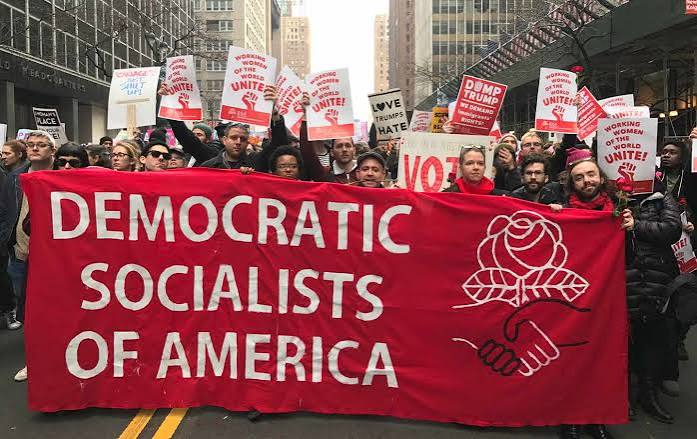
According to recent reporting, hundreds of organizations, collectively generating billions in revenue, have organized thousands of protests across the nation tied to the day’s themes.

The scale is notable:

  • Nationwide coordination
  • Large coalitions of advocacy groups
  • Messaging focused on economic ‘justice,’ labor rights, immigration, and social policy

Supporters describe this as grassroots mobilization. Critics see something more structured, and more ideological.

The Debate Over Modern Movements

The core question is not whether people have a right to protest. They do. The question is what ideas and goals are driving these movements, and where those ideas lead.

Some activists openly embrace frameworks rooted in Marxist and socialist thought, particularly in critiques of:

  • Capitalism
  • Wealth distribution
  • Corporate power
  • Traditional economic structures

Others reject those labels entirely, framing their goals as pragmatic reforms. But the overlap in language, goals, and organizing strategies has sparked a broader national debate:

Are these movements pushing reform—or a deeper transformation of the American system?

Follow the Structure

One of the more striking elements of modern activism is its level of organization. Large-scale demonstrations do not happen spontaneously. They require:

  • Funding
  • Infrastructure
  • Communication networks
  • Coordinated messaging

Reports highlighting the financial scale of some participating organizations have raised questions about:

  • How these groups are funded
  • How resources are allocated
  • Whether their agendas align with the broader public

These are the kinds of questions that should be asked of any large, influential movement.

Why the Pushback Exists

Skepticism toward May Day activism in the U.S. is not simply about policy disagreements. It is rooted in historical memory. Many Americans associate Marxism not with theory, but with outcomes:

  • Centralized control over economic life
  • Oppression and reduced individual autonomy
  • Political systems that suppressed opposition

That history makes some wary of any movement that appears to draw inspiration, even indirectly, from those ideas.

A Country Built on a Different Model

The United States was founded on a different set of assumptions.

  • Individual rights over collective identity
  • Families as the foundational unit of society
  • Very limited government over centralized control
  • Market-driven opportunity over state-directed outcomes

Those principles have been debated, refined, and challenged over time, but they remain foundational, and have catapulted America to the most powerful, wealthy, and benevolent nation in the world, ever.

Movements that call for sweeping structural change inevitably raise questions about how far those principles should be altered, or whether they should be replaced altogether.

The Meaning of May Day Today

For some Americans, May Day is a call to action; an opportunity to advocate for workers, fairness, and reform.

However, these calls are obviously farcical, because workers and fairness have been strongly represented in our constitutional republic, elevating all American citizens through adherence to our constitutional principles of individual freedom and the individual pursuit of life, liberty and happiness.

What is the Left demanding? What is their aim? Redistribute wealth, which is to steal the wealth of those who have worked hard and risked all, and give it to those who sit around and complain. They hate corporations, and demand that their wealth be confiscated and given to lazy people. Of course, corporations are owned by collectives of hard working Americans, whose retirement plans have funded corporate enterprises, the returns on which will fund retirement. The anti-corporate, anti-liberty howlings of the Marxist Left are preposterous to everyday Americans, and if given their way, would reduce America to the status of a third world wasteland.

Filed Under: Entitlement, Economy, Elections, Featured, Foreign

The Supreme Court Draws the Line: America Should Not Be Gerrymandered by Race

May 1, 2026 By Editor Leave a Comment

The Supreme Court’s ruling in Louisiana v. Callais marks a major moment in America’s long struggle over voting rights, representation, and the meaning of equal protection under the Constitution.

By striking down Louisiana’s congressional map as an unconstitutional racial gerrymander, the Court reaffirmed a principle that should not be controversial: Government should not sort Americans by race when drawing political power, or for any other reason. That would be racism.

The case arose after Louisiana adopted a congressional map creating a second majority-Black district. The creation of the district was based on the race of those being included. Supporters argued that the map was necessary to comply with the Voting Rights Act. Challengers argued that race had become the dominant factor in drawing the district, violating the Equal Protection Clause (racism). The Supreme Court agreed that the Constitution does not permit states to make race the controlling principle in redistricting, or any other activity.

That ruling is already triggering political shockwaves on the Left. Louisiana has suspended congressional primaries while lawmakers consider a new map, and other states are watching closely as they evaluate whether their own districts can withstand constitutional scrutiny.

But beneath the political consequences lies the deeper constitutional issue: whether America’s election districts should be designed around citizens as individuals—or around racial or other blocs.

The Court’s answer is the right one.

Race-conscious districting has always rested on a dangerous premise: that voters of the same race think alike, vote alike, and must be politically grouped together to have meaningful representation. That idea is defended in the language of so-called civil rights advocates, but it reduces citizens to racial categories, and that is exactly what the Constitution protects us from.

The Constitution promises something better.

The Equal Protection Clause of the Constitution was included to prevent government from treating Americans differently because of race or other identifying characteristics. That principle does not vanish simply because the state claims a ‘benevolent’ purpose.

A district drawn primarily because of race is still a district drawn primarily because of race.

The Court’s ruling does not say states may ignore discrimination. It does not erase the practice of dividing by race from the Voting Rights Act. What it says is that compliance with voting-rights law cannot become a blank check for racial engineering. States must respect both the Voting Rights Act and the Constitution. That balance matters.

For decades, courts have wrestled with the tension between preventing minority vote dilution and preventing racial sorting. Cases such as Shaw v. Reno and Cooper v. Harris made clear that race cannot predominate in redistricting unless the state satisfies strict constitutional scrutiny. The Louisiana ruling follows that same constitutional path: race may be considered in limited ways, but it cannot become the mapmaker’s master key.

Critics of the decision argue that it will weaken minority representation and make it harder to challenge discriminatory maps. That concern deserves to be heard, but the answer cannot be to permanently divide Americans into racial districts.

A republic cannot flourish if its election system teaches citizens that race is destiny.

The better standard is one rooted in equal citizenship. Districts should be compact, coherent, and grounded in geographical communities of interest, not manipulated to produce racial outcomes demanded by Leftist political activists, party strategists, or federal judges.

That is especially important because racial gerrymandering often masks partisan motives. Both parties know that race and party preference frequently overlap in modern politics, although that is becoming less true. That creates an obvious temptation: claim racial necessity while pursuing partisan advantage.

The Court’s decision helps close that loophole.

States should not be allowed to hide political manipulation behind racial classifications. Nor should judges pressure legislatures into drawing districts that violate one constitutional command in the name of satisfying a statute.

The Voting Rights Act was designed to protect Americans from discrimination. It should not become a tool for institutionalizing race as the organizing principle of American elections, which IS racial discrimination.

The left will call this decision an attack on voting rights. It is not. It is a defense of the most basic voting right of all: the right to be treated as an individual citizen, not as a member of a racial category.

America has spent generations trying to move beyond government-imposed racial classifications. The Court’s ruling is a positive step in that direction.

The principle is simple. No racial spoils system. No racial mapmaking. No assumption that skin color determines political identity.

The Constitution protects citizens, not racial coalitions, and in Louisiana v. Callais, the Supreme Court was right to say so.

Filed Under: Featured, Bias, Elections

School Choice Is Winning — And the Education Establishment Knows It

April 30, 2026 By Editor Leave a Comment

For decades, American families were told they had no real say in their children’s education. They were told to just leave everything to the ‘experts.’

You went to the school assigned to you. You accepted whatever curriculum was offered. You trusted a system that, in many parts of the country, has produced steeply declining performance, frustrated parents, and myriad students left behind.

That model is now being challenged—and the reaction from the education establishment has been swift, loud, and deeply revealing.

Because in states like Arizona, the rules have changed.

A System Finally Forced to Compete

Arizona, for example, has emerged as a national leader in school choice, implementing programs that allow education funding to follow the student instead of being locked into a specific school or district.

Families now have real options:

  • Public schools
  • Charter schools
  • Private institutions
  • Homeschooling programs

Each child carries with them a portion of education funding, and that money goes wherever the family decides. That simple shift has introduced something that has long been absent in public education: Competition and Accountability.

Public schools are no longer guaranteed funding simply because they exist. They have to earn it. They have to compete for available dollars. They have to do do better than the competition to receive the funding.

And that changes everything.

Why Parents Are Embracing It

The appeal of school choice is not theoretical. It is practical, immediate, and deeply personal.

Parents are choosing schools based on:

  • Academic performance
  • Safety
  • Discipline
  • Values
  • Individual student needs

For families who have felt trapped in underperforming districts, the ability to leave is more than a policy change—it is a lifeline. And once families experience that freedom, they rarely want to go back.

The Resistance: A System That Doesn’t Want to Change

Despite growing support, school choice faces fierce opposition from entrenched interests that have long shaped American education. Critics of CHOICE argue that these programs threaten public schools, divert funding, and create uneven outcomes.

But behind those arguments is a deeper reality: School choice disrupts a system that has operated for decades with limited competition and guaranteed funding.

When funding follows students, institutions that once operated without pressure or accountability are suddenly forced to respond—to parents, to outcomes, and to alternatives.

That is not a small shift. It is a fundamental one.

The Performance Problem No One Can Ignore

Across the country, there are school systems, particularly in large urban areas, that have struggled for years with:

  • Low proficiency rates
  • Graduation gaps
  • Safety concerns
  • Declining public confidence

These issues did not appear overnight, and they have not been resolved by maintaining the status quo. They developed over decades as teachers’ unions fought for more money for less work, and the right essentially replace students’ parents in matters of values. They have foisted woke, Marxist, and anti-religious curricula on students, and parents who showed up at the principal’s office or school board meetings were often placed on FBI terror watch lists.

School choice does not claim to solve every problem. But it does introduce a mechanism that public systems have lacked: The ability for families to leave.

And when families can leave, systems must adapt, or risk losing relevance, and funding.

The Accountability Divide

One of the sharpest lines in the debate is over accountability. Supporters of school choice argue that:

  • Parents are the ultimate accountability mechanism
  • Schools that fail to meet expectations lose students

Critics counter that:

  • Public funds require consistent oversight
  • Not all alternatives are held to the same standards

Both arguments carry weight. But the current system raises its own question: What accountability exists when families have no realistic alternative?

A Shift in Power

At its core, school choice is about more than education policy. It is about power. For generations, decisions about education have largely been made at the institutional level, by districts, boards, and administrators.

School choice shifts that power outward to families. And that redistribution is at the heart of the conflict. Because when parents gain control over where funding goes, long-standing structures are forced to compete, adapt, and justify their performance in ways they never had to before. Public schools struggle fiercely to remain relevant in the face of competition. The socialist malaise of the public education system has rendered public schools and teachers undesirable, and in many case, abhorrent.

The Stakes Going Forward

The expansion of school choice is not slowing down. More states are exploring similar models, and more families are demanding options. The topic has become political in that democrats fight against choice, be the power that is being redirected to parents is essentially that curated by the Left over the decades.

Now, the debate is no longer about whether school choice exists. It does. And it is thriving, as are the students who are attending the best schools at no cost to them.

Public schools and teachers’ unions fight against school choice in Arizona.

It is really about how far it will go, and how the existing system will respond. So, will public schools evolve and compete? Will policymakers refine these programs to address legitimate concerns?
Or will the divide deepen as quality of choice spreads, and the stagnant decline of public schools digs in?

The Bottom Line

School choice is not a fringe idea anymore. It is a centrist, growing movement that is forcing a national conversation about how education works, and who it is meant to serve. Families, or teachers’ unions?

For supporters, it represents long-overdue accountability and freedom. For critics, it raises serious concerns about equity, funding, and oversight.

But one thing is certain: The days of a one-size-fits-all education system are coming to an end.

And the fight over what replaces it is only just beginning.

Filed Under: Featured, Bias, Entitlement, Gender, Religion

After the Gunfire: What Comes Next for a Nation on Edge

April 30, 2026 By Editor Leave a Comment

In the hours following the attempted attack at the White House Correspondents’ Dinner, the immediate shock has begun to fade. The headlines have stabilized. The suspect is in custody. Investigations are underway. Democrats are lying about it. Everything has returned to normal, more or less.
But the most important questions are only now beginning to surface. Because what happened that night was not just a security failure—it was a warning. And what comes next will determine whether anyone in power is actually listening.

A System That Was Supposed to Be Impenetrable

The White House Correspondents’ Dinner is not an ordinary public event. It is one of the most tightly controlled environments in the country, layered with Secret Service protection, credentialing systems, surveillance, and advance threat assessment.

And yet, a determined man with a manifesto and a plan got close enough to carry out an attack. That fact alone should send shockwaves through Washington.

This was not a random breakdown. It was a breach of a system designed specifically to prevent exactly this kind of scenario. So the question is unavoidable: How did he get that close?

The Questions That Will Not Go Away

In the coming days, officials will release carefully worded statements. There will be reassurances. There will be promises of “review” and “improved protocols.”

But those answers will not be enough. Because the American people—and frankly, anyone paying attention—are already asking far more serious questions:

  • Were there warning signs that were missed—or ignored?
  • Was the suspect known to authorities prior to the attack?
  • Did intelligence agencies flag any behavioral or online indicators?
  • Were security protocols relaxed, even slightly, for the event?
  • And perhaps most troubling of all: Was this preventable?

These are not partisan questions. They are fundamental ones, demanding real answers.

A New Reality for Presidential Security

Regardless of what the investigation ultimately reveals, one thing is already clear: Presidential security is entering a new era.

The threats facing public officials today are not the same as they were a decade ago. They are more decentralized, more unpredictable, and more influenced by the rapid spread of political narratives online. Democratic leaders are actively ginning up their base to take violence to the streets, and to get into the faces of conservatives “everywhere, all the time.”

Constant accusations that President Trump is a fascist, a Nazi, a child rapist, a child murderer are landing on their mark—the distorted minds of many Leftist activists. Democrat leaders understand that the modern threat environment is not just about organized groups, about individuals who absorb, internalize, and act on ideas that are reinforced constantly in their digital world. That makes detection harder. That makes prevention harder. And it raises a difficult but unavoidable question: Can existing security models keep up with this new kind of threat?

The Copycat Risk No One Wants to Talk About

There is another danger that officials are often reluctant to discuss openly: the risk of imitation.

This is the third time a Democrat has attempted to take the life of the president. High-profile attacks—especially those tied to political motives, have a way of inspiring others. Not because they are justified, but because they are seen, and in this case, praised by the leadership.

They dominate headlines. They saturate social media. They become, in the minds of unstable individuals, a template.

History has shown this pattern again and again. Which means this incident is not just about what happened. It’s about what could happen next.

A Nation Already on Edge

This attack did not occur in a vacuum. It comes at a time when political tensions are already elevated, when distrust in institutions is widespread, and when rhetoric on the Left has grown sharper, vitriolic, personal, and more violent.

In that environment, the line between words and actions can begin to blur, especially for those already on the edge. Just yesterday, darling of the Left Former FBI Director James Comey, was indicted on federal charges for threatening the life of the president.

We are operating in a far more volatile climate than many are willing to admit. If a Democrat bullet ever finds its way to our president, a bloody civil war is sure to ensue.

What Comes Next

In the days ahead, there will be investigations, hearings, and policy discussions. There may be new security measures, new surveillance tools, new restrictions.

But none of that will matter if the core questions are not addressed honestly. If this was a failure of intelligence, it must be fixed. If it was a failure of coordination, it must be corrected. If it was a failure to take warning signs seriously, that must never happen again. Because the next time, the outcome may not be the same.

The Bottom Line

What happened at the White House Correspondents’ Dinner was not just an isolated incident. It was a test.

A test of our security systems. A test of our awareness. A test of whether those in power are willing to confront uncomfortable truths. A test of democrat leadership.

Now the real test begins: Will Washington treat this as a wake-up call—or just another headline to move past?

Filed Under: Elections, Bias, Crime, Ethics, Featured

« Previous Page

Federalist Press Dispatch

Get breaking political news, investigations, and uncensored analysis delivered directly to your inbox.

Please wait...

Thank you for subscribing to the Federalist Press Dispatch.

Get free info to help your life

Get free info to help your life

Simple bite-sized guides for life, money, civics, and more . . . because some stuff school just didn’t cover.

Brit Axton Mysteries Series

Brit Axton Mysteries Series

Brit Axton Mysteries is a series of young adult adventure novels that lead young Brit Axton and her friends on whirlwind adventures to uncover hidden secrets and long lost treasures.

Byrna Non-lethal Self Protection

Byrna Non-lethal Self Protection

Byrna offers non-lethal self protection at an affordable price. Watch the short video, or click to learn more!

Understanding Cryptocurrency: Essentials for Building Wealth in Digital Currency

Understanding Cryptocurrency: Essentials for Building Wealth in Digital Currency

Understanding Cryptocurrency serves as a definitive guide for novice investors looking to understand the world of cryptocurrency and harness its potential for financial growth and prosperity.

Real Estate Wealth Strategies During High Inflation

Real Estate Wealth Strategies During High Inflation

Real Estate Wealth Strategies During High Inflation is a comprehensive guide on navigating the real estate market, offering strategies and insights for successful investing, during high inflation and interest rates.

Follow us

  • parler
  • welcome-widgets-menus
  • facebook
  • envato

Privacy Policy

Terms of Service

Economy

May Day in America: A Radical Marxist Tradition Reemerges

Tens of Billions Lost: Inside the Expanding Web of Dem Government Fraud From Minnesota to California

The Myth of the “Mandatory” Government Shutdown

Elections

There Is No Constitutional Requirement to Shut Down the Government

California Democrat Mayor Pleads Guilty in Explosive Chinese Foreign Agent Case

Supreme Court Redistricting Shockwave May Have Just Changed the 2026 Midterms

Foreign

Pro-Palestine-Anti-Israel Terrorist behind Attack on Penn. Gov. Shapiro

JONATHAN TURLEY: Biden DOJ behind even the Times in pursuing alleged Hunter corruption

The Human Cost of the Southern Border Crisis: Trafficking, Exploitation, and the U.S. Demand

Crime

Gun Violence in America: The Stark Disparities and the Hard Questions They Raise

May Day in America: A Radical Tradition Returns—and Raises Hard Questions

After the Gunfire: What Comes Next for a Nation on Edge

Science Tech

Missing General, Missing Answers: The Strange Disappearance of Retired Maj. Gen. Neil McCasland

Trump’s Decisive Strike: Ending Iran’s Nuclear Threat and Exposing Decades of Diplomatic Failure

Unlocking the Unseen: UAP Propulsion, Hidden Fields, and the Dimensional Fabric of Reality

Reader Responses

  • Linda Livaudais on Trump’s UFO Disclosure Has Changed the Conversation — But Not Yet Answered the Biggest Question
  • T059736 on Trump and Musk Announce Plans to Shut Down USAID
  • C.Josef.D on ‘Pay to Play’ at Clinton Foundation Under Investigation
  • John D Cole on Biden Says ‘You ain’t black’ If You Don’t Vote for Him
  • Ed on U.S. Attorney Huber Moving to Indict Clintons and Others

Copyright © 2026 by Federalist Press · All rights reserved · Website design by RoadRunner CRM · Content Wiriting by GhostWriter · Log in