
For years, Americans have been told that gerrymandering is one of the greatest threats to democracy.
But after examining congressional representation state by state against actual presidential voting patterns in the 2024 Trump–Harris election, one uncomfortable reality becomes impossible to ignore:
Both parties benefit from distorted representation.
That may sound obvious. But the modern political narrative rarely admits it. Instead, Americans are usually presented with a cartoonishly simplified version of the issue in which one party is uniquely evil while the other merely seeks “fair maps.”
Reality is more complicated.
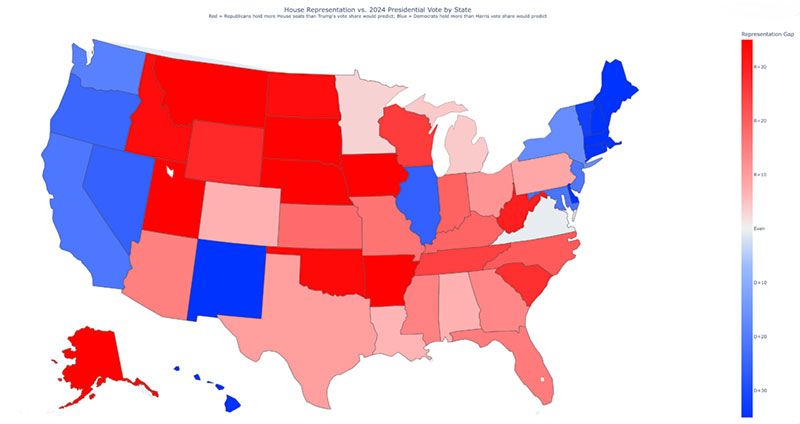
Federalist Pres recently compared each state’s congressional delegation against its presidential vote. The logic was intentionally simple and intuitive:
- If Donald Trump won roughly 60% of a state’s vote, Republicans would be expected to hold roughly 60% of that state’s House seats.
- If Kamala Harris won roughly 60%, Democrats would be expected to hold roughly 60%.
The interactive map below compares each state’s 2024 Trump–Harris presidential vote share with its current U.S. House delegation. Hover over each state to see whether Republicans or Democrats are overrepresented compared to the statewide vote.
Perfect proportionality is impossible, of course. Geography matters. Urban concentration matters. Small states with one or two House seats naturally produce exaggerated outcomes. But over time, and especially in larger states, representation should at least loosely approximate the electorate.
In many states, it does not. The resulting map was fascinating. And, we note that the most fairly apportioned state is Virginia, which just attempted to make all but one district democrat, blowing through all of the constitutional safeguards to accomplish the task.
As we see, some states strongly overrepresent Republicans compared to statewide voting patterns. Others strongly overrepresent Democrats. And several supposedly “competitive” states are far less balanced than Americans might assume.
The strongest Republican-leaning representation gaps appeared in sparsely populated states like Iowa, Utah, Oklahoma, Arkansas, Nebraska, and Montana, where Republicans hold substantially more congressional power than Trump’s statewide vote percentage alone would predict.
Meanwhile, Democrats enjoy enormous representation advantages in states like Massachusetts, Connecticut, Rhode Island, Hawaii, New Mexico, and Illinois. This is especially true in states with massive populations, like California and New York, where Republican share is merely half of what the presidential outcome would demand. This is an excellent example of why the GOP has recently begun trying to re-balance where it can.
As the map indicates, gerrymandering and structural advantage are not uniquely Republican inventions. They are political tools. Both parties use them whenever possible.
That does not mean the distortions are morally identical or arise from identical causes. In some Democratic states, heavily concentrated urban voting naturally produces overwhelming Democratic delegations. In some Republican states, map drawing and district engineering clearly amplify Republican power. The causes vary.
But the public conversation almost never acknowledges the full picture. Instead, Americans are fed a simplistic morality play by the media in which every Republican district map is sinister “democracy suppression,” while Democratic structural advantages are treated as either accidental or virtuous.
Even more revealing is the selective outrage. When Republican legislatures redraw maps aggressively, national media organizations erupt in fury. When Democratic states produce congressional delegations wildly disconnected from statewide voting balance, the issue often disappears from public conversation entirely.
That inconsistency is precisely why public trust continues collapsing. In the left-leaning media, and in politicians generally.
Most Americans do not expect politics to be perfectly fair. But they do expect honesty, and transparency. And increasingly, they are noticing that the rules seem to change depending on which party benefits, and the angle pitched hardest, or buried entirely, by the media.
The Supreme Court’s recent reluctance to aggressively intervene in partisan gerrymandering cases has only intensified the debate. Critics argue the Court is enabling Republican-controlled legislatures. Supporters counter that courts cannot realistically become permanent national referees for every politically disputed district boundary.
Both arguments contain some truth. However, in recent cases the high courts have ruled consistently against democrat attempts to gerrymander due to their failures to follow the rules. Apportionment is based on federal and state constitutions, and democrats have rushed so quickly to push out republican representation, that they have ignored those laws, resulting in rulings of invalidation.
But perhaps the deeper problem is this: modern Americans increasingly expect election systems to produce outcomes they personally prefer. When they do not, many immediately conclude the system itself is illegitimate. That instinct is dangerous.
The Constitution was never designed to produce mathematically perfect proportional representation. It was designed to balance competing interests, competing regions, competing populations, and competing political factions inside a stable republic. It was created to protect the rights of the minority, as the majority seeks to overwhelm the system with its constant transfer of power and wealth from one group to another. Every time we hear that we should eliminate the electoral college so that the population centered majority may have its way over the minority spread out throughout the nation, for instance, that is exactly what the Constitution was created to prevent. Congressional representation, and its mirrored electoral college, were created to protect those minority rights — to prevent the bare majority (concentrated in urban centers) from pillaging the suburban and rural citizens.
Still, there is a legitimate question lurking underneath the outrage: At what point does aggressive map engineering become so disconnected from voter behavior that representation itself begins losing credibility?
That question should concern everyone — Republicans, Democrats, and Independents alike.
Because once large portions of the public conclude elections are structurally rigged, faith in institutions deteriorates rapidly. And once institutional trust collapses, republics become very difficult to hold together. That is exactly why those who demand a stacking of the Supreme Court should be relegated to the scrapheap of history. They want to transform our representative constitutional republic to a bare-fisted democracy, where the mob rules, and takes what it wants at the expense of the minority.
Ironically, the map we created may accomplish something useful precisely because it does not flatter either side. Republicans can look at it and see states where Democratic power is clearly amplified. Democrats can look at it and see states where Republican power is clearly amplified.
And honest observers can look at it and realize something even more important: The real problem may not simply be gerrymandering itself.
The real problem may be a political culture in which politicians increasingly pursue every possible structural advantage while simultaneously pretending only the other side is doing it.
Leave a Reply