
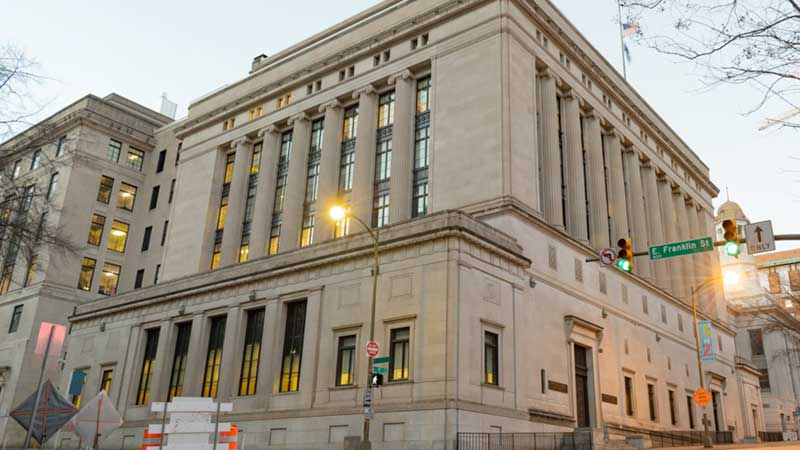
In a major political and constitutional earthquake, the Virginia Supreme Court has struck down a Democrat-backed congressional redistricting scheme that critics said amounted to a naked partisan power grab disguised as “reform.” The court ruled that the newly approved congressional map process violated constitutional procedures and declared the resulting maps effectively null and void, sending shockwaves through the political establishment just months before a critical election cycle.
The ruling is a devastating blow to Democrats who had hoped to use the new maps to lock in long-term congressional dominance in a state that has become one of the Left’s most important political battlegrounds. Analysts had projected that the proposed redraw could have handed Democrats as many as 10 of Virginia’s 11 congressional seats despite the state remaining politically competitive overall. In other words, the maps were not about “fairness.” They were about engineering outcomes.
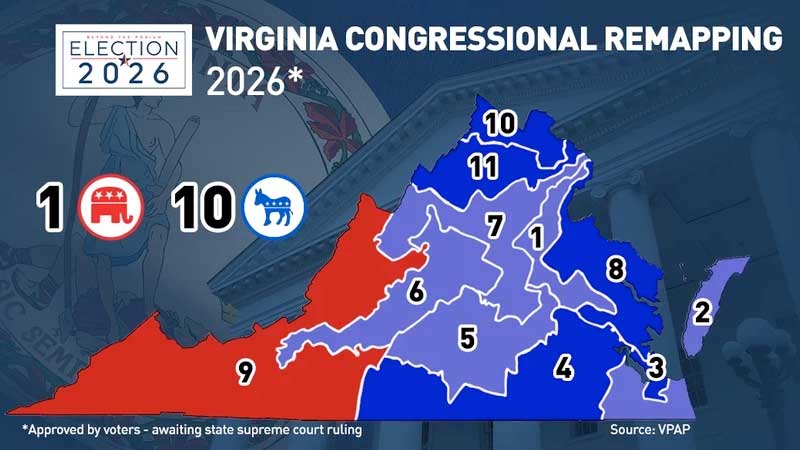
The Virginia Supreme Court’s decision cuts directly against a growing movement on the Left to use redistricting not as a neutral constitutional process, but as a weaponized political tool. The justices found that the constitutional amendment process used to place the referendum before voters was fatally flawed, including failures involving required procedural timing and publication rules. In plain English: the process itself violated the law.
This matters enormously because Democrats across the country have increasingly attempted to portray every Republican-led redistricting effort as “authoritarian” or “anti-democratic” while simultaneously pursuing aggressive gerrymanders of their own whenever they gain institutional control. Virginia appears to have been one of the clearest examples yet.
For years, the Left has insisted that redistricting reform is necessary to “protect democracy.” But in practice, many of these so-called reforms simply transfer power from elected legislatures into activist commissions, courts, bureaucracies, or carefully structured systems designed to produce predictable ideological outcomes favorable to Democrats. When Republicans draw maps, Democrats call it a threat to democracy. When Democrats attempt the same thing, it suddenly becomes “equity,” “representation,” or “justice.”
The Virginia ruling exposes the hypocrisy.
Even more significant is the broader national backdrop. The decision comes just days after major Supreme Court rulings limiting the use of race as a dominant factor in congressional mapmaking. Across several states, Republicans are now moving aggressively to redraw districts after years of being constrained by legal doctrines that often elevated racial balancing above traditional constitutional principles like equal protection and geographic representation.
That changing legal landscape has sent Democrats into panic mode. For years, the party relied heavily on courts and race-based districting theories to construct favorable political maps. Now those tools are weakening.
Virginia Democrats clearly hoped to get ahead of the shift by cementing a new structure before the next election cycle. Instead, the state Supreme Court slammed the brakes.
The ruling also reveals a deeper problem with modern American politics: both parties increasingly understand that control of congressional maps can determine control of Congress itself. The stakes are immense. In a narrowly divided House of Representatives, a gain or loss of only a few seats can change national policy on immigration, taxes, regulation, foreign policy, impeachment, judicial appointments, and federal spending.
That is why these battles have become so vicious.
But there is an important distinction. One side increasingly argues that voters should choose representatives. The other increasingly behaves as though representatives should choose voters.
The Virginia Supreme Court, at least for now, sided with constitutional procedure over partisan manipulation.
The court’s ruling may also have broader implications nationwide. If procedural shortcuts and legally questionable referendums can no longer survive judicial scrutiny, similar efforts in other blue states could face serious challenges. Democrats who hoped to use state-level legal engineering to counter Republican gains may suddenly find themselves trapped by the very constitutional rules they spent years trying to reinterpret.
The irony is difficult to miss.
For years, Americans have been lectured endlessly about “protecting democracy.” Yet many of the most aggressive attempts to manipulate electoral outcomes in recent years have come from political actors claiming to defend democracy itself.
Virginia’s highest court just reminded the country that constitutional rules still matter — even when powerful political interests would prefer otherwise.
Leave a Reply