
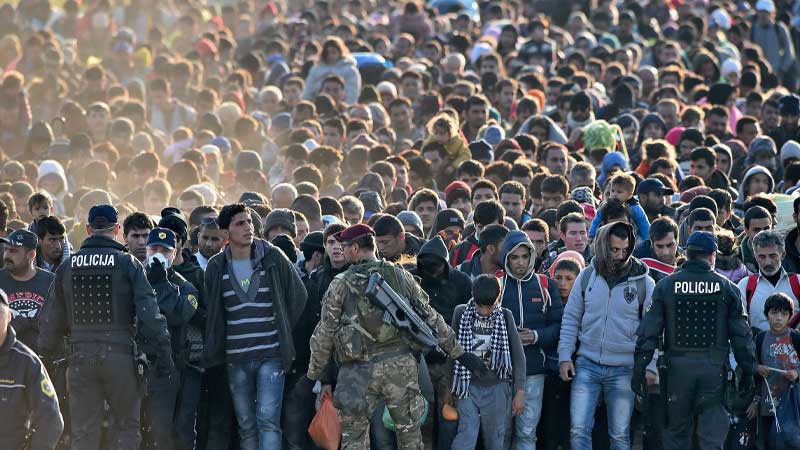
For years, political leaders across Europe dismissed concerns about mass migration as fearmongering. They called opponents of mass migration xenophobic, racist, and worse. Citizens who questioned the pace of immigration were labeled reactionaries.
Border enforcement was portrayed as intolerance. Calls for assimilation were dismissed as outdated nationalism.
Now, reality is forcing a reassessment.
Across Europe, governments that once embraced large-scale migration are tightening border controls, increasing deportations, restricting asylum policies, and openly acknowledging social tensions that many citizens have been discussing for years.
The shift is remarkable because it echoes a warning Donald Trump delivered long before it became politically fashionable: A nation without borders eventually struggles to remain a nation.
The issue is not whether immigration can benefit a country. Throughout history, immigration has helped fuel economic growth, innovation, and cultural vitality. The issue is scale. The issue is speed. The issue is whether newcomers can be successfully integrated into the civic, legal, and cultural framework of the receiving nation.
When migration occurs faster than assimilation, problems emerge. Housing shortages intensify. Schools become strained. Healthcare systems face insurmountable new pressure. Infrastructure falls behind population growth. Wages for some lower-skilled workers come under pressure. Social trust declines. And political polarization accelerates.
Many European leaders now find themselves confronting realities that voters noticed years ago. The debate is increasingly less about race or ethnicity and more about governance.
Can a nation absorb large numbers of newcomers while maintaining social cohesion? Can welfare systems remain sustainable when populations grow rapidly and high numbers of newcomers are injected as recipients of public benefits? Can democratic institutions function effectively when citizens lose confidence that their governments control their own borders?
These questions are no longer confined to conservative circles. They are becoming mainstream concerns.
Another concern increasingly raised by European citizens involves public safety and the failure of some governments to confront uncomfortable realities surrounding certain migrant crime patterns. Over the past decade, several European countries have been rocked by highly publicized grooming-gang and sexual-exploitation scandals, particularly in the United Kingdom, where authorities were widely criticized for failing to act aggressively enough against organized abuse networks.
Similar debates have emerged in Germany, Sweden, France, and other nations following incidents of sexual violence involving recent migrants or asylum seekers. Most immigrants are law-abiding people seeking better lives, but critics argue that political leaders too often suppressed discussion of these crimes out of fear of appearing intolerant. The result, they contend, has been a breakdown of public trust and a growing demand that governments place the safety of their own citizens above political sensitivities.

There is another aspect of mass migration that receives far less attention. The people who leave developing nations are often among the most ambitious, capable, entrepreneurial, educated, and determined members of their societies. Economists have long referred to this phenomenon as “brain drain.” While wealthy nations may gain workers, professionals, and future taxpayers, poorer nations often lose many of the very people most capable of building businesses, creating jobs, strengthening institutions, and improving living conditions for those left behind. If the goal is truly to help struggling nations prosper, one must at least ask whether encouraging the permanent departure of their most productive citizens is always the best solution.
In many cases, the long-term answer to poverty may not be moving millions of people from poor countries to wealthy countries. It may be helping nations develop the conditions necessary for prosperity where people already live—stable governments, secure property rights, functioning legal systems, economic freedom, educational opportunity, and public safety. The countries that lose their most capable citizens often need them the most.
The United States faces many of the same challenges. The southern border experienced historically high levels of illegal immigration during the Biden administration. Local governments across the country have struggled with housing shortages, school enrollment pressures, public-assistance costs, and the practical challenges of accommodating large numbers of new arrivals.
Reasonable people can debate the exact scale of these effects. What is becoming harder to debate is whether unlimited migration is a workable long-term policy.
Every nation has a right to determine who enters, under what conditions, and in what numbers. That principle is not extremism. It is sovereignty.
Critics often portray border enforcement as hostility toward immigrants. But nations can be both welcoming and selective. They can support legal immigration while opposing illegal immigration. They can show compassion while insisting on order. They can remain open to newcomers while preserving the institutions, values, and social trust that made them attractive destinations in the first place.
Perhaps the most important lesson emerging from Europe is that citizens eventually demand reality. Political slogans can delay that reckoning. Media narratives can obscure it. Government programs can temporarily mask it.
But reality always arrives.
The debate over immigration is not fundamentally about compassion versus cruelty. It is about whether leaders are willing to balance compassion with responsibility. A country that cannot control its borders eventually discovers that it cannot effectively control many other things either.
Europe appears to be learning that lesson. The question now is whether America will learn it as well.
Leave a Reply