
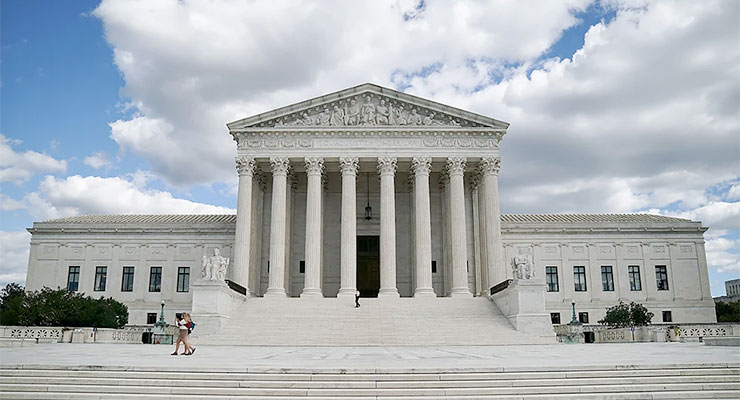
The United States Supreme Court unanimously ruled Monday that a so-called exception to the Fourth Amendment called “community caretaking” does not permit police officers to enter and search your home without first obtaining a search warrant, even if doing so may be in the public’s interest.
Background
The Supreme Court heard the case — Caniglia v. Strom — upon appeal by Edward Caniglia, a Rhode Island man whose house was searched by warrantless police officers in 2015. During that search, police seized two firearms, which Caniglia recovered only after jumping through numerous bureaucratic hoops.
Caniglia later sued law enforcement, arguing their actions violated his Fourth Amendment right against a warrantless search and seizure.
However, police claimed they acted lawfully under the “community caretaking” exception, which originated from Cady v. Dombrowski, a 1973 Supreme Court case that said police officers can conduct certain “community caretaking functions” if done in a “reasonable” manner. In that case, police officers had seized a gun located in an impounded car without a warrant.
The ruling overturned rulings by the federal district court and First Circuit Court of Appeals.
What did the high court say?
In a 9-0 ruling, the Supreme Court ruled the “community caretaking” exception does not apply to private residences.
“What is reasonable for vehicles is different from what is reasonable for homes. Cady acknowledged as much, and this Court has repeatedly ‘declined to expand the scope of … exceptions to the warrant requirement to permit warrantless entry into the home,'” Justice Clarence Thomas wrote in the majority opinion.
In fact, Thomas specifically rebuked the First Circuit Court of Appeals for extending the exception.
The First Circuit’s “community caretaking” rule, however, goes beyond anything this Court has recognized. The decision below assumed that respondents lacked a warrant or consent, and it expressly disclaimed the possibility that they were reacting to a crime. The court also declined to consider whether any recognized exigent circumstances were present because respondents had forfeited the point.
Nor did it find that respondents’ actions were akin to what a private citizen might have had authority to do if petitioner’s wife had approached a neighbor for assistance instead of the police. Neither the holding nor logic of Cady justified that approach. True, Cady also involved a warrantless search for a firearm. But the location of that search was an impounded vehicle—not a home—”‘a constitutional difference'” that the opinion repeatedly stressed. In fact, Cady expressly contrasted its treatment of a vehicle already under police control with a search of a car “parked adjacent to the dwelling place of the owner.”
“But this recognition that police officers perform many civic tasks in modern society was just that—a recognition that these tasks exist, and not an open-ended license to perform them anywhere,” Thomas added.
Anything else?
In rejecting the extension of the “community caretaking” exception to the Fourth Amendment, the Supreme Court rejected an argument from the Biden administration, which had urged the court to uphold as legal the violation of Caniglia’s constitutional rights.
An amicus brief filed by Justice Department lawyers said:
The touchstone of the Fourth Amendment is reasonableness. For criminal investigations, this Court has generally incorporated the Warrant Clause into the Fourth Amendment’s overarching reasonableness requirement, but it has not generally done so for searches or seizures objectively premised on justifications other than the investigation of wrongdoing. The ultimate question in this case is therefore not whether the respondent officers’ actions fit within some narrow warrant exception, but instead whether those actions were reasonable. And under all of the circumstances here, they were.
The brief further argued that warrants should not be “presumptively required when a government official’s action is objectively grounded in a non-investigatory public interest, such as health or safety.”
The Justice Department, in fact, was so keen on the Supreme Court not ruling in Caniglia’s favor that they urged the court to uphold the officers’ actions “by concluding that the officers are entitled to qualified immunity” if they rejected the Fourth Amendment argument.
By Chris Enloe
Leave a Reply