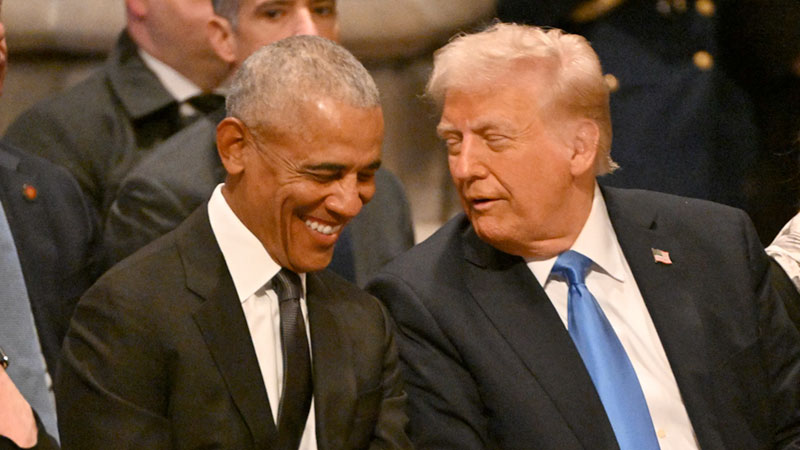
For nearly a decade, Americans have been told that Donald Trump represents an unprecedented authoritarian threat to the republic.
The language has been relentless:
- Fascist
- Dictator
- Nazi
- Extremist
- Threat to democracy
The accusations are repeated so often in media and political circles that many Americans have stopped questioning them. But when one steps away from the rhetoric and examines the actual policy positions involved, a different picture emerges.
On issue after issue, many of Donald Trump’s core stances are not historically radical at all. In fact, they are remarkably moderate and traditional.
1. Border Enforcement
For decades, both parties supported strong border enforcement.
Presidents from Eisenhower to Obama:
- expanded border security,
- increased deportations,
- and emphasized national sovereignty.
Even prominent Democrats once argued that uncontrolled borders undermine wages, strain public systems, and weaken national cohesion. President Obama was dubbed the “deporter and chief” because he deported millions of illegal aliens during his tenure. Speeches by all democratic leaders going back 40 years stress the importance of closed national borders.
Trump’s position, that a nation has the right and duty to control its borders, is not historically extreme. It is historically normal.
2. Merit-Based Immigration
Trump has repeatedly argued for immigration systems that prioritize:
- skills,
- economic contribution,
- and national interest.
That model is used by numerous, if not all countries around the world, including Canada and Australia.
Supporting legal immigration while demanding enforcement and structure is not authoritarian. It is standard statecraft.
3. Opposition to Endless Wars
One of Trump’s defining positions has been skepticism toward prolonged foreign military interventions.
He criticized:
- nation-building,
- open-ended wars,
- and interventionist policies embraced by both parties for decades.
Whether one agrees or not, anti-interventionism is not fascism. In many ways, it reflects older American traditions of restraint and strategic realism.
The three-week attack on Iran to prevent its development of nuclear weapons is a master class in how to conduct a pinpoint military action without getting bogged down in a foreign quagmire.
4. Energy Independence
Trump’s support for domestic oil production, pipeline infrastructure, and energy self-sufficiency was framed by critics as reckless nationalism. But energy independence has long been viewed by policymakers as a matter of:
- economic stability,
- lower consumer costs,
- and national security.
Again, this is not a radical historical position.
5. Opposition to Crime and Disorder
As open borders and degradation of blue cities has led to steep increases in crime, Trump’s calls for:
- stronger policing,
- tougher prosecution of violent crime,
- and safer cities
These were always bipartisan political staples. Today, such positions are increasingly framed as authoritarian by democrat leaders, liberal media, and commentators. But historically, public order has been considered one of the most basic responsibilities of government. President Trump offered to restore peace and civility in these cities by employing the National Guard. We watched as democrats resisted his efforts, but reaped the rewards, as in the case of Washington C.C., where crime fell remarkably.
6. Protection of Free Speech
Ironically, one of Trump’s strongest themes has been opposition to:
- censorship,
- deplatforming,
- and institutional suppression of dissenting views.
His supporters argue that major institutions increasingly attempt to narrow acceptable public discourse. Defending broader speech protections, even offensive or controversial speech, is rooted deeply in American constitutional tradition, and was the darling of the Left until conservatives began voicing the virtues of traditional values.
7. Opposition to Bureaucratic Expansion
Trump’s repeated criticism of unelected bureaucrats, entrenched bureaucracies, and administrative overreach is often portrayed as an attack on institutions themselves.
But skepticism toward concentrated federal power has long existed across the political spectrum—for hundreds of years. Most Americans historically viewed excessive bureaucracy as a threat to democratic accountability.
8. America-First Economic Policy
Tariffs, industrial protection, and economic nationalism are frequently portrayed as extremist ideas today. Yet throughout American history, leaders from both parties used tariffs and industrial policy to protect domestic production and strategic industries.
Trump’s economic nationalism may be somewhat controversial, mainly because it has been ignored for many decades, but it is not historically unprecedented.
9. Judicial Originalism
Trump’s judicial appointments emphasize:
- textualism,
- constitutional originalism,
- and limits on judicial activism.
Critics strongly oppose many resulting rulings, but interpreting the Constitution according to its original meaning is not authoritarianism. It is a longstanding legal philosophy embraced by most constitutional scholars and jurists. Only Leftists claim the Constitution to be a “living” document, meaning malleable to the desired results of the Left.
10. Religious Liberty
Trump has consistently aligned himself with:
- religious liberty protections,
- conscience rights,
- and public accommodation of faith traditions.
These positions reflect traditional American debates about:
- free exercise,
- pluralism,
- and the role of religion in public life.
Again, these are not fringe ideas in American history.
11. Parental Rights in Generally, and in Education
Support for parental rights over their children vs. the state’s right to supervise and indoctrinate them has only recently arisen as an issue. Traditionally, parents had all the rights, as long as they were not placeing their children in unreasonable danger.
Educational oversight, curriculum transparency, and local control in education has become one of the defining cultural issues of the past several years as the Left has pushed to overtake parental rights.
Yet historically, American education was deeply local and parent-driven. Opposition to centralized educational authority is hardly a novel or authoritarian impulse.
12. Election Integrity
Trump’s rhetoric around elections has been among the most controversial aspects of his political career.
But concerns over election security itself are not new. For years, politicians from both parties supported:
- voter ID laws,
- ballot safeguards,
- and anti-fraud measures.
The debate is not whether elections should be secure. It is how best to secure them while maintaining broad access. The requirement of a voter I.D. is nothing new, and democratic harping that such a requirement will disenfranchise “many” liberal voters who lack the capacity to obtain an I.D. are nonsense.
13. Opposition to Ideological Enforcement
Many Americans increasingly feel pressured by:
- corporate ideological mandates,
- speech codes,
- social media conformity,
- and institutional activism.
Trump’s political appeal often stems less from ideology itself than from opposition to perceived coercion.
His supporters view him not as an authoritarian figure, but as a disruptive reaction against institutional pressure and cultural rigidity.
14. Skepticism Toward Globalization
Trump’s criticism of global trade structures, outsourcing, and transnational institutions is frequently mocked as backward nationalism.
But skepticism toward globalization emerged across the political spectrum long before Trump entered politics. As a result of globalism, many millions of Americans experienced:
- industrial decline,
- wage stagnation,
- and economic displacement
Trump’s desire to re-establish an industrial base in the U.S. reflects his understanding that outsourcing the production of key products puts America at the mercy of foreign interests, and in many cases, America’s competitors, or even its enemies.
15. National Sovereignty
At the core of Trump’s worldview is a simple principle: The United States should prioritize its own national interests.
Critics often frame this as dangerous nationalism. Supporters view it as the basic responsibility of any elected government.
Historically speaking, nation-states asserting sovereignty is not unusual. It is the global norm.
The Power of Political Labeling
None of this means Trump is beyond criticism. He is polarizing, confrontational, and frequently inflammatory in tone.
Reasonable people can strongly disagree with:
- his rhetoric,
- his conduct,
- or many of his policies.
But there is an important distinction between opposing a politician, and redefining traditional political positions as extremist simply because they are politically inconvenient.
That distinction matters. Because once ordinary disagreement is routinely described as fascism or authoritarianism, language itself loses meaning.
The Bigger Picture
Much of the modern political conflict in America is not simply about Trump himself. It is about two competing visions of the country:
- one favoring stronger national identity, local control, borders, tradition, and constitutional restraint;
- the other emphasizing Leftist technocratic governance, global integration, institutional management, and unhealthy cultural change.
Those are substantial political disagreements. But they are not evidence that President Trump and political conservatives have abandoned democracy. In fact, it IS democracy, as its been understood and practiced for 250 years in America.
The repeated portrayal of Donald Trump as uniquely authoritarian relies less on historical comparison than on extreme political rhetoric.
When many of his actual positions are examined individually, they are not revolutionary departures from American tradition. In most cases, they are positions that large numbers of Americans, including Democrats in recent eras, once openly supported themselves.
That does not make Trump perfect necessarily, but it does make the constant attempt to frame ordinary political disagreement as extremism increasingly difficult to take seriously.
Leave a Reply