
It made the Senate more democratic — and that’s not good.
By Charles C.W. Cooke, Reprinted from National Review Online
In our grubby, unhelpful political lexicon, certain words exist solely to end conversations. The most prominent such word is “racist.” Less popular, but by no means less potent, are “democracy” and “rights.” When welded together as “democratic rights,” the pair becomes all-powerful — strong enough to send grown men spinning for the exits and to render eloquent speakers mute.
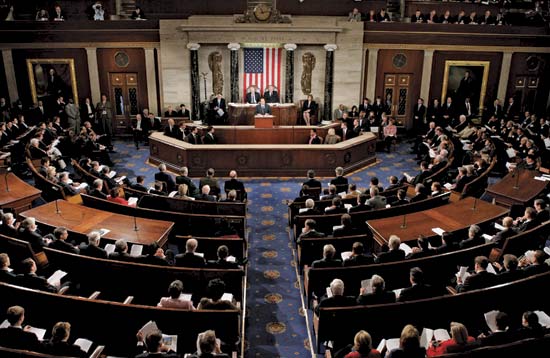 For a good example of this principle in motion, witness the orthodox reaction to anyone who calls for the repeal of the 17th Amendment. (Direct election of senators, if you’re wondering.) Removing this ugly violation from the Constitution it so corrupts is an idea that has long lingered on the fringe (there’s another of those conversation-terminating words) and, until the massive expansion of federal power that marked the past decade and woke up the sleeping libertarians, it seemed destined to remain there in perpetuity. Even now, to declare in public that you think the whole of 1913 was one long, ghastly mistake is to be looked at as if you have just announced that the United States should consider restoring the British monarchy.
Providing what may be the Platonic ideal of such dismissals, Salon’s Alex Seitz-Wald reacted to the renewed interest by declaring in 2012 that, because any increase of democracy was “unquestionably positive,” any modifications were tantamount to “doing away with rights.” America, “we’re told from a young age, is all about democracy,” Seitz-Wald wrote, “and democracy is all about choosing whom you want to be your representative and holding them accountable.” This, he added, “seems like an entirely uncontroversial idea.” I cannot account for Mr. Seitz-Wald’s grasp of America’s history, beyond saying that if he has indeed been told “from a young age” that America is “all about democracy,” then he must be forgiven for believing it. Still, whatever his schools might have told him, the United States is not in fact a democracy but a constitutional republic, and her virtues lie as much in her undemocratic institutions as in her ample provisions for self-rule — more, perhaps.
Doubt it? Look around. Despite the violence that the 17th Amendment did to it, the Senate remains a partially anti-democratic institution; the Supreme Court is an entirely undemocratic institution; the Constitution is undemocratic, too, requiring for any changes to its structure the consent of a supermajority and containing the Bill of Rights, which is as elevated and explicitly counter-majoritarian a component of national law as you will find. The strong American protections of free speech, freedom of religion, the right to bear arms, due process, privacy, and the right to a jury trial are triumphs of minority rights. How about the absence of a state church? Not for nothing did Patrick Henry cry ardently for “liberty or death.” It is liberty, not democracy, that is America’s highest ideal.
Walter Lippmann famously observed that, at some point in their history, “the American people came to believe that their Constitution was a democratic instrument, and treated it as such.” The New York Times’ David Firestone appears to be one of these American people, arguing as he did in 2010 that “a modern appreciation of democracy” makes the idea of directly electing senators “so obvious” that any proposal of change is “unthinkable.” Putting to one side for now the narrow procedural majoritarianism inherent in his definition, Firestone’s thesis runs into two problems: America is not “modern” and it is not a “democracy.” Perish the thought.
Instead, the American system was deliberately designed to balance power between the various branches of government and to guarantee individual rights against majority rule, thus protecting the people from tyranny whether they liked it or not. The United States government was arranged in this way as a permanent bulwark against federal encroachment. “Changing times” was no more a strong justification for the undoing of this system in 1913 than it is now. And whatever the Wilson-era progressives might have held, the federal government was not intended to be a wholly separated layer of government. Instead, it was to be intertwined with the states to such an extent that it could not ride roughshod over their interests without pushback. As James Madison resolved during the debate over the Bill of Rights:
The state legislatures will jealously and closely watch the operations of this Government, and be able to resist with more effect every assumption of power, than any other power on earth can do; and the greatest opponents to a Federal government admit the State Legislatures to be sure guardians of the people’s liberty.
It is exactly here that America’s democracy fetishists go wrong. As Madison makes clear in the Federalist Papers, in order to defend the vertical checks and balances that allow America’s federal system to function, senators would be “elected absolutely and exclusively by state legislatures.” The Senate was not intended to be the people’s representative body, but that of the states. Lest the federal government “swallow up the state legislatures,” George Mason insisted to his fellow convention delegates in Philadelphia, “let the state legislatures appoint the Senate.” The delegates backed him unanimously.
It makes no more sense to argue that to return to this original arrangement would be to “take away” the “rights” of the people than it does to maintain that not being able to vote directly for Supreme Court justices violates their democracy. Everything has its place, and indulging popular sovereignty is simply not what the Senate was designed to do. One could sometimes be forgiven for thinking otherwise, but the states are not regional departments of the federal government. To ensure that they had a working mechanism by which to resist the expansion of federal power, the architects of our Constitution hard-wired the state legislatures into its structure; with the 17th Amendment, progressives pulled out that wiring like punch-drunk Jacobins.
Has there ever been a time when America was more in need of the states’ being represented in Washington? “The People” have their representatives in the House. The nation has its leader in the White House. What of the states? Andrew Napolitano has it right: The 17th Amendment, he gripes, “effectively just gave us another house like the House of Representatives . . . and the states lost their place at the federal table.” This is problematic because, to their great discredit, The People seem not greatly to care how power is structured. Who then is surprised that the abolition of the Senate as the supporting wall of federalism has led inexorably to, as Jefferson warned just before his death, “all government, domestic and foreign, in little as in great things,” being “drawn to Washington as the center of all power”? Returning the selection of senators to state legislatures would help to focus citizens’ eyes locally, where they belong.
“Democracy” may be the cry now. But as Alex Seitz-Wald goes on to acknowledge in his dissent, the primary argument in favor of the 17th Amendment was that it might serve to cut out corruption. Money was said to be rife in politics; direct elections would stamp it out. Lobbying by big business was staining the republic; direct elections would cut the buggers off at the knee. The small constituency that a senator served effectively gave him tenure; an amendment would make the body competitive. Bad behavior among senators was rife; the rigors of direct election would make them moral. And how are things now that the scalpel has been taken to Madison’s handiwork? There is more money in politics than ever before; direct elections have served only to cut out the middleman between lobbyists and politicians; senators rarely lose their seats; and Ted Kennedy killed a woman and got away with it.
In a brilliant Humanitas essay from 1996, C. H. Hoebeke rendered this judgment:
In retrospect, the amendment failed to accomplish what was expected of it, and in most cases failed dismally. Exorbitant expenditures, alliances with well-financed lobby groups, and electioneering sleights-of-hand have continued to characterize Senate campaigns long after the constitutional nostrum was implemented. In fact, such tendencies have grown increasingly problematic.
Americans purchased this dismal failure at the cost of their federal system’s integrity. Like the other two Progressive Era amendments that sit either side, the 17th is a testament to hubris — a parchment admonition of those who would tinker with the permanent in the name of the temporary. Nonetheless, it benefits those who would be required to amend it, which, alas, is a recipe for eternal life in Washington. Repeal is thus almost certainly a dead end; interest in such things is limited. And so the federal titan lumbers on, the states shrinking inexorably in stature. One cheer for democracy, Mr. Wilson.
— Charles C. W. Cooke is an editorial associate at National Review.
Leave a Reply