
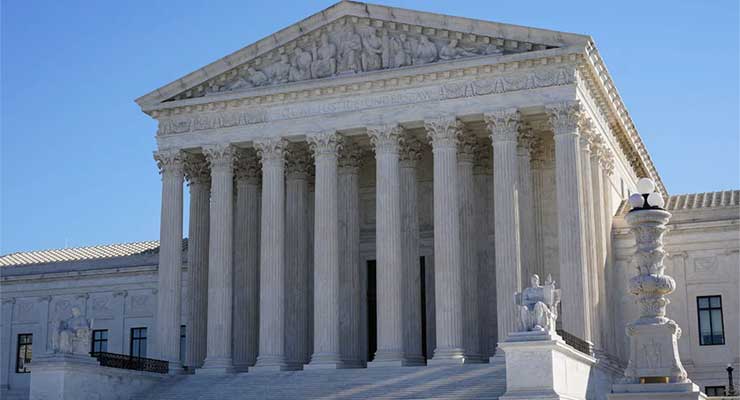
The Supreme Court’s ruling in Louisiana v. Callais marks a major moment in America’s long struggle over voting rights, representation, and the meaning of equal protection under the Constitution.
By striking down Louisiana’s congressional map as an unconstitutional racial gerrymander, the Court reaffirmed a principle that should not be controversial: Government should not sort Americans by race when drawing political power, or for any other reason. That would be racism.
The case arose after Louisiana adopted a congressional map creating a second majority-Black district. The creation of the district was based on the race of those being included. Supporters argued that the map was necessary to comply with the Voting Rights Act. Challengers argued that race had become the dominant factor in drawing the district, violating the Equal Protection Clause (racism). The Supreme Court agreed that the Constitution does not permit states to make race the controlling principle in redistricting, or any other activity.
That ruling is already triggering political shockwaves on the Left. Louisiana has suspended congressional primaries while lawmakers consider a new map, and other states are watching closely as they evaluate whether their own districts can withstand constitutional scrutiny.
But beneath the political consequences lies the deeper constitutional issue: whether America’s election districts should be designed around citizens as individuals—or around racial or other blocs.
The Court’s answer is the right one.
Race-conscious districting has always rested on a dangerous premise: that voters of the same race think alike, vote alike, and must be politically grouped together to have meaningful representation. That idea is defended in the language of so-called civil rights advocates, but it reduces citizens to racial categories, and that is exactly what the Constitution protects us from.
The Constitution promises something better.
The Equal Protection Clause of the Constitution was included to prevent government from treating Americans differently because of race or other identifying characteristics. That principle does not vanish simply because the state claims a ‘benevolent’ purpose.
A district drawn primarily because of race is still a district drawn primarily because of race.
The Court’s ruling does not say states may ignore discrimination. It does not erase the practice of dividing by race from the Voting Rights Act. What it says is that compliance with voting-rights law cannot become a blank check for racial engineering. States must respect both the Voting Rights Act and the Constitution. That balance matters.
For decades, courts have wrestled with the tension between preventing minority vote dilution and preventing racial sorting. Cases such as Shaw v. Reno and Cooper v. Harris made clear that race cannot predominate in redistricting unless the state satisfies strict constitutional scrutiny. The Louisiana ruling follows that same constitutional path: race may be considered in limited ways, but it cannot become the mapmaker’s master key.
Critics of the decision argue that it will weaken minority representation and make it harder to challenge discriminatory maps. That concern deserves to be heard, but the answer cannot be to permanently divide Americans into racial districts.
A republic cannot flourish if its election system teaches citizens that race is destiny.
The better standard is one rooted in equal citizenship. Districts should be compact, coherent, and grounded in geographical communities of interest, not manipulated to produce racial outcomes demanded by Leftist political activists, party strategists, or federal judges.
That is especially important because racial gerrymandering often masks partisan motives. Both parties know that race and party preference frequently overlap in modern politics, although that is becoming less true. That creates an obvious temptation: claim racial necessity while pursuing partisan advantage.
The Court’s decision helps close that loophole.
States should not be allowed to hide political manipulation behind racial classifications. Nor should judges pressure legislatures into drawing districts that violate one constitutional command in the name of satisfying a statute.
The Voting Rights Act was designed to protect Americans from discrimination. It should not become a tool for institutionalizing race as the organizing principle of American elections, which IS racial discrimination.
The left will call this decision an attack on voting rights. It is not. It is a defense of the most basic voting right of all: the right to be treated as an individual citizen, not as a member of a racial category.
America has spent generations trying to move beyond government-imposed racial classifications. The Court’s ruling is a positive step in that direction.
The principle is simple. No racial spoils system. No racial mapmaking. No assumption that skin color determines political identity.
The Constitution protects citizens, not racial coalitions, and in Louisiana v. Callais, the Supreme Court was right to say so.
Leave a Reply