
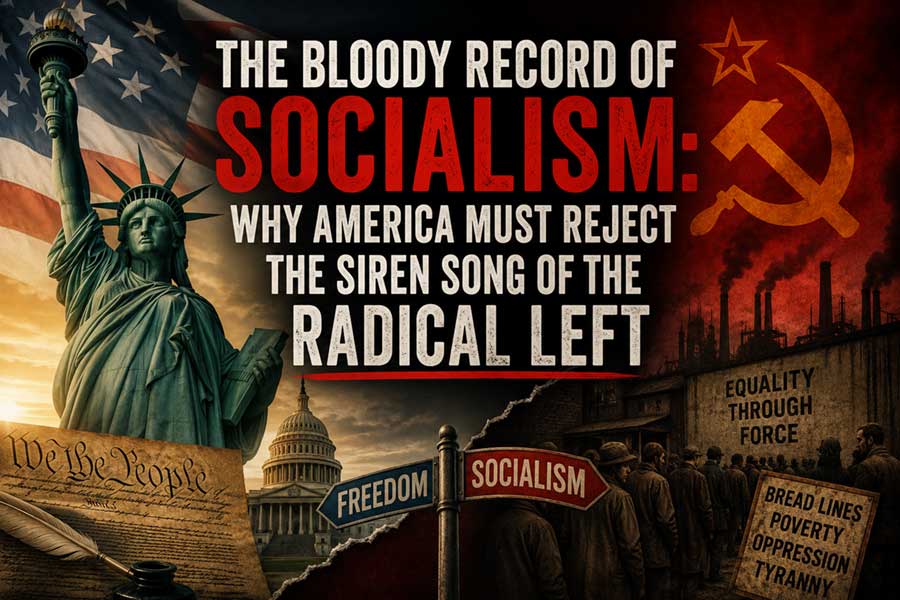
From Marx to Mao, from Stalin to Venezuela, history has rendered its verdict on socialism. America ignores that verdict at its peril.

Every generation is tempted by old ideas repackaged in new slogans.
Today, America is witnessing a remarkable phenomenon. Politicians who, only a decade ago, would have hidden their socialist beliefs now proudly campaign under banners proclaiming themselves “Democratic Socialists.” College campuses celebrate Karl Marx. Radical activists openly advocate wealth redistribution, government ownership of key industries, universal income, rent controls, nationalized healthcare, and the ever-expanding power of Washington over the lives of ordinary Americans.
The Democratic Party itself has undergone a dramatic ideological transformation. What was once a party that generally accepted free enterprise while advocating a larger safety net has steadily migrated toward a philosophy that increasingly views government—not individual liberty—as the primary engine of prosperity and justice.
History, however, has already conducted this experiment. It failed. Every single time.
Socialism Always Begins With Noble Promises
Socialism rarely begins with dictators. It begins with promises. Politicians promise fairness. They promise equality. Then they promise equity.
They promise free healthcare. Free education. Free housing. Free childcare. Free college. Guaranteed incomes.
They insist that only the wealthy will pay for all these things. They tell struggling citizens that government can eliminate hardship simply by taking more from those who have succeeded. It is an appealing message. Unfortunately, economics, and history, are not governed by wishful thinking. They are governed by reality.
Margaret Thatcher understood this better than most leaders of the twentieth century: “The problem with socialism is that eventually you run out of other people’s money.” Those words have been vindicated repeatedly.
The Twentieth Century Became Socialism’s Greatest Indictment
No political philosophy has left a trail of human misery comparable to that produced by Marxist socialism and communism.
The Soviet Union promised workers’ paradise. Instead, Joseph Stalin built one of history’s most brutal police states. Tens of millions died through forced collectivization, engineered famine, executions, political purges, and labor camps.
Communist China under Mao Zedong promised equality. The result was the Great Leap Forward, perhaps the worst man-made famine in history. Scholars estimate that tens of millions perished.

Cuba exchanged political freedom for permanent economic stagnation.
Cambodia’s Khmer Rouge attempted to create an agrarian socialist utopia. Nearly one-quarter of the country’s population was exterminated.
Venezuela transformed itself from one of South America’s wealthiest nations into an international symbol of economic collapse, shortages, inflation, and mass migration after embracing socialist economic policies.
The precise historical death toll remains debated among scholars, but many historians estimate that communist governments were responsible for well over 90 million deaths during the twentieth century through famine, forced labor, political repression, imprisonment, and execution.
No other economic theory has produced a comparable record of catastrophe.
Why Socialism Always Fails
The failure is not accidental. It is built into the system itself. Socialism replaces millions of individual economic decisions with centralized political planning. Instead of consumers deciding what succeeds, politicians decide. Instead of entrepreneurs risking their own capital, bureaucrats allocate other people’s money. Instead of rewarding innovation, socialism increasingly rewards political influence.
Eventually incentives disappear. Investment slows. Productivity declines. Government spending expands faster than economic growth. Taxes rise. Debt explodes. Inflation follows.
Government then responds with more controls, more regulations, more subsidies, and still more intervention.
The cycle repeats until economic collapse becomes unavoidable. The lesson has been repeated across continents for more than a century.
America’s Slow Drift Left
The United States has never embraced full socialism. But over many decades the Democratic Party has increasingly advocated expanding federal authority over larger portions of American life. Programs created during the New Deal dramatically enlarged Washington’s role.
Later administrations expanded Medicare, Medicaid, federal education spending, housing programs, environmental regulation, and welfare benefits.
The Affordable Care Act, better known as Obamacare, represented another significant expansion of federal involvement in healthcare, increasing regulation and government oversight while expanding insurance coverage.
More recently, many progressive politicians have proposed government-funded college tuition, Medicare for All, universal basic income, student debt forgiveness, wealth taxes, federal rent controls, and other policies that would further expand the role of government in directing economic activity.
Supporters argue these proposals provide greater economic security. Critics contend they move the nation incrementally toward a system of greater dependency on government and reduced economic freedom.
The Rise of Self-Described Democratic Socialists
What once existed primarily on the political fringe now occupies an increasingly visible place within the Democratic coalition. Senator Bernie Sanders has long identified as a democratic socialist. Representative Alexandria Ocasio-Cortez has promoted expansive government programs through the Democratic Socialists of America.
A growing number of state and local candidates now openly campaign using socialist labels that would have been politically unthinkable only a generation ago. Some argue they merely seek Scandinavian-style social democracy. That comparison deserves closer examination.
The Scandinavian Myth
Critics of free markets frequently point to Sweden, Denmark, Norway, and Finland as examples of successful socialism. The comparison is misleading. These countries are not socialist economies in the traditional sense. Private ownership dominates their economies. Markets remain highly competitive. Property rights are strongly protected. Entrepreneurship is encouraged.
Indeed, Sweden undertook significant market-oriented reforms after economic problems associated with its more expansive state model in the 1970s and 1980s.
What distinguishes Scandinavian nations today is not government ownership of the means of production but relatively high taxation combined with extensive public services operating within market-based economies. Those systems also developed within comparatively small populations possessing high levels of social trust and historically greater cultural homogeneity than the modern United States.
Whether such models are desirable is a legitimate subject of debate. But they are not evidence that traditional socialism has succeeded.
America’s Constitution Was Designed to Prevent Class Warfare
The Framers understood one danger above many others. Democracy, untethered from constitutional restraints, can become nothing more than legalized plunder. James Madison warned repeatedly against factions using political power to confiscate the property of others. The Constitution therefore established a constitutional republic, not a pure democracy.
Individual rights exist precisely so that temporary political majorities cannot simply vote away the liberty or property of minorities. Private property is not merely an economic concept. It is one of the fundamental pillars of personal freedom.
A government empowered to redistribute wealth at will eventually acquires the power to control every aspect of economic life, and life generally.
That is precisely why the Founders placed constitutional limits on government rather than trusting politicians to exercise restraint voluntarily.
Why This Debate Matters
Supporters of socialism often insist that “this time will be different.” History offers little reason for such confidence. The names change. The slogans evolve. The promises become more polished. Yet the underlying philosophy remains remarkably consistent.
Government grows. Individual liberty contracts. Economic freedom declines. Political power concentrates. The productive are asked to finance ever-expanding promises until those promises become impossible to sustain.
As Winston Churchill observed: “The inherent vice of capitalism is the unequal sharing of blessings. The inherent virtue of socialism is the equal sharing of miseries.”
The remark was characteristically sharp, but history has repeatedly vindicated its central point.
America Still Has a Choice
President Donald Trump has repeatedly declared that socialism and communism have no place in the United States and has pledged to oppose efforts to expand those ideologies in American public life. This is why the Left treats him as an existential threat. He is—to their Leftist takeover of the nation. Whether one agrees with every aspect of his agenda or not, the broader warning reflects a historical reality: free societies do not remain free by accident.
Every generation inherits the responsibility of preserving liberty. The American “experiment” has produced unprecedented prosperity not because government planned it, but because millions of free citizens were permitted to build businesses, own property, invest, innovate, compete, fail, and succeed without the constant direction of the state.
Socialism offers a seductive promise of equality through centralized power. The historical record tells a different story. It has consistently produced less freedom, less prosperity, and greater human suffering.
America would be wise to remember that history before repeating it.
Leave a Reply