

Washington just crossed another procedural Rubicon.
While most headlines focused on the Senate confirming nearly 50 of President Trump’s nominees tied to energy, land management, diplomacy, and executive agencies, the real story was not the nominees themselves.
The real story was how Republicans were able to confirm them.
In one of the most consequential Senate procedural moves in years, Senate Republicans invoked a modified form of the “nuclear option” to weaken the filibuster for large blocs of lower-level executive nominees, allowing confirmations to proceed by simple majority rather than through the Senate’s traditional slow-motion confirmation machinery.
That matters far beyond the fate of a few dozen Trump appointees. It marks yet another step in the decades-long erosion of one of the Senate’s defining characteristics: the minority party’s ability to slow, obstruct, or force compromise through procedural leverage.
The irony, of course, is overwhelming.
For years, Democrats openly threatened to abolish or severely weaken the filibuster whenever it stood in the way of their progressive legislation. Republicans warned such moves would permanently damage Senate norms and unleash escalating retaliation.
Now Republicans themselves are carving out new exceptions to Senate tradition in order to accelerate Trump’s governing agenda. And they are doing it using the exact parliamentary weapon Washington now casually calls the “nuclear option.” Or, at least a watered down version.
The mechanics are arcane but important.
Under traditional Senate procedure, the minority party can effectively delay action by refusing unanimous consent and forcing lengthy procedural votes and debate periods. Breaking that obstruction usually requires 60 votes to invoke cloture and cut off debate.
Before Americans debate yet another erosion of Senate tradition, it is worth remembering that the Senate itself was once fundamentally different. Originally, U.S. senators were chosen by state legislatures under Article I of the Constitution, serving in part as institutional defenders of state sovereignty and as a stabilizing counterweight to the more populist House of Representatives. That changed with the Seventeenth Amendment in 1913, which shifted Senate elections directly to the people. Supporters called it democratic reform; critics argue it transformed the Senate from a reflective body designed to slow sudden political passions and protect federalism into a second popularly elected chamber increasingly responsive to national political movements, donor networks, party machinery, and organized interest groups. In the view of many constitutional traditionalists, the Senate gradually became less of a brake on majoritarian momentum and more of another battlefield where competing factions seek legislative advantage through federal power.
Republicans did not technically eliminate the legislative filibuster this time. Bills still generally require 60 votes to overcome obstruction. But Senate Majority Leader John Thune engineered a precedent change allowing large batches of lower-level executive nominees to move through the chamber under a simple-majority standard rather than the older supermajority framework.
In practical terms, this dramatically speeds up confirmations. Instead of forcing the Senate to grind through nominees one at a time — consuming precious floor time for days or weeks — Republicans can now move blocs of nominees together.
And Democrats are furious. Senate Democrats argue the GOP is destroying institutional guardrails and weakening oversight in order to install Trump loyalists more rapidly throughout the federal government.
Republicans counter that Democrats themselves started this process years ago. They are not wrong.
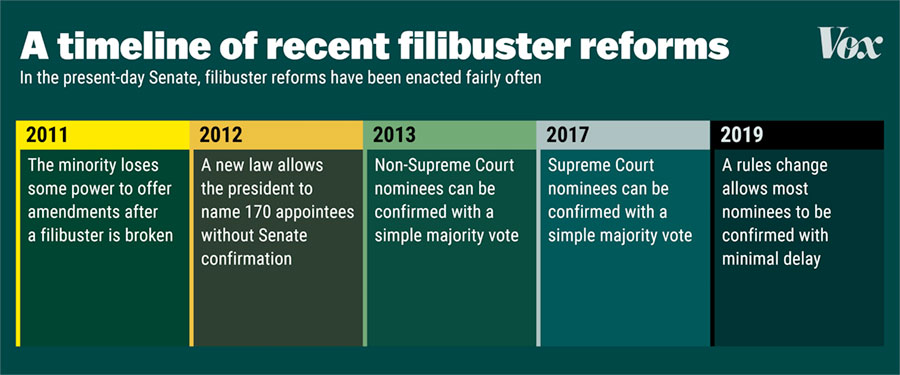
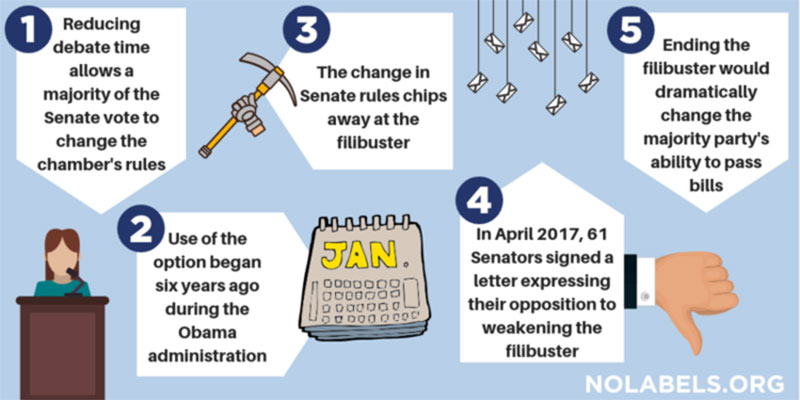
The modern Senate arms race over the filibuster began in earnest under President Obama. In 2013, then-Senate Majority Leader Harry Reid used the nuclear option to eliminate the 60-vote threshold for most executive branch and lower federal court nominees.
Republicans then expanded the precedent in 2017 to allow Supreme Court nominees to advance by simple majority, clearing the way for Justice Neil Gorsuch. In 2019, Republicans further reduced post-cloture debate time for many nominations.
Now comes the next escalation. Each side insists it is merely responding to abuses committed by the other side first. And in fairness, there is some truth in that claim on both sides.
But the broader institutional trend is unmistakable: The Senate is slowly transforming from a deliberative body built around minority protections into a chamber increasingly governed by raw majoritarian power.
For conservatives, this creates both satisfaction and danger. The satisfaction is obvious. Republican voters elected Trump specifically to reshape the executive branch, dismantle bureaucratic resistance, expand domestic energy production, reverse Biden-era environmental rules, and install officials aligned with his agenda. Delaying confirmations indefinitely through procedural obstruction would effectively nullify election outcomes.
That is the Republican argument. And politically, it is powerful. But there is also danger in normalizing continual rule erosion.
Every time one party weakens Senate procedure to achieve short-term victories, the other party inherits the new precedent later. That is how institutional escalation works in Washington. Temporary tactical advantages eventually become permanent structural changes.
Democrats know this because they started it. Republicans know this because they warned about it.
And yet here we are, again. The most fascinating aspect of the current fight may be the complete inversion of rhetoric. Democrats who once championed weakening the filibuster now defend Senate tradition with almost constitutional reverence.
Republicans who once defended Senate tradition now argue procedural hardball is necessary to overcome obstruction tactics by the Left. Washington’s principles often seem remarkably flexible depending on who controls the majority leader’s office.
Still, Republicans appear to have calculated that the political moment favors action over restraint. And they may be right.
The American public did not elect Donald Trump to watch hundreds of executive branch positions remain vacant while the Senate spends months drowning in obstructionist procedural warfare. Republicans clearly decided voters expect results, not parliamentary nostalgia.
So the Senate has changed again. Not completely. Not yet. But enough to remind Washington of a lesson both parties keep relearning: Once one side uses the nuclear option, the fallout never stays contained for long.
Leave a Reply