
After four tranches of declassified records, Americans finally have what previous administrations refused to provide: access to the evidence itself.
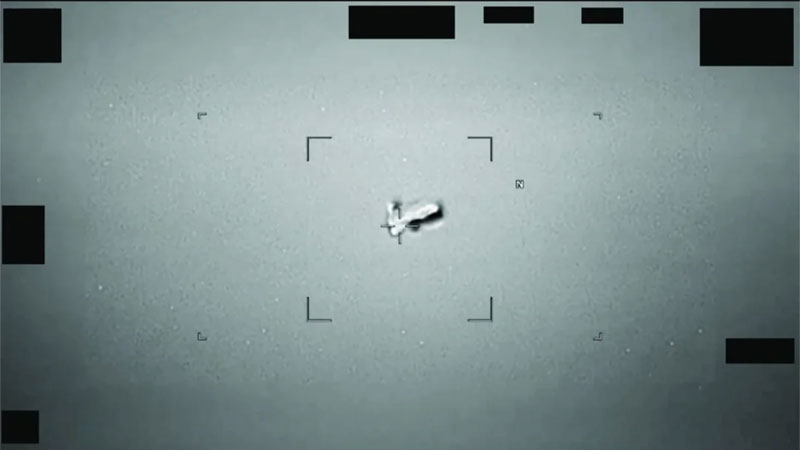
One of the most remarkable transparency initiatives in modern American history quietly continued today as the Trump administration released the fourth tranche of declassified UFO—or, in Pentagon terminology, Unidentified Anomalous Phenomena (UAP)—records through the Department of War’s Presidential Unsealing and Reporting System for UAP Encounters (PURSUE).
Whether one believes these incidents involve advanced foreign technology, secret American programs, natural phenomena, or something more extraordinary, one fact has become increasingly difficult to dispute: The United States government has acknowledged that it possesses hundreds of reports, photographs, videos, radar tracks, pilot accounts, and investigative records documenting aerial phenomena it cannot readily explain.
That alone represents an extraordinary departure from decades of official secrecy.
The Fourth Release Is the Most Diverse Yet
According to the Department of War, today’s release contains approximately 40 newly declassified records, including:
- 19 videos
- 14 investigative documents
- 4 audio recordings
- 3 still photographs
The material comes from multiple federal agencies, including the Pentagon, NASA, the CIA, the FBI, and the Department of Energy.
Unlike previous releases, this tranche focuses heavily on more recent military encounters and sensor recordings.
The “Star-Shaped” Object
Perhaps the most discussed item is an 18-second military video showing a strange six-pointed or star-shaped object tracked over the Yellow Sea by U.S. Indo-Pacific Command sensors. Officials have offered no definitive explanation.
The object displays an unusual geometry unlike conventional aircraft silhouettes, and investigators have not publicly attributed it to any known platform. Whether the appearance results from optics, imaging artifacts, an unconventional drone, or something else remains unknown. But the footage is already generating significant public interest.
Nuclear Facilities Continue to Appear
Another newly released case involves a 2015 incident over the Pantex Plant in Texas, America’s principal nuclear weapons assembly and disassembly facility.
Military personnel documented an unidentified object operating near one of the nation’s most sensitive strategic installations. For decades, researchers have noted that many of the government’s most intriguing UAP reports seem to cluster around:
- nuclear missile bases
- strategic bomber facilities
- naval strike groups
- weapons laboratories
Today’s release adds another example to that long-running pattern.
Some Cases Become Less Mysterious
Not every newly released record points toward something extraordinary. One report involving a so-called “jellyfish” object over the Atlantic appears likely to have involved an ordinary balloon. Perhaps. That, too, is valuable. A transparent investigative process should eliminate mundane explanations whenever possible.
The objective is not to prove extraterrestrial visitation. It is to separate the explainable from the genuinely unexplained.
Looking Back at All Four Releases
Viewed together, the four releases paint a fascinating picture.
Among the material released over the past several months are:
- military cockpit videos
- infrared tracking footage
- astronaut observations
- FBI investigative memoranda
- NASA imagery
- law-enforcement reports
- eyewitness testimony
- radar records
- intelligence summaries
- audio recordings
- photographs
Several recurring themes have emerged.
Objects displaying unusual flight characteristics
Numerous reports describe objects capable of abrupt, or even instantaneous accelerations, hovering, or movements difficult to reconcile with conventional aircraft.
Military interest
Many sightings originate not from civilians but from trained military personnel operating sophisticated sensor systems.
Nuclear connections
Repeated reports involve strategic military installations and nuclear facilities.
Persistent uncertainty
Perhaps most striking is how often official investigators conclude not that an object was extraterrestrial, but simply that there was insufficient information to identify it as human technology with confidence. That distinction matters.
“Unidentified” does not automatically mean “alien.” Although it could. It simply means investigators could not determine what was observed, and it was unconventional enough to categorize it as unknown.
Transparency Is the Real Story
Some critics have dismissed the releases because none so far contains definitive proof of extraterrestrial life.
That criticism misses the point. President Trump did not promise proof of aliens. He promised transparency.
For decades Americans were told that such files either did not exist or could not be released. Today, thousands of pages of government records, videos, photographs, and investigative files are publicly available for independent analysis.
Scientists, engineers, pilots, historians, and ordinary citizens may now examine much of the same material previously confined to classified archives.
Whether every mystery eventually receives a conventional explanation remains to be seen. But the principle behind the releases is sound.
In a constitutional republic, information should remain classified only when national security genuinely requires it, not simply because disclosure might prove embarrassing or politically inconvenient.
What Readers Should Look At First
For readers visiting the Department of War’s UFO portal, several items stand out:
- The newly released six-pointed “star” object video over the Yellow Sea.
- The Pantex nuclear facility case, documenting a UAP near one of America’s most sensitive weapons sites.
- Military infrared tracking videos from earlier tranches showing unusual objects observed by U.S. aircraft.
- Apollo-era records and astronaut observations released during the first tranche, which remain among the most historically interesting materials.
- The FBI and Pentagon investigative reports that reveal how seriously many of these incidents were treated internally, regardless of their ultimate explanation.
The Conversation Has Changed
Perhaps the greatest accomplishment of the four releases is not what they prove. It is what they have made possible. For decades, discussions about UFOs were largely confined to speculation and rumor. Today, they increasingly revolve around authentic government records, military sensor data, and official investigative files available for public scrutiny.
Whether these phenomena ultimately represent advanced foreign technology, misunderstood natural events, classified aerospace programs, or something entirely unexpected, one conclusion is already justified: The American people are far better served by transparency than by secrecy.
And after four successive releases, it appears that the current declassification effort is only beginning. Thank you, President Trump!
Leave a Reply