
Newly released Census and Labor Department figures contain some strikingly positive news for American households. Income reached a record high in 2025, child and Hispanic poverty reached record lows, and the latest employment report showed a sharp rebound in job creation. The numbers strengthen the economic case for President Trump’s agenda—but the underlying government data tell a more nuanced story in some areas.
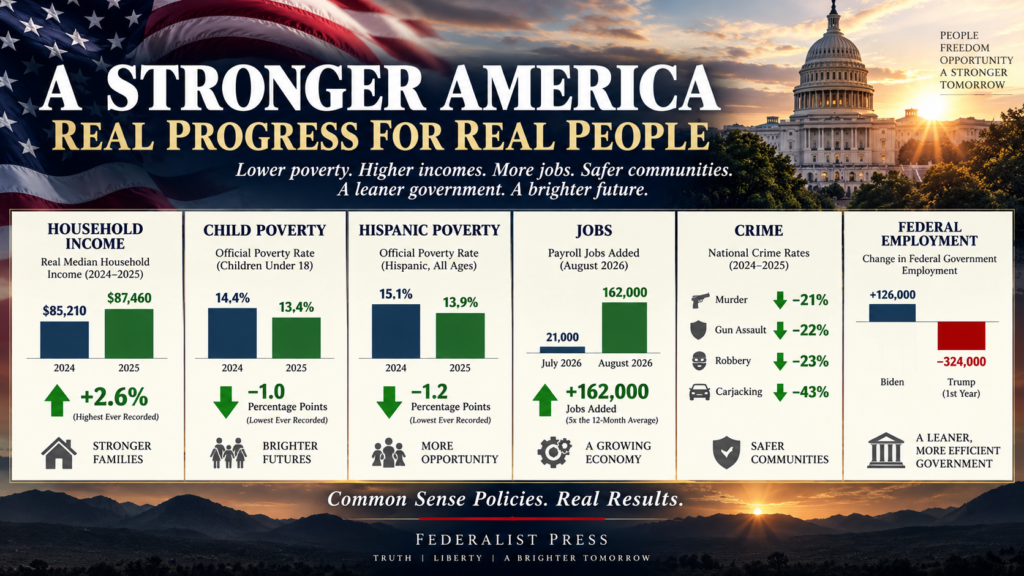
Americans have spent years hearing about inflation, affordability, government debt and economic anxiety. Those problems have not vanished. But a remarkable collection of statistics released by the federal government this month deserves attention for another reason: several important measures of American economic well-being moved decisively in a favorable direction during 2025, the first year of Donald Trump’s second administration.
Median household income reached the highest level ever recorded by the Census Bureau. Official child poverty fell to the lowest level in the government’s historical series. Hispanic poverty reached its lowest recorded level. Black households registered a particularly large increase in median income. And the latest employment report, covering August 2026, showed payroll growth rebounding sharply after a period of weak job creation during the Biden years.
Those results form the centerpiece of a new economic assessment from the Committee to Unleash Prosperity, the conservative economic-policy organization associated with economists Stephen Moore, Arthur Laffer and Steve Forbes. Its presentation is unabashedly favorable to Trump’s economic record and compares a series of indicators under Trump and former President Joe Biden. The Economic State of the Union — Unleash Prosperity
And several of those numbers are striking.
Household Income Reaches a Record
The Census Bureau reported September 15 that median U.S. household income reached $87,460 in 2025, up from $85,210 in 2024. Adjusted for inflation, that was an increase of 2.6 percent in a single year.
More significantly, Census says 2025 median household income was the highest recorded in its data series going back to 1967.
Americans don’t experience prosperity merely through changes in GDP or the stock market. What ultimately matters to a household is what its income can purchase after accounting for rising prices.
The gains were not confined to the highest-income households. Census reported that median income increased 3 percent among White households and 4.8 percent among Black households between 2024 and 2025. The estimates for Asian and Hispanic households did not show statistically significant changes.
A 4.8 percent real increase in median Black household income is substantial.
There is additional good news after taxes. Census found that median household income after accounting for taxes and credits increased 3.1 percent, from $73,760 in 2024 to $76,060 in 2025.
Child Poverty Hits a Historic Low
Perhaps the most consequential statistic has received considerably less attention than most monthly political controversies. According to the Census Bureau, the official poverty rate among American children fell to 13.4 percent in 2025—the lowest level ever recorded under the official measure.
The overall official poverty rate also declined, from 10.7 percent in 2024 to 10.2 percent in 2025, leaving approximately 34.5 million Americans below the official poverty threshold.
The official measure compares pretax money income with poverty thresholds based on family composition. The Supplemental Poverty Measure incorporates taxes, government benefits, housing costs, work expenses and medical expenses.
By America’s long-established official poverty measure, child poverty reached an historic low in 2025. That is genuinely important news.
Hispanic Poverty Also Reaches a Record Low
The Hispanic poverty numbers are similarly striking. Census reports that the official Hispanic poverty rate dropped 1.2 percentage points in 2025, reaching 13.9 percent—the lowest recorded level in the historical series. Census says the record remains even after accounting for methodological changes in the survey over time.
Other groups also experienced declines. The Unleash Prosperity presentation highlights the racial and ethnic breakdown and argues that the gains undermine claims that Trump’s economic policies primarily benefit wealthy Americans.
The data establish the improvement. Annual income and poverty outcomes reflect many forces simultaneously: wages, employment, inflation, monetary policy, previous legislation, demographic changes and broader economic conditions.
Record real household income, record-low official child poverty and record-low Hispanic poverty are consequential economic developments and Trump’s policies certainly have earned the political credit.
Then Came a Much Stronger Jobs Report
The newest employment report adds another favorable development. The Bureau of Labor Statistics reported on September 4 that employers added 162,000 payroll jobs in August, while unemployment remained at 4.1 percent.
The improvement from July was dramatic. July produced only 21,000 additional jobs. Over the previous 12 months, monthly job growth had averaged approximately 31,000. August’s 162,000 therefore represented more than five times the preceding 12-month monthly average.
Food services and drinking establishments added about 59,000 jobs. Local-government education added approximately 42,000. Manufacturing added 16,000, while information employment declined by 23,000.
Government Employment Is Moving in the Opposite Direction
One of Unleash Prosperity’s most dramatic charts concerns federal employment.
Its argument is ideological as well as economic: private-sector employment produces goods and services in the marketplace, while government employment is financed through taxation and borrowing. The organization therefore presents reductions in federal payrolls under Trump as evidence of “draining the swamp.”
The underlying direction is real: the federal workforce has contracted significantly since Trump returned to office. The precise comparison depends heavily upon which starting and ending months are chosen and how employees receiving severance or paid leave are counted, so the group’s headline figure should not be treated as a simple measure of government savings.
What can safely be said is that Trump’s second administration has deliberately pursued a smaller federal workforce while the Biden administration generally presided over federal employment growth.
The Inflation Story Is Better Than 2022
One of the most visually arresting Unleash Prosperity charts traces inflation from the Biden years into Trump’s second administration.
There is an important truth behind it: inflation reached 9.1 percent in June 2022, the highest 12-month CPI increase in four decades, before declining considerably.
The Bureau of Labor Statistics reported last week that consumer prices rose 0.4 percent in August 2026 and were 3.4 percent higher than a year earlier. Core inflation, excluding food and energy, was 2.4 percent over the year. Gasoline prices were responsible for more than one-third of August’s monthly increase.
Economic Growth Continues
The economy itself continues to expand. Real GDP grew at a 2.1 percent annual rate in the first quarter of 2026 and 1.5 percent in the second quarter, according to the Bureau of Economic Analysis. Consumer spending, exports and investment contributed positively to second-quarter growth, while declining government spending partially offset them.
The composition is noteworthy. An economy in which private consumption, investment and exports expand while government spending contracts is different from one in which headline GDP growth depends heavily upon expanding public expenditures.
The third-quarter numbers, due later, will tell us considerably more about whether the August employment rebound is part of a broader acceleration.
Retirement Accounts Have Benefited From Strong Markets
Unleash Prosperity also highlights retirement accounts, arguing that average 401(k) balances lost purchasing power during the Biden years but have increased substantially during Trump’s two terms.
This is an area where the organization’s calculation requires more caution than its graphic suggests.
A 401(k) balance is affected not merely by presidential economic policy but by employee contributions, employer matches, withdrawals, participant demographics, asset allocation, interest rates and financial-market performance. Comparing average balances at presidential endpoints therefore cannot establish that a president personally “created” or “destroyed” the difference.
Nevertheless, strong equity markets and rising asset values unquestionably matter to tens of millions of Americans with retirement accounts. For households with substantial market exposure, asset appreciation can be an important component of financial well-being even when it doesn’t appear in household-income statistics.
Crime Has Fallen Dramatically
Another chart supplied by Unleash Prosperity attributes large crime reductions to Trump. The underlying decline is real—and remarkable.
The Council on Criminal Justice found that in its sample of large cities, homicide fell 21 percent in 2025 compared with 2024, gun assaults fell 22 percent, robbery 23 percent and carjackings 43 percent.
The improvement continued in 2026. During the first half of this year, homicide was another 18 percent lower than during the corresponding period of 2025, robbery fell 17 percent and carjacking fell 47 percent.
What the Numbers Actually Tell Us
The emerging economic picture contains a substantial amount of good news.
In 2025, inflation-adjusted median household income rose 2.6 percent and reached a record. Black median household income increased 4.8 percent. Official child poverty reached a record low. Hispanic poverty reached a record low. Overall official poverty declined. After-tax median household income increased. Crime continued falling dramatically. And now August 2026 has produced the strongest payroll-growth month in some time.
The Biden years included the 2021–22 inflation surge that sharply reduced household purchasing power.
Americans will ultimately judge Trump’s policies by results accumulated over years, and the latest results provide plenty worth noticing.
American household income is at a record high. Official child poverty is at a record low. Hispanic poverty is at a record low. Unemployment is 4.1 percent. August produced 162,000 new payroll jobs. And several categories of violent crime have continued their steep decline.
Those aren’t campaign slogans. They are measurements appearing in the latest reports from the Census Bureau, Bureau of Labor Statistics and independent crime researchers. And in an era when Americans are accustomed to being told what’s going wrong, they are also a reminder that sometimes the numbers contain genuinely good news.
Leave a Reply