
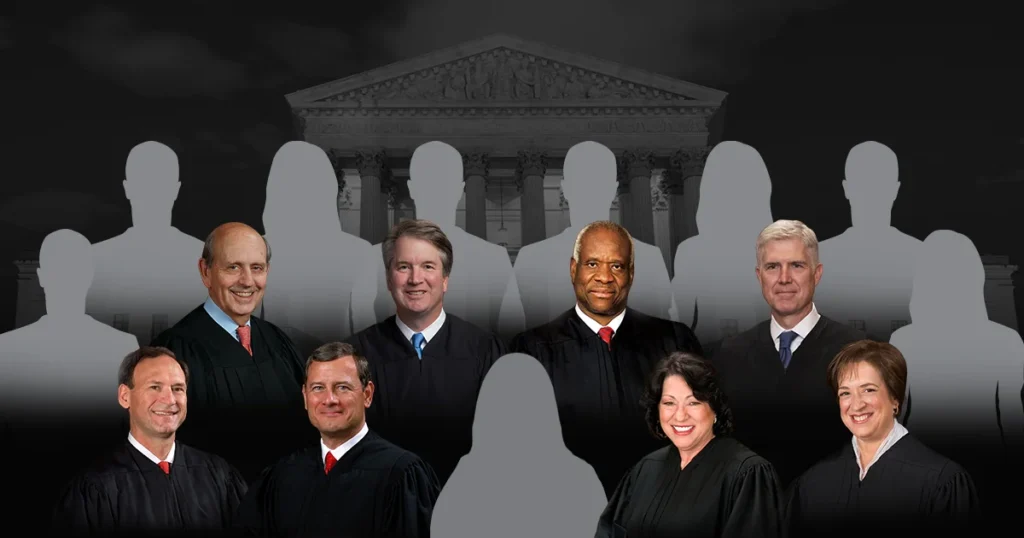
For years, many progressive Democrats have argued that the Supreme Court should be expanded by four seats. They call it “court reform.” Others call it “court balancing.” Critics have called it by a more accurate name: court packing.
The argument is simple. Democrats dislike the current ideological makeup of the Court, so they propose changing the rules until they achieve a different outcome. It is a remarkable admission that the problem is not with the Constitution, nor even with the qualifications of the justices. The problem, they argue, is simply that too many justices disagree with them.
But there is a simple thought experiment that exposes the weakness of the entire proposal.
If expanding the Supreme Court by four justices is fair when Democrats control Washington, why wouldn’t it be equally fair for President Donald Trump and a Republican Congress to do exactly the same thing? Now!
Imagine President Trump announcing tomorrow that he intends to appoint four additional constitutional originalists to the Supreme Court. Would the same politicians who have spent years demanding court expansion applaud his commitment to institutional reform?
Of course not.
They would denounce it as authoritarian. They would call it an assault on democracy. Editorial boards would declare the judiciary under attack. Cable news networks would run wall-to-wall coverage warning of constitutional crisis.
The very people who have insisted that adding four seats is perfectly legitimate would suddenly discover that it is dangerous, reckless, and fundamentally unfair.
That reaction reveals the truth.
The debate has never really been about the number of justices.
It has always been about who gets to appoint them.
The Supreme Court has consisted of nine justices since 1869. That number is not fixed by the Constitution, but it has endured through Republican and Democratic administrations alike because both parties gradually recognized that constantly changing the size of the Court would destroy public confidence in its independence.
Once one party expands the Court for political advantage, the other party has every incentive to respond in kind.
Nine becomes thirteen.
Thirteen becomes seventeen.
Seventeen becomes twenty-one.
Eventually the Supreme Court ceases to function as an independent judicial branch and instead becomes another political battlefield whose membership changes whenever power changes hands. Supreme Court Justices become political activists, appointed by the party what holds the White House.
The institution itself becomes the casualty.
Even President Franklin Roosevelt—perhaps the most powerful Democratic president of the twentieth century—failed in his attempt to enlarge the Supreme Court after the justices struck down portions of the New Deal. Roosevelt argued that additional justices were necessary for efficiency. Few believed him. Americans understood that the proposal was fundamentally about changing judicial outcomes rather than improving judicial administration.
Congress rejected the idea, including many members of Roosevelt’s own party.
History has generally vindicated that decision.
The genius of the American constitutional system lies in its separation of powers. The judiciary was intentionally insulated from day-to-day politics precisely so that constitutional rights would not depend upon whichever party happened to win the most recent election.
Court packing undermines that safeguard.
Ironically, many of the same politicians advocating Supreme Court expansion have spent years warning that American institutions must be protected from political interference. Yet they propose changing one of the nation’s oldest institutions because they dislike its current decisions.
That is not judicial reform.
It is political retaliation.
There is another question that proponents rarely answer. If four additional justices are appropriate today, why stop there?
Why not six? Why not ten?
What constitutional principle determines the “correct” number of justices?
There is none.
The only apparent principle is obtaining enough votes to guarantee preferred outcomes.
That is a dangerous precedent regardless of which party holds power.
Those who support court packing today should remember that political fortunes change. Every tool one administration creates eventually becomes available to its successor. That is exactly why the GOP refuses to do away with the filibuster; a tool that works against them currently.
If expanding the Court is acceptable when progressives hold the White House, it must also be acceptable when conservatives do.
If President Trump were to announce tomorrow that he intended to appoint four new constitutional originalists to a newly expanded Supreme Court, would today’s advocates of court packing cheer the decision?
Their answer would almost certainly be no. And that answer tells us everything we need to know.
The issue has never been the number nine. The issue has always been power.
The American people should be wary of any proposal that changes the rules of our constitutional system simply because one political faction dislikes the current outcome. The Constitution was designed to restrain temporary political passions, not surrender to them. Preserving the independence and legitimacy of the Supreme Court ultimately requires something increasingly rare in modern politics: the willingness to respect institutions even when they do not always produce the decisions we prefer.
Leave a Reply