
The most important revelation may not be a single photograph or video. It is that the United States government has finally acknowledged, in public and at scale, that it has spent decades collecting and studying phenomena it often could not explain.
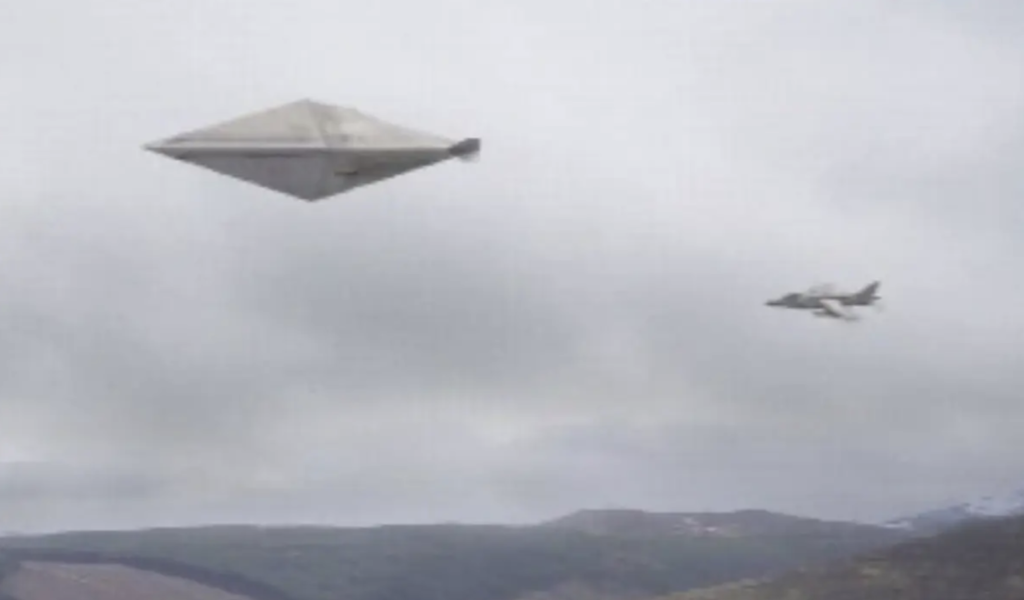
Something extraordinary has happened in Washington over the past several months, and it risks being missed because Americans have been conditioned to expect “disclosure” to arrive as a single spectacular photograph of an alien spacecraft or a president standing behind a podium announcing that mankind is not alone.
That is not what has happened. In fact, from what President Trump has said in the past, it appears that he and his tops officials have not been read officially into the government’s legacy UAP programs yet, but are exerting force within the government to obtain all of the records.
Instead, President Donald Trump directed the federal government to begin identifying, reviewing, declassifying, and releasing records involving UFOs and Unidentified Anomalous Phenomena. Five separate tranches have now been published through the Department of War’s Presidential Unsealing and Reporting System for UAP Encounters—PURSUE—beginning May 8 and continuing through the fifth release on August 7. The Department says the effort involves dozens of agencies, tens of millions of records, material extending across many decades, and additional releases expected on a rolling basis. See documents>
That statement alone represents remarkable progress.
For generations, Americans who suspected that the government had taken UFO reports seriously were routinely portrayed as conspiracy theorists. Yet the government’s own disclosure portal now openly acknowledges that agencies throughout the national-security establishment possess decades of UAP-related records, that many remain unresolved, and that officials are conducting a government-wide effort to locate and release them. The Department explicitly states that the cases published through PURSUE remain unresolved because officials cannot make definitive determinations about what was observed.
That does not mean the Pentagon has announced that extraterrestrials are visiting Earth.
It means something more modest, but historically important: the phenomenon was real enough to investigate, important enough to classify, persistent enough to generate records across generations, and unresolved enough that the government is now asking outside scientists and researchers to help evaluate the evidence.
That is a very different world from the one Americans inhabited only a decade ago.
The Fifth Tranche May Be the Most Interesting Yet
Veteran UFO historian Richard Dolan, who has studied the government’s handling of this subject for more than three decades, spent hours reviewing all 41 files in the fifth release. His assessment was unusually positive. Dolan called Tranche Five the most interesting of the releases so far, while simultaneously criticizing the government for continuing to withhold important dates, locations, telemetry, and identifying details necessary for rigorous independent analysis.
That balance is important.
The fifth tranche is not the smoking gun many disclosure advocates have spent years anticipating. It contains incomplete records, artist reconstructions, ambiguous imagery, and cases lacking enough data to reach definitive conclusions.
But it also contains material that deserves serious attention.
Perhaps the most striking involves a September 2021 encounter over the Gulf of Oman involving a U.S. Special Operations Forces AC-130J gunship. Newly released infrared footage and an accompanying intelligence report describe approximately 25 UAP observations during a live-fire exercise. The report characterized some of the objects as “cold orbs,” estimated their speeds at approximately 250 to 1,300 miles per hour, and reported aggressive maneuvering and apparent reactions to the aircraft’s cannon fire.
Scientific American—hardly a publication known for sensational UFO reporting—highlighted the Gulf of Oman material because it originated from a sophisticated U.S. military platform operating infrared sensors during an actual military exercise.
Dolan also drew attention to expanded footage associated with the USS Omaha encounter, an incident already familiar to serious UAP researchers. Earlier leaked material showed an oval or spherical object apparently descending toward the Pacific Ocean. Tranche Five provides additional video surrounding that event, giving analysts more context than the brief clips previously available.
Declassified Pentagon UAP files, Gulf of Oman 2021: an AC-130 gunship crew reports ~25 “cold orbs” at 250–1300 mph — on six phone videos. DEEP FILE 001.
The release also contains CENTCOM footage, FBI witness interviews describing large triangular objects, and historical military documents dating back to the early years of the modern UFO era. Dolan’s conclusion was not that Tranche Five proves extraterrestrial visitation, but that anyone dismissing the release as containing “nothing” has failed to examine what is actually there.
That seems about right.
The Historical Documents May Ultimately Matter More Than the Videos
Modern audiences naturally gravitate toward photographs and video. Yet some of the most important evidence in the five tranches may be the paper trail.
The releases include military memoranda, intelligence reports, astronaut material, FBI records, pilot accounts, investigative files, and photographs extending back into the 1940s. Taken together, they establish beyond serious dispute that elements of the U.S. government have been collecting and evaluating UFO reports for roughly eighty years.
That history matters because the official public posture toward UFOs was often far more dismissive than the private bureaucratic record now being exposed.
Director Dan Farah, whose documentary The Age of Disclosure featured dozens of former and current senior government, military, and intelligence officials, argues that the historical files demonstrate just how seriously the government treated the problem internally. Farah singled out an Apollo 17 photograph in the first tranche showing a triangular arrangement of unidentified objects above the lunar horizon as particularly intriguing, though the image itself remains open to competing interpretations.
More important than any single photograph is the cumulative pattern.
Military organizations were writing memoranda about unusual aerial objects in the 1940s.
Pilots were reporting extraordinary encounters.
Intelligence agencies were collecting witness accounts.
Nuclear and military installations repeatedly appeared in UAP files.
Modern warships and aircraft continued recording unexplained objects decades later.
And today, rather than dismissing these records as meaningless, the government is publicly cataloging and releasing them.
That is progress.
What Has Changed Most Is Washington
The transformation of the political environment may ultimately be more significant than any individual release.
UAP disclosure has become genuinely bipartisan.
On the Republican side, Representatives Anna Paulina Luna, Eric Burlison, and Tim Burchett have been among the most visible advocates for transparency. Democratic Representatives Jared Moskowitz and André Carson have also pushed disclosure efforts. In the Senate, Chuck Schumer, Mike Rounds, and Kirsten Gillibrand have backed legislation and oversight intended to force additional government records into the open.
Years before Trump’s PURSUE initiative, Schumer and Rounds introduced legislation modeled partly on the JFK Records Act that sought a formal government collection of UAP records and contemplated government control over recovered technology of unknown origin and biological evidence of non-human intelligence if such materials existed in private hands.
That is not the language of a government that considers the entire subject frivolous.
Congressional interest has only intensified.
A major Disclosure Forum held on Capitol Hill this summer brought lawmakers together with former intelligence officials, scientists, military personnel, whistleblowers, and researchers. Participants discussed not merely sightings but whistleblower protections, classification, alleged crash-retrieval programs, national security, and how government should respond if more consequential information eventually becomes public.
Congresswoman Luna made one particularly revealing comment about the degree of White House engagement, praising senior presidential adviser Stephen Miller as “absolutely incredible on this topic” and saying disclosure advocates were providing the administration with names of individuals who might receive immunity in order to come forward.
Whether those witnesses ultimately substantiate extraordinary claims remains to be seen.
But it is increasingly difficult to argue that the disclosure effort consists only of UFO enthusiasts shouting from the political sidelines.
It now reaches deeply into Congress and the executive branch.
Trump Appears Serious About the Process
President Trump’s February directive instructed the Secretary of War and other departments and agencies to identify and release government material involving UFOs, UAP, extraterrestrial life, and related subjects. The Department of War subsequently stated that it is coordinating with the Office of the Director of National Intelligence on an unprecedented government-wide review of tens of millions of records. Secretary Pete Hegseth has publicly described the effort as part of an administration commitment to unprecedented transparency.
That does not tell us what Trump personally believes UFOs are.
It tells us something arguably more important: he has ordered the government to look.
Farah says senior cabinet officials have been pressing agencies and military branches for evidence and records, while encountering resistance from portions of the national-security bureaucracy. Those assertions come from Farah and his sources rather than from independently released government documentation, but they are consistent with the administration’s acknowledgement that the review involves a massive, decentralized archive spread across many agencies.
Ross Coulthart has similarly argued that Trump appears serious about exposing secrets held within the national-security establishment, while continuing to press officials and whistleblowers for greater disclosure.
The significance is difficult to overstate.
For decades, disclosure advocates complained that presidents expressed curiosity about UFOs but eventually surrendered to the bureaucracy.
This administration has created an actual public release mechanism.
Five tranches later, it is still operating.
There Is Still Plenty to Criticize
Disclosure advocates should resist the temptation to treat every government release as proof of their preferred theory.
Many files remain incomplete.
Some photographs are ambiguous.
Some objects will almost certainly prove to be balloons, drones, sensor artifacts, satellites, aircraft, or natural phenomena.
The government itself emphasizes that “unresolved” means precisely that—unresolved—not extraterrestrial.
Dolan’s criticism is especially important: independent analysts often cannot properly evaluate cases because crucial metadata remains redacted or absent.
If the government truly wants private-sector scientists to analyze the evidence, it must eventually provide better-quality original sensor data, telemetry, complete incident timelines, radar records, chain-of-custody information, and sufficient contextual material to permit real scientific evaluation.
A fuzzy video without metadata may generate curiosity.
It does not settle anything.
Yet Look How Far We Have Come
That criticism should not obscure what has changed.
Within a remarkably short period of time, the United States has moved from institutional ridicule of the UFO subject to:
a presidential directive ordering disclosure;
a permanent government website releasing UAP records;
five successive public tranches;
Cabinet-level involvement;
cooperation from the Office of the Director of National Intelligence;
bipartisan congressional pressure;
formal legislation concerning UAP records;
government acknowledgement of decades of investigations;
and military videos and reports being openly released for public examination.
The stigma is collapsing.
Whatever the final explanation for UAP turns out to be, the question itself is no longer politically unserious.
Scientists are examining the material.
Members of Congress are demanding records.
Military personnel are speaking publicly.
Government agencies are publishing evidence.
And the President of the United States has explicitly told his administration to pursue the truth.
That may ultimately be the most important disclosure of all.
We still do not know what some of these objects are.
We do know, finally and officially, that the government has been asking the same question for a very long time.
And for perhaps the first time in modern history, it is beginning to let the American people look over its shoulder while it searches for the answer.
Leave a Reply