Democrats speak constantly about choice. But when parents want to choose where their children are educated, and where the public money assigned to those children is spent, the party and its most powerful education allies suddenly discover the virtues of monopoly.

There is perhaps no government service in America for which failure would be more consequential than education. A school can lose money and recover it. A district can replace a superintendent. A legislature can rewrite a curriculum. But a child gets only one fourth grade, one eighth grade and one senior year. When a school fails him year after year, government cannot return those years at age 25 and allow him to try again.
That is the moral case for school choice, and it is far more important than the institutional arguments surrounding it.
For most of modern American history, the public education system has operated on a principle that would be considered strange almost anywhere else: government assigns a child to a school largely according to the family’s home address, sends enormous amounts of taxpayer money to the institution, and then asks parents to trust that the institution will deliver. Wealthy parents have always possessed school choice because they can move to a desirable district, pay private-school tuition or hire tutors. The families most thoroughly trapped by geography have generally been those with the fewest resources.
Arizona decided to challenge that model.
The result is one of the broadest educational marketplaces in the country: traditional district schools, open enrollment across district lines, charter schools, private schools, homeschooling and Empowerment Scholarship Accounts that allow eligible families to direct state education money toward an educational setting they choose.
The operating principle is almost embarrassingly simple:
Fund the child, not the building.
Arizona Turned the ZIP Code Into a Starting Point, Not a Sentence
Arizona’s public-school open-enrollment law says families can seek admission not merely to another school within their district but to schools in other districts, subject principally to available capacity and specified enrollment preferences. Districts must publish capacity information and accept students throughout the year when space exists.
That alone changes the relationship between school and family.
A neighborhood district school no longer possesses a guaranteed customer simply because a child lives within a particular boundary. If parents believe another district school offers better academics, discipline, athletics, special education or simply a better environment, they can pursue it.
Arizona then added one of America’s largest charter-school sectors. State financial data show approximately 231,660 students were enrolled in Arizona charter schools in fall 2024, across roughly 560 schools. And the state went further still.
Arizona’s Empowerment Scholarship Account program is now universally available to resident K-12 students who satisfy the program’s requirements. Instead of automatically directing the child’s state education allocation to the neighborhood school, an ESA permits qualifying educational expenses such as private-school tuition, tutoring, curriculum and other approved services. As of August 31, 2026, the Arizona Department of Education reported 104,644 students enrolled for the 2026-27 ESA year.
That is not a pilot project anymore. It is an alternative education system operating alongside the traditional one.
For decades, the political answer to disappointing educational results has been remarkably consistent: spend more money. Yet the states themselves provide a natural experiment demonstrating the limits of that prescription.
New York spends roughly three times as much per public-school student as Arizona. $30,000 vs just $11,000 per student. Arizona operates under this fiscal constraint familiar throughout the West: enormous portions of its territory remain under federal ownership and therefore outside the normal state and local property-tax base. Congress makes Payments in Lieu of Taxes to Western communities partly because those governments cannot tax federally owned land the way communities elsewhere tax private property.
Yet, Arizona has built one of America’s broadest educational marketplaces on a comparatively very lean public-education budget. District schools compete with other district schools through open enrollment, with charter schools, and increasingly with private and alternative educational arrangements through Empowerment Scholarship Accounts.
What Happens When Schools Have to Compete?
The economic argument for school choice is one conservatives will immediately recognize. Competition normally disciplines providers.
A grocery store that provides bad food at high prices loses customers. A restaurant that treats patrons contemptuously eventually closes. A manufacturer that ignores what consumers want watches a competitor take its business.
Traditional public education largely insulated schools from that feedback mechanism. A chronically underperforming school could lose the confidence of thousands of parents while retaining most of those parents’ children because geography, transportation and finances left them nowhere else to go.
School choice changes the incentive.
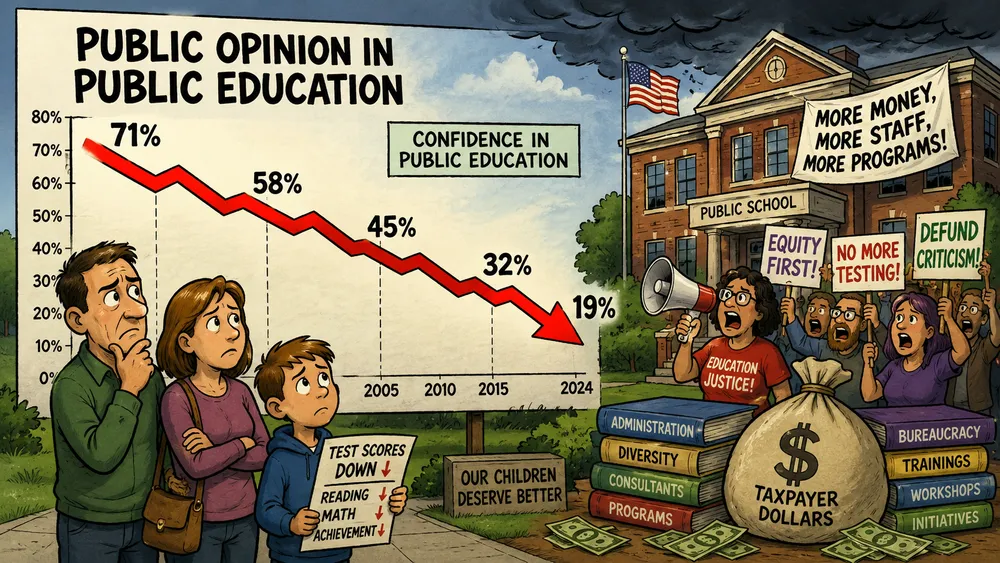
When money follows students, losing families eventually means losing revenue. At that point, parental dissatisfaction is no longer merely an unpleasant school-board meeting. It has financial consequences.
Arizona’s experience is especially interesting because most educational competition does not involve private schools at all. An earlier Goldwater Institute examination found that, in sampled Maricopa County districts, more than 30 percent of students were attending a district school other than the one assigned by residence; combined with charter attendance, roughly 47 percent were attending something other than their geographically assigned public school. That analysis predates today’s universal ESA program, but it illustrates something frequently lost in the voucher debate: school choice often means choosing another public school.
And there is evidence that competition can improve the schools students leave behind.
Research on Ohio’s voucher program, for example, found academic improvement among students remaining in public schools close to the threshold for voucher eligibility—a competitive effect also found in earlier Florida research. That does not prove every choice program produces the same result, but it undermines the assumption that choice can benefit only the child who leaves.
That point deserves more attention. A school-choice program does not have to destroy public education. Properly structured, it can force public education to compete for the privilege of educating the public’s children.
The Charter Evidence Is Particularly Difficult to Ignore
One of the strongest arguments for choice comes not from a conservative think tank but from Stanford University’s Center for Research on Education Outcomes.
CREDO’s major national charter-school study compared charter students with demographically and academically similar students in traditional public schools. Nationally, charter students showed greater average progress in both reading and mathematics.
Arizona’s results were notable. According to CREDO data summarized by the Goldwater Institute, Arizona charter schools produced stronger reading growth than comparable district schools in about 35 percent of comparisons while producing weaker growth in approximately 12 percent; the remainder were statistically similar. In mathematics, Arizona charters were stronger in about 38 percent of comparisons.
Those numbers do not say every charter school is excellent. Some are not, and bad charter schools should close.
That is the point. Choice should never mean replacing a government monopoly with an entitlement for private or charter operators. It should mean permitting schools to compete, measuring results, giving families useful information and allowing unsuccessful institutions to lose students.
Accountability through choice is meaningful only if failure carries consequences.
America’s Educational Results Give Parents Every Reason to Demand Something Different
The backdrop to this debate is a national educational performance crisis that neither political party should minimize.
On the 2024 National Assessment of Educational Progress—the Nation’s Report Card—only 31 percent of fourth-graders were at or above NAEP Proficient in reading. Sixty percent reached at least Basic, meaning roughly four in ten did not. Fourth-grade reading performance actually declined from 2022.
Mathematics was somewhat better but hardly reassuring. Thirty-nine percent of fourth-graders reached Proficient in 2024. Among eighth-graders, only 28 percent reached Proficient in mathematics, while 61 percent reached Basic or above.

Then there is civics. The most recent national eighth-grade NAEP civics assessment found only 22 percent of students at or above Proficient. The average score fell from 2018 and was statistically no better than it had been when the assessment began in 1998.
This is the context in which defenders of the educational status quo ask parents to be patient. Parents have already been patient. Children are still failing to read. Millions struggle with mathematics. Basic understanding of American government is frighteningly weak.
At some point, insisting that every family continue patronizing the same institution ceases to look like loyalty to public education and begins to look like loyalty to the institution itself.
Detroit Is Paying Children to Show Up
One of the articles that prompted this discussion captures the dysfunction in an almost surreal way.
Fox News reported this morning that Detroit-area public schools are experimenting with incentives of as much as $1,000 in gift cards for perfect attendance, an attempt to combat severe chronic absenteeism. The same segment discussed districts elsewhere lowering academic standards in attempts to improve reported performance.
It would be unfair to blame teachers for all of this. Chronic absenteeism has enormous causes outside school—family instability, poverty, post-pandemic habits, neighborhood conditions and parental disengagement among them.
But the spectacle still tells us something. An education system in which government must pay students simply to enter the building is not suffering from too much parental choice.
It is suffering from a collapse of confidence and accountability.
Seattle Offers Another Window Into the System
Seattle Public Schools entered this school year facing an estimated $100 million budget gap while its teachers union considered a strike.
According to reporting cited by Fox, 91 percent of participating Seattle Education Association members authorized a strike if negotiations failed to produce a new contract involving higher compensation, benefits and special-education provisions. Superintendent Ben Shuldiner, hardly a conservative school-choice activist, publicly rebuked the union and said the district was “broke.” The district reportedly has roughly 5,000 fewer students than in 2019.
The union’s position deserves to be represented accurately. Its concerns include compensation, working conditions and special-education supports, and unions argue that recruiting and retaining competent teachers requires competitive pay and manageable workloads.
But Seattle exposes the structural problem. What happens when enrollment declines but the institution’s financial and labor obligations do not decline with it? The traditional answer is usually more money.
The school-choice answer is different: ask why families are leaving.
Why Teachers’ Unions Fight Choice
The National Education Association and American Federation of Teachers make no secret of their opposition to private-school choice.
This summer the two unions jointly urged Democratic governors to reject the new federal private-school scholarship initiative, calling it a threat to public education. The AFT adopted a 2026 resolution declaring that public funds should remain in public schools and arguing that vouchers divert resources, disproportionately subsidize families already using private schools, increase segregation and permit private institutions to operate without the same obligations imposed on public schools.

The unions’ fundamental premise is that public education is a public institution with obligations no private school necessarily shares. District schools must accept the children who arrive at their doors, including students who are expensive to educate. Private schools may charge tuition above the value of a voucher, enforce admission standards or offer fewer services for students with significant disabilities. Critics also argue that widespread ESAs can subsidize families who were already paying private tuition rather than induce students to leave public schools.
Arizona’s own data give that last criticism some substance. For FY2025, Arizona’s Joint Legislative Budget Committee reported 87,602 ESA participants and $872.2 million in awards. State data also show that among newly entering universal ESA students in grades 1-12 during a reporting period, 57 percent had been enrolled in public school immediately beforehand—meaning a substantial share had not.
School-choice advocates should not duck that debate. Universal eligibility costs money, and lawmakers have a legitimate responsibility to prevent fraud, audit expenditures and determine whether the program is delivering value to taxpayers.
But there is an enormous philosophical difference between regulating a choice program responsibly and declaring that parents should not have the choice at all. The unions consistently favor the latter when public money would follow a student into private education.
Democrats Have Made Their Position Official
The alignment with the Democratic Party is not speculation.
The Democratic Party’s most recent national platform explicitly opposed “private-school vouchers, tuition tax credits, opportunity scholarships” and similar programs that transfer taxpayer-supported education funding outside public schools. Democrats argue that these programs drain public-school resources and lack sufficient transparency and nondiscrimination protections. The platform simultaneously called for greater investment in teachers, public schools and increased charter-school accountability.
So the divide could hardly be clearer. Democrats generally seek to strengthen the existing public-school system through more funding, staffing, collective-bargaining protections and government-directed reforms.
Republicans increasingly seek to strengthen education by giving families leverage over the system. Those are fundamentally different theories of accountability.
One says experts, elected boards and governments should improve schools from inside. The other says parents should have the ability to walk away.
Follow the Child
There is a revealing phrase used repeatedly by opponents of school choice: “Taking money away from public schools.”
But whose money is it? If a school receives money because James is enrolled there, and James leaves, why should the school continue receiving the portion intended to educate James?
We do not normally say a restaurant was robbed because a customer ate across the street. We do not say a university was defunded because a student enrolled somewhere else. The public-school system exists to educate children. Children do not exist to finance the public-school system. That reversal of priorities may be the most important idea in the entire school-choice debate.
Choice Is Especially Important for Families Without Money
The wealthy will always have educational choice. They can buy a house beside the best public school. They can pay $20,000 or $30,000 in private tuition. They can hire tutors. They can move. They can homeschool with one parent staying home.
The child trapped in the worst school is disproportionately the child whose parents cannot do those things. That makes opposition to educational portability strangely regressive.
A politician who sends his own children to private school while telling a poor mother that public money must remain with her failing neighborhood district is not defending equality. He is defending his choice and denying hers.
The Conservative Reform Should Be Choice Plus Accountability
There is one place where conservatives should resist ideology of their own. Simply handing money to any educational provider and declaring victory would recreate the same problem in another form.
Arizona and other choice states should insist upon aggressive financial auditing, transparent academic information, swift prosecution of fraud, easy comparisons among schools and consequences for providers that consistently fail students. Parents cannot exercise meaningful choice without meaningful information.
Universal choice should be accompanied by rigorous measurement. Reading. Mathematics. Science. History. Civics. Writing. Parents should know whether a school is teaching them. And taxpayers should know what they are buying.
That is not an argument against school choice. It is how a serious school-choice system should work.
The Institution or the Child?
At bottom, the argument isn’t really about charter schools, ESAs or vouchers. It is about who possesses the presumption of authority.
The education establishment begins with the institution: this is the public school, this is its funding, this is its staff, and reform must occur within its walls.
School choice begins with the child: this is the child’s education, and the institutions must earn the family’s confidence.
One system asks parents to wait while professionals repair failing schools. The other gives parents an exit. America has been waiting for decades.
Only 31 percent of fourth-graders are proficient readers. Only 28 percent of eighth-graders are proficient in mathematics. Only 22 percent of eighth-graders were proficient in civics on the latest national assessment.
At some point, protecting the system from competition becomes harder to justify than protecting children from the system’s failures.
Arizona has chosen competition. Other states increasingly are following. At least 18 states now have education-choice programs with universal eligibility, according to the Education Commission of the States.
The question for the rest of America is increasingly straightforward. If a public school is excellent, why should it fear choice? It should attract families. It should grow. It should prosper.
And if another school can teach a child to read better, calculate better, understand American history better and leave school better prepared for citizenship and adult life, why should government prevent his parents from choosing it?
The purpose of public education is not to preserve a particular collection of buildings, bureaucracies or bargaining units.
It is to educate the public.
And when the interests of the institution and the interests of the child diverge, there should be no question which one comes first.
Leave a Reply