
The newest PURSUE release went public Friday morning. Among the newly posted government records is a remarkable 1952 recording of Project Blue Book chief Edward Ruppelt discussing unexplained objects, extraordinary speeds, radar contacts and UFO concentrations around America’s nuclear installations.
For nearly three-quarters of a century, Americans have argued about what the United States government really knew about UFOs during the earliest years of the phenomenon.
Friday morning, the government opened another window into that history.
The Department of War has released Tranche 6 of the government’s Presidential Unsealing and Reporting System for UAP Encounters—PURSUE—the extraordinary disclosure initiative that has been releasing government UFO records in batches since May.
The sixth release went live this morning, September 18, following previous releases on May 8, May 22, June 12, July 10 and August 7. The government describes the archive as an effort to find, review, declassify and publicly release unresolved UAP records scattered across federal agencies and decades of government files.
Readers can examine the government’s complete archive themselves here: Explore the government’s PURSUE UFO archive
And while researchers will undoubtedly spend days combing through Tranche 6, one newly released item immediately stands apart.
It is an audio recording made 74 years ago. And the man speaking is Capt. Edward J. Ruppelt.
Listen to the Man Who Ran Project Blue Book
The government has now publicly posted a recording titled: “DOW-UAP-PR160, Presentation by Captain Edward J. Ruppelt, 1952.”
The recording runs one hour, five minutes and thirteen seconds and is dated March 26, 1952. According to the government’s description, Ruppelt discusses the Air Force’s reorganized investigation of what were then commonly called “flying saucers”—an investigation that became Project Blue Book.
This isn’t somebody remembering the UFO controversy decades later. It is the officer running the investigation speaking in 1952, while it was happening. That distinction makes the recording historically fascinating.
Ruppelt explains that the Air Force had examined approximately 800 historical cases and that roughly 20 percent remained unexplained after technical analysis, according to the government’s newly published description of the recording. The unresolved reports included observations by military personnel, commercial pilots and other technically qualified witnesses.
Then it gets more interesting. The government’s summary says Ruppelt discussed concentrations of reports around sensitive national-security and nuclear-weapons facilities, including Los Alamos, Albuquerque and Oak Ridge.
And he described radar observations indicating unconfirmed speeds ranging from approximately 1,000 to 3,500 miles per hour.
Remember the date: March 1952. The first operational American jet fighter had entered service only a few years earlier. Sputnik was still more than five years away. Yet the officer responsible for investigating UFOs was discussing reports involving silent high-speed objects and radar indications of velocities reaching thousands of miles per hour.
That does not establish that these objects were extraterrestrial spacecraft. Ruppelt himself apparently emphasized that the Air Force had reached no conclusive determination about their nature or origin.
But it establishes something historically significant: the United States Air Force considered at least some UFO reports sufficiently difficult to explain—and sufficiently relevant to national security—to pursue systematic methods of gathering better physical evidence.
They Wanted Better Cameras, Better Radar and Better Data
Perhaps one of the most interesting aspects of the recording is how surprisingly modern the proposed investigation sounds.
According to the government’s description, Ruppelt discusses possible use of diffraction-grating photography and synchronized radar-scope photography to obtain objective evidence rather than relying exclusively on eyewitness accounts.
In other words, 74 years before today’s arguments about whether UAP evidence needs multiple synchronized sensors, the Air Force was already wrestling with essentially the same problem: How do you turn a strange observation into measurable scientific data?
Ruppelt’s later published account confirms that the Air Force pursued specialized cameras and sought assistance from prominent scientists as the 1952 UFO wave intensified. He wrote that the Air Force wanted every available piece of evidence and was attempting to determine whether the reports represented something genuinely unknown.
The newly released recording therefore gives Americans something unusual: not merely another government memo describing what happened decades ago, but the voice of the man who was there explaining the investigation in real time.
Congress Helped Pry This Recording Loose
There is another interesting story behind the recording. Rep. Eric Burlison of Missouri specifically went looking for it.
On May 8, Burlison sent MIT Lincoln Laboratory a letter requesting preservation and review of a reel-to-reel recording identified as “AF-ATIC-FILM, 03/52” and labeled simply: “flying saucer talk.” The listed briefer was Edward J. Ruppelt.
Burlison asked MIT Lincoln Laboratory to determine whether the recording survived and to coordinate with the National Archives regarding its preservation and archival review.
Now, four months later, the government has published Ruppelt’s March 26, 1952 presentation as part of PURSUE Release 6. The newly posted government copy identifies the recording as public domain and attributes its release through the All-domain Anomaly Resolution Office.
That makes it one of the clearest examples yet of congressional pressure and the government’s current disclosure initiative bringing obscure historical UAP material directly to the public.
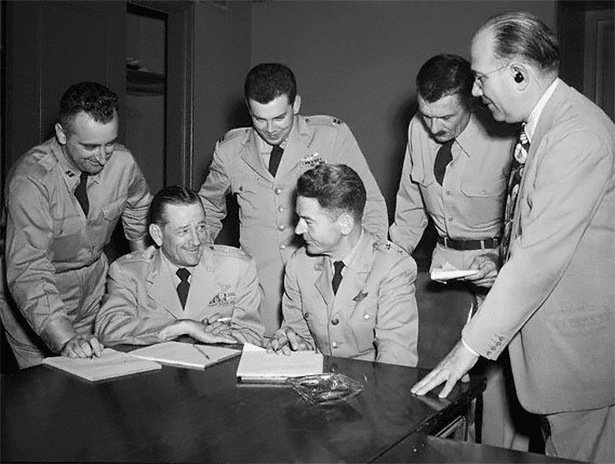
Capt. Edward J. Ruppelt discusses the Air Force investigation of UFOs in a March 26, 1952 presentation newly released by the U.S. government. The recording runs approximately 65 minutes. Source: Department of War/AARO/DVIDS. Listen to the complete 1952 Edward Ruppelt recording on the Defense Department’s DVIDS archive
But Tranche 6 Isn’t 65 Minutes of Smoking Guns
Much of the initial discussion surrounding Release 6 suggests that a significant part of the tranche consists of Defense Intelligence Reference Documents, or DIRDs, associated with the government’s later AAWSAP/AATIP research effort.
Those technical papers explore subjects at the speculative edges of aerospace engineering and theoretical physics. Early researchers going through Friday’s dump have noted that many of these documents had already become publicly available through previous government FOIA releases.
Seventy-Four Years Later, We’re Still Asking Ruppelt’s Question
Perhaps the most remarkable thing about listening to a recording from March 1952 is how little the central question has changed. What are these things?
Ruppelt and the Air Force were discussing radar, qualified observers, high speeds, nuclear facilities and the need for better scientific instrumentation.
Today’s military talks about infrared sensors, radar tracks, satellite observations, multisensor correlation and objects encountered in restricted military airspace.
The technology changed dramatically. The question survived. And so did Ruppelt’s insistence that the phenomenon deserved serious investigation rather than reflexive belief or reflexive ridicule.
His own later account of Project Blue Book makes clear that the Air Force could explain a large proportion of reports as balloons, aircraft, astronomical objects and other conventional phenomena. But it was the remainder—the well-documented cases that resisted easy explanation—that kept the investigation alive.
That same distinction should guide Americans looking through the files released today. Don’t begin with the conclusion. Begin with the evidence.
The Government Is Asking the Public to Look
One of the most unusual features of PURSUE is that the government isn’t simply releasing documents and declaring the matter closed. The Department explicitly says it welcomes private-sector analysis, information and expertise concerning unresolved cases. That amounts to an invitation.
Researchers can download the documents. Engineers can inspect the technical material. Pilots can evaluate aviation reports. Physicists can examine claims about performance. Historians can compare newly released documents against the government’s previous public explanations.
And ordinary Americans can look at the evidence themselves. That may ultimately be the most important change represented by PURSUE.
For generations, the argument surrounding UFOs was partly an argument over what information the government possessed but wasn’t showing us. Now hundreds of government records are sitting on a public website.
There will undoubtedly be prosaic explanations among them. There will be old material, duplicative material, dead ends and cases for which insufficient information will make an answer impossible. But there may also be cases that remain genuinely difficult to explain.
Tranche 6 is now public. The government has opened another box. And this time, one of the voices coming out of it has been waiting since 1952 to be heard.
Leave a Reply