
Three days after the government’s latest UAP release, researchers are finding details easily missed in the initial flood of documents: six maneuvering spheres reportedly traveling 480 mph, a military study of injuries following anomalous aerospace encounters, a 1952 UFO film the Air Force’s own laboratory struggled to explain—and evidence of how officials contemplated explaining that case to the public.
When the federal government released its sixth tranche of UFO records Friday, the sheer volume made immediate analysis difficult.
The release contains roughly 70 records spanning more than seven decades: military videos, Project Blue Book records, an hour-long recording of Capt. Edward Ruppelt, local law-enforcement evidence, Defense Intelligence Agency contracts and dozens of technical studies dealing with subjects ranging from advanced propulsion to wormholes and antigravity.
Federalist Press reported Friday on one of the most historically remarkable items—the newly released 1952 recording of Ruppelt discussing the Air Force’s early UFO investigation. Article>
But researchers have now had a weekend to dig. And several other pieces of Tranche 6 deserve considerably more attention.
None proves that extraterrestrial spacecraft are visiting Earth. The Pentagon’s All-domain Anomaly Resolution Office continues to say it has found no verifiable evidence establishing an extraterrestrial origin for the phenomena. But some of these records raise questions that are difficult to dismiss with the word “balloon.” And there is nothing saying that non-human craft hail from far-way worlds. Some beleive they may come from “here.”
Six Objects. 480 Miles Per Hour. Changing Direction.
Perhaps the most immediately intriguing contemporary case comes from U.S. Central Command.
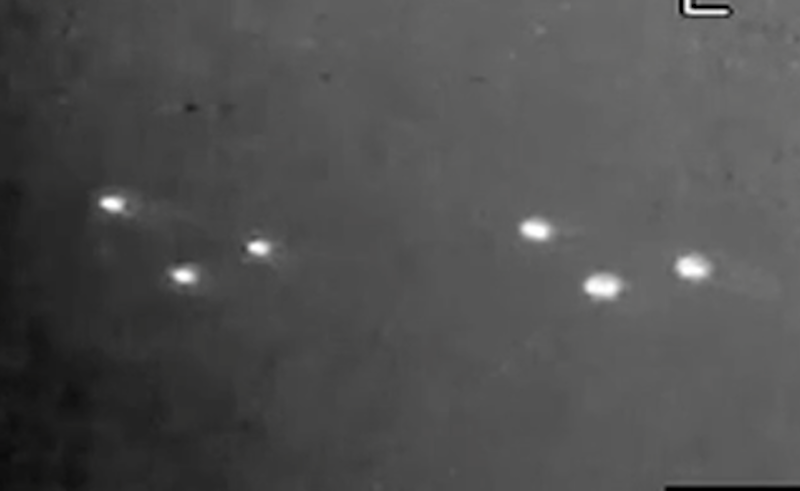
A one-minute infrared video recorded from an American military platform in the Middle East during 2025 shows what the accompanying mission report describes as six small spherical objects traveling together.
The report describes the objects as apparently agile and frequently changing direction.
Most remarkably, the observer estimated their speed at approximately 480 miles per hour.
Watch: Pentagon Tranche 6 — six spherical objects recorded by U.S. military
Harvard astrophysicist Avi Loeb has now taken a closer look at that report and raised an interesting question: could this simply have been a drone swarm?\ Possibly. But Loeb argues that the reported performance makes that explanation more complicated than it initially sounds.
Typical small drones operate nowhere near 480 mph. Loeb notes that even extremely fast racing quadcopters can approach roughly 300 mph only under unusual conditions, while coordinated drone swarms generally operate at considerably lower speeds. Maintaining a close formation while maneuvering becomes increasingly difficult as velocity rises because every aircraft must continuously know where its neighbors are while avoiding collisions.
Loeb estimates that coordinated swarms generally operate at speeds up to approximately 150 mph—less than one-third the speed reported in the military document. That doesn’t make the objects alien spacecraft. It makes “What were they?” a considerably more interesting question.
There is also an important limitation: 480 mph is an observer’s estimate recorded in the mission report, not necessarily an independently established speed derived from complete telemetry now available to the public. That distinction matters.
But so does the fact that the United States military recorded the encounter, documented the estimated speed and behavior, submitted it to AARO—and it remains unresolved.
Then There Is the Object Over the Yellow Sea
Another military video is intriguing for an entirely different reason. The 27-second infrared recording was submitted by U.S. Indo-Pacific Command following a 2023 encounter over the Yellow Sea. It appears to show a spherical object moving through or immediately above clouds.
Loeb points to what appears to be a faint trail associated with the object’s interaction with the clouds, arguing that this is evidence the image represents a physical object interacting with its environment rather than simply an internal camera artifact.
That conclusion should be treated as Loeb’s interpretation rather than a Pentagon determination. A short infrared video by itself doesn’t establish the object’s composition, distance or origin. Nevertheless, the apparent interaction with the cloud layer makes the footage worth examining closely.
The Government Studied People Who Were Allegedly Injured
Then we get to one of the strangest documents in the entire release. Consider a 38-page Defense Intelligence Reference Document produced in 2010 examining what its authors called evidence concerning injuries to human observers associated with anomalous advanced aerospace systems.
The study discussed three previously healthy and active individuals who reportedly experienced an anomalous aerospace-related event and subsequently developed physical symptoms. Those reportedly included skin heating and redness, hair loss and, in one individual, signs characterized as radiation illness followed over subsequent years by malignant changes.
The three individuals were reportedly antenna engineers. The researchers compared their cases with published and unpublished incidents involving known radio-frequency injuries and considered whether electromagnetic exposure could account for the effects.
The document’s author reached a provocative conclusion: enough incidents and medical information existed, in his assessment, to support a hypothesis that some advanced systems were already deployed while remaining incompletely understood by the United States.
And the Pentagon specifically cautions that the AAWSAP technical documents are reference and synthesis papers rather than proof that the concepts they discuss have been validated.
But the existence of the study is significant for another reason. The government wasn’t merely paying contractors to speculate about what UFOs looked like. Researchers were investigating whether some reported encounters might produce measurable physiological effects on human beings.
Loeb calls this one of the notable aspects of Tranche 6 and says the release explicitly connects investigation of physiological injuries with possible UAP encounters.
Then We Found the Tremonton File
This may be the most fascinating historical part of Tranche 6.
On July 2, 1952, Navy Chief Warrant Officer Delbert C. Newhouse was traveling near Tremonton, Utah, when he observed a group of bright objects moving across the sky. Newhouse had a movie camera. He filmed them.
The result became one of the most famous UFO films of the Project Blue Book era. The footage is included in Tranche 6.
The objects have been debated for more than seven decades. The government’s first attempt to debunk the video seven decades ago was that Newhouse filmed birds—possibly gulls—whose bodies reflected sunlight. But researchers examining the newly released government paperwork noticed something considerably more interesting than the film itself.
According to the technical material in the released Air Force file, the government’s own photographic laboratory concluded it was “reasonably certain” that the brightness recorded on the film exceeded that expected from birds. The analysis also questioned whether the objects were spherical and noted the absence of sound as a problem for an aircraft explanation.
That still doesn’t tell us what Newhouse filmed. But then comes the really interesting part.
What the Air Force Considered Telling the Public
Among the newly available records is an Air Force Memorandum for Record concerning how the Tremonton case should be handled publicly.
An independent analysis of the PURSUE archive by WARUFO drew attention to the apparent tension between the laboratory analysis and the contemplated public explanation. According to the memo, if public release became necessary, officials contemplated saying that although the Air Force could not positively identify the objects, it was reasonably confident they were balloons or gulls and therefore would pursue the incident no further.
The memo reportedly went even further when considering release of the underlying laboratory work, saying it would be poor policy to suggest that another military service had made an error.
It is historically important because it shows something UFO researchers have alleged for generations: the government’s internal uncertainty about a case could be considerably more complicated than the simplified explanation eventually contemplated for public consumption.
That is a much more defensible, and arguably more interesting, observation than declaring that the memo proves officials knew UFOs were extraterrestrial.
The Government Was Studying Warp Drives and Wormholes
Another part of Tranche 6 has generated spectacular headlines. The government really did fund studies involving subjects including warp drives, traversable wormholes, antigravity, negative-mass propulsion, invisibility cloaking and other exotic concepts.
Thirty-seven Defense Intelligence Reference Documents released in this tranche came from the Advanced Aerospace Weapon System Applications Program, or AAWSAP, established by the Defense Intelligence Agency in 2008.
AAWSAP received approximately $22 million in federal funding. That sounds extraordinary. But there is an important distinction being lost in some online discussion. The existence of a government study titled around warp drive does not establish that the government possesses a warp drive.
The Pentagon explicitly cautions that these documents should be understood as reference and synthesis products rather than original experimental research proving that the concepts work. Indeed, one of the antigravity studies acknowledges that proposed concepts were not then feasible from an engineering standpoint.
What the documents establish is still fascinating: The Defense Intelligence Agency considered these concepts sufficiently relevant to future aerospace threats to pay experts to examine them.
A Police Officer Adds Something New to the Government Archive
Another story has received relatively little attention.
For the first time in the PURSUE tranches, Release 6 includes a distinct category of evidence originating with local law enforcement rather than military or intelligence personnel.
The Colorado case occurred in October 2023. According to the released material, an officer observed and filmed an object described as silent, displaying red, blue and green flashing lights. The officer reportedly checked available radar information and found no aircraft in the area. More interestingly, the officer said the object remained stationary for approximately 15 minutes before appearing to move closer.
Four videos accompany the report.
We now have a trained civilian law-enforcement observer documenting what he was seeing contemporaneously, checking for conventional air traffic and recording the event.
And Then There Is the 74-Year Continuity Problem
This may ultimately be the most interesting observation to emerge from the entire release. Put the files side by side.
In 1952, Edward Ruppelt told his audience that approximately 20 percent of roughly 800 Air Force cases consisted of good reports from reliable observers for which investigators could draw no conclusion. He discussed silent high-speed objects, radar detections and concentrations around Los Alamos, Albuquerque and Oak Ridge.
In 2022, military personnel reported small objects moving erratically over the Middle East. In 2023, an American military sensor recorded a spherical object over the Yellow Sea. A Colorado law-enforcement officer separately filmed an unexplained silent object. And in 2025, U.S. Central Command documented six small spherical objects reportedly maneuvering together at an estimated 480 mph.
Different decades. Different sensors. Different witnesses. Different locations. Different agencies. Yet some descriptions are surprisingly persistent: spheres or orbs, unusual movement, high speeds, lack of obvious conventional propulsion and objects that remain unidentified after investigation.
So What Does Tranche 6 Actually Prove?
It doesn’t prove extraterrestrial visitation . . . yet. There is no recovered spacecraft in these files. No extraterrestrial body. No verified alien communication. No document in which the United States government formally concludes that a particular object originated beyond Earth. Even some of the most provocative technical studies are literature reviews rather than observational evidence.
But dismissing the entire release because it doesn’t contain an alien spaceship would miss what is actually happening.
The United States government has now publicly released hundreds of records showing that military personnel, intelligence agencies, scientists, pilots and now local police officers have encountered things they sometimes could not satisfactorily identify.
Some cases undoubtedly have ordinary explanations. Some almost certainly suffer from insufficient data. But some contain measurements, trained witnesses, military sensors or multiple pieces of evidence that justify further investigation.
And that may be the real story of PURSUE. For most of the modern UFO era, Americans argued about whether the government possessed serious information about unidentified objects at all. We don’t have to argue about that anymore. The government is publishing it.
The question now is whether scientists, journalists and the American public are willing to actually read it.
Leave a Reply