
Trump’s Art of the Deal: The agreement Trump signed with Denmark and Greenland gives the US greatly expanded, enduring military access to one of the most strategically important pieces of territory on Earth — while restricting potential Russian and Chinese military and economic footholds.
For years, Donald Trump’s fixation on Greenland was treated in much of the political world as something between an eccentricity and a diplomatic provocation.
Trump talked about buying the enormous Arctic island during his first presidency. After returning to the White House, he went considerably further, repeatedly arguing that American control of Greenland was necessary for national security. The rhetoric alarmed Denmark, angered some Greenlanders and generated months of friction inside NATO.
Then came the deal. Of course.
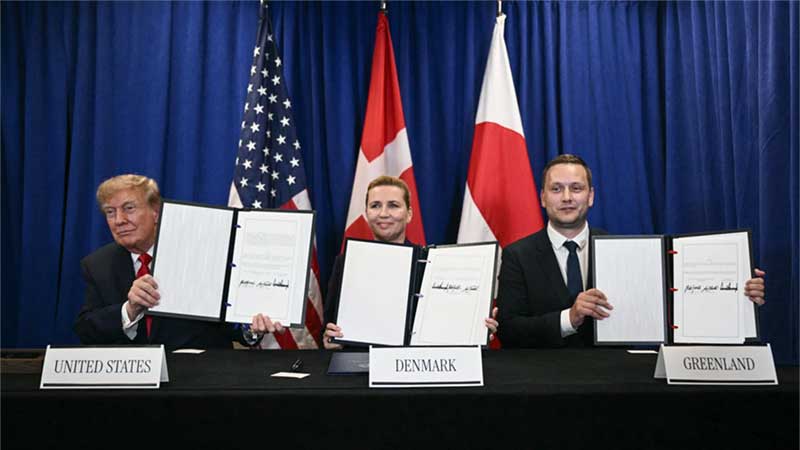
On September 22, President Trump sat beside Danish Prime Minister Mette Frederiksen and Greenland Prime Minister Jens-Frederik Nielsen at the United Nations in New York and signed a sweeping new Arctic security agreement:
The agreement permits America to substantially enlarge its military presence;
- modernize and expand Pituffik Space Base;
- establish new defense areas at Narsarsuaq and Mestersvig;
- propose additional defense areas in the future;
- move American military aircraft, vessels, forces and vehicles broadly through Greenland;
- develop components of the Golden Dome missile-defense system; and
- prevent non-NATO nations from establishing military installations or maintaining a persistent military presence there.
The agreement has no expiration date and provides for its continuation even if Greenland eventually becomes independent, provided an independent Greenland remains within NATO and assumes the agreement’s obligations.
That is a very different outcome from the caricature that surrounded Trump’s Greenland campaign.
The Opening Demand Was Greenland Itself
Trump is the author, with Tony Schwartz, of The Art of the Deal, and he has long used large opening demands, public pressure and threatened alternatives as elements of negotiation. Supporters see the Greenland episode through precisely that lens; critics argue that his threats unnecessarily damaged relations with two friendly governments.
The chronology is nevertheless striking. Trump began with the maximal position: America needed Greenland.
Denmark said no. Greenland said no. Political leaders and commentators ridiculed the idea. Relations became sufficiently strained that Greenland’s prime minister now says trust with Washington will have to be rebuilt. Reuters reports that Trump’s refusal earlier this year to rule out military or economic coercion produced a diplomatic crisis and months of intensive negotiations.
Yet those negotiations did not end with Washington walking away empty-handed. They ended with Denmark and Greenland signing an agreement that grants the United States many of the strategic benefits that made Greenland attractive to Washington in the first place, without transferring sovereignty.
Whether that was Trump’s intended landing point from the beginning is known only to the people inside the negotiations. But as a negotiating sequence, it is unmistakable: an extraordinary opening demand was followed by months of resistance and bargaining, culminating in an agreement substantially expanding the American position.
The agreement provides permanent American access, basing and overflight rights and the ability to establish additional military installations when agreed under the treaty’s procedures.
Why Greenland Matters So Much
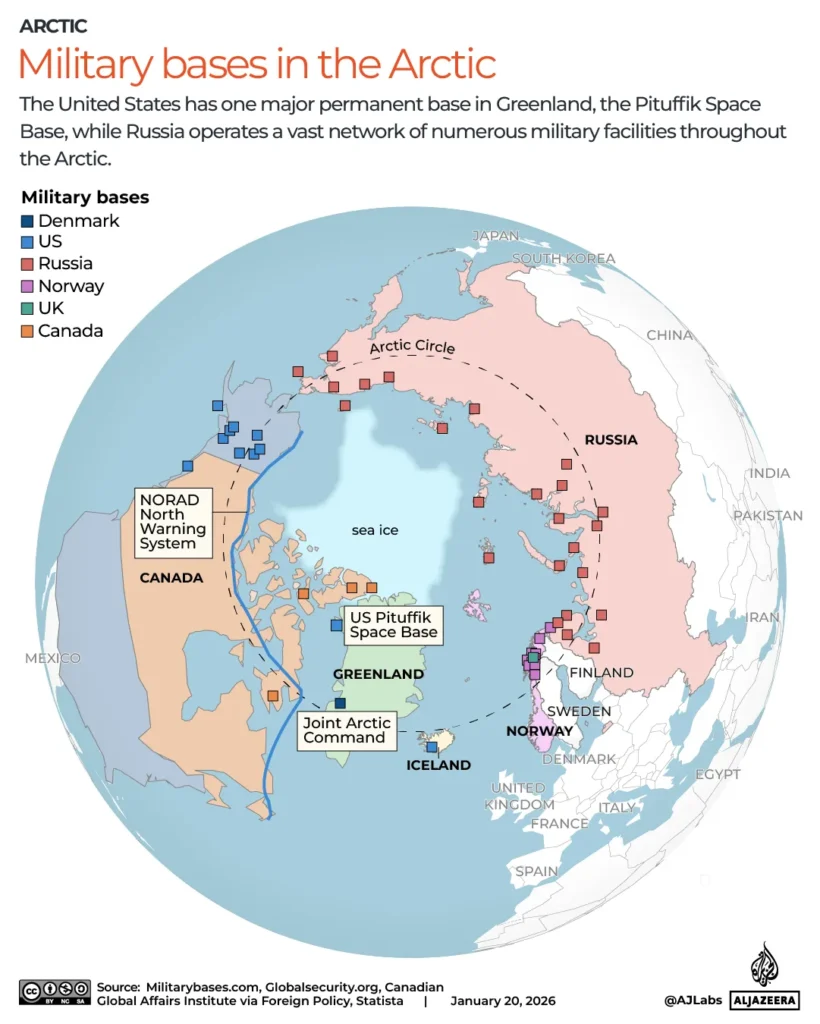
Pull out a globe rather than a conventional flat map and Trump’s interest becomes considerably easier to understand.
Greenland sits astride the Arctic and North Atlantic approaches to North America. A missile, bomber or other threat approaching the United States from parts of Russia would encounter the Arctic as a natural avenue of approach. Greenland consequently occupies valuable geography for early warning, missile tracking, space surveillance, air operations and North Atlantic defense.
America already operates Pituffik Space Base in northwestern Greenland, the Defense Department’s northernmost installation. The U.S. Space Force says the base supports force projection and space superiority and traces its missile-warning mission to the Ballistic Missile Early Warning Site established there in 1961. The 12th Space Warning Squadron today provides warning of ballistic-missile launches to U.S. national authorities and NORAD.
The new agreement goes considerably beyond preserving Pituffik.
It expressly allows the United States to modernize and expand operations there and establishes additional defense areas at Narsarsuaq in southern Greenland and Mestersvig in eastern Greenland. It also creates a procedure for additional American defense areas should future threats require them.
The agreement further gives U.S. military aircraft the ability to fly over and land throughout Greenland and gives American public vessels access and movement rights through Greenland’s territorial waters, subject to the treaty’s terms.
In strategic terms, America is no longer talking merely about one isolated Arctic installation. It has secured a framework for a much broader military posture across the island.
Golden Dome Moves North
Perhaps the most consequential words in the agreement concern missile defense.
The treaty specifically recognizes the parties’ interest in American military access necessary to defend Greenland, the NATO area and the American continent, “including through establishment of a Golden Dome defense system.” Geography is the reason.
Greenland lies along important northern approaches to North America. Hudson Institute senior fellow Liselotte Odgaard argued earlier this year that inadequate surveillance and response capability around eastern Greenland leaves vulnerabilities that Russia could exploit in posing a nuclear threat to both the United States and NATO. She noted that the 2026 U.S. National Defense Strategy identifies access to Greenland as important to homeland defense.
NATO itself has been expanding its focus on the High North. Seven of the eight Arctic states are now NATO members, and the alliance launched Arctic Sentry in February 2026 as part of its strengthened northern deterrence posture.
Greenland therefore is not simply a remote island covered in ice. It is part of the northern shield of North America.
Russia and China Are Effectively Locked Out Militarily
Article IX of the agreement is remarkably direct: No country outside NATO may establish a manned or unmanned military installation in Greenland or maintain a persistent military-force presence there unless the parties agree otherwise.
That provision has obvious implications for Russia and China.
Russia is an Arctic power with extensive northern military infrastructure. China, although geographically far removed from the Arctic, declared itself a “Near-Arctic State” in its 2018 Arctic policy and has sought economic, scientific and infrastructure footholds across the region. CSIS documents Chinese attempts over the past decade to participate in Greenlandic airports, an abandoned naval facility, a satellite ground station and mineral development; several projects were blocked because of Western security concerns.
The new agreement turns that concern into treaty architecture.
The Other Prize Beneath the Ice
Then there are the minerals.
Greenland contains iron ore, graphite, tungsten, palladium, vanadium, zinc, gold, uranium, copper and significant rare-earth resources. CSIS estimates Greenland ranks eighth globally in rare-earth reserves and identifies Kvanefjeld and Tanbreez as two exceptionally large deposits. China, meanwhile, remains dominant in important parts of the world’s rare-earth mining and processing system.
Europe understands the stakes as well. The European Commission has identified 25 of its 34 critical raw materials in Greenland and signed a strategic raw-materials partnership with Greenland in 2023.
Rare earths and other critical minerals aren’t merely commodities. They feed technologies used in electronics, energy systems and advanced defense equipment. Dependence on a geopolitical competitor for critical supply chains can therefore become a national-security vulnerability.
The Greenland agreement doesn’t hand Greenland’s minerals to the United States, and it would be inaccurate to describe it that way. Greenland retains control over its resources, and actually developing them remains difficult and expensive because of Arctic conditions and limited infrastructure.
What the agreement does do is strategically important.
It defines resource extraction as one of the “particularly sensitive” sectors covered by foreign-investment safeguards. Greenland, working with Denmark and in consultation with the United States and other partners, must prevent investors from countries outside NATO, NATO partner nations or the EU from obtaining control, significant influence or dangerous access to non-public information in sensitive activities when national security or public order would be threatened.
That creates another barrier against an adversarial power converting Greenland’s mineral wealth into strategic leverage.
Greenland and Denmark Got Something, Too
This was not a unilateral American acquisition, and understanding what Denmark and Greenland received is important to understanding why they signed.
The treaty explicitly reaffirms Danish sovereignty and Greenlanders’ right to determine their own political future. It requires the United States to use Greenlandic businesses for construction and servicing of defense areas to the maximum extent feasible, potentially directing substantial economic activity toward the island. It also commits the parties to respecting Greenlandic environmental, cultural and economic interests.
Prime Minister Frederiksen called the agreement one that could “last forever” and said it strengthens NATO while respecting Greenlandic self-determination. Prime Minister Nielsen likewise said a strong NATO presence in the Arctic is vital, although he acknowledged that trust between Greenlanders and Washington needs rebuilding after the confrontation over American acquisition.
Those facts complicate simplistic descriptions of the agreement as either an American conquest or an American retreat. It is a negotiated security arrangement in which all three governments accepted obligations and obtained benefits.
What did America Get?
The most interesting question may ultimately be whether possession was ever necessary to accomplish America’s principal strategic objectives.
The American flag will not replace Greenland’s flag. The island remains part of the Kingdom of Denmark. Trump did not obtain the territorial acquisition he repeatedly demanded.
But the agreement signed in New York gives the United States an enduring military framework across Greenland, two additional defense locations, the ability to expand Pituffik, broad military transit rights, provisions for Golden Dome, a mechanism for additional future bases, protection against non-NATO military penetration and safeguards against threatening foreign control of critical infrastructure and resource extraction. And it does so within NATO rather than by dissolving the alliance relationship.
Perhaps the most extraordinary provision is Article XI. The agreement has no end date.
Even if Greenland someday exercises its right to become an independent nation, the agreement requires Denmark and Greenland to ensure that the new state remains within NATO and assumes the defense agreement’s rights and obligations.
That is why the Greenland story looks considerably different today than it did when Trump’s opening demands dominated the headlines. The debate began with a seemingly audacious question: Will America own Greenland?
The agreement ultimately produced a different question, and perhaps the strategically more important one: How much of what America actually needs from Greenland can it secure without owning Greenland at all?
The treaty signed September 22 provides a substantial answer. President Donald Trump got exactly what he wanted in the deal—exactly what America needed. Anyone who doubts his powers of strategic negotiation has simply not been paying attention.
Leave a Reply