
High Court removes key legal obstacle to administration’s election-integrity order as battle over mail voting enters critical final weeks
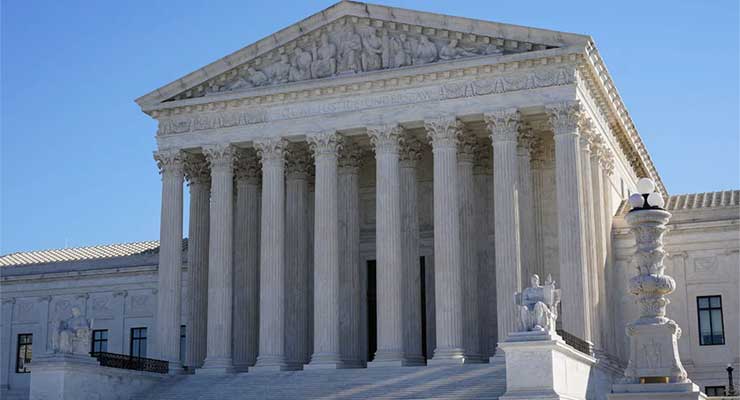
The Trump administration scored a significant victory at the U.S. Supreme Court Monday as the justices cleared away a major legal obstacle that had prevented the administration from implementing new safeguards governing mail-in ballots ahead of November’s midterm elections.
The Court lifted an injunction affecting 23 states that had challenged President Donald Trump’s March executive order. Justices Sonia Sotomayor, Elena Kagan and Ketanji Brown Jackson dissented. The Justice Department and U.S. Postal Service indicated that they would move toward implementing the revised requirements.
The administration has made election integrity a major priority, Monday’s ruling removes an important roadblock at a critical moment.
What Trump actually ordered
Much of the political argument surrounding the order has been reduced to the phrase “restricting mail-in voting.” The actual provisions are more specific.
Trump’s March 31 executive order directs the Department of Homeland Security, working with the Social Security Administration, to compile state-by-state lists of confirmed U.S. citizens of voting age. It also directed the Postal Service to develop standards for handling federal-election mail ballots.
Those postal safeguards include unique Intelligent Mail barcodes on ballot envelopes, standardized Official Election Mail markings and USPS-compatible envelope designs. The administration also called for state-specific lists identifying people participating in mail or absentee voting.
The Postal Service subsequently produced a 95-page final rule. Under the rule, states participating in the system would provide USPS with information concerning voters receiving mailed ballots and use unique barcodes on outbound and return ballot envelopes. USPS says the system is intended to provide an auditable trail and assist enforcement of federal election laws.
Those details matter.
Whatever one’s opinion of Trump, barcoding an election envelope so that it can be tracked is fundamentally different from examining the voter’s choices. USPS says postal employees would not inspect ballot contents, and the system would not collect party affiliation. The information maintained would concern the exterior of the envelope, including addresses and tracking information.
The argument for the safeguards
Supporters see a straightforward principle at work: voting should be easy for eligible citizens, but the mechanisms used to distribute and return ballots should also be auditable.
Mail voting introduces a logistical chain that does not exist when a voter personally appears at a polling place. A ballot can travel from an election office through the postal system to a residence and back again.
The administration argues that unique identifiers and voter-list verification create a stronger chain of accountability without examining how anyone voted.
Postmaster General David Steiner described the objective in practical terms: USPS wants to ensure that ballots states believe they sent correspond with what actually entered the postal system.
The administration also emphasizes something on which there is little legal controversy: noncitizens are prohibited by federal law from voting in federal elections. Trump’s order cites existing federal statutes imposing criminal penalties for unlawful registration and voting and directs federal agencies to improve citizenship-verification capabilities.
The political dispute is therefore not principally about whether noncitizens should vote in federal elections. They cannot legally do so. The argument concerns what verification measures government may employ, which level of government possesses the authority to impose them, and whether the federal executive branch has exceeded that authority.
The constitutional objection
Opponents have a substantial constitutional argument of their own.
The Constitution gives states primary responsibility for determining the “Times, Places and Manner” of congressional elections, while granting Congress authority to alter those regulations. Democratic-led states and voting-rights organizations contend that this structure does not give a president independent power to redesign state election administration through executive action.
They also warn that introducing substantial procedural changes only weeks before voting begins could create confusion or prevent otherwise eligible voters from receiving ballots. Some states are preparing to distribute ballots very soon, making the timing particularly consequential.
Those arguments have not disappeared because of Monday’s decision. They may ultimately determine the fate of portions of Trump’s program.
An important distinction from another recent Supreme Court ruling
There is another reason for precision.
This case should not be confused with the Supreme Court’s June ruling involving Mississippi’s deadline for receiving mailed ballots.
In Watson v. Republican National Committee, the Court rejected a challenge to Mississippi’s law allowing ballots postmarked by Election Day to arrive and still be counted during a subsequent grace period. That decision therefore went against the Republican challengers seeking an Election Day receipt deadline.
Monday’s case concerns a different set of federal mail-ballot procedures stemming from Trump’s executive order.
The distinction is worth emphasizing because headlines describing the Court as simply “limiting mail-in voting” can blur two quite different legal controversies.
The larger question: confidence in elections
Beyond the lawsuits lies a problem neither political party can afford to dismiss: Americans need confidence that elections are both accessible and secure.
Critics of Trump’s approach point to studies finding documented mail-ballot fraud to be rare and argue that sweeping new restrictions address a problem that has not been shown to alter modern national election outcomes. Supporters respond that election safeguards should be preventative rather than imposed only after substantial fraud has occurred. The Supreme Court has sided with President Trump.
A system can have historically low documented fraud while still benefiting from technologies that make ballot movement more transparent and auditable—provided those safeguards do not improperly prevent qualified citizens from voting.
That is ultimately the standard against which the new rules should be judged.
A consequential victory—but not the last word
For President Trump, Monday’s Supreme Court action is unquestionably a significant legal victory. A lower-court barrier to one of his administration’s most ambitious election-integrity initiatives has been removed at precisely the moment preparations for the 2026 midterms are accelerating.
But it is not necessarily the final word from the judiciary. The unresolved question is whether the administration’s proposed safeguards survive the remaining constitutional challenges—and whether they can be implemented effectively in the short period remaining before Americans vote in November.
What Monday’s ruling guarantees is that the administration will have an opportunity to press forward with its case: that modern mail voting can remain available while becoming more verifiable, trackable and auditable.
For a country in which confidence in elections has itself become a deeply contested political issue, the American people are one significant step closer to regaining their confidence in a system that has been hijacked by widespread fraud.
Leave a Reply