
America’s federal government spent $1.37 for every dollar it collected in fiscal 2026. Decades of congressional promises, expanding entitlements, and accumulated debt have created a fiscal crisis that even a president determined to cut spending cannot solve alone.
November 19, 2026 | Federalist Press
President Donald Trump is frequently blamed for America’s growing national debt. But anyone who wants to understand why Washington continues borrowing nearly $2 trillion a year should begin by examining the federal budget itself.
The numbers are staggering.
According to the U.S. Treasury Department, the federal government collected $5.403 trillion during fiscal year 2026, which ended September 30. It spent $7.396 trillion. The difference, approximately $1.993 trillion, was added to an already enormous national debt.
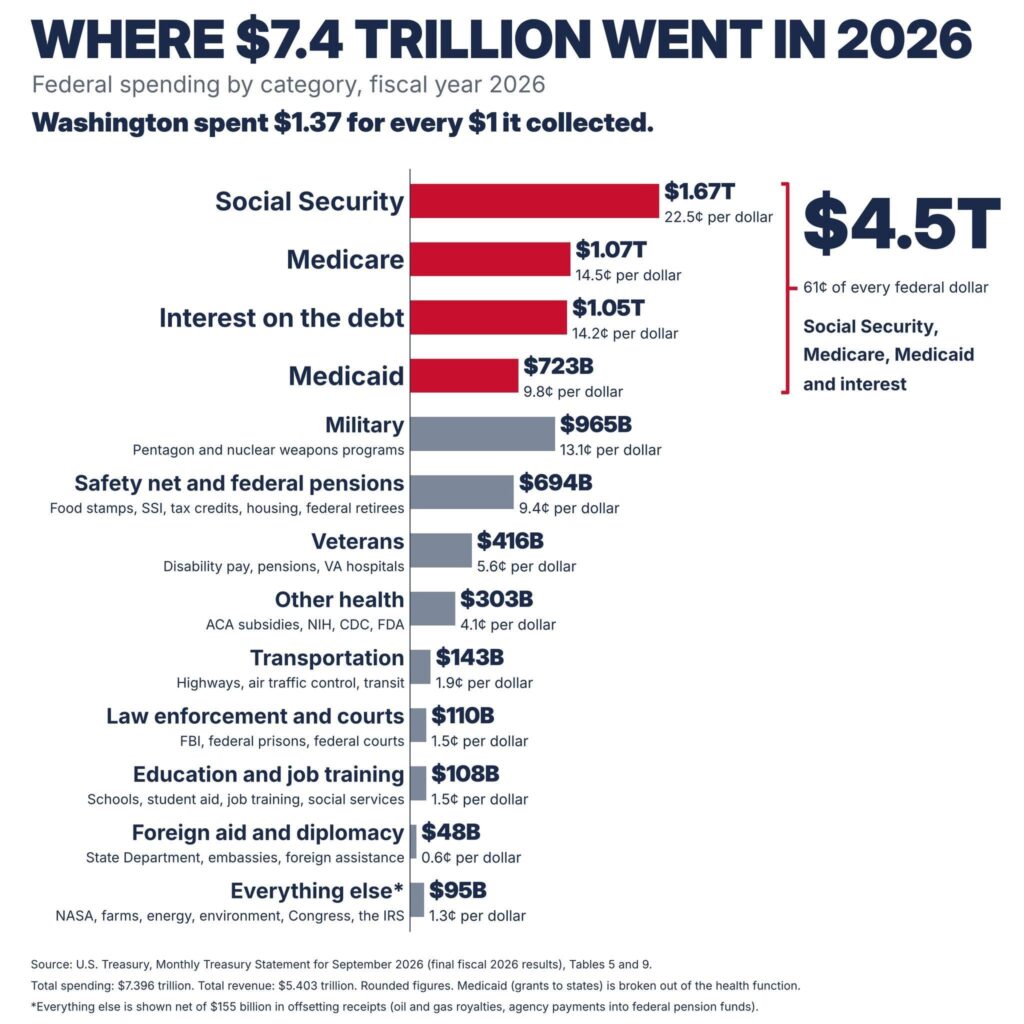
Put another way, Washington spent $1.37 for every dollar it collected. More than one-quarter of everything the federal government spent was financed by borrowing.
And this was hardly an isolated occurrence. The federal government has operated at a deficit almost continuously for decades, under Republican and Democratic presidents alike. Congress has repeatedly authorized spending commitments without establishing the revenues necessary to pay for them.
The result is a government whose financial obligations have grown so large that even a president with decades of business experience has remarkably little freedom to reduce spending without congressional cooperation.
And the new Democrat controlled congress has no intention of curtailing spending. We need look no further than the way they excoriated Elon Musk and DOGE for trying to ferret out fraud and waste in the budget.
Where the $7.4 Trillion Went
Consider the federal government’s spending priorities in fiscal 2026.
Social Security consumed approximately $1.67 trillion, or 22.5 percent of federal spending. Medicare required another $1.07 trillion, while Medicaid accounted for approximately $723 billion. Democrats seek to greatly expand Medicare / Medicaid by forcing everyone onto the program.
Then came interest on the national debt: an astonishing $1.05 trillion annually.
Together, these four categories consumed approximately $4.5 trillion, or 61 percent of every federal dollar spent.
That money was committed before Washington could begin addressing the nation’s other responsibilities, including national defense, its core constitutional responsibility.
The military, including Pentagon operations and nuclear weapons programs, accounted for approximately $965 billion, or 13.1 percent of federal spending. That is less than the federal government spent servicing its accumulated debt.
Other major expenditures included approximately $694 billion for income-security programs and federal pensions, $416 billion for veterans, $303 billion for other health-related spending, $143 billion for transportation, and $108 billion for education and job training.
These figures reveal something profoundly troubling about Washington’s priorities. The United States now spends more paying interest on yesterday’s borrowing than it spends on its military.
National defense is among the federal government’s most fundamental constitutional responsibilities. Yet its share of federal expenditures has been overtaken by programs and financial obligations accumulated over generations.
The problem is not that Social Security recipients or veterans are undeserving. Millions of Americans have paid taxes throughout their working lives in reliance upon promises made by their government. Those commitments cannot simply be discarded.
The problem is that Congress has made promises without establishing a sustainable means of financing them.
Congress Created a Budget That Runs on Autopilot
Many Americans imagine that the president prepares a budget, Congress approves it, and the government then spends according to that plan.
The reality is considerably more complicated.
Federal spending falls into three broad categories: mandatory spending, discretionary spending, and interest on the national debt.
Mandatory spending includes programs such as Social Security, Medicare, and Medicaid. Congress established eligibility requirements and benefit formulas through legislation. As long as those laws remain in effect, qualifying beneficiaries are entitled to receive payments without Congress having to approve each individual expenditure annually.
Discretionary spending, by contrast, is generally determined through annual appropriations. This includes much of the military budget and funding for numerous federal agencies.
Interest payments arise from the government’s existing debt obligations.
This distinction explains why presidents who promise to eliminate waste and balance the budget encounter such formidable obstacles. Much of the money is committed under existing law. A president cannot simply announce that Social Security, Medicare, or Medicaid will spend substantially less next year.
Changing those programs generally requires congressional legislation, often involving politically painful decisions about eligibility, benefits, taxes, or future obligations.
And whenever a president proposes meaningful reductions, the political consequences can be immediate.
Democrats and their allies frequently portray Republican proposals to restrain federal spending as attacks on seniors, veterans, children, and vulnerable Americans. Media coverage often emphasizes the people who might lose benefits or services while giving less attention to the long-term financial consequences of maintaining programs without adequate funding.
That does not mean every proposed cut is wise or that every objection is dishonest. It does mean that Washington’s political incentives strongly favor maintaining expenditures and postponing difficult decisions.
The politicians who promise additional benefits receive immediate political rewards. The taxpayers who must eventually finance those promises may not receive the bill for decades.
Every Federal Dollar Has to Come From Somewhere
There is no mysterious reservoir of government money separate from the American economy.
Federal spending is financed through taxes, borrowing, and, indirectly, monetary arrangements that can affect the purchasing power of money.
When Washington collects taxes, it transfers purchasing power from individuals and businesses to the government. When it borrows, it creates obligations that must be serviced through future revenues, additional borrowing, or other fiscal adjustments.
Deficit spending does not make the cost disappear. It postpones the reckoning.
Government borrowing can serve legitimate purposes, particularly during wars, emergencies, or severe economic downturns. But routine borrowing on the scale of nearly $2 trillion annually is an entirely different matter.
It means the federal government is financing ordinary operations by continually increasing its indebtedness.
The consequences extend far beyond Washington. Federal borrowing competes for available capital, debt-service costs absorb future revenues, and persistent fiscal imbalances can constrain economic growth and the government’s ability to respond to emergencies.
Meanwhile, American families must contend with taxes, housing expenses, food prices, insurance premiums, and the costs of raising children.
Every dollar devoted to servicing federal debt is a dollar unavailable for national defense, essential public services, tax relief, or reducing future borrowing.
Ronald Reagan Saw This Coming
President Ronald Reagan understood the danger more than four decades ago.
In 1982, Reagan urged Congress to adopt a constitutional amendment requiring a balanced federal budget and imposing limits on taxation.
He believed that ordinary political promises were insufficient to restrain Washington’s appetite for spending. Congress needed a binding constitutional obligation.
Speaking to supporters of the amendment on September 8, 1982, Reagan explained that the solution was to make balanced budgets the law of the land.
The Senate approved a balanced-budget amendment proposal that year, but the measure failed to obtain the necessary support in the House of Representatives.
On October 1, Reagan again appealed to House members, arguing that enforceable constitutional limits were essential to controlling both deficits and the overall size of government.
He warned against substituting an unenforceable promise to balance the budget on paper for a genuine constitutional restraint.
More than forty years later, Washington is still living with the consequences of failing to impose that discipline.
Reagan himself did not achieve balanced federal budgets, and deficits increased substantially during his presidency. That history illustrates the difficulty of translating fiscal principles into policy, even when a president strongly supports restraint.
Most states operate under some form of balanced-budget requirement, although the rules differ and states can still issue debt or use accounting mechanisms that complicate the picture.
The federal government has no comparable constitutional obligation.
Congress can continue spending more than it collects, provided it authorizes the necessary borrowing.
And that is precisely what it has done.
Trump and the Political Price of Cutting Government
Donald Trump entered politics with extensive business experience and a reputation for challenging established institutions. His supporters reasonably expected
Leave a Reply