
Air traffic halted nationwide. Microsoft systems disrupted around the world. Military refrigeration failures under investigation as possible cyberattacks. A warning from an intelligence source raises an urgent question: How prepared are Americans if the next disruption is worse?
Federalist Press | November 13, 2026
A series of extraordinary technological disruptions is raising troubling questions about the vulnerability of America’s critical infrastructure, the possibility of hostile foreign interference, and whether ordinary Americans are adequately prepared for a prolonged interruption of essential services.
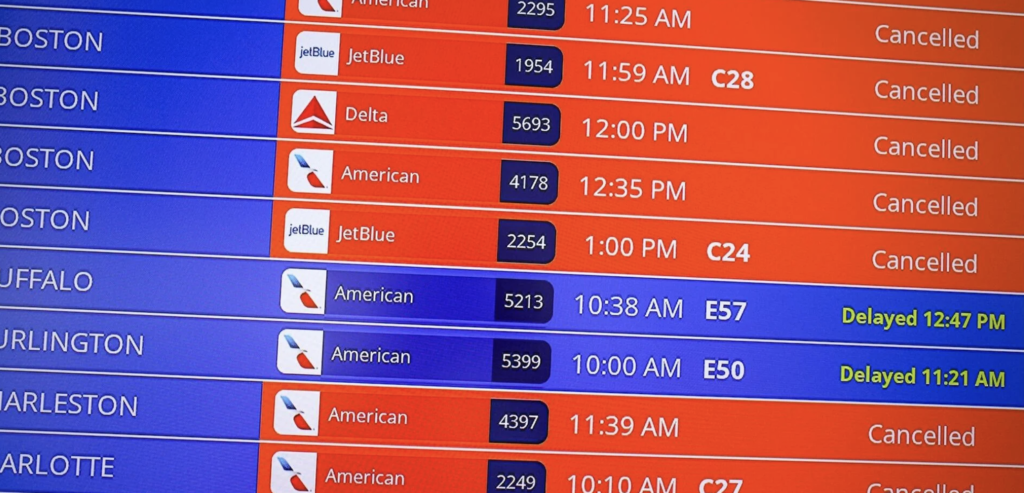
On Friday, the Federal Aviation Administration ordered a nationwide halt to departing flights after a telecommunications failure affected air traffic control operations across the country. The unprecedented disruption came as Microsoft struggled to restore services following a massive global outage that affected governments, businesses and communications in dozens of countries.
Meanwhile, the Pentagon continues investigating mysterious refrigeration failures at American military commissaries, incidents that investigators have reportedly treated as possible cyberattacks.
Individually, these events might be explained by technical failures, aging infrastructure or criminal interference. Together, they expose something more consequential: the extraordinary dependence of modern American life on interconnected digital systems that can fail with little warning.
And according to a source with connections to the U.S. intelligence community who recently contacted Federalist Press, concerns about a potentially more serious disruption may be circulating within national-security circles.
The source recommended that American families maintain enough groceries and essential supplies to sustain themselves for several weeks, describing concerns that recent infrastructure problems could precede more serious difficulties.
Federalist Press has not independently verified the source’s assessment or a reported recommendation that intelligence personnel and their families increase household emergency supplies. No public government warning establishing an imminent nationwide cyberattack has been identified.
Nevertheless, the documented incidents deserve serious attention.
An Extraordinary Shutdown of America’s Airspace
Friday’s nationwide ground stop was one of the most significant interruptions of American commercial aviation in decades.
According to the Associated Press and Reuters, communications problems affected the Federal Aviation Administration’s 22 regional air traffic control centers, prompting officials to suspend departures nationwide for safety reasons.
Homeland Security Secretary Markwayne Mullin said the disruption appeared to involve telecommunications infrastructure and that investigators had found no indication of malicious activity.
The government has not established that the failure resulted from a cyberattack.
But the consequences were immediate. Airlines faced widespread delays and cancellations, travelers were stranded, and an enormous transportation system suddenly found itself unable to operate normally.
The incident also renewed concerns about the age and reliability of America’s air traffic control infrastructure. Congress has already committed billions of dollars to modernization, but substantial additional investment is considered necessary.
Whether Friday’s failure resulted from a technical malfunction or something more deliberate, it demonstrated how a problem affecting a critical communications network can rapidly disrupt transportation across an entire country.
Microsoft: A Worldwide Digital Breakdown
The aviation emergency followed a major Microsoft outage that began Thursday and continued into Friday.
Outlook, Teams, Exchange Online and other Microsoft 365 services became inaccessible or unreliable for users across 74 countries and territories.
Government operations were affected in Australia, Japan, Singapore and the Philippines. American businesses and state government agencies also reported problems, including Massachusetts, where state employees were notified that email and other Microsoft services were unavailable.
The disruption extended beyond Microsoft customers because numerous organizations depend on its cloud infrastructure and integrated services to conduct ordinary business.
For companies that rely on email to coordinate production, shipping, payments or customer service, even a relatively brief outage can have consequences extending well beyond the technology department.
Microsoft reported that servers were becoming unexpectedly unavailable, placing additional pressure on those still functioning. The company subsequently attributed the disruption to technical problems associated with network infrastructure changes and said it had found no evidence of malicious cyber activity.
That explanation is important. The outage should not be characterized as a confirmed cyberattack.
But it also illustrates a fundamental vulnerability: when essential services are concentrated within a small number of technology platforms, an internal malfunction can produce consequences resembling those of a successful cyberattack.
From the perspective of an affected hospital, government office or business, the immediate problem is the same. Critical systems are unavailable.
The Pentagon’s Mysterious Refrigeration Failures
The most suspicious incidents in the recent series involve refrigeration equipment at military installations.
On October 29, Reuters reported that Pentagon investigators were treating a series of mysterious freezer malfunctions at American military commissaries as possible cyberattacks.
The problems occurred in August at facilities associated with at least six military bases or stores, resulting in spoiled food and disruptions to the availability of meat, dairy products, produce and frozen goods.
One affected location was Fort Huachuca, Arizona, an installation associated with military intelligence and cybersecurity operations.
The investigation acquired additional significance because commercial refrigeration systems in France had experienced confirmed cyberattacks.
European investigators identified malicious interference affecting refrigeration equipment at hundreds of locations, demonstrating that equipment normally regarded as mundane commercial infrastructure can become a target of digital sabotage.
A November 4 report in Stars and Stripes confirmed that the Pentagon had not publicly established the cause of the American incidents. Military investigators were examining the overseas attacks, but the connection between those incidents and the American refrigeration failures remained unproven.
The implications extend far beyond military grocery stores.
Modern food distribution depends on electronically controlled refrigeration, automated warehouses, computerized inventory systems and tightly coordinated transportation networks.
A successful attack against those systems could destroy perishable inventory, interrupt deliveries and create shortages even when adequate food exists elsewhere in the supply chain.
It would not require an adversary to destroy farms or factories. Disrupting the systems that preserve and distribute food could be enough to cause serious economic damage.
Could Foreign Adversaries Be Testing America’s Vulnerabilities?
Russia, China, Iran and other hostile actors have long been recognized as potential cyber threats to American infrastructure.
The strategic attraction of cyber operations is obvious. A sophisticated adversary may be able to interfere with communications, transportation, utilities or industrial equipment without launching a conventional military attack.
Such operations can also be difficult to attribute, particularly when malicious activity is designed to resemble equipment failure or ordinary network problems.
Security specialists sometimes describe campaigns involving cyberattacks, disinformation, economic pressure and conventional military threats as hybrid warfare.
One possible strategy involves identifying weaknesses in an adversary’s infrastructure before attempting a more consequential disruption.
But the existence of such strategies does not establish that the recent American outages are connected.
Microsoft has specifically denied finding evidence of a cyberattack. Federal officials have reported no indication of malicious interference in Friday’s aviation disruption. The military refrigeration incidents remain under investigation.
At present, there is no publicly verified evidence demonstrating that these events constitute a coordinated foreign operation.
The appropriate question is therefore not whether an attack has already been proven. It is whether American infrastructure is resilient enough to withstand one.
A Warning to Prepare, but Not to Panic
Federalist Press recently received a warning from a source with connections to the intelligence community expressing concern about the possibility of additional disruptions.
The source recommended that households obtain sufficient groceries and essential supplies to remain self-sufficient for several weeks.
The source also described what was said to be heightened preparedness advice circulating among some intelligence personnel and their families.
Federalist Press has not independently corroborated that account, and it should not be interpreted as confirmation of an official intelligence-community warning or a prediction that a nationwide emergency is imminent.
There is, however, nothing extreme about maintaining emergency supplies.
The Federal Emergency Management Agency has long recommended that Americans keep food, drinking water, medications, flashlights, batteries and other necessities available in case ordinary services become temporarily unavailable.
The Centers for Disease Control and Prevention has also published emergency-kit guidance that includes two weeks of nonperishable food.
Such preparations are useful during hurricanes, earthquakes, winter storms, power failures, cyber incidents and other emergencies.
Families do not need to know which particular disruption might occur to benefit from reasonable advance planning.
What American Families Can Do Now
The most sensible response is measured preparation rather than fear or panic buying.
A household seeking greater resilience can gradually build a reserve of ordinary groceries that family members already eat. Canned vegetables, beans, rice, pasta, peanut butter, shelf-stable milk and other durable foods can provide useful protection against temporary supply interruptions.
Families should also consider the following precautions:
- Maintain a food reserve. Begin with several days of nonperishable meals and, where practical and affordable, gradually expand toward one or two weeks. Rotate supplies into normal household use to avoid waste.
- Store drinking water. FEMA recommends at least one gallon per person per day for drinking and sanitation, with additional allowances for pets, medical needs and hot weather.
- Protect access to medications. Keep necessary prescriptions current, maintain a first-aid kit and consider how essential medical equipment would operate during an extended power outage.
- Prepare for communications failures. Keep phones charged, maintain backup batteries, and have a battery-powered or hand-crank radio. Write down important telephone numbers rather than relying entirely on cloud-stored contacts.
- Maintain reasonable payment alternatives. A modest amount of cash in small denominations can be useful if electronic payment networks become unavailable. There is no reason to empty bank accounts or make extraordinary withdrawals.
- Plan for electricity and refrigeration outages. Keep flashlights and batteries available, know how to preserve food safely, and use generators only outdoors, well away from doors and windows, because of carbon monoxide hazards.
- Make a family communications plan. Establish how relatives will contact one another if cellular networks, internet services or ordinary transportation are disrupted.
These precautions require neither expensive survival equipment nor an assumption that catastrophe is inevitable.
They are practical steps that reduce dependence on systems beyond an individual’s control.
The National-Security Question Washington Must Answer
The deeper concern is not whether Americans have enough canned food in their cupboards.
It is whether the United States has allowed essential infrastructure to become so interconnected, centralized and digitally dependent that relatively small failures can produce nationwide consequences.
The vulnerabilities extend across transportation, banking, telecommunications, food distribution, energy, water treatment and medical services.
Some disruptions may result from hostile activity. Others may arise from software errors, equipment failures, inadequate maintenance or poor system design.
For the families and businesses affected, the distinction matters less in the immediate aftermath than the availability of reliable backup systems.
Washington should therefore treat infrastructure resilience as a national-security priority, including stronger cybersecurity protections, independent backup communications, rigorous testing, contingency planning and clear public explanations when major failures occur.
The public also deserves transparency about incidents that could involve foreign interference. Investigations should establish what happened without either prematurely dismissing credible threats or encouraging speculation unsupported by evidence.
The Warning Signs Are Real. The Next Crisis Is Not Yet Known.
America has not experienced a confirmed, coordinated cyberattack connecting the military refrigeration incidents, Microsoft’s global outage and Friday’s aviation emergency.
It would be irresponsible to claim otherwise.
But it would be equally irresponsible to ignore what these incidents reveal about the fragility of systems upon which hundreds of millions of people depend.
A communications failure can ground aircraft. A cloud-services outage can interrupt government operations across continents. A malfunction in refrigeration equipment can destroy food supplies before they reach consumers.
The possibility that hostile nations might exploit these vulnerabilities is a legitimate national-security concern, regardless of whether they caused the present disruptions.
Americans should not be frightened into believing that a catastrophic attack is inevitable. Nor should they assume that the systems supporting their daily lives are incapable of failure.
The sensible response is to demand greater resilience from government and industry while taking reasonable precautions at home.
Preparation is not panic. It is the recognition that when essential systems fail, even temporarily, a family with food, water, medicine and a workable emergency plan is in a better position than one entirely dependent on uninterrupted services.
Whatever the cause of the next disruption, that is a lesson worth learning before it happens.
Leave a Reply