• Home
  • Mission
  • Federalist Papers
  • Foundation
  • U.S. Constitution
  • Bill of Rights

Federalist Press | Defending Liberty — Informing America

Breaking News and Political Commentary

  • All Stories
  • Economy
  • Elections
  • Entitlement
  • Ethics
  • Foreign
  • Gender
  • Religion
  • Sci-Tech

Vaccines Save Lives. They Also Injure Some Children. Both Facts Can Be True.

August 4, 2026 By Editor Leave a Comment

There is something of a pro-vax / anti-vax vibe in the air in America. There shouldn’t be. But Americans need to know that there is a real risk for many children receiving vaccines.

HHS Secretary RFK, Jr. tells Dana Bash ‘Parents should get their children vaccinated for measles’

For years, Americans have been told that vaccines are “safe and effective.” In the broad sense, that statement is true. Vaccines have dramatically reduced or eliminated diseases that once killed or permanently disabled hundreds of thousands of children.

But another statement is also true. Some children are seriously injured by vaccines.

That fact is neither new nor controversial within the medical community. It is the reason Congress established the National Vaccine Injury Compensation Program in 1986. Lawmakers recognized that while vaccines benefit society as a whole, a small number of individuals would inevitably suffer severe adverse reactions through no fault of their own.

The question is not whether vaccine injuries exist. The question is how honestly we discuss them.

A Rare Event Is Still a Tragedy

Parents naturally think in terms of percentages. If a serious adverse reaction occurs once in every million doses, statisticians describe that as “extremely rare.”

The family whose child suffers that reaction describes it differently. To them, the risk is 100 percent.

Modern medicine recognizes several vaccine-related adverse events as genuine complications. These include severe allergic reactions, certain seizure disorders associated with fever, immune-mediated blood disorders, and rare bowel complications following rotavirus vaccination. In uncommon circumstances, these reactions can result in permanent disability or death.

These are not conspiracy theories. They are recognized medical conditions documented by federal health agencies, peer-reviewed research, and the federal vaccine compensation program itself.

Congress Created the Compensation Program for a Reason

The National Vaccine Injury Compensation Program has compensated thousands of claims over the past several decades.

Importantly, not every compensated case represents a definitive scientific finding that a vaccine caused an injury. Many claims are resolved through settlement, and some are compensated because the legal standard differs from the scientific standard.

Nevertheless, the existence of the program acknowledges an important reality: vaccines are not completely risk-free.

No responsible physician claims they are. The proper question is whether the benefits outweigh those risks—not whether the risks exist.

Why the Numbers Are Difficult to Measure

One of the greatest frustrations for both parents and researchers is determining how often serious vaccine injuries actually occur. The United States relies on several surveillance systems, each with strengths and limitations.

The Vaccine Adverse Event Reporting System (VAERS) accepts reports from anyone, making it valuable for identifying potential safety signals. At the same time, reports alone do not establish that a vaccine caused an injury, and many reported events ultimately prove unrelated . . . perhaps. Of course, most reporting and determining functions lean heavily pro-vax, so the numbers are considered unreliable by many.

Other surveillance systems actively study medical records and provide stronger evidence regarding causation, but they examine narrower populations. As a result, there is no perfect accounting system.

Some critics argue that passive reporting inevitably misses many cases because not every adverse event is recognized or reported. Public health officials, meanwhile, caution that raw reports cannot be interpreted as confirmed vaccine injuries because illnesses naturally occur in the same age groups receiving routine immunizations.

Both observations can be true.

Understanding the actual incidence of vaccine injury is therefore more complicated than either side of the debate often acknowledges.

Honest Medicine Requires Honest Conversation

Unfortunately, public discussion has become polarized. Some activists portray every childhood illness following vaccination as proof that vaccines are dangerous. Others behave as though questioning vaccine safety is itself irresponsible.

Neither position serves parents well. Medicine advances by openly examining evidence—not by dismissing uncomfortable questions.

Parents deserve to know that every medical intervention carries some degree of risk, whether it is surgery, anesthesia, prescription medication, or vaccination. Vaccines should not be exempt from that principle. Nor should they be uniquely condemned.

Trust Requires Transparency

Public confidence is not strengthened by pretending that vaccine injuries never occur. It is strengthened by acknowledging them honestly, caring for the families affected, continually improving vaccine safety, and conducting rigorous independent research whenever legitimate questions arise.

The overwhelming majority of children experience nothing more than temporary soreness or fever after vaccination. A very small number experience something far more serious. Those families should never be treated as collateral damage in a political argument. They deserve compassion. They deserve answers.

And they deserve a medical system willing to investigate every credible safety concern with the same determination it brings to preventing infectious disease. Public health does not require blind faith. It requires transparency, accountability, and the willingness to follow evidence wherever it leads—even when that evidence is inconvenient.

Only then can Americans have the confidence that both the benefits and the risks of vaccination are being reported honestly.

Filed Under: Sci-Tech, Bias, Featured

Stop Financing Degrees That Cannot Repay Their Loans

August 3, 2026 By Editor Leave a Comment

Federal student lending should help Americans build productive careers—not guarantee universities unlimited customers while leaving graduates buried beneath debts their earnings cannot support.

Why does the federal government continue lending tens of thousands of dollars to students for degree programs whose graduates routinely earn too little to repay what they borrowed?

No private lender would knowingly finance a $100,000 investment without examining whether the investment had a reasonable prospect of producing enough income to service the debt. Yet Washington has spent decades making enormous education loans with remarkably little regard for the price of the program, its completion rate, the employment prospects of its graduates, or the relationship between their expected earnings and monthly payments.

The result is a system that protects universities from ordinary market discipline while transferring nearly all the risk to students and taxpayers. By the first quarter of 2026, the federal student-loan portfolio had reached approximately $1.7 trillion across 43 million borrowers. Meanwhile, the average student at a public university who borrows to obtain a bachelor’s degree leaves with roughly $31,960 in debt.

That enormous flow of federally guaranteed money has not merely helped students pay rising tuition. It has also enabled institutions to raise prices, expand administrative bureaucracies, construct lavish facilities, and create programs whose economic value is often disconnected from their cost. Tuition and fees nearly doubled in nominal terms between the 2005–06 and 2025–26 academic years, rising 93.2 percent; even after adjusting for inflation, the increase was 17.4 percent. Public universities now charge an average of about $10,340 annually in resident tuition, while private colleges average approximately $39,307 before housing, meals, books, and other expenses are added.

The central failure is simple: Washington has treated nearly every accredited college program as though it represents an equally prudent public investment. It does not.

Federal Loans Should Be Investments, Not Blank Checks

A student loan is not a prize for admission to college. It is a financial investment in a course of study that is expected to increase a student’s knowledge, employability, and future earnings enough to justify the expense.

That does not mean education has no value beyond income. Literature, music, history, philosophy, languages, and the arts contribute enormously to civilization. A free society should permit universities to offer them and students to study them. The issue is not whether such subjects may be taught. The issue is whether taxpayers should guarantee virtually unlimited borrowing for any program, at any price, regardless of whether its graduates can reasonably repay the debt.

People remain free to purchase countless things that the federal government does not subsidize. Freedom to pursue a degree does not create an entitlement to have taxpayers assume its financial risk.

Federal loans should therefore be conditioned upon measurable economic outcomes. Before guaranteeing tens of thousands of dollars for a particular degree at a particular institution, the government should ask the questions any responsible lender would ask: What percentage of students complete the program? What do graduates earn? How many find work related to their education? How much do they borrow? What percentage can repay without requiring decades of subsidies, deferments, forgiveness, or default?

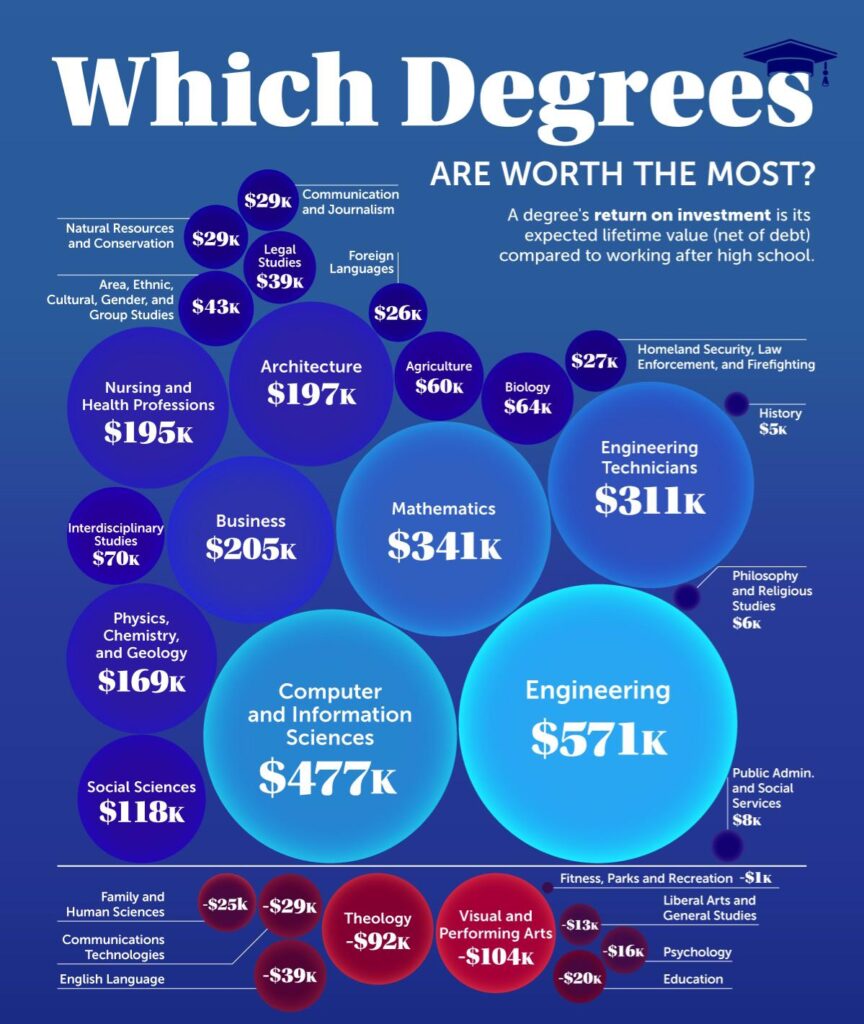
The answers vary enormously by field. Georgetown University’s Center on Education and the Workforce reports that median earnings among prime-age bachelor’s-degree holders range from about $58,000 in education and public-service fields to $98,000 in STEM fields. A bachelor’s degree still produces a substantial average advantage over a high-school diploma, but the return is far from uniform across majors and institutions.

That distinction matters. “College pays” is an average, not a guarantee. It tells a prospective student little about whether borrowing $80,000 for one particular program at one particular university is sensible.

Universities Receive the Money; Students Carry the Risk

The present system creates a dangerous imbalance. Universities receive tuition immediately. They are paid whether the student graduates or drops out, whether the degree leads to a career or unemployment, and whether the borrower repays the loan or spends decades trapped in delinquency.

The school has already been paid. The graduate and the taxpayer remain responsible for everything that follows.

This is a textbook example of moral hazard. When institutions receive the reward while someone else bears the risk, prices rise and accountability collapses. Universities have little financial incentive to close weak programs, reduce tuition, limit enrollment in oversupplied fields, or tell applicants that their chosen degree may never justify its cost.

The federal government should end that arrangement. Institutions should be required to share the losses when their programs repeatedly leave students unable to repay. A university that collects federal loan dollars should have financial skin in the game.

If graduates consistently default, the institution should reimburse part of the federal loss. If a program repeatedly fails objective earnings and repayment standards, its access to new federally guaranteed loans should be reduced and ultimately suspended. Schools would remain free to offer the program, but they would have to persuade students to pay for it voluntarily, lower its price, finance it themselves, or demonstrate improved outcomes.

The market discipline would be immediate. Programs with genuine value would survive. Programs maintained primarily because federal money makes them profitable would face pressure to improve, shrink, or disappear.

Debt Is Not Merely a Number on a Statement

Bad education debt does more than reduce a borrower’s disposable income. It can delay marriage, homeownership, family formation, retirement saving, entrepreneurship, and other milestones through which people enter stable middle-class life.

Research has also identified an association between student debt and psychological distress. One study found a significant relationship between student-loan debt and distress among graduates, while broader reviews have linked educational debt with anxiety, depression, and diminished well-being. Association does not prove that debt alone causes every mental-health problem, but it confirms what common sense already suggests: beginning adult life with a large obligation and weak earnings can impose profound emotional as well as financial strain.

The current labor market has made the problem harder to ignore. The unemployment rate for recent college graduates reached 5.8 percent in 2025, its highest level since 2013 outside the pandemic disruption.

Many graduates eventually succeed, and some low-paying fields provide immense public value. Teachers, social workers, public defenders, artists, and researchers should not be casually dismissed because their salaries are modest. But acknowledging the social value of a profession does not justify allowing institutions to charge any amount they choose. A necessary but modestly compensated career requires lower-cost training, targeted scholarships, employer support, service-based grants, or explicit public appropriations—not a disguised system that saddles the worker with debt and hopes repayment somehow works itself out.

A Better Student-Loan System

Congress should replace the current blank-check model with an outcomes-based system built around several straightforward principles.

First, federal borrowing limits should be established program by program, rather than merely by degree level. The permissible loan should bear a reasonable relationship to the historical earnings of graduates from that specific program and institution. A degree whose graduates typically earn $45,000 should not carry the same federally backed borrowing capacity as one whose graduates routinely earn $100,000.

Second, every applicant should receive a plain-language financial disclosure before borrowing. It should show tuition, total expected debt, completion rates, median graduate earnings, monthly payments under a standard repayment plan, employment rates, and the percentage of former students who are delinquent or require income-based subsidies. Students should have to acknowledge those figures before taxpayers guarantee the loan.

Third, universities should share repayment risk. When a program repeatedly produces poor outcomes, the institution—not merely the borrower and Treasury—should absorb part of the loss.

Fourth, programs that fail minimum standards for several consecutive years should lose access to federal student loans. The Department of Education has already developed transparency and accountability mechanisms using earnings and debt measures, and a 2026 accountability framework moves toward denying federal loans to persistently failing programs. The sound principle should be applied consistently across public, private nonprofit, and proprietary institutions rather than selectively according to institutional type.

Fifth, federal policy should give much greater support to lower-cost pathways connected to demonstrable workforce demand: community colleges, apprenticeships, skilled trades, technical certifications, nursing, medicine, engineering, advanced manufacturing, cybersecurity, accounting, and other fields in which training leads to identifiable employment opportunities.

This does not require Washington to dictate everyone’s career. It requires Washington to stop pretending that every educational purchase is equally safe for federal financing.

Stop Confusing Access With Value

Defenders of the existing system will argue that restricting federal loans could reduce access to higher education, particularly for students from lower-income families. That concern deserves serious consideration, but “access” to an unaffordable program with poor completion and employment outcomes may be access to financial harm.

A young person is not helped by being admitted, praised, indebted, and abandoned.

Real access means access to education worth its cost. It means an honest chance of graduation, employment, repayment, independence, and advancement. A federal program that helps someone borrow $70,000 for a credential that adds little to his earning capacity has not expanded opportunity. It has financed a trap.

Low-income students should receive grants and scholarships where there is a compelling public purpose. They should also have access to affordable community colleges, apprenticeships, occupational programs, and properly priced universities. But institutions should not be permitted to invoke disadvantaged students as moral cover for charging prices their graduates cannot sustain.

Universities Must Once Again Serve Students

The federal student-loan system was created to expand opportunity. Too often, it now functions as a revenue pipeline for higher education.

Universities have learned that they can increase tuition because students do not pay the full cost at the moment of purchase. The government advances the money, the institution receives it immediately, and the painful consequences arrive years later—after the graduation ceremony, after the brochure promises have faded, and after the borrower discovers what the degree is actually worth in the labor market.

The market cannot correct prices when government continually supplies more borrowed money to meet them. As long as Washington guarantees the financing, universities remain insulated from the most basic signal in economics: customers refusing to buy something that costs more than it is worth.

That insulation must end.

Students should remain free to study whatever they choose. Universities should remain free to teach any lawful subject. But taxpayers should not be compelled to guarantee any debt an institution wishes to generate.

Federal lending should support opportunity, not institutional excess. It should finance education that gives borrowers a reasonable path toward repayment and productive independence. It should inform applicants rather than seduce them with borrowed money. It should reward schools that deliver value and impose consequences on those that do not.

The guiding rule should be neither complicated nor ideological:

No university is entitled to federally guaranteed customers, and no student should be encouraged to borrow more for an education than that education can reasonably help repay.

That reform would not destroy higher education. It might finally force higher education to remember whom it is supposed to serve.

Filed Under: Economy, All Stories, Entitlement, Featured

Envy Is the Fuel of Socialism

July 28, 2026 By Editor Leave a Comment

Social media has created a generation taught to compare, covet, and consume. Socialism arrives promising to satisfy desires that only hard work and free enterprise can sustainably provide.

One of the most destructive cultural developments of the past twenty years has received remarkably little attention. It is not merely the rise of social media, but the rise of manufactured envy. Platforms that began as a way for families and friends to stay connected have evolved into global competitions where millions of people display carefully edited versions of their lives.

Filters erase imperfections. Luxury vacations become routine. Exotic automobiles, designer clothing, expensive homes, private jets, and seemingly effortless wealth fill endless scrolling feeds.

For many users, especially young people, the result is not inspiration—it is comparison. And comparison, left unchecked, often becomes envy.

Researchers have found that social media encourages upward social comparison, particularly among younger users, increasing dissatisfaction with their own circumstances and amplifying the “fear of missing out.” Social media companies profit from that emotion. Influencers profit from it. Advertisers profit from it. Increasingly, politicians do as well.

Every successful political movement appeals to deeply rooted human emotions. Some appeal to hope. Others appeal to patriotism or fear. Socialism has historically found its greatest appeal in resentment and envy. Its message is deceptively simple: someone else has more than you. Someone else lives in the house you wish you owned, drives the car you wish you could afford, and enjoys a lifestyle you have been taught to believe you deserve.

Rather than asking how successful people created their prosperity, socialism asks a different question: Why should they have it at all?

Former British Prime Minister Margaret Thatcher understood this tendency better than most. She famously observed, “The problem with socialism is that eventually you run out of other people’s money.” She also noted that socialism often appears less interested in making the poor wealthier than in making the wealthy poorer. In fact, history repeatedly demonstrates that many redistributive political movements spend far more time discussing how wealth should be divided than how wealth is actually created.

Social media has fundamentally altered the psychology of younger generations. Previous generations compared themselves primarily to neighbors, classmates, or coworkers. Today’s young adults compare themselves every waking hour to celebrities, entrepreneurs, professional athletes, entertainers, and social media influencers whose carefully curated lives bear little resemblance to reality. Algorithms continuously feed users images of people who appear richer, happier, more attractive, and more successful than themselves. It should surprise no one that many young Americans conclude they are somehow falling behind.

What rarely appears on Instagram, TikTok, or YouTube are the years of sacrifice that almost always precede genuine success. Viewers seldom see the entrepreneur who mortgaged his home three times before building a successful business, the contractor who worked nights and weekends for twenty years, the physician who endured a decade of education and residency, or the investor who quietly accumulated wealth through disciplined saving and decades of compound growth.

Social media compresses decades of effort into a thirty-second highlight reel. Success appears effortless. Wealth appears instantaneous. Luxury appears normal rather than exceptional. When the hard work disappears from the story, redistributing someone else’s success begins to seem perfectly reasonable.

It is therefore not surprising that socialism has gained renewed popularity among many younger Americans. Surveys have shown that younger generations express more favorable attitudes toward socialism than their parents and grandparents. There are many reasons for this. Housing prices have risen dramatically. College tuition has exploded. Student debt burdens millions of graduates. Economic mobility often feels more difficult than it did for previous generations. These concerns are genuine and deserve serious attention. Yet social media magnifies those frustrations by presenting extraordinary lifestyles as though they are ordinary expectations. The emotional response creates fertile ground for politicians promising to solve inequality by expanding government and redistributing wealth.

Within today’s Democratic Party, that message has become increasingly prominent. Self-described democratic socialists now occupy influential positions within the party, while others advocate policies that would significantly expand federal control over healthcare, education, housing, energy, taxation, and wealth redistribution. Supporters argue these programs create greater fairness and economic security. Critics respond that every new entitlement, regulation, or subsidy eventually raises the same unavoidable question: At whose expense?

Government creates no wealth of its own. Every benefit it provides must first be financed through taxation, borrowing, inflation, or future generations who will eventually be asked to pay today’s bills.

America has never promised equal outcomes. It has promised equal opportunity under the law. Those are profoundly different ideas. Free societies inevitably produce different results because individuals make different choices, possess different talents, assume different risks, and devote different levels of effort to different pursuits.

Capitalism rewards innovation, investment, entrepreneurship, and productive labor. Socialism increasingly looks to political power to redistribute what others have already created. History offers countless examples of that experiment, and the results have consistently included slower economic growth, diminished innovation, expanding government control, and declining personal freedom.

The proper response to seeing another person’s success has never been resentment. It should be curiosity. How did they build it? What sacrifices did they make? What risks did they assume? What can I learn from their example? Those questions built the American economy. They inspired generations of immigrants, entrepreneurs, inventors, and workers who transformed modest beginnings into remarkable success stories. Envy has never built a civilization. Innovation has. Discipline has. Entrepreneurship has. Personal responsibility has.

Social media will continue rewarding appearances, and politicians will continue rewarding promises. But neither can repeal economic reality. A nation that teaches its young people to covet what others possess rather than encouraging them to build prosperity for themselves risks replacing ambition with resentment. The American Dream was never that government would guarantee every citizen the lifestyle of an internet influencer. It was that every citizen would remain free to pursue success through talent, perseverance, innovation, prudent risk-taking, and hard work.

That dream remains worth defending. Perhaps the first step is teaching the next generation not to ask, “Why do they have more than I do?” but instead, “What can I build?”

Filed Under: Entitlement, Bias, Crime, Economy, Elections, Ethics, Featured, Gender

The Left’s Favorite Question Is “Who Benefits?” Their Forgotten Question Is “At Whose Expense?”

July 24, 2026 By Editor Leave a Comment

Every law creates winners and losers. Good government begins by honestly acknowledging both.

One of the great weaknesses of modern American politics is that too many public debates begin with compassion, but end without arithmetic. Every election cycle, Americans hear a familiar list of promises: free college, free childcare, free healthcare, student loan forgiveness, rent control, expanded housing subsidies, guaranteed income, climate subsidies, new entitlement programs, higher minimum wages, new regulations, and expanded workplace mandates. The list changes, but the sales pitch remains remarkably consistent.

Supporters almost always ask the same question: “Who will benefit?” It is an important question, but it is only half of the equation. The question too often left unanswered is far more important: At whose expense?

Every law has a cost. Every regulation shifts burdens. Every subsidy comes from someone else’s earnings. Every new government program consumes resources that would otherwise remain in private hands. Economics does not permit free lunches simply because politicians promise them.

Government possesses no independent wealth. It produces no goods. It manufactures no products. Every dollar Washington spends first belongs to someone. It comes from taxpayers, borrowing, inflation, or future generations. Politicians often describe spending as though government itself is writing the check. It isn’t. Your neighbors are—or your children eventually will be. That reality rarely appears in campaign speeches.

Consider healthcare. Supporters of expanded federal healthcare argue that medical care should be available to everyone regardless of income. That is a legitimate moral aspiration. But every proposal must still answer practical questions. Who pays physicians? Who finances hospitals? What taxes increase? What services become rationed? How long do patients wait? How much innovation declines when government sets prices? These are not arguments against helping the sick. They are questions every responsible legislature must answer before expanding government obligations.

The same is true of student loan forgiveness. Canceling student debt sounds compassionate until someone asks, at whose expense? The debt does not disappear. It transfers. Construction workers who never attended college, electricians, truck drivers, retirees, and taxpayers who already repaid their own loans ultimately absorb the obligation. Debt forgiven by government is simply debt shifted to others.

Rent control provides another example. Few ideas sound kinder than making housing more affordable. Yet economists across the political spectrum have long observed that strict rent controls often discourage new housing construction, reduce maintenance, and ultimately shrink housing supply. The intended beneficiaries may receive lower rents, but future renters frequently encounter fewer apartments and higher long-term costs. Once again, the obvious question remains: At whose expense?

Minimum wage increases illustrate the same principle. Everyone wants workers to earn higher wages, and better pay is a worthy objective. But labor markets also operate according to economic reality. If government requires wages substantially above what many small businesses can sustain, employers reduce hiring, automate jobs, cut employee hours, or raise prices. Some workers benefit, consumers pay more, and others never receive the job in the first place. Good intentions cannot repeal the laws of supply and demand.

Environmental regulation presents similar trade-offs. Most Americans support clean air, clean water, and responsible stewardship of natural resources. Yet every major regulation carries economic costs. Electricity becomes more expensive. Fuel prices increase. Manufacturing costs rise. Housing becomes more costly to build. Consumers ultimately bear much of the financial burden. That does not mean environmental protections are unwise. It simply means honest policymaking requires acknowledging both the benefits and the costs.

Perhaps the most overlooked trade-offs involve expanding legal rights. Whenever government creates a new legal entitlement, someone else frequently acquires a new legal obligation. Employers, schools, businesses, religious organizations, parents, and taxpayers all may assume new responsibilities. One person’s newly created legal right often becomes another person’s legal duty. Responsible lawmakers should examine both sides of that equation before legislating.

America’s Founders understood these realities well. They rarely spoke of unlimited government. Quite the opposite. James Madison warned repeatedly that factions would seek political power to advance their own interests at the expense of others. The Constitution therefore limits what government may do—not because compassion is undesirable, but because concentrated political power can become dangerous. Every expansion of governmental authority should be viewed with caution, not because government never helps, but because government almost never relinquishes power once it acquires it.

The genius of free markets is not that they produce perfect outcomes. They do not. Rather, they allow millions of individuals to make voluntary decisions based upon prices, risks, incentives, and personal responsibility, instead of centralized political commands. Markets force difficult choices. Politics often conceals them. Politicians can promise benefits today while postponing the costs until tomorrow. Economics, however, eventually demands payment.

America desperately needs compassion. It also desperately needs honesty. Every proposed law should face one unavoidable question before becoming law: Who pays? Whose freedom is reduced? Whose taxes increase? Whose opportunities disappear? Whose business becomes harder to operate? Whose children inherit the debt?

These questions are not obstacles to good government. They are the beginning of good government. Every benefit has a cost. Every promise has a price. Before Congress passes another trillion-dollar program or another sweeping regulatory scheme, Americans deserve one simple answer that too few politicians are willing to provide: At whose expense?

Filed Under: Featured, Economy, Elections, Entitlement, Ethics, Foreign

Trump Sounds the Alarm on Election Security—America Cannot Survive Elections That Half the Country Can’t Trust

July 17, 2026 By Editor Leave a Comment

Every proven case of voter fraud, ballot abuse, and election corruption erodes public confidence. Instead of dismissing those concerns, Congress should finally fix them.

Ballot stuffing concerns force Connecticut judge to overturn Democratic mayoral election results

One of the greatest strengths of the American constitutional republic has always been the peaceful transfer of power. Americans have accepted election results, even painful ones, because they believed the process itself was fundamentally honest.

That trust is quickly evaporating.

President Donald Trump’s release yesterday of declassified intelligence concerning election security, foreign cyber activity, and America’s voting infrastructure has reignited a debate that never should have become partisan in the first place.

Whether one supported Donald Trump, Joe Biden, or someone else entirely, every American should want exactly the same thing: Every legal vote counted once. Every illegal vote rejected. Every election conducted transparently enough that the public has confidence in the result.

Instead, Americans have spent years watching politicians, bureaucrats, activist judges, and much of the national media insist that even asking questions about election integrity is somehow dangerous. It isn’t. It is necessary.

Confidence Is Earned

The Left often responds that there is “no widespread voter fraud.” That phrase misses the point. The question isn’t whether prosecutors have already proven enough fraud to overturn a presidential election. The question is whether our election system contains vulnerabilities large enough to undermine public confidence.

The answer is obviously yes. No serious observer denies that voter rolls contain errors. No serious observer denies that ballot harvesting has been abused. No serious observer denies that absentee ballots are more vulnerable to fraud than in-person voting. No serious observer denies that election laws vary wildly from one state to another.

No serious observer denies that foreign adversaries, including Communist China, Russia and Iran, have devoted enormous intelligence resources toward understanding and exploiting America’s political system. Those facts alone should concern every American.

The Cases Keep Coming

For years Americans have been told (by Democrats) election fraud is virtually nonexistent. Yet every year prosecutors continue announcing new indictments, and that is only a small fraction of cases of actual fraud.

Bridgeport, Connecticut became perhaps the most famous recent example. Security video appeared to show individuals depositing large numbers of absentee ballots into drop boxes, leading the Connecticut Supreme Court to order a new Democratic mayoral primary election.

That wasn’t internet rumor. That happened.

Special Prosecutor charges two Hamtramck councilmembers with election fraud

Texas has prosecuted multiple ballot-harvesting operations over the past decade. Philadelphia has seen election judges convicted of accepting bribes.

Local officials around the country have faced charges involving absentee ballots, fraudulent registrations, vote buying, and election misconduct.

Together, they prove something important: Election fraud really occurs. And every successful scheme that escapes detection encourages the next one.

Foreign Adversaries Are Watching

President Trump’s declassified documents also reveal another uncomfortable reality. America’s enemies are not merely watching our elections. They are studying them.

According to information released by the administration, Chinese intelligence collected enormous quantities of American voter information while examining weaknesses within our election infrastructure.

Communist China clearly believes American elections are valuable intelligence targets. Would anyone seriously argue otherwise? China has stolen military technology. China has stolen corporate secrets. China has stolen intellectual property. China conducts cyber operations against American government agencies every day.

Why would anyone believe America’s elections are somehow off limits? No one. In fact, there are recent reports that China has provided Democratic operatives with the equipment and materials to produce millions of forged ballots, with explicit understanding that all efforts to sway elections must go against President Trump and Republicans.

Voter ID Is Not Suppression

Opponents continue insisting that requiring proof of citizenship or photo identification somehow suppresses legitimate voters. That argument has become increasingly difficult to defend.

Americans show identification to board airplanes. To purchase firearms. To open bank accounts. To obtain employment. To purchase alcohol. To receive countless government services. To enter the Obama presidential library.

Yet somehow proving citizenship and identity before helping choose the President of the United States is portrayed as unreasonable. Racist.

It is exactly backwards. Citizenship is the minimum qualification for federal voting. Government should verify that qualification before anyone casts a ballot, not years later during litigation.

The Public Doesn’t Trust the Process

Perhaps the most troubling reality is not the overwhelming number of proven fraud cases. It is the collapse in public confidence. Millions of Americans watched elections take days or weeks to finish counting. California just took five weeks to count their votes.

They watched ballot totals change dramatically overnight. They watched election procedures altered shortly before voting began. They watched lawsuits dismissed on procedural grounds rather than factual findings. They watched social media companies suppress discussion. They watched former Democrat intelligence officials publicly dismiss concerns that later proved worthy of investigation.

Whether every suspicion proved justified is almost beside the point. Government exists to inspire confidence. Instead, it often appeared determined to silence questions.

That was a catastrophic mistake.

Congress Should Act

Election reform should no longer be viewed as a Republican issue. Sure, Democrats almost uniquely defraud the system to garner more votes than exist lawfully, but in fact, it should be viewed as an American issue.

Congress should require proof of citizenship for federal registration. States should maintain accurate voter rolls. Mail voting should return primarily to only those who genuinely need it, like infirm voters, or those who are abroad, or military personnel.

Ballot harvesting should be severely restricted or eliminated. Every vote should generate a voter-verifiable paper record. Mandatory post-election audits should become standard practice. Election Day should once again mean Election Day, not election months..

None of these proposals suppress legal votes. They protect them. The only votes that are suppressed with these measures are, in fact, illegal votes. That’s an inescapable fact. Anyone who stands against these protective measures is a purveyor of voter fraud.

The Republic Depends Upon Trust

America cannot survive if nearly half the country enters every presidential election convinced the system cannot be trusted. Perhaps the greatest tragedy of the past decade is that restoring confidence should have united Republicans and Democrats.

Instead, it became another partisan battlefield. Democrats resist election integrity like they resist immigration integrity, and for the very same reason: because they can’t win elections legitimately.

President Trump’s declassification of election intelligence should mark the beginning, not the end, of this conversation. Americans deserve complete transparency. They deserve vigorous investigations. They deserve secure elections.

Most of all, they deserve government that welcomes scrutiny rather than fears it.

Because in a constitutional republic, confidence in elections is not a luxury. It is the foundation upon which every other liberty depends.

Filed Under: Elections, Crime, Ethics, Featured

A Good Beginning—Now Finish the Job: Return America’s Western Lands to the States

July 14, 2026 By Editor Leave a Comment

President Trump’s decision to reduce Utah’s national monuments should mark the beginning—not the end—of restoring constitutional balance in the American West.

President Donald Trump signed an order Monday drastically reducing the size of Grand Staircase-Escalante National Monument and Bears Ears National Monument. Combined, the lands will shrink by more than 90%, from over 3 million acres to just over 300,000 acres, according to White House statistics.

President Donald Trump’s decision to dramatically reduce the size of the Bears Ears and Grand Staircase-Escalante National Monuments is more than a victory for Utah. It is an opportunity for Congress to address one of the longest-running constitutional and political disputes in the American West: the federal government’s ownership and control of vast portions of western states.

For decades, Democrat presidents have used the Antiquities Act to place millions of acres under federal control with the stroke of a pen. President Bill Clinton created Grand Staircase-Escalante in 1996. President Barack Obama established Bears Ears in 2016. President Joe Biden later expanded both monuments after President Trump’s earlier reductions. Now President Trump has again reduced them, arguing that the original designations far exceeded what was necessary to protect the specific historic and scientific resources contemplated by the Antiquities Act.

Whether one applauds or opposes the latest action, it highlights a larger question that Congress has largely ignored: Who should control the land inside the western statest?

The West Is Not Treated Like the Rest of America

No one would suggest that Washington should own half of Texas, Georgia, or Pennsylvania. Yet in many western states, the federal government controls enormous portions of the land. Nevada is more than 80 percent federally owned. See our article of February 24, 2020, It’s Time: Western Lands Must Be Returned to States.

Utah, Idaho, Oregon, Wyoming, and several other western states likewise remain under extensive federal ownership, much of it administered by agencies thousands of miles away from the people who actually live there.

In this map the amount of red in each state reflects the amount of land retained by the federal government, illustrating that the Western States have been unfairly treated.

This imbalance has existed since statehood and has been a source of continuing conflict over economic development, recreation, grazing, timber, mining, water rights, wildfire management, and local taxation.

Congress Has the Authority to Act

The Constitution grants Congress broad authority over federal property. It also gives Congress the power to admit new states on an equal footing with the original thirteen.

Many western leaders have long argued that perpetual federal ownership of vast landscapes is inconsistent with that principle of equal sovereignty, especially when eastern states generally do not operate under similar levels of federal land control.

What is beyond dispute is that Congress—not the executive branch alone—possesses the authority to determine the long-term disposition of federal lands, which were placed in temporary “escrow” as the states applied for statehood over 100 years ago. The eastern states’ land was released from that escrow, but the western states are still waiting for Congress to complete the statehood process and release the escrowed lands.

That makes this a legislative question as much as an executive one.

Monument Designations Should Not Become Permanent Land Policy

The Antiquities Act was enacted in 1906 to protect specific archaeological, historical, and scientific objects.

Supporters of President Trump’s action argue that designating millions of acres as national monuments stretches that law far beyond its original purpose. Utah officials have maintained that monuments should encompass only the land reasonably necessary to protect the resources being preserved.

Opponents argue that broader boundaries are necessary to preserve interconnected ecosystems, cultural landscapes, and archaeological sites.

That debate will continue in the courts. But it also illustrates why national land policy should not swing dramatically every four or eight years depending upon who occupies the White House.

A Better Long-Term Solution

Instead of repeatedly expanding and shrinking monument boundaries through executive action, Congress should establish a durable framework for evaluating whether certain federal lands are better managed by the states, as they are in eastern states.

Returning appropriate lands to state stewardship would not eliminate national parks, military installations, Native American reservations, wilderness areas specifically protected by Congress, or other lands serving clear national purposes.

Rather, it would allow states to assume greater responsibility for lands whose primary value is local management, recreation, grazing, forestry, or responsible resource development.

States are fully capable of protecting natural beauty while balancing economic opportunity, public access, and environmental stewardship.

Local Stewardship Encourages Local Accountability

Citizens who live near these lands experience their benefits—and their challenges—every day. They depend on healthy forests, functioning watersheds, responsible recreation, and sound wildfire management.

State governments are directly accountable to those citizens through elections. Federal agencies, by contrast, often answer primarily through administrative processes far removed from the communities most affected by their decisions.

That does not guarantee states will always make better choices. It does mean those choices are made closer to the people who must live with the consequences.

A Rare Opportunity

President Trump’s decision regarding Bears Ears and Grand Staircase-Escalante will almost certainly face legal challenges by democrats. But he is right in returning the last for public access and use. It’s a good start.

Filed Under: Featured, All Stories

The Battle for Lindsey Graham’s Senate Seat Begins

July 12, 2026 By Editor Leave a Comment

South Carolina faces a two-step succession process as Republicans move to fill one of the party’s most influential Senate seats.

The sudden passing of Senator Lindsey Graham has left South Carolina mourning the loss of one of its most recognizable political figures. It has also triggered one of the most consequential succession battles of the 2026 election cycle.

Because Senator Graham had already secured the Republican nomination for another six-year term, his death sets in motion two separate legal and political processes—one to fill the remainder of his current term and another to determine who will carry the Republican banner in November.

Two Decisions, Not One

The first decision belongs to Governor Henry McMaster.

Under South Carolina law, the governor will appoint an interim United States senator to serve until Graham’s current term expires in early January 2027. That appointment ensures South Carolina maintains full representation in Washington while voters prepare to choose Graham’s long-term successor.

The second decision belongs to Republican voters.

Because Graham had already won the GOP primary before his death, the South Carolina Republican Party must select a replacement nominee through a special process expected to culminate in an August primary. That nominee will then face the Democratic nominee in November for the full six-year Senate term.

Rep. Ralph Norman speaks with reporters as he arrives for a House Republican Conference meeting at the U.S. Capitol on July 22, 2025, in Washington, D.C. (Eric Lee/Bloomberg via Getty Images)

It is entirely possible that the governor’s appointee and the eventual Republican nominee will be the same person—but they do not have to be.

Why This Seat Matters

South Carolina has been one of the nation’s most reliably Republican states for decades, and Republicans enter the process as the favorites to retain the seat. Even so, Senate vacancies are never routine.

In a closely divided Senate, every seat matters for committee assignments, floor votes, and the ability of the majority party to advance or block legislation. For that reason, Republicans will be eager to unify behind a strong candidate, while Democrats will look for any opportunity to make the race more competitive than originally expected.

Early Republican Names

Although the field is still taking shape, several Republicans are already being discussed as potential successors.

Representative Ralph Norman has publicly acknowledged that he is seriously considering a Senate campaign. A member of the House Freedom Caucus, Norman has built a reputation as a fiscal conservative and has generally aligned himself with President Trump’s agenda.

Representative Nancy Mace is also reportedly weighing a campaign. Mace has become one of South Carolina’s best-known Republicans and has previously sought statewide office.

Nancy Mace teases bid to replace Lindsey Graham

Other names mentioned in early reporting include longtime Congressman Joe Wilson, while Governor McMaster’s appointment itself will undoubtedly receive close attention. As of now, no consensus favorite has emerged.

The Trump Factor

One factor may ultimately prove more influential than any other.

President Donald Trump and Lindsey Graham developed a close political relationship during Trump’s presidency after a sometimes rocky beginning in 2016. Graham became one of Trump’s most dependable allies on judicial nominations, impeachment proceedings, military actions, and many legislative priorities.

Following Graham’s death, Trump paid tribute to his longtime ally and indicated that he already has someone in mind for the Senate seat, though he has not publicly identified that individual.

Given Trump’s considerable influence within South Carolina Republican politics, many observers believe his endorsement could significantly shape the race.

A Legacy to Continue

Whoever ultimately succeeds Lindsey Graham will inherit more than a Senate seat. They will inherit one of the Republican Party’s most prominent national platforms.

For more than two decades, Graham played a central role in debates over judicial confirmations, military policy, national security, foreign affairs, and constitutional questions. His successor will immediately find himself, or herself, operating on one of Washington’s largest stages.

Over the coming days, attention will focus first on Governor McMaster’s interim appointment. Soon afterward, the Republican nomination contest is expected to accelerate as candidates formally announce their intentions and begin making their case to South Carolina voters.

The political dynamics may evolve rapidly, but one thing is already clear: The contest to succeed Lindsey Graham is no ordinary Senate race. It is a contest over who will carry forward the legacy of one of South Carolina’s most influential public servants, and who will become the state’s next voice in the nation’s most closely watched legislative body.

Filed Under: Crime, Economy, Elections, Entitlement, Ethics, Featured, Foreign

Senator Lindsey Graham, 71, Dies After Lifetime of Public Service

July 12, 2026 By Editor Leave a Comment

South Carolina loses its senior senator, President Trump loses a trusted ally, and the Republican Party loses one of its most influential voices.

The nation awakes today to the unexpected news that Senator Lindsey Graham of South Carolina has died at the age of 71 following what his office described as a “brief and sudden illness.” His passing marks the end of more than three decades of public service that spanned the military, the House of Representatives, and the United States Senate.

Few modern senators occupied a more prominent place in American politics.

Whether one agreed with him or not, Graham was impossible to ignore. He was a leading voice on national security, a steadfast supporter of America’s armed forces, an influential member of the Senate Judiciary Committee, and, in recent years, one of President Donald Trump’s closest political advisers and allies.

From Small-Town South Carolina to the United States Senate

Born in Central, South Carolina, on July 9, 1955, Lindsey Olin Graham overcame personal tragedy at an early age. After losing both parents while still in his early twenties, he became the legal guardian of his younger sister while completing his education at the University of South Carolina.

After earning his law degree, Graham entered the U.S. Air Force Judge Advocate General’s Corps, where he served as a military attorney. He would continue serving in the Air Force Reserve for many years, ultimately retiring as a colonel after a distinguished military legal career that included overseas deployments and the award of the Bronze Star Medal.

His military background shaped nearly every aspect of his political career.

A Career Defined by Service

Graham entered elected office in the South Carolina House of Representatives before winning election to the U.S. House in 1994.

In 2002, he was elected to the United States Senate, succeeding the legendary Strom Thurmond.

Over the next twenty-three years he became one of the Senate’s most recognizable Republicans, serving on and eventually chairing several of Congress’s most influential committees, including the Senate Judiciary Committee and, most recently, the Senate Budget Committee.

His influence extended well beyond South Carolina.

Presidents, military leaders, foreign heads of state, and fellow senators frequently sought his counsel on matters involving national security, judicial nominations, and foreign affairs.

From Critic to Trusted Trump Ally

One of the most remarkable political relationships of the past decade was Graham’s evolution from one of Donald Trump’s sharpest critics during the 2016 Republican presidential primary to one of his closest friends and advisers.

Many political observers doubted such a partnership could endure.

Instead, it became one of the defining alliances within modern Republican politics.

Although the two occasionally disagreed on specific policy matters, particularly involving foreign affairs, Graham became one of Trump’s most reliable defenders during impeachment proceedings, judicial confirmation battles, and both presidential campaigns.

President Trump responded to today’s news with a heartfelt tribute, describing Graham as “a true American Patriot” and “one of the greatest Senators I have ever known.”

A Hawk on Foreign Policy

If there was one issue that consistently defined Graham’s career, it was national defense.

He believed America’s strength abroad protected its security at home.

He strongly supported the U.S. military, advocated robust assistance for Israel, backed Ukraine following Russia’s invasion, and consistently argued that adversaries such as Iran, China, and terrorist organizations should be confronted from positions of unmistakable American strength.

Even those who disagreed with his policy prescriptions rarely questioned the sincerity of his convictions.

A Sudden Loss

According to statements released by his office, Senator Graham died after a brief and sudden illness. No additional medical details have yet been released publicly.

His death came only days after celebrating his seventy-first birthday and while actively campaigning for another Senate term.

What Happens Next?

Under South Carolina law, Governor Henry McMaster is expected to appoint an interim United States senator to serve until a special election or the next regularly scheduled election, depending upon the timing requirements established by state law.

Because South Carolina remains one of the nation’s most reliably Republican states, considerable attention will now turn toward potential successors.

Among the names likely to be discussed are current and former statewide elected officials, members of Congress, and other prominent Republican leaders.

Whoever ultimately succeeds Graham will inherit not only a Senate seat but also one of the Republican Party’s most visible national platforms.

Remembering Lindsey Graham

Throughout his career, Lindsey Graham often generated headlines.

He could be combative, outspoken, and unapologetic.

Yet colleagues from both parties frequently spoke of his personal kindness, humor, accessibility, and loyalty to friends.

He never married and devoted much of his life to public service, military duty, and the institution of the United States Senate.

As the nation reflects on his passing, Americans will undoubtedly debate many of his policy positions.

But few will dispute that Lindsey Graham spent his adult life serving his country.

For more than four decades—as an Air Force officer, military attorney, congressman, senator, and adviser to presidents—he remained deeply committed to the nation he loved.

Today, South Carolina mourns the loss of one of its most consequential political figures.

The Republican Party loses an experienced statesman.

President Trump loses a trusted friend.

And the United States Senate loses one of its most recognizable voices.

Filed Under: Featured, All Stories

Trump’s Fourth UFO File Release Deepens the Mystery — But the Biggest Story Is Transparency

July 10, 2026 By Editor Leave a Comment

After four tranches of declassified records, Americans finally have what previous administrations refused to provide: access to the evidence itself.

One of the most remarkable transparency initiatives in modern American history quietly continued today as the Trump administration released the fourth tranche of declassified UFO—or, in Pentagon terminology, Unidentified Anomalous Phenomena (UAP)—records through the Department of War’s Presidential Unsealing and Reporting System for UAP Encounters (PURSUE).

Whether one believes these incidents involve advanced foreign technology, secret American programs, natural phenomena, or something more extraordinary, one fact has become increasingly difficult to dispute: The United States government has acknowledged that it possesses hundreds of reports, photographs, videos, radar tracks, pilot accounts, and investigative records documenting aerial phenomena it cannot readily explain.

That alone represents an extraordinary departure from decades of official secrecy.

The Fourth Release Is the Most Diverse Yet

According to the Department of War, today’s release contains approximately 40 newly declassified records, including:

  • 19 videos
  • 14 investigative documents
  • 4 audio recordings
  • 3 still photographs

The material comes from multiple federal agencies, including the Pentagon, NASA, the CIA, the FBI, and the Department of Energy.

Unlike previous releases, this tranche focuses heavily on more recent military encounters and sensor recordings.

The “Star-Shaped” Object

Perhaps the most discussed item is an 18-second military video showing a strange six-pointed or star-shaped object tracked over the Yellow Sea by U.S. Indo-Pacific Command sensors. Officials have offered no definitive explanation.

The object displays an unusual geometry unlike conventional aircraft silhouettes, and investigators have not publicly attributed it to any known platform. Whether the appearance results from optics, imaging artifacts, an unconventional drone, or something else remains unknown. But the footage is already generating significant public interest.

Nuclear Facilities Continue to Appear

Another newly released case involves a 2015 incident over the Pantex Plant in Texas, America’s principal nuclear weapons assembly and disassembly facility.

Military personnel documented an unidentified object operating near one of the nation’s most sensitive strategic installations. For decades, researchers have noted that many of the government’s most intriguing UAP reports seem to cluster around:

  • nuclear missile bases
  • strategic bomber facilities
  • naval strike groups
  • weapons laboratories

Today’s release adds another example to that long-running pattern.

Some Cases Become Less Mysterious

Not every newly released record points toward something extraordinary. One report involving a so-called “jellyfish” object over the Atlantic appears likely to have involved an ordinary balloon. Perhaps. That, too, is valuable. A transparent investigative process should eliminate mundane explanations whenever possible.

The objective is not to prove extraterrestrial visitation. It is to separate the explainable from the genuinely unexplained.

Looking Back at All Four Releases

Viewed together, the four releases paint a fascinating picture.

Among the material released over the past several months are:

  • military cockpit videos
  • infrared tracking footage
  • astronaut observations
  • FBI investigative memoranda
  • NASA imagery
  • law-enforcement reports
  • eyewitness testimony
  • radar records
  • intelligence summaries
  • audio recordings
  • photographs

Several recurring themes have emerged.

Objects displaying unusual flight characteristics

Numerous reports describe objects capable of abrupt, or even instantaneous accelerations, hovering, or movements difficult to reconcile with conventional aircraft.

Military interest

Many sightings originate not from civilians but from trained military personnel operating sophisticated sensor systems.

Nuclear connections

Repeated reports involve strategic military installations and nuclear facilities.

Persistent uncertainty

Perhaps most striking is how often official investigators conclude not that an object was extraterrestrial, but simply that there was insufficient information to identify it as human technology with confidence. That distinction matters.

“Unidentified” does not automatically mean “alien.” Although it could. It simply means investigators could not determine what was observed, and it was unconventional enough to categorize it as unknown.

Transparency Is the Real Story

Some critics have dismissed the releases because none so far contains definitive proof of extraterrestrial life.

That criticism misses the point. President Trump did not promise proof of aliens. He promised transparency.

For decades Americans were told that such files either did not exist or could not be released. Today, thousands of pages of government records, videos, photographs, and investigative files are publicly available for independent analysis.

Scientists, engineers, pilots, historians, and ordinary citizens may now examine much of the same material previously confined to classified archives.

Whether every mystery eventually receives a conventional explanation remains to be seen. But the principle behind the releases is sound.

In a constitutional republic, information should remain classified only when national security genuinely requires it, not simply because disclosure might prove embarrassing or politically inconvenient.

What Readers Should Look At First

For readers visiting the Department of War’s UFO portal, several items stand out:

  1. The newly released six-pointed “star” object video over the Yellow Sea.
  2. The Pantex nuclear facility case, documenting a UAP near one of America’s most sensitive weapons sites.
  3. Military infrared tracking videos from earlier tranches showing unusual objects observed by U.S. aircraft.
  4. Apollo-era records and astronaut observations released during the first tranche, which remain among the most historically interesting materials.
  5. The FBI and Pentagon investigative reports that reveal how seriously many of these incidents were treated internally, regardless of their ultimate explanation.

The Conversation Has Changed

Perhaps the greatest accomplishment of the four releases is not what they prove. It is what they have made possible. For decades, discussions about UFOs were largely confined to speculation and rumor. Today, they increasingly revolve around authentic government records, military sensor data, and official investigative files available for public scrutiny.

Whether these phenomena ultimately represent advanced foreign technology, misunderstood natural events, classified aerospace programs, or something entirely unexpected, one conclusion is already justified: The American people are far better served by transparency than by secrecy.

And after four successive releases, it appears that the current declassification effort is only beginning. Thank you, President Trump!

Filed Under: Featured, Elections, Ethics, Religion, Sci-Tech

The National Opportunity Corps: A Second Chance for America’s Lost Generation

July 9, 2026 By Editor Leave a Comment

Instead of condemning millions of young Americans to dependency, crime, or dead-end lives, America should offer them something far more powerful: opportunity.

For decades, Americans have argued over who deserves the blame for our nation’s growing social and educational crisis. Politicians blame one another. Teachers blame parents. Parents blame schools. Schools blame society.

Meanwhile, millions of young Americans quietly slip through the cracks.

Some graduate from high school unable to write a coherent paragraph, balance a checkbook, explain the Constitution, or calculate compound interest. Others leave school with little preparation for careers that can provide a solid middle-class life. Many never graduate at all.

The tragedy extends far beyond academics.

America faces severe shortages of electricians, plumbers, welders, HVAC technicians, heavy equipment operators, mechanics, construction workers, and countless other skilled professionals. At the same time, many young adults struggle to find stable careers that offer dignity, purpose, and economic independence.

These two problems should not exist simultaneously. Yet they do.

Rather than spending another generation arguing over who created the crisis, perhaps it is finally time to build a solution worthy of the American people. America should establish a National Opportunity Corps.

Not another welfare program. Not another bureaucracy. Not a military draft. A voluntary national institution dedicated to rebuilding lives and rebuilding America.

A Second Chance

Every American deserves an opportunity to succeed. Not everyone receives one. Some young people grow up in excellent schools with supportive families and strong communities. Others do not.

Some are raised by parents who teach discipline, responsibility, financial literacy, and the value of hard work. Others reach adulthood having never learned these basic life skills.

The National Opportunity Corps would not ask why someone fell behind. It would simply ask: “Are you willing to work for a better future?”

If the answer is yes, America should meet that determination with opportunity.

Education That Actually Prepares People for Life

Participants between roughly eighteen and thirty years old could voluntarily enroll for eighteen to twenty-four months. During that time they would receive housing, meals, healthcare, uniforms, and a modest living allowance.

More importantly, they would receive an education focused on practical success rather than political fashion. Participants would study:

  • English composition and communication
  • Mathematics and practical problem solving
  • American history
  • Constitutional government and civics
  • Economics and free enterprise
  • Financial literacy
  • Budgeting
  • Investing
  • Retirement planning
  • Entrepreneurship
  • Interview skills
  • Leadership
  • Personal responsibility

Many Americans finish twelve years of public education without ever learning how mortgages work, how investments grow over time, or how to build wealth through disciplined saving. These subjects should not be optional. They should form the foundation of adult life.

Learn a Trade. Build a Future.

Classroom education would occupy only part of each day. The remainder would be devoted to learning marketable skills through apprenticeships supervised by experienced professionals.

Participants could pursue nationally recognized certifications in fields including:

  • Plumbing
  • Electrical work
  • HVAC
  • Carpentry
  • Welding
  • Diesel mechanics
  • Aviation maintenance
  • Heavy equipment operation
  • Construction management
  • Manufacturing
  • Cybersecurity
  • Information technology

America does not merely need more college graduates. It desperately needs more highly skilled workers. Many trades now provide incomes that exceed those of countless four-year college graduates while requiring little or no student debt.

Building America While Building Character

The National Opportunity Corps should not exist solely inside classrooms. Participants should help rebuild America itself.

Working alongside engineers, contractors, conservation specialists, and veterans’ organizations, corps members could restore public lands, assist communities recovering from natural disasters, improve parks and trails, rehabilitate housing, and undertake infrastructure projects that strengthen the nation.

Such work teaches far more than technical skills. It teaches pride. Responsibility. Teamwork. Leadership.

These are qualities that cannot be downloaded from a smartphone. They must be learned through experience.

Rewarding Success

One of the most innovative features of the National Opportunity Corps should be its savings program.

Rather than paying participants large weekly wages, much of their compensation would be deposited automatically into an investment account held in trust throughout their enrollment. When they graduate successfully, they would receive those accumulated funds.

For many graduates, this could mean leaving the program with enough money to purchase professional tools, secure housing, begin college, launch a small business, or make a down payment on a first home.

Instead of graduating into debt, they would graduate with assets. That single difference could alter the trajectory of an entire lifetime.

A Program That Pays for Itself

Critics will undoubtedly ask how America can afford such a program. The better question is: How can America afford not it?

Every year taxpayers spend enormous sums addressing the consequences of educational failure, chronic unemployment, addiction, crime, incarceration, homelessness, and long-term dependency.

Transforming even a fraction of those lives into productive careers would reduce future public costs while increasing tax revenue, economic growth, and civic stability.

This is not merely compassionate. It is fiscally prudent.

Restoring the American Dream

For generations, the American Dream rested upon a simple promise. If you were willing to work hard, learn useful skills, obey the law, and take responsibility for your own future, success remained within reach.

That promise has become more difficult for many Americans to realize. The answer is not to lower expectations. Nor is it to convince young Americans that government can redistribute prosperity.

The answer is to restore the institutions that help people create prosperity for themselves. Opportunity. Education. Discipline. Responsibility. Meaningful work.

Those principles built the strongest middle class in human history. They can do so again.

A Challenge Worth Accepting

President Donald Trump has often spoken about restoring American manufacturing, rebuilding the skilled trades, revitalizing forgotten communities, and renewing national pride. He has also talked about the tragedy of children growing up in fatherless homes, and of generational poverty.

The National Opportunity Corps would advance each of those goals. It would strengthen the workforce. Reduce dependency. Address skilled labor shortages. Revitalize communities.

And most importantly, it would give countless young Americans something many have never truly been offered: A genuine second chance.

America has never suffered from a shortage of talent. It has sometimes suffered from a shortage of opportunity. The National Opportunity Corps would help bridge that gap.

Not by promising equal outcomes. But by ensuring that every American willing to work, learn, and persevere has another chance to build a productive, independent, and meaningful life.

That is not merely good public policy. It is an investment in the future of the Republic itself.

President Donald J. Trump — please consider a program like this to provide many millions of young Americans with the opportunity to reset their lives, and climb out of the rut that decades of foolish Washington policies have thrust them into.


James Thompson is an author and well known ghostwriter, and a political analyst.

Filed Under: Featured, Crime, Economy, Elections, Entitlement, Gender, Sci-Tech

The Bloody Record of Socialism: Why America Must Reject the Siren Song of the Radical Left

July 8, 2026 By Editor Leave a Comment

From Marx to Mao, from Stalin to Venezuela, history has rendered its verdict on socialism. America ignores that verdict at its peril.

Every generation is tempted by old ideas repackaged in new slogans.

Today, America is witnessing a remarkable phenomenon. Politicians who, only a decade ago, would have hidden their socialist beliefs now proudly campaign under banners proclaiming themselves “Democratic Socialists.” College campuses celebrate Karl Marx. Radical activists openly advocate wealth redistribution, government ownership of key industries, universal income, rent controls, nationalized healthcare, and the ever-expanding power of Washington over the lives of ordinary Americans.

The Democratic Party itself has undergone a dramatic ideological transformation. What was once a party that generally accepted free enterprise while advocating a larger safety net has steadily migrated toward a philosophy that increasingly views government—not individual liberty—as the primary engine of prosperity and justice.

History, however, has already conducted this experiment. It failed. Every single time.

Socialism Always Begins With Noble Promises

Socialism rarely begins with dictators. It begins with promises. Politicians promise fairness. They promise equality. Then they promise equity.

They promise free healthcare. Free education. Free housing. Free childcare. Free college. Guaranteed incomes.

They insist that only the wealthy will pay for all these things. They tell struggling citizens that government can eliminate hardship simply by taking more from those who have succeeded. It is an appealing message. Unfortunately, economics, and history, are not governed by wishful thinking. They are governed by reality.

Margaret Thatcher understood this better than most leaders of the twentieth century: “The problem with socialism is that eventually you run out of other people’s money.” Those words have been vindicated repeatedly.

The Twentieth Century Became Socialism’s Greatest Indictment

No political philosophy has left a trail of human misery comparable to that produced by Marxist socialism and communism.

The Soviet Union promised workers’ paradise. Instead, Joseph Stalin built one of history’s most brutal police states. Tens of millions died through forced collectivization, engineered famine, executions, political purges, and labor camps.

Communist China under Mao Zedong promised equality. The result was the Great Leap Forward, perhaps the worst man-made famine in history. Scholars estimate that tens of millions perished.

The Chinese Communist Party’s Human Rights Abuses in Xinjiang affect the lives of millions

Cuba exchanged political freedom for permanent economic stagnation.

Cambodia’s Khmer Rouge attempted to create an agrarian socialist utopia. Nearly one-quarter of the country’s population was exterminated.

Venezuela transformed itself from one of South America’s wealthiest nations into an international symbol of economic collapse, shortages, inflation, and mass migration after embracing socialist economic policies.

The precise historical death toll remains debated among scholars, but many historians estimate that communist governments were responsible for well over 90 million deaths during the twentieth century through famine, forced labor, political repression, imprisonment, and execution.

No other economic theory has produced a comparable record of catastrophe.

Why Socialism Always Fails

The failure is not accidental. It is built into the system itself. Socialism replaces millions of individual economic decisions with centralized political planning. Instead of consumers deciding what succeeds, politicians decide. Instead of entrepreneurs risking their own capital, bureaucrats allocate other people’s money. Instead of rewarding innovation, socialism increasingly rewards political influence.

Eventually incentives disappear. Investment slows. Productivity declines. Government spending expands faster than economic growth. Taxes rise. Debt explodes. Inflation follows.

Government then responds with more controls, more regulations, more subsidies, and still more intervention.

The cycle repeats until economic collapse becomes unavoidable. The lesson has been repeated across continents for more than a century.

America’s Slow Drift Left

The United States has never embraced full socialism. But over many decades the Democratic Party has increasingly advocated expanding federal authority over larger portions of American life. Programs created during the New Deal dramatically enlarged Washington’s role.

Later administrations expanded Medicare, Medicaid, federal education spending, housing programs, environmental regulation, and welfare benefits.

The Affordable Care Act, better known as Obamacare, represented another significant expansion of federal involvement in healthcare, increasing regulation and government oversight while expanding insurance coverage.

More recently, many progressive politicians have proposed government-funded college tuition, Medicare for All, universal basic income, student debt forgiveness, wealth taxes, federal rent controls, and other policies that would further expand the role of government in directing economic activity.

Supporters argue these proposals provide greater economic security. Critics contend they move the nation incrementally toward a system of greater dependency on government and reduced economic freedom.

The Rise of Self-Described Democratic Socialists

What once existed primarily on the political fringe now occupies an increasingly visible place within the Democratic coalition. Senator Bernie Sanders has long identified as a democratic socialist. Representative Alexandria Ocasio-Cortez has promoted expansive government programs through the Democratic Socialists of America.

Zohran Mamdani, Bernie Sanders and Alexandria Ocasio-Cortez at socialist rally in New York

A growing number of state and local candidates now openly campaign using socialist labels that would have been politically unthinkable only a generation ago. Some argue they merely seek Scandinavian-style social democracy. That comparison deserves closer examination.

The Scandinavian Myth

Critics of free markets frequently point to Sweden, Denmark, Norway, and Finland as examples of successful socialism. The comparison is misleading. These countries are not socialist economies in the traditional sense. Private ownership dominates their economies. Markets remain highly competitive. Property rights are strongly protected. Entrepreneurship is encouraged.

Indeed, Sweden undertook significant market-oriented reforms after economic problems associated with its more expansive state model in the 1970s and 1980s.

What distinguishes Scandinavian nations today is not government ownership of the means of production but relatively high taxation combined with extensive public services operating within market-based economies. Those systems also developed within comparatively small populations possessing high levels of social trust and historically greater cultural homogeneity than the modern United States.

Whether such models are desirable is a legitimate subject of debate. But they are not evidence that traditional socialism has succeeded.

America’s Constitution Was Designed to Prevent Class Warfare

The Framers understood one danger above many others. Democracy, untethered from constitutional restraints, can become nothing more than legalized plunder. James Madison warned repeatedly against factions using political power to confiscate the property of others. The Constitution therefore established a constitutional republic, not a pure democracy.

Individual rights exist precisely so that temporary political majorities cannot simply vote away the liberty or property of minorities. Private property is not merely an economic concept. It is one of the fundamental pillars of personal freedom.

A government empowered to redistribute wealth at will eventually acquires the power to control every aspect of economic life, and life generally.

That is precisely why the Founders placed constitutional limits on government rather than trusting politicians to exercise restraint voluntarily.

Why This Debate Matters

Supporters of socialism often insist that “this time will be different.” History offers little reason for such confidence. The names change. The slogans evolve. The promises become more polished. Yet the underlying philosophy remains remarkably consistent.

Government grows. Individual liberty contracts. Economic freedom declines. Political power concentrates. The productive are asked to finance ever-expanding promises until those promises become impossible to sustain.

As Winston Churchill observed: “The inherent vice of capitalism is the unequal sharing of blessings. The inherent virtue of socialism is the equal sharing of miseries.”

The remark was characteristically sharp, but history has repeatedly vindicated its central point.

America Still Has a Choice

President Donald Trump has repeatedly declared that socialism and communism have no place in the United States and has pledged to oppose efforts to expand those ideologies in American public life. This is why the Left treats him as an existential threat. He is—to their Leftist takeover of the nation. Whether one agrees with every aspect of his agenda or not, the broader warning reflects a historical reality: free societies do not remain free by accident.

Every generation inherits the responsibility of preserving liberty. The American “experiment” has produced unprecedented prosperity not because government planned it, but because millions of free citizens were permitted to build businesses, own property, invest, innovate, compete, fail, and succeed without the constant direction of the state.

Socialism offers a seductive promise of equality through centralized power. The historical record tells a different story. It has consistently produced less freedom, less prosperity, and greater human suffering.

America would be wise to remember that history before repeating it.

Filed Under: Elections, Economy, Entitlement, Featured, Foreign

Peace Through Strength: Trump Forces Iran into Submission

June 14, 2026 By Editor Leave a Comment

For nearly half a century, the Islamic Republic of Iran has been one of the world’s most dangerous sources of instability.

Since the Ayatollahs seized power during the 1979 Iranian Revolution, the regime has financed terrorism, armed proxy militias, threatened its neighbors, chanted “Death to America,” pledged the destruction of Israel, attacked shipping lanes, sponsored regional warfare, and pursued nuclear capabilities that much of the world feared would eventually produce an Iranian atomic bomb.

Presidents came and went. Administrations negotiated. Diplomats issued statements. The United Nations passed resolutions. European leaders pleaded. The Iranian regime laughed at them all, and continued forward in its apocalyptic death cult march.

Now, for the first time in decades, that trajectory appears to have changed.

Multiple international sources, including officials in Pakistan and reports from several major news organizations, indicate that a major peace agreement has been reached between the United States and Iran following months of escalating confrontation and sustained military pressure. While final details are still emerging and formal signing ceremonies remain pending, the broad outlines are becoming clear.

Iran’s leadership has come to the negotiating table after discovering that President Donald Trump was prepared to do what previous administrations would not. He took their nuclear ambitions seriously. And he acted accordingly.

For years, critics warned that Iran’s nuclear program represented more than a scientific endeavor. It was a strategic weapon. A shield behind which the regime could expand its terrorist influence throughout the Middle East while threatening its enemies with unprecedented consequences.

Israeli intelligence repeatedly warned that Tehran was moving steadily toward nuclear weapons capability. American intelligence officials expressed concern. Regional allies sounded alarms. Yet the world largely continued negotiating while Iran continued enriching uranium.

Then came Trump. Unlike many Western leaders who treated Iran’s threats as rhetorical posturing, Trump treated them as declarations of intent.

When intelligence assessments concluded that Iran was nearing critical nuclear thresholds, the administration authorized direct military action against key nuclear facilities. The strikes were devastating.

Facilities that had taken years to construct were damaged or destroyed. Equipment was lost. Research programs were interrupted. Nuclear scientists were killed. Infrastructure was crippled.

Trump orders attacks on three sites tied to Iran’s nuclear program

According to administration officials, when Iranian efforts to restore portions of the program were detected, additional strikes followed.

The message was unmistakable: The United States would not permit Iran to cross the nuclear threshold.

For years, foreign-policy experts warned that such actions would trigger regional catastrophe. Instead, something unexpected (to them) happened. Iran blinked. The regime that had spent decades projecting strength suddenly faced a reality it could not ignore.

Its economy was strained. Its military infrastructure was vulnerable. Its nuclear investments were increasingly at risk. Its regional proxies had suffered significant setbacks. And the United States had demonstrated a willingness to act repeatedly rather than merely threaten action.

That combination changed the strategic equation.

History may ultimately record this moment as one of the clearest examples of what Ronald Reagan famously called “peace through strength.”

The principle is simple: Aggressors rarely negotiate seriously when they believe their opponents lack resolve. Negotiations become meaningful only when consequences become unavoidable.

That is precisely what occurred here. The significance extends far beyond Iran. For decades, critics of American strength foolishly argued that military power creates instability.

Yet some of the most dangerous regimes in modern history have altered course only after encountering overwhelming force. The Soviet Union negotiated from weakness. Libya abandoned its nuclear ambitions after witnessing American power.

And now Iran appears to be making concessions that years of diplomatic engagement alone failed to produce. None of this means the danger has disappeared. The Iranian regime remains the same regime, three layers down after Trump and Israel killed their first two tiers of leadership. Its remaining leadership remains in place. Its ideology has not fundamentally changed. Its history of deception gives every reason for caution.

Verification will matter. Inspections will matter. Enforcement will matter. Trust will not be enough.

But even acknowledging those realities, the achievement is significant.

For nearly fifty years, Iran’s nuclear ambitions represented one of the most persistent threats to stability in the Middle East and beyond.

Today, for the first time in a generation, there is reason to believe that threat may be moving toward resolution. Critics will undoubtedly complain that Trump’s methods were too aggressive. They always do. Yet those same critics spent years defending Democrat negotiations that produced little more than temporary delays while Iran continued advancing its nuclear and ballistic capabilities.

The lesson may be uncomfortable for Washington’s foreign-policy establishment. In ways, diplomacy remains essential. But diplomacy works best when backed by strength.

Words matter. Agreements matter. Negotiations matter. But when dealing with regimes that openly announce hostile intentions, and have lied and deceived for several decades, or longer, strength matters more.

The Ayatollahs spent decades betting that America lacked the will to stop them. That bet appears to have failed, in the form of Donald Trump.

Ayatollah Ali Hosseini Khamenei, who ruled Iran with an iron fist as its supreme leader for nearly four decades, facing off against the US and Israel while crushing dissent and advancing a controversial nuclear program at home, was killed in America’s first volley.

And if the emerging agreement holds, one of the world’s most dangerous nuclear confrontations may have been resolved not through accommodation, but through determination.

For millions of people across the Middle East—and for Americans who have watched this conflict unfold for nearly half a century—that would be a remarkable achievement indeed.

Filed Under: Elections, Featured, Foreign, Religion, Sci-Tech

The Climate Scare Revisited: What Happened to the Predictions?

June 12, 2026 By Editor Leave a Comment

For more than half a century, Americans have been told that environmental catastrophe is just around the corner. The names changed. The slogans changed. The predictions changed.

But the underlying message remained remarkably consistent: Trust the experts. Expand government power. Spend vast sums of money. And act immediately before it is too late.

Yet after decades of increasingly dramatic warnings, many Americans are beginning to ask a simple question: How many of those predictions actually came true? The answer is not nearly as clear as the climate establishment would like the public to believe.

Many readers are old enough to remember when the scientific consensus appeared to point in the opposite direction. During the 1970s, major media outlets warned of global cooling and a possible coming ice age. Television specials discussed advancing glaciers and shrinking growing seasons. One famous program hosted by Leonard Nimoy warned viewers that climate change could bring dramatic cooling and widespread disruption.

The science was settled. The National Oceanic and Atmospheric Administration (NOOA) provided incontrovertible data that we were headed into a mini ice age.

Until it wasn’t. After a few years of study, the data turned out to indicate there was no global cooling problem. In fact, the earth had been on a 400 year natural warming cycle, which predated the industrial age and burning of fossil fuels.

So, then came global warming. Then climate change. Then climate emergency.

The terminology had evolved, and the direction had changed, but the dead certainty remained.

For the next few decades the public heard that the polar bears were disappearing, that Arctic ice would soon vanish entirely, that entire island nations would be underwater, that major coastal cities would be flooded, and that civilization itself faced imminent danger.

Of course, those most dramatic timelines have passed without the predicted outcomes. Not even close.

Miami remains standing. New York remains standing. London remains standing. The Netherlands remains inhabited. The great coastal cities of the world continue to function much as they always have, and no one suffers from wet feet.

Sea levels have risen only slightly, if at all, a couple of inches over decades rather than the catastrophic multi-foot increases frequently promised by climate alarmists and envisioned by the public.

Meanwhile, some of the world’s wealthiest climate advocates continue purchasing beachfront properties while warning others that the coastlines are in imminent danger. That obvious contradiction has not escaped public notice.

The Earth itself tells a more complicated story than political slogans allow. Long before automobiles, coal-fired power plants, or industrial civilization, Earth experienced dramatic warming and cooling periods.

The Medieval Warm Period brought conditions that allowed farming farther north than today in some regions.

The Little Ice Age brought colder temperatures that famously froze over of the Thames River in England and affected weather patterns throughout Europe and North America.

A winter fair used to be held on the frozen Thames River in London every year, and even elephants could walk across the thick ice. These annual affairs came to an end even before the rise of the industrial age due to a natural warming trend of the earth, which could reverse in the near future, depending on solar activity.

Climate has always changed. It always will.

Many researchers have argued that solar activity, ocean cycles, volcanic activity, atmospheric oscillations, and other natural factors play larger roles than the public is often led to believe. Various long-term climate-cycle theories have been proposed, some extending over centuries. Scientists continue to debate the precise causes and magnitude of these influences, but few dispute that natural variability plays a significant role in Earth’s climate system.

That reality raises an important question: How much of modern warming is natural? Is any of it man made?

The honest answer is that nobody can isolate every contributing factor with absolute certainty. What is certain is that climate is an extraordinarily complex system influenced by countless interacting variables.

What have we learned about climate alarmists in these years? Think Climategate.

In 2009, leaked emails from prominent climate researchers shocked many Americans. The public saw something deeply troubling: discussions about controlling narratives, influencing publication decisions, and managing how data would be presented. In other words — lying about the amount of global warming was have experienced.

The famous phrase “hide the decline” became a symbol of a deeper problem. Trust.

Whether or not the researchers believed they were acting appropriately, many citizens concluded that some climate scientists had become advocates first, and scientists second. That damage to public confidence has never healed.

The controversy also exposed another reality that was rarely discussed publicly at the time. Climate datasets are routinely adjusted. Historical temperature records are revised. Measurement stations are corrected. Observations are recalibrated.

At the same time the Thames River would freeze in London, the Delaware was likewise known to freeze and be choked with ice during the American Revolution. These annual deep freezes ceased before the rise of the industrial age.

Scientists argue these adjustments improve accuracy. Critics note that many adjustments appear to amplify modern warming trends relative to earlier records, without the predicted results materializing.

Regardless of one’s position, the public learned that the data were not as simple or straightforward as they had been led to believe. There was no ‘settled science.’

Perhaps the most important lesson of the past twenty years, however, is not scientific. It is economic.

Climate policy has become one of the largest transfers of wealth and authority in modern history. Trillions of dollars now flow through climate initiatives, green-energy subsidies, carbon-credit markets, government grants, international agreements, research institutions, universities, nonprofit organizations, consulting firms, and advocacy groups.

Entire bureaucracies depend upon climate funding. Entire industries depend upon climate regulations. Entire political movements depend upon climate urgency.

These gigantic transfers of power and wealth to Leftist advocacy groups deserve scrutiny, seeing that they produce no improvements in global climate.

Whenever enormous amounts of money and political power become attached to a particular conclusion, skepticism becomes a civic responsibility.

The fishing industry provides one example. For years, American fishermen complained that vast regulatory systems increasingly restricted their access to waters that had sustained coastal communities for generations. Meanwhile, America became heavily dependent on imported seafood despite possessing some of the richest fishing grounds on Earth. In fact, the “imported” fish were actually being harvested from the same waters that had been restricted by Obama and Biden executive orders, but not by American fishermen. See our article of June 11, 2026, Trump Throws a Lifeline to America’s Fishermen.

Whether one agrees with every policy decision, the broader pattern is difficult to ignore: climate and environmental concerns have repeatedly been used to justify expanding regulatory authority over land, energy production, transportation, agriculture, and natural resources.

The result has been a steady transfer of decision-making power away from local communities and toward distant bureaucracies.

Even some former climate alarmists have begun moderating their views. Prominent voices who once predicted near-term catastrophe increasingly acknowledge humanity’s remarkable ability to adapt, innovate, and solve problems. Several, like climate activist billionaire Bill Gates, have warned that exaggerated claims may ultimately undermine public trust by creating expectations that reality does not support.

That may be the greatest danger facing the climate movement today. Not skepticism. Not debate. Not criticism. But credibility.

Science advances through questioning assumptions, challenging theories, testing evidence, and revising conclusions when new information emerges. Politics often works differently. Politics rewards certainty. Politics rewards fear. Politics rewards urgency. Politics rewards crisis. And for decades, climate politics has frequently operated as though uncertainty itself were forbidden.
Americans deserve better. They deserve honest data. They deserve transparent methods. They deserve open scientific debate. They deserve acknowledgment of natural climate variability.

And they deserve the freedom to question institutions that have repeatedly demanded trust while accumulating extraordinary wealth, power and influence.

The Earth will continue warming and cooling as it always has, in natural cycles, dictated by the sun and other natural influences.

The real question is whether those claiming to ‘save the planet’ are willing to submit their own assumptions, incentives, and predictions to the same scrutiny they demand from everyone else.

Filed Under: Featured, Bias, Sci-Tech

Trump’s Third UFO File Dump Raises the Stakes Again

June 12, 2026 By Editor Leave a Comment

FBI reconstruction image from the Western U.S. federal-agent orb sighting

The Trump administration has released its third tranche of UFO and UAP records under PURSUE, and this latest document dump may be the most intriguing yet.

Unlike earlier releases dominated heavily by military imagery, older files, and historical reports, Release 03 includes a striking mix of government documents, FBI-collected witness videos, NASA audio recordings, digital reconstructions, and reports involving unexplained orb-like objects seen by federal agents and private citizens.

The Department of War released the third tranche on June 12, following earlier releases on May 8 and May 22. The PURSUE archive now stands as one of the most significant official UFO transparency efforts in American history.

The latest release reportedly includes 53 documents, 10 images, six videos, and three NASA audio recordings from the CIA, FBI, NASA, the Department of Defense, and other agencies.

Several of the most compelling files involve orb sightings.

One case, titled “Northeastern Orb Sighting,” involves two bright lights moving together in the sky in July 2025. Witnesses reportedly described the objects as silent, smooth, and moving in tandem, almost as if flying in formation or tethered together.

Another video, “Orbs Over the Pond,” reportedly shows a luminous object hovering near a secluded pond in the northeastern United States in October 2024. The object was described as a plasma-like sphere that changed shape and brightness, at times appearing to separate into smaller points of light. According to the government’s description, the object remained generally stationary for roughly 45 minutes before disappearing.

That is not the kind of report easily dismissed as a passing aircraft.

Perhaps even more dramatic are the files involving federal law-enforcement agents in the western United States in October 2023. Five federal agents reportedly gave accounts to the Pentagon’s All-domain Anomaly Resolution Office after witnessing strange lights and orbs. One agent described red lights that accelerated instantly and moved in smooth coordination. Another described smaller orbs being released from a larger orange light. Another compared the effect to grapes being expelled from a basketball.

That imagery is remarkable. So is the fact that the FBI produced digital renderings to reconstruct what the agents described.

The third tranche also includes a newly public 2008 Zimbabwe case in which a UFO was reportedly seen hovering over Harare International Airport. According to reporting on the declassified cable, the object was described as disc-like, with a hollow center and rotating lights underneath. Beams were reportedly seen emanating from it before it rapidly ascended and vanished.

The location is significant. Zimbabwe already occupies an important place in UFO history because of the famous 1994 Ruwa school encounter, where dozens of children reported seeing a craft and beings near their school. The newly released airport case does not prove a connection, but it adds another serious government-documented incident to a country already associated with one of the most discussed mass-sighting cases in modern UFO history.

One of the most historically revealing files in Release 03 concerns the CIA’s Scientific Advisory Panel on Unidentified Flying Objects from 1952 and 1953. That panel reportedly concluded that flying saucers did not present a physical threat but recommended an official debunking policy to strip the subject of its mystery.

That may be one of the most important revelations in the entire release.

For decades, Americans suspected that the government was not merely studying UFOs, but also shaping public perception of them. A government-backed debunking posture would help explain why ridicule became so deeply embedded in the subject. Witnesses were not simply ignored. They were often socially conditioned to remain silent.

That culture is now collapsing.

The Trump administration’s PURSUE releases do not prove that aliens are visiting Earth. They do not prove crash retrievals. They do not prove non-human technology. But they do prove something historically important: the federal government collected, studied, classified, archived, and is now publicly releasing unresolved cases it cannot definitively explain. That alone changes the conversation.

For years, serious witnesses were mocked. Pilots stayed quiet. Military personnel hesitated. Law-enforcement officers, scientists, contractors, and ordinary citizens often kept extraordinary experiences to themselves for fear of being ridiculed or professionally damaged. Now the government itself is saying: here are the files, here are the videos, here are the witness accounts, and here are the unresolved cases.

That does not mean every object is extraordinary. Some may be drones. Some may be aircraft. Some may be atmospheric phenomena. Some may be camera artifacts, sensor errors, or misidentified ordinary objects.

But some remain unexplained. And the American people have every right to ask why. Why do so many reports involve orbs? Why do so many sightings occur near sensitive military, aerospace, nuclear, or government sites? Why did government panels recommend debunking rather than open inquiry? Why were many of these records hidden for decades? And why is the public only now being allowed to review material that taxpayers paid to collect?

The third PURSUE release does not end the UFO debate. It deepens it. It shows that the phenomenon is not confined to fringe witnesses or grainy internet videos. It appears in official cables, FBI files, military reports, NASA audio, historical panels, eyewitness interviews, and government reconstructions.

That is the story.

The official stamp of government authenticity does not tell us what these things are. But it tells us the mystery is real. And with each new tranche, the old answer — “nothing to see here” — becomes harder to believe.

Filed Under: Religion, Featured, Sci-Tech

Trump Throws a Lifeline to America’s Fishermen

June 11, 2026 By Editor Leave a Comment

Thanks to Obama and Biden, U.S. controls over four million square miles of prime fishing grounds yet imports nearly 90% of its seafood and runs a seafood trade deficit exceeding $20 billion annually.
For decades, American fishermen have watched a painful contradiction unfold. The United States controls some of the richest fishing grounds on Earth. Millions of square miles of productive ocean lie under American jurisdiction.

Yet America imports nearly 90 percent of its seafood. Something about that equation never made sense.

Today, President Donald Trump took another step toward changing it. During an Oval Office event and through a series of administrative actions, Trump continued his effort to roll back Democrat restrictions that commercial fishermen argue have devastated coastal economies while doing nothing to improve conservation outcomes.

At the center of the dispute is a nearly 5,000-square-mile area off the New England coast known as the Northeast Canyons and Seamounts Marine National Monument. Created by Obama in 2016, the monument prohibited commercial fishing in large portions of the protected area.

Trump removed those restrictions during his first term. President Biden restored them. Trump has now reopened the area to American commercial fishing once again.

The administration’s argument is straightforward. American fishermen already operate under some of the most heavily regulated fishing systems in the world. Catch limits, seasonal restrictions, vessel monitoring requirements, species management plans, gear restrictions, and federal enforcement mechanisms are extensive.

Trump Re-Opens Fisheries within Pacific Remote Islands Marine National Monument

Trump argues that additional blanket prohibitions are unnecessary and unfairly punished working American fishermen whose livelihoods depend on access to waters that have sustained coastal communities for several generations.

The issue extends far beyond one marine monument. The administration has also launched what it calls an “America First Seafood Strategy” designed to reduce regulatory burdens, combat unfair foreign competition, strengthen domestic seafood production, and crack down on illegal foreign fishing operations.

The numbers are astonishing. According to the White House, America now runs a seafood trade deficit exceeding $20 billion annually despite possessing some of the most productive fishing waters on the planet. Nearly nine out of every ten seafood products consumed in the United States are imported, many from American waters.

For many fishermen, that statistic tells the whole story. They argue that while American boats face mounting regulations, foreign fleets operate under dramatically lower labor standards, weaker environmental protections, and less aggressive enforcement. Imported seafood competes directly with domestic catches, driving down prices for American fishermen struggling to remain profitable.

Democrats claim that opening additional waters to commercial fishing risks environmental damage and overfishing. But American fishermen see the issue differently. They believe modern fisheries management already provides extensive protections and that many of the restrictions imposed over the last decade have been driven more by Leftist ideology than science.

America’s fishing communities have been shrinking, while foreign fleets have moved into out protected waters and overfished them, selling the products to American retailers.

From Maine lobster docks to Gulf Coast shrimp fleets to Pacific fishing ports, generations of family businesses have struggled under rising costs, growing regulations, foreign competition, and changing market conditions.

Trump’s message to those communities is simple: America should harvest its own seafood. American fishermen should not be pushed aside in American waters. And a nation blessed with immense natural resources should not become dependent on foreign suppliers for products it can sustainably produce itself.

To thousands of fishermen who have spent years watching regulators close waters, tighten restrictions, and expand protected zones, the administration’s actions represent something many believed Washington had forgotten long ago: Someone is finally listening.

Filed Under: Economy, Ethics, Featured, Foreign

The SPLC and the Profits of Division

June 10, 2026 By Editor Leave a Comment

Bryan Fair, interim president and CEO of the Southern Poverty Law Center, testifies before House Judiciary Committee hearing on June 9.

The Southern Poverty Law Center built its brand by claiming to fight hate. But this week’s House Judiciary Committee hearing raised a darker question: What happens when an organization becomes more powerful by finding, labeling, amplifying, and monetizing hate than by healing the divisions it claims to oppose?

The hearing, titled The Southern Poverty Law Center: Manufacturing Hate, Part II, placed the SPLC under congressional scrutiny over its role in modern civil-rights politics, its influence over public policy, its ideological labeling machine, and disturbing allegations regarding the use of donor funds. Republicans pressed SPLC leadership over whether the organization has become less a neutral civil-rights watchdog and more a partisan political weapon. Democrats largely defended the organization as a necessary opponent of extremism.

That divide tells the story. For decades, the SPLC has used its “hate” and “extremist” labels to shape media narratives, influence corporate behavior, pressure technology platforms, and stigmatize conservative organizations. In theory, tracking genuine violent extremism is a public service. In practice, the SPLC increasingly blurred the line between actual hate groups and mainstream traditional conservatives, Christians, pro-life advocates, parental-rights activists, and constitutional traditionalists.

That is not civil rights. That is Marxist ideological enforcement.

Dr. Alveda King, niece of Martin Luther King Jr., delivered one of the hearing’s most powerful rebukes. King accused the SPLC of “profiteering from division” and warned that organizations claiming to fight hatred can themselves become agents of distrust when they weaponize accusations for political or financial gain. Indeed, the SPLC has profited to the tune of hundreds of millions of dollars as a purveyor of hate.

Dr. King’s testimony cut to the moral heart of the matter. The civil-rights movement led by her uncle appealed to America’s founding promises. It asked the nation to live up to the Declaration of Independence and the Constitution. It appealed to conscience, equal dignity, Christian moral language, and the principle that all men are created equal.

Much of the modern left has taken a very different road. Rather than binding Americans together around shared citizenship, activist institutions divide the country into permanent categories of oppressor and oppressed. They do not heal wounds. They reopen them. They re-injure them, and often. They do not encourage gratitude for constitutional liberty and economic opportunity. They teach suspicion toward the very system that has allowed Americans of every background to rise farther and faster than any people in history.

The SPLC’s critics argue that this is the real business model: find division, intensify division, fundraise from division, then claim moral authority over the chaos.

The abortion issue reveals the contradiction especially clearly.

The SPLC and other left-wing organizations often portray pro-life Americans as extremists, even though the pro-life movement is the traditional centrist view, and includes millions of Christians, conservatives, Catholics, evangelicals, Black pastors, Hispanic families, mothers, fathers, and ordinary citizens who believe unborn children possess human life and dignity.

Dr. King has long argued that abortion has disproportionately harmed Black Americans. Federal data has consistently shown that Black and Brown women account for a disproportionately high share of abortions compared with their share of the population. Pro-life advocates therefore ask a question the modern Left rarely wants to confront: how can a movement claim to defend Black lives while defending an abortion regime that has ended tens of millions of Black lives before birth?

The history of the abortion and birth-control movements makes that question even more uncomfortable. Margaret Sanger and other early population-control advocates operated in an intellectual world deeply influenced by eugenics. Sanger is famously tied to the belief that Black and Brown people are nothing more than “human weeds,” and should be controlled in like manner, giving birth to Planned Parenthood and other abortion providers — always located in the center of minority neighborhoods.

This is why many pro-life Americans view the SPLC’s labeling apparatus as morally inverted. Orwellian doublespeak, Leftist propaganda and lies. It condemns those who defend unborn life while aligning culturally with movements that have treated abortion as liberation, even when the heaviest consequences fall on minority communities.

That is not justice. It is exploitation dressed in Orwellian moral language.

The deeper problem is that far-left organizations have failed to do anything to improve the daily lives of the people they claim to champion. They do not rebuild families. They do not restore safe neighborhoods. They do not improve failing schools. They do not reduce dependency. They do not strengthen churches. They do not create businesses. They do not teach young people discipline, marriage, thrift, faith, responsibility, and hope.

Instead, they often offer resentment. They offer grievance. They offer ideological identity. They offer gender and social confusion. And then they ask for money.

The constitutional vision is better. America’s founding principles offer every citizen — Black, white, Hispanic, Asian, rich, poor, immigrant, native-born, believer, skeptic — the same basic promise: equal protection under law, freedom of speech, freedom of religion, property rights, due process, local self-government, and the opportunity to build a life through work, family, faith, and enterprise.

Those principles do not guarantee equal outcomes. Nothing can. But they create the conditions in which human beings can flourish. They provide opportunities.

That is what the old civil-rights movement understood. It did not ask America to abandon its founding. It asked America to honor it.

The modern activist Left increasingly asks the opposite. It treats the Constitution as an obstacle, traditional religion as a threat, the nuclear family as a problem, free speech as dangerous, and political disagreement as hate.

That worldview does not liberate anyone. It traps Americans in permanent conflict. It permanently traps minorities in a Leftist ghetto.

The SPLC hearing exposed more than one organization’s criminal problems. It exposed a broader industry of division that profits from convincing Americans they are enemies.

The country does not need more hate maps. It needs moral clarity.

It needs constitutional confidence. It needs leaders who believe that Americans of every background can rise together, not activists who grow rich by keeping them divided.

Filed Under: Bias, Crime, Elections, Entitlement, Ethics, Featured

Europe Is Finally Learning the Lesson Trump Tried to Teach

June 8, 2026 By Editor Leave a Comment

For years, political leaders across Europe dismissed concerns about mass migration as fearmongering. They called opponents of mass migration xenophobic, racist, and worse. Citizens who questioned the pace of immigration were labeled reactionaries.

Border enforcement was portrayed as intolerance. Calls for assimilation were dismissed as outdated nationalism.

Now, reality is forcing a reassessment.

Across Europe, governments that once embraced large-scale migration are tightening border controls, increasing deportations, restricting asylum policies, and openly acknowledging social tensions that many citizens have been discussing for years.

The shift is remarkable because it echoes a warning Donald Trump delivered long before it became politically fashionable: A nation without borders eventually struggles to remain a nation.

The issue is not whether immigration can benefit a country. Throughout history, immigration has helped fuel economic growth, innovation, and cultural vitality. The issue is scale. The issue is speed. The issue is whether newcomers can be successfully integrated into the civic, legal, and cultural framework of the receiving nation.

When migration occurs faster than assimilation, problems emerge. Housing shortages intensify. Schools become strained. Healthcare systems face insurmountable new pressure. Infrastructure falls behind population growth. Wages for some lower-skilled workers come under pressure. Social trust declines. And political polarization accelerates.

Many European leaders now find themselves confronting realities that voters noticed years ago. The debate is increasingly less about race or ethnicity and more about governance.

Can a nation absorb large numbers of newcomers while maintaining social cohesion? Can welfare systems remain sustainable when populations grow rapidly and high numbers of newcomers are injected as recipients of public benefits? Can democratic institutions function effectively when citizens lose confidence that their governments control their own borders?

These questions are no longer confined to conservative circles. They are becoming mainstream concerns.

Another concern increasingly raised by European citizens involves public safety and the failure of some governments to confront uncomfortable realities surrounding certain migrant crime patterns. Over the past decade, several European countries have been rocked by highly publicized grooming-gang and sexual-exploitation scandals, particularly in the United Kingdom, where authorities were widely criticized for failing to act aggressively enough against organized abuse networks.

Similar debates have emerged in Germany, Sweden, France, and other nations following incidents of sexual violence involving recent migrants or asylum seekers. Most immigrants are law-abiding people seeking better lives, but critics argue that political leaders too often suppressed discussion of these crimes out of fear of appearing intolerant. The result, they contend, has been a breakdown of public trust and a growing demand that governments place the safety of their own citizens above political sensitivities.

Many Middle-Eastern groups of immigrants have continued their native practices of abusing and raping women in their new host nations, grooming impressionable young European women for lives of abuse and prostitution.

There is another aspect of mass migration that receives far less attention. The people who leave developing nations are often among the most ambitious, capable, entrepreneurial, educated, and determined members of their societies. Economists have long referred to this phenomenon as “brain drain.” While wealthy nations may gain workers, professionals, and future taxpayers, poorer nations often lose many of the very people most capable of building businesses, creating jobs, strengthening institutions, and improving living conditions for those left behind. If the goal is truly to help struggling nations prosper, one must at least ask whether encouraging the permanent departure of their most productive citizens is always the best solution.

In many cases, the long-term answer to poverty may not be moving millions of people from poor countries to wealthy countries. It may be helping nations develop the conditions necessary for prosperity where people already live—stable governments, secure property rights, functioning legal systems, economic freedom, educational opportunity, and public safety. The countries that lose their most capable citizens often need them the most.

The United States faces many of the same challenges. The southern border experienced historically high levels of illegal immigration during the Biden administration. Local governments across the country have struggled with housing shortages, school enrollment pressures, public-assistance costs, and the practical challenges of accommodating large numbers of new arrivals.

Reasonable people can debate the exact scale of these effects. What is becoming harder to debate is whether unlimited migration is a workable long-term policy.

Every nation has a right to determine who enters, under what conditions, and in what numbers. That principle is not extremism. It is sovereignty.

Critics often portray border enforcement as hostility toward immigrants. But nations can be both welcoming and selective. They can support legal immigration while opposing illegal immigration. They can show compassion while insisting on order. They can remain open to newcomers while preserving the institutions, values, and social trust that made them attractive destinations in the first place.

Perhaps the most important lesson emerging from Europe is that citizens eventually demand reality. Political slogans can delay that reckoning. Media narratives can obscure it. Government programs can temporarily mask it.

But reality always arrives.

The debate over immigration is not fundamentally about compassion versus cruelty. It is about whether leaders are willing to balance compassion with responsibility. A country that cannot control its borders eventually discovers that it cannot effectively control many other things either.

Europe appears to be learning that lesson. The question now is whether America will learn it as well.

Filed Under: Crime, Bias, Economy, Elections, Entitlement, Featured, Foreign, Gender

Missing Los Alamos Scientist Found Dead — But Serious Questions Remain

June 5, 2026 By Editor Leave a Comment

Melissa Casias, 54, disappeared in June 2025 from Taos, leaving behind her purse, driver’s license and multiple cellphones, police say

After months of uncertainty, one of the nation’s most closely watched missing-person cases has taken a troubling turn.

The body of Diana Alcaraz, a Los Alamos National Laboratory employee who disappeared in June, was reportedly discovered in a remote area near Los Alamos. According to reports, investigators located a handgun near her remains and have publicly indicated they believe suicide is a possibility.

Her family disagrees. They have publicly rejected the suicide theory and continue to argue that foul play should be considered. Family members point to her future plans, her personal relationships, and the absence of obvious warning signs that typically accompany suicidal behavior.

At this point, authorities have not publicly released a final determination regarding her death.

That alone would make the story significant. But it becomes even more interesting because Alcaraz worked at one of America’s most sensitive scientific facilities.

Melissa Casias was last seen on June 26, 2025, and witnesses affirm that she did not seem suicidal or even depressed.

Los Alamos National Laboratory has played a central role in nuclear weapons research, national security, and advanced scientific programs since the Manhattan Project. Whenever individuals connected to highly sensitive government work die unexpectedly, questions naturally arise.

Most such cases ultimately have ordinary explanations. Some do not.

What makes the Alcaraz case especially intriguing is that it joins a growing list of unexplained deaths and disappearances involving individuals connected to highly sensitive scientific, technological, and national-security work. Most investigators caution against assuming a conspiracy, and no government agency has publicly concluded that the cases are linked. Nevertheless, the accumulation of incidents involving researchers, engineers, defense contractors, and scientists has drawn increasing attention from lawmakers, journalists, and federal officials. Whether the pattern is merely statistical coincidence or something more significant remains unknown, but each new case inevitably revives questions that many Americans believe have never been fully answered.

The Alcaraz case now joins that long list of mysteries that capture public attention precisely because so much remains unknown. But there is another aspect of this story that deserves attention.

According to reports, Alcaraz’s remains were discovered in an area that had already been searched. That detail immediately caught the attention of many observers familiar with the work of investigator David Paulides, whose Missing 411 books and movies document hundreds of disappearances in national parks and wilderness areas.

One of the recurring themes in Paulides’ research is what he calls the “searched but not found” phenomenon. In case after case, search teams thoroughly examine an area, sometimes multiple times, only to have a missing person’s body—or occasionally a living person—later discovered in a location that had already been cleared.

Search-and-rescue professionals acknowledge that it happens that missing persons are discovered later in areas that had previously been thoroughly examined. That reality does not require anything supernatural. But it does remind us that wilderness searches are far less precise than television dramas often portray.

The Alcaraz case raises several possibilities. If she took her own life, why was she not located sooner? If foul play occurred, how did it happen? If her dead body was present in the area from the beginning, why did search efforts fail to locate her?

If she was not present initially, how did she arrive there later?

At present, no public evidence answers those questions. And that is precisely why the story continues to resonate.

Human beings are naturally uncomfortable with unresolved mysteries. We want clear narratives. We want definitive explanations. We want certainty.

But many cases refuse to provide it. Writer and Producer David Paulides documents thousands of these types of inexplicable cases. Although most missing persons cases are resolved quickly, using normal methods such as searchers, canines, helicopters and drones, horses, etc., there is a thin slice of the cases that defy all of the historical and logical results. This case appears to fall into that category.

Perhaps investigators will ultimately establish exactly what happened. Perhaps the family’s concerns will prove unfounded. Perhaps they will not.

Until then, the mystery remains.

And as with so many strange disappearances before it, the most intriguing question may not be how she died—but why the answers continue to feel just out of reach.

Filed Under: Crime, Featured, Foreign

Trump Was Right To Ask — Georgia’s Election Questions Didn’t Disappear, They Got Louder

June 2, 2026 By Editor Leave a Comment

For years, Americans were told that questioning Georgia’s 2020 election was itself a threat to democracy. But history has a way of complicating simple narratives.

The official result remains unchanged — thus far. Joe Biden carried Georgia by the slimmest margin; 11,779 votes. Yet, the story does not end there.

In the years since the election, investigators, auditors, journalists, courts, and election officials have continued uncovering procedural failures, recordkeeping problems, audit discrepancies, misplaced documentation, and other irregularities that raise a legitimate question: Was Donald Trump wrong to demand a closer look?

That question matters because one of the most famous moments of the post-election controversy became the basis for enormous legal and political attacks against Trump. During his January 2021 call with Georgia Secretary of State Brad Raffensperger, Trump asked officials to “find” 11,780 votes. Critics portrayed the statement as an attempt to manufacture votes. Find and manufacture are very different things.

Trump and his supporters argued that they believed legitimate votes had been overlooked, miscounted, or improperly handled, and that a thorough review would reveal enough errors to change the outcome.

Subsequent events make that argument harder to dismiss than many in the media originally suggested. During Georgia’s recount process, officials discovered nearly 6,000 ballots that had not been included in the original count because of reporting and scanning failures. Thousands of those votes favored Trump.

The discovery demonstrated something important: Missing votes were not a conspiracy theory. They existed.

Additional reviews later identified audit mistakes and tabulation discrepancies in Fulton County. State investigators found thousands of audit-related errors that should never have occurred in an election decided by fewer than 12,000 votes.

Again, officials maintained the mistakes were not large enough to alter the certified outcome. But they were mistakes nonetheless. Significant mistakes.

Then came further revelations. Fulton County officials acknowledged problems involving unsigned tabulator tapes and election documentation that should have been properly preserved and verified.

Questions surrounding election records continued years after the race had supposedly been settled. The credibility of the Georgia prosecution itself has suffered significant damage. Fulton County District Attorney Fani Willis became the subject of intense scrutiny after it was revealed that she had a romantic relationship with special prosecutor Nathan Wade, whom she had hired to help lead the case against Trump. Courts ultimately disqualified Willis from continuing to prosecute the case unless Wade resigned, and subsequent legal battles, appeals, and ethics investigations have further delayed proceedings. What was once portrayed as one of the strongest cases against Trump has become mired in questions about prosecutorial misconduct, conflicts of interest, and whether political considerations played too large a role in one of the most consequential prosecutions in modern American history.

Fulton County District Attorney Fani Willis (center) confers with prosecutors, Donald Wakeford (left) and Nathan Wade, (right) during a hearing on July 1, 2022.

Most recently, federal investigators obtained election-related records and materials from Fulton County as part of an ongoing investigation. Fulton County Democrats fought the feds in court, and the court found in the fed’s favor. The legal battles surrounding those records continue.

Perhaps those investigations will ultimately reveal nothing significant. Perhaps they will reveal serious misconduct. There are indications of elections fraud. However, at this point, nobody knows the ultimate outcome of the federal investigation.

What Americans do know is that confidence in elections depends on transparency. Georgia has not been tranparent.

When elections are extraordinarily close, scrutiny should not be feared. It should be welcomed.

That is why many Americans view the legal campaign against President Trump in Georgia with increasing skepticism. The central question is not whether every claim made after the election turned out to be correct. The question is whether asking for a full accounting of ballots, records, audits, and procedures in a race decided by 11,779 votes should be treated as criminal conduct.

Reasonable people can disagree about Trump’s conclusions. But it is becoming increasingly difficult to argue that there were no legitimate issues worthy of investigation.

The more that election officials acknowledge missing ballots, flawed audits, misplaced records, and procedural failures, the more many Americans wonder whether the response should have been greater transparency rather than criminal prosecution.

A healthy republic does not fear questions. It answers them. And four years later, Georgia still has questions that many citizens believe deserve answers.

Filed Under: Bias, Crime, Economy, Elections, Entitlement, Ethics, Featured

The Left’s Poverty Industry Nobody Wants to Talk About

May 30, 2026 By Editor Leave a Comment

When President Lyndon Johnson launched the Great Society and the War on Poverty in the 1960s, Americans were promised something extraordinary: a nation that would dramatically reduce poverty through an unprecedented expansion of federal programs.

Sixty years later, taxpayers have spent tens of trillions of dollars on anti-poverty programs, welfare initiatives, housing assistance, food subsidies, Medicaid, educational interventions, homelessness programs, and countless grant-funded efforts.

Yet poverty remains. Homelessness remains. Dependency remains. Generational dysfunction remains. In fact, things have only grown exponentially worse over the decades since the Democrat Party set about to eradicate poverty in America.

Especially in many of America’s largest cities—cities governed almost exclusively by progressive political leadership for decades—the problems are so much worse, with hundreds of murders and tens of thousands of abortions, affecting minorities in ways that have devastated them.

This is not an argument against helping the poor. Americans have always been generous people. The question is whether the systems built in the name of helping the poor have become more effective at sustaining themselves and lining the campaign pockets of the Democrat politicians than solving the problems they were created to address.

Los Angeles, for example, provides a striking example Year after year, voters approve new spending measures. Billions are allocated. New agencies are formed. New task forces are announced. New consultants are hired. New nonprofits receive grants. There are approximately 100,000 government employees in Los Angeles County suckling at the public teet, dolling out billions every year to their close friends and associates at NGOs to eradicate poverty.

Yet tents continue to line sidewalks. Encampments grow. Drug addiction spreads. Human waste stains the sidewalks. Public frustration mounts.

Even Los Angeles Mayor Karen Bass has publicly expressed frustration with the bureaucratic obstacles she encountered after taking office. When asked why she has failed to miserably to end homelessness in Los Angeles, a key campaign promise she made in her first run for L.A. mayor, she responded that she was surprised how entrenched bureaucrats fought her at every turn, doing their best to ensure poverty continues in Los Angeles. The system is internally resistant to meaningful reform and change.

That observation raises a difficult question: What happens when an entire ecosystem of agencies, contractors, consultants, nonprofits, grant recipients, advocates, and bureaucracies becomes financially dependent on the continued existence of a problem? Is there any hope of ever overcoming the problems being tackled by the agencies?

Some of the people working within these systems undoubtedly have good intentions. Many genuinely want to help. But incentives matter.

If homelessness disappeared tomorrow, thousands of jobs, contracts, grants, consulting arrangements, administrative positions, and advocacy organizations would no longer have the same purpose.If poverty were dramatically reduced, vast portions of the poverty-management apparatus would shrink. They would lose their funding, and close their doors.

The numbers themselves are staggering. Various audits and analyses have estimated that Los Angeles and California governments spend the equivalent of roughly $60,000 to well over $100,000 per homeless individual per year when all homelessness-related programs, emergency services, housing initiatives, healthcare, law enforcement, sanitation, and administrative costs are considered. New York City’s spending has often been reported at even higher levels for individuals placed in shelters and supportive housing programs. At those expenditure levels, taxpayers are entitled to ask a simple question: if society can spend the equivalent of a middle-class income—or in some cases enough to cover a mortgage payment on a modest home—every year for a single homeless individual, why do the encampments continue to grow? After decades of expanding budgets and billions of dollars in appropriations, many Americans see a system that appears remarkably successful at spending money, creating programs, and sustaining bureaucracies, yet remarkably unsuccessful at significantly helping people escape homelessness, addiction, dependency, and poverty.

Homelessness increases significantly each year despite bloated budgets earmarked to get people off the streets.

That does not necessarily mean that low level bureaucrats are secretly conspiring to keep people poor. In the best possible light, it does mean that institutions can gradually develop incentives that differ from the interests of the people they were created to serve.

Americans see the results every day. The country has become increasingly divided between those who believe government programs simply need more funding and those who believe the programs themselves have become the problem.

Many taxpayers are asking a straightforward question: If trillions of dollars and six decades of intervention have not produced the promised results, or any results; why should citizens believe that the next trillion dollars will succeed where the previous trillions failed?

That question deserves an honest answer. Because the true measure of compassion is not how much money is spent. It is whether lives are actually improved.

And after sixty years of promises, many Americans are beginning to wonder whether the poverty industry has become better at administering poverty than ending it.

Filed Under: Economy, Entitlement, Ethics, Featured

« Previous Page
Next Page »
Click to talk with us about writing your book >>

Do you want to write a book? James Thompson is a ghostwriter who writes the books of people just like you.

Copyright © 2026 by Federalist Press · All rights reserved · Website design by RoadRunner CRM · Content Wiriting by GhostWriter · Log in