
The Trump administration’s seventh release of UFO documents reveals that Pentagon contractors were investigating alleged recovered spacecraft and biological material as early as 2008. Newly disclosed records also describe a silent triangular craft encountered by federal agents in 2026 and government plans for recovering objects that fall from space.
Federalist Press | October 26, 2026
WASHINGTON — The Trump administration released its seventh installment of declassified UFO records on Friday, October 23, adding another 28 documents to the growing collection of government materials being made public under the Presidential Unsealing and Reporting System for UAP Encounters, or PURSUE. [See Release]
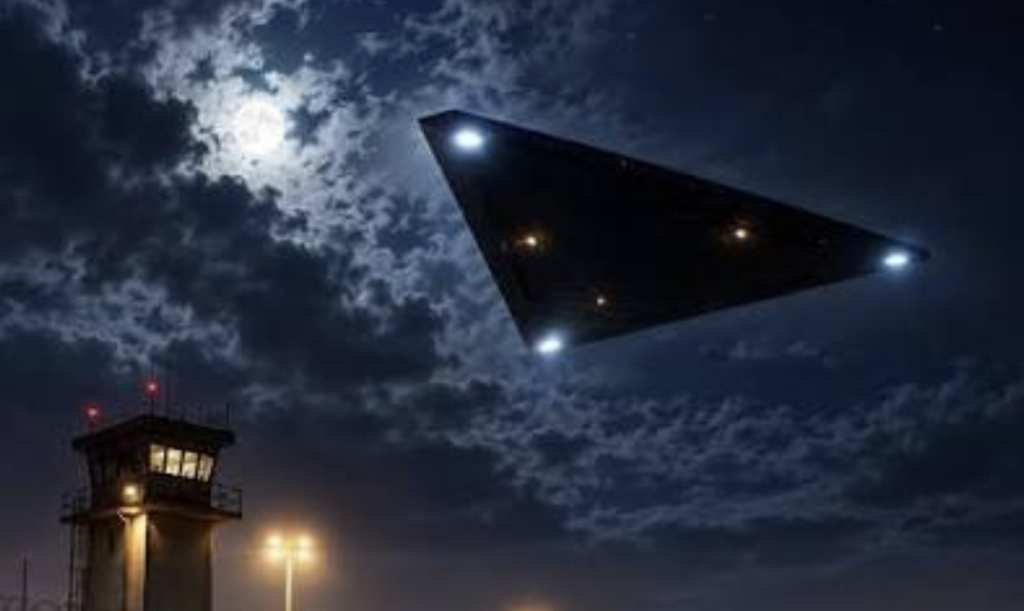
The release includes an extraordinary report involving federal agents who observed a mysterious black triangular object near a sensitive national-security installation earlier this year. But buried among the historical records are documents potentially even more consequential: Pentagon contractor reports discussing alleged spacecraft retrieval programs, biological material of possible non-human origin, and plans to construct a secure underground facility to store unusual recovered technology.
Other documents disclose previously unpublished details of government-funded investigations at Utah’s notorious Skinwalker Ranch, including accounts of strange creatures, unexplained lights, unusual electromagnetic activity, and efforts to establish communication with whatever intelligence investigators believed might be responsible.
The release also contains Cold War-era government correspondence concerning the recovery of fallen spacecraft and the management of public information about those operations.
Taken together, the records provide a remarkable look into the government’s historical and contemporary investigations of unidentified anomalous phenomena. They also raise questions about what federal agencies and their contractors have known, what they have attempted to investigate, and why so much of the underlying information remained outside public view for years.
The documents do not establish that extraterrestrial spacecraft have been recovered or that non-human biological specimens exist. They do, however, demonstrate that such possibilities were being seriously considered by personnel working under a Defense Intelligence Agency contract nearly two decades ago.
Seven Tranches and a Growing Government Archive
The latest release follows six earlier installments beginning May 8, when the Department of War launched the PURSUE disclosure effort under President Trump’s direction.
The seven releases have appeared on May 8, May 22, June 12, July 10, August 7, September 18, and October 23. The material encompasses military incident reports, intelligence assessments, photographs, videos, audio recordings, scientific studies, contractor documents, and historical correspondence.
The October 23 installment contains 28 PDF documents, without a separate video or audio release. Twenty-five records are attributed to the Department of War, one to the FBI, one to the Executive Office of the President, and one to the U.S. government more generally.
Independent inventories differ slightly in their cumulative counts because some files have been added or categorized differently after their initial release. The government’s October 23 index has been reported as containing approximately 478 records, while another independently maintained archive counts 481.
The important point is that the archive now extends across more than seven decades of government activity, connecting the early Air Force UFO investigations of the 1940s and 1950s with the modern Pentagon programs that brought the subject back into national prominence.
Department of War spokesman Sean Parnell confirmed Friday that the agency and its partners are preparing additional releases. The government has not announced a firm date for Tranche 8.
A Silent Black Triangle Over a Sensitive American Installation
The most immediately dramatic document in Tranche 7 concerns a sighting reported by federal agents at an undisclosed national-security site in the western United States in June 2026.
According to a memorandum prepared by the Pentagon’s All-domain Anomaly Resolution Office, or AARO, two experienced federal special agents observed a matte-black triangular object that appeared over a ridge near their observation position.
The object was estimated to have a wingspan of approximately 13 to 15 feet. Witnesses described a remarkably thin profile, with a length of roughly six to nine feet and a thickness of only one or two feet.
The AARO account describes the object rising vertically, remaining stationary for approximately 20 seconds, and then descending into a canyon in a rapid banking maneuver.
The witnesses reported no audible engine noise, visible exhaust, recognizable propulsion system, or conventional aircraft control surfaces. A handheld thermal device reportedly showed a relatively uniform heat signature across the object.
Its apparent speed during the final maneuver was compared to that of a military fighter aircraft.
A ground search conducted afterward reportedly found no wreckage, damaged vegetation, or evidence that the object had struck the terrain.
AARO concluded that the case warranted further investigation, particularly because the object’s reported appearance and movements resembled other sightings from the same general region.
That is a significant assessment. It indicates that the Pentagon’s own investigators considered the report sufficiently unusual to merit additional scrutiny.
The FBI Record Reveals an Important Discrepancy
One of the most revealing aspects of Tranche 7 emerges when the AARO memorandum is compared with a separate FBI interview record concerning the same event.
The FBI document reproduces a statement attributed to the two federal agents. Their account describes the object as resembling a delta-wing drone and estimates the total sighting duration at approximately three seconds.
That differs substantially from the AARO memorandum, which describes a vertical climb lasting about ten seconds, a hover of approximately twenty seconds, and a final descent lasting another two or three seconds.
The documents also differ slightly in their reported times and estimated dimensions.
Some differences could result from transcription, interpretation, or the way investigators summarized witness testimony. But the discrepancy in duration is too substantial to ignore.
If the entire encounter lasted only three seconds, the opportunity to assess the object’s flight characteristics was considerably more limited than the longer AARO account suggests.
The witnesses’ use of the term unmanned aerial system also deserves attention. It indicates that at least one description contemplated a drone-like object rather than necessarily an aircraft of unknown origin.
Neither document provides an instrumentally measured speed. And although the FBI file includes nine images illustrating the object’s reported path, those images are reconstructions using a photograph of the terrain with the triangular shape added. They are not photographs of the object itself.
These distinctions do not invalidate the witnesses’ observations. They demonstrate the importance of obtaining the original sensor data, complete witness statements, and any additional analytical records before drawing conclusions about the object’s capabilities.
The AARO file’s official description also refers to another observation the following evening, although the released memorandum does not provide the corresponding detailed account.
That apparent omission is itself a legitimate subject for further inquiry.
The Pentagon’s 2008 Contractor Plan Discussed Alleged UFO Crashes
The most consequential historical document in Tranche 7 may be DOW-UAP-D168, a December 2008 project management plan prepared by Bigelow Aerospace Advanced Space Studies, or BAASS.
BAASS was the principal contractor for the Defense Intelligence Agency’s Advanced Aerospace Weapon System Applications Program, commonly known as AAWSAP.
The program was managed by intelligence official Dr. James Lacatski and received congressional support associated with the late Senator Harry Reid. It investigated reports of unidentified aerial phenomena, advanced aerospace technologies, unusual physical effects, and other subjects considered relevant to national security.
The newly released management plan contains remarkable statements about alleged spacecraft recovery programs.
According to the document, BAASS personnel believed testimony supported claims that several unconventional spacecraft had crashed outside the United States.
The plan further stated that contractor-associated personnel had identified approximately ten individuals reportedly connected with programs involving the recovery of advanced aerospace hardware or associated biological material.
It also contemplated the possibility that biological material of non-human origin had been recovered and proposed obtaining access to relevant samples.
These assertions closely resemble claims that have subsequently become central to the modern UFO disclosure movement.
Former intelligence official David Grusch testified before Congress in 2023 that he had learned of longstanding programs involving recovered non-human spacecraft and biological material. Former Pentagon investigators Luis Elizondo and Jay Stratton have also described allegations concerning recovered technology and deeply compartmentalized government activities.
The significance of the 2008 BAASS document is chronological as well as substantive.
It demonstrates that these ideas were circulating within a government-funded research program long before Grusch’s congressional testimony and the recent wave of disclosure-related books and interviews.
But an important distinction remains: The BAASS document reports testimony, describes potential sources, and proposes avenues of investigation. It does not establish that its authors personally examined recovered spacecraft or non-human remains.
Indeed, the document acknowledges uncertainty about what progress any alleged recovery programs may have achieved.
Nevertheless, the release provides a valuable historical record of the questions government contractors were attempting to investigate.
A Secret Underground Vault for Recovered Materials
A second document makes the connection to alleged crash-retrieval programs even more intriguing.
The June 2009 BAASS monthly report, identified as DOW-UAP-D171, describes plans for a highly secure underground storage facility.
The proposed facility was intended to accommodate unusual recovered hardware and biological samples that BAASS hoped to obtain from private individuals, organizations, or corporate sources.
The report references possible material located outside the United States, including Brazil.
The language is significant because it shows that the contractor was contemplating the practical requirements of acquiring and preserving potentially sensitive materials.
This was not simply a theoretical discussion of advanced propulsion. It involved proposed facilities, security requirements, custody arrangements, and the possibility of obtaining physical specimens.
However, the report describes materials the contractor hoped to acquire. It does not document a completed transfer or identify a verified specimen in BAASS custody.
The distinction is essential, particularly because recent public discussions have included allegations that defense contractors possess unusual recovered technology.
The 2009 document establishes that at least one government-funded contractor was actively considering how such material might be obtained and secured.
The Roswell Connection Reappears
The December 2008 BAASS management plan also contains a reference to a sealed affidavit associated with the 1947 Roswell incident.
The affidavit, dated 2002, is attributed to the former public information officer at the Roswell Army Air Field, who described his belief that the material involved in the incident represented a craft and occupants originating beyond Earth.
That individual was Walter Haut, whose public statements and later affidavit have long figured prominently in Roswell research.
The affidavit is historically significant because Haut was directly associated with the military installation that issued the famous July 1947 announcement concerning the recovery of a flying disc.
But the affidavit was prepared approximately 55 years after the original incident.
Its inclusion in the BAASS files demonstrates that the contractor considered historical Roswell testimony relevant to its investigation.
It does not independently authenticate the account or overturn the Air Force’s official explanations involving classified balloon activities.
Still, its appearance in a Pentagon-funded contractor file illustrates the continuity between early UFO controversies and the modern investigation of alleged recovered technology.
Skinwalker Ranch: The Government’s Unusual Investigation
Another major document, DOW-UAP-D174, provides a detailed account of BAASS field investigations conducted in March and April 2010 at a Utah property widely identified as Skinwalker Ranch.
The ranch, located in northeastern Utah, became internationally known for reports of unexplained aerial objects, unusual animal encounters, strange lights, and other phenomena that witnesses sometimes interpreted as evidence of an unknown intelligence.
The newly released report documents interviews with more than two dozen individuals, including local residents, ranchers, law-enforcement personnel, business owners, and members of nearby communities.
The witness accounts are extraordinary.
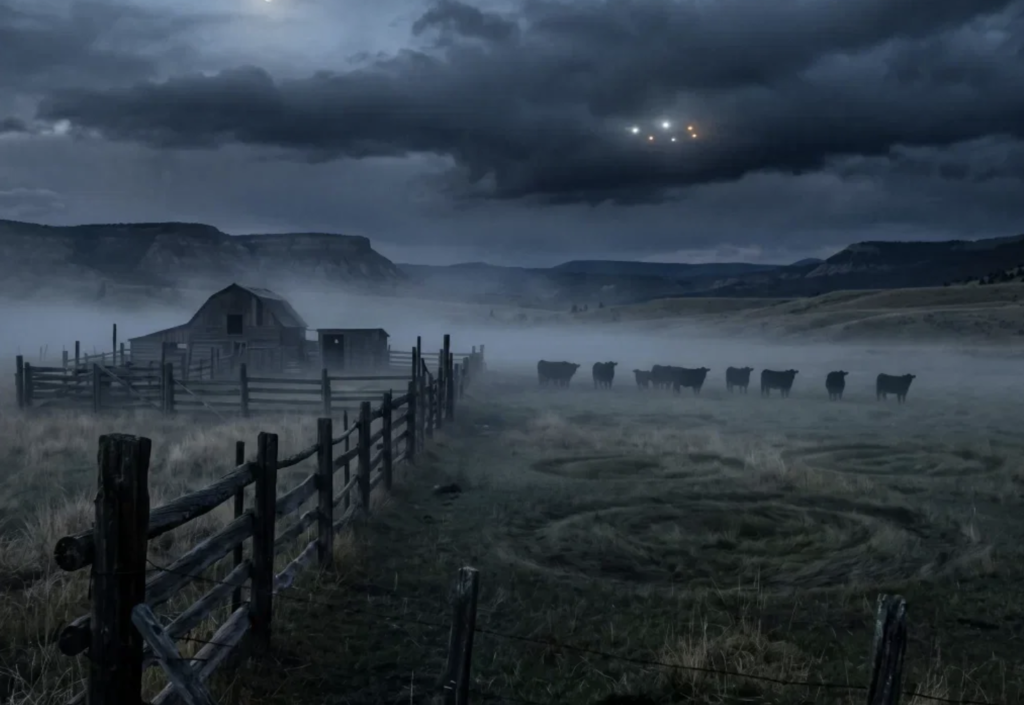
Some described large dog-like creatures moving on two legs. Others reported small humanoid figures, unusual birds, luminous objects, and other experiences that defied their ordinary expectations.
The report also describes field measurements and proposed experiments intended to detect or characterize unusual activity.
One particularly revealing objective involved attempting to establish communication with whatever source investigators believed might be responsible for the reported phenomena.
The proposed techniques included games, puzzles, and other methods intended to produce an observable response. That approach demonstrates that the investigators were considering possibilities beyond conventional aircraft identification. They were exploring whether some reported events might involve purposeful behavior by an unidentified intelligence.
How Tranche 7 Connects to Tranche 6
The sixth PURSUE release, published September 18, contained 75 records and substantially expanded the public documentation of AAWSAP.
Among its most significant materials were scientific and technical research papers exploring advanced propulsion, unusual aerospace concepts, and speculative physical theories.
Those studies included subjects such as advanced space-time engineering, unconventional propulsion, and other possibilities far removed from ordinary aircraft development.
The seventh release provides a different perspective on the same program.
Where Tranche 6 revealed much of the scientific research and theoretical groundwork, Tranche 7 exposes the contractor’s operational planning, field investigations, proposed evidence collection, and internal assessments.
Together, the two releases help reconstruct what AAWSAP was attempting to accomplish.
The program was not confined to examining unusual lights in the sky. It also explored advanced aerospace concepts, possible physical effects on witnesses, historical UFO reports, alleged recovered materials, and the prospect of obtaining evidence for scientific examination.
That broader scope helps explain why the program remains controversial.
Supporters see evidence that serious government investigators were pursuing questions that conventional institutions had neglected.
Critics argue that some activities ventured into speculative subjects without producing reliable evidence sufficient to justify extraordinary conclusions.
Both observations can be evaluated more concretely now that the contractor’s records are becoming available.
The Earlier Tranches: Military Encounters and Unresolved Sensor Evidence
The earlier PURSUE releases provide another important part of the picture.
The second tranche included material associated with military encounters involving objects near or over water, along with records concerning the February 2023 Lake Huron aerial-object engagement.
The fourth tranche included numerous infrared videos that AARO continued to classify as unresolved.
The sixth tranche added further historical investigations, military reports, and law-enforcement observations.
These records differ from the BAASS contractor files in an important respect. Some concern operational military observations and sensor recordings. Others involve historical testimony, research proposals, or contractor assessments. They cannot all be assigned the same evidentiary weight.
A military sensor recording with reliable calibration and contextual information may provide stronger evidence about an object’s movement than a witness recollection recorded decades after an event.
Conversely, a detailed historical document may be valuable for understanding government decisions even if it cannot establish the physical nature of the phenomenon being investigated.
The cumulative archive therefore presents two overlapping stories: the history of unusual observations and the history of the government’s efforts to understand them.
Tranche 7 is particularly valuable for the second.
Catalina Island and the Early UFO Investigations
Tranche 7 also includes historical Air Force reports involving sightings from the late 1940s through the 1950s.
Four concern California’s Catalina Island, a location frequently mentioned in UFO literature because of reports of unusual objects in and over the surrounding ocean.
The records include a 1949 report of six unidentified objects, a 1952 sighting by Boy Scouts, a 1953 report of a luminous object moving toward Los Angeles, and a 1955 observation of an orange light.
The documents illustrate how early military investigators collected witness statements and attempted to distinguish unusual aircraft from astronomical objects, weather effects, and other conventional explanations.
Additional reports in the tranche concern sightings in Saudi Arabia, Guam, Italy, Germany, Morocco, Sweden, Alaska, Canada, and Indiana.
One particularly interesting 1957 report describes a B-52 crew detecting an unidentified radar return over Saudi Arabia for several minutes.
These records provide historical context, but they do not all represent unexplained phenomena after investigation. Their principal value is showing how widely the military collected reports during the early Cold War and how the subject intersected with concerns about foreign aircraft, surveillance, and national security.
Jay Stratton, James Lacatski and the New Disclosure Debate
The timing of Tranche 7 is especially noteworthy because it follows the publication of former Pentagon UAP Task Force director Jay Stratton’s new memoir, Out of the Shadows: Revealing the Truth About Non-Human Intelligent Life.
Stratton has publicly described his involvement in the Pentagon’s UAP investigations and has advanced allegations concerning recovered non-human technology and longstanding secrecy.
James Lacatski, who managed AAWSAP for the Defense Intelligence Agency, has written extensively about the program’s history.
Luis Elizondo has similarly described his work investigating unidentified aerial phenomena, while David Grusch has testified about information he says he obtained concerning alleged crash-retrieval and reverse-engineering programs.
The newly released BAASS records are relevant because they document the earlier institutional setting in which some of these questions were investigated.
They establish that a Defense Intelligence Agency contractor was discussing alleged crashes, potential biological materials, and individuals associated with retrieval programs in 2008.
The newly released records offer additional opportunities to identify original sources, reconstruct timelines, and determine which claims were independently investigated. That may ultimately prove more valuable than simply adding another extraordinary assertion to the public debate.
What the Government Still Has Not Released
After seven tranches, important gaps remain. The public has received numerous witness reports, historical records, research papers, and videos. But the releases have not produced independently authenticated extraterrestrial hardware or biological specimens.
The 2026 triangular-object incident lacks publicly released footage of the actual object and a reliable instrumented speed measurement.
The BAASS contractor records discuss potential crash-retrieval witnesses and proposed storage facilities without documenting the successful acquisition of extraordinary materials.
And the Cold War recovery documents establish procedures for handling human-made spacecraft fragments rather than proving the recovery of non-human vehicles.
These limitations do not make the releases unimportant. They identify the next questions that Congress, investigators, and the public should ask.
If BAASS maintained a list of individuals associated with alleged recovery programs, can those individuals be identified and interviewed?
If contractors sought recovered materials, what correspondence documents their efforts, and were any transfers completed? If AARO has additional analytical material concerning the 2026 triangular object, why was it not included in the public release?
And if government agencies possess original sensor recordings relevant to the cases already disclosed, can those recordings be released with enough technical information to permit independent examination?
These are specific questions that could move the debate beyond competing assertions.
Disclosure Is Becoming a Test of Government Transparency
The significance of PURSUE extends beyond the question of whether unidentified objects represent extraterrestrial technology.
For decades, the federal government investigated unusual aerial reports through a complicated assortment of military, intelligence, and contractor organizations.
Some activities were publicly acknowledged. Others remained obscure until journalists, congressional investigators, whistleblowers, and Freedom of Information Act researchers brought them to light.
The seven tranches are gradually exposing portions of that institutional history. They show that government officials investigated unusual objects during the Cold War, that military personnel continued reporting unexplained encounters in later decades, and that intelligence agencies funded research into possibilities extending well beyond conventional aviation.
The latest records also show that government-funded contractors considered alleged recovered spacecraft and biological material sufficiently relevant to include them in formal planning documents.
The Seventh Tranche May Be More Important Than It First Appears
At first glance, Tranche 7 might seem less dramatic than earlier releases containing military videos and other visual evidence.
There are no new standalone videos. Many documents are decades old. Some witness reports have plausible conventional explanations, and others lack sufficient information for firm conclusions.
Yet the release provides something potentially more enduring: a documentary record of what government investigators and contractors were discussing, planning, and attempting to obtain.
The 2008 BAASS management plan is especially important because it connects allegations about recovered spacecraft and biological material to a specific government-funded program, specific dates, and identifiable institutional relationships.
The 2009 underground-vault proposal reveals how seriously the contractor contemplated acquiring sensitive physical evidence.
The Skinwalker Ranch report shows the unusual scope of the investigation, including both extraordinary testimony and ordinary scientific findings.
And the 2026 triangular-object report demonstrates that federal personnel continue to encounter phenomena they cannot immediately identify, even as the available documentation sometimes contains inconsistencies that require further investigation.
Together, these records make Tranche 7 a significant contribution to the historical record.
The documents do not prove that humanity has encountered extraterrestrial intelligence. But they do prove that important elements of the American national-security establishment have spent years investigating claims of extraordinary technology, unusual biological material, and phenomena that remain difficult to explain.
President Trump’s disclosure initiative is making more of that history available to the public. The challenge now is to determine whether the remaining records can answer the questions that the first seven tranches have brought into sharper focus.
If recovered non-human technology exists, the American people deserve verifiable evidence. If it does not, they deserve a complete accounting of why government-funded investigators pursued those allegations for so many years.
Either way, the documents should continue to be released. The public has waited long enough for the evidence.
Leave a Reply