
Federal student lending should help Americans build productive careers—not guarantee universities unlimited customers while leaving graduates buried beneath debts their earnings cannot support.
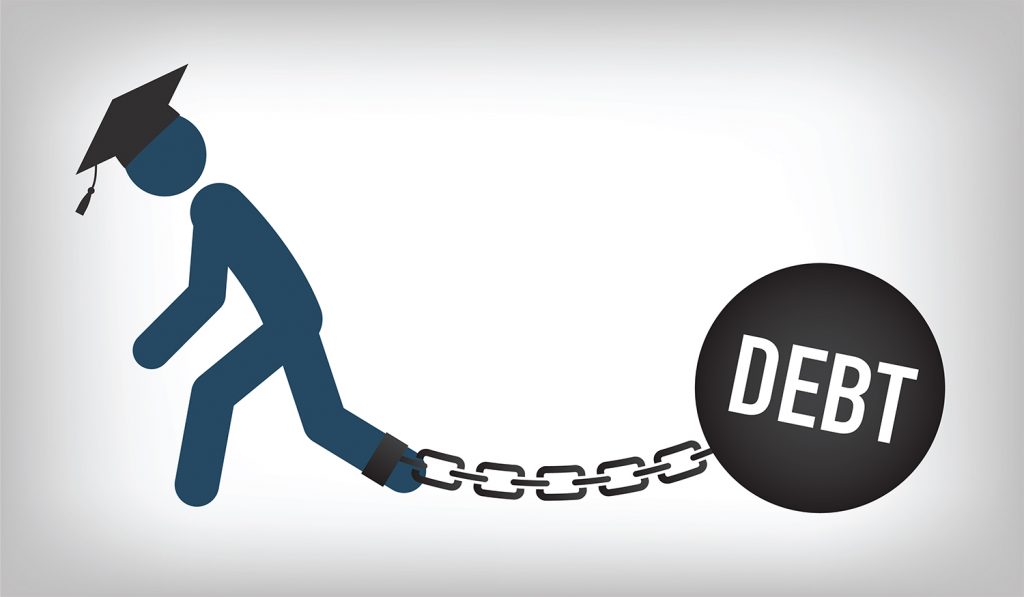
Why does the federal government continue lending tens of thousands of dollars to students for degree programs whose graduates routinely earn too little to repay what they borrowed?
No private lender would knowingly finance a $100,000 investment without examining whether the investment had a reasonable prospect of producing enough income to service the debt. Yet Washington has spent decades making enormous education loans with remarkably little regard for the price of the program, its completion rate, the employment prospects of its graduates, or the relationship between their expected earnings and monthly payments.
The result is a system that protects universities from ordinary market discipline while transferring nearly all the risk to students and taxpayers. By the first quarter of 2026, the federal student-loan portfolio had reached approximately $1.7 trillion across 43 million borrowers. Meanwhile, the average student at a public university who borrows to obtain a bachelor’s degree leaves with roughly $31,960 in debt.
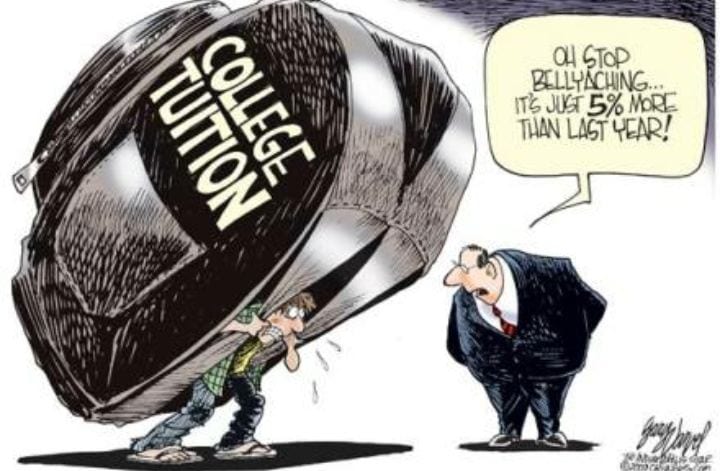
That enormous flow of federally guaranteed money has not merely helped students pay rising tuition. It has also enabled institutions to raise prices, expand administrative bureaucracies, construct lavish facilities, and create programs whose economic value is often disconnected from their cost. Tuition and fees nearly doubled in nominal terms between the 2005–06 and 2025–26 academic years, rising 93.2 percent; even after adjusting for inflation, the increase was 17.4 percent. Public universities now charge an average of about $10,340 annually in resident tuition, while private colleges average approximately $39,307 before housing, meals, books, and other expenses are added.
The central failure is simple: Washington has treated nearly every accredited college program as though it represents an equally prudent public investment. It does not.
Federal Loans Should Be Investments, Not Blank Checks
A student loan is not a prize for admission to college. It is a financial investment in a course of study that is expected to increase a student’s knowledge, employability, and future earnings enough to justify the expense.
That does not mean education has no value beyond income. Literature, music, history, philosophy, languages, and the arts contribute enormously to civilization. A free society should permit universities to offer them and students to study them. The issue is not whether such subjects may be taught. The issue is whether taxpayers should guarantee virtually unlimited borrowing for any program, at any price, regardless of whether its graduates can reasonably repay the debt.
People remain free to purchase countless things that the federal government does not subsidize. Freedom to pursue a degree does not create an entitlement to have taxpayers assume its financial risk.
Federal loans should therefore be conditioned upon measurable economic outcomes. Before guaranteeing tens of thousands of dollars for a particular degree at a particular institution, the government should ask the questions any responsible lender would ask: What percentage of students complete the program? What do graduates earn? How many find work related to their education? How much do they borrow? What percentage can repay without requiring decades of subsidies, deferments, forgiveness, or default?
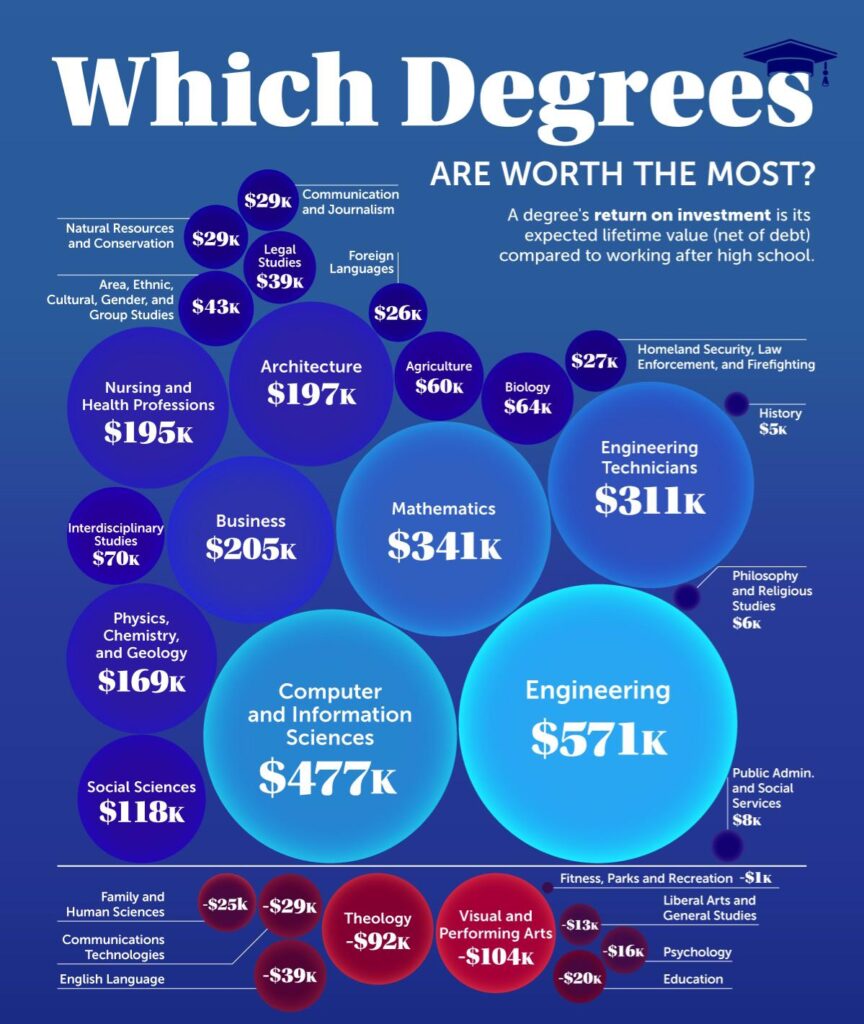
The answers vary enormously by field. Georgetown University’s Center on Education and the Workforce reports that median earnings among prime-age bachelor’s-degree holders range from about $58,000 in education and public-service fields to $98,000 in STEM fields. A bachelor’s degree still produces a substantial average advantage over a high-school diploma, but the return is far from uniform across majors and institutions.
That distinction matters. “College pays” is an average, not a guarantee. It tells a prospective student little about whether borrowing $80,000 for one particular program at one particular university is sensible.
Universities Receive the Money; Students Carry the Risk
The present system creates a dangerous imbalance. Universities receive tuition immediately. They are paid whether the student graduates or drops out, whether the degree leads to a career or unemployment, and whether the borrower repays the loan or spends decades trapped in delinquency.
The school has already been paid. The graduate and the taxpayer remain responsible for everything that follows.
This is a textbook example of moral hazard. When institutions receive the reward while someone else bears the risk, prices rise and accountability collapses. Universities have little financial incentive to close weak programs, reduce tuition, limit enrollment in oversupplied fields, or tell applicants that their chosen degree may never justify its cost.
The federal government should end that arrangement. Institutions should be required to share the losses when their programs repeatedly leave students unable to repay. A university that collects federal loan dollars should have financial skin in the game.
If graduates consistently default, the institution should reimburse part of the federal loss. If a program repeatedly fails objective earnings and repayment standards, its access to new federally guaranteed loans should be reduced and ultimately suspended. Schools would remain free to offer the program, but they would have to persuade students to pay for it voluntarily, lower its price, finance it themselves, or demonstrate improved outcomes.
The market discipline would be immediate. Programs with genuine value would survive. Programs maintained primarily because federal money makes them profitable would face pressure to improve, shrink, or disappear.
Debt Is Not Merely a Number on a Statement
Bad education debt does more than reduce a borrower’s disposable income. It can delay marriage, homeownership, family formation, retirement saving, entrepreneurship, and other milestones through which people enter stable middle-class life.
Research has also identified an association between student debt and psychological distress. One study found a significant relationship between student-loan debt and distress among graduates, while broader reviews have linked educational debt with anxiety, depression, and diminished well-being. Association does not prove that debt alone causes every mental-health problem, but it confirms what common sense already suggests: beginning adult life with a large obligation and weak earnings can impose profound emotional as well as financial strain.
The current labor market has made the problem harder to ignore. The unemployment rate for recent college graduates reached 5.8 percent in 2025, its highest level since 2013 outside the pandemic disruption.
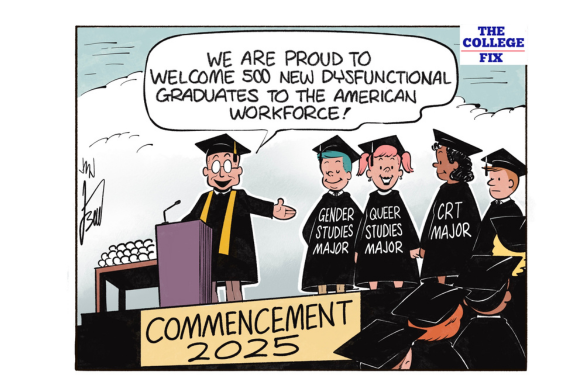
Many graduates eventually succeed, and some low-paying fields provide immense public value. Teachers, social workers, public defenders, artists, and researchers should not be casually dismissed because their salaries are modest. But acknowledging the social value of a profession does not justify allowing institutions to charge any amount they choose. A necessary but modestly compensated career requires lower-cost training, targeted scholarships, employer support, service-based grants, or explicit public appropriations—not a disguised system that saddles the worker with debt and hopes repayment somehow works itself out.
A Better Student-Loan System
Congress should replace the current blank-check model with an outcomes-based system built around several straightforward principles.
First, federal borrowing limits should be established program by program, rather than merely by degree level. The permissible loan should bear a reasonable relationship to the historical earnings of graduates from that specific program and institution. A degree whose graduates typically earn $45,000 should not carry the same federally backed borrowing capacity as one whose graduates routinely earn $100,000.
Second, every applicant should receive a plain-language financial disclosure before borrowing. It should show tuition, total expected debt, completion rates, median graduate earnings, monthly payments under a standard repayment plan, employment rates, and the percentage of former students who are delinquent or require income-based subsidies. Students should have to acknowledge those figures before taxpayers guarantee the loan.
Third, universities should share repayment risk. When a program repeatedly produces poor outcomes, the institution—not merely the borrower and Treasury—should absorb part of the loss.
Fourth, programs that fail minimum standards for several consecutive years should lose access to federal student loans. The Department of Education has already developed transparency and accountability mechanisms using earnings and debt measures, and a 2026 accountability framework moves toward denying federal loans to persistently failing programs. The sound principle should be applied consistently across public, private nonprofit, and proprietary institutions rather than selectively according to institutional type.
Fifth, federal policy should give much greater support to lower-cost pathways connected to demonstrable workforce demand: community colleges, apprenticeships, skilled trades, technical certifications, nursing, medicine, engineering, advanced manufacturing, cybersecurity, accounting, and other fields in which training leads to identifiable employment opportunities.
This does not require Washington to dictate everyone’s career. It requires Washington to stop pretending that every educational purchase is equally safe for federal financing.
Stop Confusing Access With Value
Defenders of the existing system will argue that restricting federal loans could reduce access to higher education, particularly for students from lower-income families. That concern deserves serious consideration, but “access” to an unaffordable program with poor completion and employment outcomes may be access to financial harm.
A young person is not helped by being admitted, praised, indebted, and abandoned.
Real access means access to education worth its cost. It means an honest chance of graduation, employment, repayment, independence, and advancement. A federal program that helps someone borrow $70,000 for a credential that adds little to his earning capacity has not expanded opportunity. It has financed a trap.
Low-income students should receive grants and scholarships where there is a compelling public purpose. They should also have access to affordable community colleges, apprenticeships, occupational programs, and properly priced universities. But institutions should not be permitted to invoke disadvantaged students as moral cover for charging prices their graduates cannot sustain.
Universities Must Once Again Serve Students
The federal student-loan system was created to expand opportunity. Too often, it now functions as a revenue pipeline for higher education.
Universities have learned that they can increase tuition because students do not pay the full cost at the moment of purchase. The government advances the money, the institution receives it immediately, and the painful consequences arrive years later—after the graduation ceremony, after the brochure promises have faded, and after the borrower discovers what the degree is actually worth in the labor market.
The market cannot correct prices when government continually supplies more borrowed money to meet them. As long as Washington guarantees the financing, universities remain insulated from the most basic signal in economics: customers refusing to buy something that costs more than it is worth.
That insulation must end.
Students should remain free to study whatever they choose. Universities should remain free to teach any lawful subject. But taxpayers should not be compelled to guarantee any debt an institution wishes to generate.
Federal lending should support opportunity, not institutional excess. It should finance education that gives borrowers a reasonable path toward repayment and productive independence. It should inform applicants rather than seduce them with borrowed money. It should reward schools that deliver value and impose consequences on those that do not.
The guiding rule should be neither complicated nor ideological:
No university is entitled to federally guaranteed customers, and no student should be encouraged to borrow more for an education than that education can reasonably help repay.
That reform would not destroy higher education. It might finally force higher education to remember whom it is supposed to serve.
Leave a Reply