
Senate Minority Leader Once Argued It Was “Easy” to Obtain Identification, and important to election security. What Changed?
For years, Democrats have argued that requiring voters to present identification at the polls amounts to “voter suppression.” It amounts to “Jim Crow 2.0,” to quote Chuck Schumer. They contend that voter ID laws disproportionately burden minorities, women, the elderly, and low-income Americans, making it more difficult for eligible citizens to cast a ballot.
Yet there is one prominent Democrat whose own words tell a remarkably different story.
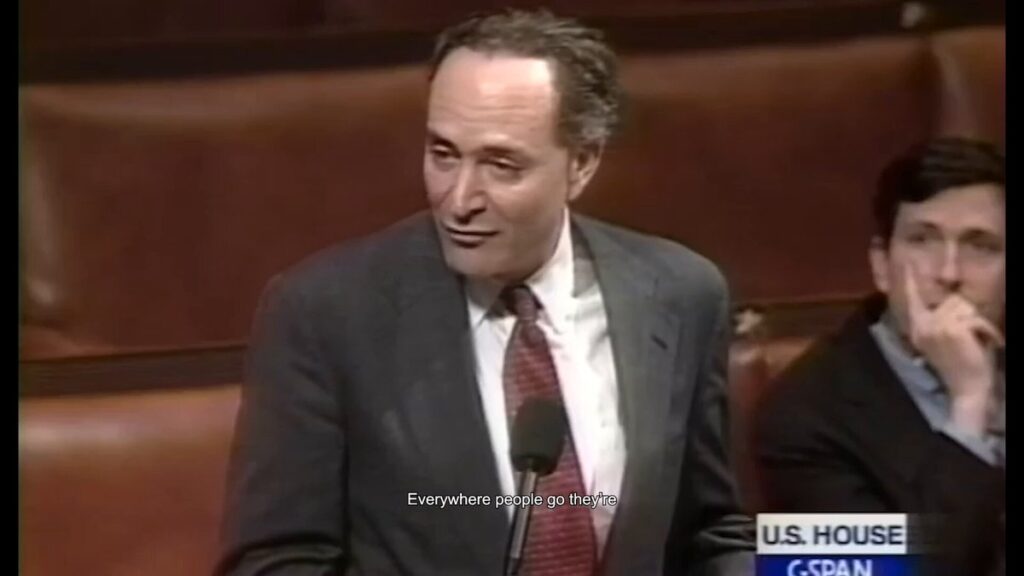
A recently resurfaced video shows Senate Minority Leader Chuck Schumer standing on the floor of the United States Senate making the very arguments Republicans have repeated for years. “This is an anti-fraud amendment,” he asserts. Watch the 31 second video.
Schumer argued that obtaining identification is not difficult. Americans need identification to cash checks, board airplanes, drive automobiles, receive government services, open bank accounts, and perform countless everyday tasks. Requiring identification to participate in the most important civic act in our constitutional republic, he argued, was simply common sense.
Schumer said, “Everywhere people go, they’re asked for a social security card. In fact, one way to prove you’re a bonafide person who can have a job is to ask for a driver’s license and a social security card. This is an anti-fraud amendment. All the over, where we go, people say, ‘Well, why can’t you stop illegal immigrants or others from coming here?’ And the number one answer we give our constituents is when they come here they can get jobs, get benefits against the law, because of fraud.” Chuck Schumer, 1996.
Today, however, the Democratic Party and Chick Schumer specifically have abandoned that position. Why?
A Dramatic Reversal
The contrast is impossible to ignore. Modern Democratic leadership has opposed many Republican-backed election integrity measures, including legislation requiring documentary proof of citizenship for federal voter registration and stricter voter identification requirements.
Republicans argue these proposals protect the integrity of elections, in nearly the exact terms as Chuck Schumer, by ensuring that only eligible citizens vote, and that every lawful vote carries equal weight.
Democrats respond that ID laws prevent eligible citizens from voting because of documentation requirements or administrative burdens.
The contrast between Senator Schumer’s earlier remarks and his current position raises an obvious question: If voter identification was once considered simple and common sense, why is it now portrayed by Democrats as an attack on democracy?
Confidence Matters
Every election produces winners and losers. What should never be a casualty is public confidence in the process itself.
Poll after poll has shown that large majorities of Americans—including many independents and substantial numbers of Democrats—support requiring voters to present valid identification before casting a ballot.
Supporters argue that the requirement is modest, widely accepted throughout daily life, and helps reassure the public that elections are conducted fairly. Recent revelations reflect that millions of illegal aliens have been registered to vote in many states.
Confidence in elections depends not only on preventing fraud, but on convincing the public that the rules are fair, transparent, and consistently applied. They are not.
Immigration and Election Integrity
Immigration has become deeply intertwined with the election debate. The Biden administration’s border policies produced record levels of illegal immigration, estimated at nearly 30 million illegals in the country, prompting Republicans to argue that restoring border security is inseparable from protecting election integrity. Democrats, on the other hand, have gone to extraordinary lengths to guarantee that the borders are wide open, and that any attempts by the current administration to remove illegal aliens musst face the highest level of resistance.
Of course, federal law prohibits non-citizens from voting in federal elections. Nevertheless, Republicans have argued that maintaining accurate voter rolls, verifying citizenship during registration, and requiring voter identification at the polls are prudent safeguards in light of the nation’s immigration challenges.
Democrats respond that existing laws already prohibit non-citizen voting and that there is insufficient evidence of widespread non-citizen voting affecting federal election outcomes. They argue the greater danger is disenfranchising eligible voters through overly burdensome registration requirements–a nonexistent problem.
Consistency Builds Trust
One lesson emerges from Chuck Schumer’s earlier speech.
At one time, prominent Democrats openly acknowledged that proving one’s identity before voting was neither extraordinary nor oppressive. It was simply one of many routine responsibilities of citizenship.
Today, many of those same Democrats oppose all of the same measures they once defended. What is the difference? They now consider those illegal aliens that they invited into the country, their voters.
But consistency matters. When political leaders reverse longstanding positions on fundamental issues such as election integrity, they should be prepared to explain why.
The American people deserve elections that are both secure and accessible. Those objectives need not be mutually exclusive. In fact, maintaining confidence in democratic institutions requires both. Republican policies provide both. Democrat policies rob the nation of election integrity.
As the video of Senator Schumer demonstrates, there was once broad agreement that verifying a voter’s identity was a reasonable safeguard rather than a partisan controversy. He was right. Now, he is just lying.
Leave a Reply