
“The inherent vice of capitalism is the unequal sharing of blessings. The inherent virtue of socialism is the equal sharing of miseries.” — Winston Churchill
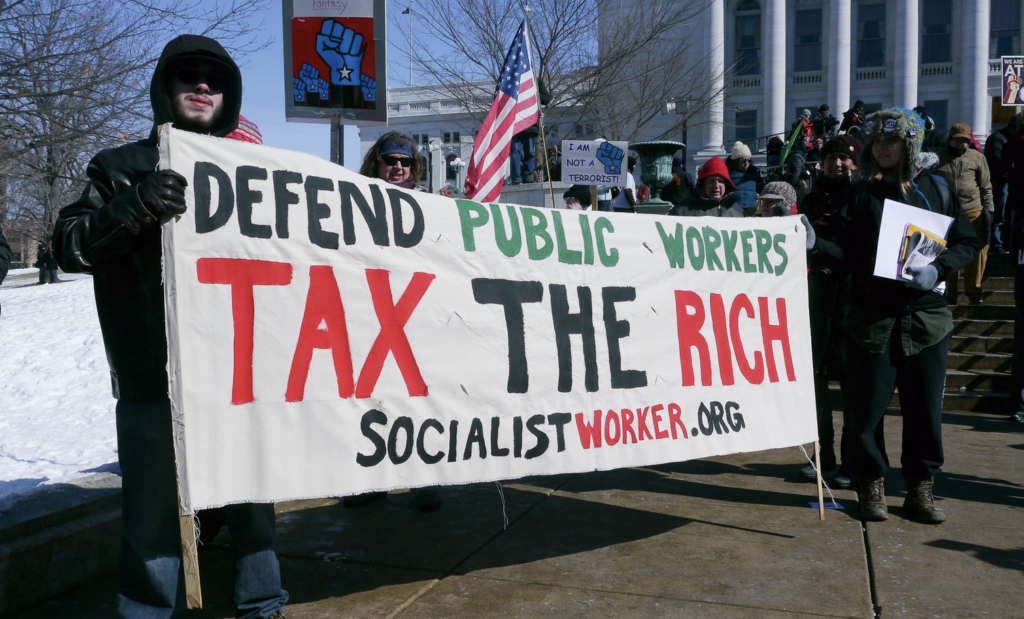
One of the most popular slogans on today’s political left is also one of its least examined: “Tax the rich.”
The slogan gives the false impression that “the rich” are not taxed, or not sufficiently taxed.
It is a rallying cry heard at political rallies, on college campuses, and increasingly from elected officials who openly identify as democratic socialists. “Eat the rich.” “Make billionaires pay.” “No one should have that much money.”
These slogans promote class warfare, but they fail to answer a far more important question: How much should the rich pay?
Ask advocates whether millionaires should pay 50 percent, 70 percent, or 90 percent of their income. Ask whether billionaires should surrender half their wealth. Ask what percentage would finally satisfy the demand for “fairness.” There is rarely a clear answer. The line simply moves whenever the previous one is crossed.
The goal appears less about reaching a tax rate than sustaining a political grievance.
The Wealthy Already Pay Most Federal Income Taxes
One fact often missing from the debate is that America’s federal income tax system is already among the most progressive (stair-stepped) in the developed world.
According to IRS data, the top 1 percent of taxpayers pay roughly 38 to 40 percent of all federal individual income taxes, despite earning about one-fifth of all reported income. The top half of all taxpayers pay well over 95 percent of federal individual income taxes, while the bottom half pays only a small fraction.
That does not mean lower-income Americans contribute nothing. They pay payroll taxes, sales taxes, fuel taxes, property taxes through rent, and countless other taxes embedded throughout the economy. But when politicians speak of “the rich paying their fair share,” they are almost always referring to federal income taxes, and on that measure the burden is already concentrated heavily on upper-income earners.
Billionaires Are Not Vaults of Cash
Another common misconception is that billionaires possess enormous piles of cash sitting idle in bank vaults.
They do not.
Most billionaire wealth consists of ownership in companies, factories, warehouses, office buildings, patents, farmland, and investments. Those assets finance businesses that employ millions of Americans.
When someone says, “Take half of every billionaire’s wealth,” they are usually talking about forcing the liquidation or transfer of ownership in productive businesses—not seizing stacks of currency.
The practical effect would almost certainly include reduced investment, declining stock values, lower business expansion, and diminished job creation. Economists argue that confiscating large portions of productive capital would come with significant economic consequences.
Even Massive Wealth Taxes Have Limits
Suppose, for the sake of argument, Congress confiscated half the wealth of every billionaire in America.
The number sounds enormous because billionaire wealth is measured in trillions of dollars.
Yet federal spending is also measured in trillions.
Even several trillion dollars would finance only a relatively limited period of current federal spending before being exhausted. It would not permanently fund Medicare, Social Security, Medicaid, national defense, interest on the debt, veterans’ benefits, and every other federal program. It would be a one-time transfer against recurring annual obligations measured in the trillions. After the money was spent, the government would still face the same structural deficits unless spending itself changed.
History shows that governments never solve chronic spending problems with one-time revenue windfalls.
Wealth Is Created Before It Is Taxed
The discussion often overlooks an even more fundamental point.
Before someone can pay millions—or billions—in taxes, that wealth first has to be created.
Successful entrepreneurs build companies that manufacture products, develop software, transport freight, discover medicines, finance new ventures, construct buildings, or provide services that millions of people voluntarily purchase.
Those businesses generate payrolls for employees, contracts for suppliers, retirement savings for investors, charitable donations, and tax revenue at nearly every level of government.
The overwhelming majority of American workers are employed not by government agencies but by private businesses Without profitable enterprises, there are no payroll taxes because there are no payrolls.
Without successful businesses, there are no corporate taxes because there are no profits Without investment, there is less innovation, slower productivity growth, and fewer opportunities for upward mobility.
Taxing Success Does Not Eliminate Poverty
Perhaps the greatest weakness of the “tax the rich” philosophy is its assumption that reducing wealth at the top automatically improves conditions at the bottom. History offers no support for that proposition.
Societies become prosperous not because everyone is equally poor, but because people are free to innovate, invest, compete, and create new wealth. The greatest advances in living standards have generally occurred where economic freedom allowed businesses to expand and productivity to increase.

That does not mean every wealthy individual acquired his fortune virtuously, nor does it mean every tax policy is perfect. Tax reform is a legitimate subject of debate. Closing loopholes, simplifying the tax code, and eliminating favoritism deserve bipartisan support But those discussions are very different from the politics of envy.
Punishing Success Is Not an Economic Strategy
The language surrounding taxation has increasingly shifted from financing government to punishing success.
When politicians promise to “make the rich pay,” the applause often comes not because voters have calculated the expected revenue, but because they enjoy seeing someone else penalized. That is not tax policy. It is emotional politics.
A nation cannot tax itself into prosperity. Government does not create wealth; it redistributes wealth that has first been created by someone else. The more successful that creation becomes, the larger the tax base available to fund legitimate public functions.
The challenge is to encourage more wealth creation—not less.
Former British Prime Minister Margaret Thatcher understood this problem better than most. She famously observed, “The problem with socialism is that eventually you run out of other people’s money.” She also noted that socialism often appears less interested in making the poor wealthier than in making the wealthy poorer. In fact, history repeatedly demonstrates that redistributive political movements spend all their time discussing how wealth should be divided, and none on how wealth is actually created.
Whether every word commonly attributed to Churchill originated with him is debated by historians. The principle, however, remains worthy of serious consideration.
A prosperous society should seek to expand opportunity, reward innovation, and encourage productive investment—not elevate resentment into an economic philosophy that destroys the wellbeing of everyone.
Leave a Reply