
In his explosive new memoir, former Pentagon UAP Task Force director Jay Stratton alleges that the United States has recovered technology and biological remains of non-human origin. His account reaches into the CIA, major defense contractors, the Roswell mystery, and the government’s most secret intelligence programs.
Federalist Press | October 22, 2026
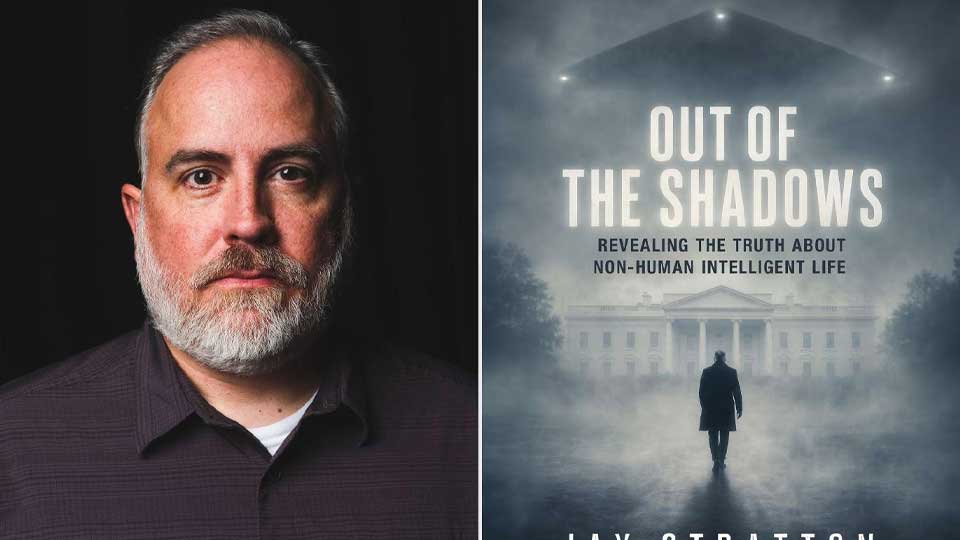
For decades, Americans who claimed that the United States government possessed crashed extraterrestrial spacecraft were generally dismissed as conspiracy theorists. Now, one of the most senior intelligence officials ever assigned to investigate unidentified anomalous phenomena for the Pentagon has published a book confirming that those extraordinary claims are true.
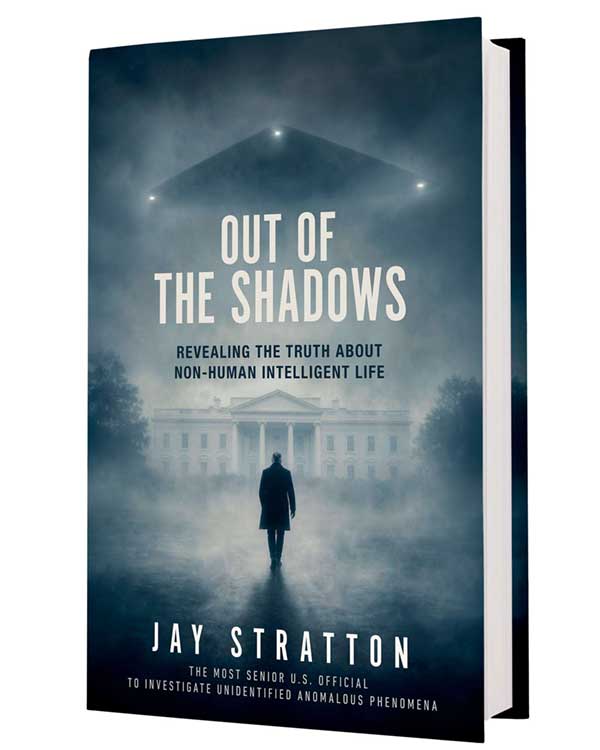
His name is Jay Stratton, and unlike many UFO enthusiasts, he did not spend his career investigating the subject from the outside. He worked inside the Defense Intelligence Agency and the Office of Naval Intelligence, helped establish the government’s modern UFO investigations, and eventually became the first director of the Pentagon’s Unidentified Aerial Phenomena Task Force. His new book, Out of the Shadows: Revealing the Truth About Non-Human Intelligent Life, was published October 13 by William Morrow, a HarperCollins imprint.
Stratton’s central allegation is extraordinary: The United States has recovered spacecraft of non-human origin, possesses evidence of non-human biological entities, and has maintained a highly compartmentalized effort to study and exploit that technology while concealing much of the operation from Congress and the public. He further alleges that the secrecy extends back approximately eight decades, encompassing some of the most famous incidents in UFO history.
Stratton shares these revelations drawing upon his government experience, investigations, and information obtained from other sources in the government. The identity and professional background of the man making them have ensured that his book is attracting attention far beyond the traditional UFO community.
The Intelligence Officer Who Helped Build the Pentagon’s UFO Programs
Stratton spent nearly 33 years in military and civilian government service, specializing in intelligence analysis and emerging aerospace technologies. According to his account, approximately 16 of those years involved investigating unidentified objects and the possibility of non-human intelligence.
His involvement began while he was working with the Defense Intelligence Agency. In 2005, he encountered video evidence of an unidentified black triangular object operating over a sensitive American nuclear-weapons facility. The object’s apparent performance troubled him because, according to Stratton, it did not correspond to any American or foreign aerospace capability he could identify.
During an October 18 interview on WABC’s The Cats Roundtable, Stratton described the object as something that was neither an American system nor a known adversary’s technology. He said the encounter helped lead to a renewed federal investigation beginning in 2008.
Stratton subsequently became involved in the Advanced Aerospace Weapon System Applications Program, commonly known as AAWSAP, which was managed by Defense Intelligence Agency official Dr. James Lacatski and funded through a contract involving businessman Robert Bigelow’s aerospace interests.
The program gathered information about unexplained aerial encounters, advanced propulsion systems, reported physiological effects on witnesses, and other unusual phenomena. Stratton also worked alongside Luis Elizondo, who later became widely known for his public statements about the Pentagon’s Advanced Aerospace Threat Identification Program, or AATIP.
Stratton’s subsequent leadership of the UAP Task Force placed him in a particularly influential position. Reports from military aviators, intelligence analysts, and defense installations could reach his organization for assessment. His work therefore involved considerably more than reviewing civilian UFO sightings.
The Tic Tac, Gimbal and GOFAST Encounters
Among the most significant cases associated with the modern UFO experience are the Navy’s well-known Tic Tac, Gimbal and GOFAST incidents. The videos became central to the public discussion after their release and eventual official acknowledgment by the Pentagon.
In a newly released episode of WEAPONIZED, hosted by investigative journalist George Knapp and filmmaker Jeremy Corbell, Stratton describes how such military evidence reached Pentagon investigators.
The episode, published October 20, includes an interview recorded in Huntsville, Alabama, in 2022, when Stratton had not yet become a prominent public figure. He explains that information about the Navy encounters passed through his office because assessing such incidents was part of his responsibility.
He also describes consulting specialists associated with Lockheed Martin’s Skunk Works and Boeing’s Phantom Works, two organizations closely associated with advanced military aerospace development.
An intelligence officer confronted with an apparently extraordinary aircraft must first determine whether it represents a classified American project, an adversary’s technological breakthrough, a conventional object observed under unusual circumstances, or something genuinely unexplained.
The Allegation That America Possesses Non-Human Spacecraft
Perhaps the most consequential claim in Out of the Shadows concerns what Stratton describes as a longstanding government effort to recover and reverse-engineer technology not manufactured by human beings.
Stratton alleges that American authorities and private contractors have possessed recovered vehicles and biological remains associated with non-human intelligence. He contends that information about these materials has been protected within deeply compartmentalized programs, sometimes beyond the knowledge of senior government officials.
The distinction between direct observation and information obtained from other insiders is critical. Stratton’s firsthand experience establishing and managing UAP investigations is documented through his career. His claims about recovered spacecraft and biological remains also rely on accounts attributed to individuals who had access to secret programs.
Stratton’s assertions resemble allegations previously advanced by former intelligence official David Grusch, who told Congress in 2023 that he had learned of a longstanding crash-retrieval and reverse-engineering program. Grusch likewise distinguished information received from sources from material he could publicly substantiate.
What is new is that another former senior official with direct responsibility for UAP investigations has placed his own name and professional reputation behind a similar narrative.
Roswell Returns to the Center of the Story
Stratton’s memoir revisits the 1947 Roswell incident, perhaps the most famous UFO crash in American history.
Stratton challenges the broader official narrative, alleging that the Roswell incident forms part of a much longer history of recovered non-human technology and concealed government investigations.
The fact that a former Pentagon UAP Task Force director is now explicitly discussing Roswell in connection with a modern recovery program illustrates how far the subject has moved from its earlier treatment as a collection of unrelated historical curiosities.
Lockheed Martin, Robert Bigelow and an Alleged CIA Intervention
One of the most intriguing subjects discussed in the latest WEAPONIZED episode involves an alleged effort to transfer unusual materials from Lockheed Martin to a research organization associated with Robert Bigelow.
Knapp and Corbell discuss claims that the transfer was prevented by an intervention involving the Central Intelligence Agency. If accurate, such an episode could help explain why certain investigators believed potentially significant materials existed but were unable to obtain them for scientific examination.
The allegation also intersects with the history of AAWSAP, which operated under a Defense Intelligence Agency contract awarded to Bigelow Aerospace Advanced Space Studies.
However, several questions remain unresolved in the public record. What precisely were the materials? Who had custody of them? Was their origin ever scientifically established? What authority allegedly prevented the transfer, and what documentation exists concerning that decision?
The claim is one of the more concrete avenues for further investigation because it involves identifiable organizations, an alleged transfer, and a purported government intervention that might have generated records.
The Mysterious “Axelrod” and Skinwalker Ranch
Stratton’s book also connects him more directly to another controversial chapter of government-sponsored UFO research: Skinwalker Ranch, the Utah property associated with reports of unusual aerial objects, strange creatures, unexplained physical effects, and other anomalous events.
Readers of Skinwalkers at the Pentagon, written by James Lacatski, Colm Kelleher and George Knapp, will recognize the pseudonym “Axelrod,” used for a government investigator involved in unusual experiences associated with the program.
Stratton has now been publicly identified as the individual behind that pseudonym.
This disclosure links one of the most recognizable firsthand figures in the Skinwalker Ranch narrative to the leadership of the Pentagon’s later UAP Task Force. It also highlights a controversial aspect of the modern UFO investigation: the overlap between conventional military aerospace encounters and reports of phenomena that do not fit neatly within ordinary aviation or intelligence analysis.
Some investigators view those reports as potentially connected manifestations of a larger phenomenon. Critics question whether such connections are supported by reliable evidence or whether unrelated experiences have been grouped together under the broad category of UAP.
Stratton’s account makes clear that he considers the unusual experiences associated with these investigations relevant to the larger mystery.
The Experiences That Followed Him Home
Perhaps the most personal and unsettling portion of Stratton’s story concerns events he says affected his own family.
In interviews and reporting accompanying the book, Stratton has described unusual experiences that he associates with his UAP investigations, including an encounter involving a being near his son’s bedroom window.
The experiences are sometimes discussed within the UFO community as examples of the “hitchhiker effect”—the reported tendency for unusual phenomena to follow certain investigators or witnesses into their personal lives.
Similar claims have appeared in accounts associated with Skinwalker Ranch and in the work of investigators connected to Robert Bigelow’s research programs.
Stratton r believes the experiences diminished or ceased after he retired from government service.
The claims raise a broader question that conventional aerospace investigations are not designed to answer: If some UAP reports genuinely involve an unknown intelligence, are the observed effects limited to aircraft-like objects, or do they encompass a wider range of experiences? Stratton’s book clearly entertains the latter possibility.
A Growing Group of Former Officials Is Challenging the Government’s Narrative
Stratton’s memoir arrives amid an increasingly visible series of books, interviews, congressional appearances, and documentaries involving former national-security personnel.
Luis Elizondo’s Imminent presented his account of the Pentagon’s modern UFO investigations and his belief that some encounters may involve technology beyond known human capabilities. James Lacatski’s writings, including Skinwalkers at the Pentagon, provided an account of AAWSAP’s origins, investigations, and research priorities.
Intelligence Officer David Grusch brought allegations about secret recovery programs before Congress, while Stratton’s new book connects the early DIA effort, later military investigations, and the UAP Task Force through the career of one official who participated in those successive programs.
The convergence is noteworthy. Several of these individuals worked together, consulted the same investigators, or encountered overlapping sources. The involvement of former officials with genuine national-security experience provides a compelling reason to investigate the underlying claims rather than dismissing them solely because the subject is unusual.
The National-Security Question Cannot Be Ignored
Even setting aside the possibility of extraterrestrial origins, Stratton’s account highlights a serious national-security issue.
Military personnel have reported objects or sensor contacts they could not readily identify, sometimes near sensitive installations or during operational training. Such incidents may involve unfamiliar technologies, sensor errors, environmental conditions, or other explanations. Identifying those causes is a legitimate responsibility of military intelligence.
Stratton argues that certain objects display a particular interest in American nuclear facilities, submarines, and aircraft carriers. If any unknown technology is repeatedly operating near strategic military assets, the United States has an obvious reason to investigate its capabilities and intentions. That concern exists independently of whether the objects are extraterrestrial.
The public debate often becomes polarized between those who believe the government has already confirmed non-human intelligence and those who believe the entire subject is a misunderstanding. Stratton’s professional history illustrates why the underlying security questions deserve more disciplined attention than either viewpoint permits.
What Would Constitute Real Disclosure?
The publication of Out of the Shadows is an important development in the public history of the UFO controversy, but it is not the same thing as official disclosure.
A former official’s testimony may identify witnesses, locations, documents, and programs worthy of investigation. A memoir can provide context and help establish a timeline. Interviews can clarify what an investigator personally observed and what he learned from others.
But confirmation of recovered non-human technology would require evidence that can withstand independent examination.
If physical materials exist, as confirmed by Stratton and others, scientists should be able to study their composition, structure, provenance, and manufacturing characteristics under appropriate safeguards. If recovery programs operated for decades, records should exist concerning budgets, custody transfers, contractors, facilities, and authorizations. If non-human biological remains were recovered, their existence and nature would require rigorous scientific documentation.
National-security restrictions complicate public disclosure of some records, but they do not eliminate the need for evidence.
The central value of Stratton’s book may therefore lie not simply in the extraordinary claims it advances, but in the more specific investigative questions it creates.
A New Chapter in the Search for the Truth
Jay Stratton has now joined a small but growing group of former American intelligence and defense officials willing to publicly associate their names with claims that would fundamentally alter humanity’s understanding of its place in the universe.
His allegations encompass recovered spacecraft, non-human biological remains, an extensive secrecy apparatus, defense contractors, intelligence agencies, and experiences that reach beyond conventional aerospace phenomena.
Some of those allegations overlap with claims made by Luis Elizondo, James Lacatski, David Grusch, and other prominent figures in the disclosure movement. Others draw upon Stratton’s own professional experiences and the information he says reached him during years of classified government work.
The book does not settle the UFO question, and the public has not been given independently verifiable evidence sufficient to confirm its most extraordinary assertions.
But neither can Stratton’s professional role be dismissed. He was not merely watching UFO documentaries or interviewing witnesses as a private enthusiast. He helped establish and direct government investigations into the very phenomena he now describes.
That leaves the American public with a consequential question: If the former director of the Pentagon’s UAP Task Force believes the government has concealed evidence of non-human intelligence for generations, what evidence can he and other former officials provide that will allow Congress and the public to determine whether he is correct?
The answer will be found in the records, testimony, and physical evidence that can be independently examined.
For now, Stratton’s Out of the Shadows adds another prominent voice to the demand that those questions be answered. And it ensures that the controversy over what the Pentagon knows about unidentified anomalous phenomena is far from over.
Learn more about UAP/UFO disclosure at UFO-Disclosure>
Leave a Reply