
Military investigators are examining a series of unexplained refrigeration failures at U.S. bases as a similar cyberattack in France raises disturbing questions about the vulnerability of America’s food supply.
Federalist Press | October 30, 2026
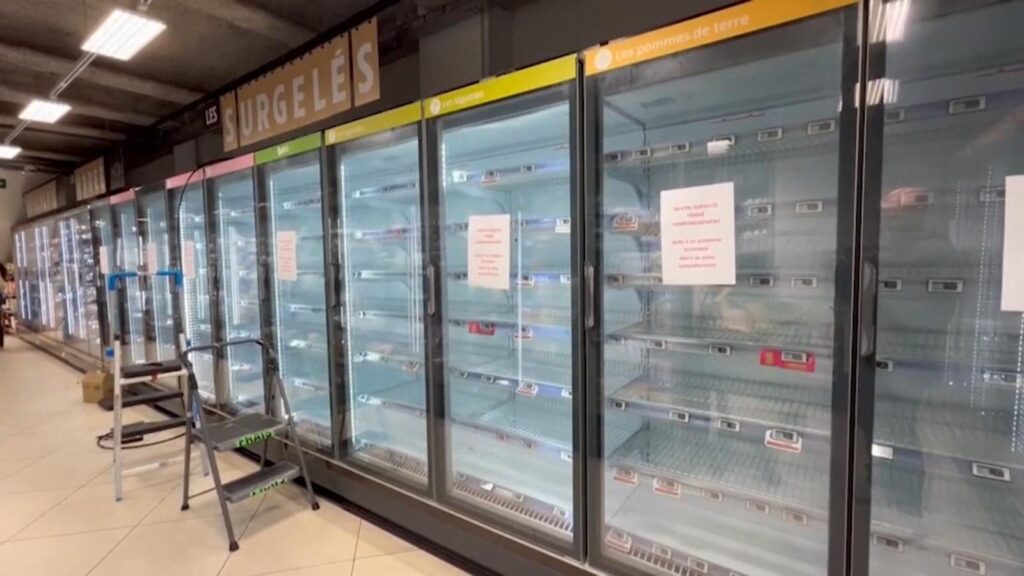
WASHINGTON — It sounds like something from a spy thriller: Someone remotely takes control of refrigeration equipment at American military installations, turns up the temperature, and destroys thousands of dollars’ worth of food intended for military personnel and their families. Yet that is precisely the possibility Pentagon investigators are now examining following a series of mysterious freezer failures at military bases across the United States.
At least six military commissaries experienced unusual refrigeration malfunctions during August. In one particularly troubling incident at Fort Huachuca, Arizona, a freezer reportedly switched into defrost mode overnight, heating its contents instead of keeping them frozen. By morning, the food had been ruined.
What initially appeared to be a series of unrelated equipment failures has attracted the attention of the Pentagon’s cybersecurity specialists and military criminal investigators. Officials are now examining whether the incidents were deliberate acts of cyber sabotage.
The investigation has taken an international turn because French authorities are examining a remarkably similar attack against their commercial refrigeration systems. American investigators are coordinating with their French counterparts, although no connection between the incidents has yet been established.
From Frozen Food to National Security
The Department of the Army Criminal Investigation Division confirmed to Fox News that its Cyber Field Office is working with the Defense Commissary Agency and the Defense Criminal Investigative Service to determine what caused the failures. U.S. Cyber Command personnel are also involved.
The affected facilities are military commissaries, the grocery stores serving service members, veterans, and their families. Although the incidents did not involve battlefield weapons or classified communications systems, their potential significance extends well beyond spoiled groceries.
Modern military operations depend on enormous networks of civilian and military infrastructure. Food storage, transportation, fuel distribution, electrical systems, communications equipment, and medical facilities all rely increasingly on computerized controls. An adversary capable of manipulating those systems remotely could disrupt military operations without firing a shot.
The freezer incidents illustrate how a seemingly insignificant target can reveal a potentially serious vulnerability. If refrigeration equipment at military installations can be manipulated through a network connection, investigators must determine whether other essential systems face similar exposure.
At present, officials have not publicly identified a hacker, a foreign government, or any other responsible party. The possibility of malicious interference remains under investigation.
France Experienced Something Far More Dangerous
The American investigation becomes particularly interesting when compared with events in France earlier this month.
A cyberattack reportedly manipulated refrigeration controls at more than 350 commercial locations, including supermarkets. Instead of maintaining safe temperatures, some equipment began heating its contents, destroying substantial quantities of food. In several cases, the temperatures rose so dramatically that refrigeration units reportedly caught fire.
The financial damage could reach tens of millions of euros, according to estimates cited in the Reuters investigation.
The French incidents demonstrate that remotely controlled refrigeration systems can become instruments of physical destruction when compromised. The damage is not confined to stolen information or disabled computers. It can include spoiled food, damaged machinery, fires, and disruption of essential commercial operations.
Investigators have not established whether the American military incidents and the French attacks were carried out by the same individuals or through the same technical vulnerabilities. Nevertheless, the similarities have prompted cooperation between the two countries’ law-enforcement authorities.
The Unexpected Weakness in Modern Refrigeration
The underlying technological problem is surprisingly straightforward.
Modern commercial refrigeration systems frequently use computerized controllers to monitor temperatures, regulate compressors, schedule defrost cycles, and alert operators when equipment malfunctions. Many of these systems can now be accessed remotely, allowing technicians to monitor and service equipment without visiting the facility.
That convenience creates an opportunity for hackers.
Some refrigeration controllers were originally designed to operate as isolated industrial equipment. As businesses connected them to larger networks and the internet, security protections did not always keep pace.
Reuters reported that the Danish manufacturer Danfoss acknowledged that many controllers involved in the French incidents were obsolete or operated with outdated firmware. Such equipment can be vulnerable when exposed to unauthorized network access.
Investigators have not established whether Danfoss controllers were used at the affected American military installations.
The larger problem extends across industrial technology. Equipment that once required physical access can increasingly be manipulated remotely, sometimes through systems that were never designed to withstand modern cyberattacks.
A compromised refrigeration controller might appear less threatening than a compromised weapons system. But the same general vulnerability can exist in equipment controlling heating, ventilation, water treatment, manufacturing, and other essential services.
A Warning for America’s Food Supply
The implications reach far beyond military bases.
America’s food supply depends on a vast refrigerated network extending from farms and processing facilities to warehouses, refrigerated trucks, grocery stores, restaurants, and hospitals. Much of that infrastructure relies on automated temperature controls.
A successful attack against a major distribution center could destroy substantial quantities of perishable food. Coordinated disruptions across multiple facilities could interrupt deliveries, create shortages, and impose considerable economic losses.
This is not an entirely hypothetical threat.
Reuters documented previous incidents involving refrigeration systems in Russia and Israel, while federal prosecutors in California have accused a Ukrainian woman of participating in a cybercrime operation that disabled refrigeration at a meatpacking facility in 2024, destroying more than 2,000 pounds of meat.
Those earlier cases do not establish who was responsible for the recent military incidents. They do demonstrate that attacks against refrigeration infrastructure have occurred before.
The Global Food Safety Initiative has already urged food-industry professionals and technology specialists to strengthen cybersecurity protections for refrigeration systems, recognizing that digital attacks can create consequences comparable to mechanical failures.
The lesson is that food security increasingly depends on cybersecurity.
A New Kind of Battlefield
For generations, national-security planning focused primarily on protecting military installations, transportation routes, energy supplies, and communications networks against physical attack. The digital revolution has introduced vulnerabilities that are often less visible but potentially far-reaching.
An attacker no longer necessarily needs to infiltrate a military base to interfere with its equipment. In some circumstances, access to an inadequately secured network may be sufficient.
That possibility complicates national defense because many essential systems are operated by private companies, civilian contractors, and local institutions rather than military personnel.
The distinction between civilian infrastructure and military logistics is becoming increasingly difficult to maintain.
There is no public evidence that the freezer incidents were directed by a hostile foreign government, and investigators have not established that the American failures resulted from hacking at all. Mechanical problems, software errors, and other explanations remain possible.
But the Pentagon’s decision to investigate the incidents as potential cyber sabotage demonstrates that officials recognize the seriousness of the possibility.
The investigation also raises a broader question: How many other industrial systems remain connected to networks without adequate protection against unauthorized access?
The Threat Hiding in Plain Sight
The mysterious freezer failures may ultimately prove to have an innocent explanation. Investigators could discover defective equipment, an ordinary software malfunction, or unrelated technical problems.
But if the incidents were deliberate, they would illustrate an unsettling reality about modern warfare and economic security: An adversary does not always need sophisticated weapons to inflict meaningful damage.
Sometimes the most effective targets are the ordinary systems upon which Americans depend every day.
The same technology that allows businesses to monitor refrigeration equipment remotely can become a vulnerability if access is not properly secured. The consequences can extend from a few thousand dollars in spoiled groceries to widespread disruption of essential supply chains.
The Pentagon’s investigation is therefore about considerably more than malfunctioning freezers. It is about whether America’s increasingly interconnected infrastructure has created opportunities for sabotage that traditional security measures were never designed to prevent.
And that is a question worth answering before the next mysterious equipment failure involves something far more consequential than frozen food.
Leave a Reply