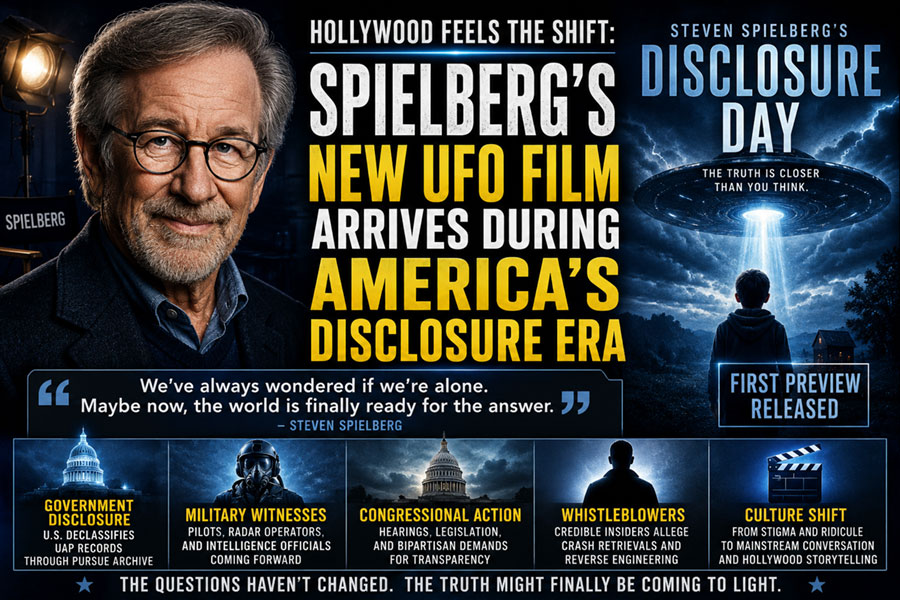
Steven Spielberg appears to sense what much of America is beginning to feel: Something has changed.
This week, a chilling preview was released for Spielberg’s highly anticipated UFO-themed film Disclosure Day, reigniting national fascination with extraterrestrials, government secrecy, and unexplained aerial phenomena.
Under normal circumstances, another Spielberg alien movie would simply be entertainment news. But these are not normal circumstances.
The film arrives at precisely the moment the American government itself is openly releasing UFO-related records through the Trump administration’s new PURSUE archive, while whistleblowers, intelligence officials, military pilots, and lawmakers increasingly speak publicly about unidentified aerial phenomena as a legitimate national-security issue rather than a fringe obsession.
That timing matters. For decades, UFOs lived primarily in science fiction. Hollywood explored the subject because government and academia largely refused to do so openly. Movies like Close Encounters of the Third Kind and E.T. The Extraterrestrial allowed Americans to imagine possibilities the culture officially discouraged them from discussing seriously.
Now the line between fiction and official inquiry is becoming increasingly blurred. Congress has held hearings. Military video, sensor and radar footage has been authenticated. Radar operators and fighter pilots have spoken publicly.
Whistleblowers such as David Grusch have alleged crash-retrieval and reverse-engineering programs under oath before congress.
Senators, including now Secretary of State Marco Rubio, have stated that high-level officials and intelligence personnel have brought forward serious testimony that cannot simply be dismissed.
And now the Department of War itself is releasing previously classified UAP materials to the public. That changes the atmosphere surrounding everything connected to the phenomenon.
Spielberg, perhaps more than any filmmaker alive, understands the psychology of wonder and fear surrounding the unknown. His original UFO films captured a public simultaneously fascinated and terrified by the possibility that humanity might not be alone.
But in the 1970s and 1980s, UFO fascination still largely belonged to the realm of speculation. Today, millions of Americans increasingly believe the government knows far more than it has admitted publicly. That does not mean every claim is true. It does not mean every video shows extraterrestrial craft. It does not mean Hollywood fiction should be confused with verified reality. But it does mean the stigma barrier has collapsed. That may be the biggest disclosure of all.
For generations, serious witnesses often remained silent because ridicule carried professional and social consequences. Pilots feared losing careers. Military personnel feared security repercussions. Business professionals feared reputational damage. See e.g., our May 20 article Fed Appeals Court Judge Stayed Silent for Decades – Now Witnesses Beginning to Talk.
Now major newspapers, congressional committees, cable news programs, podcasters, documentary filmmakers, local newsrooms, and even legacy Hollywood directors openly discuss the subject without embarrassment.
The cultural shift is undeniable. And perhaps Hollywood recognizes something else as well: Americans are hungry for mystery again.
After years of institutional distrust, political division, censorship debates, bureaucratic secrecy, and collapsing public confidence, the UFO issue touches something deeper in the national psyche. It raises questions larger than politics — questions about reality, secrecy, human identity, technology, spirituality, and mankind’s place in the universe.
That is why disclosure stories increasingly dominate public attention. Not because every person believes aliens have landed. But because millions of Americans now suspect the official story they were given for decades was incomplete, or a complete lie.
Spielberg’s new film may ultimately prove to be fiction. But the world into which it is being released suddenly feels very different from the one that existed when Close Encounters first appeared nearly fifty years ago. Back then, Americans wondered whether the government might know something. Now many Americans are beginning to suspect the government may finally be admitting it.
Leave a Reply