
President Trump’s decision to reduce Utah’s national monuments should mark the beginning—not the end—of restoring constitutional balance in the American West.
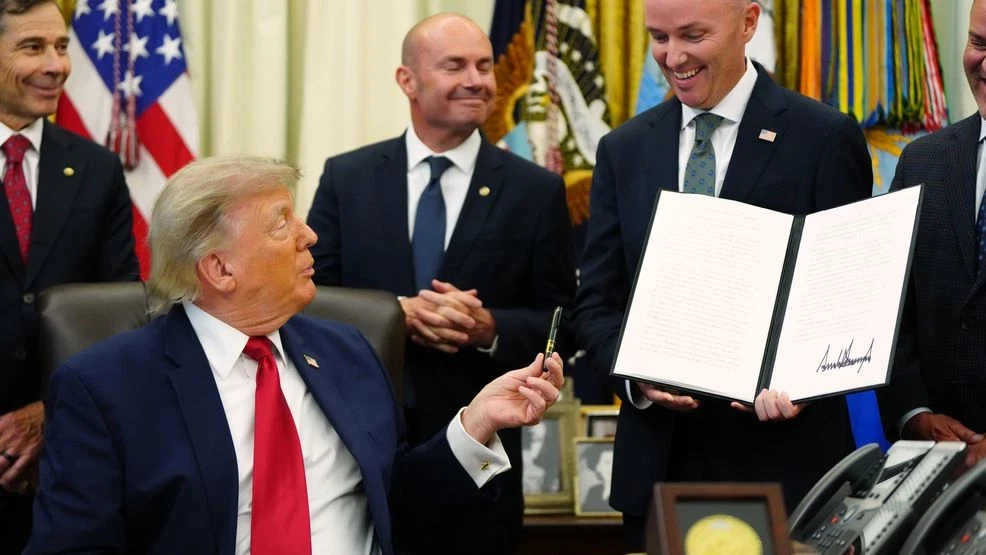
President Donald Trump’s decision to dramatically reduce the size of the Bears Ears and Grand Staircase-Escalante National Monuments is more than a victory for Utah. It is an opportunity for Congress to address one of the longest-running constitutional and political disputes in the American West: the federal government’s ownership and control of vast portions of western states.
For decades, Democrat presidents have used the Antiquities Act to place millions of acres under federal control with the stroke of a pen. President Bill Clinton created Grand Staircase-Escalante in 1996. President Barack Obama established Bears Ears in 2016. President Joe Biden later expanded both monuments after President Trump’s earlier reductions. Now President Trump has again reduced them, arguing that the original designations far exceeded what was necessary to protect the specific historic and scientific resources contemplated by the Antiquities Act.
Whether one applauds or opposes the latest action, it highlights a larger question that Congress has largely ignored: Who should control the land inside the western statest?
The West Is Not Treated Like the Rest of America
No one would suggest that Washington should own half of Texas, Georgia, or Pennsylvania. Yet in many western states, the federal government controls enormous portions of the land. Nevada is more than 80 percent federally owned. See our article of February 24, 2020, It’s Time: Western Lands Must Be Returned to States.
Utah, Idaho, Oregon, Wyoming, and several other western states likewise remain under extensive federal ownership, much of it administered by agencies thousands of miles away from the people who actually live there.
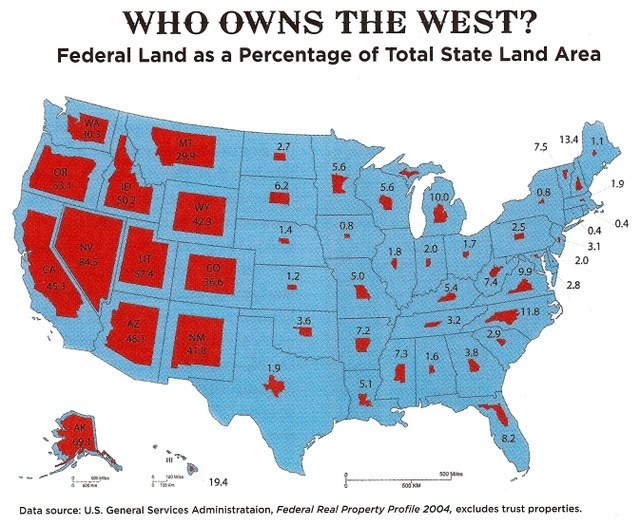
This imbalance has existed since statehood and has been a source of continuing conflict over economic development, recreation, grazing, timber, mining, water rights, wildfire management, and local taxation.
Congress Has the Authority to Act
The Constitution grants Congress broad authority over federal property. It also gives Congress the power to admit new states on an equal footing with the original thirteen.
Many western leaders have long argued that perpetual federal ownership of vast landscapes is inconsistent with that principle of equal sovereignty, especially when eastern states generally do not operate under similar levels of federal land control.
What is beyond dispute is that Congress—not the executive branch alone—possesses the authority to determine the long-term disposition of federal lands, which were placed in temporary “escrow” as the states applied for statehood over 100 years ago. The eastern states’ land was released from that escrow, but the western states are still waiting for Congress to complete the statehood process and release the escrowed lands.
That makes this a legislative question as much as an executive one.
Monument Designations Should Not Become Permanent Land Policy
The Antiquities Act was enacted in 1906 to protect specific archaeological, historical, and scientific objects.
Supporters of President Trump’s action argue that designating millions of acres as national monuments stretches that law far beyond its original purpose. Utah officials have maintained that monuments should encompass only the land reasonably necessary to protect the resources being preserved.
Opponents argue that broader boundaries are necessary to preserve interconnected ecosystems, cultural landscapes, and archaeological sites.
That debate will continue in the courts. But it also illustrates why national land policy should not swing dramatically every four or eight years depending upon who occupies the White House.
A Better Long-Term Solution
Instead of repeatedly expanding and shrinking monument boundaries through executive action, Congress should establish a durable framework for evaluating whether certain federal lands are better managed by the states, as they are in eastern states.
Returning appropriate lands to state stewardship would not eliminate national parks, military installations, Native American reservations, wilderness areas specifically protected by Congress, or other lands serving clear national purposes.
Rather, it would allow states to assume greater responsibility for lands whose primary value is local management, recreation, grazing, forestry, or responsible resource development.
States are fully capable of protecting natural beauty while balancing economic opportunity, public access, and environmental stewardship.
Local Stewardship Encourages Local Accountability
Citizens who live near these lands experience their benefits—and their challenges—every day. They depend on healthy forests, functioning watersheds, responsible recreation, and sound wildfire management.
State governments are directly accountable to those citizens through elections. Federal agencies, by contrast, often answer primarily through administrative processes far removed from the communities most affected by their decisions.
That does not guarantee states will always make better choices. It does mean those choices are made closer to the people who must live with the consequences.
A Rare Opportunity
President Trump’s decision regarding Bears Ears and Grand Staircase-Escalante will almost certainly face legal challenges by democrats. But he is right in returning the last for public access and use. It’s a good start.
Leave a Reply