
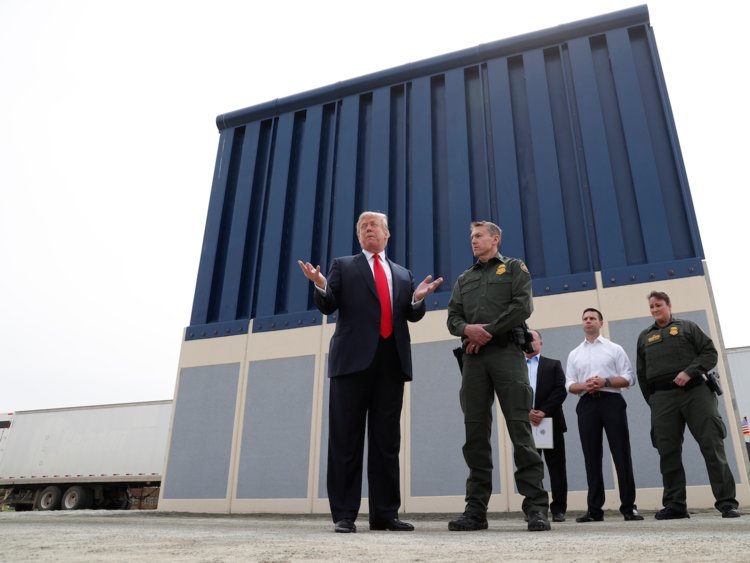
SCOTUS RULING — The Constitution does not prevent President Trump from moving federal funds to build a wall on the southern border — and the Supreme Court will not rule otherwise.
Democratic leaders greeted last week’s news that the Pentagon had carried out Trump’s transfer of $3.6 billion for the border wall as if the constitutional heavens had fallen. “The president is negating the Congress’ most fundamental principles — the Constitution’s most fundamental principle — the separation of powers,” Speaker Nancy Pelosi said on Wednesday, “by assaulting the Constitution’s power, our power of the purse, and he’s undermining the oath of office he takes to protect and defend the Constitution and the American people.” Even conservative commentators have echoed the claim that the president is violating the Constitution by moving funds for the wall without congressional permission.
Most of this criticism is pure partisanship. But those on the Left and Right who oppose the president’s actions in good faith are either wrong or confused about the nature of presidential power and congressional delegations of authority.
The Constitution says only a specific list of “legislative Powers herein granted” are “vested in a Congress.” But it vests “[t]he executive Power” of the entire federal government wholly and completely to the president. The Constitution purposefully does not limit the president to a specific list of powers, as it does with Congress. “Good government,” Alexander Hamilton explained in Federalist 70, requires “energy in the executive,” which is “essential to the protection of the community from foreign attacks” and “the steady administration of the laws.”
The Framers knew that it was impossible to define beforehand the nature of emergencies and crises, and so did not try to define the president’s powers to act in response. Because the “circumstances that endanger the safety of nations are infinite,” Hamilton warned in Federalist 23 during the fight over ratification, “no constitutional shackles can wisely be imposed on the power.”
If presidents are to protect America and execute its laws, they must have the ability to identify an emergency. Throughout our history, presidents have understood the Constitution’s grant of “the executive power” to include such a power. Thomas Jefferson effectively did so in response to Aaron Burr’s effort to raise a rebellion in Louisiana; Abraham Lincoln declared an emergency at the start of the Civil War; FDR did so, with far less justification, at the start of his presidency to handle the Great Depression.
Not only do presidents have the constitutional authority to respond to emergencies, but Congress has also enhanced it with the right to re-allocate military spending.
In the judgment of President Trump and, presumably, many of those who elected him, our immigration laws at the border have failed. Even the New York Times and other media critics of the president have called the situation at the border an “emergency.” As commander-in-chief, the president has already ordered 3,000 troops to defend the integrity of the border. This recalls the U.S. Army to its roots — safeguarding the frontier.
Congress long ago blessed presidential authority to follow up an emergency declaration with deeds. In 1976, Congress enacted the National Emergency Act. While it terminated most existing emergencies, the NEA neither defined a national emergency nor limited the president’s ability to declare one. The law only sets out the process for publication and congressional notification for the president’s declaration. Every president has used the NEA to declare a national emergency, several under circumstances far less immediate than this one. The Supreme Court has never disagreed.
Not only do presidents have a reservoir of constitutional authority to respond to emergencies, but Congress has also enhanced it with the right to re-allocate military spending. Congress has passed at least two specific laws that give the president the power to transfer funds to a construction project, such as a wall, after a declaration of emergency. The first, Section 2808 of Title 10, states that if Trump declares an emergency “that requires use of the armed forces, the Secretary of Defense…may undertakemilitary construction projects” using construction funding if it supports the armed forces.
A wall would clearly support the troops deployed at the border. A wall would make the troops safer by protecting them and reducing the size of migrant flows. A wall would also reduce the size of necessary deployments along the border by reducing the area that must be patrolled. Further, decisions over what “requires” the armed forces and what is “necessary to support” them traditionally have rested within the expertise of the president and have rarely, if ever, been second-guessed by the courts
A second law, Section 2293 of Title 33 of the U.S. Code, allows the secretary of Defense to reallocate funds from military construction projects if the president declares an emergency. This means the president can “terminate or defer the construction, operation, maintenance, or repair” of any project “he deems not essential to the national defense” and “apply the resources of the Department of the Army’s civil works program, including funds, personnel, and equipment” to military construction projects deemed essential.
This statute appears even more generous than Section 2808. It does not demand that the national emergency requires the use of the U.S. Armed Forces; it allows that it could be an emergency that “requires or may require” their use. It also does not require that the construction be necessary to support the armed forces. Instead, the statute requires that (a) the civil works, military construction, or civil defense project be “authorized,” and (b) that the project be “essential to the national defense.” As law professor John Eastman has observed, the Secure Fence Act of 2006 authorized construction of a wall along the U.S.-Mexico border, which meets condition (a).
These laws do not define what construction projects are essential to the national defense. The courts will be rightly reluctant to review these decisions. Instead, the Supreme Court will likely give the president the broadest deference to decide whether any construction project, even a border wall, would satisfy this statutory language.
This makes perfect sense. It would be difficult, if not impossible, to define by antecedent law what is militarily necessary — this lies squarely within the scope of executive power. Would the courts review whether the president’s decision to build a particular base, road, waterway, airport, fortification, defense structure, storage facility, arsenal, or even a bunker, is “essential” to the national defense? Such a decision would depend on the circumstances and the nature of the threat, which almost by definition could not be fully anticipated by Congress.
Despite the pleas of administration critics, the Supreme Court will almost certainly agree. If President Trump’s critics disagree with him as a matter of policy, they will be free to vote for someone else in 2020.
Matthew Peterson, Ph.D, is Vice President of Education and Salvatori Research Fellow at the Claremont Institute.
John C. Yoo is Heller professor law at UC Berkeley School of Law, a visiting fellow at the American Enterprise Institute and a visiting scholar at The Hoover Institution, Stanford University. He is the author of the new book “Striking Power: How Cyber, Robots and Space Weapons Change the Rules of War.”
Tired of Facebook? Check out Conservative-friendly social media. Join FREE today: PlanetUS
Watch this 30 sec. video about PlanetUS:

Leave a Reply