• Home
  • Mission
  • Federalist Papers
  • Foundation
  • U.S. Constitution
  • Bill of Rights

Federalist Press | Defending Liberty — Informing America

Breaking News and Political Commentary

  • All Stories
  • Economy
  • Elections
  • Entitlement
  • Ethics
  • Foreign
  • Gender
  • Religion
  • Sci-Tech

Top Senate Dem Tells Colleagues to Oppose Trump’s Supreme Court Pick, Suggests Sacrificing Senate Seats

July 8, 2018 By Editor Leave a Comment

Just one day before President Trump is set to announce his pick to replace retiring Supreme Court Associate Justice Anthony Kennedy in a primetime address from the White House, a top Democratic senator suggested that stopping the nominee is more important than the upcoming midterm elections.

Sen. Dick Durbin, D-Ill., acknowledged that so-called red-state Democrats may be tempted to vote for Trump’s selection out of political necessity, but urged his colleagues Sunday to consider more than their political careers.

“Beyond the procedure, beyond the gamesmanship, it is a life-and-death important decision to be made by this court on so many issues,” the Senate minority whip said on NBC’s “Meet the Press.”

“The men and women that I work with on the Democratic side really take this seriously,” he added, after host Chuck Todd raised the possibility that Democrats could lose their bid to retake the Senate by opposing the nominee. “They understand it’s an historic decision. It’s about more than the next election. It’s about what future the United States of America is going to chart.”

“They understand it’s an historic decision. It’s about more than the next election.”

– Sen. Dick Durbin, D-Ill.

Speaking on “Fox News Sunday,” Republican Sen. Lindsey Graham called the situation a veritable “nightmare” for Democrats hanging onto their vulnerable seats in states that largely support Trump.

Those Democrats — including West Virginia’s Joe Manchin, North Dakota’s Heidi Heitkamp, and Indiana’s Joe Donnelly — must choose between alienating their constituents, or trying to halt a conservative nominee who may ultimately prove unstoppable anyway because of the GOP’s slim Senate majority.

Only 50 votes are needed to confirm a justice, because Senate Republicans eliminated the filibuster for Supreme Court justices last year — widely seen as a retaliation for Democrats’ decision to get rid of the filibuster to ensure that President Barack Obama’s nominees were seated on the D.C. Circuit.

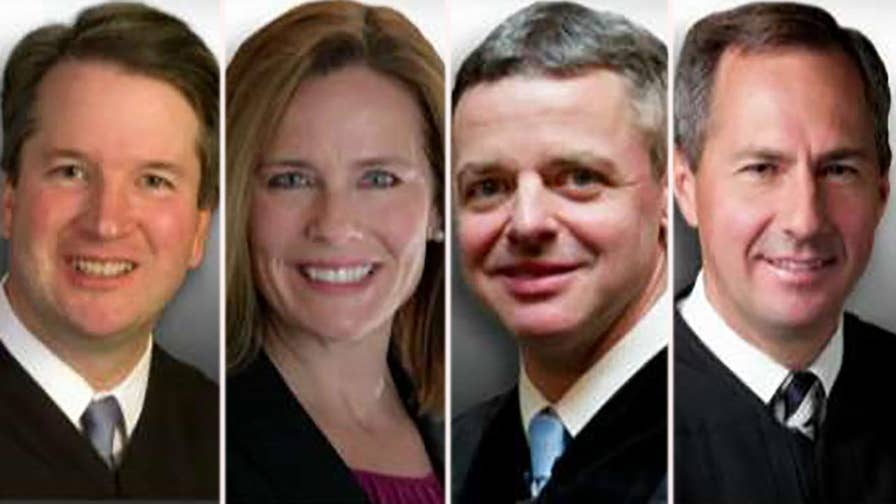
What are the differences between the four judges on Trump's SCOUTS shortlist? Insight on 'America's News HQ.'

WATCH: SEN. LINDSEY GRAHAM SAYS SCOTUS SITUATION A ‘NIGHTMARE’ FOR RED-STATE DEMOCRATS

Durbin charged that it was “totally inconsistent” for Republicans to press for a vote on Trump’s nominee after stalling the nomination of Merrick Garland in 2016. GOP Senate leaders refused to vote on Garland’s selection, saying it was inappropriate to consider a nomination during a presidential election year — a principle Durbin claimed must logically apply to midterm election cycles as well.

But Judiciary Committee member Sen. Chris Coons, D-Del., said Sunday he would still be willing to meet with Trump’s nominee, even as he echoed Durbin’s complaints about Garland’s treatment.

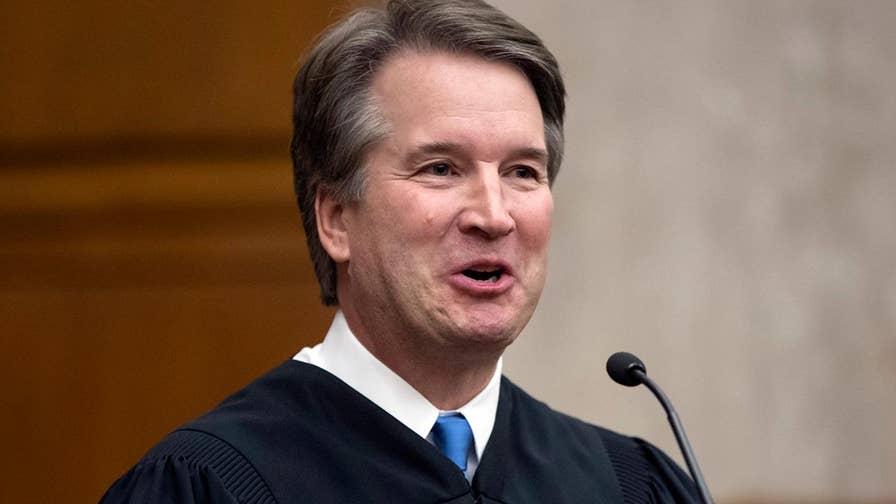
After rampant speculation that has reached a fevered pitch, Trump is believed to have narrowed his shortlist to four candidates: federal judges Thomas Hardiman, Brett Kavanaugh, Raymond Kethledge and Amy Coney Barrett.

Graham called the hyper-partisan Supreme Court nomination process “dysfunctional,” but said Republicans should be happy with those four candidates.

“If you’re a conservative Republican, the four people named — particularly Thomas Hardiman, I’m glad he’s on the list — are all winners, and all Republicans should embrace these picks,” Graham told host Dana Perino.

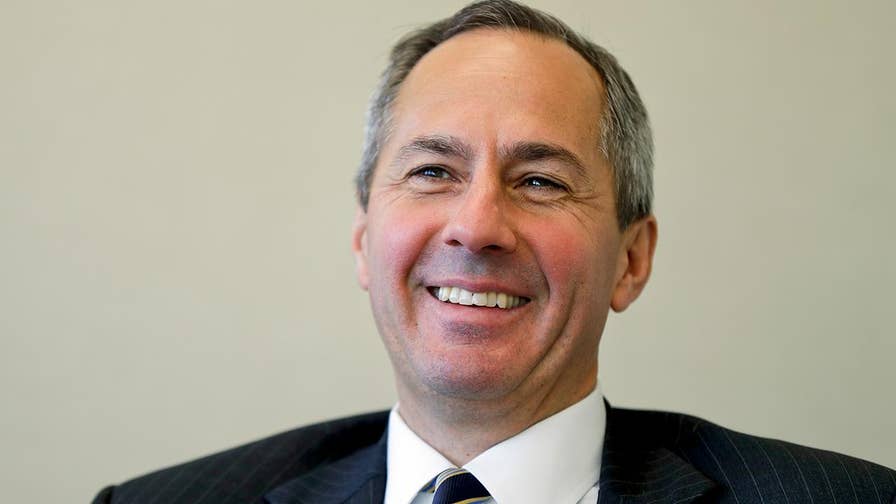
Sources tell Fox News that Judge Thomas Hardiman of the 3rd Circuit Court of Appeals is a candidate to replace retiring Justice Anthony Kennedy; chief White House correspondent John Roberts reports.

Hardiman, a newer arrival on Trump’s shortlist, is a 3rd Circuit judge with blue-collar appeal who married into a prominent Democratic family. He was a front-runner for the Supreme Court seat that went to Neil Gorsuch last year, and was reportedly recommended to Trump by his sister, Maryanne Trump Barry, who served on the bench with him.

DID SEN. ORRIN HATCH JUST GIVE A BIG CLUE ABOUT TRUMP’S SCOTUS PICK?

Hardiman’s stock was rising as some conservatives have soured on Kavanaugh in recent days, saying he has too much baggage from his work related to the Ken Starr investigation that led to President Bill Clinton’s impeachment.

Kavanaugh has also taken criticism for writing an opinion on the D.C. Circuit that used an obscure jurisdictional argument to avoid ruling at all on the constitutionality of ObamaCare — a rationale ultimately rejected by the Supreme Court, which opted to take the case and uphold the law on other grounds.

But Leonard Leo, a top Federalist Society executive and key adviser to Trump on Supreme Court picks, on Sunday downplayed those concerns.

“Every potential nominee before announcement, every potential nominee before announcement, gets concerns expressed about them by people who might ultimately support them,” Leo said on ABC’s “This Week.”

“People aren’t always familiar with their records,” he added. “Sometimes people say things about one nominee because they favor another.”

Key adviser to President Trump helped draw up that list of 25 names from which the president says he will choose his next Supreme Court nominee.

In fact, Leo said, the lack of a lengthy paper trail can be a detriment on its own, even if it can lead to less complicated confirmation hearings.

“Well, I think that first of all with regard to Ray Kethledge and Tom Hardiman, they’re a little bit less known by conservatives,” he said. “And their records are a little bit lighter.”

Republicans have long expressed regret over President H.W. Bush’s nomination of David Souter to the court, and vowed to more carefully screen future nominees. Predicted to be a conservative justice, Souter instead turned out to be a reliably liberal vote.

The White House has reportedly prepared advance information packages on four potential nominees. Trump’s announcement of his ultimate pick is expected at 9 p.m. ET on Monday.


Gregg Re is an editor for Fox News. Follow him on Twitter @gregg_re.

Filed Under: All Stories, Economy, Elections, Entitlement, Ethics, Foreign, Gender, Religion, Sci-Tech

‘Their Party Has No Future’: Former Democrat Urges Liberals to ‘Walk Away’ From Democratic Party

July 5, 2018 By Editor Leave a Comment

The creator of a social media campaign urging liberals to detach themselves from the Democratic Party said that the future of the party is over.

Brandon Straka started the “#WalkAway Campaign,” which shares video stories of people who decide to dissociate themselves from liberalism.

According to the movement’s Facebook page, it’s meant to “encourage and support those on the left to walk away from the divisive tenets.”

Straka appeared on The Ingraham Angle Tuesday and said that negative rhetoric spoken by the left and intolerance it has shown has been a big reason as to why he’s walked away.

“What do these people stand for? What is there platform? All I can figure out so far is ‘We hate Trump’ and ‘We love illegal immigrants,'” Straka said.

Straka said that his campaign is proving that politicians like the self-proclaimed socialist Alexandria Ocasio-Cortez (N.Y.) are the reasons why people are leacing the Democratic party.

DNC Chairman Tom Perez gave Ocasio-Cortez high praise on Tuesday, dubbing her “the future of our party.”

“Their party has no future, it’s over,” Straka said in response.

The one reason Straka was initially a Democrat was because he is gay.

“I think that if you’re a minority in America … there’s sort of this assumption that you are not wanted on the right,” he said.

He added that he believes the left takes minorities for granted and makes people feel that President Trump’s administration is looking to “hurt” them.

“If you’re a minority, you have a choice,” he said.

As seen on The Ingraham Angle

Filed Under: All Stories, Economy, Elections, Entitlement, Ethics, Foreign, Gender, Religion, Sci-Tech

BREAKING: Justice Kennedy Retires from High Court, Giving President Trump Another Pick

June 27, 2018 By Editor Leave a Comment

Justice Anthony Kennedy announced Wednesday that he is retiring, giving President Trump a critical opportunity to move the Supreme Court more solidly to the right in what promises to be an epic confirmation fight.
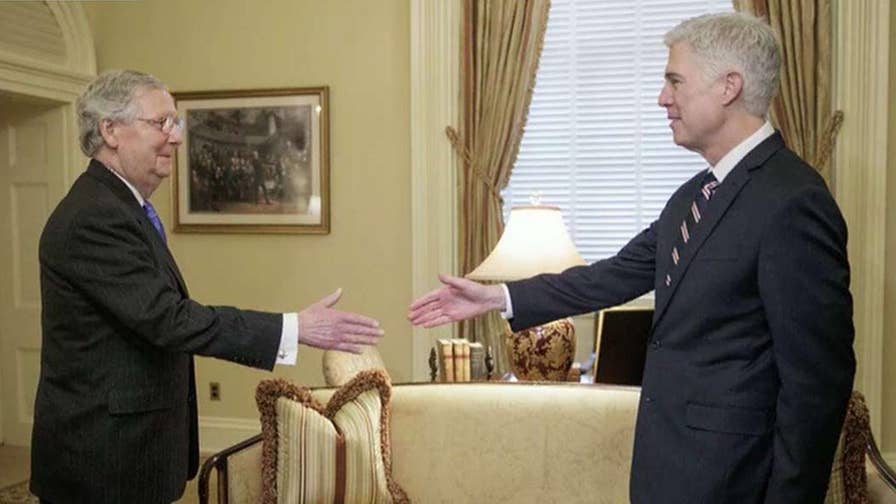
The 81-year-old senior associate justice informed the White House in a letter of his intention to step down from the high court after 30 years, effective July 31. Rumors of another vacancy have reverberated across Washington in recent months, and it comes a year after Kennedy’s former law clerk Justice Neil Gorsuch, took over the seat occupied by the late Justice Antonin Scalia.

Arguably the most powerful member of the Supreme Court, Kennedy’s moderate-conservative views often left him the “swing” — or deciding — vote in hot-button cases ranging from abortion to gay rights to political campaign spending.

A Supreme Court vacancy will likely become a key issue in a midterm congressional election year, when control of the Senate is at stake.

That body will consider Trump’s latest high court nominee, requiring only a simple majority for confirmation. GOP leaders changed the rules when Gorsuch was being considered, to get rid of the 60-vote procedural filibuster threshold.

But Democrats are expected to try and transform the court opening into a broader political referendum on Trump’s leadership, and the future of social issues like immigration, gun rights, and race.

Republicans, for their part, hope Kennedy’s replacement helps them in the November elections.


By Bill Mears, Shannon Bream | Fox News

Filed Under: All Stories, Economy, Elections, Entitlement, Ethics, Foreign, Gender, Religion, Sci-Tech

SCOTUS Rules for Workers, Against Union Bosses

June 27, 2018 By Editor Leave a Comment

Supreme Court Justice Neil Gorsuch tipped the scales on another landmark decision on Wednesday, joining the conservative majority for the 5-4 ruling against so-called “fair share” union fees.

It was the latest example of President Trump’s nominee delivering a win for the administration’s agenda and conservative causes, coming on the heels of the 5-4 ruling upholding Trump’s “travel ban.”

Fox & Trends with Carley Shimkus.

In the union case, Gorsuch’s impact was strikingly evident.

Justices split 4-4 on the issue in a similar case following the death of Justice Antonin Scalia. After Gorsuch was confirmed to fill the seat, he played it close to the vest during arguments in February — offering no comments or questions from the bench during nearly 70 minutes of oral arguments.

But in the end, Gorsuch sided with a conservative majority ruling that state government workers cannot be forced to pay “fair share” fees to support collective bargaining and other union activities.

The decision, which dealt a blow to unions, said that a union’s contract negotiations over pay and benefits were inextricably linked with its broader political activities, and concluded workers had a limited constitutional right not to underwrite such “speech.”

The case specifically examined union fees paid by non-members.

“The procedure violates the First Amendment and cannot continue,” Justice Samuel Alito wrote in the majority opinion. “Neither an agency fee nor any other payment to the union may be deducted from a nonmembers wages, nor may any other attempt be made to collect such a payment, unless the employee affirmatively consents to pay.”

The court now ends its session with Gorsuch’s impact on full display.

Gorsuch also sided with conservative justices this week to uphold Trump’s so-called travel ban — the first major high court decision on a Trump administration policy. The 5-4 ruling upheld selective travel restrictions for certain Muslim majority countries. Chief Justice John Roberts wrote that the order was “squarely within the scope of presidential authority” under federal law.

Liberal justices and advocates lamented the outcome of both the travel ban and union cases.

On the former, Justice Sonia Sotomayor suggested the policy remained discriminatory: “Based on the evidence in the record, a reasonable observer would conclude that the proclamation was motivated by anti-Muslim animus.”

Writing the dissent for the court’s four liberal members in the union case, Justice Elena Kagan said the majority succeeded in its “crusade” by “turning the First Amendment into a sword.”

But conservatives cheered.

After the travel ban decision, Senate Majority Leader Mitch McConnell’s campaign arm tweeted a photo of him and Gorsuch — a reminder that it was McConnell who stalled on former President Barack Obama’s Supreme Court nominee, and later helped confirm Trump’s nominee last year.

McConnell and his staff have touted the Gorsuch confirmation as a major GOP win.

Gorsuch had kept observers guessing. In April, he sided against the Trump administration in a case involving government efforts to deport foreigners convicted of serious crimes in the U.S., aligning with the court’s four more liberal justices.


Brooke Singman is a Politics Reporter for Fox News. Follow her on Twitter at @brookefoxnews. Fox News’ Bill Mears contributed to this report.

Filed Under: All Stories, Economy, Elections, Entitlement, Ethics, Foreign, Gender, Sci-Tech

SCOTUS: President Wins Travel Ban

June 26, 2018 By Editor Leave a Comment


The Supreme Court on Tuesday upheld President Trump’s controversial travel ban affecting several mostly Muslim countries, offering a limited endorsement of the president’s executive authority on immigration in one of the hardest-fought battles of this term.

The 5-4 ruling marks the first major high court decision on a Trump administration policy. It upholds the selective travel restrictions, which critics called a discriminatory “Muslim ban” but the administration argued was needed for security reasons.

At issue was whether the third and latest version of the administration’s policies affecting visitors from five majority Muslim nations – known as travel ban 3.0 – discriminates on the basis of nationality and religion, in the government’s issuance of immigrant visas.

Chief Justice John Roberts, who authored the conservative majority opinion, wrote that the order was “squarely within the scope of presidential authority” under federal law.

“The sole prerequisite set forth in [federal law] is that the president find that the entry of the covered aliens would be detrimental to the interests of the United States. The president has undoubtedly fulfilled that requirement here,” he wrote.

Associate Justice Sonia Sotomayor was among the court’s four liberals that wrote a dissent.

“This repackaging does little to cleanse [the policy] of the appearance of discrimination that the president’s words have created,” she said. “Based on the evidence in the record, a reasonable observer would conclude that the proclamation was motivated by anti-Muslim animus.”

While the policy was upheld, the case was sent back to the lower courts, which were told to rely on the Supreme Court’s interpretation of executive authority.

It was the first significant legal test so far of Trump’s policies and power and could lead to a precedent-setting expansion on the limits of presidential power, especially within the immigration context.

Federal appeals courts in Virginia and California in recent months had ruled against the administration. The San Francisco-based 9th Circuit Court last December concluded Trump’s proclamation, like the two previous executive orders, overstepped his powers to regulate the entry of aliens.

But the justices had allowed the current restrictions to be enforced at the Justice Department’s request, at least until the case was fully litigated.

The Trump administration also seemed to enjoy a favorable reception before the court during arguments in April.

Associate Justice Samuel Alito, during those April arguments, noted that of the 50 or so mostly Muslim majority countries, only five were on the current banned list, or about 8 percent of the population, he said.

The White House had framed the issue as a temporary move involving national security.

Sixteen state leaders led by Texas were among a number of coalitions backing the Trump administration. But Hawaii officials, who filed the appeal contesting all of the president’s orders, said the president’s policies violate the Constitution’s guarantee of religious freedom:

“Any reasonable observer who heard the president’s campaign promises, read his thinly justified orders banning overwhelmingly Muslim populations, and observed his administration’s persistent statements linking the two, would view the order and each of its precursors as the fulfillment of the president’s promise to prohibit Muslim immigration to the United States.”

A coalition of groups in opposition called the order blatant religious discrimination, since the countries involved have mostly Muslim populations: Iran, Libya, Sudan, Syria and Yemen. Chad was recently removed from the list after the administration said that country had beefed up its information-sharing.

FoxNews.com / The Associated Press contributed to this report. 

Filed Under: All Stories, Economy, Elections, Entitlement, Ethics, Foreign, Gender, Religion, Sci-Tech

The Asylum Crisis Is a Security Challenge, Not a Legal Problem

June 25, 2018 By Editor Leave a Comment

Our government’s first duty is to secure the border.

This weekend, Washington mourned the iconic Charles Krauthammer’s passing. It seemed a pause in the bedlam on the border, about which he would surely have had something wise to say. As someone who knew Dr. K mainly through his scintillating columns and television commentary, I suspect his thoughts on the refugee tide would be shorn of hubris about what Washington’s laws can accomplish.

The futility of dictating to the tide, rather than shoring up against it, was an occasional Krauthammer theme. He was wont to invoke an apocryphal tale about Canute the Great (see, e.g., here), who ruled a North Sea empire a millennium ago. In this, as in innumerable other ways, Charles was singular among commentators because he got the story right. His throne moved to the coastline, Canute audaciously orders the incoming tide to halt. But this is not a cautionary tale about the delusional arrogance of power. It is about humility: The king was showing his sycophantic courtiers that the law — in this instance, the writ of a purportedly omnipotent monarch — is limited, sometimes impotent, against such phenomena as the forces of nature.

The “rule of law” is not a magic wand. It is possible only in a community that has agreed to live under its provisions. Even within such a community, it must enforced by the power of the state. Law enforcement is manageable as long its resources are commensurate with the reasonably expected degree of law-breaking.

The situation is different when we are dealing with outsiders who seek entry into the community. By nature, that is more of a security challenge than a legal one. If the outsiders are not legally entitled to enter, or if their claim to such entitlement is dubious, the situation can masquerade as a legal problem only as long as it can be addressed by the resources the society has dedicated to enforcement. But what generally happens when a security challenge is handled as if it were a mere law-enforcement issue is that the bureaucracy gets overwhelmed and we find that enacting laws is no solution.

Congress cannot enact a law that prevents Central American migrants from flooding the border. Or, one supposes, it can enact a thousand such laws and look on in Canute-like futility as the incursion continues. Passing laws is not a serious response to a security challenge, and an unserious response always emboldens the challenger. Outsiders can overwhelm a national border by armed force or, if the nation is not willing to defend its border, by sheer numbers. Either way, the challenge can be answered only by the deployment of physical barriers and armed force sufficient to deny the onslaught and discourage others from coming.

Only after the crisis is over, after the security threat is contained, can we establish a legal process backed by resources scaled to handle the number of outsiders realistically expected to petition for entry.

We are a litigious society, so our first impulse in any crisis is to hurl our laws at it. It rarely works. For one thing, our law is always a step behind new crises – which is part of what makes them crises.

In 1993, I was assigned to prosecute a jihadist cell that had bombed the World Trade Center and plotted to carry out similar attacks on other New York City landmarks. Our country had had little experience to that point with international terrorism as a sustained threat. That was fortunate, but it also meant our law was not prepared for it.

Congress eventually overhauled anti-terrorism law in 1996. The new laws (e.g., terrorism conspiracy, material support, offenses involving the construction and use of mass-destruction weapons) specifically targeted jihadist organizations as they operate in modern times. But in the interim, we had to prosecute with the laws we had (using a rarely invoked Civil War–era sedition statute that made it a crime to conspire to levy war against the U.S.). The strategy worked for purposes of our case, and the new laws were a significant legal advance.

Yet the ability to convict the occasional handful of enemy operatives did not change the nature of the threat. It was still a national-security challenge, not a law-enforcement problem. It would not be addressed effectively until a catastrophic event, 9/11, snapped us from our security slumbers. Only then were military and intelligence assets deployed to attack the threat at its source. Only then did we accept the limited support role that domestic law enforcement can play in meeting a foreign threat to national security — or at least most of us did.

In the matter of refugees’ flooding the border, our law is again behind the curve. As a society based on individual liberty, we subscribe to the precept that guilt is personal — we don’t convict a person for being a member of a suspect group. That is fine in the realm of domestic law enforcement. It does not transfer well to security against outsiders.

And sure enough, if you look at federal asylum law, it addresses the individual migrant, not a systemic incursion. It dwells on what a migrant must establish to qualify for relief, and on what conduct the government may rely to deny or withdraw asylum status in any specific case. It does not address what could happen if thousands of migrants simultaneously seek asylum, abetted by the Lawyer Left’s insistence that our asylum law entitles them to due process — even if this means that, as a practical matter, a high percentage of them will be released into the United States, they will never show up for their legal proceedings, and they will settle here illegally while Washington agitates to bring them “out of the shadows” and formally make them Democrats, er, I mean citizens.

We can have humanitarian sympathy for the plight of migrants fleeing dystopian societies while still recognizing that the United States government exists to protect the American people.

It has become a favorite progressive talking point that the number of migrants seeking entry has plummeted in the last 20 years — the 300,000 captured attempting illegal entry last year is a fraction of the over 1.6 million captured trying in 2000. This misses — or, rather, distorts — the point.

The demographics of the migrant population have drastically changed — no longer mainly Mexican men but large numbers of women and children from Central America (especially Honduras, Guatemala, and El Salvador). The latter are more difficult to turn away because of a law enacted in 2008 — called the William Wilberforce Trafficking Victims Protection Reauthorization Act, though a better title would have been “The Law of Unintended Consequences.” The point, in any event, is that the number of migrants need not approach historic highs to prompt a crisis. It need only overwhelm the resources we have allocated to deal with asylum claims and the attendant complication of detaining family members while the claims are processed. This creates a security problem our law has not anticipated and is not fit to answer.

Comments

The current crisis is the fallout of a category error. We have a security problem that has been exacerbated by laws that, depending on your perspective, are either foolish or cynically designed to enable illegal immigration. The fact that bad laws make the security challenge worse does not mean that good laws would solve it. Better laws cannot transform a security challenge into a legal problem.

We can have humanitarian sympathy for the plight of migrants fleeing dystopian societies while still recognizing that the United States government exists to protect the American people. Our government should do as little harm as is practical under the circumstances. Its first duty, however, is to secure the border.

Andrew C. McCarthy — Andrew C. McCarthy is a senior fellow at the National Review Institute and a contributing editor of National Review. @AndrewCMcCarthy

Filed Under: All Stories, Economy, Elections, Entitlement, Ethics, Foreign, Gender, Religion, Sci-Tech

Michael Anton-Why do we Need More People in this Country, Anyway?

June 22, 2018 By Editor 1 Comment

As Capitol Hill Republicans attempt for — what, the eighth? ninth? — time in the past two decades to jam through an amnesty that their voters have explicitly, loudly and repeatedly said they do not want, it’s worth asking a question that is rarely raised:

Does the United States — population 320 million and rising — need more people? If so, why?

To most ears, the question sounds blasphemous, which illustrates the rottenness of our immigration debate. Actually, “debate” is far too generous. One side has made sure that there is no debate. Good people want more immigration, and bad people object or raise questions. An inherently political issue has been effectively rendered religious, with the righteous on one side, sinners on the other.

The basic question remains. The pat answer over the past 20 years — “to do the jobs Americans just won’t do” — may seem to have some salience with a 3.9 percent unemployment rate. But that only further raises the question. After at least two decades of wage stagnation and even decline, now that we’ve finally reached the nirvana of full employment (and who knows how long it will last), why not take advantage of this tight labor market to raise wages across the board? Especially for the working and middle classes that got nowhere or even lost ground during the housing, finance and tech booms of recent years?

Just about everyone knows the answer: because the business community does not like tight labor markets and the concomitant necessity to raise wages. That’s bad for the bottom line. The solution? More workers! And so the Chamber of Commerce annex — a.k.a. Capitol Hill Republicans — dutifully attempt to do their donors’ bidding at the expense of their voters’ interests.

Critics of the Trump immigration policy that leads to separating families say it is “un-American.” They’re wrong. (Kate Woodsome, Adriana Usero/The Washington Post)

Economists in league with big business got good at torturing data to “show” that immigration benefits the economy. But as demonstrated by Harvard University’s George Borjas, one of the nation’s leading economists on the topic, immigration is a net economic benefit to immigrants and to their employers. To workers already here, not so much.

No matter, because the Democrats are no longer the party of labor. Back when they were — in the prelapsarian Clinton years — they sought tight labor markets precisely for their efficacy in boosting lower-end wages. But today’s Democrats are the party of high class, high tech and high capital.

This glamour coalition is not big enough by itself to win elections. So the left has hoodwinked some (but, as the 2016 election shows, by no means all) low-income voters into thinking that their interests align with those of Wall Street and Silicon Valley oligarchs.

It’s clear what the oligarchs get out of an endless influx of cheap labor. What the Democratic Party gets is also clear: more voters, and with them the tantalizing possibility of turning the country as irreversibly blue as Democratic policies have already done to New York, California and many other states.

Democrats used to be coy about this. The 2002 blockbuster “The Emerging Democratic Majority,” by John B. Judis, presented demographic change as an inevitability, not a deliberate plot to rig elections. But now, for the first time facing real pushback from those whose interests more immigration does not serve, the left is more open in exhorting their side and demonizing the other. Hence this year’s “How Democracies Die,” by Steven Levitsky, states openly that immigration favors Democrats, so the more the better. It also construes any opposition as (of course) racist.

Another argument for more people is to point to falling birthrates among the native-born. In fact, the United States remains near the top of birthrates in the developed world. Regardless, consider that immigration not only lowers wages but also raises housing prices by increasing demand and stresses public schools by adding non-English-speaking students. And as such factors worsen, research suggests that people are putting off marriage — which reduces birthrates.

Related is the claim that more people are necessary to solve our looming entitlement crisis. This quickly falls apart once you think it through. In 1967, future Nobel laureate Paul Samuelson favorably compared Social Security to a Ponzi scheme, arguing that it will be sustainable because younger people will always outnumber retirees. But does anyone really believe the United States — or any country — is capable of sustaining population growth without end? Somehow, the United States needs to find a way to meet its fiscal commitments without stuffing the land beyond the bursting point.

So again: Why do we need more people? For the extra traffic congestion? More crowded classrooms? Longer emergency room and Transportation Security Administration lines? Higher greenhouse-gas emissions?

We know how more immigration benefits big business and the Democratic Party. No one has yet convincingly explained how it benefits the American people as a whole. That’s the foremost consideration that should drive our immigration debate, and that’s what should determine our immigration policy.

by Michael Anton June 21 at 3:29 PM

Michael Anton is a lecturer and research fellow at Hillsdale College and a former national security official in the Trump administration.

Filed Under: All Stories, Economy, Elections, Entitlement, Ethics, Foreign, Gender, Religion, Sci-Tech

Charles Krauthammer, Conservative Commentator and Pulitzer Prize Winner, Dead at 68

June 21, 2018 By Editor Leave a Comment

Charles Krauthammer, a longtime Fox News contributor, Pulitzer Prize winner, Harvard-trained psychiatrist and best-selling author who came to be known as the dean of conservative commentators, has died. He was 68.

His death had been expected after he wrote a heartbreaking letter to colleagues, friends and viewers on June 8 that said in part “I have been uncharacteristically silent these past ten months. I had thought that silence would soon be coming to an end, but I’m afraid I must tell you now that fate has decided on a different course for me…

“Recent tests have revealed that the cancer has returned. There was no sign of it as recently as a month ago, which means it is aggressive and spreading rapidly. My doctors tell me their best estimate is that I have only a few weeks left to live. This is the final verdict. My fight is over.”

In recent years, Krauthammer was best known for his nightly appearance as a panelist on Fox News’ “Special Report with Bret Baier” and as a commentator on various Fox news shows.

Following the news of the death of his “good friend,” Baier posted on Twitter, “I am sure you will be owning the panel discussion in heaven as well. And we’ll make sure your wise words and thoughts – your legacy – will live on here.”

Brit Hume, senior political analyst on Fox News, also tweeted about the “terribly sad news.”

“The great Charles Krauthammer has died,” he said.

But Krauthammer was arguably a Renaissance man, achieving mastery in such disparate fields as psychiatry, speech-writing, print journalism and television. He won the Edwin Dunlop Prize for excellence in psychiatric research and clinical medicine. Journalism honors included the Pulitzer Prize for Commentary for his Washington Post columns in 1987 and the National Magazine Award for his work at The New Republic in 1984. His book, “Things That Matter: Three Decades of Passions, Pastimes and Politics,” instantly became a New York Times bestseller, remaining in the number one slot for 10 weeks, and on the coveted list for nearly 40.

Krauthammer delivered his views in a mild-mannered yet steady and almost philosophical style, befitting his background in psychiatry and detailed analysis of human behavior. Borrowing from that background, Krauthammer said in 1990, after the fall of the Berlin Wall, that the post-Cold War world had gone from bipolar to “unipolar,” with the United States as the sole superpower. He also coined the term “The Reagan Doctrine,” among others.

Krauthammer harbored no compunction about calling out those in power, whether they were Democrats or Republicans or conservatives.

During the Democratic National Convention, he assailed lack of substance in the build-up to nominating Hillary Clinton.

“As for the chaos abroad, the Democrats are in see-no-evil denial. The first night in Philadelphia, there were 61 speeches. Not one mentioned the Islamic State or even terrorism.”

“In this crazy election year, there are no straight-line projections,” he noted, adding presciently, “As Clinton leaves Philadelphia, her lifelong drive for the ultimate prize is perilously close to a coin flip.”

Columnist, author and Fox News commentator Charles Krauthammer lived his life telling others exactly what he thought.

At the same time, Krauthammer was quick to express disagreement with President Donald Trump in no uncertain terms.

He denounced Trump’s handling of the violence that erupted at Charlottesville, Va. protests over the planned removal of a Robert E. Lee statue, saying that most Americans were “utterly revolted by right-wing white supremacist neo-Nazi groups.” Krauthammer said that Trump’s failure to strongly denounce the supremacist group, and to say that both sides in the protest shared blame, “was a moral disgrace.”

The man who wore many hats, figuratively, throughout his life — excelling at just about everything he tried, even when he was still a rookie — easily took himself in new directions when curiosity or instinct struck.

Krauthammer’s intellectual heft belied an ability to be candid and witty about his quirks.

“Everything I’ve gotten good at I quit the next day to go on to do something else,” he quipped in a 1984 interview with The Washington Post.

Krauthammer embraced a strong personal constitution that kept him determined and resilient, even in the face of extraordinary physical limitations.

He spent most of his life confined to a wheelchair, the result of a snap decision — when he was 22 years old and a first-year student at Harvard – to go for a quick swim with a friend before a planned game of tennis.

“We go for a swim, we take a few dives and I hit my head on the bottom of the pool,” he said in a Fox News special in 2013 that looked at his life. “The amazing thing is there was not even a cut on my head. It just hit at precisely the angle where all the force was transmitted to one spot…the cervical vertebrae which severed the spinal cord.”

Unable to move, and at a time when his studies happened to focus on the spinal cord, Krauthammer instantly knew the consequences of the accident would be severe.

Fox News senior political analyst and former anchor of 'Special Report' shares memories of the syndicated columnist and Fox News contributor.

“There were two books on the side of the pool when they picked up my effects,” he recalled. “One was ‘The Anatomy of the Spinal Cord’ and the other one [was] ‘Man’s Fate’ by Andre Malraux.”

A lifelong opponent of being stereotyped in any fashion, Krauthammer was not going to let being in a wheelchair define him.

“I don’t like when they make a big thing about it,” he told the Washington Post. “And the worst thing is when they tell me how courageous I am. That drives me to distraction.”

“That was the one thing that bothered me very early on,” Krauthammer said. “The first week, I thought, the terrible thing is that people are going to judge me now by a different standard. If I can just muddle through life, they’ll say it was a great achievement, given this.”

“I thought that would be the worst, that would be the greatest defeat in my life — if I allowed that. I decided if I could make people judge me by the old standard, that would be a triumph and that’s what I try to do. It seemed to me the only way to live.”

As soon as he could after the accident, Krauthammer forged ahead with his studies, finishing medical school and going on to do a three-year residency at Massachusetts General Hospital, where he wrote about a condition he called “secondary mania,” which gained wide acclaim.

Then Krauthammer realized his heart was not really in health care, and after going to Washington D.C. and making some connections, he ended up as a speech writer for Democrat Walter Mondale during Jimmy Carter’s re-election campaign.

Later, as a writer for The New Republic, Krauthammer, then a self-styled Democrat, exhibited the kind of willingness to criticize political leaders regardless of their party.

“I’m very unhappy with the Democratic foreign policy,” he told the Post.  “And I’m very unhappy with Republican domestic policy.”

“If I have to choose between Republican foreign policy and Democratic foreign policy I would choose the Republican. That’s not to say there’s a lot in it I don’t find wrong, but they have done certain good things in foreign policy.”

About a decade ago, Krauthammer joined Fox News, drawing praise from conservatives, moderates, and liberals for his thoughtful and meticulously framed remarks.

New York Times columnist David Brooks called him “the most important conservative columnist.”

When his book became a fixture on the New York Times bestseller list, Newsweek observed: “To those who are trying to make sense of the rise of the conservative movement, Krauthammer’s success is a triumph for temperate, smart conservatism.”

Krauthammer politely downplayed the accolades.

“I don’t know if I have influence,” he was quoted as saying in Michellbard.com. “I know there are people who read me and people who make decisions who read what I write and they may be affected…my role is to challenge them, but people don’t come up to me on the street and say ‘I used to be a liberal until I read you.’”

“My goal is to write something parents will clip and send to their kids in college.”

Charles Krauthammer was born in New York in 1950, and grew up in Montreal, steeped in the Jewish faith.

His father, Shulim Krauthammer, was Austro-Hungarian and his mother, Thea, was born in Belgium. His parents met in Cuba.

Before going to Harvard Medical School, Krauthammer attended McGill University, and Oxford, where he met his wife, Robyn.

They had a son, Daniel. Both his wife and son survive him.

Despite his busy professional life, Krauthammer enjoyed baseball and chess, and made his family a priority.

He often spoke of growing up in a happy, tight-knit family, and spoke proudly of his wife and son.


Elizabeth Llorente is Senior Reporter for FoxNews.com, and can be reached at Elizabeth.Llorente@Foxnews.com. Follow her on Twitter @Liz_Llorente.

Filed Under: All Stories, Economy, Elections, Entitlement, Ethics, Foreign, Gender, Religion, Sci-Tech

Dems Stage Border Crisis Hoax – Again

June 19, 2018 By Editor Leave a Comment

Deplorable conditions of children separated from parents, USA TODAY Network Published 10:33 p.m. ET June 20, 2014

There is nothing new under the sun . . . of the US-Mexico border. Anyone who lives near the US-Mexico border well knows that the news of the past few days is nothing new–it was the same under the Obama Administration and the Bush Administration. Children are not with their parents–mostly because they arrived without their parents. A small percentage of the adults that accompany the children are questionable, so parentage is researched to ensure that they are really the children’s parents. Another small proportion of adults arriving with children to illegally enter the US are criminals, and like any American accused criminal, are separated from their children as they are processed.

Over the weekend we heard a recording of a little Latino child pleading “Daddy, daddy,” tugging at our heartstrings. We hear democrats denouncing the cruel practice of separating children from parents as a hideous, “Nazi” act. Indeed, if we listen to the democrats, and their propaganda wing, the US press, things have changed since the evil Donald Trump became president.

Of course, none of it is true. Not a single word. Nothing has changed at the border, except that it is not as entirely porous as it was under former administrations.

First, Ann Coulter has taken heat for saying that videos of children suffering are often staged. She is correct. We are often exposed to videos and audios of children suffering, and lied to that it is the direct result of the crisis-du-jour. What about an audio of a child crying “Daddy, daddy”? I don’t know, but how many border-crashing children call their fathers “Daddy”? I’ve been around many sweet little Latino children, calm and distressed, and those who hail from south of the border never call their fathers “Daddy.” They call them Papi, or Papá, or perhaps Papito. Never Daddy. So where did this audio come from of a distressed child calling out for Daddy? It could have been any day care center in America–seeing that millions of American children are separated from their American parents every day in this nation because the economic policies of the left for decades have forced both parents into the workforce just to make ends meet.

How quickly Americans forget. Pick any June 19 in the past several years, and Google search “children border Mexico.” You will quickly see that two years ago, three years ago, four years ago, etc., the same problem existed. Here’s an article by Hannah Fraser-Chanpong, CBS News, June 19, 2014, 4:08 AM, titled Surge in unaccompanied immigrant children pushes Texas border patrol to its limits>> The article reads exactly like most of the articles we have read and seen broadcast over the past few days–children separated from parents, held in horrible conditions, overcrowding, garbage strewn about, and they are “among the more than 47,000 unaccompanied minors apprehended at the southernmost border of the U.S. this year, according to U.S. Customs and Border Protection. The agency estimates that number will grow to 90,000 by the end of September.” Then, like now, most of the children being held were actually sent to the US border by their absent parents, who paid Coyotes to deliver them to border agents on the hope of getting them in.

In a similar article, dated June 19, 2014 9:13PM ET, Aljazeera, US, Mexico discuss influx of immigrant children>>, the same situation and the horrific conditions are decried, and the article concludes with a rather harsh statement from the President of the United States: “Obama repeated his position that arriving migrants would not be eligible for legalization under proposed immigration reform legislation or deferred action for childhood (DACA) rules.”

Damn, that’s harsh Obama.

[pullquote]They should be sent back. – Hillary Clinton[/pullquote]

Here’s my favorite article of June 19, 2014, IndyStar, Published 1:44 p.m. ET, Hillary Clinton on border kids: Send them back>>. “We have to send a clear message. Just because your child gets across the border, that doesn’t mean the child gets to stay. So we don’t want to send a message that is contrary to our laws or will encourage more children to make that dangerous journey.” Hillary Clinton. “After an audience member lambasted President Barack Obama as the nation’s ‘deporter in chief,’ Amanpour asked the former secretary of state what she would do about the thousands of children who have been crossing the U.S.-Mexico border illegally. Some 90,000 unaccompanied minors are expected to be apprehended this year. ‘Should they be sent back?’ Amanpour asked. Before Clinton said flatly that ‘they should be sent back.'”

Seeing that all of the circumstances of June 19, 2018 are precisely the same as they were June 19, 2014, what has changed? Just one thing. Donald Trump is the president, and Obama is not. The democrats and press are ginning up a crisis that doesn’t exist. It’s a hoax. It’s a nonexistent crisis, created in the name of “The Children,” as are most leftist crises–you can get people to pay attention to a stupid idea if you wrap it up in a colorful, teary, heart-tugging “the Children” wrapper.

The president is right–we must seal our southern border, and put a gate in it that will allow deserving foreigners to enter legally. Until we do, we will be barraged with lawlessness and exploitation along the border, and everyone will suffer–as they always do when the democrats lie to prop up a leftist political ploy.


James Thompson is a political commentator and professional ghostwriter.

Filed Under: All Stories, Economy, Elections, Entitlement, Ethics, Foreign, Gender, Religion, Sci-Tech

Kimberley Strassel: Insubordination and Bias at FBI

June 15, 2018 By Editor Leave a Comment

Justice Department Inspector General Michael Horowitz’s 500-page report covers plenty, but it can be distilled to two words he uses to describe the Federal Bureau of Investigation during the 2016 election: insubordination and bias. Two terms that are chilling in connection with such a powerful agency.

That won’t be the message from Democrats and most of the press, who will focus on a few episodes they will claim cost Hillary Clinton an election. Watch for them to blame former FBI Director James Comey, whom the report faults for “a serious error of judgment,” for having “concealed information” from superiors, and for “violation of or disregard for” departmental and bureau policies.

568-page IG report comes at the end of an 18 month investigation; chief intelligence correspondent Catherine Herridge reports from the Justice Department. Video

IG Report: ‘We’ll stop’ Trump from becoming President

True, the report is damning about the man who lectures Americans on “higher loyalty.” It describes how an “insubordinate” Mr. Comey was, as early as April 2016, considering how to cut his Justice Department bosses from a public statement exonerating Hillary Clinton. He hid this scheme for fear “they would instruct him not to do it”—and therefore was able to “avoid supervision.” He then “violated long-standing Department practice and protocol” by using his July 5 press conference for “criticizing Clinton’s uncharged conduct.” In October, he made public that the FBI had reopened the investigation, even though the Justice Department recommended he not do so. Mr. Comey went rogue, and President Trump had plenty of justification in firing him in May 2017.

Yet it is the report’s findings on the wider culture of the FBI and Justice Department that are most alarming. The report depicts agencies that operate outside the rules to which they hold everybody else, and that showed extraordinary bias while investigating two presidential candidates.

Keep reading Kimberley Strassel’s column in the Wall Street Journal.>>

Kimberley Strassel writes the Potomac Watch column for the Wall Street Journal where she is a member of the editorial board. Her latest book is “The Intimidation Game: How the Left Is Silencing Free Speech” (Twelve, 2016).  Follow her on Twitter @KimStrassel.

Filed Under: All Stories, Economy, Elections, Entitlement, Ethics, Foreign, Gender, Sci-Tech

DOJ IG Report Released on FBI’s Handling of Clinton Email Case; Comey Found ‘Insubordinate’

June 14, 2018 By Editor Leave a Comment

The Justice Department’s internal watchdog released its much anticipated report on the FBI’s handling of its investigation into Hillary Clinton’s use of a private email server while she was secretary of state. The report marks the culmination of an 18-month review.

Click here to read the full report: READ FULL REPORT

This is a developing story. Check back for updates.


Filed Under: All Stories, Economy, Elections, Entitlement, Ethics, Foreign, Gender, Sci-Tech

FBI Agent Strzok Texted ‘We’ll Stop’ Trump from Becoming President

June 14, 2018 By Editor Leave a Comment

FBI agent Peter Strzok texted a fellow bureau official in August 2016 that “we’ll stop” Donald Trump from becoming president, the Justice Department inspector general reportedly reveals in his highly anticipated report on the Hillary Clinton email case.

The Washington Post reported that Inspector General Michael Horowitz’s report includes an August 2016 text message exchange between Strzok and then-FBI lawyer Lisa Page about Trump’s chance of being elected president.

“[Trump’s] not ever going to become president, right? Right?!” Page texted Strzok.

“No. No he won’t. We’ll stop it,” Strzok responded.

Horowitz’s review months ago revealed other anti-Trump texts between the two officials, who were romantically involved. The “stop” Trump text goes further, and is likely to fuel claims from the White House that the bureau was working against him.

Republican lawmakers pounced on the new text.

Strzok's text refers to inter-agency meeting.

“In Louisiana, we call that bias, we don’t call that objective,” Sen. John Kennedy, R-La., said on Fox News’ “Outnumbered Overtime” on Thursday.

House Oversight and Government Reform Committee Chairman Trey Gowdy, R-S.C., said in a statement the report shows “an alarming and destructive level of animus displayed by top officials at the FBI.”

“Peter Strzok’s manifest bias trending toward animus casts a pall on this investigation…His bias impacted his decision making and he assigned to himself the role of stopping the Trump campaign or ending a Trump Presidency,” Gowdy said. “This is not the FBI I know.”

But Bloomberg News, which also reported the new Strzok message, said Horowitz’s report says investigators “did not find documentary or testimonial evidence [in the Clinton case] that improper considerations, including political bias, directly affected the specific investigative actions we reviewed.”

For more than a year, Horowitz has been reviewing the FBI and DOJ’s actions related to its investigation into Clinton’s use of a private email server while she was secretary of state.

The report is not expected to address the DOJ and FBI’s actions taken in the Trump-Russia investigation, or relitigate the Clinton case itself. But it will mark the most definitive accounting of the email probe to date, looking at — among other things — whether “certain underlying investigative decisions were based on improper considerations.”

The report is set to be released later Thursday. Deputy Attorney General Rod Rosenstein was seen arriving at the White House, where he was expected to brief Trump on its findings.

The inspector general’s review months ago uncovered a trove of anti-Trump texts from Strzok, who famously called Trump an “idiot” and texted about an “insurance policy” against a Trump presidency.

Strzok was reassigned to the FBI’s human resources division. Page has since left the bureau.

A congressional source told Fox News that Page’s text about Trump “not ever going to become president” was produced to Congress, but Strzok’s response that “we’ll stop it” was not.

According to the Associated Press, the Justice Department’s watchdog also faults former FBI Director James Comey for breaking with established protocol in his handling of the Clinton email investigation, but it says his decisions before the 2016 elections were not driven by political bias, according to a person familiar with the findings.

The report from the inspector general also criticizes Comey for not keeping his superiors at the Justice Department, including former Attorney General Loretta Lynch, properly informed about his handling of the investigation, said the person, who spoke to The Associated Press on condition of anonymity because the report is not yet public.

Fox News / The Associated Press contributed to this report.

Filed Under: All Stories, Economy, Elections, Entitlement, Ethics, Foreign, Gender, Sci-Tech

Kim Jong Un to Start Denuclearization ‘Virtually Immediately’

June 12, 2018 By Editor Leave a Comment

President Trump, on the heels of his historic summit with Kim Jong Un, told Fox News’ Sean Hannity that he believes the North Korean leader will begin to work toward dismantling his country’s nuclear program “virtually immediately.”

The president left Singapore after the two leaders signed a document stating Pyongyang would work toward “complete denuclearization of the Korean Peninsula.”

In an interview with Fox News, Trump said the process is “really moving rapidly.”

“I just think that we are now we are going to start the process of denuclearization of North Korea, and I believe that he’s going back and will start it virtually immediately – and he’s already indicated that and you look at what he’s done,” Trump said.

Chairman of the DPRK Kim Jong Un, left, meets with President Trump, right, at the Capella Hotel on Sentosa Island in Singapore on June 12, 2018. (AP)

The historic agreement came after the two leaders held several meetings throughout the day. Trump was asked by a reporter if Kim agreed to denuclearize and he said, “We are starting that process very quickly.”

Trump said at a press conference that he will be ending joint military exercises between the United States and South Korea.

He also said Kim agreed to destroy a “major” missile testing site, but did not offer specific details.

The joint declaration states that the U.S. has committed to providing “security guarantees” to Pyongyang.

Whether the unpredictable North Korean leader will follow through remains unclear, but Trump sounded optimistic as he left the summit. He told “Hannity” the two of them “got along from the beginning” and Kim understood the need to dismantle his nuclear program.

“His country has to be de-nuked and he understood that, he fully understood that, he didn’t fight it,” Trump said.

The summit, which almost didn’t happen, represented a remarkable turnaround from the tension between Washington and Pyongyang last summer when Trump and Kim exchanged a war of words, with the American president warning the dictator of “fire and fury.”

Trump told Fox News, though, that “without the rhetoric we wouldn’t have been here.”

“So I think the rhetoric, I hated to do it, sometimes I felt foolish doing it, but we had no choice,” he said.

As for what happens next, Trump insisted, “I think he’s gone back to get this done. He wants to get it done.”

Video

Wallace: Definition of ‘Denuclearization,’ Timetable of Sanctions Relief Could Be Sticking Points

During a gaggle later in the day with reporters on Air Force One, Trump said he trusts Kim but the U.S. would have to “check” to ensure denuclearization occurs.

“We’re going to have to check him. And we will check him, we’ll check him very strongly. But he has a plan total and complete,” Trump said. “He’s got a total plan. It will get done.”

When asked whether he had any concerns about Kim, the president insisted Kim “wants to get it done.”

He added: “And we should all want that to happen.”

FoxNews.com / The Associated Press contributed to this report.

Filed Under: All Stories, Economy, Elections, Entitlement, Ethics, Foreign, Gender, Religion, Sci-Tech

Prof Steven Hayward – Climate Change Has Run Its Course

June 9, 2018 By Editor Leave a Comment

Its descent into social-justice identity politics is the last gasp of a cause that has lost its vitality.

Climate change is over. No, I’m not saying the climate will not change in the future, or that human influence on the climate is negligible. I mean simply that climate change is no longer a pre-eminent policy issue. All that remains is boilerplate rhetoric from the political class, frivolous nuisance lawsuits, and bureaucratic mandates on behalf of special-interest renewable-energy rent seekers.

Judged by deeds rather than words, most national governments are backing away from forced-marched decarbonization. You can date the arc of climate change as a policy priority from 1988, when highly publicized congressional hearings first elevated the issue, to 2018. President Trump’s ostentatious withdrawal from the Paris Agreement merely ratified a trend long becoming evident.

A good indicator of why climate change as an issue is over can be found early in the text of the Paris Agreement. The “nonbinding” pact declares that climate action must include concern for “gender equality, empowerment of women, and intergenerational equity” as well as “the importance for some of the concept of ‘climate justice.’ ” Another is Sarah Myhre’s address at the most recent meeting of the American Geophysical Union, in which she proclaimed that climate change cannot fully be addressed without also grappling with the misogyny and social injustice that have perpetuated the problem for decades.

The descent of climate change into the abyss of social-justice identity politics represents the last gasp of a cause that has lost its vitality. Climate alarm is like a car alarm—a blaring noise people are tuning out.

This outcome was predictable. Political scientist Anthony Downs described the downward trajectory of many political movements in an article for the Public Interest, “Up and Down With Ecology: The ‘Issue-Attention Cycle,’ ” published in 1972, long before the climate-change campaign began. Observing the movements that had arisen to address issues like crime, poverty and even the U.S.-Soviet space race, Mr. Downs discerned a five-stage cycle through which political issues pass regularly.

The first stage involves groups of experts and activists calling attention to a public problem, which leads quickly to the second stage, wherein the alarmed media and political class discover the issue. The second stage typically includes a large amount of euphoric enthusiasm—you might call it the “dopamine” stage—as activists conceive the issue in terms of global peril and salvation. This tendency explains the fanaticism with which divinity-school dropouts Al Gore and Jerry Brown have warned of climate change.

Then comes the third stage: the hinge. As Mr. Downs explains, there soon comes “a gradually spreading realization that the cost of ‘solving’ the problem is very high indeed.” That’s where we’ve been since the United Nations’ traveling climate circus committed itself to the fanatical mission of massive near-term reductions in fossil fuel consumption, codified in unrealistic proposals like the Kyoto Protocol. This third stage, Mr. Downs continues, “becomes almost imperceptibly transformed into the fourth stage: a gradual decline in the intensity of public interest in the problem.”

While opinion surveys find that roughly half of Americans regard climate change as a problem, the issue has never achieved high salience among the public, despite the drumbeat of alarm from the climate campaign. Americans have consistently ranked climate change the 19th or 20th of 20 leading issues on the annual Pew Research Center poll, while Gallup’s yearly survey of environmental issues typically ranks climate change far behind air and water pollution.

“In the final stage,” Mr. Downs concludes, “an issue that has been replaced at the center of public concern moves into a prolonged limbo—a twilight realm of lesser attention or spasmodic recurrences of interest.” Mr. Downs predicted correctly that environmental issues would suffer this decline, because solving such issues involves painful trade-offs that committed climate activists would rather not make.

A case in point is climate campaigners’ push for clean energy, whereas they write off nuclear power because it doesn’t fit their green utopian vision. A new study of climate-related philanthropy by Matthew Nisbet found that of the $556.7 million green-leaning foundations spent from 2011-15, “not a single grant supported work on promoting or reducing the cost of nuclear energy.” The major emphasis of green giving was “devoted to mobilizing public opinion and to opposing the fossil fuel industry.”

Scientists who are genuinely worried about the potential for catastrophic climate change ought to be the most outraged at how the left politicized the issue and how the international policy community narrowed the range of acceptable responses. Treating climate change as a planet-scale problem that could be solved only by an international regulatory scheme transformed the issue into a political creed for committed believers. Causes that live by politics, die by politics.


Steven F. Hayward is a senior resident scholar at the Institute of Governmental Studies at the University of California, Berkeley.

Filed Under: All Stories, Economy, Elections, Entitlement, Ethics, Foreign, Gender, Sci-Tech

Charles Krauthammer Reveals He Has Only Weeks to Live

June 8, 2018 By Editor 1 Comment

Charles Krauthammer, the beloved and brilliant Fox News Channel personality who gave up a pioneering career in psychiatry to become a Pulitzer Prize-winning political analyst, on Friday revealed the heartbreaking news that he is in the final stages of a losing battle with cancer.

The 68-year-old’s incisive takes on politics of the day have been missing from Fox News Channel’s “Special Report” for nearly a year as he battled an abdominal tumor and subsequent complications, but colleagues and viewers alike had held out hope that he would return to the evening show he helped establish as must-viewing. But in an eloquent, yet unblinking letter to co-workers, friends and Fox News Channel viewers, Krauthammer disclosed that he has just weeks to live.

“I have been uncharacteristically silent these past ten months,” the letter began. “I had thought that silence would soon be coming to an end, but I’m afraid I must tell you now that fate has decided on a different course for me.”

[pullquote]This is the final verdict. My fight is over.[/pullquote]

Krauthammer, who graduated from Harvard Medical School in 1975 despite a first-year diving accident that left him a quadriplegic, explained that he had a malignant tumor removed from his abdomen last August. Although a series of setbacks left him in the hospital in the ensuing months, he believed until recently that he was on the road to recovery.

“However, recent tests have revealed that the cancer has returned,” Krauthammer wrote. “There was no sign of it as recently as a month ago, which means it is aggressive and spreading rapidly. My doctors tell me their best estimate is that I have only a few weeks left to live. This is the final verdict. My fight is over.”

Fox News viewers will undoubtedly miss Krauthammer’s formidable intellect and ability to analyze politics and politicians with a cerebral wit and keen charm. As the dean of “The Fox News All Stars,” the panel of pundits who break down headlines and events nightly on Fox News Channel’s top-rated “Special Report,” Krauthammer could be counted on to make viewers think, question and even chuckle.

Krauthammer was on his way to greatness in the medical field when he veered first into policy, and then into journalism. After medical school, he became chief psychiatry resident at Massachusetts General Hospital, where he studied depression and published ground-breaking findings in top medical journals. But in 1978, he took a job in the Carter administration directing planning in psychiatric research and later served as a speech writer for Vice President Walter Mondale.

It was in the nation’s capital that Krauthammer trained his mind and talents on political analysis and began penning columns for The New Republic, Time magazine and finally the Washington Post. In 1985, he won journalism’s top prize for his weekly political commentary. In his sobering farewell, Krauthammer said he is “grateful to have played a small role in the conversations that have helped guide this extraordinary nation’s destiny.”

“I leave this life with no regrets,” Krauthammer wrote. “It was a wonderful life – full and complete with the great loves and great endeavors that make it worth living. I am sad to leave, but I leave with the knowledge that I lived the life that I intended.”

By Greg Wilson

Filed Under: All Stories, Economy, Elections, Entitlement, Ethics, Foreign, Gender, Religion, Sci-Tech

Plugging Leaks – Senate Intel Panel Security Director Indicted

June 8, 2018 By Editor Leave a Comment

A former security director for the Senate Intelligence Committee — who was in charge of maintaining all classified information from the Executive Office to the panel — was indicted for allegedly giving false statements to FBI agents looking into possible leaks to reporters, the Justice Department announced Thursday night.

James A. Wolfe, 58, served as the panel’s security director for 29 years, according to the feds.

Wolfe lied to the FBI in December 2017 about contacts he had with three reporters, the indictment read. He also allegedly lied about giving two reporters non-public information about committee matters.

The New York Times revealed federal investigators had seized years’ worth of email and phone records relating to reporter Ali Watkins.

Earlier Thursday, the New York Times revealed that federal investigators had seized years’ worth of email and phone records relating to one of its reporters, Ali Watkins. She previously had a three-year romantic relationship with Wolfe, the Times reported, adding that the records covered a period of time before she joined the paper. 

Wolfe allegedly admitted to FBI agents in 2017 that he lied about his relationship with a reporter identified in court papers as “REPORTER #2.” He admitted the relationship after he was shown photos of the two of them together, according to the indictment.

Wolfe was allegedly in contact with “REPORTER #2” and they exchanged tens of thousands of electronic communications and often daily phone calls. He would also meet at the reporter’s apartment, court papers alleged.

Wolfe had extensive contact with reporters about “MALE-1,” who was reportedly identified as Carter Page, a Trump campaign adviser.

Wolfe received classified information about “MALE-1” on the same day he exchanged 82 text messages with “REPORTER #2,” according to the indictment. A few weeks later, “REPORTER #2” published an online article that revealed the identity of “MALE-1.”

On April 3, 2017, Watkins’ byline appeared on a BuzzFeed article that revealed that Page had met with a Russian intelligence operative in 2013.

Wolfe allegedly called “REPORTER #2” nearly a half-hour after the story went live and had a phone conversation for about seven minutes.

In December 2017, Wolfe allegedly messaged “REPORTER #2.”

“I’ve watched your career take off even before you ever had a career in journalism. … I always tried to give you as much Information (sic) that I could and to do the right thing with it so you could get that scoop before anyone else. … I always enjoyed the way that you would pursue a story,like nobody else was doing in my hal1way (sic). I felt like I was part of your excitement and was always very supportive of your career and the tenacity that you exhibited to chase down a good story,” the message read, according to the indictment.

Watkins worked previously for BuzzFeed, Politico and McClatchy.

The Wall Street Journal, citing an unnamed source, reported that Watkins disclosed the relationship when she joined The Times.

Mark MacDougall, Watkins’ attorney, said: “It’s always disconcerting when a journalist’s telephone records are obtained by the Justice Department — through a grand jury subpoena or other legal process. Whether it was really necessary here will depend on the nature of the investigation and the scope of any charges.”

Wolfe maintained that he did not share any classified information or news leads, according to the indictment. He is not charged with disclosing classified information.

Wolfe used several means to contact reporters, including Signal and WhatsApp, according to court papers. He also met “clandestinely in person,” in secluded areas of the Hart Senate Office Building, the indictment charged.

Wolfe is expected to make his first court appearance Friday. It wasn’t immediately clear if he had a lawyer. Each false statement count is punishable by up to five years in prison, though if convicted, Wolfe would almost certainly face only a fraction of that time.

By Edmund DeMarche, John Roberts | Fox News

Fox News’ Chad Pergram, Mike Arroyo, Mike Emanuel and the Associated Press contributed to this report.

Edmund DeMarche is a news editor for FoxNews.com. Follow him on Twitter @EDeMarche.

Filed Under: All Stories, Economy, Elections, Entitlement, Ethics, Foreign, Gender, Sci-Tech

Massive Mars Discovery: Organic Molecules Found by NASA Rover

June 7, 2018 By Editor Leave a Comment

NASA’s Curiosity Mars rover has found organic molecules on Mars, the space agency revealed in a major announcement Thursday

During a press conference at NASA’s Goddard Space Flight Center in Goddard, Md., and NASA’s Jet Propulsion Laboratory in Pasadena, Calif., scientists noted that the molecules provide fresh insight into the Red Planet.

“We found organic molecules in rocks from an ancient lake bed,” explained Jen Eigenbrode, research scientist at Goddard. A variety of molecules were identified, she added.

While NASA was at pains to explain that it has not discovered life on Mars, the organic molecules could provide vital clues.

“Organic compounds are fundamental to our search for life,” said Paul Mahaffy, director of the Solar System Exploration Division at
Goddard.

Described as the most technologically advanced rover ever built, Curiosity launched on Nov. 6 2011. The rover landed on Mars’ Gale Crate on Aug. 6 2012 with the goal of determining whether Mars was ever able to support microbial life.

Eigenbrode explained that the organic molecules found on Mars are not specific evidence of life. “They could have come from things that are non-biological,” she said.

The rover has already delivered some important scientific results. In 2013, for example, analysis of a rock sample collected by the vehicle showed that ancient Mars could have supported living microbes. In 2014 the rover measured a tenfold spike in methane, an organic chemical, in the atmosphere around it. The robotic laboratory also detected other organic molecules in a rock-powder sample collected by its drill.

Space.com reports that Curiosity recently began drilling on the Martian surface for the first time in 18 months. The rover is climbing Mount Sharp, a 3-mile-high mountain in the center Gale Crater, according to Space.com.

Mars looms ever larger in America’s space future. On May 5, NASA launched its InSight Mars lander on a 7-month journey to the red planet. The mission, which is managed by NASA’s Jet Propulsion Laboratory, will provide scientists with a wealth of data.

NASA’s long-term goal is to send a manned mission to Mars in the 2030s. However, former astronaut Buzz Aldrin thinks that a slightly later target date of 2040 is more realistic. In an interview in 2016, the Gemini 12 and Apollo 11 astronaut told Fox News that by 2040, astronauts could have visited Mars’ moon Phobos, which could serve as a sort of stepping stone to the Red Planet.

Other NASA missions to Mars are also planned, although the heat shield for the agency’s 2020 Mars Rover recently cracked during tests. Officials say that the incident won’t affect the mission’s 2020 launch date, according to Space.com. The six-wheeled robot is expected to arrive on Mars in 2021.

Earlier this year, NASA announced a project to build robotic bees capable of flying on Mars.

NASA’s Mars Reconnaissance Orbiter also celebrated 12 years at the Red Planet this year.

Private space company SpaceX is also working to reach Mars. Speaking at the South by Southwest festival earlier this year, SpaceX CEO Elon Musk said that he expects to see test flights of the firm’s Mars spacecraft next year.


Fox News’ Chris Ciaccia contributed to the article. Follow James Rogers on Twitter @jamesjrogers

Filed Under: All Stories, Economy, Elections, Entitlement, Ethics, Foreign, Religion, Sci-Tech

Supreme Court Sides with Colorado Baker who Refused to Make Gay Wedding Cake – 7/2 Decision

June 4, 2018 By Editor Leave a Comment

The Supreme Court ruled Monday in favor of a Colorado baker who refused to make a wedding cake for a same-sex couple, in one of the most closely watched cases of the term.

In a 7-2 decision, the justices set aside a Colorado court ruling against the baker — while stopping short of deciding the broader issue of whether a business can refuse to serve gay and lesbian people. The opinion was penned by Justice Anthony Kennedy, who is often the swing justice in tight cases.

The narrow ruling here focused on what the court described as anti-religious bias on the Colorado Civil Rights Commission when it ruled against baker Jack Phillips.

“The Commission’s hostility was inconsistent with the First Amendment’s guarantee that our laws be applied in a manner that is neutral toward religion,” Kennedy wrote in his majority opinion.

READ THE DECISION

The court said the broader issue, though, “must await further elaboration.”

Baker Jack Phillips

Baker Jack Phillips had refused to bake a wedding cake for a gay couple.  (Alliance Defending Freedom)

“The reason and motive for the baker’s refusal were based on his sincere religious beliefs and convictions. The Court’s precedents make clear that the baker, in his capacity as the owner of a business serving the public, might have his right to the free exercise of religion limited by generally applicable laws,” Kennedy wrote. “Still, the delicate question of when the free exercise of his religion must yield to an otherwise valid exercise of state power needed to be determined in an adjudication in which religious hostility on the part of the State itself would not be a factor in the balance the State sought to reach.”

At issue was a July 2012 encounter. At the time, Charlie Craig and David Mullins of Denver visited Masterpiece Cakeshop to buy a custom-made wedding cake. Phillips refused his services when told it was for a same-sex couple. The state civil rights commission sanctioned Phillips after a formal complaint from the gay couple.

Mullins has described their case as symbolizing “the rights of gay people to receive equal service in business … about basic access to public life.”

But the Trump administration backed Phillips, who was represented in court by the Alliance Defending Freedom, a conservative Christian nonprofit. He had lost at every step in the legal appeals process, bringing the case down to the Supreme Court’s decision Monday.

Phillips has said he lost business and had to let employees go because of the controversy.

And he has maintained that it’s his choice: “It’s not about turning away these customers, it’s about doing a cake for an event — a religious sacred event — that conflicts with my conscience,” he said last year.

The court in December specifically examined whether applying Colorado’s public accommodations law to compel the local baker to create commercial “expression” violated his constitutionally protected Christian beliefs about marriage.

By wading again into the culture wars, the justices had to confront recent decisions on both gay rights and religious liberty: a 2015 landmark opinion legalizing same-sex marriage nationwide and a separate 2014 decision affirming the right of some companies to act on their owner’s faith by refusing to provide contraception to its workers.

The Trump administration agreed with Phillips’ legal claims to a large extent. Attorney General Jeff Sessions in October issued broad guidance to executive branch agencies, reiterating the government should respect religious freedom, which in the Justice Department’s eyes extends to people, businesses and organizations.

But civil rights groups were concerned the conservative majority on the court may be ready to peel back protections for groups with a history of enduring discrimination – and predicted that giving businesses the right to refuse service to certain customers would undermine non-discrimination laws and hurt minorities.

When the justices heard arguments in December, Kennedy was plainly bothered by certain comments by a commission member. The commissioner seemed “neither tolerant nor respectful of Mr. Phillips’ religious beliefs,” Kennedy said in December.

Liberal justices Stephen Breyer and Elena Kagan joined the conservative justices in the outcome. Kagan wrote separately to emphasize the limited ruling.

But Justices Ruth Bader Ginsburg and Sonia Sotomayor dissented.

“I see no reason why the comments of one or two Commissioners should be taken to overcome Phillips’ refusal to sell a wedding cake to Craig and Mullins,” Ginsburg wrote.

FoxNews.com/The Associated Press contributed to this report. 

Filed Under: All Stories, Economy, Elections, Entitlement, Ethics, Gender, Religion, Sci-Tech

Pres Trump Pulls Out of Summit with North Korea’s Kim Jong Un

May 24, 2018 By Editor Leave a Comment

President Trump on Thursday canceled the highly anticipated summit with North Korea that was set for next month, calling the talks “inappropriate” following the “hostility” displayed in the latest comments from dictator Kim Jong Un.

The move to pull out of the summit, slated to take place in Singapore on June 12, came after threats from Kim to call off the talks. In a letter to Kim on Thursday, Trump said the world, and North Korea, has lost a “great opportunity for lasting peace and great prosperity.”

“Based on the tremendous anger and open hostility displayed in your most recent statement, I feel it is inappropriate, at this time, to have this long-planned meeting,” Trump wrote in a letter to Kim on Thursday. “Therefore, please let this letter serve to represent that the Singapore summit, for the good of both parties, but to the detriment of the world, will not take place.”

Trump Kim Letter Fox by Fox News on Scribd

North Korea for days has questioned whether the summit would go forward.

On Thursday, Vice Minister of the North Korean Foreign Ministry, Choe Son Hui, also said that whether the U.S. “will meet us at a meeting room or encounter us at nuclear-to-nuclear showdown is entirely dependent upon the decision and behavior of the United States,” according to South Korea’s Yonhap News Agency.

The official also insulted Vice President Pence after he said North Korea had asked for the meeting.

“As a person involved in the U.S. affairs, I cannot suppress my surprise at such ignorant and stupid remarks gushing out from the mouth of the U.S. vice president,” Choe reportedly said.

Officials, though, told Fox News that it was the threat of nuclear war — not the insult to Pence — that led to the summit pullout.

“You talk about your nuclear capabilities, but ours are so massive and powerful that I pray to God they will never have to be used,” Trump wrote to Kim. “If you change your mind having to do with this most important summit, please do not hesitate to call me or write. The world, and North Korea in particular, has lost a great opportunity for lasting peace and great prosperity and wealth.”

Trump added: “This missed opportunity is truly a sad moment in history.”

The president also expressed his gratitude for the release of the three American hostages from North Korea earlier this month.

Secretary of State Mike Pompeo had traveled to North Korea on a surprise diplomatic mission to get the American prisoners, and even met with Kim in preparation for the summit.

Secretary of State Pompeo reads President Trump's letter to Kim Jong Un.

“I want to thank you for the release of the hostages who are now home with their families,” Trump wrote. “That was a beautiful gesture and was very much appreciated.”

AMERICAN PRISONERS HELD IN NORTH KOREA ON THEIR WAY HOME AFTER POMPEO VISIT, TRUMP SAYS

He added: “Some day, I look very much forward to meeting you.”

Pompeo, who had met with Kim in North Korea, testified on Capitol Hill Thursday before the Senate Foreign Intelligence Committe, to discuss the State Department’s budget as the news from the White House broke.

“I can add, over past many days, that we have endeavored to do what Kim and I agreed, put teams togehter in advance of the summit, and we received no response from North Korea,” Pompeo said. “The American team was rocking, were ready, and fully prepared for this meeting.”

Pompeo added that there was “little doubt” that Kim understood “the scope” of what the U.S. was requesting.

“We made this abundantly clear through multiple channels,” Pompeo said. “I regret statements North Korea made over the past few days, and that we haven’t been able to conduct prep necessary for a successful summit.”

The anticipated summit was set to come on the heels of a “historic meeting” between North and South Korea last month, as leaders from the two nations pledged to clear the peninsula of nuclear weapons.

Moon and Kim announced they would work to achieve a “nuclear-free Korean Peninsula,” and also expressed hope to officially end the 1950-53 Korean War by the end of the year, though it is not clear at this point the steps the leaders will take to achieve denuclearization.

"Nuclear Showdown" author Gordon Chang on how President Trump should handle North Korea now that the White House called off the summit. Video

Trump cancels North Korea summit: What’s next?

“KOREAN WAR TO END! The United States, and all of its GREAT people, should be very proud of what is now taking place in Korea!” Trump tweeted last month.

The leaders had agreed that by May 1, the loudspeaker propaganda broadcasts that had been blaring from each side of the heavily-armed border would be suspended. They agreed to also dismantle broadcasting equipment and stop flying propaganda leaflets across their border.

TRUMP TOUTS ‘HISTORIC’ KOREAN SUMMIT: ‘KOREAN WAR TO END’ 

Kim also promised Moon that he “won’t interrupt” his “early morning sleep anymore,” referring to missile tests, South Korea said.

But Kim’s tune changed last week, canceling a high-level summit with Moon, following U.S.-South Korean military exercises, which the state-run Korean media outlet suggested were a rehearsal for a potential invasion of the North.

During Trump’s meeting on Monday with Moon in the Oval Office, the South Korean president expressed confidence in the summit, and in “the future of Kim.”

But Trump said “maybe it will happen later.”

“In the end, it will work out. I can’t tell you how or why, but in the end it will work out,” Trump said. “It always does.”

Fox News’ John Roberts and Adam Shaw contributed to this report. 

Brooke Singman is a Politics Reporter for Fox News. Follow her on Twitter at @brookefoxnews.

Filed Under: All Stories, Economy, Elections, Entitlement, Ethics, Foreign, Sci-Tech

“Collusion Against Trump” Timeline

May 22, 2018 By Editor Leave a Comment


By Sharyl Attkisson


It’s easy to find timelines that detail Trump-Russia collusion developments. Here are links to two of them I recommend:

Politifact Russia-Trump timeline

Washington Post Russia-Trump timeline

On the other side, evidence has emerged in the past year that makes it clear there were organized efforts to collude against candidate Donald Trump–and then President Trump. For example:

  • Anti-Russian Ukrainians allegedly helped coordinate and execute a campaign against Trump in partnership with the Democratic National Committee and news reporters.
  • A Yemen-born ex-British spy reportedly delivered political opposition research against Trump to reporters, Sen. John McCain, and the FBI; the latter of which used the material–in part–to obtain wiretaps against one or more Trump-related associates.
  • There were orchestrated leaks of anti-Trump information and allegations to the press, including by ex-FBI Director James Comey.
  • The U.S. intel community allegedly engaged in questionable surveillance practices and politially-motivated “unmaskings” of U.S. citizens, including Trump officials.
  • Alleged conflicts of interests have surfaced regarding FBI officials who cleared Hillary Clinton for mishandling classified information and who investigated Trump’s alleged Russia ties.

But it’s not so easy to find a timeline pertinent to the investigations into these events.

Here’s a work in progress.

(Please note that nobody cited has been charged with wrongdoing or crimes, unless the charge is specifically referenced. Temporal relationships are not necessarily evidence of a correlation.)

“Collusion against Trump” Timeline

2011

U.S. intel community vastly expands its surveillance authority, giving itself permission to spy on Americans who do nothing more than “mention a foreign target in a single, discrete communication.” Intel officials also begin storing and entering into a searchable database sensitive intelligence on U.S. citizens whose communications are accidentally or “incidentally” captured during surveillance of foreign targets. Prior to this point, such intelligence was supposed to be destroyed to protect the constitutional privacy rights the U.S. citizens. However, it’s required that names U.S. citizens be hidden or “masked” –even inside U.S. intel agencies –to prevent abuse.

2012

July 1, 2012: Secretary of State Hillary Clinton improperly uses unsecured, personal email domain to email President Obama from Russia.

2013

June 2013: FBI interviews U.S. businessman Carter Page, who’s lived and worked in Russia, regarding his ongoing contacts with Russians. Page reportedly tells FBI agents their time would be better spent investigating Boston Marathon bombing (which the FBI’s Andrew McCabe helped lead). Page later claims his remark prompts FBI retaliatory campaign against him. The FBI, under McCabe, will later wiretap Page after Page becomes a Donald Trump campaign adviser.

FBI secretly records suspected Russian industrial spy Evgeny Buryakov. It’s later reported that Page helped FBI build the case.

Sept. 4, 2013: James Comey becomes FBI Director, succeeding Robert Mueller.

2014

Russia invades Ukraine. Ukraine steps up hiring of U.S. lobbyists to make its case against Russia and obtain U.S. aid. Russia also continues its practice of using U.S. lobbyists.

Ukraine forms National Anti-Corruption Bureau as a condition to receive U.S. aid. The National Anti-Corruption Bureau later signs evidence-sharing agreement with FBI related to Trump-Russia probe.

Ukrainian-American Alexandra Chalupa, a paid consultant for the Democratic National Committee (DNC), begins researching lobbyist Paul Manafort’s Russia ties.

FBI investigates, and then wiretaps, Paul Manafort for allegedly not properly disclosing Russia-related work. FBI fails to make a case, according to CNN, and discontinues wiretap.

August 2014: State Dept. turns over 15,000 pages of documents to Congressional Benghazi committee, revealing former secretary of state Hillary Clinton used private server for government email. Her mishandling of classified info on this private system becomes subject of FBI probe.

2015

FBI opens investigation into Virginia governor Terry McAuliffe, including for donations from a Chinese businessman and Clinton Foundation donor.

FBI official Andrew McCabe meets with Gov. McAuliffe, a close Clinton ally. Afterwards, “McAuliffe-aligned political groups donated about $700,000 to Mr. McCabe’s wife…for her campaign to become a Democrat state Senator in Virginia.” The fact of the McAuliffe-related donations to wife of FBI’s McCabe—while FBI was investigating McAuliffe and Clinton—later becomes the subject of conflict of interest inquiry by Inspector General.

Feb. 9, 2015: U.S. Senate forms Ukrainian caucus to further Ukrainian interests. Sen. John McCain (R-Ariz.) is a member.

March 4, 2015: New York Times breaks news about Clinton’s improper handling of classified email as secretary of state.

In internal emails, Clinton campaign chairman (and former Obama adviser) John Podesta suggests Obama withhold Clinton’s emails from Congressional Benghazi committee under executive privilege.

March 2015: Attorney General Loretta Lynch privately directs FBI Director James Comey to call FBI Clinton probe a “matter” rather than an “investigation.” Comey follows the instruction, though he later testifies that it made him “queasy.”

March 7, 2015: President Obama says he first learned of Clinton’s improper email practices “through news reports.” Clinton campaign staffers privately contradict that claim emailing: “…it looks like [President Obama] just said he found out [Hillary Clinton] was using her personal email when he saw it on the news.” Clinton aide Cheryl Mills responds, “We need to clean this up—[President Obama] has emails from” Clinton’s personal account.

May 19, 2015: Justice Dept. Assistant Attorney General for Legislative Affairs Peter Kadzik emails Clinton campaign chairman John Podesta from a private Gmail account to give him a “heads ups” involving Congressional questions about Clinton email.

Summer 2015: Democratic National Committee computers are hacked.

Sept. 2015: Glenn Simpson, co-founder of political opposition research firm Fusion GPS, is hired by conservative website Washington Free Beacon to compile negative research on presidential candidate Donald Trump and other Republicans.

Oct. 2015: President Obama uses a “confidentiality tradition” to keep his Benghazi emails with Hillary Clinton secret.

Oct. 12, 2015: FBI Director Comey replaces head of FBI Counterintelligence Division at New York Field Office with Louis Bladel.

Oct. 22, 2015: Rep. Adam Schiff (D-Calif.) publicly states that Clinton is “not under criminal investigation.”

Clinton testifies to House Benghazi committee.

Oct. 23, 2015: Clinton campaign chair John Podesta meets for dinner with small group of friends including a top Justice Dept. official Peter Kadzik.

Late 2015: Democratic operative Chalupa expands her political opposition research about Paul Manafort to include Trump’s ties to Russia. She “occasionally shares her findings with officials from the Democratic National Committee and the Clinton campaign.”

Dec. 4, 2015: Donald Trump is beating his nearest Republican presidential competitor by 20 points in latest CNN poll.

Dec. 9, 2015: FBI Director Comey replaces head of FBI Counterintelligence Division at Washington Field Office with Charles Kable.

Dec. 23, 2015: FBI Director Comey names Bill Priestap as assistant director of Counterintelligence Division.

2016

Obama officials vastly expand their searches through NSA database for Americans and the content of their communications. In 2013, there were 9,600 searches involving 195 Americans. But in 2016, there are 30,355 searches of 5,288 Americans.

Justice Dept. associate deputy attorney general Bruce Ohr meets with Fusion GPS’ Christopher Steele, the Yemen-born ex-British spy leading anti-Trump political opposition research project.

January 2016: Democratic operative Ukrainian-American Chalupa tells a senior Democratic National Committee official that she feels there’s a Russia connection with Trump.

Jan. 29, 2016: FBI Director Comey promotes Andrew McCabe to FBI Deputy Director.

McCabe takes lead on Clinton probe even though his wife received nearly $700,000 in campaign donations through Clinton ally Terry McAuliffe, who’s also under FBI investigation.

March 2016: Clinton campaign chair John Podesta’s email gets hacked.

FBI interviews Carter Page again.

Carter Page is named as one of the Trump campaign’s foreign policy advisers.

March 2, 2016: FBI Director Comey replaces head of Intelligence Division of Washington Field Office with Gerald Roberts, Jr.

March 11, 2016: Russian Evgeny Buryakovwhich pleads guilty to spying in FBI case that Carter Page reportedly assisted with.

March 25, 2016: Ukrainian-American operative for Democratic National Committee (DNC) Chalupa meets with top Ukrainian officials at Ukrainian Embassy in Washington D.C. to “expose ties between Trump, top campaign aide Paul Manafort and Russia,” according to Politico. Chalupa previously worked for the Clinton administration.

Ukrainian embassy proceeds to work “directly with reporters researching Trump, Manafort and Russia to point them in the right directions,” according to an embassy official (though other officials later deny engaging in election-related activities.)

March 29, 2016: Trump campaign hires Paul Manafort as manager of July Republican convention.

March 30, 2016: Ukrainian-American Democratic operative Alexandra Chalupa briefs Democratic National Committee (DNC) staff on Russia ties to Paul Manafort and Trump.

With “DNC’s encouragement,” Chalupa asks Ukrainian embassy to arrange meeting with Ukrainian President Petro Poroshenko to discuss Manafort’s lobbying for Ukraine’s former president Viktor Yanukovych. The embassy declines to arrange meeting but becomes “helpful” in trading info and leads.

Ukrainian embassy officials and Democratic operative Chalupa “coordinat[e] an investigation with the Hillary team” into Paul Manafort, according to a source in Politico. This effort reportedly includes working with U.S. media.

April 2016: There’s a second breach of Democratic National Committee computers.

Washington Free Beacon breaks off deal with Glenn Simpson’s Fusion GPS for political opposition research against Trump.

Clinton campaign and Democratic National Committee lawyer Mark Elias and his law firm, Perkins Coie, hire Fusion GPS for anti-Trump political research project.

Ukrainian member of parliament Olga Bielkova reportedly seeks meetings with five dozen members of U.S. Congress and reporters including former New York Time reporter Judy Miller, David Sanger of New York Times, David Ignatius of Washington Post, and Washington Post editorial page editor Fred Hiatt.

April 5, 2016: Convicted spy Buryakov is turned over to Russia.

Week of April 6, 2016: Ukrainian-American Democratic operative Chalupa and office of Rep. Mary Kaptur (D-Ohio), co-chair of Congressional Ukrainian Caucus, discuss possible congressional investigation or hearing on Paul Manafort-Russia “by September.”

Chalupa begins working with investigative reporter Michael Isikoff, according to her later account.

April 10, 2016: In national TV interview, President Obama states that Clinton did not intend to harm national security when she mishandled classified emails. FBI Director James Comey later concludes that Clinton should not face charges because she did not intend to harm national security.

Around this time, the FBI begins drafting Comey’s remarks closing Clinton email investigation, though Clinton had not yet been interviewed.

April 12, 2016: Ukrainian parliament member Olga Bielkova and a colleague meet with Sen. John McCain associate David Kramer with the McCain Institute. Bielkova also meets with Liz Zentos of Obama’s National Security Council, and State Department official Michael Kimmage.

April 26, 2016: Investigative reporter Michael Isikoff publishes story on Yahoo News about Paul Manafort’s business dealings with a Russian oligarch.

April 28, 2016: Ukrainian-American Democratic operative Chalupa is invited to discuss her research about Paul Manafort with 68 investigative journalists from Ukraine at Library of Congress for Open World Leadership Center, a U.S. congressional agency. Chalupa invites investigative reporter Michael Isikoff to “connect(s) him to the Ukrainians.”

After the event, reporter Isikoff accompanies Chalupa to Ukrainian embassy reception.

May 3, 2016: Ukrainian-American Democratic operative Chalupa emails Democratic National Committee (DNC) that she’ll share sensitive info about Paul Manafort “offline” including “a big Trump component…that will hit in next few weeks.”

May 4, 2016: Trump locks up Republican nomination.

May 19, 2016: Paul Manafort is named Trump campaign chair.

May 23, 2016: FBI probe into Virginia governor and Clinton ally Terry McAuliffe becomes public. (McAuliffe is ultimately not charged with a crime.)

Justice Department Inspector General confirms it’s looking into FBI’s Andrew McCabe for alleged conflicts of interest in handling of Clinton and Gov. McAuliffe probes in light of McAuliffe directing campaign donations to McCabe’s wife.

FBI officials Lisa Page and Peter Strzok, who are reportedly having an illicit affair, text each other that Trump’s ascension in the campaign will bring “pressure…to finish” Clinton probe.

Nellie Ohr, wife of Justice Dept. associate deputy attorney general Bruce Ohr and former CIA worker, goes on the payroll of Fusion GPS and assists with anti-Trump political opposition research. Her husband, Bruce, reportedly fails to disclose her specific employer and work in his Justice Dept. conflict of interest disclosures.

Nellie Ohr applies for a ham radio license.

June 2016: Fusion GPS’ Glenn Simpson hires Yemen-born ex-British spy Christopher Steele for anti-Trump political opposition research project. Steele uses info from Russian sources “close to Putin” to compile unverified “dossier” later provided to reporters and FBI, which the FBI uses to obtain secret wiretap.

The Guardian and Heat Street report that the FBI applied for a FISA warrant in June 2016 to “monitor four members of the Trump team suspected of irregular contacts with Russian officials” but that the “initial request was denied.” 

June 7, 2016: Hillary Clinton locks up the Democrat nomination.

June 9, 2016: Meeting in Trump Tower includes Donald Trump Jr., Trump campaign chair Paul Manafort and Trump son-in-law Jared Kushner with Russian lawyer who said he has political opposition research on Clinton. (No research was ultimately provided.) According to CNN, the FBI has not yet restarted a wiretap against Manafort but will soon do so.

June 10, 2016: Democratic National Committee (DNC) tells employees that its computer system has been hacked. DNC blames Russia but refuses to let FBI examine its systems.

June 15, 2016: “Guccifer 2.0” publishes first hacked document from Clinton campaign chair John Podesta.

June 17, 2016: Washington Post publishes front page story linking Trump to Russia: “Inside Trump’s Financial Ties to Russia and His Unusual Flattery of Vladimir Putin.”

June 20, 2016: Christopher Steele proposes taking some of Fusion GPS’ research about Trump to FBI.

June 22, 2016: WikiLeaks begins publishing embarrassing, hacked emails from Clinton campaign and Democratic National Committee.

June 27, 2016: Attorney General Loretta Lynch meets privately with former President Bill Clinton on an airport tarmac in Phoenix, Arizona.

Late June 2016: DCLeaks website begins publishing Democratic National Committee emails.

The National Anti-Corruption Bureau of Ukraine signs evidence-sharing agreement with FBI and will later publicly release a “ledger” implicating Paul Manafort in allegedly improper payments.

June 30, 2016: FBI circulates internal draft of public remarks for FBI Director Comey to announce closing of Clinton investigation. It refers to Mrs. Clinton’s “extensive” use of her personal email, including “from the territory of sophisticated adversaries,” and a July 1, 2012 email to President Obama from Russia. The draft concludes it’s possible that hostile actors gained access to Clinton’s email account.

Comey’s remarks are revised to replace reference to “the President” with the phrase: “another senior government official.” (That reference, too, is removed from the final draft.)

Attorney General Lynch tells FBI she plans to publicly announce that she’ll accept whatever recommendation FBI Director Comey makes regarding charges against Clinton.

July 2016: Ukraine minister of internal affairs Arsen Avakov attacks Trump and Trump campaign adviser Paul Manafort on Twitter and Facebook, calling Trump “an even bigger danger to the US than terrorism.”

Former Ukrainian Prime Minister Arseny Yatseniuk writes on Facebook that Trump has “challenged the very values of the free world.”

Carter Page travels to Russia to give a university commencement address. (Fusion GPS political opposition research would later quote Russian sources as saying Page met with Russian officials, which Page denies under oath and is not proven.)

One-time CIA operative Stefan Halper reportedly begins meetings with Trump advisers Carter Page and George Papadopoulos, secretly gathering information for the FBI. These contacts begin prior to the date FBI Director Comey later claimed the Russian investigation began. 

July 1, 2016: Under fire for meeting with former President Clinton amid the probe into his wife, Attorney General Lynch publicly states she’ll accept whatever FBI Director Comey recommends—without interfering.

FBI official Lisa Page texts her boyfriend, FBI official Peter Strzok, sarcastically commenting that Lynch’s proclamation is “a real profile in courage, since she knows no charges will be brought.”

July 2, 2016: FBI official Peter Strzok and other agents interview Clinton. They don’t record the interview. Two potential subjects of the investigation, Cheryl Mills and Heather Samuelson, are allowed to attend as Clinton’s lawyers.

July 5, 2016: FBI Director Comey recommends no charges against Clinton, though he concludes she’s been extremely careless in mishandling of classified information. Comey claims he hasn’t coordinated or reviewed his statement in any way with Attorney General Lynch’s Justice Department or other government branches. “They do not know what I am about to say,” says Comey.

Fusion GPS’ Steele, an ex-British spy, approaches FBI with allegations against Trump, according to Congressional investigators.

Days after closing Clinton case, FBI official Peter Strzok signs document opening FBI probe into Trump-Russia collusion.

July 10, 2016: Democratic National Committee (DNC) aide Seth Rich, reportedly a Bernie Sanders supporter, is shot twice in the back and killed. Police suspect a bungled robbery attempt, though nothing was apparently stolen. Conspiracy theorists speculate that Rich—not the Russians— had stolen DNC emails after he learned the DNC was unfairly favoring Clinton. The murder remains unsolved.

July 2016: Trump adviser Carter Page makes a business trip to Russia.

FISC (Foreign Intelligence Surveillance Court) rejects FBI request to wiretap Page.

Obama national security adviser Susan Rice begins to show increased interest in National Security Agency (NSA) intelligence material including “unmasked” Americans’ identities, according to news reports referring to White House logs.

July 18-21, 2016: Republican National Convention

Late July 2016: FBI agent Peter Strzok opens counterintelligence investigation based on Trump campaign adviser George Papadopoulos.

Democratic operative and Ukrainian-American Chalupa leaves the Democratic National Committee (DNC) to work full-time on her research into Manafort, Trump and Russia; and provides off-the-record guidance to “a lot of journalists.”

July 22, 2016: WikiLeaks begins publishing hacked Democratic National Committee emails. WikiLeaks’ Julian Assange denies the email source is Russian.

July 25-28, 2016: Democratic National Convention

July 31, 2016: FBI begins counterintelligence investigation regarding Russia.

Summer 2016: Nellis Ohr, wife of Justice Dept. associate deputy attorney general Bruce Ohr is still on the payroll of Fusion GPS.

Fusion GPS’ Christopher Steele, a British citizen, briefs FBI leadership on his anti-Trump political opposition research. Weeks later, the info makes it to FBI agent Peter “Strzok and his team,” according to New York Times.

Aug. 4, 2016: Ukrainian ambassador to U.S. writes op-ed against Trump.

Aug. 14, 2016: New York Times breaks story about cash payments made a decade ago to Paul Manafort by pro-Russia interests in Ukraine. The ledger was released and publicized by the National Anti-Corruption Bureau of Ukraine.

Aug. 15, 2016: CNN reports the FBI is conducting an inquiry into Trump campaign chair Paul Manafort’s payments from pro-Russia interests in Ukraine in 2007 and 2009.

After a meeting discussing the election in FBI Deputy Director Andrew McCabe’s office, the FBI’s Lisa Page and Peter Strzok text of needing an “insurance policy” in case Trump is elected.

Aug. 19, 2016: Paul Manafort resigns as Trump campaign chairman.

Ukrainian parliament member Sergii Leshchenko holds news conference to draw attention to Paul Manafort and Trump’s “pro-Russia” ties.

Late August 2016:

Reportedly working for the FBI, one-time CIA operative Professor Halper meets with Trump campaign co-chair Sam Clovis offering his services as a foreign-policy adviser, according to The Washington Post. Halper would later offer to hire Carter Page.

Approx. Aug. 2016: FBI initiates a new wiretap against ex-Trump campaign chair Paul Manafort, according to CNN, which extends at least through early 2017.

Sept. 2016: Fusion GPS’ Steele becomes FBI source and uses associate deputy attorney general Bruce Ohr as point of contact. Steele tells Ohr that he’s “desperate that Donald Trump not get elected.”

President Obama warns Russia not to interfere in the U.S. election

Sept. 2, 2016: FBI officials Lisa Page and Peter Strzok text that “[President Obama] wants to know everything we’re doing.”

Sept. 13, 2016: The nonprofit First Draft, funded by Google, whose parent company is run by major Hillary Clinton supporter and donor Eric Schmidt, announces initiative to tackle “fake news.” It appears to be the first use of the phrase in its modern context.

Sept. 15, 2016: Clinton computer manager Paul Combetta appears before House Oversight Committee but refuses to answer questions, invoking his Fifth Amendment rights.

Sept. 19, 2016: At UN General Assembly meeting, Ukrainian President Poroshenko meets with Hillary Clinton.

Mid-to-late Sept. 2016: Fusion GPS’ Christopher Steele’s FBI contact tells him the agency wants to see his opposition research “right away” and offers to pay him $50,000, according to the New York Times, for solid corroboration of his salacious, unverified claims. Steele flies to Rome, Italy to meet with FBI and provide a “full briefing.”

Sept. 22, 2016: Clinton computer aide Brian Pagliano is held in contempt of Congress for refusing to comply with subpoena.

Sept. 23, 2016: It’s revealed that Justice Department has granted five Clinton officials immunity from prosecution: former chief of staff Cheryl Mills, State Department staffers John Bentel and Heather Samuelson, and Clinton computer workers Paul Combetta and Brian Pagliano.

Yahoo News publishes article by Michael Isikoff about Carter Page’s July 2016 trip to Moscow. (The article is apparently based on leaked info from Fusion GPS Steele anti-Trump “dossier” political opposition research.)

Sept. 26, 2016: Obama administration asks secretive Foreign Intelligence Surveillance Court (FISC) court to allow National Counter Terrorism Center to access sensitive, “unmasked” intel on Americans acquired by FBI and NSA. (The Court later approves the request.)

Sept. 27, 2016: Justice Department Assistant Attorney General of National Security Division John Carlin announces he’s stepping down. He was former chief of staff and senior counsel to former FBI director Robert Mueller.

End of Sept. 2016: Fusion GPS’ Glenn Simpson and Christopher Steele meet with reporters, including New York Times, Washington Post, Yahoo News, the New Yorker and CNN or ABC. One meeting is at office of Democratic National Committee general counsel.

Early October 2016: Fusion GPS’ Christopher Steele, the Yemen-born author of anti-Trump “dossier,” meets in New York with David Corn, Washington-bureau chief of Mother Jones.

According to The Guardian, the FBI submits a more narrowly focused FISA wiretap request to replace one turned down in June to monitor four Trump associates. 

Oct. 3, 2016: FBI seizes computers belonging to Anthony Weiner, who is accused of sexually texting an underage girl. Weiner is married to top Hillary Clinton aide Huma Abedin. FBI learns there are Clinton emails on Weiner’s laptop but waits several weeks before notifying Congress and reopening investigation.

Oct. 4, 2016: FBI Director Comey replaces head of Counterintelligence Division, New York Field Office with Charles McGonigal.

Oct. 7, 2016: Director of National Intelligence James Clapper and Department of Homeland Security issue statement saying Russian government is responsible for hacking Democrat emails to disrupt 2016 election.

Oct. 13, 2016: President Obama gives a speech in support of the crackdown on “fake news” by stating that somebody needs to step in an “curate” information in the “wild, wild West media environment.”

Mid-Oct. 2016: Fusion GPS’ Steele again briefs reporters about Trump political opposition research. The reporters are from the New York Times, the Washington Post, and Yahoo News.

Oct. 16, 2016: Mary McCord is named Assistant Attorney General for Justice Department National Security Division.

Oct. 18, 2016: President Obama advises Trump to “stop whining” after Trump tweeted the election could be rigged. “There is no serious person out there who would suggest somehow that you could even — you could even rig America’s elections,” said Obama. He also calls Trump’s “flattery” of Russian president Putin “unprecedented.”

Oct. 19, 2016: Ex-British spy Christopher Steele writes his last memo for anti-Trump “dossier” political opposition research provided to FBI. The FBI reportedly authorizes payment to Steele. Fusion GPS has reportedly paid him $160,000.

Approx. Oct. 21, 2016: For the second time in several months, Justice Department and FBI apply to wiretap former Trump campaign adviser Carter Page. This time, the request is approved based on new FBI “evidence,” including parts of Fusion GPS’ “Steele dossier” and Michael Isikoff Yahoo article. The FBI doesn’t tell the court that Trump’s political opponent— the Clinton campaign and the Democratic National Committee— funded the “evidence.”

Oct. 24, 2016: Benjamin Wittes, confidant of FBI Director James Comey and editor-in-chief of the blog Lawfare, writes of the need for an “insurance policy” in case Trump wins. It’s the same phrase FBI officials Lisa Page and Peter Strzok had used when discussing the possibility of a Trump win.

Obama intel officials orally inform Foreign Intelligence Surveillance Court of an earlier Inspector General review uncovering their “significant noncompliance” in following proper “702” procedures safeguarding the National Security Agency (NSA) intelligence database with sensitive info on US citizens.

Late Oct. 2016: Fusion GPS’ Steele again briefs reporter from Mother Jones by Skype about Trump political opposition research.

Oct. 26, 2016: Foreign Intelligence Surveillance Court holds hearing with Obama intel officials over their “702” surveillance violations. The judge criticizes NSA for “institutional lack of candor” and states “this is a very serious Fourth Amendment issue.”

Oct. 28, 2016: FBI Director Comey notifies Congress that he’s reopening Clinton probe due to Clinton emails found on Anthony Wiener laptop several weeks earlier.

Oct. 30, 2016: Mother Jones writer David Corn is first to report on the anti-Trump “dossier,” quoting unidentified former spy, presumed to be Christopher Steele. FBI general counsel James Baker had reportedly been in touch with Corn but Corn later denies Baker was the leaker.

FBI terminates its relationship with Steele because Steele had leaked his FBI involvement in Mother Jones article.

Steele reportedly maintains backchannel contact with Justice Dept. through Deputy Associate Attorney General Bruce Ohr.

Oct. 31, 2016: New York Times reports FBI is investigating Trump and found no illicit connections to Russia.

Nov. 6, 2016: FBI Director Comey tells Congress that Clinton emails on Anthony Weiner computer do not change earlier conclusion: she should not be charged.

Nov. 8, 2016: Trump is elected president.

Obama National Security Adviser Susan Rice’s interest in NSA materials accelerates, according to later news reports.

Associate Deputy Attorney General Bruce Ohr meets with Fusion GPS co-founder Glenn Simpson shortly after election.

The FBI interviews Ohr about his ongoing contacts with Fusion GPS.

Nov. 2016: National Security Agency Mike Rogers meets with president-elect Trump and is criticized for “not telling the Obama administration.”

Nov. 17, 2016: Trump moves his Friday presidential team meetings out of Trump Tower.

Nov. 18-20, 2016: Sen. John McCain and his longtime adviser, David Kramer–an ex-U.S. State Dept. official–attend a security conference in Halifax, Nova Scotia where former UK ambassador to Russia Sir Andrew Wood tells them about the Fusion GPS anti-Trump dossier. (Kramer is affiliated with the anti-Russia “Ukraine Today” media organization). They discuss confirming the info has reached top levels of  FBI for action.

Nov. 28, 2016: Sen. McCain associate David Kramer flies to London to meet Christopher Steele for a briefing on the anti-Trump research. Afterward, Fusion GPS’ Glenn Simpson gives Sen. McCain a copy of the “dossier.” Steele also passes anti-Trump info to top UK government official in charge of national security. Sen. McCain soon arranges a meeting with FBI Director Comey.

Late Nov. 2016: Justice Dept. official Bruce Ohr officially tells FBI about his contacts with Fusion GPS’ Christopher Steele and about Ohr’s wife’s contract work for Fusion GPS.

Dec. 2016: Text messages between FBI officials Strzok and Page are later said to be “lost” due to a technical glitch beginning at this point.

Dec. 8 or 9, 2016: Sen. John McCain meets with FBI Director Comey at FBI headquarters and hands over Fusion GPS anti-Trump research, elevating the FBI’s investigation into the matter. The FBI compiles a classified two-page summary and attaches it to intel briefing note on Russian cyber-interference in election for President Obama.

Hillary Clinton makes a pubic appearance denouncing “fake news.”

Hillary Clinton and Democratic operative David Brock of Media Matters announces he’s leaving board of Citizens for Responsibility and Ethics in Washington (CREW), one of his many propaganda and liberal advocacy groups, to focus on “fake news” effort.

Brock later claims credit— privately to of donors— for convincing Facebook to crack down on conservative fake news.

Dec. 15, 2016: Obama intel officials “incidentally” spy on Trump officials meeting with the United Arab Emirates crown prince in Trump Tower. This is taken to mean the government was wiretapping the prince and “happened to capture” Trump officials communicating with him at Trump Tower. Identities of Americans accidentally captured in such surveillance are strictly protected or “masked” inside intel agencies for constitutional privacy reasons.

Obama National Security Adviser Susan Rice secretly “unmasks” names of the Trump officials, officially revealing their identities. They reportedly include: Steve Bannon, Jared Kushner and Lt. Gen. Michael Flynn.

Director of National Intelligence Clapper expands rules to allow the National Security Agency (NSA) to widely disseminate classified surveillance material within the government.

Dec. 29, 2016: President Obama imposes sanctions against Russia for its alleged election interference.

President-elect Trump national security adviser Lt. Gen. Michael Flynn speaks with Russian Ambassador to U.S. Sergey Kislyak. The call is wiretapped by U.S. intelligence and later leaked to the press.

State Department releases 2,800 work-related emails from Huma Abedin, a top aide to Hillary Clinton, found by FBI on laptop computer of Abedin’s husband, former Rep. Anthony Weiner.

2017

Jan. 2017: According to CNN: a wiretap reportedly continues against former Trump campaign chair Paul Manafort, including times he speaks to Trump, meaning U.S. intel officials could have “accidentally” captured Trump’s communications.

Justice Dept. Inspector General confirms it’s investigating several aspects of FBI and Justice Department actions during Clinton probe.

Director of National Intelligence James Clapper testifies to Congress that Russia interfered in U.S. elections by spreading fake news on social media.

Justice Dept. official Peter Kadzik, who “tipped off” Clinton campaign regarding Congressional questions about her email, leaves government work for private practice.

Early Jan. 2017: FBI renews wiretap against Carter Page.

Jan. 3, 2017: Obama Attorney General Lynch signs rules Director of National Intelligence Clapper expanded Dec. 15 allowing the National Security Agency (NSA) to widely disseminate surveillance within the government.

Jan. 5, 2017: Intelligence Community leadership provides classified briefing on alleged Russia hacking during 2016 campaign, according to notes later written by national security adviser Susan Rice.

After briefing, according notes made later by Rice, President Obama convenes Oval Office meeting with her, FBI Director Comey, Vice President Biden and Deputy Attorney General Sally Yates. The “Steele dossier” is reportedly discussed.

Jan. 6, 2017: FBI Director Comey and other Intel leaders meet with President-Elect Trump and his national security team at Trump Tower in New York to brief them on alleged Russian efforts to interfere in the election.

Later, Obama national security adviser Susan Rice would write herself an email stating that President Obama suggested they hold back on providing Trump officials with certain info for national security reasons.

After Trump team briefing, FBI Director Comey meets alone with Trump to “brief him” on Fusion GPS Steele allegations “to alert the incoming President to the existence of this material, even though it was salacious and unverified…” Comey later says Director of National Intelligence Clapper asked him (Comey) to do the briefing personally.

Jan. 10, 2017: The 35-page Fusion GPS anti-Trump “dossier” is leaked to the media and published. It reveals that sources of the unverified info are Russians close to President Putin.

Jan. 12, 2017: Obama administration finalizes new rules allowing NSA to spread certain intel to other U.S. intel agencies without normal privacy protections.

Justice Dept. inspector general announces review of alleged misconduct by FBI Director Comey and other matters related to FBI’s Clinton probe as well as FBI leaks.

Jan. 13, 2017: Senate Intelligence Committee opens investigation into Russia and U.S. political campaign officials.

Jan. 20, 2017: Trump becomes president.

Fifteen minutes after Trump becomes president, former National Security Adviser Susan Rice emails memo to herself purporting to summarize the Jan. 5 Oval Office meeting with President Obama and other top officials. She states that Obama instructed the group to investigate “by the book” and asked them to be mindful whether there were certain things that “could not be fully shared with the incoming administration.”

Jan. 22, 2017: Intel info leaks to Wall Street Journal which reports “US counterintelligence agents have investigated communications” between Trump aide Gen. Michael Flynn and Russia ambassador to the U.S. Kislyak to determine if any laws were violated.

Jan. 24, 2017: Acting Attorney General Sally Yates sends two FBI agents, including Peter Strzok, to the White House to question Gen. Flynn.

Jan. 21, 2017: Acting Attorney General Sally Yates and a high-ranking colleague go to White House to tell counsel Don McGahn that “the underlying conduct that Gen. Flynn had engaged in was problematic in and of itself.”

Jan. 27, 2017: Acting Attorney General Sally Yates again visits the White House.

Jan. 31, 2017: President Trump fires Acting Attorney General Sally Yates after she refuses to enforce his temporary travel ban on Muslims coming into U.S. from certain countries.

Dana Boente becomes Acting Attorney General. (It’s later revealed that Boente signed at least one wiretap application against former Trump adviser Carter Page.)

Feb. 2, 2017: It’s reported that five men employed by House of Representatives Democrats, including leader Debbie Wasserman Schultz (D-Florida), are under criminal investigation for allegedly “accessing House IT systems without lawmakers’ knowledge.” Suspects include three Awan brothers “who managed office information technology for members of the House Permanent Select Committee on Intelligence and other lawmakers.”

Feb. 3, 2017: A Russian tech mogul named in the Steele “dossier” files defamation lawsuits against BuzzFeed in the U.S. and Christopher Steele in the U.K. over the dossier’s claims he interfered in U.S. elections.

Feb. 8, 2017: Jeff Sessions becomes Attorney General and Dana Boente moves to Deputy Attorney General.

Feb. 9, 2017: News of FBI wiretaps capturingTrump national security adviser Lt. Gen. Michael Flynn speaking with Russia’s ambassador is leaked to the press. New York Times and Washington Post report Flynn discussed U.S. sanctions, despite his earlier denials. The Post also reports the FBI “found nothing illicit” in the talks.

Feb. 13, 2017: Washington Post reports Justice Dept. has opened a “Logan Act” violation investigation against Trump national security adviser Lt. Gen. Michael Flynn.

Feb. 14, 2017: New York Times reports that FBI had told Obama officials there was no “quid pro quo” (promise of a deal in exchange for some action) discussed between Gen. Flynn and Russian ambassador Kislyak.

Gen. Flynn resigns, allegedly acknowledging he misled vice president Mike Pence about the content of his discussions with Russia.

Feb. 17, 2017: Washington Post reports that “Flynn told FBI he did not discuss sanctions” with Russia ambassador and that “Lying to the FBI is a felony offense.”

March 1, 2017: Washington Post reports Attorney General Jeff Sessions has met with Russian ambassador twice in the recent past (as did many Democrat and Republican officials). His critics say that contradicts his earlier testimony to Congress.

March 2017: FBI Director James Comey gives private briefings to members of Congress and reportedly says he does not believe Gen. Flynn lied to FBI.

House Intelligence Committee requests list of unmasking requests Obama officials made. The intel agencies do not provide the information, prompting a June 1 subpoena.

March 2, 2017: Attorney General Jeff Sessions recuses himself from Russia-linked investigations.

Rod Rosenstein, the Deputy Attorney General, becomes Acting Attorney General for Russia Probe. It’s later revealed that Rosenstein singed at least one wiretap application against former Trump adviser Carter Page.

March 4, 2017: President Trump tweets: “Is it legal for a sitting President to be ‘wire tapping’ a race for president prior to an election? Turned down by court earlier. A NEW LOW!” and “How low has President Obama gone to tapp my phones during the very sacred election process. This is Nixon/Watergate. Bad (or sick) guy!”

March 10, 2017: Former Congressman Dennis Kucinich, a Democrat, steps forward to support Trump’s wiretapping claim, revealing that the Obama administration intel officials recorded his own communications with a Libyan official in Spring 2011.

March 20, 2017: FBI Director Comey tells House Intelligence Committee he has “no information that supports” the President’s tweets about “alleged wiretapping directed at him by the prior administration. “We have looked carefully inside the FBI,” Comey says. “(T)he answer is the same for the Department of Justice and all its components.”

FBI Director Comey tells Congress there is “salacious and unverified” material in the Fusion GPS dossier used by FBI, in part, to obtain Carter Page wiretap. (Under FBI “Woods Procedures,” only facts carefully verified by the FBI are allowed to be presented to court to obtain wiretaps.)

March 22, 2017: Chairman of House Intelligence Committee Devin Nunes (R-Calif.) publicly announces he’s seen evidence of Trump associates being “incidentally” surveilled by Obama intel officials; and their names being “unmasked” and illegally leaked. Nunes briefs President Trump and holds a news conference. He’s criticized for doing so. An ethics investigation is opened into his actions but later clears him of wrongdoing.

In an interview on PBS, former Obama National Security Adviser Susan Rice responds to Nunes allegations by stating: “I know nothing about this…I really don’t know to what Chairman Nunes was referring.” (She later acknowledges unmasking names of Trump associates.)

March 2017: Sen. Charles Grassley (R-Iowa) writes Justice Dept. accusing Fusion GPS of acting as an agent for Russia—without properly registering—due to its pro-Russia effort to kill a law allowing sanctions against foreign human rights violators. Fusion GPS denies the allegations.

March 24, 2017: Fusion GPS declines to answer Sen. Grassley’s questions or document requests.

March 27, 2017: Former Deputy Asst. Secretary of Defense Evelyn Farkas admits she encouraged Obama and Congressional officials to “get as much information as they can” about Russia and Trump officials before inauguration. “…that’s why you have the leaking,” she told MSNBC.

Early April, 2017: A third FBI wiretap on former Trump campaign aide Carter Page is approved.

April 3, 2017: Multiple news reports state that Obama National Security Adviser Susan Rice had requested and reviewed “unmasked” intelligence on Trump associates whose information was “incidentally” collected by intel agencies.

April 4, 2017: Obama former National Security Adviser Rice admits, in an interview, that she asked to reveal names of U.S. citizens previously masked in intel reports. She says her motivations were not political. When asked if she leaked names, Rice states, “I leaked nothing to nobody.”

April 6, 2017: House Intelligence Committee Chairman Devin Nunes recuses himself from Russia part of his committee’s investigation.

April 11, 2017: FBI Director Comey appoints Stephen Laycock as special agent in charge of Counterintelligence Division for Washington Field Office.

Washington Post reports FBI secretly obtained wiretap against Trump campaign associate Carter Page last summer. (Later, it’s revealed the summer wiretap had been turned down, but a subsequent application was approved in October.)

April 20, 2017: Acting Assistant Attorney General Mary McCord resigns as acting head of Justice Dept. National Security Division. She’d led probes of Russia interference in election and Trump-Russia ties.

April 28, 2017: Dana Boente is appointed acting assistant attorney general for national security division to replace Mary McCord. (Boente has signed one of the questioned wiretap applications for Carter Page.)

National Security Agency (NSA) submits remedies for its egregious surveillance violations (revealed last October) to Foreign Intelligence Surveillance Court promising to “no longer collect certain internet communications that merely mention a foreign intelligence target.” The NSA also begins deleting collected data on U.S. citizens it had been storing.

May 3, 2017: FBI Director Comey testifies he’s “mildly nauseous” at the idea he might have affected election with the 11th hour Clinton email notifications to Congress.

Comey also testifies he’s “never” been an anonymous news source on “matters relating to” investigating the Trump campaign.

Obama’s former national security adviser Susan Rice declines Republican Congressional request to testify at a hearing about unmaskings and surveillance.

May 8, 2017: Former acting Attorney General Sally Yates and former Director of National Intelligence James Clapper testify to Congress. They admit having reviewed “classified documents in which Mr. Trump, his associates or members of Congress had been unmasked,” and possibly discussing it with others under the Obama administration.

May 9, 2017: President Trump fires FBI Director James Comey. Andrew McCabe becomes acting FBI Director.

May 12, 2017: Benjamin Wittes, confidant of ex-FBI Director James Comey and editor in chief of Lawfare, contacts New York Times reporter Mike Schmidt to leak conversations he’d had with Comey as FBI Director that are critical of President Trump.

May 16, 2017: New York Times publishes leaked account of FBI memoranda recorded by former FBI Director James Comey. Comey later acknowledges engineering the leak of the FBI material through his friend, Columbia Law School professor Daniel Richman, to spur appointment of special counsel to investigate President Trump.

Trump reportedly interviews, but passes over, former FBI Director Robert Mueller for position of FBI Director.

May 17, 2017: Deputy Attorney General Rod Rosenstein appoints Robert Mueller as Special Counsel, Russia-Trump probe. Mueller and former FBI Director Comey are friends and worked closely together in previous Justice Dept. and FBI positions.

The gap of missing text messages between FBI officials Peter Strzok and Lisa Page ends. The couple is soon assigned to the Mueller team investigating Trump.

May 19, 2017: Anthony Wiener, former Congressman and husband of Hillary Clinton confidant Huma Abedin, turns himself in to FBI in case of underage sexting; his third major kerfuffle over sexting in six years.

June 1, 2017: House Intelligence Committee issues 7 subpoenas, including for information related to unmaskings requested by ex-Obama officials national security adviser Susan Rice, former CIA Director John Brennan, and former U.S. ambassador to the U.N. Samantha Power.

June 8, 2017: Former FBI Director James Comey admits having engineered leak of his own memo to New York Times to spur appointment of a special counsel to investigate President Trump.

June 20, 2017: Acting FBI Director Andrew McCabe names Philip Celestini as Special Agent in Charge of the Intelligence Division, Washington Field Office.

Late June, 2017: FBI renews wiretap against Carter Page for the fourth and final time that we know of. It lasts through late Sept.  2017. (Page is never ultimately charged with a crime.)

Late July, 2017: FBI reportedly searches Paul Manafort’s Alexandria, Virginia home.

Summer 2017: FBI lawyer Lisa Page is reassigned from Mueller investigation. Her boyfriend, FBI official Peter Strzok is removed from Mueller investigation after the Inspector General discovers compromising texts between Strzok and Page. Congress is not notified of the developments.

Aug. 2, 2017: Christopher Wray is named FBI Director.

August 2017: Ex-FBI Director Comey signs a book deal for a reported $2 million.

Sept. 13, 2017: Under questioning from Congress, Obama’s former National Security Adviser Susan Rice reportedly admits having requested to see the protected identities of Trump transition officials “incidentally” captured by government surveillance.

Approx. Oct. 10, 2017: Former Trump campaign adviser George Papadopoulos pleads guilty to lying to FBI about his unsuccessful efforts during the campaign to facilitate meetings between Trump officials and Russian officials.

Oct. 17, 2017: Obama’s former U.N. Ambassador Samantha Power reportedly tells Congressional investigators that many of the hundreds of “unmasking” requests in her name during the election year —were not made by her.

Oct. 24, 2017: Congressional Republicans announce new investigations into a 2010 acquisition that gave Russia control of 20% of U.S. uranium supply while Clinton was secretary of state; and FBI decision not to charge Clinton in classified info probe.

Oct. 30, 2017: Special Counsel Mueller charges ex-Trump campaign manager Paul Manafort and business associate Rick Gates with tax and money laundering crimes related to their foreign work. The charges do not appear related to Trump.

Nov. 2, 2017: Carter Page testifies to House Intelligence committee under oath without an attorney and asks to have the testimony published. He denies ever meeting the Russian official that Fusion GPS claimed he’d met with in July 2016.

Nov. 5, 2017: Special Counsel Robert Mueller files charges against ex-Trump national security adviser Lt. Gen. Michael Flynn for allegedly lying to FBI official Peter Strzok about contacts with Russian ambassador during presidential transition.

Dec. 1, 2017: Former national security adviser Gen. Flynn pleads guilty of lying to the FBI.

James Rybicki steps down as chief of staff to FBI Director.

Dec. 6, 2017: Associate Deputy Attorney General Bruce Ohr is reportedly stripped of one of his positions at Justice Dept. amid controversy over his and his wife’s role in anti-Trump political opposition research.

Dec. 7, 2017: FBI Director Wray incorrectly testifies that there have been no “702” surveillance abuses by the government.

Dec. 19, 2017: FBI Deputy Director Andrew McCabe repeatedly testifies that the wiretap against Trump campaign official Carter Page would not have been approved without the Fusion GPS info. FBI general counsel James Baker, who is himself subject of an Inspector General probe over his alleged leaks to the press, attends as McCabe’s attorney. McCabe acknowledges that if Baker had met with Mother Jones reporter David Corn, it would have been inappropriate.

FBI general counsel James Baker is reassigned amid investigation into his alleged anti-Trump related contacts with media.

2018

Jan. 4, 2018: Sen. Charles Grassley (R-Iowa) and Sen. Lindsey Graham (R-S.C.) refer criminal charges against Christopher Steele to the FBI for investigation. There’s an apparent conflict of interest with the FBI being asked to investigate Steele since the FBI has used Steele’s controversial political opposition research to obtain wiretaps.

Jan. 8, 2018: Justice Dept. official Bruce Ohr loses his second title at the agency.

Jan. 10, 2018: Donald Trump lawyer Michael Cohen files defamation suits against Fusion GPS and BuzzFeed News for publishing the “Steele dossier” which he says falsely claimed he met Russian government officials in Prague, Czech Republic, in August of 2016.

Jan. 11, 2018: House of Representatives approves government’s controversial “702” wireless surveillance authority. The Senate follows suit.

Jan. 19, 2018: Justice Dept. produces to Congress some text messages between FBI officials Lisa Page and Peter Strzok but states that FBI lost texts between December 14, 2016 and May 17, 2017 due to a technical glitch.

President Trump signs six-year extension of “702” wireless surveillance authority.

Jan. 23, 2018: Former FBI Director Comey friend who leaked on behalf of Comey to New York Times to spur appointment of special counsel is now Comey’s attorney.

Jan. 25, 2018: Justice Dept. Inspector General notifies Congress it has recovered missing text messages between FBI officials Lisa Page and Peter Strzok.

Jan. 27, 2018: Edward O’Callaghan is named Acting Assistant Attorney General, National Security Division.

Jan. 29, 2018: Andrew McCabe steps down as Deputy FBI Director ahead of his March retirement.

Jan. 30, 2018: News reports allege that Justice Department Inspector General is looking into why FBI Deputy Director Andrew McCabe appeared to wait three weeks before acting on new Clinton emails found right before the election.

Feb. 2, 2018: House Intelligence Committee (Nunes) Republican memo is released. It summarizes classified documents revealing for the first time that Fusion GPS political opposition research was used, in part, to justify Carter Page wiretap; along with Michael Isikoff Yahoo News article based on the same opposition research.

Memo also states that Fusion GPS set up back channel to FBI through Nellie Ohr, who conducted opposition research on Trump and passed it to her husband, associate deputy attorney general Bruce Ohr.

Feb. 7, 2018: Justice Department official David Laufman, who helped oversee the Clinton and Russia probes, steps down as chief of National Security Division’s Counterintelligence and Export Control Section.

Feb. 9, 2018: Former FBI Director Comey assistant Josh Campbell leaves FBI for job at CNN.

Justice Department Associate Attorney General, Office of Legal Policy, Rachel Brand, resigns.

Feb. 16, 2018: Special counsel Mueller obtains guilty plea from a Dutch attorney for lying to federal investigators about the last time he spoke to Rick Gates regarding a 2012 project related to Ukraine. The plea does not appear to relate to 2016 campaign or Trump. The Dutch attorney is married to the daughter of a Russian oligarch who’s suing Buzzfeed and Christopher Steele for alleged defamation in the “dossier.”

Feb. 22, 2018: Former State Dept. official and Sen. John McCain associate David Kramer invokes his Fifth Amendment right not to testify before House Intelligence Committee. Kramer reportedly picked up the anti-Trump political opposition research in London and delivered it to Sen. McCain who delivered it to the FBI.

Special counsel Mueller files new charges against former Trump campaign manager Paul Manafort and former campaign aide Rick Gates, accusing them of additional tax and bank fraud crimes. The allegations appear to be unrelated to Trump.

Fri. Feb. 23, 2018: Former Trump campaign aide Rick Gates, pleads guilty to conspiracy and lying to investigators (though he issues a statement saying he’s innocent of the indictment charges). The allegations and plea have no apparent link to Trump-Russia campaign collusion.

Sat. Feb. 24, 2018: Democrats on House Intel Committee release their rebuttal memo to the Republican version that summarized alleged FBI misconduct re: using the GPS Fusion opposition research to get wiretap against Carter Page.

March 12, 2018: House Intelligence Committee closes Russia-Trump investigation with no evidence of collusion.

Fri. March 16, 2018: Attorney General Jeff Sessions fires Deputy FBI Director Andrew McCabe, based on recommendation from FBI ethics investigators.

Thurs. March 22, 2018: President Trump announces plans to replace National Security Adviser H.R. McMaster with former U.S. Ambassador to the U.N. John Bolton.

House Judiciary Committee issues subpoenas to Department of Justice after Department failed to produce documents.


Filed Under: All Stories, Economy, Elections, Entitlement, Ethics, Foreign, Gender, Religion, Sci-Tech

« Previous Page
Next Page »

Federalist Press Dispatch

Get breaking political news, investigations, and uncensored analysis delivered directly to your inbox.

Please wait...

Thank you for subscribing to the Federalist Press Dispatch.

Get free info to help your life

Get free info to help your life

Simple bite-sized guides for life, money, civics, and more . . . because some stuff school just didn’t cover.

Brit Axton Mysteries Series

Brit Axton Mysteries Series

Brit Axton Mysteries is a series of young adult adventure novels that lead young Brit Axton and her friends on whirlwind adventures to uncover hidden secrets and long lost treasures.

Byrna Non-lethal Self Protection

Byrna Non-lethal Self Protection

Byrna offers non-lethal self protection at an affordable price. Watch the short video, or click to learn more!

Understanding Cryptocurrency: Essentials for Building Wealth in Digital Currency

Understanding Cryptocurrency: Essentials for Building Wealth in Digital Currency

Understanding Cryptocurrency serves as a definitive guide for novice investors looking to understand the world of cryptocurrency and harness its potential for financial growth and prosperity.

Real Estate Wealth Strategies During High Inflation

Real Estate Wealth Strategies During High Inflation

Real Estate Wealth Strategies During High Inflation is a comprehensive guide on navigating the real estate market, offering strategies and insights for successful investing, during high inflation and interest rates.

Follow us

  • parler
  • welcome-widgets-menus
  • facebook
  • envato

Privacy Policy

Terms of Service

Economy

Why Is the United States Still Allowing Iran to Threaten the Strait of Hormuz?

May Day in America: A Radical Tradition Returns—and Raises Hard Questions

“All Animals Are Equal”: How Orwell’s ‘Animal Farm’ Exposed the Lie at the Heart of Collectivism

Elections

Senate Republicans Go Semi-Nuclear — Again

The Gerrymandering Map Neither Party Wants You to See

Kamala Harris Wants to “Save Democracy” by Rewriting It

Foreign

Unmasked: Biden and Dems Lied about Border

Pope Francis, First Latin American Pontiff, Dies at 88

Pro-Palestine-Anti-Israel Terrorist behind Attack on Penn. Gov. Shapiro

Crime

Skid Row Vote-Buying Case Exposes How Dems Cheat America’s Election System

Kamala Harris Wants to “Save Democracy” by Rewriting It

There Is No Constitutional Requirement to Shut Down the Government

Science Tech

Trump Releases First Major UFO/UAP Files — “The People Can Decide for Themselves What the Hell Is Going On”

Why Is the United States Still Allowing Iran to Threaten the Strait of Hormuz?

The Vanishing General and the Eleven

Reader Responses

  • Linda Livaudais on Trump’s UFO Disclosure Has Changed the Conversation — But Not Yet Answered the Biggest Question
  • T059736 on Trump and Musk Announce Plans to Shut Down USAID
  • C.Josef.D on ‘Pay to Play’ at Clinton Foundation Under Investigation
  • John D Cole on Biden Says ‘You ain’t black’ If You Don’t Vote for Him
  • Ed on U.S. Attorney Huber Moving to Indict Clintons and Others

Copyright © 2026 by Federalist Press · All rights reserved · Website design by RoadRunner CRM · Content Wiriting by GhostWriter · Log in