• Home
  • Mission
  • Federalist Papers
  • Foundation
  • U.S. Constitution
  • Bill of Rights

Federalist Press | Defending Liberty — Informing America

Breaking News and Political Commentary

  • All Stories
  • Economy
  • Elections
  • Entitlement
  • Ethics
  • Foreign
  • Gender
  • Religion
  • Sci-Tech

The $6 Trillion Lie

March 13, 2013 By Editor Leave a Comment

We observed a brief exchange in social media between a liberal and conservative, based on a quote posted by the liberal: “A nation that continues year after year to spend more money on military defense than on programs of social uplift is approaching spiritual death.” Martin Luther King, Jr.
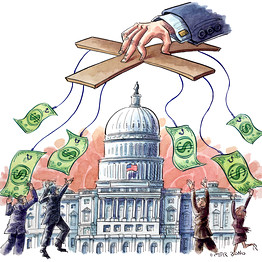
The implication is the same always proffered by the left–that government wastes its revenues on defense spending at the expense of social programs, and should reduce spending on defense and increase spending on social programs.

The argument, on its surface, is one that causes the good-hearted to stop and reflect. Certainly, we all want to assist those in dire circumstances, and as a society we have made a social pact to protect those who have fallen from a secure position in life. We seek to lift up the weak, and to champion the oppressed.

But is it true that we spend more on defense than on social uplift?

As we look at the question, we must first ask ourselves, what is the role of government? For instance, is it the duty of the San Francisco city government to provide aircraft carriers in the Pacific Ocean? We all know it is not. But why is it not? Because different levels of government have different duties to their citizens. With all levels of government working together to provide for the needs of their citizens, so the theory goes, all needs are covered.

So, starting at the top, what is the duty of the federal government to its citizens? The constitution mandates that the federal government be delegated certain duties by the states and their citizens, duties, like national military defense, that cannot be provided by state or local governments very well. Those duties, and powers to fulfill them, are limited by the constitution. These limited powers enable it to provide for the common defense, free the flow of commerce, coin money, establish weights and measures, provide for immigration, bankruptcies, postal services, patents and copyrights, declare wars, establish a Navy and Army, and to establish duties, imposts and excises to pay for the national government’s activities. That’s it.

So if the federal government has no constitutional delegation to provide schools, hospitals or firefighters, how do we get those? We get them from state and local governments. In fact, at the state and local level we find almost all “social uplift” programs. Do states, counties and cities have to provide social uplift programs? No. Do they choose to? Yes.

So how much money do all levels of government spend each year to pay for all levels of government and the services they provide? Here is what we will be spending in the next year:

Federal Gross Spending $3.8 trillion
Intergovernmental $-0.7 trillion
State Direct Spending $1.6 trillion
Local Direct Spending $1.7 trillion
Total Spending $6.4 trillion

Armed with this information we can now make some simple comparisons. For instance–How much is the defense budget? It is $830 billion, or $0.83 trillion. As anyone can see, defense is only 14% of total spending. But how does defense spending stack up to educational spending? In this same time frame we will spend approximately the same amount on each (see our article of June 11, 2012, NEA Report Card: F).

So if America spends around 14% of its annual taxes on defense, and a like amount on education, where does the remaining 72% go? It goes to healthcare ($1.1 trillion), welfare ($0.8 trillion), public employee pensions ($1.1 trillion), etc.

Those on the left have created a myth of government spending that they share among themselves that says that most taxes go to defense spending (which actually pays for the employment of millions of Americans), and social programs get the leftover crumbs. In fact, it is not true at all–it is quite the opposite.

All of those $ trillions are up for grabs to an array of government employee unions, special interests, and administration cronies and contributors, and are funding all manner of social and anti-social programs and movements. This is why Mitt Romney, noting that the federal government borrows 40% of its budget every year (to be paid by a future generation), indicated in the first presidential debate that government spending must be pared back to essentials until the economy returns to full employment.

With all of those fingers in the $6.4 trillion pie (which does not include unfunded obligations), it may be a little difficult for statesmen to serve the American people without offending a few hogs at the trough.

PUBLIUS

Filed Under: All Stories, Economy, Elections, Entitlement, Ethics

House Republican Plan Aims to Balance Budget in 10 Years, Without Tax Hikes

March 12, 2013 By Editor Leave a Comment

House Republicans unveiled an ambitious cost-cutting plan Tuesday that would balance the budget in 10 years without raising taxes, while repealing ObamaCare and overhauling entitlements — a document Democrats are sure to reject but could be used as a negotiating tool in talks with President Obama.

paul_ryanRep. Paul Ryan, R-Wis., chairman of the House Budget Committee, is sticking by controversial proposals, including one to give future Medicare retirees the option of using government payments for private health care plans.

The plan warns of a looming debt crisis, and endeavors to pay off the debt by 2050.

“It’s not too late,” the plan says. “This budget provides an exit ramp from the current mess.”

Democrats preemptively panned Ryan’s spending plan, with House Democratic Whip Steny Hoyer, D-Md., saying it relies on “spurious budget trickery.”

“His past budgets have included lofty rhetoric about deficit savings, but very few actual details of how those savings are found,” Hoyer said in an op-ed in Politico.

Senate Democrats promise to offer a counterproposal on Wednesday with higher spending on domestic programs and additional tax hikes on top of the higher rates imposed on top-bracket earners in January. It will, in turn, arrive as a dead letter in the GOP-controlled House.

But this year’s dueling GOP and Democratic budget proposals are more about defining political differences than submitting a plan that can pass Congress unchanged.

The exercise comes even as President Obama was to travel to Capitol Hill on Tuesday to meet with Senate Democrats in an attempt to resuscitate his failed efforts for bipartisanship.

Ryan, who became a national GOP figure as the losing vice presidential nominee last year, has for now settled back into his wonkish role as Budget Committee chairman and chief tutor for dozens of relatively junior Republicans. His budget helps to undergird Republican claims that the government does not need to raise taxes in order to bring down the deficit.

The plan would achieve $4.6 trillion in deficit reduction over 10 years. It also aims to simplify the tax code, consolidating the seven income-tax brackets into two, with a top rate of 25 percent.

“We’re introducing a budget that balances in 10 years — without raising taxes,” Ryan said in an op-ed in The Wall Street Journal. “How do we do it? We stop spending money the government doesn’t have.” All told, Ryan’s plan would slash $4.6 trillion in spending over the coming decade.

“On the current path, we’ll spend $46 trillion over the next 10 years. Under our proposal, we’ll spend $41 trillion,” Ryan said. “On the current path, spending will increase by 5 percent each year. Under our proposal, it will increase by 3.4 percent.”

The plan calls for a 10 percent reduction in the federal workforce by 2015, as well as changes to give states more flexibility on Medicaid, the health care program for low-income Americans. It would also repeal the federal health care overhaul, particularly targeting the expansion of Medicaid and government subsidies meant to help millions buy private insurance.

The House Budget Committee has scheduled a vote on the soon-to-be-released measure Wednesday, and the Senate Budget panel is slated to vote Thursday on rival legislation by new Budget Committee Chairwoman Patty Murray, D-Wash., who promises new tax revenues but few cuts from domestic programs like Medicare and Medicaid.

“We are working toward fair and balanced, which is what the American public has said time and time again that they want,” Murray said. “We need to make sure that everybody participates in getting us to a budget that deals with our debt and our deficit responsibly.”

For his part, Ryan has resurrected a controversial Medicare proposal that replaces traditional Medicare for those currently under 55 with a government subsidy to buy health insurance on the open market. Critics of the plan say the subsidies won’t grow with inflation fast enough and would shove thousands of dollars in higher premiums onto seniors before very long.

The House GOP plan again proposes sharp cuts to Medicaid, tighter food stamp eligibility rules and more than $1 trillion in savings over a decade by repealing Obama’s signature overhaul of the U.S. health care system. It seeks to preserve the Pentagon budget, but only at the expense of proposing domestic agency budgets that may prove too low for GOP moderates and the pragmatists atop the Appropriations Committee responsible for guiding them into law.

Even as it proposes repealing ObamaCare, the Ryan plan banks more than $700 billion in the health care law’s cuts to Medicare providers over a decade — just as more than $600 billion in tax hikes on the wealthy enacted in January make it easier for Ryan’s budget to predict balance.

At the White House, Press Secretary Jay Carney was asked about Obama’s failure to submit a budget on time.

“The president has always believed that deficit reduction is not a goal unto itself,” Carney said. “The proposals he’s put forward keep the No. 1 objective in mind, which is economic growth and job creation, not deficit reduction solely for the purpose of reducing the deficit.”

As the two sides battle over future-year budgets, top Senate Democrats and Republicans late Monday released a catchall government funding bill for the ongoing fiscal year that denies Obama new money for implementing signature first-term accomplishments like new regulations on Wall Street and his expansion of government health care subsidies, but provides modest additional funding for domestic priorities like health research and highway projects.

Monday’s measure was the product of bipartisan negotiations and is the legislative vehicle to fund the day-to-day operations of government through Sept. 30 — and prevent a government shutdown when current funding runs out March 27.

It sets a path for government after across-the-board spending cuts that took effect March 1. In most cases the minor changes in agency budgets amount to housekeeping within a trillion-dollar cap for the day-to-day operations of agencies in the current budget year.

Passage in the Senate this week seems routine and could presage an end to a mostly overlooked battle between House Republicans and Obama and his Senate Democratic allies over the annual spending bills required to fund federal agency operations.

Published March 12, 2013  FoxNews.com

The Associated Press contributed to this report.

Filed Under: All Stories, Economy, Elections, Entitlement, Ethics

Leaked email adds fuel to claims White House playing politics over impact of cuts

March 6, 2013 By Editor Leave a Comment

Reprinted from Foxnews.com, March 06, 2013.

A leaked email from an Agriculture Department field officer adds fuel to claims President Obama’s political strategy is to make the billions in recent federal budget cuts as painful as possible to win the public opinion battle against Republicans.

obama_closeupThe email, circulated around Capitol Hill, was sent Monday by Charles Brown, a director at the agency’s Animal and Plant Health Inspection Service office in Raleigh, N.C. He appears to tell his regional team about a response to his recent question on the amount of latitude he has in making cuts.

According to the partially redacted email, the response came from the Agriculture Department’s budget office and in part states: “However you manage that reduction, you need to make sure you are not contradicting what we said the impact would be.”
The response noted that the administration had already told Congress that the APHIS would “eliminate assistance to producers in 24 states in managing wildlife damage to the aquaculture industry” without additional funds.

Arkansas Republican Rep. Tim Griffin said the administration’s response to Brown’s email shows a bid to undermine efforts to replace the cuts, known as sequester, with less onerous ones.

“This email confirms what many Americans have suspected: The Obama administration is doing everything they can to make sure their worst predictions come true and to maximize the pain of the sequester cuts for political gain,” Griffin said in a statement.

Griffin told Fox News on Wednesday that the bosses effectively said “you can’t do anything that is inconsistent with the negative impact that we’ve told everybody these cuts are going to have.”

Under the 2011 deal reached by Obama and Congress, the cuts are supposed to be across the board, meaning government officials have limited flexibility in moving around money.

The administration in recent weeks has made doomsday predictions about the impact of the cuts. And the White House so far has appeared unwilling to accept a Republican offer to give the president more autonomy in making the cuts, covering $85 billion this fiscal year, to help reduce the impact on some of the most essential or hardest-hit programs or agencies.

Some political strategists say the president hopes the cuts hurt enough to compel Republican lawmakers seeking re-election next year to end them by agreeing to more tax increases.

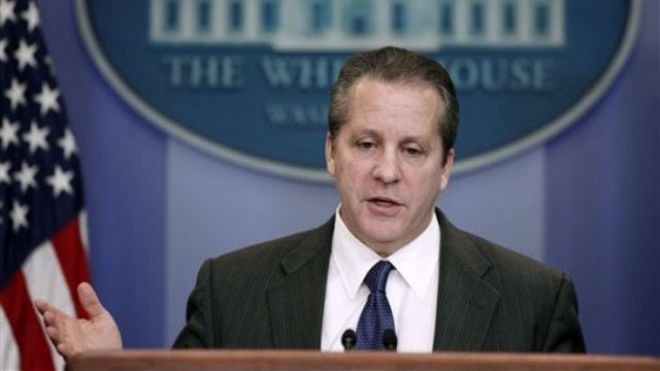
On Sunday, Gene Sperling, the White House’s top economic adviser, suggested Republicans would indeed make this decision.

“Our hope is, as more Republicans start to see this pain in their own districts, they will choose bipartisan compromise over this absolutist position,” he said.

Agriculture Secretary Tom Vilsack, during a House hearing Tuesday, was asked by South Dakota Republican Rep. Kristi Noem about the Brown e-mail.

Vilsack said he was unaware of the email but denied the administration has a policy of being inflexible and maximizing the cuts’ impact.

“I wouldn’t say that we’ve said no to flexibility,” Vilsack said. “But there are certain circumstances where we don’t have flexibility.”

“I’m hopeful that isn’t an agenda that has been put forward,” Noem said.

Filed Under: All Stories, Economy, Elections, Entitlement, Ethics

White House retreats from doomsday spending cuts predictions, but keeps blame on Republicans

March 4, 2013 By Editor Leave a Comment

Reprinted March 03, 2013 from FoxNews.com

The White House is retreating from its doomsday predictions about the impact of the $85 billion in federal spending cuts as they enter a second week — with Republican leaders appearing at least satisfied about delivering on their promise to limit government spending and hold down taxes.

sperling_geneGene Sperling, the White House’s top economic adviser, repeatedly said Sunday the cuts will not hurt as much on “Day One” as they will over the long haul.

“Nobody ever suggested that this … was going to have all its impact in the first few days,” he told “NBC’s “Meet the Press.” “It is a slow grind.”

His remarks are in contrast to weeks of President Obama and his Cabinet warning that the cuts will result in furloughs or pay cuts for middle-class wage-earners such as teachers, Capitol Hill janitors and air traffic controllers, which they said could cause 90-minute delays at major U.S. airports.

Sperling declined at least twice to directly answer questions about whether the worst-case-scenario rhetoric has hurt the president’s credibility on the issue. He instead stuck to his argument that independent economists forecast the cuts will result in 750,000 fewer jobs and that corporate executives now anticipate slower economic growth.

Senate Republican Leader Mitch McConnell told CNN’s “State of the Union” Americans absorbed similar cuts once already this year.

“This modest reduction of 2.4 percent in spending over the next six months is a little more than the average American experienced just two months ago, when their own pay went down when the payroll tax holiday expired,” the Kentucky Republican said.

Congress agreed to the cuts, known as sequester, in 2011 after failing to agree on more measure reductions — to defense and some domestic spending. However, the cuts were intended to be so drastic that Democrats and Republicans would be forced to compromise before they started.

Still, Sperling rejected several Republican-backed plans and said no compromise would be reached unless the party agrees to tax increases.

Sen. Kelly Ayotte, R-N.H., responded by saying Congress agreed to such increases in January “at the president’s request” and questioned why Obama and other Democrats will not agree to additional spending cuts.

She argued for potential pay freezes for federal employees and reforms to the federal food stamps program.

“There’s a whole host of ideas to cut spending” without jeopardizing security, Ayotte said on ABC’s “This Week.”

However, she also said she would consider tax reform that comes with entitlement reforms. But she would not agree to revenue increases to pay for additional government spending.

Earlier on the show, Sperling said Republican strategy is flawed because the cuts will take resources from several of the party’s most valued positions — including national defense and border security.

“This is not a win for Republicans,” Sperling said. “This cuts into military preparedness.”

He hinted Sunday at Democrats’ likely strategy for retaking the House in 2014.

“Our hope is as more Republicans start to see this pain in their own districts, they will choose bipartisan compromise over this absolutist position,” he said.

Sperling also dismissed a plan backed by at least some Republicans to give the president some flexibility in the cuts.

“It’s like saying you have to cut off three of your fingers but you can choose which ones,” he said.

Sperling also addressed an email sent to Bob Woodward in which he said The Washington Post reporter might “regret” writing a story that said Obama has “moved the goal posts” on sequester.

He told ABC that he and Woodward share a mutual respect and he hopes they can “put this behind us.”

Sen. Lindsey Graham, R-S.C., told CBS’ “Face the Nation” that any tax increases were unacceptable.

“I’m not going to do any more small deals,” he said. “I’m not going to raise taxes to fix sequestration. We don’t need to raise taxes to fund the government.”

All of this comes ahead of a new, March 27 deadline that could spell a government shutdown and a debt-ceiling clash coming in May.

House Speaker John Boehner said his chamber would move this week to pass a measure to keep government open through Sept. 30.

McConnell said a government shutdown was unlikely to come from his side of Capitol Hill. The White House said it would dodge the shutdown and roll back the cuts, which hit domestic and defense spending in equal share.

Sperling said the White House is committed to trying to find a way that Republicans and Democrats can reach a compromise.

The billions in cuts apply to the remainder of fiscal 2013, which ends Sept. 30. But without a deal they will continue slashing government spending by about $1 trillion more over a 10-year period.

Filed Under: All Stories, Economy, Elections, Entitlement, Ethics

Woodward blasts Obama “madness” in handling cuts

March 4, 2013 By Editor Leave a Comment

By Susan Heavey, WASHINGTON | Reprinted from Reuters

Journalist Bob Woodward on Wednesday criticized Barack Obama’s handling of the automatic U.S. budget cuts set to take effect this week, calling the president’s decision to hold back on military deployments “madness.”

arrogance_obamaHis comments continued what has become a running dispute between Woodward, perhaps the country’s best-known print journalist, and the Democratic White House over who is responsible for the across-the-board cuts scheduled to begin on Friday.

Last week, Woodward published an opinion piece in the Washington Post – where he is an associate editor – saying the administration was “wrong” to blame the cuts on Republicans.

That drew retorts from White House press secretary Jay Carney, who in posts on Twitter and later in comments to reporters blamed the budget stalemate on Republican opposition to including increased revenues in any deal to replace the cuts.

The $85 billion across-the-board budget cuts were mandated by Congress and the White House as part of the August 2011 deal to avoid a government default. The reductions are split between defense spending and domestic programs.

Woodward, who first gained fame in the 1970s from exposing the Watergate scandal during the administration of President Richard Nixon, wrote a detailed account in his 2012 book, “The Price of Politics,” of the August 2011 deal that led to the cuts.

On Wednesday he attacked Obama for drawing national security into the budget debate.

“So we now have the president going out (saying) ‘Because of this piece of paper and this agreement, I can’t do what I need to do to protect the country.’ That’s a kind of madness that I haven’t seen in a long time,” Woodward told MSNBC on Wednesday.

On Tuesday, Obama warned of threats to Navy readiness in a visit to the Newport News Shipbuilding shipyard in Virginia, where maintenance to the aircraft carrier USS Abraham Lincoln has been delayed by the budget crisis.

Earlier this month, the Pentagon said it was delaying deployment of another carrier, the USS Harry Truman, to the Middle East because of funding.

Obama’s decision to drag the military into the budget fight likely would not have happened in previous administrations, Republican or Democratic, Woodward added on MSNBC’s “Morning Joe” program.

(Reporting by Susan Heavey; Editing by Fred Barbash and Eric Beech)

Filed Under: All Stories, Economy, Elections, Entitlement, Ethics

Bob Woodward: Obama’s sequester deal-changer

March 2, 2013 By Editor Leave a Comment

Reprinted from The Washington Post: Bob Woodward (woodwardb@washpost.com) is an associate editor of The Post. His latest book is “The Price of Politics.” Evelyn M. Duffy contributed to this column.

Misunderstanding, misstatements and all the classic contortions of partisan message management surround the sequester, the term for the $85 billion in ugly and largely irrational federal spending cuts set by law to begin Friday.

What is the non-budget wonk to make of this? Who is responsible? What really happened?

The finger-pointing began during the third presidential debate last fall, on Oct. 22, when President Obama blamed Congress. “The sequester is not something that I’ve proposed,” Obama said. “It is something that Congress has proposed.”The White House chief of staff at the time, Jack Lew, who had been budget director during the negotiations that set up the sequester in 2011, backed up the president two days later.“There was an insistence on the part of Republicans in Congress for there to be some automatic trigger,” Lew said while campaigning in Florida. It “was very much rooted in the Republican congressional insistence that there be an automatic measure.”

The president and Lew had this wrong. My extensive reporting for my book “The Price of Politics” shows that the automatic spending cuts were initiated by the White House and were the brainchild of Lew and White House congressional relations chief Rob Nabors — probably the foremost experts on budget issues in the senior ranks of the federal government.

Obama personally approved of the plan for Lew and Nabors to propose the sequester to Senate Majority Leader Harry Reid (D-Nev.). They did so at 2:30 p.m. July 27, 2011, according to interviews with two senior White House aides who were directly involved.

Nabors has told others that they checked with the president before going to see Reid. A mandatory sequester was the only action-forcing mechanism they could devise. Nabors has said, “We didn’t actually think it would be that hard to convince them” — Reid and the Republicans — to adopt the sequester. “It really was the only thing we had. There was not a lot of other options left on the table.”

A majority of Republicans did vote for the Budget Control Act that summer, which included the sequester. Key Republican staffers said they didn’t even initially know what a sequester was — because the concept stemmed from the budget wars of the 1980s, when they were not in government.

At the Feb. 13 Senate Finance Committee hearing on Lew’s nomination to become Treasury secretary, Sen. Richard Burr (R-N.C.) asked Lew about the account in my book: “Woodward credits you with originating the plan for sequestration. Was he right or wrong?”

“It’s a little more complicated than that,” Lew responded, “and even in his account, it was a little more complicated than that. We were in a negotiation where the failure would have meant the default of the government of the United States.”

“Did you make the suggestion?” Burr asked.

“Well, what I did was said that with all other options closed, we needed to look for an option where we could agree on how to resolve our differences. And we went back to the 1984 plan that Senator [Phil] Gramm and Senator [Warren] Rudman worked on and said that that would be a basis for having a consequence that would be so unacceptable to everyone that we would be able to get action.”


Filed Under: All Stories, Economy, Elections, Entitlement

Who’s to blame for sequestration frustration?

March 2, 2013 By Editor Leave a Comment

Reprinted from Your World, Neil Cavuto

It’s not me. It’s the GOP.

The president laying the blame for this sequestration frustration, on Republicans blocking everything in creation.

They allowed these cuts to happen, not him, who did everything in his power not to let them happen.

obama_blame_gameThey’re stubborn for not wanting tax hikes, because they’ve already given in on taxes in a prior deal. He’s not stubborn for suddenly wanting to include tax hikes, even though Bob Woodward confirms, they weren’t supposed to be part of this deal.

Republicans are playing games by always bringing these things to the brink. But he’s not by holding a hastily arranged PR meeting with them at the White House on the day we hit the brink.

They’re playing to the press when they all but call the meeting kabuki theater. He’s not when he talks to the press right afterwards to insist a meeting that lasted mere minutes wasn’t kabuki theater.

Look, I understand, each side is entitled to its agenda. But neither side is entitled to its own set of facts. Because the fact is Republicans didn’t come up with sequestration as a back-up plan. The president did. And the fact is Republicans didn’t scare the nation into thinking we’d all be eating horsemeat because beef inspectors would start disappearing. The president did. Even though he knew beef inspectors would not start disappearing.

It just amazes me to hear the president today joke about others who say an apocalypse will come, when he was the guy who all but said the apocalypse was here.

If memory serves me right wasn’t the president the one who said our airport security was hanging in the balance?

Wasn’t he the one who stood in front of firemen and policemen, whose jobs he said were at stake, even though they aren’t paid by the federal government, so they can’t be at stake?

Wasn’t his education secretary the guy who had to take back that, tens of thousands of teachers’ jobs lost line?

And his homeland security secretary the one who said our border security was on the line?

Over the line. Over the top.

It takes two to tango.

I’m just saying, would it kill the media to at least try to be fair? If you’re going to call Republicans intransigent because they only want spending cuts, why is the other side not because they only want tax hikes?

And if you’re going to say republicans won’t compromise, even though they already did on taxes, would it kill you to say the same of Democrats, who have yet to budge on spending?

Leaving aside 85 billion in cuts in a $3.8 trillion budget is chicken feed, hearing this lopsided, one-sided, hopelessly blind-sided approach to facts that is just chicken… fit.

Filed Under: All Stories, Economy, Elections, Entitlement

Repeal the 17th Amendment!

March 1, 2013 By Editor Leave a Comment

It made the Senate more democratic — and that’s not good.

By Charles C.W. Cooke, Reprinted from National Review Online

In our grubby, unhelpful political lexicon, certain words exist solely to end conversations. The most prominent such word is “racist.” Less popular, but by no means less potent, are “democracy” and “rights.” When welded together as “democratic rights,” the pair becomes all-powerful — strong enough to send grown men spinning for the exits and to render eloquent speakers mute.

SenateFor a good example of this principle in motion, witness the orthodox reaction to anyone who calls for the repeal of the 17th Amendment. (Direct election of senators, if you’re wondering.) Removing this ugly violation from the Constitution it so corrupts is an idea that has long lingered on the fringe (there’s another of those conversation-terminating words) and, until the massive expansion of federal power that marked the past decade and woke up the sleeping libertarians, it seemed destined to remain there in perpetuity. Even now, to declare in public that you think the whole of 1913 was one long, ghastly mistake is to be looked at as if you have just announced that the United States should consider restoring the British monarchy.

Providing what may be the Platonic ideal of such dismissals, Salon’s Alex Seitz-Wald reacted to the renewed interest by declaring in 2012 that, because any increase of democracy was “unquestionably positive,” any modifications were tantamount to “doing away with rights.” America, “we’re told from a young age, is all about democracy,” Seitz-Wald wrote, “and democracy is all about choosing whom you want to be your representative and holding them accountable.” This, he added, “seems like an entirely uncontroversial idea.” I cannot account for Mr. Seitz-Wald’s grasp of America’s history, beyond saying that if he has indeed been told “from a young age” that America is “all about democracy,” then he must be forgiven for believing it. Still, whatever his schools might have told him, the United States is not in fact a democracy but a constitutional republic, and her virtues lie as much in her undemocratic institutions as in her ample provisions for self-rule — more, perhaps.

Doubt it? Look around. Despite the violence that the 17th Amendment did to it, the Senate remains a partially anti-democratic institution; the Supreme Court is an entirely undemocratic institution; the Constitution is undemocratic, too, requiring for any changes to its structure the consent of a supermajority and containing the Bill of Rights, which is as elevated and explicitly counter-majoritarian a component of national law as you will find. The strong American protections of free speech, freedom of religion, the right to bear arms, due process, privacy, and the right to a jury trial are triumphs of minority rights. How about the absence of a state church? Not for nothing did Patrick Henry cry ardently for “liberty or death.” It is liberty, not democracy, that is America’s highest ideal.

Walter Lippmann famously observed that, at some point in their history, “the American people came to believe that their Constitution was a democratic instrument, and treated it as such.” The New York Times’ David Firestone appears to be one of these American people, arguing as he did in 2010 that “a modern appreciation of democracy” makes the idea of directly electing senators “so obvious” that any proposal of change is “unthinkable.” Putting to one side for now the narrow procedural majoritarianism inherent in his definition, Firestone’s thesis runs into two problems: America is not “modern” and it is not a “democracy.” Perish the thought.

Instead, the American system was deliberately designed to balance power between the various branches of government and to guarantee individual rights against majority rule, thus protecting the people from tyranny whether they liked it or not. The United States government was arranged in this way as a permanent bulwark against federal encroachment. “Changing times” was no more a strong justification for the undoing of this system in 1913 than it is now. And whatever the Wilson-era progressives might have held, the federal government was not intended to be a wholly separated layer of government. Instead, it was to be intertwined with the states to such an extent that it could not ride roughshod over their interests without pushback. As James Madison resolved during the debate over the Bill of Rights:

The state legislatures will jealously and closely watch the operations of this Government, and be able to resist with more effect every assumption of power, than any other power on earth can do; and the greatest opponents to a Federal government admit the State Legislatures to be sure guardians of the people’s liberty.

It is exactly here that America’s democracy fetishists go wrong. As Madison makes clear in the Federalist Papers, in order to defend the vertical checks and balances that allow America’s federal system to function, senators would be “elected absolutely and exclusively by state legislatures.” The Senate was not intended to be the people’s representative body, but that of the states. Lest the federal government “swallow up the state legislatures,” George Mason insisted to his fellow convention delegates in Philadelphia, “let the state legislatures appoint the Senate.” The delegates backed him unanimously.

It makes no more sense to argue that to return to this original arrangement would be to “take away” the “rights” of the people than it does to maintain that not being able to vote directly for Supreme Court justices violates their democracy. Everything has its place, and indulging popular sovereignty is simply not what the Senate was designed to do. One could sometimes be forgiven for thinking otherwise, but the states are not regional departments of the federal government. To ensure that they had a working mechanism by which to resist the expansion of federal power, the architects of our Constitution hard-wired the state legislatures into its structure; with the 17th Amendment, progressives pulled out that wiring like punch-drunk Jacobins.

Has there ever been a time when America was more in need of the states’ being represented in Washington? “The People” have their representatives in the House. The nation has its leader in the White House. What of the states? Andrew Napolitano has it right: The 17th Amendment, he gripes, “effectively just gave us another house like the House of Representatives . . . and the states lost their place at the federal table.” This is problematic because, to their great discredit, The People seem not greatly to care how power is structured. Who then is surprised that the abolition of the Senate as the supporting wall of federalism has led inexorably to, as Jefferson warned just before his death, “all government, domestic and foreign, in little as in great things,” being “drawn to Washington as the center of all power”? Returning the selection of senators to state legislatures would help to focus citizens’ eyes locally, where they belong.

“Democracy” may be the cry now. But as Alex Seitz-Wald goes on to acknowledge in his dissent, the primary argument in favor of the 17th Amendment was that it might serve to cut out corruption. Money was said to be rife in politics; direct elections would stamp it out. Lobbying by big business was staining the republic; direct elections would cut the buggers off at the knee. The small constituency that a senator served effectively gave him tenure; an amendment would make the body competitive. Bad behavior among senators was rife; the rigors of direct election would make them moral. And how are things now that the scalpel has been taken to Madison’s handiwork? There is more money in politics than ever before; direct elections have served only to cut out the middleman between lobbyists and politicians; senators rarely lose their seats; and Ted Kennedy killed a woman and got away with it.

In a brilliant Humanitas essay from 1996, C. H. Hoebeke rendered this judgment:

In retrospect, the amendment failed to accomplish what was expected of it, and in most cases failed dismally. Exorbitant expenditures, alliances with well-financed lobby groups, and electioneering sleights-of-hand have continued to characterize Senate campaigns long after the constitutional nostrum was implemented. In fact, such tendencies have grown increasingly problematic.

Americans purchased this dismal failure at the cost of their federal system’s integrity. Like the other two Progressive Era amendments that sit either side, the 17th is a testament to hubris — a parchment admonition of those who would tinker with the permanent in the name of the temporary. Nonetheless, it benefits those who would be required to amend it, which, alas, is a recipe for eternal life in Washington. Repeal is thus almost certainly a dead end; interest in such things is limited. And so the federal titan lumbers on, the states shrinking inexorably in stature. One cheer for democracy, Mr. Wilson.

— Charles C. W. Cooke is an editorial associate at National Review.

Filed Under: All Stories, Economy, Elections, Entitlement, Ethics

The “Mormon Effect”

February 22, 2013 By Editor 345 Comments

During the 2012 presidential campaign, that awesomely deep well of perpetual wisdom, Alec Baldwin, proclaimed that if Barack Obama were not black, his vote total would have been 20 percent higher.

mormon_templePeople of real intelligence realize that the opposite was probably true: if he had been white, his vote total would have been 20 percent lower. The African-American voting bloc combined with enough whites suffering from liberal guilt guaranteed a higher vote total for Obama.

The truth of the matter is, if Mitt Romney had not been a Mormon, his vote total might very well have been significantly higher.
In fact, according to a Gallop poll released in June of last year, while 4 percent of people said they would not vote for a black president, a full 22 percent said they would not vote for a Mormon. In fact, only atheists and gays ranked higher.

So Baldwin probably had it backwards, which he usually does, so that comes as no surprise.

What did come as a surprise to me is why people would have such negative views of Mormons. I have known lots of them in my life, and in most cases they have been hard-working, kind, generous family-oriented people—just the kind of people this country used to value (and maybe that’s the problem right there.)

Mormons have intrigued me ever since Mike Huckabee back in 2007 claimed that Mormons believe that Jesus and Satan are brothers. With the recent election over, I decided to check out Mormons a bit more.

My hope in doing this was to explain to readers who Mormons are and whether or not 22 percent of the people were justified in opposing having a Mormon president.

But instead I’m going to share an intriguing bit of Mormon theology I learned that I think makes them perhaps the most politically wise human beings on the planet. Ironically, this story stems from that Huckabee quote about the relationship between Jesus and the devil, but the lesson to be learned is one that, regardless of our political or religious views, we would all be wise to consider.

So here’s what I learned: Mormons, unlike most other Christian sects, believe that all humans lived a life before mortality. They call this the pre-existence or pre-earth life. At birth a veil is placed over our minds so that we don’t remember it (you’ll see why in a minute).

In this pre-earth life, we were all in the presence of God as His spirit children. Jesus was there—the first-born of God’s spirit children, and a leader in the councils in Heaven. Lucifer was also there, and was another leader among the children of God. He was called a “son of the morning.”

At some point in this existence, the Father called all of His children together to explain how things worked. All of His children would have to leave His presence and come to earth for a period of testing. The goal was to see if we would live a righteous life even when we had to live by faith, as we would no longer be able to remember God or heaven (that’s the reason for the veil).

If we would live a righteous life, we would be given the opportunity to return and live with God forever. Otherwise we would forfeit that chance, because no unclean thing can live in God’s presence. However, God knew that we would all make mistakes, so he would provide a Savior for the world. This Savior would live a sinless life, and because of that, he would qualify to pay for the sins of the world through what would be called the “Atonement.” If people would sincerely repent of their sins, then the Atonement would essentially erase their sins, and they could still return and live with God. The Father called for volunteers to be this savior, and two stepped forward: Jesus and Lucifer.

mormon_conferenceLucifer said that he would be the savior and he would force everybody to live righteously, thus guaranteeing that all of God’s spirit children would return to Him in heaven [and he, Lucifer would receive all the credit/glory]. Jesus said that He would follow the Father’s plan and allow God’s children their free agency [and all the glory would go to God]. They could choose for themselves whether to live righteously and take advantage of the Atonement or whether to live in sin and forfeit the opportunity to return and live with God.

God rejected Lucifer’s plan, causing Lucifer to rebel and declare war on God. One-third of God’s spirit children joined Lucifer in this rebellion. In the end, the rebellion failed and Lucifer and his followers were cast out of heaven. They came to earth without bodies and now, continuing the war they started in heaven, they tempt men to do evil to one another and lose out on the chance to return to God. [Luke 10:18; Revelation 12:9; Isaiah 14:12]

PAY ATTENTION HERE; THIS IS THE GOOD PART

Now, any traditional Christians reading this will see similarities to their own belief system. Most traditional Christians believe that Lucifer lived in heaven as an angel, but then declared war on God and was cast out. However, the causes for that war are not necessarily clear in traditional Christian theology.

That is where Mormon theology is so intriguing. For Mormons, the greatest of all battles, the war in heaven, was fought over LIBERTY—or as they call it, “free agency.”Lucifer wanted to take it away, while God demanded that humans have it.

Although a Mormon might balk at my making comparisons between their religious beliefs and modern politics (and as I said earlier, every Mormon I’ve ever known was a very good person, so I apologize to any I offend), I see a direct correlation here. For a Mormon, the battle for liberty is not unique to this life; it is the core battle of the ages. Lucifer lost the war in heaven (he really thought he could beat God?), but the war continues on earth. So seeing the government become more and more tyrannical is not just a political concern; it’s a fundamental, eternal concern.

I’m inspired by this Mormon theological idea: God intended for humans to be free to make our own choices and live with the consequences of those choices. The Founding Fathers of this country said essentially the same thing in the Declaration of Independence:
We hold these truths to be self-evidence, that all men are created equal, that they are endowed by their creator with certain unalienable Rights, that among these are Life, Liberty and the pursuit of Happiness.

My study of Mormonism has not only given me newfound respect for this people and their religion; it has also made me evaluate my own attitude towards the liberty that seems to be slipping through all of our fingers. Is this just something that is nice to have, and for which I thank the Founding Fathers? Or is it really something that is endowed by God, and that He expects me to fight for. According to Mormon theology, I already fought for this once. The fact that I’m here says that I was on God’s side in the war in heaven, and fought for liberty.

A Mormon might ask, why should any of us be less willing to fight for it here than we were there?

Reprinted from “SMART MORMONS,” By Mike Jensen, January 22, 2013

Readers of this story also find the following stories interesting:

This Easter Morning, Remember

What ‘NOAH’ Movie Gets Wrong, and Right

Christians: Marked For Extinction?

Harry Reid: Worst Human On Earth

British Court Dismisses Case Against LDS Church President

The Tree of Liberty is Dying—Is Civil War Coming?

Is Obama Targeting LDS Canneries?

Mormons and Progressivism: United Order vs. Socialism

The Spirit of Antichrist Permeates Our Nation

AdvertisementsNoah_Enoch_Flood_Ad2

 Let Scottsdale Multimedia write your book. The nation’s premier ghostwriters.>>

Filed Under: All Stories, Economy, Elections, Entitlement, Ethics, Foreign, Gender, Religion

GOP Betrays American People

January 2, 2013 By Editor Leave a Comment

GOP-HouseAt a time when the American people can no longer afford politics as usual, and re-elected a GOP majority in the House to protect them from socialistic tax increases, the GOP led House has caved on a Senate bill that substantially raises taxes on many Americans.

As has been pointed out many times from all quarters, the taxpayers affected are those the country looks to to create more jobs in an economy with real unemployment over 15 percent. These tax hikes are coupled with the incoming Obamacare tax, which is already slated to close many businesses and put millions of additional Americans out of work.

The Republican majority in the House had no reason to go along with these Democrat tax hikes. Without their approval and support, the president and senate have absolutely no authority to raise taxes, or to even spend any money. (See our article GOP House Has Power To Wag The Dog, November 8, 2012).

The GOP controlled House only had to stand firm, and send a single bill to the Democrats; a bill that reduced taxes and reduced spending. In response the Senate and White House would have had no choice but to go along with the bill, because there would have been no money appropriated for running the government without it.  It would have been noisy, yes, but it would have forced the government into a responsible approach to a failing economy.

Instead of exercising strength, the mushy, jelly-bellied slugs in the House decided to go along to get along.

The nation is sliding quickly into a pit of quicksand, and every branch of our national government is pushing it down that hill as fast as it can.

PUBLIUS

Filed Under: All Stories, Economy, Entitlement, Ethics

Should GOP Rethink Abortion Policy?

November 29, 2012 By Editor Leave a Comment

Following one of the worst performances for an American president in this nation’s history, Americans awarded Barack Obama a second term. What was the pitch from the far left that got him re-elected following four years of economic upheaval and government socialization of the medical industry?

The winning formula was 1) convincing voters that an honest business genius who had turned around the failing Olympics and the State of Massachusetts in short terms and had served his fellow humans all his life without fanfare or recognition was a greedy and uncaring monster to be avoided at all costs; 2) that the government should be the only source of one’s hope for prosperity and happiness; and 3) that government supplied birth-control and abortion-on-demand are the only rights worth preserving.

There has been much armchair quarterbacking post-election, and we hear of many in the GOP wringing their hands as they contemplate a strategy to again gain the White House and Senate. Proposals such as caving in on tax increases, ala George “Read My Lips” Bush are bandied about. Or winning strategies like “go along to get along” are being trumpeted by the party’s old guard.

The Federalist Press suggests that the GOP consider adopting a democratic party long-term strategy. Indeed, democrats have exercised control of American government for much of the past 100 years by long-term planning—which became necessary following the beating they took in the Civil War and post-war reconstruction, as republicans freed the slaves and passed and enforced the civil rights amendments.

Democrats have had 4 simple strategies for reacquiring power. 1) Class warfare, promulgated by taxing citizens at different rates—taking from some and giving to others. 2) Spending escalation, making the government the provider of goodies. 3) Create dependent underclass by impoverishing minorities and opening borders, making over ½ of voters dependent on government handouts. 4) Re-educating population through leftist takeover of media and education systems, to believe that socialism is the fairest system of government.

It’s that simple. So, can the GOP learn anything from the left?  Perhaps, but these tactics are naturally repugnant to those who espouse personal liberty, so it is doubtful.

What is in the abortion issue that could help the GOP, if as polls indicate, it is minorities who are voting in extremely high percentages for Democrats? Let’s revisit the founding of the birth control and abortion movement, and see what is behind it.

Planned Parenthood was founded by Margaret Sanger, and like-minded racists, like Dr. S. Adolphus Knopf and Lothrop Stoddard, a Harvard graduate and the author of The Rising Tide of Color against White Supremacy. Margaret Sanger was an ardent proponent of sterilizing those she considered “unfit,” which would be the “salvation of American civilization.” Who was unfit? Those of African descent.

Margaret Sanger and her followers were the regents of Western Eugenics, the practice of improving the human gene pool by eliminating undesirable DNA. She and her associates admired the Aryan dreams of the Nationalist Socialists (Nazis) in Germany, and like their counterparts, thought that exterminating lower life forms (Jews, Blacks) was a service to God and country. For those who might doubt that the founder of Planned Parenthood held these beliefs, please refer to some of her many articles and speeches on the subject such as “Some Moral Aspects of Eugenics” (June 1920), “The Eugenic Conscience” (February 1921), “The purpose of Eugenics” (December 1924), “Birth Control and Positive Eugenics” (July 1925), “Birth Control: The True Eugenics” (August 1928), and many others.

Indeed, as a direct result of the Sanger movement, even today, American black children suffer death by the millions at the hands of abortionists. Planned Parenthood is the largest abortion provider in America, with 78% of their clinics in minority communities. Although blacks make up only 12% of the population, 35% of all the abortions in America are black babies.

So when it comes to the political parties’ struggle for dominance in America, where should the parties come down on the abortion issue? With Democrats clamoring for dependent minority voters, they should be the ones who immediately outlaw the practice of murdering minority babies.  They would have at least 13,000,000 more black voters on the rolls if they had not killed them all.

Where does that leave the GOP on the abortion issue? Should they embrace the practice of killing minority babies to purify the voting gene pool?

That’s right America. This is who we’ve become. Embrace the left.

PUBLIUS

Filed Under: All Stories, Economy, Elections, Entitlement, Ethics, Gender, Religion

GOP House Has Power to Wag The Dog

November 8, 2012 By Editor Leave a Comment

With the 2012 elections in the  books, the result is that there has been no change in the makeup of America’s government. The Democrats won major advances in 2008, but were rebuked in the 2010 elections with the loss of the House of Representatives. The status quo prevails.

As we leave the 2012 elections behind us and look forward to the next 4 years of governance, our state of the nation is extremely precarious, as we head for the brink of a deadly fiscal cliff. At the end of next month the Bush era tax cuts expire, and as everyone’s tax rates return to previous levels, the economy is slated to lose nearly a million more jobs and personal income, which has suffered a $4,000 annual decrease since Obama took office, will decline further, plunging the economy into a stinging recession.

The second Obama era fiscal cliff which is fast approaching are the automatic cuts to the budget enacted in 2011 as a result of the government’s inability to agree on spending and budgetary matters. Indeed, deep cuts to domestic and military budgets will automatically kick in this January.

During Obama’s first term Republicans in the House were loathe to exercise the power the Constitution affords the House of Representatives. The time to step up and enforce the Constitution is long past due, and we call upon House Speaker John Boehner to abandon his tepid leadership practices of the past and begin doing what the American people and Constitution sent him to do–govern.

In fact, not one penny gets spent in this nation without the GOP controlled House consenting to it. This fact gives Boehner and the GOP all power. They don’t have to compromise. They are the kid with the ball, who is able to take it home and end the game any time the other kids fail to play by the rules. The Democrats stopped playing by the rules of the Constitution generations ago, and their hell-bent march to the left has rendered them enemies of the Constitution.

Obamacare, deficits, military cuts . . . these are all fantasies of the left, but need not be if the GOP would just exercise its Constitutional mandates.

The GOP must simply send a balanced budget with spending appropriated for Constitutionally mandated items to the Senate with instructions: “Pass this budget and send it to the president for signing, because it is the only budget you will get from us.” If they do that, then go to the golf course; GAME OVER.

Will the Democrats in the Senate and White House whine and scream? Yes. Will it do them any good? No. Why? Because without the consent of the House, the government cannot spend any money. Not one thin dime. Not a penny. Not a peso.

Can the Dems do an end run around the House and appropriate money for their programs? No. Will the government shut down? Yes. Is that bad? No. Why? Because the American government actually does very little to help the American citizen, and we can outlast a shutdown of the US government better than federal unions and Washington deal-makers can.

Will this plan work? YES! It is time for the GOP to show the American people that they are doing the job they were elected to do–govern within a balanced budget and provide basic services mandated by the Constitution.

PUBLIUS

Filed Under: All Stories, Economy, Elections, Entitlement

America Embraces Failure

November 7, 2012 By Editor Leave a Comment

Following 4 years of economic, social and political failure by President Obama, Americans doubled down and asked him to give them more of the same.

Historically, this election could not have happened. Any president who kept the country at an average of 9% unemployment during his first term was doomed to be turned out by the electorate. A president who increased the cumulative national debt by 60% in just one term would be unelectable. Any president who presided over tens of millions entering into poverty would have been sent packing.

So why did Americans re-elect the man who is arguably the worst president in US history?  The answer is a frightening one.

Like much of Europe, Americans’ loyalty has been purchased with their own dollars, many of which are being borrowed and must be repaid by our children, and their children, and their children.

It appears that America has reached that tipping point where bribing voters with their own dollars to keep a person and party in power is the norm. What MUST follow is a scene of rapid economic and political decline, like Romans who were placated by the emperors with the carnage of the Colosseum, sitting indolently, distracted by the games, while the empire crumbles around them.

The handouts will soon run out, and you will find yourselves in the streets–first, demanding what the government can no longer provide, then rioting, then starving.

Congratulations America. You’ve just made yourself into Greece.

PUBLIUS

Filed Under: All Stories, Economy, Elections, Entitlement

Undecided? Watch This to See Your Real Choice

November 6, 2012 By Editor Leave a Comment

There are still a few people who claim to be undecided about today’s elections. Do they want to continue to support Barack Obama, or has our country reached a point where we must make a change of leadership . .  from the top down?

This is a video documenting the development of Obama’s policies, and how he made certain representations to the public while making different promises to special interests, and made political decisions different than he promised.

Watch this video, then share it with your friends and associates.

Obama, in his own words:

PUBLIUS

Filed Under: All Stories, Economy, Elections, Entitlement, Ethics

Niall Ferguson: Obama’s Gotta Go

November 5, 2012 By Editor Leave a Comment

Reprinted from NEWSWEEK, Aug 19, 2012 1:00 AM EDT

Why does Paul Ryan scare the president so much? Because Obama has broken his promises, and it’s clear that the GOP ticket’s path to prosperity is our only hope.

I was a good loser four years ago. “In the grand scheme of history,” I wrote the day after Barack Obama’s election as president, “four decades is not an especially long time. Yet in that brief period America has gone from the assassination of Martin Luther King Jr. to the apotheosis of Barack Obama. You would not be human if you failed to acknowledge this as a cause for great rejoicing.

Despite having been—full disclosure—an adviser to John McCain, I acknowledged his opponent’s remarkable qualities: his soaring oratory, his cool, hard-to-ruffle temperament, and his near faultless campaign organization.

Yet the question confronting the country nearly four years later is not who was the better candidate four years ago. It is whether the winner has delivered on his promises. And the sad truth is that he has not.

In his inaugural address, Obama promised “not only to create new jobs, but to lay a new foundation for growth.” He promised to “build the roads and bridges, the electric grids, and digital lines that feed our commerce and bind us together.” He promised to “restore science to its rightful place and wield technology’s wonders to raise health care’s quality and lower its cost.” And he promised to “transform our schools and colleges and universities to meet the demands of a new age.” Unfortunately the president’s scorecard on every single one of those bold pledges is pitiful.

In an unguarded moment earlier this year, the president commented that the private sector of the economy was “doing fine.” Certainly, the stock market is well up (by 74 percent) relative to the close on Inauguration Day 2009. But the total number of private-sector jobs is still 4.3 million below the January 2008 peak. Meanwhile, since 2008, a staggering 3.6 million Americans have been added to Social Security’s disability insurance program. This is one of many ways unemployment is being concealed.

In his fiscal year 2010 budget—the first he presented—the president envisaged growth of 3.2 percent in 2010, 4.0 percent in 2011, 4.6 percent in 2012. The actual numbers were 2.4 percent in 2010 and 1.8 percent in 2011; few forecasters now expect it to be much above 2.3 percent this year.

Unemployment was supposed to be 6 percent by now. It has averaged 8.2 percent this year so far. Meanwhile real median annual household income has dropped more than 5 percent since June 2009. Nearly 110 million individuals received a welfare benefit in 2011, mostly Medicaid or food stamps.

Welcome to Obama’s America: nearly half the population is not represented on a taxable return—almost exactly the same proportion that lives in a household where at least one member receives some type of government benefit. We are becoming the 50–50 nation—half of us paying the taxes, the other half receiving the benefits.

And all this despite a far bigger hike in the federal debt than we were promised. According to the 2010 budget, the debt in public hands was supposed to fall in relation to GDP from 67 percent in 2010 to less than 66 percent this year. If only. By the end of this year, according to the Congressional Budget Office (CBO), it will reach 70 percent of GDP. These figures significantly understate the debt problem, however. The ratio that matters is debt to revenue. That number has leapt upward from 165 percent in 2008 to 262 percent this year, according to figures from the International Monetary Fund. Among developed economies, only Ireland and Spain have seen a bigger deterioration.

Not only did the initial fiscal stimulus fade after the sugar rush of 2009, but the president has done absolutely nothing to close the long-term gap between spending and revenue.

His much-vaunted health-care reform will not prevent spending on health programs growing from more than 5 percent of GDP today to almost 10 percent in 2037. Add the projected increase in the costs of Social Security and you are looking at a total bill of 16 percent of GDP 25 years from now. That is only slightly less than the average cost of all federal programs and activities, apart from net interest payments, over the past 40 years. Under this president’s policies, the debt is on course to approach 200 percent of GDP in 2037—a mountain of debt that is bound to reduce growth even further.

And even that figure understates the real debt burden. The most recent estimate for the difference between the net present value of federal government liabilities and the net present value of future federal revenues—what economist Larry Kotlikoff calls the true “fiscal gap”—is $222 trillion.

The president’s supporters will, of course, say that the poor performance of the economy can’t be blamed on him. They would rather finger his predecessor, or the economists he picked to advise him, or Wall Street, or Europe—anyone but the man in the White House.

There’s some truth in this. It was pretty hard to foresee what was going to happen to the economy in the years after 2008. Yet surely we can legitimately blame the president for the political mistakes of the past four years. After all, it’s the president’s job to run the executive branch effectively—to lead the nation. And here is where his failure has been greatest.Jobs Graphic

On paper it looked like an economics dream team: Larry Summers, Christina Romer, and Austan Goolsbee, not to mention Peter Orszag, Tim Geithner, and Paul Volcker. The inside story, however, is that the president was wholly unable to manage the mighty brains—and egos—he had assembled to advise him.

According to Ron Suskind’s book Confidence Men, Summers told Orszag over dinner in May 2009: “You know, Peter, we’re really home alone … I mean it. We’re home alone. There’s no adult in charge. Clinton would never have made these mistakes [of indecisiveness on key economic issues].” On issue after issue, according to Suskind, Summers overruled the president. “You can’t just march in and make that argument and then have him make a decision,” Summers told Orszag, “because he doesn’t know what he’s deciding.” (I have heard similar things said off the record by key participants in the president’s interminable “seminar” on Afghanistan policy.)

This problem extended beyond the White House. After the imperial presidency of the Bush era, there was something more like parliamentary government in the first two years of Obama’s administration. The president proposed; Congress disposed. It was Nancy Pelosi and her cohorts who wrote the stimulus bill and made sure it was stuffed full of political pork. And it was the Democrats in Congress—led by Christopher Dodd and Barney Frank—who devised the 2,319-page Wall Street Reform and Consumer Protection Act (Dodd-Frank, for short), a near-perfect example of excessive complexity in regulation. The act requires that regulators create 243 rules, conduct 67 studies, and issue 22 periodic reports. It eliminates one regulator and creates two new ones.

It is five years since the financial crisis began, but the central problems—excessive financial concentration and excessive financial leverage—have not been addressed.

Today a mere 10 too-big-to-fail financial institutions are responsible for three quarters of total financial assets under management in the United States. Yet the country’s largest banks are at least $50 billion short of meeting new capital requirements under the new “Basel III” accords governing bank capital adequacy.

And then there was health care. No one seriously doubts that the U.S. system needed to be reformed. But the Patient Protection and Affordable Care Act (ACA) of 2010 did nothing to address the core defects of the system: the long-run explosion of Medicare costs as the baby boomers retire, the “fee for service” model that drives health-care inflation, the link from employment to insurance that explains why so many Americans lack coverage, and the excessive costs of the liability insurance that our doctors need to protect them from our lawyers.

Ironically, the core Obamacare concept of the “individual mandate” (requiring all Americans to buy insurance or face a fine) was something the president himself had opposed when vying with Hillary Clinton for the Democratic nomination. A much more accurate term would be “Pelosicare,” since it was she who really forced the bill through Congress.

Pelosicare was not only a political disaster. Polls consistently showed that only a minority of the public liked the ACA, and it was the main reason why Republicans regained control of the House in 2010. It was also another fiscal snafu. The president pledged that health-care reform would not add a cent to the deficit. But the CBO and the Joint Committee on Taxation now estimate that the insurance-coverage provisions of the ACA will have a net cost of close to $1.2 trillion over the 2012–22 period.

The president just kept ducking the fiscal issue. Having set up a bipartisan National Commission on Fiscal Responsibility and Reform, headed by retired Wyoming Republican senator Alan Simpson and former Clinton chief of staff Erskine Bowles, Obama effectively sidelined its recommendations of approximately $3 trillion in cuts and $1 trillion in added revenues over the coming decade. As a result there was no “grand bargain” with the House Republicans—which means that, barring some miracle, the country will hit a fiscal cliff on Jan. 1 as the Bush tax cuts expire and the first of $1.2 trillion of automatic, across-the-board spending cuts are imposed. The CBO estimates the net effect could be a 4 percent reduction in output.

The failures of leadership on economic and fiscal policy over the past four years have had geopolitical consequences. The World Bank expects the U.S. to grow by just 2 percent in 2012. China will grow four times faster than that; India three times faster. By 2017, the International Monetary Fund predicts, the GDP of China will overtake that of the United States.

GDP Graphic


Meanwhile, the fiscal train wreck has already initiated a process of steep cuts in the defense budget, at a time when it is very far from clear that the world has become a safer place—least of all in the Middle East.

For me the president’s greatest failure has been not to think through the implications of these challenges to American power. Far from developing a coherent strategy, he believed—perhaps encouraged by the premature award of the Nobel Peace Prize—that all he needed to do was to make touchy-feely speeches around the world explaining to foreigners that he was not George W. Bush.

In Tokyo in November 2009, the president gave his boilerplate hug-a-foreigner speech: “In an interconnected world, power does not need to be a zero-sum game, and nations need not fear the success of another … The United States does not seek to contain China … On the contrary, the rise of a strong, prosperous China can be a source of strength for the community of nations.” Yet by fall 2011, this approach had been jettisoned in favor of a “pivot” back to the Pacific, including risible deployments of troops to Australia and Singapore. From the vantage point of Beijing, neither approach had credibility.

His Cairo speech of June 4, 2009, was an especially clumsy bid to ingratiate himself on what proved to be the eve of a regional revolution. “I’m also proud to carry with me,” he told Egyptians, “a greeting of peace from Muslim communities in my country: Assalamu alaikum … I’ve come here … to seek a new beginning between the United States and Muslims around the world, one based … upon the truth that America and Islam are not exclusive and need not be in competition.”

Fact Check: Has Obama Kept His Promises?

Obama
Charles Ommanney for Newsweek


Believing it was his role to repudiate neoconservatism, Obama completely missed the revolutionary wave of Middle Eastern democracy—precisely the wave the neocons had hoped to trigger with the overthrow of Saddam Hussein in Iraq. When revolution broke out—first in Iran, then in Tunisia, Egypt, Libya, and Syria—the president faced stark alternatives. He could try to catch the wave by lending his support to the youthful revolutionaries and trying to ride it in a direction advantageous to American interests. Or he could do nothing and let the forces of reaction prevail.

In the case of Iran he did nothing, and the thugs of the Islamic Republic ruthlessly crushed the demonstrations. Ditto Syria. In Libya he was cajoled into intervening. In Egypt he tried to have it both ways, exhorting Egyptian President Hosni Mubarak to leave, then drawing back and recommending an “orderly transition.” The result was a foreign-policy debacle. Not only were Egypt’s elites appalled by what seemed to them a betrayal, but the victors—the Muslim Brotherhood—had nothing to be grateful for. America’s closest Middle Eastern allies—Israel and the Saudis—looked on in amazement.

“This is what happens when you get caught by surprise,” an anonymous American official told The New York Times in February 2011. “We’ve had endless strategy sessions for the past two years on Mideast peace, on containing Iran. And how many of them factored in the possibility that Egypt moves from stability to turmoil? None.”

Remarkably the president polls relatively strongly on national security. Yet the public mistakes his administration’s astonishingly uninhibited use of political assassination for a coherent strategy. According to the Bureau of Investigative Journalism in London, the civilian proportion of drone casualties was 16 percent last year. Ask yourself how the liberal media would have behaved if George W. Bush had used drones this way. Yet somehow it is only ever Republican secretaries of state who are accused of committing “war crimes.”

The real crime is that the assassination program destroys potentially crucial intelligence (as well as antagonizing locals) every time a drone strikes. It symbolizes the administration’s decision to abandon counterinsurgency in favor of a narrow counterterrorism. What that means in practice is the abandonment not only of Iraq but soon of Afghanistan too. Understandably, the men and women who have served there wonder what exactly their sacrifice was for, if any notion that we are nation building has been quietly dumped. Only when both countries sink back into civil war will we realize the real price of Obama’s foreign policy.

America under this president is a superpower in retreat, if not retirement. Small wonder 46 percent of Americans—and 63 percent of Chinese—believe that China already has replaced the U.S. as the world’s leading superpower or eventually will.

It is a sign of just how completely Barack Obama has “lost his narrative” since getting elected that the best case he has yet made for reelection is that Mitt Romney should not be president. In his notorious “you didn’t build that” speech, Obama listed what he considers the greatest achievements of big government: the Internet, the GI Bill, the Golden Gate Bridge, the Hoover Dam, the Apollo moon landing, and even (bizarrely) the creation of the middle class. Sadly, he couldn’t mention anything comparable that his administration has achieved.

Now Obama is going head-to-head with his nemesis: a politician who believes more in content than in form, more in reform than in rhetoric. In the past days much has been written about Wisconsin Congressman Paul Ryan, Mitt Romney’s choice of running mate. I know, like, and admire Paul Ryan. For me, the point about him is simple. He is one of only a handful of politicians in Washington who is truly sincere about addressing this country’s fiscal crisis.

Deficit Graphic


Over the past few years Ryan’s “Path to Prosperity” has evolved, but the essential points are clear: replace Medicare with a voucher program for those now under 55 (not current or imminent recipients), turn Medicaid and food stamps into block grants for the states, and—crucially—simplify the tax code and lower tax rates to try to inject some supply-side life back into the U.S. private sector. Ryan is not preaching austerity. He is preaching growth. And though Reagan-era veterans like David Stockman may have their doubts, they underestimate Ryan’s mastery of this subject. There is literally no one in Washington who understands the challenges of fiscal reform better.

Just as importantly, Ryan has learned that politics is the art of the possible. There are parts of his plan that he is understandably soft-pedaling right now—notably the new source of federal revenue referred to in his 2010 “Roadmap for America’s Future” as a “business consumption tax.” Stockman needs to remind himself that the real “fairy-tale budget plans” have been the ones produced by the White House since 2009.

I first met Paul Ryan in April 2010. I had been invited to a dinner in Washington where the U.S. fiscal crisis was going to be the topic of discussion. So crucial did this subject seem to me that I expected the dinner to happen in one of the city’s biggest hotel ballrooms. It was actually held in the host’s home. Three congressmen showed up—a sign of how successful the president’s fiscal version of “don’t ask, don’t tell” (about the debt) had been. Ryan blew me away. I have wanted to see him in the White House ever since.

It remains to be seen if the American public is ready to embrace the radical overhaul of the nation’s finances that Ryan proposes. The public mood is deeply ambivalent. The president’s approval rating is down to 49 percent. The Gallup Economic Confidence Index is at minus 28 (down from minus 13 in May). But Obama is still narrowly ahead of Romney in the polls as far as the popular vote is concerned (50.8 to 48.2) and comfortably ahead in the Electoral College. The pollsters say that Paul Ryan’s nomination is not a game changer; indeed, he is a high-risk choice for Romney because so many people feel nervous about the reforms Ryan proposes.

But one thing is clear. Ryan psychs Obama out. This has been apparent ever since the White House went on the offensive against Ryan in the spring of last year. And the reason he psychs him out is that, unlike Obama, Ryan has a plan—as opposed to a narrative—for this country.

Mitt Romney is not the best candidate for the presidency I can imagine. But he was clearly the best of the Republican contenders for the nomination. He brings to the presidency precisely the kind of experience—both in the business world and in executive office—that Barack Obama manifestly lacked four years ago. (If only Obama had worked at Bain Capital for a few years, instead of as a community organizer in Chicago, he might understand exactly why the private sector is not “doing fine” right now.) And by picking Ryan as his running mate, Romney has given the first real sign that—unlike Obama—he is a courageous leader who will not duck the challenges America faces.

The voters now face a stark choice. They can let Barack Obama’s rambling, solipsistic narrative continue until they find themselves living in some American version of Europe, with low growth, high unemployment, even higher debt—and real geopolitical decline.

Or they can opt for real change: the kind of change that will end four years of economic underperformance, stop the terrifying accumulation of debt, and reestablish a secure fiscal foundation for American national security.

I’ve said it before: it’s a choice between les États Unis and the Republic of the Battle Hymn.

I was a good loser four years ago. But this year, fired up by the rise of Ryan, I want badly to win.

Filed Under: All Stories, Economy, Elections, Entitlement

Why It’s Time to Change Presidents

November 4, 2012 By Editor Leave a Comment

Community Organizer Barack Hussein Obama released his first book about himself in 1995, titled Dreams from My Father, as publicity to launch his Senatorial campaign. The book has only recently received any scrutiny, and reveals a very disturbing ideology and series of life choices in the form of socialist associations and heavy drug use of the would-be leader.

Obama’s second book about himself, The Audacity of Hope: Thoughts on Reclaiming the American Dream, was then written and released by Senator Barack Hussein Obama, as publicity to launch his presidential campaign. The reader quickly learns that Obama’s version of the American Dream is much different than that of the average American.

The promises made to the American people in Obama’s campaigns turn out to bear no resemblance to his actions in office: There would be no rise in taxes for anyone under $250,000 per year, Obamacare would not raise the cost of health care and those who preferred their own plan would not lose it. Also, Gitmo would be closed and the wars in the middle east would be turned off like a spigot. Or here’s a good one . . . his administration would be the most transparent of any, and the partisan rhetoric would end. Even now, Obama is stumping on the promise that he will reach out across the aisle and work with republicans if re-elected. How about this one—Obama would cut the federal deficit in half!? He actually doubled it!

In fact, of all of the promises made by candidate Obama, Pulitzer Prize winning Politifact.com of the Tampa Bay Times demonstrates that he has reneged on two-thirds.

No doubt, many of the broken campaign promises were leftist pipe-dreams and would be devastating to the country, and with thankful hearts we recognize that President Obama got a taste of reality on several fronts once he took office, and began to see the world from a more realistic viewpoint, carrying on many of the policies of the Bush administration, notwithstanding the venomous denunciation of those policies by Obama and the left beforehand.

The fact remains, however, that Obama is an ideologue, and his political thinking is much different than that of most American’s, and completely the opposite of the founders of our nation.

Notwithstanding his adoption of some less radical paths once in office, Obama has still been guilty of ignoring the will of the American people on several issues, and has comported himself more like a ruler in many regards, than a public servant—as he was elected to be.

The administration has refused to accept responsibility for its many failures and shortcomings, and has stonewalled congressional attempts to get at the heart of corruption and unlawful activities in Eric Holder’s Department of Justice as well as other agencies under the administration. The way the president and his entire administration ignored the pleas for help from our ambassador in Benghazi, then watched live video feed of their 7 hour massacre by known al Qaeda activists, then lied to the American people for more than 2 weeks to convince them that Obama had personally killed off al Qaeda is only the latest episode in the president’s arrogance and disrespect of the American people.

As a result of 4 years of autocratic rule, Obama’s loss of personal likeability in the polls and Mitt Romney’s emergence as a likeable, competent business genius has rendered the 2012 election up for grabs.

The misinformation and corruption of Obama’s 4 year presidency is crumbling around him as the Greek columns that ushered in his presidency have turned to sand and tens of millions of victims have suffered horrifically at the hands of his leftist policies. Poverty levels have skyrocketed and 23,000,000 Americans are looking for work, all while promised economic expansion resulting from gargantuan spending bills have failed to produce a single net job.

Democratic attempts to paint GOP challenger Mitt Romney as a greedy, uncaring man out of touch with common Americans melted before the flames of reality during the RNC and first presidential debate, and Obama’s significant leads among women and other groups have disappeared. Within the past few weeks polls have swung in Romney’s favor, and much of America finds itself on its knees in prayer for a change of leadership on Tuesday. The choice between socialism and capitalism has never been clearer in a presidential election, and we can only add our voices to those offering up prayers for Mitt Romney today that America will return to its traditional path of personal liberty and the prosperity that attends it.

You may recall President Obama’s famous interview with Matt Lauer on “Today” on February 1, 2009 (we’ve inserted the video below), just after taking office as he asked the congress for his first economic stimulus package—nearly $900 billion.

Lauer: At some point will you say ‘Wait a minute. We’ve spent this amount of money; we’re not seeing the results. We’ve got to change course dramatically.’

Obama: Look, I’m at the start of my administration. One nice thing I find about the situation I find myself in is that I will be held accountable. I’ve got four years. A year from now people are going to see that we’re starting to make some progress, but there’s still going to be some pain out there. If I don’t have this done in three years then there’s going to be a one term proposition.

A one term proposition indeed. Let it be so.

PUBLIUS

Filed Under: All Stories, Economy, Elections, Entitlement

‘Islamization’ of Paris – a Warning to the West

November 1, 2012 By Editor Leave a Comment

Friday in Paris. A hidden camera shows streets blocked by huge crowds of Muslim worshippers and enforced by a private security force.

This is all illegal in France: the public worship, the blocked streets, and the private security. But the police have been ordered not to intervene.

It shows that even though some in the French government want to get tough with Muslims and ban the burqa, other parts of the French government continue to give Islam a privileged status.

An ordinary French citizen who has been watching the Islamization of Paris decided that the world needed to see what was happening to his city. He used a hidden camera to start posting videos on YouTube. His life has been threatened and so he uses the alias of “Maxime Lepante. ”

Lepante’s View

His camera shows that Muslims “are blocking the streets with barriers. They are praying on the ground. And the inhabitants of this district cannot leave their homes, nor go into their homes during those prayers.”

“The Muslims taking over those streets do not have any authorization. They do not go to the police headquarters, so it’s completely illegal,” he says.

The Muslims in the street have been granted unofficial rights that no Christian group is likely to get under France’s Laicite’, or secularism law.

“It says people have the right to share any belief they want, any religion,” Lepante explained. “But they have to practice at home or in the mosque, synagogues, churches and so on.”

Some say Muslims must pray in the street because they need a larger mosque. But Lepante has observed cars coming from other parts of Paris, and he believes it is a weekly display of growing Muslim power.

“They are coming there to show that they can take over some French streets to show that they can conquer a part of the French territory,” he said.

France’s Islamic Future?

If France faces an Islamic future, a Russian author has already written about it. The novel is called “The Mosque of Notre Dame, 2048,” a bestseller in Russia, not in France.

French publisher Jean Robin said the French media ignored the book because it was politically incorrect.

“Islam is seen as the religion of the poor people, so you can’t say to the poor people, ‘You’re wrong,’ otherwise, you’re a fascist,” Robin explained.

The book lays out a dark future when France has become a Muslim nation, and the famous cathedral has been turned into a mosque.

Whether that plot is farfetched depends on whom you ask. Muslims are said to be no more than 10 percent of the French population, although no one knows for sure because French law prohibits population counts by religion.

But the Muslim birthrate is significantly higher than for the native French. Some Muslim men practice polygamy, with each extra wife having children and collecting a welfare check.

“The problem of Islam is more than a problem of numbers,” said French philosopher Radu Stoenescu, an Islamic expert who debates Muslim leaders on French TV. “The problem is one of principles. It’s an open question. Is Islam an ideology or just a creed?”

“It doesn’t matter how many there are,” he aded. “The problem is the people who follow Islam; they’re somehow in a political party, which has a political agenda, which means basically implementing Sharia and building an Islamic state.”

In Denial or Fed Up

From the 1980s until recently, criticizing or opposing Islam was considered a social taboo, and so the government and media effectively helped Islam spread throughout France.

“We were expecting Islam to adapt to France and it is France adapting to Islam,” Robin said.

About the burqa controversy, one French Muslim man told a reporter that Europeans should respect Muslim dress. One Parisian woman wearing a headscarf said “the veil is in the Koran” and “we only submit to God and nobody else.”

But even if many government elites are in France are in denial over Islam, the people in the streets increasingly are not. Some have become fed up with what they see as the growing Islamization of France.

They’ve started staging pork and wine “aperitifs,” or cocktail parties in the street. They’re patriotic demonstrations meant to strike back against Islam.  Another national demonstration is planned for Saturday, Sept. 4.

A Warning to the West

The French parliament debated the burqa law in this year. Jean-Francois Cope, president of the Union for a Popular Movement political party, has a warning for the West and for America.

“We cannot accept the development of such practice because it’s not compatible with the life in a modern society, you see,” he said. “And this question is not only a French question. You will all have to face this challenge. ”

For more insight on the slide toward a post-Christian Western society, check out Dale Hurd’s blog Hurd on the Web. 

For more insight on ‘Islamization’ around the world, check out Stakelbeck on Terror.

Reprinted from CBN.com

By Dale Hurd, CBN News Sr. Reporter

Filed Under: All Stories, Economy, Elections, Entitlement, Ethics, Foreign, Gender, Religion

Swiss Arm Borders for EU Collapse

October 28, 2012 By Editor Leave a Comment

In a revealing move the Swiss Defense Ministry is beefing up its military presence to defend Swiss borders against a massive influx of refugees from Greece, Spain, France, Italy, Portugal and other European Union countries on the brink of collapse.

As a result of 1) skyrocketing national debts and 2) a silent invasion by Muslims from the Middle East, EU nations are facing escalating threats of violence and civil unrest from those within their borders.

Many of Europe’s top earners have already moved their savings and wealth out of national banks and into safer Swiss banks to protect them from local financial collapse or confiscation by socialist governments taking over the various members of the EU. Swiss security experts concede that Switzerland is generally considered a safe haven from the looming social collapse and resulting chaos of its neighbors, and say that the recent moves of the Defense Ministry reflect its growing unease with conditions in the failing countries.

Switzerland is not a member of the EU, and promotes a hard-working, capitalist society. As a result, the Swiss enjoy unemployment rates below 3%. Switzerland also requires that every able-bodied male of military age be armed and trained, meaning it has one of the largest armies in the world relative to the size of its population. It can quickly mobilize hundreds of thousands of troops if the need arises.

At a time when the American president is doing his best to transform the US into a EU-like nation, voters would do well to scrutinize that model more closely before casting the deciding vote.

PUBLIUS

Filed Under: All Stories, Economy, Elections, Entitlement, Foreign

Debate Heavyweight – Candy Crowley

October 17, 2012 By Editor Leave a Comment

In last night’s second presidential debate, hosted at Hofstra University in New York, the candidates came out swinging. It was clear that President Obama’s handlers had taken him to the woodshed over his first debate performance, notwithstanding his own assessment of the debate–that he had won it handily–and he was prepared to engage Mitt Romney aggressively.

Indeed, the candidates sparred over issues on the economy, entitlements, energy, and foreign policy, with Obama claiming that his first term has been a resounding success, and Romney tearing the president’s performance apart and laying out his own plan to add 12,000,000 jobs in his first term. The debate was animated, and the candidates relentless in their resolve to hold their ground . . . looking as though they were ready to take it out to the parking lot on a few occasions.

Obama was tireless in his efforts to convince viewers that he has turned in a stellar performance in his first term, and that he deserves their nod for a second. Romney turned and spoke to the audience, saying, “I think you know better. I think you know that these last four years haven’t been so good as the president just described and that you don’t feel like you’re confident that the next four years are going to be much better either. I can tell you that if you were to elect President Obama, you know what you’re going to get. You’re going to get a repeat of the last four years. We just can’t afford four more years like the last four years.”

At an especially contentious point near the close of the debate an audience member asked Obama about the administration’s failure to provide the requested security for our embassy in Benghazi, Libya, prior to the attacks that killed four Americans. “Who was it that denied enhanced security and why?”

After glossing the question over with a dose of the Administration’s convoluted double-speak, Romney laid bare the Administration’s vacillation and cover-up of the terrorist attack that murdered our diplomats in Benghazi.

Obama fired back indignantly, “The suggestion that anybody in my team … would play politics or mislead when we’ve lost four of our own, Governor, is offensive. That’s not what we do.” Of course, that is exactly what Obama and his administration do, but he made the claim with a straight face. Obama then claimed that he had designated the assault a terrorist attack from the beginning, calling it that the following day in a Rose Garden press conference.

Romney bristled at the remark, reminding the public that Obama and his people had claimed repeatedly for the next 14 days that the assault was a “spontaneous demonstration” spawned by the existence of a YouTube video. Moderator Candy Crowley (CNN) was quick to interrupt, waiving some papers she had picked up, saying, “It — it — it — he did in fact, sir. So let me — let me call it an act of terror.”

Obama asked her to repeat it, and she dutifully complied. “He — he did call it an act of terror.” Romney seemed confused by the assertion, based on weeks of Administration obfuscation, and said he wanted to get the claim into the record.

After the debate Crowley was forced to recant her assertion, based on the actual presidential transcript of Obama’s Rose Garden statement, which makes it clear that Obama was doing his best to include the word “terror” without actually saying the incident was a terror attack. After mentioning 9/11, Iraq and Afghanistan, the president had stated, “No acts of terror will ever shake the resolve of this great nation, alter that character or eclipse the light of the values that we stand for.” He then moved on to the Libya attack, not calling it a terrorist attack, and sent out Administration officials for the following 2 weeks with the story about a “spontaneous demonstration” turned violent. Certainly, no news agencies reported during that time that the president had claimed the assault was a terrorist attack.

In fact, the Administration’s position has been that Obama is personally responsible for wiping out al-Qaeda, having dispatched Osama Bin Laden with his own bare hands, and that his policies have brought peace to the Middle East and the friendship of Muslims everywhere. The reality is much different, of course, but it is that narrative which drove the Administration’s efforts to cover up the terrorist attack on on our diplomats in Benghazi.

Overall, the debate was a feisty display of unmitigated testosterone . . . and the presidential candidates were a little testy too. Crowley did the same thing that moderators in the first two debates did–cover for the Democrat, interrupt and cut off the Republican, and ensure that the Dem gets more speaking time; over 3 minutes more in this debate.

Although there appears to be a general consensus that Dems will believe that Obama won the debate and GOP will believe Romney won, political pollster Frank Luntz conducted a focus group in Nevada, a swing state, during the debate, made up of undecideds, most of whom voted for Obama 4 years ago. The conclusion of this focus group was that although Obama turned in a good performance, it was nothing more than empty rhetoric, too little too late, and that another 4 years of his policies would be toxic to our nation. In contrast, they nearly unanimously agreed that Romney is a seasoned businessman who understands the economy and how to create jobs, and that it is time to put him into the White House. That cannot be good news for an administration hopeful that Romney’s momentum would be slowed if the president performed well.

PUBLIUS

Filed Under: All Stories, Economy, Elections, Entitlement

VP Debate Turns Bizarre

October 13, 2012 By Editor Leave a Comment

The vice presidential debate between VP Joe Biden and GOP challenger Paul Ryan was anticipated by liberals as the party’s opportunity for payback following the spanking their fearless leader took in the first presidential debate last week at the hands of Mitt Romney. Feeling that Obama had simply failed to put in the necessary time to adequately prepare for the debate, Joe Biden was removed from the campaign trail and sequestered in debate rehearsal for nearly a week.

The VP debate was moderated by ABC News political correspondent and Obama cronie, Martha Raddatz. If one were to read a sterilized transcript of the debate, he would come away with the impression that each candidate expressed his party’s view on the issues presented by Radditz, and that there was no reason to think that bias or chicanery played a major role in the debate.

For those of us who watched the debate on television, however, that’s not how the evening went. In fact, Radditz ran interference for Biden all evening, tossing him underhanded pitches and assisting him to make clarifications, while interrupting and cutting off Paul Ryan a total of 82 times while he attempted to make his points, and allowing Biden to do the same more than 30 times. Overall, Biden was afforded a minute and a half more talking time than Ryan.

During the entire debate Biden laughed, smirked, scoffed, grunted, snorted and chuckled during Ryan’s speaking time in an animated and exaggerated display. The behavior was not only unbecoming the office of the Vice President, but would have been considered reason for being kicked off even a high school debate team. One must wonder why the VP and his debate coaching team made a conscious decision to have him carry on in such a disturbing and unprofessional manner, especially when they well knew that the broadcast would provide a split screen view to the 54 million viewers.

Although one could argue that each candidate adequately delivered his ticket’s respective message, conservative and leftist, the debate will go down in history as one of the most bizarre displays of strange behavior by a sitting vice president, bordering on drunken and obnoxious.

PUBLIUS

Filed Under: All Stories, Economy, Elections, Entitlement

« Previous Page
Next Page »

Federalist Press Dispatch

Get breaking political news, investigations, and uncensored analysis delivered directly to your inbox.

Please wait...

Thank you for subscribing to the Federalist Press Dispatch.

Get free info to help your life

Get free info to help your life

Simple bite-sized guides for life, money, civics, and more . . . because some stuff school just didn’t cover.

Brit Axton Mysteries Series

Brit Axton Mysteries Series

Brit Axton Mysteries is a series of young adult adventure novels that lead young Brit Axton and her friends on whirlwind adventures to uncover hidden secrets and long lost treasures.

Byrna Non-lethal Self Protection

Byrna Non-lethal Self Protection

Byrna offers non-lethal self protection at an affordable price. Watch the short video, or click to learn more!

Understanding Cryptocurrency: Essentials for Building Wealth in Digital Currency

Understanding Cryptocurrency: Essentials for Building Wealth in Digital Currency

Understanding Cryptocurrency serves as a definitive guide for novice investors looking to understand the world of cryptocurrency and harness its potential for financial growth and prosperity.

Real Estate Wealth Strategies During High Inflation

Real Estate Wealth Strategies During High Inflation

Real Estate Wealth Strategies During High Inflation is a comprehensive guide on navigating the real estate market, offering strategies and insights for successful investing, during high inflation and interest rates.

Follow us

  • parler
  • welcome-widgets-menus
  • facebook
  • envato

Privacy Policy

Terms of Service

Economy

The Left’s Poverty Industry Nobody Wants to Talk About

‘Rules for Radicals’ and the Socialist March Through America’s Institutions

Stephen Colbert’s Final Curtain: When Late Night Became Political Therapy Instead of Comedy

Elections

The SPLC and the Profits of Division

Europe Is Finally Learning the Lesson Trump Tried to Teach

Trump Was Right To Ask — Georgia’s Election Questions Didn’t Disappear, They Got Louder

Foreign

Trump’s Big Beautiful Bill Passes Congress in Landmark Victory

Trump’s Decisive Strike: Ending Iran’s Nuclear Threat and Exposing Decades of Diplomatic Failure

BREAKING: President Trump Orders Devastating Airstrikes on Iran’s Nuclear Weapons Facilities in Historic Preemptive Strike

Crime

Trump Was Right To Ask — Georgia’s Election Questions Didn’t Disappear, They Got Louder

How Many More Victims of Lethal Compassion?

‘Rules for Radicals’ and the Socialist March Through America’s Institutions

Science Tech

UFO Disclosure Has Crossed the Line From Fringe to Official Reality

Trump Administration Releases Second UFO Tranche — and One File Contains 209 Reports Near a Secret U.S. Facility

Fed Appeals Court Judge Stayed Silent for Decades. Now Witnesses Beginning to Talk.

Reader Responses

  • Linda Livaudais on Trump’s UFO Disclosure Has Changed the Conversation — But Not Yet Answered the Biggest Question
  • T059736 on Trump and Musk Announce Plans to Shut Down USAID
  • C.Josef.D on ‘Pay to Play’ at Clinton Foundation Under Investigation
  • John D Cole on Biden Says ‘You ain’t black’ If You Don’t Vote for Him
  • Ed on U.S. Attorney Huber Moving to Indict Clintons and Others

Copyright © 2026 by Federalist Press · All rights reserved · Website design by RoadRunner CRM · Content Wiriting by GhostWriter · Log in