
• Home
  • Mission
  • Federalist Papers
  • Foundation
  • U.S. Constitution
  • Bill of Rights

Federalist Press | Defending Liberty — Informing America

Breaking News and Political Commentary

  • All Stories
  • Economy
  • Elections
  • Entitlement
  • Ethics
  • Foreign
  • Gender
  • Religion
  • Sci-Tech

Top Dem Sen. Baucus Warns of ‘Train Wreck’ for Obamacare

April 18, 2013 By Editor Leave a Comment

maxbaucusA senior Democratic senator who helped write President Obama’s health care law stunned administration officials Wednesday, saying openly he thinks it’s headed for a “train wreck.”

“I just see a huge train wreck coming down,” Senate Finance Committee Chairman Max Baucus, D-Mont., told Obama’s health care chief during a routine budget hearing that suddenly turned tense.

Baucus is the first top Democrat to publicly voice fears about the rollout of the new health care law, designed to bring coverage to some 30 million uninsured Americans through a mix of government programs and tax credits for private insurance that start next year.

The six-term Democrat is also expected to face a tough re-election in 2014. Baucus is still trying to recover from approval ratings that nosedived amid displeasure with the health care law in his home state.

Normally low-key and supportive, Baucus challenged Health and Human Services Secretary Kathleen Sebelius at Wednesday’s hearing.

He said he’s “very concerned” that new health insurance marketplaces for consumers and small businesses will not open on time in every state, and that if they do, they might just flop because residents don’t have the information they need to make choices.

“The administration’s public information campaign on the benefits of the Affordable Care Act deserves a failing grade,” he told Sebelius. “You need to fix this.”

Responding to Baucus, Sebelius pointedly noted that Republicans in Congress last year blocked funding for carrying out the health care law, and she had to resort to raiding other departmental funds that were legally available to her.

The administration is asking for $1.5 billion in next year’s budget, and Republicans don’t seem willing to grant that either.

“I don’t know what he’s looking at,” Sebelius told reporters following her out of the room after Baucus adjourned the hearing. “But we are on track to fully implement marketplaces in Jan. 2014, and to be open for open enrollment.”

That open-enrollment launch is only months away, Oct. 1. It’s when millions of middle-class consumers who don’t get coverage through their jobs will be able to start shopping for a private plan in the new marketplaces, or exchanges. They’ll also be able to find out if they qualify for tax credits that will lower their premiums. At the same time, low-income people will be steered to government programs, mainly an expanded version of Medicaid.

But half the states, most of them Republican-led, have refused to cooperate in setting up the infrastructure of Obama’s law. Others, like Montana, are politically divided. The overhaul law provided that the federal government would step in and run the new markets if a state failed to do so. Envisioned as a fallback, federal control now looks like it will be the norm in about half the country, straining the resources of the department Sebelius leads.

Published April 18, 2013 / Associated Press

Filed Under: All Stories, Economy, Elections, Entitlement, Ethics

IRS Agents Caught Stealing – From You

April 18, 2013 By Editor Leave a Comment

government_spendingMEMPHIS, Tenn. –  Twenty-four current and former Internal Revenue Service employees have been charged with stealing government benefits, federal prosecutors said Wednesday.

The IRS employees were indicted on charges that they illegally received more than $250,000 in benefits including unemployment insurance payments, food stamps, welfare, and housing vouchers, the U.S. attorney’s office in Memphis said in a news release.

Prosecutors say 13 of the IRS employees face federal charges of lying about being unemployed while applying for or recertifying their government benefits. They each face up to five years in prison if convicted of making false statements to receive the benefits.

Eleven others face state charges of theft of property over $1,000, a felony that can carry a sentence of probation up to 12 years in prison if they are convicted.

“While these IRS employees were supposed to be serving the public, they were instead brazenly stealing from law-abiding American taxpayers,” U.S. Attorney Edward Stanton said in a statement

Those charged range in ages from 28 to 64. They include residents of Memphis, Jackson, Tenn., and Southaven, Miss.

“The taxes that we pay are supposed to support our nation and assist individuals in need, not free-loaders who are gaming the system,” said Amy Weirich, the district attorney for Shelby County.

Prosecutors scheduled, then canceled, a news conference to announce the indictments. U.S. attorney’s office spokesman Rodney King said the cancellation was due to “unforeseen events,” without elaborating.

King would not say whether the cancellation was related to the investigation into two letters sent to President Barack Obama and a Mississippi senator that indicated they contained poisonous ricin.

The FBI says the letters were postmarked Memphis.

Published April 18, 2013 / Associated Press

Filed Under: All Stories, Economy, Elections, Entitlement, Ethics

2 Dead, Dozens Injured After 2 Bombs Explode at Boston Marathon

April 15, 2013 By Editor Leave a Comment

boston_marathon_blastAt least two people are dead and dozens injured – including up to 10 with amputated limbs – after at least two bombs tore through the finish line of the Boston Marathon, according to the Boston Police Department.

The simultaneous explosions, and reports of two other unexploded devices found near the scene raised suspicions that the blasts, just before 3 p.m., could be part of a terrorist attack. Intelligence officials told The Associated Press two unexploded devices were being dismantled, and reports of a third “controlled” explosion near the JFK Library in the Columbia Point section of Dorchester, may have been an intentional detonation supervised by authorities. Competitors and race organizers were crying as they fled the bloody chaos, while some witnesses reported seeing victims with lost limbs.

“Somebody’s leg flew by my head,” a spectator, who gave his name as John Ross, told the Boston Herald. “I gave my belt to stop the blood.”

Witnesses heard booms that sounded like two claps of thunder near the finish line inside the Fairmount Copley Plaza Hotel, according to multiple local reports. The horror unfolded as the city marked the 238th annual Patriot’s Day, commemorating the anniversary of the Battles of Lexington and Concord at the beginning of the Revolutionary War.

Video of the scene showed a number of emergency crews in the area tending to victims and blood on the ground near the finish line.

“I saw two explosions. The first one was beyond the finish line. I heard a loud bang and I saw smoke rising,” Boston Herald reporter Chris Cassidy, who was running in the marathon, told the newspaper. “I kept running and I heard behind me a loud bang. It looked like it was in a trash can or something…There are people who have been hit with debris, people with bloody foreheads.”

“There are a lot of people down,” said one man, whose bib No. 17528 identified him as Frank Deruyter of North Carolina. He was not injured, but marathon workers were carrying one woman, who did not appear to be a runner, to the medical area as blood gushed from her leg. A Boston police officer was wheeled from the course with a leg injury that was bleeding.

About three hours after the winners crossed the line, there was a loud explosion on the north side of Boylston Street, just before the photo bridge that marks the finish line. Another thunderous explosion could be heard a few seconds later.

Runner Laura McLean of Toronto said she heard two explosions outside the medical tent.

“There are people who are really, really bloody,” McLean said. “They were pulling them into the medical tent.”

Cherie Falgoust was waiting for her husband, who was running the race.  “I was expecting my husband any minute,” she said. “I don’t know what this building is … it just blew. Just a big bomb, a loud boom, and then glass everywhere. Something hit my head. I don’t know what it was. I just ducked.”

Authorities in New York, meanwhile, are deploying counter-terrorism vehicles around landmark sites in Manhattan, including prominent hotels, according to the New York City Police Department.

Nearly 25,000 people, including runners from around the world, competed in Boston’s celebrated 26.2-mile race, attracting huge throngs of onlookers, especially near the finish line.

“This is a horrific day in Boston,” Massachusetts Gov. Deval Patrick said in a statement. “My thoughts and prayers are with those who have been injured. I have been in touch with the President, Mayor [Thomas] Menino and our public safety leaders. Our focus is on making sure that the area around Copley Square is safe and secured. I am asking everyone to stay away from Copley Square and let the first responders do their jobs.”

Click for more from MyFoxBoston.com

Published April 15, 2013

FoxNews.com /The Associated Press contributed to this report.

Filed Under: All Stories, Elections, Entitlement, Ethics, Foreign, Religion

Dems Run from Progress Kentucky

April 14, 2013 By Editor Leave a Comment

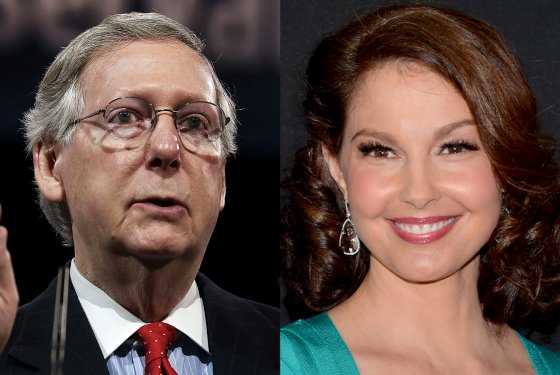
Progress Kentucky is a super PAC that is acting more like a rogue operation in its efforts to unseat Kentucky Republican Sen. Mitch McConnell — sending out racially sensitive tweets and allegedly making a secret recording of the Senate minority leader’s re-election strategy talks.

ashley_judd_mitch_mcconnellThe group has been around only since December, raising about $1,000 and spending $18, compared to the McConnell campaign that has raised $10 million toward 2014 re-election efforts, according to recent Federal Election Commission filings.

Kentucky Democrats have over the past week made numerous, overt efforts to separate their party from Kentucky Progress and its questionable activities.

A former state party official described group members as “just a couple of activists” intent on making a mockery of super PACs, compared to those active in the 2012 elections that were run by savvy political operatives raising millions from well heeled contributors.

“This has nothing to do with the party or even a group,” said Chris Tobe, the former state party board member.

Earlier this week, Jacob Conway, a member of Kentucky’s Jefferson County Democratic Party, told Fox News that two group members secretly recorded the McConnell strategy sessions.

Conway alleges Executive Director Shawn Reilly and volunteer Curtis Morrison recorded the February office meeting from a hallway, perhaps with an iPhone, and later told him about it.

Conway said he came forward because he didn’t want the situation tarnishing the Democratic Party.

In the meeting held by McConnell, aides disparaged actress Ashley Judd, then a potential Democratic challenger, laughing about her bouts with depression and discussing possibly using that against her. They also talked about Judd’s political positions and religious beliefs, according to the tape posted Tuesday by the left-leaning Mother Jones magazine.

Judd has since said she will not run.

mcconnell_juddMcConnell called the taping “Watergate-style tactics,” and the FBI is now investigating the allegation, following his request.

Ted Shouse, Reilly’s attorney, said his client and Morrison were in a “public hallway” outside the office where McConnell’s meeting took place but Reilly never recorded anything.

Morrison didn’t return phone calls or answer the door Friday of his Louisville residence, where the blinds and curtains were closed and mail overflowed in the mailbox.

Kentucky has more registered Democrats than Republicans but tends to vote for Republican candidates for Congress and president.

Progress Kentucky first attracted national attention in February with a tweet from a volunteer that referred to the Asian heritage of Elaine Chao, McConnell’s wife and a former U.S. Labor secretary.

The tweet was about the United States losing jobs to China, and McConnell promptly called the message a “racial slur” and “the ultimate outrage.”

His campaign then ran a statewide television spot in which the Taiwan-born Chao said “far-left special interests are also attacking my ethnicity.”

Another tweet from Progress’ account suggested Chao’s “Chinese” money is buying state elections, referring to members of her family last year giving $80,000 to the state Republican Party.

According to an FEC filing, Progress Kentucky’s treasurer was Douglas L. Davis until he resigned on Tuesday — the day the secret recording was made public.  He declined to comment Friday.

“With my resignation I will no longer be liable for any reporting, donations or expenditures made to, from or on behalf of the committee,” Davis wrote in the filing. Earlier this year, the group failed to turn in its year-end report on time, according to the FEC.

Morrison ran unsuccessfully for the state Senate in 2012 and was one of the organizers of the Occupy Louisville movement.

He wrote for a community journalism website, InsiderLouisville.com. Executive Editor Terry Boyd wrote in a blog post on Friday that Morrison is no longer a contributor.

“Curtis has the makings of a solid reporter, under adult supervision,” Boyd stated in his blog post. “Unfortunately, Curtis is also an overt and dedicated political activist, and you can’t be both at the same time at Insider Louisville.”

Published April 13, 2013 / FoxNews.com /The Associated Press contributed to this report.

Filed Under: All Stories, Economy, Elections, Entitlement, Ethics, Gender, Religion

Obama Plan: More Spending + Tax Hikes + SS Cuts = $3.77T

April 10, 2013 By Editor 1 Comment

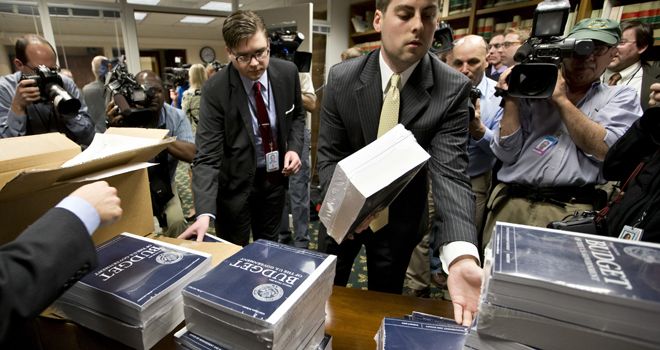
ObamaBudgetPresident Obama found himself weathering bipartisan broadsides Wednesday as he sent Congress his 2014 budget proposal, which in its effort to please both sides of the aisle has ended up angering both.

The budget arrived on Capitol Hill Wednesday morning, delivered 65 days after the legal deadline. The $3.77 trillion spending plan, which is over 2,000 pages, tries to curb deficits by further raising taxes on top earners and reining in the growth of Social Security.

But Republicans argue they already consented to increased taxes as part of the fiscal crisis deal and have expressed little interest in negotiating another hike. And liberal Democrats — particularly powerful advocacy groups — have launched a series of campaigns to oppose the changes to Social Security.

The president’s proposal being unveiled Wednesday includes an additional $1.8 trillion in deficit reduction over the next decade, bringing total deficit savings to $4.3 trillion, based on the administration’s calculations. It projects that the deficit for the 2014 budget year, which begins Oct. 1, would fall to $744 billion. That would be the lowest gap between spending and revenue since 2008.

The president’s plan tracks an offer he made to House Speaker John Boehner, R-Ohio, during December’s budget negotiations, which Boehner ended up walking away from because of his opposition to higher taxes on the wealthy.

The Obama budget proposal will join competing budget outlines already approved by the Republican-controlled House and the Democratic-run Senate.

The most sweeping proposal in Obama’s budget is a switch in the way the government calculates the annual cost-of-living adjustments for the millions of recipients of Social Security and other government benefit programs. The current method of measuring increases in the consumer price index would be modified to track a process known as chained CPI.

The new method takes into account changes that occur when people substitute goods rising in price with less expensive products. It results in slightly lower annual reading for inflation.

The switch in the inflation formula would cut spending on government benefit programs by $130 billion over 10 years, although the administration said it planned to protect the most vulnerable, including the very elderly. The change would also raise about $100 billion in higher taxes because the current CPI formula is used to adjust tax brackets each year. A lower inflation measure would mean more money taxed at higher rates.

In the tax area, Obama would raise an additional $580 billion by restricting deductions for the top 2 percent of family incomes. The budget would also implement the “Buffett Rule” requiring that households with incomes of more than $1 million pay at least 30 percent of their income in taxes. Charitable giving would be excluded.

Obama’s plan is not all about budget cuts. It also includes an additional $50 billion to fund infrastructure investments, including $40 billion in a “Fix It First” effort to provide immediate investments to repair highways, bridges, transit systems and airports nationwide.

Obama’s budget would also provide $1 billion to launch a network of 15 manufacturing innovation institutes across the country, and it earmarks funding to support high-speed rail projects.

The president also is proposing establishment of program to offer preschool to all 4-year-olds from low- and moderate-income families, with the money to support the effort coming from increased taxes on tobacco products.

The administration said its proposals to increase spending would not increase the deficit but rather are paid for either by increasing taxes or making deeper cuts to other programs.

Among the proposed cuts, the administration wants to trim defense spending by an additional $100 billion and domestic programs by an extra $100 billion over the next decade.

The budget proposes cutting $400 billion from Medicare and other health care programs over a decade. The cuts would come in a variety of ways, including negotiating better prescription drug prices and asking wealthy seniors to pay more.

It would obtain an additional $200 billion in savings by scaling back farm subsidies and trimming federal retiree programs.

Congress and the administration have already secured $2.5 trillion in deficit reduction over the next 10 years through budget reductions and with the end-of-year tax increase on the rich. Obama’s plan would bring that total to $4.3 trillion over 10 years.

It is unlikely that Congress will get down to serious budget negotiations until this summer, when the government once again will be confronted with the need to raise the government’s borrowing limit or face the prospect of a first-ever default on U.S. debt.

As part of the administration’s effort to win over Republicans, Obama will have a private dinner at the White House with about a dozen GOP senators Wednesday night. The budget is expected to be a primary topic, along with proposed legislation dealing with gun control and immigration.

Early indications are that the budget negotiations will be intense. Republicans have been adamant in their rejection of higher taxes, arguing that the $600 billion increase on top earners that was part of the late December agreement to prevent the government from going over the “fiscal cliff” were all the new revenue they will tolerate.

The administration maintains that Obama’s proposal is balanced with the proper mix of spending cuts and tax increases.

Obama has presided over four straight years of annual deficits totaling more than $1 trillion, reflecting in part the lost revenue during a deep recession and the government’s efforts to get the economy going again and stabilize the financial system.

The Obama budget’s $1.8 trillion in new deficit cuts would take the place of the automatic $1.2 trillion in reductions required by a 2011 budget deal. That provision triggered $85 billion in automatic cuts for the current budget year, and those reductions, known as a “sequester,” would not be affected by Obama’s new budget.

The budget plan already passed by the GOP-controlled House would cut deficits by a total $4.6 trillion over 10 years on top of the $1.2 trillion called for in the 2011 deal. The budget outline approved by the Democratic-controlled Senate tracks more closely to the Obama proposal, although it does not include changes to the cost-of-living formula for Social Security.

Published April 10, 2013 / FoxNews.com  / The Associated Press contributed to this report.

Filed Under: All Stories, Economy, Elections, Entitlement, Ethics, Foreign, Gender, Religion

Federal Judge Orders Abortion Pill Must Be Over-Counter For All Girls

April 5, 2013 By Editor 1 Comment

Plan_BA federal judge ruled Friday that the morning-after pill known as Plan B must be made available over the counter for women and girls of all ages.

The decision on the controversial subject comes after lengthy legal battles over who should have access to the pill and at what age. The Justice Department did not say whether it would appeal.

The Food and Drug Administration had initially decided to allow the emergency pill to be available for young teens. But Health and Human Services Secretary Kathleen Sebelius overruled the FDA in late 2011, and the agency limited availability without a prescription to women 17 and older.

The decision Friday by U.S. District Judge Edward Korman ordered the FDA to make the pill, commonly referred to as the abortion pill, available for all ages. The decision means that unless the FDA appeals and is granted a stay, by this time next month a teenager 16 or under could walk into a local pharmacy and buy the pill off the shelf.

Korman accused the FDA of “intolerable delays” in reviewing a petition seeking broad access to the drug, likening the process to an “administrative agency filibuster.”

“The plaintiffs should not be forced to endure, nor should the agency’s misconduct be rewarded by, an exercise that permits the FDA to engage in further delays and obstruction,” he wrote.

The FDA declined to comment on the ruling, describing it as an “ongoing legal matter.”

Pill manufacturer Teva said it is “currently reviewing” the decision. “We have no additional comment at this time,” the company said.

The judge ordered the change to be completed in a month. The opinion is sure to rile conservatives and other pro-life groups, who consider the morning-after pill — in some cases — to act as an abortion-inducing drug.

“This ruling places the health of young girls at risk,” said Anna Higgins of the Family Research Council. “There is a real danger that Plan B may be given to young girls, under coercion or without their consent. The involvement of parents and medical professionals act as a safeguard for these young girls. However, today’s ruling removes these commonsense protections.”

The case started in 2005, and Korman initially ruled in 2009 that 17 year-olds should have over-the-counter access. The FDA then moved to allow that access to all ages, until Sebelius stepped in.

Korman wrote in his opinion that “the FDA bowed to political pressure emanating from the White House.”

The Center for Reproductive Rights, which filed suit against the age restriction, and other groups have argued that contraceptives are being held to a different and non-scientific standard than other drugs and that politics has played a role in decision-making.

“I think this is a landmark decision in terms of providing women and girls in the United States access to a safe and effective form of birth control,” said attorney Andrea Costello with the Partnership for Civil Justice Fund.

The morning-after pill contains a higher dose of the female progestin hormone that is in regular birth control pills. Taking it within 72 hours of rape, condom failure or just forgetting regular contraception can cut the chances of pregnancy by up to 89 percent. But it works best within the first 24 hours.

If a woman already is pregnant, the pill has no effect. It prevents ovulation or fertilization of an egg. According to the medical definition, pregnancy doesn’t begin until a fertilized egg implants itself into the wall of the uterus. Still, some critics say Plan B is the equivalent of an abortion pill because it may also be able to prevent a fertilized egg from attaching to the uterus, a contention that scientists — and Korman, in his ruling — said has been discredited.

Published April 05, 2013 / FoxNews.com /The Associated Press contributed to this report.

Filed Under: All Stories, Economy, Elections, Entitlement, Ethics, Gender, Religion, Sci-Tech

Obama Puts Social Security, Medicare On Block to Gain Tax-Hike Support

April 5, 2013 By Editor Leave a Comment

obama_tax_hikePresident Obama will propose modest changes to Social Security and other benefit programs in his 2014 budget — a gesture that is meant to soften Republicans to the idea of tax hikes, but has already drawn the ire of liberal Democrats who want the entitlement shielded.

The president plans to unveil his budget Wednesday, but a senior administration official confirmed the key details in advance. Included in the plan, which would aim to reduce the deficit by $1.8 trillion over 10 years, is a provision to lower cost-of-living adjustments to Social Security, the benefit program for retirees. This would curb the growth in benefits.

“While this is not the president’s ideal deficit reduction plan, and there are particular proposals in this plan like the (Social Security change) that were key Republican requests,” the official said. “The president felt it was important to make it clear that the offer still stands.”

The administration is clear that it is offering changes to Social Security and Medicare — the two benefit programs most important to seniors — in order to convince Republicans to accept increased revenues. The official said the plan to be unveiled next week “isn’t a menu of options for them to choose from — it’s a cohesive package.”

The proposal, though, is sure to get hit from both sides. Republicans want the Social Security change but for years have resisted new tax revenue — Obama’s plan calls for additional tax revenue, including a proposal to place limits on tax-preferred retirement accounts for top earners. Obama has also called for limits on tax deductions by top earners, a proposal that could generate about $580 billion in revenue over 10 years.

But the president could face an even tougher time selling the Social Security change to liberal members of Congress.

Sen. Bernie Sanders, I-Vt., fired off a statement Thursday responding to what was then the rumor that Obama’s budget could include the change.

“Millions of working people, seniors, disabled veterans, those who have lost a loved one in combat, and women will be extremely disappointed if President Obama caves into the long standing Republican effort to cut Social Security and benefits for disabled veterans and their survivors through a so-called chained CPI,” Sanders said. “In 2008, candidate Barack Obama told the American people that he would not cut Social Security.  Having him go back on his word will only add to the rampant political cynicism that our country is experiencing today.”

Chained CPI is the Washington term for the revised inflation adjustment that would effectively curb annual increases in a broad swath of government programs, but would have its biggest impact on Social Security.

The inflation adjustment would reduce federal spending over 10 years by about $130 billion, according to past White House estimates. Because it also affects how tax brackets are adjusted, it would also generate about $100 in higher taxes and affect even middle income taxpayers.

Obama’s budget, to be released next week, comes after the Republican-controlled House and the Democratic-run Senate passed separate and markedly different budget proposals. House Republicans achieved long-term deficit reductions by targeting safety net programs; Democrats instead protected those programs and called for $1 trillion in tax increases.

Obama’s budget proposal includes features from an offer he made to House Speaker John Boehner during fiscal negotiations last year. Those talks ultimately failed but Congress did agree to increase tax rates on top earners.

The reductions in growth of benefit programs, which would affect veterans, the poor and the older Americans, is sure to anger many Democrats.

Labor groups and liberals have long been critical of Obama’s offer to Boehner for including such a plan.

Obama’s new plan would also replace the sequester with other spending cuts. But it will steer clear of major cuts to Medicaid, including tens of billions in reductions to the health care plan for the poor that the administration had proposed only last year.

Published April 05, 2013 / FoxNews.com / The Associated Press contributed to this report.


Filed Under: All Stories, Economy, Elections, Entitlement, Ethics

AP Imposes PC Gag on Itself

April 3, 2013 By Editor Leave a Comment

IllegalImmgrantFenceWASHINGTON –  The Associated Press is being accused of trying to influence the immigration debate following a decision to stop using the term “illegal immigrant” in its coverage — despite the fact it is still being used by U.S. government officials including Homeland Security Secretary Janet Napolitano.The decision comes as a bipartisan group of senators prepares to introduce sweeping immigration legislation which is expected to propose a pathway to citizenship for millions of illegal immigrants.

Indeed, the move by the influential wire service is being hailed as a victory by immigrant advocacy groups.

The conservative Media Research Center, though, described the change as a “politically-correct mumble.”

The new style guideline was first announced this week on the wire service’s blog by Senior Vice President and Executive Editor Kathleen Carroll, who said the change came out of conversations with people who opposed the term.

“Our goal always is to use the most precise and accurate words so that the meaning is clear to any reader anywhere,” Carroll said.

“The Stylebook no longer sanctions the term ‘illegal immigrant’ or the use of ‘illegal’ to describe a person,” Carroll said. “Instead, it tells users that ‘illegal’ should describe only an action, such as living in or immigrating to a country illegally.”

Still, some are wondering why the AP decided to nix the phrase when high-ranking government officials don’t seem to have a problem with it.

Last week, Napolitano told reporters that she didn’t “really get caught up in the vocabulary wars.”

“They are immigrants who are here illegally, that’s an illegal immigrant,” she said.

Previously, the AP rejected the term “undocumented immigrants,” favored by some activists, as inaccurate.

AP_PC_LenoChanges to the AP Stylebook, which is updated annually, have important and widespread repercussions in the media. The changes don’t just influence the AP’s writing, which is found in publications around the world. The book is the primary writing style guide for journalists in both print and broadcast.

The Congressional Hispanic Caucus, a group of 27 House Democrats, applauded the AP’s decision and called it “a great step forward.”

On a more tongue-in-cheek note, ALIPAC announced Wednesday it would be changing its “style” preference in all future articles to “illegal invaders” — “in response to the totalitarian steps by the Associated Press to make ‘illegal immigrants’ disappear with the stroke of a pen just days before legislation attempting to do the same is expected to be filed in Washington, DC, by the ‘Gang of 8.'”

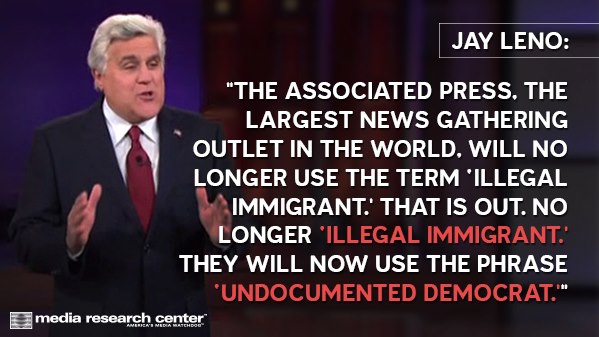
Comedian Jay Leno joked that the phrase should be replaced with “undocumented Democrat.”

The AP said its decision to stop using the term “illegal immigrants” is part of a broader shift away from labeling people and toward labeling behavior — for example, referring to people “diagnosed with schizophrenia” instead of “schizophrenics.”

In 1986, the AP’s then-stylebook editor Christopher French used the same reasoning to support the wire service’s decision to use “anti-abortion” instead of “pro-life,” and abortion rights instead of “pro-abortion” or “pro-choice.”

“Until a specific rule is agreed upon at AP, the following existing guideline is being applied: Avoid labeling groups or individuals and instead spend an extra sentence on a more specific description,” French said at the time.

In February, it reversed a decision on gay marriage, saying people in same-sex marriages could now be referred to as “husbands” and “wives.”

Several news organizations are also dropping the term “illegal immigrant” from their reporting. CNN, ABC News and NBC News have all parted ways with the phrase in the past few years.

The debate on whether to change the term at The New York Times is still being debated, public editor Margaret Sullivan wrote in an article Tuesday.

“The Times, for the past couple of months, has also been considering changes to its stylebook entry on this term and will probably announce them to staff members this week,” she wrote.

“From what I can gather, The Times’s changes will not be nearly as sweeping as The AP’s,” Sullivan said, adding, “I would be surprised to see The Times ban the use of ‘illegal immigrant,’ as the AP has done.”

Published April 03, 2013 / FoxNews.com

Filed Under: All Stories, Economy, Elections, Entitlement, Ethics, Foreign

Delays and Denials Threaten Obamacare

April 3, 2013 By Editor Leave a Comment

“It’s about jobs. In its life, [President Obama’s health law] will create 4 million jobs — 400,000 jobs almost immediately.”

— Then-House Speaker Nancy Pelosi speaking at a Feb. 25, 2010 summit on Obama’s pending health-insurance legislation.

Obama_CareOne of the key selling points in President Obama’s 2010 health law was that small business owners would be able to offer more insurance options to their employees.

But according to a New York Times report today, that benefit, set to kick in at the beginning of 2014, will be delayed for at least a year as federal regulators and insurance companies struggle to offer the expanded options.

This is partly a consequence of Obama relying on private insurance companies to implement his legacy law. With premiums already rising as a result of the law and set to increase by nearly a third on average with the full imposition of the new rules, insurance companies are in a strong position to demand a slowdown of the law.

With Midterm Elections just ahead and Obama still unable to rally much public support for the law, the administration is not keen to push costs even higher, especially as middle-class families are feeling the squeeze of higher taxes and higher fuel costs.

The stumbling start for Obama’s law ahead of the beginning of enrollment in its new health-insurance entitlement program is proving to be a major headache for the president. Enrollment in the federally subsidized insurance program – the centerpiece of the law – is set to begin on Oct. 1. But despite delaying the start of the program for nearly four years from the signing of the law, the federally funded insurance system does not look ready for liftoff.

With Democrats voting to cut out a key tax funding the program and the Department of Health and Human Services up to its eyeballs in delays, waivers and the difficulties of stitching together a patchwork system, the fate of what the president called “Obamacare” is looking uncertain.

Meanwhile, Senate Republicans are preparing to drag the controversial law into the budgeting process this summer. Obama is looking for a full-year fiscal plan that would provide enough borrowing authority to get to the next elections when voters might break the deadlock in Washington. The uncertainty about the law and its growing number of missed expectations enhances the ability of Senate Majority Leader Mitch McConnell and others to make the still-pending Obama entitlement part of the discussion.

Dissatisfaction with the law and the bureaucratic botch of its implementation makes Obama’s legacy program a much riper target for changes and legislative delays.

Dissatisfied Democrats may be willing to sacrifice parts of the law or slow its imposition before they are willing to meddle with popular programs like Medicare. It was politically helpful for Obama to shove the difficult or unpopular laws beyond his re-election bid. Some Senate Democrats may find it appropriate to return the favor.

The Obama administration’s decision to delay the expanded options for small business employees makes that prospect more appealing.

One of the main claims the president made in selling the law, aside from the promise of helping small businesses, was that individuals happy with their insurance and doctors would not have to make changes. Obama later clarified that he meant the government would not force citizens to change, but allowed that government regulations would cause employers, doctors and insurers to drop individuals, stop offering services or raise prices.

Obama modified his initial promise to a hope tinged with high-minded regret: “If you are happy with your plan, and if you are happy with your doctor, we don’t want you to have to change.”

But the changes are coming fast as employers prepare to jettison workers from health care plans, doctors retire or stop accepting government insurance and insurers jack up rates to cover new costs.

The delay of the expanded menu of insurance offerings will almost certainly accelerate the process.

Currently, small businesses are weighing whether to drop health insurance altogether. Obama’s law requires businesses to offer coverage of a certain caliber, above the above the basic catastrophic coverage offered by many companies. For many of them, it will be cheaper to pay the fines imposed for employers who offer no coverage at all or drop full-time workers down to part-time status to avoid the requirements.

The Congressional Budget Office already foresees some 8 million insurance customers getting dropped by employers. That’s more than before and the number will go up with this change and others still to come.

During the debate of the law, a key promise was that new regulation would require insurance companies to offer a broader menu of insurance choices to small businesses across a range of price points.

But if insurers are only offering one, more expensive health plan to small shops there will be even more employers who decide to get out of the game altogether and dump their workers onto taxpayer-subsidized insurance programs. Given the choice between that and being made part-time employees or seeing their paychecks shrink with higher premiums, many workers may prefer being dumped.

(Power Play will leave for another time the consideration of how much payroll tax fraud the new law will engender as small businesses pay “part-time” workers full-time wages. Woof.)

All of this will raise costs and dissatisfy consumers, yes. But the members of Team Obama also know that as long as implementation is lurching forward it becomes harder to uproot the system, no matter how expensive or unwieldy. That’s why Republicans are hoping to use these myriad problems and cost overruns to delay the system. Repeal or alteration remains possible as long as the system isn’t in place.

Obama’s decision to ram through the health law when it was still a jumble, especially using a procedural trick, was predicated on the belief that after he was re-elected he could put the law into place.

But the jumble persists and now threatens his legacy project.

And Now, A Word From Charles

“The Episcopal Church, it used to be said of it a generation ago it was the establishment at prayer. And now, it’s the American left at prayer. And I think that’s one of the reasons why it and the other mainline denominations are in such decline. Because if you want a message like what Reverend Leon delivered you go to a Democratic Party meeting or a pro-choice rally, you don’t go to church.”

— Charles Krauthammer on “Special Report with Bret Baier.”

By Chris Stirewalt / Power Play / Published April 02, 2013 / FoxNews.com

Filed Under: All Stories, Economy, Elections, Entitlement, Ethics

UN Adopts Pact to Regulate Multibillion-dollar Global Arms Trade

April 2, 2013 By Editor Leave a Comment

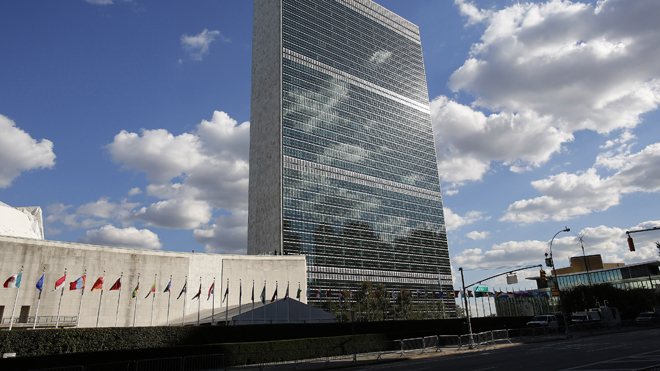
Clouds are reflected off the Secretariat Building of the UN headquarters during the 67th United Nations General Assembly, in New YorkThe U.N. General Assembly has overwhelmingly approved the first U.N. treaty regulating the multibillion-dollar international arms trade.

The resolution adopting the landmark treaty was approved by a vote of 154 to 3 with 23 abstentions.

The 193-member world body voted after Iran, North Korea and Syria blocked its adoption by consensus at a negotiating conference last Thursday. The three countries voted “no” on the resolution.

The vote capped a more than decade-long campaign by activists and some governments to regulate the $60 billion global arms trade and try to keep illicit weapons out of the hands of terrorists, insurgent fighters and organized crime.

It will not control the domestic use of weapons in any country, but it will require countries to establish national regulations to control arms transfers.

Published April 02, 2013 / Associated Press

Filed Under: All Stories, Economy, Elections, Entitlement, Ethics, Foreign

Californians Face 30% Jump in Health-Care Premiums

April 2, 2013 By Editor Leave a Comment

HealthCareCostsCalifornia residents should brace for significantly higher health-care premiums next year, a new study shows.

Covered California, the agency tasked to rolling out the Patient Protection and Affordable Care Act in the Golden State, found nearly five million middle-income residents who are individually-insured could face 30% higher increases next year.

The agency reports the Affordable Care Act benefits low-income residents the most by shedding as much as 84% off their coverage costs. And these figures may push out individual policy holders, who are needed to subsidize those low-income residents’ insurance.

The higher premium costs doesn’t surprise, Kip Piper, of health-care policy advisors Health Results Group, who explains having more bodies in the system that might older, sicker and poorer than before just means the cost to keep them covered will go up for younger and healthier people.

“They may simply opt out, or risk being uninsured. The ACA hopes to get more people into this [insurance] pool, and treat them all pretty much equally. So the young will pay higher premiums to subsidize the old.”

Under current law, Piper says insurers can charge a range of premiums on a scale of one to six dependent on age, sex, location and health status. Under the ACA, that number lowers from one to three, compressing costs for an “adjusted community rating.” The way things stand now, older people are often charged up to five or six times as much for coverage than younger people, he says.

“The people who are least able to afford insurance, or least likely to need it like young healthy males, may just take the risk and be uninsured,” under the new law, he says.

Piper says states like New York already that have already switched to a community rating model, limiting the factors insurers can take into consideration when charging individuals for insurance, won’t see as high premium increases as states like California.

by Kate Rogers / Published March 29, 2013 / FOXBusiness

Filed Under: All Stories, Economy, Elections, Entitlement

Congress Spars Over Universal Background Checks

April 1, 2013 By Editor Leave a Comment

GunControl_kellySenate Democrats recently removed bans on semi-automatic weapons from pending gun-control legislation in apparent hopes of passing the more politically acceptable universal background checks — even referring to the checks as the “sweet spot” of the proposal.

But the issue has turned into the new sticking point in Congress with a top Republican saying Sunday the plan is “going nowhere” and Democrats and other gun-control advocates pressing the issue.

South Carolina Republican Sen. Lindsey Graham repeated the argument among gun-rights advocates that the federal government should not add new checks when existing ones are not enforced.

“The current system is broken,” he said on CNN’s “State of the Union.” “Why in the world would you expand that system if you’re not enforcing the law that exists today. … So I think that legislation is going nowhere.”

Leading gun-control advocate Mark Kelly warned Republican senators that trying to block a vote on new firearms legislation that includes universal background checks could hurt their re-election efforts.

Kelly, a former astronaut and Navy captain, directed his remarks to Sens. Rand Paul and Marco Rubio, among five Republican senators who have suggested they will filibuster a debate and full floor vote.

“They should listen to their constituents” and not get in the way of the debate, Kelly told “Fox News Sunday.”

Kelly, who with wife and retired Congresswoman Gabrielle Giffords leads the gun-control advocacy group Americans for Responsible solutions, said at least 80 percent of voters in Paul and Rubio’s districts favor the checks for potential gun buyers.

Giffords was shot in the head by Jared Lee Loughner, a mentally ill young man, in January 2011 during a town hall-style meeting outside Tucson, Ariz.

New York Democratic Sen. Chuck Schumer told NBC’s “Meet the Press,” he once called background checks the sweet spot “because it would do a whole lot of good and have a good chance of passing.”

“I’m working very hard with both Democrats and Republicans, pro-(National Rifle Association) and anti-NRA people, to come up with a background check that will be acceptable to 60 senators and be very strong and get the job done,” he said. “It’s very hard and we’re working hard and I’m very hopeful that we can get this passed.”

Congress returns April 8 from spring break. No vote on the legislation has been scheduled. But Senate Majority Leader Harry Reid is expected to bring legislation to the floor next month that is likely to include the background check but no bans on semi-automatic weapons and high-capacity gun magazines.

Sens. Ted Cruz, Texas; Mike Lee, Utah; and James Inhofe, Oklahoma, are the three others who have vowed to join in the filibuster.

“We, the undersigned, intend to oppose any legislation that would infringe on the American people’s constitutional right to bear arms, or on their ability to exercise this right without being subjected to government surveillance,” they said in a March 22 letter to Reid, a Nevada Democrat.

Graham said he will not join the filibuster, unless Reid blocks alternative amendments in the floor vote.

Meanwhile, Iowa Sen. Charles Grassley is crafting a Republican alternative to the one recently passed by the Senate Judiciary Committee, his office said Thursday.

No details have been released, but the bill is expected to include tougher laws on straw purchases and illegal gun trafficking, efforts to increase school safety and keeping guns out of the hands of the mentally ill.

A new CBS News poll shows 47 percent of Americans now support tougher gun laws, compared to 57 percent after the December 2012 shooting massacre at a Connecticut elementary school in which 20 first-graders and six adults were killed.

President Obama, who said the day of the shootings was the worst so far of his two-term presidency, push back last week on criticism that Washington has missed its opportunity to pass reform legislation by allowing momentum to fade.

“Let me tell you, people here don’t forget,” said Obama, who will travel Wednesday to Denver to talk with community leaders and local law enforcement officials about new state gun laws. “I haven’t forgotten those kids. Shame on us if we’ve forgotten.”

Kelly also called the potential Grassley bill a “mistake” because it doesn’t include the background check and disagreed with the argument it will lead to a federal registry and possible gun confiscation.

However, he agreed with the argument that states a need to pass along to the federal government information about mentally ill people.

“They absolutely have a point,” Kelly told Fox.

Published March 31, 2013 / FoxNews.com /The Associated Press contributed to this report.
Filed Under: All Stories, Economy, Elections, Entitlement, Ethics

Left Want Ben Carson Replaced as Commencement Speaker After Gay Marriage Remarks

March 30, 2013 By Editor Leave a Comment

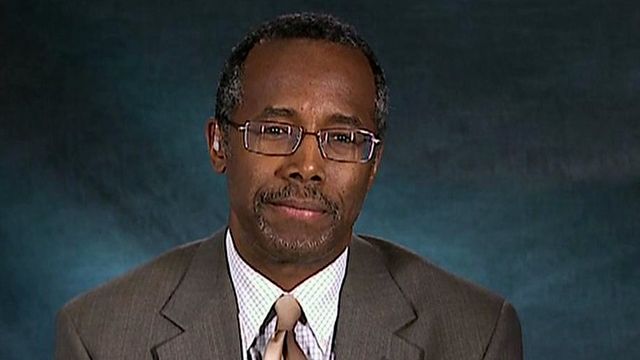
Ben_carsonJohns Hopkins students are campaigning to have Dr. Ben Carson pulled from this year’s commencement speaker line-up, in response to comments the well-known neurosurgeon, a critic of the Obama administration, made about gay marriage.

Carson has since said he apologizes for having offended anyone and indicated he might withdraw from the commencement role, though he says his words are being misconstrued.

Carson — who rocketed to political fame after criticizing President Obama’s policies during the National Prayer Breakfast, which Obama attended — made the gay marriage comments on Fox News Tuesday night.

Host Sean Hannity asked Carson his opinion on same-sex marriage, given the Supreme Court’s consideration of two gay marriage cases this week.

“Marriage is between a man and a woman,” Carson said. “It’s a well-established, fundamental pillar of society and no group, be they gays, be they NAMBLA, be they people who believe in bestiality — it doesn’t matter what they are, they don’t get to change the definition.”

Students accused Carson of effectively comparing “gay relationships with pedophilia and bestiality.”

The Health and Human Rights Student Group began circulating a petition, linked out of its Facebook page, challenging Carson’s selection as the 2013 commencement speaker for the Johns Hopkins School of Medicine.

“At the time of his nomination, Dr. Carson was known to most of us as a world-class neurosurgeon and passionate advocate for education. Many of us had read his books and looked up to him as a role model in our careers,” the group said. “Since then, however, several public events have cast serious doubt on the appropriateness of having Dr. Carson speak at our graduation.”

The group cited his gay marriage comments, but also his comments at the National Prayer Breakfast — Carson was hailed by conservatives, and even landed a speaking role at the Conservative Political Action Conference, for his remarks in February.

The commencement address may be in doubt.

Asked about the students’ objections, Carson on Friday told MSNBC it’s “their day and the last thing I would want to do is rain on their parade.”

Asked whether he’s told the university he would not deliver the address, Carson said he was “waiting for appropriate channels.”

Carson also told the Baltimore Sun that people “have completely taken the wrong meaning out of what I was saying.”

He added:  “Now perhaps the examples were not the best choice of words, and I certainly apologize if I offended anyone. But the point that I was making was that no group of individuals, whoever they are, whatever their belief systems, gets to change traditional definitions.”

Published March 29, 2013 / FoxNews.com

Filed Under: All Stories, Elections, Entitlement, Ethics, Gender, Religion

Teachers’ Union: F

March 28, 2013 By Editor Leave a Comment

nea_report_cardWe hear constantly about how American students are losing ground in worldwide performance standards. We score around 500 out of 1,000 in a number of important categories like reading and science.

Every three years the Organization for Economic Co-operation and Development (OECD) Program for International Student Assessment (PISA) report is compiled and released, comparing the knowledge and skills of 15-year-olds in 70 countries around the world. The United States ranks 14th of 34 OECD countries for reading skills, 17th for science, and a dismal 25th for mathematics.

The man-on-the-street interview has become common fodder for comedy shows, because the ignorance of the average American is overwhelmingly predictable. If you don’t believe it, casually ask someone in Starbucks the most fundamental of social studies questions: how many senators are in the US congress, or even the name of the vice president. You will be surprised at the number of blank stares you receive.

The Dumbing Down of America

So what do children learn in schools under the stern directives of the National Education Association? They learn about global warming, necessary tolerance for abhorrent human behaviors, and about how bad President Bush was. They are taught to speak out vehemently against anything and everything that is traditional or moral, and to blindly embrace every edict and dogma of the left.

Our classrooms are often filled with NEA union “change agents,” set in place to transition impressionable minds from logical and moral thought to leftist nonsense of redistribution and “fairness.” Our children don’t dare question the dogmatic edicts of these “community organizers” whose job it is to preach the gospel of the left, numbing the minds of the children and getting them to thoughtlessly repeat the chants and talking points of liberals.

Even in conservative Provo, Utah, we’ve received reports of a female seventh-grade teacher who recently bullied a female student in front of the class for having a note in her papers on the desk that she was supporting Mitt Romney for president. When the girl’s father asked the principal why his daughter was berated in front of the entire class and called “stupid” for her written thought, he was threatened with a lawsuit and a restraining order if he mentioned the incident outside of the principal’s office.

With all of that “education” going on, it’s no wonder that there is no time or energy left over for things like reading, writing and arithmetic.

“This is an absolute wake-up call for America,” U.S. Education Secretary Arne Duncan said in an interview with The Associated Press. “The results are extraordinarily challenging to us and we have to deal with the brutal truth. We have to get much more serious about investing in education.”

Does Education Need More Money?

Duncan’s use of the word “investing” is liberal-speak for raising taxes and feeding the NEA with more money to donate to Democratic candidate political campaigns. In fact, where students are more likely to drop out of school, and to be unemployed when they leave school, we find the highest levels of NEA influence, and the highest support for Democrats. Think east coast and west coast cities, Chicago, Detroit, etc.

Indeed, we constantly hear how underpaid teachers are, and how our schools need more money for the classrooms. Let’s look at some real numbers. First, we spend more than $9,000 per student per year on K-12 education (far more than all the countries who beat us in PISA reports), totaling over $120,000 per student by high school graduation. That is over $800 billion annually, which is a full 4.5% of our gross domestic product.

So where does all of this money go? Around 60% goes to classroom instruction, including teachers’ salaries. The rest (40%) goes to non-teaching employees and extras, in place mainly to ensure federal compliance, to qualify for the small percentage of the local budget that comes from Washington, D.C.

According to U.S. Bureau of Labor Statistics, mechanical engineers earn $31.93 per hour, but public school teachers earn on average more than $34.00 per hour, with an average annual salary of over $47,000. That salary is for a job that consumes just 36.5 hours per week compared with many hours more for nearly everyone else. Compared with public school teachers, editors and reporters earn 24% less; architects, 11% less; psychologists, 9% less; chemists, 5% less; mechanical engineers, 6% less; and economists, 1% less. It is true that there are those who earn more than public school teachers. Nuclear engineers earn 17% more; actuaries, 9% more; and physicists, 3% more. There are public school teachers working for a number of failing school systems who are earning a lot more than most people. The Detroit metropolitan area has the highest average public school teacher pay among metropolitan areas for which data are available, at $47.28 per hour, followed by the San Francisco metropolitan area at $46.70 per hour, and the New York metropolitan area at $45.79 per hour.

We need to invest more? No, we need to take back control of our schools and ensure that motivated teachers are teaching basic educational courses—the kind of subjects that are tested and measured internationally. We need to make sure there is competition in the teaching profession, something the NEA has fought with tremendous ferocity. We need to reward teachers who excel, and fire teachers who aren’t teaching useful subject matter to our children.

PUBLIUS

Filed Under: All Stories, Economy, Entitlement, Ethics

The Spirit of Antichrist Permeates Our Nation

March 27, 2013 By Editor 2 Comments

Satan_ObamaBecause of all the buzz in the press lately about religious freedoms coming under attack, there has been a great deal of discussion about the role of religion in our nation.

Barack Hussein Obama has declared that “America is no longer a Christian nation,” and in our article of May 28, 2012 Obama vs. Catholic Church, we outlined how one of his first acts as POTUS was to insist that the gold “IHS” monograms for the name of Christ be covered up with black painted plywood in Gaston Hall at the Catholic church’s Georgetown University, where he delivered a speech on economics.

We see on national television, in the movies, magazines and other media, on left-leaning news programs, newspapers and the blogs and social networks a hardening stance against Christianity in America. Even our political leaders who claim a Christian background not only embrace practices and policies that are clearly against the teachings of the Bible, but publically belittle and berate anyone who endorses them—or endorses Jesus Christ or His Father, the God of Israel.

The Democratic Party, and indeed, many if not most liberals and progressives in this country have adopted an anti-God, anti-Christian approach to public life, and in a growing number of cases, their personal lives.  See, e.g., our article of September 9, 2012 DNC Boos God . The support for the State of Israel has waned with the decline of Christianity in this country—leaving American Jewish families to wonder if they’ve been abandoned by the Democratic Party that they so willingly embraced.

Antichrist is a personage mentioned in the New Testament of the Bible on a few occasions; but also described is a “Spirit of Antichrist,” illustrated by John the Apostle in 1 John 4 thus:

 3 And every spirit that confesseth not that Jesus Christ is come in the flesh is not of God: and this is that spirit of antichrist, whereof ye have heard that it should come; and even now already is it in the world.

The Apostle further elaborates the principle of the Spirit of Antichrist in 2 John 1, explaining:

7 For many deceivers are entered into the world, who confess not that Jesus Christ is come in the flesh. This is a deceiver and an antichrist.

Indeed, we are deluged in a sea of deceivers. We live in that Orwellian world where good is bad and bad is good, where our universities churn out “spin doctors” by the millions, whose only purpose is to make wickedness appear to be goodness through tolerance and inclusion, and to make enslavement appear as liberty through taxation, regulation and the public dole. They belly up to news desks and slither on couches looking into television cameras and lie about everything with a sophistry that oozes effortlessly from their filthy lips, and assail anyone who dares speak a word of decency or honesty.

Yes, the Spirit of Antichrist has doubtless overtaken our nation’s media, government, education and many other institutions. Deceivers rule the country. It was foretold, and we must accept its eventuality and reality.

The only questions that remain are a) which team’s jersey do you wear? and b) is the person of Antichrist already among us, arising on the scene?

Publius

Filed Under: All Stories, Economy, Elections, Entitlement, Ethics, Religion

The Ghost of Jimmy Carter

March 27, 2013 By Editor Leave a Comment

obama-carterPresident Jimmy Carter promised Hope and Change to an America dragged through the mud by a media feeding frenzy during the Nixon Watergate era.

The left got the white house handed to them, along with the congress, and nothing could stop the wholesale implementation of liberal-progressive policies. Anyone who lived during the Carter administration knows that it was a horrific time in American history.

Carter began his presidency by apologizing for American success, and it wasn’t long before Arabs began slapping him around like the whimp he told them he was.

OPEC decided the US was powerless to oppose them, and they immediately began cutting oil supplies and raising prices. Carter’s response was classic Democrat, demonstrating a complete lack of understanding of global free markets–impose price freezes on gasoline in the US. World oil markets naturally sought out the more lucrative markets and we well recall the gas lines stretching for blocks as Americans waited for hours to get their tanks filled, reminiscent of the Depression Era shortages and rationing schemes.
In grand Neville Chamberlain style Carter immediately tried diplomatic talks with the Soviet Union feeling that thrill going up his leg as the Soviets put their signatures on pieces of paper with him. Of course, while agreeing to limit expansion, the USSR invaded Afghanistan behind his back, bitch-slapping the president of the United States in front of the entire world.

Carter also withdrew US support of the Shah of Iran, historically a strong U.S. ally in the Middle East, one of few who recognized Israel as a sovereign state. Without our support the Shah was forced into exile, replaced by a fundamentalist government, hostile to the U.S. Iranian students stormed the US embassy and took 53 Americans hostages, and held them as political prisoners for 444 days. Carter had been paring back the US military and saw his duty as Commander in Chief as unbecoming a Progressive President, and when it was time to send in a military extraction team to get our hostages out, the equipment failed in one of the greatest military blunders in history. The hostages were kept in Iran and paraded before the world media up until President Elect Ronald Reagan sent Iran the message, “Let my people go,” and they were brushed up and sent back immediately.

Carter, the Apologizer in Chief, also gave up US control of the American-built Panama Canal, affording China and other nations greater access to our easier trade routes, further harming US trade superiority. Seeing no deterrence, the Soviets further expanded their influence in the Western Hemisphere by helping leftists overthrow governments in Central and South America.

Democratic economic strategies had our US economy spiraling in a tailspin, with the prime rate at 21 percent, killing business expansion and the housing market. Of course, unemployment skyrocketed under these circumstances.

DOES ANY OF THIS SOUND FAMILIAR?

This writer has always said that American politics has been reduced to this: The Democrats take control of government based on promises of throwing a big party, and the next election the Republicans are called in to clean up the mess.

At what point will America wake up to the reality that the policies of the left don’t work? It’s time to install a conservative government, and to keep a conservative government in place . . . and replace the long-term growth, development and expansion of personal liberty that we enjoyed for the first 100 years. Call me old fashioned.

PUBLIUS

Filed Under: All Stories, Economy, Elections, Entitlement, Ethics, Foreign

EU Approves Cyprus Bailout Deal, Funded by Bank Assets Seizure

March 25, 2013 By Editor Leave a Comment

cyprus_2Imagine waking up to find out that as much as 40 percent of the money you thought was safely deposited in the bank was seized, without your permission, to bail out a near-bankrupt government.

That’s just what thousands of large depositors in Cyprus woke up to Monday morning after European Union officials accepted a last-minute deal offered by the island’s lawmakers to secure a $13 billion bailout to avert imminent financial meltdown.

The deal, which also slashed the island’s oversized banking sector, came as euro ministers in Brussels threatened to cut off crucial emergency assistance to Cyprus’ embattled banks after business on Monday if no agreement was reached.

Without that EU funding, Cyprus’ banks would have collapsed, dragging the country’s economy down with them and threatening the small Mediterranean island’s membership of the 17-strong group of European Union countries that use the euro — all of which would have sent the EU’s markets spinning.

“It’s not that we won a battle, but we really have avoided a disastrous exit from the eurozone,” Finance Minister Michalis Sarris said in Brussels.

“This decision is painful for the Cypriot people. This decision was a defeat of solidarity, of social cohesion, which are fundamental freedoms, fundamental principles of the European Union,” Parliament President Yiannakis Omirou told AP.

The deal also angered Russia’s leaders. It is believed that many of the affected large accounts belong to Russian depositers, and Moscow has been a major lender to prop up the Cypriot banking system. It’s been estimated that Russians have more than $31 billion deposited in Cyprus banks.

Dmitry Medvedev reportedly likened the deal to “the stealing of what has already been stolen continues,” the Telegraph reported, a reference to Vladimir Lenin’s explanation of the Bolshevik seizure of capitalists’ assets and property.

Last week Medvedev likened the bank seizure to “a certain period of time by Soviet authorities, who did not stand on ceremony when it came to people’s savings.”

Russian President Vladimir Putin, meanwhile, ordered the government to look into restructuring the terms of a more than $3 billion loan, a move that appeared to please EU ministers.

Cyprus banks, meanwhile, were rationing the amount of money they were dispensing to 100 euros, trying to avert a run on cash from nervous depositers.

Under the deal, Laiki, the country’s second-largest bank, will be restructured, with all bond holders and people with more than 100,000 euros in their accounts facing significant losses. The bank will be dissolved immediately into a bad bank containing its uninsured deposits and toxic assets, with the guaranteed deposits being transferred to the nation’s biggest lender, Bank of Cyprus.

Jeroen Dijsselbloem, who chairs the meetings of the eurozone’s finance ministers, said it was not yet clear how severe the losses would be to Laiki’s large bank deposit holders, but he noted that it is expected to yield 4.2 billion euros overall — or much of the money that Cyprus needed to raise to secure the bailout. Analysts have estimated investors might lose up to 40 percent of their money.

Large deposits with Bank of Cyprus above the insured level will be frozen until it becomes clear whether or to what extent they will also be forced to take losses, the Eurogroup of finance ministers said in a statement.

Without a bailout deal by Monday night, the tiny Mediterranean nation would have faced the prospect of bankruptcy, which could have forced it to become the first country to abandon the euro currency. That would have sent the region’s markets spinning.

The eurozone finance ministers accepted the plan after hours of negotiations in Brussels between Cypriot officials and the so-called troika of creditors.

Markets in Europe reacted positively, opening sharply higher, and the euro was back near $1.30, though the measures are likely to deepen the recession in Cyprus.

“We believe that this will form a lasting, durable and fully financed solution,” said IMF chief Christine Lagarde.

To secure the rescue loan package, the Cypriot government had to find ways to raise 5.8 billion euros ($7.5 billion) on its own. The bulk of that money is now being raised by seizing bank assets from large deposit holders, with the remainder coming from tax increases and privatizations.

The cash-strapped island nation has been shut out of international markets for almost two years. It first applied for a bailout to recapitalize its ailing lenders and keep the government afloat last June, but the political negotiations stalled. After a botched agreement last week, the ECB threatened to cut off emergency assistance to the country’s banks.

“We’ve put an end to the uncertainty that has affected Cyprus and the euro area over the past week,” Dijsselbloem said.

That uncertainty around the nation of about 800,000 had shaken the entire eurozone of 300 million people, even though Cyprus only makes up less than
0.2 percent of the eurozone’s economy.

Several national parliaments in eurozone countries such as Germany must also approve the bailout deal, which might take another few weeks. EU officials said they expect the whole program to be approved by mid-April.

Dijsselbloem defended the creditors’ approach of making deposit holders take heavy losses, saying the measures “will be concentrated where the problems are, in the large banks.”

The international creditors, led by the IMF, were seeking a fundamental restructuring of the country’s outsized financial system, which is worth up to eight times the Cypriot gross domestic product of about 18 billion euros.
They said the country’s business model of attracting foreign investors, among them many Russians, with low taxes and lax financial regulation had backfired and needed to be upended.

The drastic shrinking of the financial sector, the wiping out of wealth through the losses on deposits, the loss of confidence with the recent turmoil and the upcoming austerity measures all mean that Cyprus is facing tough times.

Published March 25, 2013 / FoxNews.com / The Associated Press contributed to this report.

Filed Under: All Stories, Economy, Entitlement, Foreign

Massachusetts Principal Halts Honors Night – ‘Devastating’ to Other Students

March 21, 2013 By Editor 1 Comment

ipswichA Massachusetts principal has been criticized for canceling his school’s Honors Night, saying it could be ‘devastating’ to the students who worked hard, but fell short of the grades.

MyFoxBoston.com reports that David Fabrizio, principal of Ipswich Middle School, notified parents last week of his plan to eliminate the event.

“The Honors Night, which can be a great sense of pride for the recipients’ families, can also be devastating to a child who has worked extremely hard in a difficult class but who, despite growth, has not been able to maintain a high grade-point average,” Fabrizio penned in his first letter to parents, the station reported.

Fabrizio also said he decided to make the change because academic success can be influenced by the amount of support a student  receives at home and not all students receive the same level of emotional and academic support at home.

Some parents disagree with his philosophy.

“It’s been a tradition in Ipswich, and you’re very proud as a parent to see your child, as well as some of the other children who made, really, some great efforts,” Dave Morin, a parent, told the station.

Fabrizio says he plans to include the honors ceremony with a previously planned end of the year assembly where students will be recognized in front of the entire student body.

Filed Under: All Stories, Entitlement, Ethics

Dems Try to Tax Online Sales

March 21, 2013 By Editor Leave a Comment

fair_taxesCurrently in the U.S., state governments are only obligated to collect sales taxes from online retailers that are based in their own states. If an online sales tax bill makes it to law, states could collect from online retailers that don’t reside in their state.

There’s a good chance you’ve heard of the Marketplace Fairness Act (S.336), before. The bill aims to ensure that states receive taxes that they’ve been otherwise missing out on. A similar proposal is up for vote in the Senate this week thanks to an amendment to a Democratic budget resolution from Senators Mike Enzi and Dick Durbin (pictured), who sponsored the bill.

Opponents are slamming the Senators for trying to “sneak” the legislation through. The Hill reports:

Phil Bond, the executive director of the WE R HERE coalition, accused backers of online sales tax measures of trying to “sneak through” their legislation outside regular congressional order.

“There are good reasons this policy hasn’t been considered in the US Senate for over a decade: Taxpayers don’t like it, it turns the Internet into a tax collection platform, it allows state tax collectors to exercise authority far beyond their boundaries and it will put thousands of small businesses out of business,” Bond, a top Commerce Department official under George W. Bush, said in a statement.

The official summary of the Marketplace Fairness Act says:

The Marketplace Fairness Act grants states the authority to compel online and catalog retailers (“remote sellers”), no matter where they are located, to collect sales tax at the time of a transaction – exactly like local retailers are already required to do. However, there is a caveat: States are only granted this authority after they have simplified their sales tax laws.

Simplification is required because of two Supreme Court rulings (Bellas Hess and Quill, described below) cite concern that collecting sales tax for multiple states would be too difficult.

The Marketplace Fairness Act requires that states must simplify their sales tax laws in order to ease those concerns and make multistate sales tax collection easy. Specifically, states seeking collection authority have two options for simplifying their sales tax laws.

Under the Marketplace Fairness Act, states can join others that have already adopted “simplification measures” of the Streamlined Sales and Use Tax Agreement (SSUTA) or they can meet five mandates listed in the bill. States would have to agree to:

  • Notify retailers in advance of any rate changes within the state
  • Designate a single state organization to handle sales tax registrations, filings, and audits
  • Establish a uniform sales tax base for use throughout the state
  • Use destination sourcing to determine sales tax rates for out-of-state purchases (a purchase made by a consumer in California from a retailer in Ohio is taxed at the California rate, and the sales tax collected is remitted to California to fund projects and services there)
  • Provide free software for managing sales tax compliance, and hold retailers harmless for any errors that result from relying on state-provided systems and data

You can take a look at the bill here. Hundreds of national trade associations, state and local trade associations and businesses support the bill. These are listed here. They include Amazon, Autozone, Barnes and Noble, Bed, Bath, & Beyond, Best Buy, Buy.com, Foot Locker, Gap, Home Depot, Kroger, Lowes, Meijer, J.C. Penney, Safeway, Sears, Petsmart, and Walmart, to name a few.

The bill’s site only lists ten opponents, including: eBay, American Catalog Mailers Assocation, Americans For Prosperity, Campaign for Liberty, Center for Freedom and Prosperity, Computer & Communications Industry Association, Competitive Enterprise Institute, Direct Marketing Association, Freedomwworks, Heartland Institute, Heritage Foundation, National Taxpayers Union, NetChoice, R Street, TechNet, and We R Here Coalition.

AT&T, Council on State Taxation, National Cable and Telecommunications Association, National Federation of Independent Business, and Verizon are listed as neutral or undecided.

The main difference between the Marketplace Fairness Act, and what is coming up for vote this week, is that the new proposal doesn’t include the mandatory simplification, and is non-binding, as CNET’s chief political correspondent Declan McCullagh explains.

“It appears to be intended as a clever political hack: secure plenty of votes on a non-binding Internet tax amendment, then use those vote totals to argue there’s sufficient support for S.336 when it’s up for a binding vote later,” he says, before going to quote eBay’s senior director of federal government regulations and global public policy, Brian Bieron:

“The strategy of the bill’s supporters is to offer this general amendment and then claim that all the senators that vote for it support the bill. That is not just a stretch, it is not accurate. But the game plan is to rack up a sizable vote and then make the claim the bill itself should jump over the Finance Committee and go right to the floor.”

Hence the “sneaking” accusations.

Some supporters of the legislation think it’s really just a matter of when, rather than a matter of if, and whatever happens with this week’s vote could have a significant bearing on that.

Either way, brick-and-mortars have ramped up their lobbying for online sales tax, but opponents claim it’s bad for consumers and for small businesses.

Chris Crum – Follow Chris on Twitter, on StumbleUpon, on Pinterest and/or on Google: +Chris Crum.

Filed Under: All Stories, Economy, Entitlement, Ethics

Socialism is Cool (Populist)

March 21, 2013 By Editor 1 Comment

There’s no doubt that Barack Hussein Obama is a populist politician. In many ways he is the every man . . . proving to the masses that indeed, anyone can become the president of the United States of America.

It is a fanciful dream of every American, that each little citizen child can grow up to become the most powerful leader in the world. It is part of our heritage, that no matter how humble the beginnings, or how disadvantaged due to some quirk of life, in this country it is possible to overcome the hurdles and rise to the very top; and in fact, it is true.

In the case of Barack Obama, he was born a minority baby in Hawaii (although he claimed to be born in Kenya when promoting the first of multiple autobiographies) to mixed-race parents (raised by his grandparents), and was saddled with a Muslim name. Although most of his records have been sealed and whisked away to vaults where the vetting process has been declared DOA, he appears to have done well in school at times, and have finished well at ivy league institutions.

Barack Obama appears to have been a fairly common intercity youth, and describes himself as abusing alcohol, marijuana and cocaine, and leaves room to believe there were additional drugs and related activities in the mix.

Obama was a player as a young adult, and describes his out-of-marriage affairs with women of multiple races, although the fact has been recently reported that the identities of these women were mere creations, composites generated for purposes of the books about himself.

Politically, Barack Obama is a Chicago minority street fighter, fitting well into the Democratic machine — “Vote early, vote often!” He describes himself as a “community organizer,” which in retrospect appears to have included an armband of some sort and included duties like registering the Dallas Cowboy Cheerleaders to vote. His politics are those of the ’60s campus radical, as are those of his mentors and appointees. He has exchanged treasury dollars for support and votes in the tradition of his party and as promised, has siphoned trillions of them off to promote his social welfare utopian ideals — most of those dollars ending up in the hands of his cronies. Although this “tax, spend, elect” cycle is short-lived per force, concluding when the treasury is emptied, the tactic often plays well to the electorate, in the short term. That run is about over judging from the 60 percent increase in the national debt in just the first 4 years of Obama’s presidency.

The President has often been seen making the television show circuit, demonstrating to his base that he is indeed the man they were told he was just 4 years ago — before he demonstrated a deaf ear to the citizens of the nation, and turned his tenure into a non-stop vacation cruise around the world.

The President’s White House is reported to be a boy’s club, hostile to working women and focused on sports television programming and drinking beer with other cool guys. The proletariat eats this stuff up.

So is Barack Hussein Obama the coolest president we’ve had in the White House? He’s not the player that Kennedy and Clinton were, and he hasn’t put away as much booze as some of the record holders . . . but all in all, it appears safe to say that he is indeed the most common man that has graced the hallowed sanctum of the people’s house.

Publius

Filed Under: All Stories, Economy, Elections, Entitlement, Ethics

« Previous Page
Next Page »

Federalist Press Dispatch

Get breaking political news, investigations, and uncensored analysis delivered directly to your inbox.

Please wait...

Thank you for subscribing to the Federalist Press Dispatch.

Get free info to help your life

Get free info to help your life

Simple bite-sized guides for life, money, civics, and more . . . because some stuff school just didn’t cover.

Brit Axton Mysteries Series

Brit Axton Mysteries Series

Brit Axton Mysteries is a series of young adult adventure novels that lead young Brit Axton and her friends on whirlwind adventures to uncover hidden secrets and long lost treasures.

Byrna Non-lethal Self Protection

Byrna Non-lethal Self Protection

Byrna offers non-lethal self protection at an affordable price. Watch the short video, or click to learn more!

Understanding Cryptocurrency: Essentials for Building Wealth in Digital Currency

Understanding Cryptocurrency: Essentials for Building Wealth in Digital Currency

Understanding Cryptocurrency serves as a definitive guide for novice investors looking to understand the world of cryptocurrency and harness its potential for financial growth and prosperity.

Real Estate Wealth Strategies During High Inflation

Real Estate Wealth Strategies During High Inflation

Real Estate Wealth Strategies During High Inflation is a comprehensive guide on navigating the real estate market, offering strategies and insights for successful investing, during high inflation and interest rates.

Follow us

  • parler
  • welcome-widgets-menus
  • facebook
  • envato

Privacy Policy

Terms of Service

Economy

When Bill Maher Starts Worrying About Socialism, Democrats Should Pay Attention

Democratic Socialists and Democrats: Is there any Difference?

Stop Financing Degrees That Cannot Repay Their Loans

Elections

The Politics of Envy: Why “Tax the Rich” Is an Economic Dead End

When Bill Maher Starts Worrying About Socialism, Democrats Should Pay Attention

Democratic Socialists and Democrats: Is there any Difference?

Foreign

May Day in America: A Radical Marxist Tradition Reemerges

Negotiations Slow, Tensions Rising: Where U.S.–Iran Talks Stand

Did AOC Really Say Republicans Want to “Rig Elections” by Allowing Only U.S. Citizens to Vote?

Crime

Democratic Socialists and Democrats: Is there any Difference?

Envy Is the Fuel of Socialism

Trump Sounds the Alarm on Election Security—America Cannot Survive Elections That Half the Country Can’t Trust

Science Tech

The Climate Scare Revisited: What Happened to the Predictions?

Trump’s Third UFO File Dump Raises the Stakes Again

Hollywood Feels the Shift: Spielberg’s New UFO Film Arrives During America’s Disclosure Era

Reader Responses

  • Linda Livaudais on Trump’s UFO Disclosure Has Changed the Conversation — But Not Yet Answered the Biggest Question
  • T059736 on Trump and Musk Announce Plans to Shut Down USAID
  • C.Josef.D on ‘Pay to Play’ at Clinton Foundation Under Investigation
  • John D Cole on Biden Says ‘You ain’t black’ If You Don’t Vote for Him
  • Ed on U.S. Attorney Huber Moving to Indict Clintons and Others

Copyright © 2026 by Federalist Press · All rights reserved · Website design by RoadRunner CRM · Content Wiriting by GhostWriter · Log in