
House Republicans unveiled an ambitious cost-cutting plan Tuesday that would balance the budget in 10 years without raising taxes, while repealing ObamaCare and overhauling entitlements — a document Democrats are sure to reject but could be used as a negotiating tool in talks with President Obama.
 Rep. Paul Ryan, R-Wis., chairman of the House Budget Committee, is sticking by controversial proposals, including one to give future Medicare retirees the option of using government payments for private health care plans.
The plan warns of a looming debt crisis, and endeavors to pay off the debt by 2050.
“It’s not too late,” the plan says. “This budget provides an exit ramp from the current mess.”
Democrats preemptively panned Ryan’s spending plan, with House Democratic Whip Steny Hoyer, D-Md., saying it relies on “spurious budget trickery.”
“His past budgets have included lofty rhetoric about deficit savings, but very few actual details of how those savings are found,” Hoyer said in an op-ed in Politico.
Senate Democrats promise to offer a counterproposal on Wednesday with higher spending on domestic programs and additional tax hikes on top of the higher rates imposed on top-bracket earners in January. It will, in turn, arrive as a dead letter in the GOP-controlled House.
But this year’s dueling GOP and Democratic budget proposals are more about defining political differences than submitting a plan that can pass Congress unchanged.
The exercise comes even as President Obama was to travel to Capitol Hill on Tuesday to meet with Senate Democrats in an attempt to resuscitate his failed efforts for bipartisanship.
Ryan, who became a national GOP figure as the losing vice presidential nominee last year, has for now settled back into his wonkish role as Budget Committee chairman and chief tutor for dozens of relatively junior Republicans. His budget helps to undergird Republican claims that the government does not need to raise taxes in order to bring down the deficit.
The plan would achieve $4.6 trillion in deficit reduction over 10 years. It also aims to simplify the tax code, consolidating the seven income-tax brackets into two, with a top rate of 25 percent.
“We’re introducing a budget that balances in 10 years — without raising taxes,” Ryan said in an op-ed in The Wall Street Journal. “How do we do it? We stop spending money the government doesn’t have.” All told, Ryan’s plan would slash $4.6 trillion in spending over the coming decade.
“On the current path, we’ll spend $46 trillion over the next 10 years. Under our proposal, we’ll spend $41 trillion,” Ryan said. “On the current path, spending will increase by 5 percent each year. Under our proposal, it will increase by 3.4 percent.”
The plan calls for a 10 percent reduction in the federal workforce by 2015, as well as changes to give states more flexibility on Medicaid, the health care program for low-income Americans. It would also repeal the federal health care overhaul, particularly targeting the expansion of Medicaid and government subsidies meant to help millions buy private insurance.
The House Budget Committee has scheduled a vote on the soon-to-be-released measure Wednesday, and the Senate Budget panel is slated to vote Thursday on rival legislation by new Budget Committee Chairwoman Patty Murray, D-Wash., who promises new tax revenues but few cuts from domestic programs like Medicare and Medicaid.
“We are working toward fair and balanced, which is what the American public has said time and time again that they want,” Murray said. “We need to make sure that everybody participates in getting us to a budget that deals with our debt and our deficit responsibly.”
For his part, Ryan has resurrected a controversial Medicare proposal that replaces traditional Medicare for those currently under 55 with a government subsidy to buy health insurance on the open market. Critics of the plan say the subsidies won’t grow with inflation fast enough and would shove thousands of dollars in higher premiums onto seniors before very long.
The House GOP plan again proposes sharp cuts to Medicaid, tighter food stamp eligibility rules and more than $1 trillion in savings over a decade by repealing Obama’s signature overhaul of the U.S. health care system. It seeks to preserve the Pentagon budget, but only at the expense of proposing domestic agency budgets that may prove too low for GOP moderates and the pragmatists atop the Appropriations Committee responsible for guiding them into law.
Even as it proposes repealing ObamaCare, the Ryan plan banks more than $700 billion in the health care law’s cuts to Medicare providers over a decade — just as more than $600 billion in tax hikes on the wealthy enacted in January make it easier for Ryan’s budget to predict balance.
At the White House, Press Secretary Jay Carney was asked about Obama’s failure to submit a budget on time.
“The president has always believed that deficit reduction is not a goal unto itself,” Carney said. “The proposals he’s put forward keep the No. 1 objective in mind, which is economic growth and job creation, not deficit reduction solely for the purpose of reducing the deficit.”
As the two sides battle over future-year budgets, top Senate Democrats and Republicans late Monday released a catchall government funding bill for the ongoing fiscal year that denies Obama new money for implementing signature first-term accomplishments like new regulations on Wall Street and his expansion of government health care subsidies, but provides modest additional funding for domestic priorities like health research and highway projects.
Monday’s measure was the product of bipartisan negotiations and is the legislative vehicle to fund the day-to-day operations of government through Sept. 30 — and prevent a government shutdown when current funding runs out March 27.
It sets a path for government after across-the-board spending cuts that took effect March 1. In most cases the minor changes in agency budgets amount to housekeeping within a trillion-dollar cap for the day-to-day operations of agencies in the current budget year.
Passage in the Senate this week seems routine and could presage an end to a mostly overlooked battle between House Republicans and Obama and his Senate Democratic allies over the annual spending bills required to fund federal agency operations.
Published March 12, 2013 FoxNews.com
The Associated Press contributed to this report.

 email, the response came from the Agriculture Department’s budget office and in part states: “However you manage that reduction, you need to make sure you are not contradicting what we said the impact would be.”




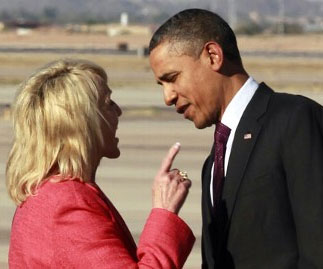 When Arizona Governor Janet Napolitano left her post to become the chief of Homeland Security in the Obama administration, she was replaced by a republican, Jan Brewer. The incoming governor inherited a budget crisis, which was one of the worst in the nation.
 At a time when the American people can no longer afford politics as usual, and re-elected a GOP majority in the House to protect them from socialistic tax increases, the GOP led House has caved on a Senate bill that substantially raises taxes on many Americans.
 A few days ago a young Hispanic man from Portland, Oregon stole a semi-automatic rifle and went into a suburban shopping mall to kill as many people as he could. Coward.
 “Today, I made the decision that it was the best thing for our country, for the American people that I not continue to be considered by the president for nomination of secretary of state,” Rice said.
 Following one of the worst performances for an American president in this nation’s history, Americans awarded Barack Obama a second term. What was the pitch from the far left that got him re-elected following four years of economic upheaval and government socialization of the medical industry?
 The Federalist Press suggests that the GOP consider adopting a democratic party long-term strategy. Indeed, democrats have exercised control of American government for much of the past 100 years by long-term planning—which became necessary following the beating they took in the Civil War and post-war reconstruction, as republicans freed the slaves and passed and enforced the civil rights amendments.
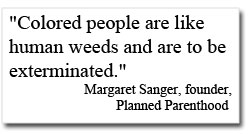
 Planned Parenthood was founded by Margaret Sanger, and like-minded racists, like Dr. S. Adolphus Knopf and Lothrop Stoddard, a Harvard graduate and the author of The Rising Tide of Color against White Supremacy. Margaret Sanger was an ardent proponent of sterilizing those she considered “unfit,” which would be the “salvation of American civilization.” Who was unfit? Those of African descent.
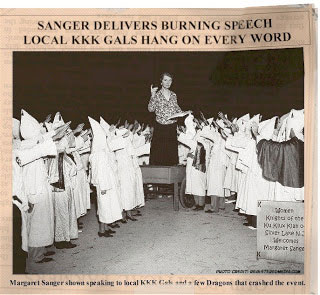 Indeed, as a direct result of the Sanger movement, even today, American black children suffer death by the millions at the hands of abortionists. Planned Parenthood is the largest abortion provider in America, with 78% of their clinics in minority communities. Although blacks make up only 12% of the population, 35% of all the abortions in America are black babies.
 With the 2012 elections in the books, the result is that there has been no change in the makeup of America’s government. The Democrats won major advances in 2008, but were rebuked in the 2010 elections with the loss of the House of Representatives. The status quo prevails.
 Following 4 years of economic, social and political failure by President Obama, Americans doubled down and asked him to give them more of the same.
 There are still a few people who claim to be undecided about today’s elections. Do they want to continue to support Barack Obama, or has our country reached a point where we must make a change of leadership . . from the top down?


 Community Organizer Barack Hussein Obama released his first book about himself in 1995, titled Dreams from My Father, as publicity to launch his Senatorial campaign. The book has only recently received any scrutiny, and reveals a very disturbing ideology and series of life choices in the form of socialist associations and heavy drug use of the would-be leader.
 Friday in Paris. A hidden camera shows streets blocked by huge crowds of Muslim worshippers and enforced by a private security force.
Reader Responses