
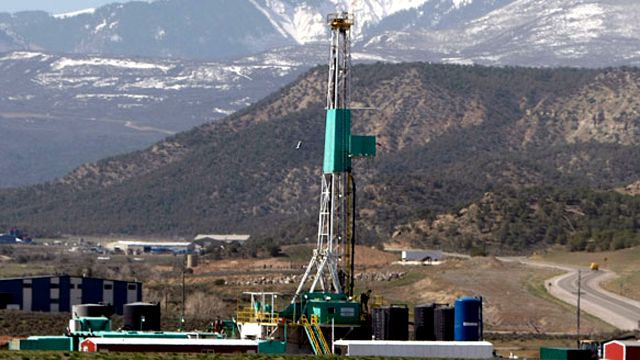
 WASHINGTON – Energy companies are lining up for their shot to drill in the Dakotas and Montana after a new government report revealed that a massive geological formation stretching across the states contains twice the oil and three times the amount of natural gas than was originally believed.
While the new estimate is drawing smaller companies to the game, the larger players like Schlumberger, Halliburton and Continental Resources are pushing forward with ambitious multi-year plans to stake their claim in the industry.
Continental recently announced a five-year plan to triple its production by 2017. The company’s growth is based on success in North Dakota and Montana as well as in parts of Oklahoma.
The dash to drill follows news from the government on how much more oil and natural gas there is to tap.
“These world-class formations contain even more energy resource potential than previously understood, which is important information as we continue to reduce our nation’s dependence on foreign sources of oil,” newly confirmed Interior Secretary Sally Jewell said Tuesday in a statement.
The new U.S. Geological Survey estimates there are 7.4 billion barrels of oil, 6.7 trillion cubic feet of natural gas and 0.53 billion barrels of natural gas liquids in the Bakken and Three Forks Formations in the Williston Basin Province of Montana, North Dakota and South Dakota.
Since 2008, close to 450 million barrels of oil have been produced in the area and if the government estimates are correct, that leaves billions of barrels of oil and trillions more cubic feet of natural gas left for the taking.
That’s good news for North Dakota — a state that’s already reaped big benefits from the oil boom and has one of the strongest state economies in the country coupled with an exceptionally low unemployment rate. Tax revenues from natural gas and oil hit $1 billion last year in North Dakota and the state is on track to double that number next year.
Republican Sen. John Hoeven believes numbers from the new USGS survey will draw even more developers to the area.
“This will mean a lot of jobs,” he told FoxNews.com. “Financially we are already very strong, we have no debt, but this will mean a lot more. Stores, restaurants, movie theaters – we’ll have to build and we’ll have to hire workers.”
The competition to court employees is already on at the McDonalds in Dickinson, N.D. where prospective hires are being lured in with $300 signing bonuses, Hoeven said.
Calls to McDonalds Corp. for comment were not immediately returned.
Some environmental experts like John Harju, associate director for research with the Energy and Environmental Research Center at the University of North Dakota, believe the possibilities are even greater than what the government forecasts.
“Like any of these USGS estimates, think of them as a milemarker that’s well behind you in the rearview mirror,” he told the Grand Forks Herald in North Dakota.
Still, not everyone is as gung-ho as Hoeven about drilling for natural gas, and the controversial process known as fracking used to access it.
The government hopes to calm some opposition to natural gas by releasing a set of draft rules to regulate hydraulic fracturing, or fracking. The process involves injecting a high-pressure mix of water, sand and chemicals deep into rock formations to release trapped oil and gas.
Supporters say the drilling method should continue and is credited for the country’s domestic energy boom. They say fracking gives the country a chance to cut its dependence on foreign oil.
Environmental groups have long objected to the practice and say it pollutes the groundwater and kills crops and livestock. They also argue that fracking releases heat-trapping methane gas into the air.
But in mid-April, the Environmental Protection Agency dramatically lowered its estimate of how much methane leaks during natural gas production. The agency said that tighter pollution controls put in place by the industry from 1990 to 2010 cut the country’s average of methane emissions by more than 850 million metric tons overall, or about 41.6 million metric tons annually. That’s a 20 percent decrease from previous EPA estimates – a decrease that took place as natural gas production in the country grew by nearly 40 percent in the past two decades.
It is not clear exactly when the government will release its fracking regulations, but it is expected in the next few weeks.
By Barnini Chakraborty / Published May 02, 2013 / FoxNews.com

 space plane fired its rocket engines for the first time during a flight Monday morning in a test from California’s Mojave Air and Spaceport. The vehicle was carried aloft by the mothership WhiteKnightTwo, and then released in midair at an altitude of about 46,000 feet. At that point, SpaceShipTwo




 Those who read George Bush’s Decision Points may have been interested to learn that up until the 9/11 attacks the most important issue facing his administration in his opinion was stem cell policy.
 In the 1970s we were told by the media, university professors, Hollywood stars, and NOAA that the earth was slipping into global cooling, the precursor to an imminent ice age. They assured us that it was our own fault – carbon emissions, etc.

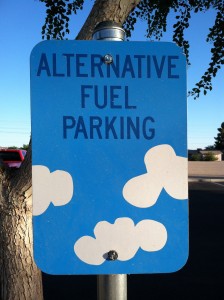 We recently visited a local library in the state of Arizona and were surprised to find opposite the obligatory row of 6 handicapped parking spots, reserved nearest the library entrance, a gratuitous row of 8 Alternative Fuel Parking spaces.
 Few appear to understand that stem cells that cure an array of illnesses and conditions have already been discovered, and are being utilized in clinics around the world to heal thousands of patients. The stories that are reported on network news and in other mainstream media outlets about “scientists” working on the development of stem cells are essentially propaganda of Pharmaceutical giants and the political left to hide the truth that “adult” stem cells are here and working.
 With so many drivers looking to stretch their gas dollars many have discovered that avoiding fuel laced with ethanol can be cost effective. Ethanol, an alcohol derived from corn, is causing additional wear and tear on cars according to many owners, and is less efficient than pure gasoline.
Reader Responses