
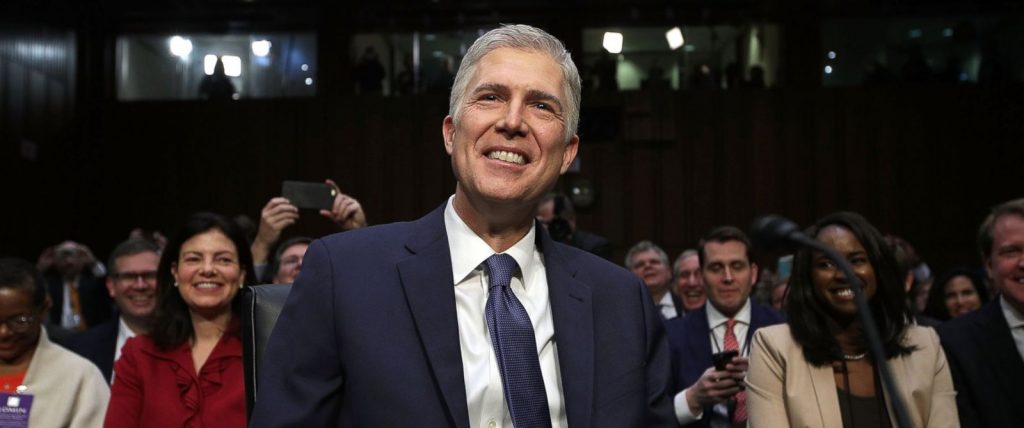
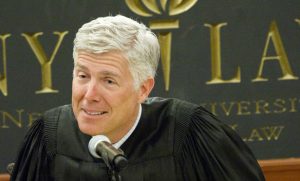
The Senate confirmed Judge Neil Gorsuch to the Supreme Court on Friday, filling the critical ninth seat that has been vacant for over a year and capping a tumultuous debate that saw Republicans overhaul the way the chamber operates in order to overcome what they described as an unprecedented Democratic filibuster.
The 54-45 vote, in which three Democrats crossed party lines to support the appeals court justice, is expected to restore a 5-4 conservative tilt on the bench. Once sworn in, Gorsuch will join the court and begin to hear cases, in the seat once held by the late Justice Antonin Scalia, who died in February 2016.
“He’s going to make the American people proud,” Senate Majority Leader Mitch McConnell, R-Ky., said.
Republicans lauded Gorsuch as an eminently qualified jurist and a fitting successor to Scalia. But Democrats accused him of giving evasive answers during his confirmation hearing, and claimed his past rulings showed a tendency to favor business interests over workers. More broadly, Democrats remain furious that Republicans under McConnell’s leadership blocked consideration of former President Barack Obama’s nominee Merrick Garland, in turn allowing Trump to nominate Gorsuch.
These partisan tensions exploded on the Senate floor this week, as Democrats mounted a filibuster against Gorsuch, prompting Republicans to use what’s known as the “nuclear option” Thursday to force a final vote.
Each party blamed the other for the escalation, accusing the other side of damaging long-standing institutions.
“Damage was done to our democracy,” Sen. Richard Blumenthal, D-Conn., said Friday. “Raw political power has been exercised to break the rules and norms of this body.”
But McConnell claimed that Republicans only triggered the nuclear option to “restore norms” that Democrats had defied.
Republicans pursued that course after Democrats blocked the nominee on Thursday, denying him the 60 votes needed to proceed to a final roll call. McConnell in turn executed a series of parliamentary maneuvers that resulted in the threshold being lowered to 51 votes. With that standard, Gorsuch easily advanced to the final vote on Friday.
McConnell said he made the move “for the sake of our country.”
McConnell’s predecessor as Senate majority leader Harry Reid, now retired, took the first step down the “nuclear” road by lowering the threshold for other nominees in 2013 – a controversial move Republicans frequently brought up on the road to Friday’s final vote.
But lowering the threshold for a Supreme Court pick is a more significant step. It means for the foreseeable future, the minority party will have significantly less leverage to oppose any nominee to the highest court in the land, no matter who is president.
Senate Minority Leader Chuck Schumer, D-N.Y., said there will be “less faith in the Supreme Court” going forward.
Republicans say Democrats have been unfair to an otherwise qualified nominee and have wrongly cast him as an ideologue.
“Rarely has this body seen a nominee to the Supreme Court so well-qualified, so skilled, [with] such command of constitutional jurisprudence, with such an established record of independence and such judicial temperament,” Sen. John McCain, R-Ariz., said Friday.
All Republicans present voted yes on Friday; Sen. Johnny Isakson, R-Ga., struggling with health issues, did not vote. Vice President Pence presided.
The three Democrats who voted for Gorsuch were North Dakota’s Heidi Heitkamp, West Virginia’s Joe Manchin and Indiana’s Joe Donnelly — all moderate Democrats facing challenging reelection bids next year in red states.
Gorsuch is expected to take the oath on Monday.
By Judson Berger Fox News’ Chad Pergram and Bill Mears contributed to this report.

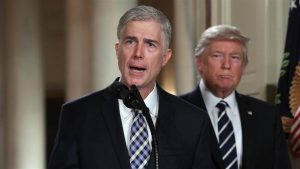 Senate Republicans have voted to stop the Democrats’ filibuster of President Trump’s nominee to the Supreme Court, invoking the so-called nuclear option.
 House Intelligence Committee Chairman Devin Nunes on Thursday stepped down temporarily from his role leading the committee’s probe of Russian interference in the 2016 presidential campaign and possible surveillance of Trump associates by the prior administration.
 House Speaker Paul Ryan backed Nunes’ decision.
 The Pentagon now assesses the North Korean missile launch Wednesday likely was a failure, Fox News has learned.

 Susan Rice claimed ignorance on Trump team surveillance, before role in unmasking revealed
 Rice, however, has her past issues with public statements.
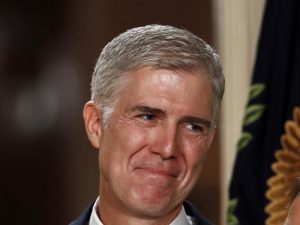 The Senate Judiciary Committee voted Monday along party lines to endorse Judge Neil Gorsuch for the Supreme Court, setting up a showdown between Democratic and Republican senators in a series of final votes expected later this week.
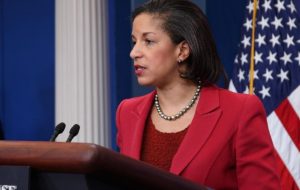 Multiple sources tell Fox News that Susan Rice, former national security adviser under then-President Barack Obama, requested to unmask the names of Trump transition officials caught up in surveillance.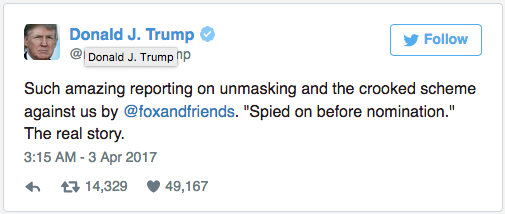
 Russia is known for many things—communism, vodka and bizarre dancing, for starters—but one thing Russia is not well-known for is its sense of humor. Perhaps that’s about to change.

 This weekend, the NY Times will publish a front-page story on former Donald Trump advisor Paul Manafort. Can you guess what shocking revelation the Times will be sharing with its readers? No doubt it will highlight Manafort’s long-time business activities in Russia, and close with a comment from another ubiquitous anonymous source, reminding the reader that the justice Department is investigating certain Trump advisors and their “alleged” contact with Russians during the 2016 Campaign. You can be sure that the Times article will not mention that this investigation, which is becoming more disturbing everyday, has yet to find the slightest bit of evidence indicating wrong-doing on the part of Trump or his staff. Between the Washington Post and the Times, its beginning to appear as if these two once-respected newspapers are taking turns, publishing stories about Trump advisors or cabinet members, which provide nothing but the same basic allegation, dressed up with the all-important comment from the secret source. Currently, journalists in DC seem to have an endless supply of inside government sources. At first, these leakers caused a firestorm by providing the Associated Press and others with the identity of three Trump advisors or confidants who had met with Russian government officials during the campaign. What should be most disturbing is the willingness of the AP, the Post and the Times, to print information which is obviously classified and illegally obtained.
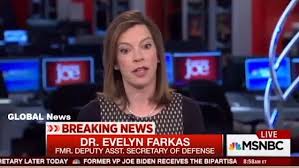 The White House is asking Congress to dig deeper into whether communications of Trump associates were improperly picked up and disseminated during surveillance operations, after an ex-Obama administration official suggested her former colleagues tried to gather such material.
 Maricopa County Sheriff Joe Arpaio was formally charged with criminal contempt of court, with liberal Obama prosecutors saying he disobeyed a liberal judge’s order by detaining illegal aliens in his county after being told to look the other way. The sheriff for much of the Phoenix metro area could face up to six months behind bars if convicted.
 Discussing ethics with liberals can be tough. While they tend not to respond to arguments featuring universal truths such as those commonly found in the realm of religion, I’ve found a sure-fire way to start such a discussion with a liberal: namely, ask the age-old question, “What would happen if everyone did what you do?” For example, is shoplifting really that bad? Think about if everyone was a shoplifter. Is it unethical to keep multiple McMansions, swimming pools, and foreign luxury cars? Is flying on jumbo jets, eating at Michelin-star restaurants, and staying at luxury hotels unethical? Just ask what would happen if everyone could. In the most literal sense, what if the Earth’s seven billion people consumed as much food, fossil fuel, electricity, plastic, or anything else as does a typical wealthy liberal family? I don’t think it’s a stretch to say that if the masses in India or Vietnam could match that lifestyle, they would do so in a heartbeat.
 The use of parochial imagery here is no mistake: the “Church of Climate Change” is most certainly a church, based on a shared faith–a dogma really. Take for example one of its more obvious rituals, the annual “Earth Hour.” As part of the event’s solemn rites, residents in thousands of cities worldwide are encouraged to turn off their lights for 60 minutes, to express their solidarity with protecting the environment. Just as many relig





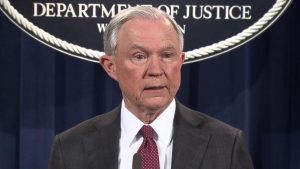 Attorney General Jeff Sessions has asked the remaining 46 U.S. attorneys to resign, the Justice Department announced Friday, describing the move as part of an effort to ensure a “uniform transition.”
Recent Comments