• Home
  • Mission
  • Federalist Papers
  • Foundation
  • U.S. Constitution
  • Bill of Rights

Federalist Press | Defending Liberty — Informing America

Breaking News and Political Commentary

  • All Stories
  • Economy
  • Elections
  • Entitlement
  • Ethics
  • Foreign
  • Gender
  • Religion
  • Sci-Tech

Obama Admin Paying for Labor Unions Worldwide

April 27, 2013 By Editor Leave a Comment

Hatch_OrrinSenate Republicans say the Labor Department appears to be spending millions in taxpayer dollars to establish labor unions and promote collective bargaining in foreign countries and is asking top Obama administration officials for a full audit.

The request was sent by Utah Sen. Orrin Hatch, the leading Republican on the Senate Finance Committee, and Tennessee Sen. Lamar Alexander, the top Republican on the Health, Education, Labor and Pensions Committee.

“At a time when our federal budget is deteriorating rapidly … it is troubling to us that the department appears to be spending millions of dollars of taxpayer funds to establish labor unions and promote collective bargaining in foreign countries,” they said in a letter to acting Labor Secretary Seth Harris.

The purported activities were conducted by the agency’s Bureau of International Labor Affairs.

The bureau for the past several years has purportedly made numerous awards — worth millions of dollars — to the United Nations, the Solidarity Center and other similar groups, “whose stated objective is to help establish labor unions in foreign countries,” the senators said.

They also said the bureau recently awarded a Colombian labor organization $1.5 million to help workers improve their collective bargaining rights and $2.2 million to the Solidarity Center, an AFL-CIO organization, to strengthen unions in Haiti and Peru.

In addition, the bureau purportedly awarded a $1.5 million grant to an international development company in 2011 to assist labor unions in Vietnam engage in collective bargaining, the lawmakers said.

The letter was also sent to Government Accountability Office Comptroller General Gene Dodaro. The BILA did not return a request Saturday for a response.

The bureau’s stated mission is to “help ensure that workers around the world are treated fairly and are able to share in the benefits of the global economy.”

The agency also states it focuses on protecting workers’ ability to exercise their rights and addressing the workplace exploitation of children and other vulnerable populations.

Published April 27, 2013 / FoxNews.com

Filed Under: All Stories, Economy, Elections, Entitlement, Ethics, Foreign

Muslim Preacher Tells Followers: Getting Welfare Cash For Holy Wars Is Easy And Right

April 25, 2013 By Editor Leave a Comment

Anjem_ChoundaryA Muslim preacher has been secretly recorded explaining to followers how to receive government assistance they can use to fund a Muslim holy war.

Calling it a “Jihadi Allowance,” cleric Anjem Choundary, 45, has four kids, brings in £25,000, or just under $39,000 U.S. in benefits himself, and says that this is the way it is supposed to work according to Islamic law.

Recorded by both the U.K. Sun and Telegraph, Choundary says:

  • “We are on Jihad Seekers Allowance, we take the Jizya (protection money paid to Muslims by non-Muslims) which is ours anyway.
  • “The normal situation is to take money from the [non-Muslims] isn’t it? So this is the normal situation.”
  • “They give us the money. You work, give us the money. Allah Akbar, we take the money.  Hopefully there is no one from the DSS (Department of Social Security) listening.”
  • “Ah, but you see people will say you are not working. But the normal situation is for you to take money from the Kuffar (non-Muslim) So we take Jihad Seeker’s Allowance.”

Choudray goes on in a separate videos to mock English workers performing 9 to 5 jobs, and tells followers that some of the most famous Islamic figures worked only one or two days a week.

“The rest of the year they were busy with jihad [holy war] and things like that,” he says, according to The Telegraph. “People will say, ‘Ah, but you are not working.’”

“But the normal situation is for you to take money from the kuffar [non-believers].”

“So we take Jihad Seeker’s Allowance. You need to get support.”

He the tells a crowd of about 30 followers: “We are going to take England — the Muslims are coming.”

“These people are like a tsunami going across Europe. And over here we’re just relaxing, taking over Bradford brother. The reality is changing.”

By Robert Johnson

Video of Anjem Choundary

Filed Under: All Stories, Economy, Elections, Entitlement, Ethics, Foreign, Religion

Media Blame US for Boston Bombings, Ignore Radical Islam Ties

April 24, 2013 By Editor Leave a Comment

liberal_media_MatthewsComedian George Carlin famously joked about the seven words you couldn’t say on air. Add two more – “Islam” and “Muslim” – but only if you use them in a negative context.

In the week following the terror attack on the Boston Marathon, lefties and their media clones have been desperate to point out the attack had nothing to do with those two scary words.

After all, journalists and pundits have had time to reflect on the bombing – from the safety of their posh offices and not Boston’s crowded hospitals. The brothers were just poor and misunderstood. It can’t be their fault.

The Brothers Tsarnaev have set media tongues a-wagging looking for someone to blame other than Muslims – like Americans.

Famed newsman Tom Brokaw took up the blame America crusade on Sunday’s NBC “Meet the Press,” discussing “motivation” like he was in an entry-level acting class.

Today in American we have a media so obsessed with feeling good about themselves, that America can’t have a conversation about the dangers of radical Islam.

According to Brokaw, we’re to blame. “I think we also have to examine the use of drones that the United States is involved in and – and there are a lot of civilians who are innocently killed in a drone attack in Pakistan, in Afghanistan, and in Iraq.”

Why? American “presumptuousness,” a crime which now merits the death penalty in certain Islamic circles.

The Washington post claimed on Tuesday that “Boston Marathon bombing suspects elude labels.” Oh? How about radical Islamic terrorists? Radical Muslim terrorists?

According to AP, “U.S. officials said Tuesday, adding another piece to the body of evidence they say suggests the two brothers were motivated by an anti-American, radical version of Islam.”

The media felt they knew better.

At MSNBC, they must be hanging gymnastics medals after the contortions it put its staff through.

media_pcWhen MSNBC’s Rachel Maddow asked a Georgetown professor about “some radicalized YouTube clips” on the older brother’s YouTube page, she received a classic response.

Prof. Charles King told her: “Well, and keep in mind that on his, on the elder brother’s, Tamerlan’s YouTube channel, there are an equal number of rap videos.” When Georgetown professors start commenting on the content of rap videos, it’s fair to say they’re clueless. Or tragically unhip.

Another MSNBC host continued that smokescreen theme, comparing the bombers to famous murderers.

On Tuesday, Alex Wagner said if the brothers had acted alone, “it ends debate regarding whether to try him as an enemy combatant,” wrote Mediaite. “With no ties to foreign terrorist networks, there would be little difference between him and so-called homegrown and lone wolf terrorists including Timothy McVeigh and Ted Kaczynski.” Only neither of those was motivated by a global belief system linked to hundreds or thousands of terror attacks.

Perhaps, instead of being PC, they might address the issue of radical Islam, especially since two Muslim men were just arrested for a Canadian terror plot.

The media are doing law-abiding American Muslims no favors by refusing to acknowledge a problem – radical Islam – that threatens them as well. But note the term, “radical Islam.”

It is not being overly PC to admit that millions of American Muslims don’t go blowing up their neighbors. Since I have Muslim neighbors, I appreciate that fact.

On Monday, Politico’s Josh Gerstein claimed that “the Boston Marathon bombing suspects’ geopolitical leanings are still largely a mystery.”

He clearly didn’t watch a week filled with news where we learned the older of the Tsarnaev brothers had visited Russia’s terrorist-filled Dagestan. And that Russia had asked the U.S. to investigate his ties to radical Islam. Oopsie.

One of The Atlantic’s “reporters” even did her best to minimize the skill of the terrorists to downplay the attack. “The more we learn of Boston bombers the more they seem like bumblers. And there’s the rub: any idiot can terrorize, doesn’t require genius,” tweeted Garance Franke-Ruta Tuesday.

Boston health authorities say 264 people were treated at local hospitals, along three killed.

Evil? Yes! Bumblers? Hardly.

Then there were those who couldn’t let that old crisis go to waste. So they used a terror attack on Americans to promote…gun control. New Yorker editor David Remnick told the “Charlie Rose” show that guns were part of the problem.

“We see yet another act which might have been a Hell of a lot more difficult to pull off with effective gun control.” Remnick is a Pulitzer Prize winner. Unsurprisingly, he didn’t get it in logic.

Even my friend, lefty radio host Thom Hartmann used the bombing to attack “all forms of religious fundamentalism that lead to violence.” Thom, like most liberals, isn’t especially tolerant of religion and said this was “a good opportunity for us to have a conversation about modernity versus Bronze Age gods.” Nothing says open-mindedness like calling Christianity “Bronze Age gods.”

What it all adds up to, is a media so obsessed with feeling good about themselves, that America can’t have a conversation about the dangers of radical Islam. It’s a world tailor made for people like nutty columnist David Sirota (OK, that’s like saying “wet ocean”). Sirota, you’ll recall, hoped that the bombers might be “a white American.”

As it turns out, it didn’t matter. The media just report what they want anyhow.

Dan Gainor is the Boone Pickens Fellow and the Media Research Center’s Vice President for Business and Culture. He writes frequently about media for Fox News Opinion. He can also be contacted on Facebook and Twitter as dangainor.

Share Your Thoughts Below

Filed Under: All Stories, Economy, Elections, Ethics, Foreign, Religion

Price of Political Correctness

April 24, 2013 By Editor Leave a Comment

People are defined by their deeds, their actions. Not their words. But the way we communicate can be both reflective of our behavior and an influence on it going forward.

PCWhat we call political correctness, for example, reflects societal behavior, how our culture has changed. It also influences societal behavior. In that sense, it reinforces the trajectory of that cultural change.

That makes it a powerful way to understand where we are and where we’re going as a nation, as an economy, and as people. It also shows the effect our words have on how we lead, how we work, and how we live.

How the trend toward political correctness came into being is anyone’s guess. At this point, it doesn’t really matter. It’s everywhere. It’s pervasive. The only way to deal with it is to understand what it is:

It’s collectivism, which destroys individualism. Competition is bad. Everyone’s a winner. Everyone has to be included and treated the same. Singling out individuals as special or unique excludes others, so that’s out. Lost is individual responsibility and accountability, the drive to compete and win, the motivation to be recognized for achievement and superior performance.

It levels the playing field, brings everyone down to the lowest common denominator. Star performers have to take it down a notch so everyone can be included. Like when you bring slower students into a gifted class, everything has to be dumbed down. It diminishes team performance and organizational effectiveness.

sheriff-political-correctnessEverything has to be filtered to ensure no one is offended or gets into trouble. That slows down information processing, waters down communication, strips out critical data, and dilutes meaning. As a result, it undermines genuine understanding and effective decision-making.

Now, here’s the confusing part. Finger pointing and blaming others is tolerated, even encouraged. Leaders blame their predecessors; parents blame teachers; society blames victims. It’s everybody’s fault but whoever is really responsible. That’s because nobody is accountable. There are no enemies or bad guys. That wouldn’t be inclusive. Including them will fix them.

In short, it’s Ayn Rand’s Atlas Shrugged come to life. It’s a nightmare. And its implications are far reaching.

The Boston Marathon bombing wasn’t the fault of some sick, twisted, cowardly, barbarian terrorists, “It was tax day,” according to former Obama advisor David Axelrod. And former Congressman Barney Frank used it as an opportunity to make a political argument for a “well-funded” government.

Nobody can blame President Obama for our out of control debt and sluggish economy. Of course not. It’s former President Bush’s fault.

political_correctness_cartoonFormer secretary of State Hillary Clinton isn’t responsible for the Benghazi attacks and four murdered Americans including Ambassador Chris Stevens; it’s a congressional funding problem.

Business leaders and managers are less willing to give employees genuine feedback because they’re afraid of being sued or accused of harassment, discrimination, or being a bully. You can’t even compliment how someone looks or show any genuine emotions anymore. That might create a hostile work environment.

When you remove personal responsibility by telling people they’re doing great when they’re not and giving them stuff for doing nothing, in time, they feel like they deserve it. That’s where our growing entitlement culture is coming from.

And when we fail to provide people with incentives to work hard and live in a fiscally responsible way as a means to long-term happiness and security, guess what they do? They sit on their butts all day and Tweet, like, update, play games, watch reality TV, and get fatter and fatter.

political-correctnessAnd how about our growing youth violence problem? If you don’t teach children personal responsibility – adult responsibility – they never grow up. And what do children do when you don’t give them attention? They throw tantrums. And any good shrink will tell you, if children can’t get positive recognition, they’ll take negative attention instead. Anything that’s self-affirming, that feeds their egos.

While it’s clear that political correctness is reflective of our societal norms, it also influences where our culture is heading. If I’m not mistaken, it’s turning us into a nation of people who look like adults but act like entitled children, who act out when they don’t get what they want or feel they deserve.

How do we stop that from happening? Don’t be politically correct. Here’s how:

Behave like an adult.

Hold yourself and others accountable.

Don’t try to be something you’re not.

Say what you mean and mean what you say.

Have a sense of humor, humility, and perspective.

Work hard, play to win, and respect the competition.

Don’t be afraid to do the right thing, no matter what.

Be proud of yourself, your loved ones, and all your accomplishments.

By Steve Tobak, a Silicon Valley-based strategy consultant and former senior executive of the technology industry. Contact Tobak; follow him on Facebook, Twitter, or LinkedIn.

Share Your Thoughts Below

Filed Under: All Stories, Economy, Elections, Entitlement, Ethics, Gender, Religion

Online Tax is Washington Money Grab That Will Hurt Small Business

April 23, 2013 By Editor Leave a Comment

online-taxOne of the most controversial pieces of legislation currently making its way through the Senate is the Marketplace Fairness Act. In essence, it would allow states to collect taxes from online purchases even if the online store doesn’t have a physical presence in the state. Brick-and-mortar stores claim the bill levels the playing field with online retailers while opponents say it would put undue regulations on online businesses while making the tax code even more cumbersome. Guess which side the White House agrees with.

The Hill reports that the White House has formally announced its support for the Marketplace Fairness Act. The newfound endorsement was a key factor in the Senate voting in favor of the bill during a procedural vote on Monday evening.

The idea of an online sales tax is nothing new. Retail stores, represented by the National Retail Federation, have been pushing for an online sales tax bill for years after the Supreme Court ruled in Quill Corp v. North Dakota that a state could not levy sales tax against a company if it had no physical presence in the state. Numerous online retailers use this to get around sales tax, and retail stores say this gives them an unfair advantage.

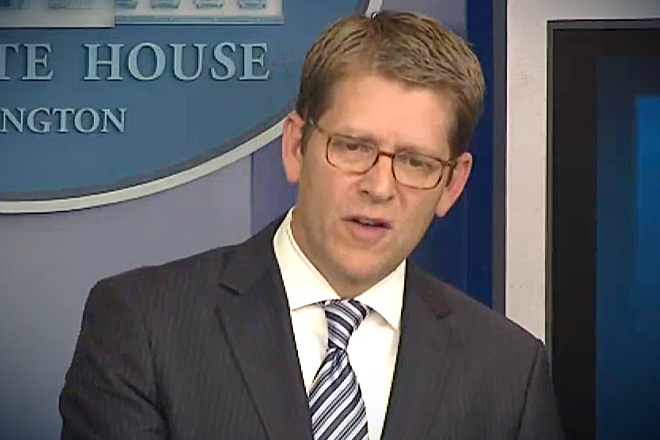
The White House completely agrees. In a statement to the press on Monday, White House press secretary Jay Carney said the bill would level the playing field for brick-and-mortar stores and online retailers:

“This administration has carefully considered the legislation, and our team has met with a broad array of people on the issue. And we have heard overwhelmingly from governors, mayors and the business community on the need for federal legislation to level the playing field for our businesses and address sales tax fairness.”

The Nation Retail Federation isn’t the only group pushing for the Senate to pass the Marketplace Fairness Act. Governors around the country, including Chris Christie of New Jersey and Rick Snyder of Michigan, have voiced their support for the bill. States are hurting for revenue, and they feel that a national mandate on sales tax will bring billions of revenue back to the states. Carney echoed the governors by saying that the potential tax revenue would help states fund “K-12 education, police and fire protection, access to affordable health care, and funding for roads and bridges.”

Even if the bill is able to pass the Senate during a final vote later this week, it faces plenty of opposition. The Republican-controlled House is just one of the many challenges the Marketplace Fairness Act faces as it progresses through the legislature. Obviously online businesses are coming out against it. Ebay has been especially hostile towards the legislation, and has even started recruiting its sellers to protest the bill.

The common complaint from Ebay and other businesses opposed is that the bill would put undue burdens on online retailers. The current tax system has created a symbiotic relationship between online companies and the states. The states attract online companies to set up a physical presence in a state through a number of perks while the company brings tax revenue and jobs to the state in question. A universal online sales tax destroys that relationship by making online companies collect sales taxes for states that they receive no benefit from.

The current legislation offers sales exemptions to online businesses that make less than $1 million annually. Ebay is currently lobbying Senators to add an amendment that would up this exemption to $10 million.

One company that’s already benefiting from that symbiotic relationship has come out strongly in favor of the bill though. Amazon, which has a number of distribution centers across the country, says that it favors the bill because it creates a unified national framework for tax collection.

Despite the Senate’s overwhelming support of the bill, TechDirt points out that Sen. Ron Wyden has come out strongly against it saying that it negatively impacts innovation.

Another group standing in the bill’s way is Wall Street as it argues that the legislation, as it stands, could negatively affect financial transactions. One group in particular, the Financial Services Roundtable, says that a sales tax on financial transactions would hurt just about everyone:

“A transaction tax on financial services products will hurt retail investors, retired Americans, and small businesses, effectively making it more expensive for them to invest and plan for the long-term. Without hearings, these implications and others will not be properly addressed.”

It should be noted that the Marketplace Fairness Act isn’t a done deal in the Senate. Monday’s vote was only procedural. Now the Senate will get to work on adding amendments to the bill with a final vote scheduled for Thursday or Friday.

Unless something disastrous happens, the bill will probably pass the Senate without much of a fight. A glowing endorsement from the White House has made sure of that.

During the debate in the Senate and the House, you’re likely to see the following argument – Do we even need an online sales tax bill? Is there any real reason to throw a bone to the retail businesses that implement stupid strategies like a $5 window shopping fee.

One compelling argument is that retail stores should find ways to better compete with online businesses. The retail store still has a few advantages over online businesses, but are they really capitalizing on those advantages?

At this point, it’s too early to tell exactly what kind of damage, if any, the Marketplace Fairness Act would cause. It could possibly do nothing, but some are right to fear that it would legitimately hurt the operations of online retailers.

Do you think that retail stores need a level playing field? Will the Marketplace Fairness Act negatively affect small online businesses?

Zach Walton is a Writer for WebProNews. He specializes in gaming and technology. Follow him on Twitter, StumbleUpon, Pinterest, and Google+ +Zach Walton

Filed Under: All Stories, Economy, Elections, Entitlement, Ethics

Obama Phones Cost $2.2 billion

April 23, 2013 By Editor Leave a Comment

obama-phoneWhat started out as an effort by President Reagan to help poor people in rural areas have a phone in cases of emergency has mushroomed into what critics suspect is a new welfare program.

“The cost has gone from $143 million a few years ago to $2.2 billion today,” Republican Louisiana Sen. David Vitter said, noting that today’s cost is 15 times what it was.

The cost of the program increased dramatically after cellphones were added in 2008. Only low-income people on welfare and food stamps legally qualify, but some lawmakers say the program is out of control.

Sen. Claire McCaskill, a Democrat from Missouri, was incensed when she got an offer of a free phone.

“I got solicitation for a free phone at my apartment, which is certainly not a building where you’re going to have people who are qualified for free phones. … There is clearly money being wasted here.”

And Vitter adds, “The FCC, itself, said in a recent year there were 270,000 beneficiaries that had more than one of these subsidized cellphones. That’s completely against the law right there.”

Funded by a small tax on all phone bills, the program has exploded — with companies advertising free phones and offering 250 minutes.

Harold Feld of a group called Public Knowledge notes, “you have a lot of these prepaid-phone, no-contract options that are obviously very popular.”

The FCC told lawmakers the top five companies can’t verify the eligibility of 41 percent of those who get phones.

“I hear from law enforcement that these phones are often found at crime scenes and are used in drug deals,” Republican Rep. Tim Griffin of Arkansas said. “Why? It’s because you can’t trace them.”

“Just handing out phones willy nilly and allowing them to be sold on the black market,” Sen. McCaskill said. “This isn’t the way to do it, and we need to stop.”

Some recipients famously called them “Obama phones,” with one boasting to the media during the election that minorities should support the president precisely because he gave them free cellphones.

That is not true, and many are appalled by the abuse in the program. One supporter, however, argues cellphones are helpful because they’re not just for emergencies:

“It’s how we find jobs, it’s how we now participate in all the activities in the economy,” Feld said.

But McCaskill says those looking for work could simply check out a phone from the unemployment office or a shelter.

With so much abuse in the current program, she is now concerned about some new proposals: “What’s really worrisome to me is now the FCC wants to expand to this program into broadband. That’s a very bad idea, I think.”

She says such a waste of money makes taxpayers think government just isn’t paying attention. And she says the current program is so far out of control, we should simply scrap it and start over, not expand it.

By Jim Angle / Published April 22, 2013 / FoxNews.com

Filed Under: All Stories, Economy, Elections, Entitlement, Ethics

Dems Trying to Tax Online Shoppers

April 22, 2013 By Editor Leave a Comment

internet_online_taxStates could force Internet retailers to collect sales taxes under a bill that overwhelmingly passed a test vote in the Senate Monday.

Under current law, states can only require stores to collect sales taxes if the store has a physical presence in the state. As a result, many online sales are essentially tax-free, giving Internet retailers a big advantage over brick-and-mortar stores.

The bill would allow states to require online retailers to collect state and local sales taxes for purchases made over the Internet. The sales taxes would be sent to the states where shoppers live.

The Senate voted 74 to 20 to begin debating the bill. If that level of support continues, the Senate could pass the bill as early as this week.

Supporters say the bill is about fairness for businesses and lost revenue for states. Opponents say it would impose complicated regulations on retailers and doesn’t have enough protections for small businesses. Businesses with less than $1 million a year in online sales would be exempt.

“I believe it is important to level the playing field for all retailers,” said Sen. Mike Enzi, R-Wyo., the bill’s main sponsor. “We should not be subsidizing some taxpayers at the expense of others.”

In many states, shoppers are required to pay unpaid sales tax when they file their state income tax returns. However, states complain that few people comply.

“I do know about three people that comply with that,” Enzi said.

President Barack Obama supports the bill, but its fate is uncertain in the House, where some Republicans regard it as a tax increase. Heritage Action for America, the activist arm of the conservative Heritage Foundation, opposes the bill and will count the vote in its legislative scorecard.

Many of the nation’s governors — Republicans and Democrats — have been lobbying the federal government for years for the authority to collect sales taxes from online sales, said Dan Crippen, executive director of the National Governors Association. Those efforts intensified when state tax revenues took hit from the recession and the slow economic recovery.

“It’s a matter of equity for businesses,” Crippen said. “It’s a matter of revenue for states.”

The bill pits brick-and-mortar stores like Wal-Mart against online services such as eBay. The National Retail federation supports it. And Amazon.com, which initially fought efforts in some states to make it collect sales taxes, supports it, too.

“Amazon.com has long supported a simplified nationwide approach that is evenhandedly applied and applicable to all but the smallest volume sellers,” Paul Misener, Amazon’s vice president of global public policy said in a recent letter to senators.

On the other side, eBay has been rallying customers to oppose the bill.

“I hope you agree that imposing unnecessary tax burdens on small online businesses is a bad idea,” eBay president and CEO John Donahoe said in a letter to customers. “Join us in letting your Members of Congress know they should protect small online businesses, not potentially put them out of business.”

The bill is also opposed by senators from states that have no sales tax, including Sen. Max Baucus, D-Mont., and Sen. Kelly Ayotte, R-N.H.

“Supporters of this online sales tax bill are trying to muscle it through before senators find out how disastrous it would be for businesses in their states,” Ayotte said. “I will fight this power grab every step of the way to protect small online businesses in New Hampshire and across the nation.”

Baucus said the bill would require relatively small Internet retailers to comply with sales tax laws in thousands of jurisdictions.

“This legislation doesn’t help businesses expand and grow and hire more employees,” Baucus said. “Instead, it forces small businesses to hire expensive lawyers and accountants to deal with the burdensome paperwork and added complexity of tax rules and filings across multiple states.”

But Sen. Dick Durbin, D-Ill., said the bill requires participating states to make it relatively easy for Internet retailers to comply. States must provide free computer software to help retailers calculate sales taxes, based on where shoppers live. States must also establish a single entity to receive Internet sales tax revenue, so retailers don’t have to send them to individual counties or cities.

“We’re way beyond the quilt pen and leger days,” Durbin said. “Thanks to computers and thanks to software it is not that complex.”

Published April 22, 2013 / Associated Press

Filed Under: All Stories, Economy, Elections, Entitlement, Ethics

Top Dem Sen. Baucus Warns of ‘Train Wreck’ for Obamacare

April 18, 2013 By Editor Leave a Comment

maxbaucusA senior Democratic senator who helped write President Obama’s health care law stunned administration officials Wednesday, saying openly he thinks it’s headed for a “train wreck.”

“I just see a huge train wreck coming down,” Senate Finance Committee Chairman Max Baucus, D-Mont., told Obama’s health care chief during a routine budget hearing that suddenly turned tense.

Baucus is the first top Democrat to publicly voice fears about the rollout of the new health care law, designed to bring coverage to some 30 million uninsured Americans through a mix of government programs and tax credits for private insurance that start next year.

The six-term Democrat is also expected to face a tough re-election in 2014. Baucus is still trying to recover from approval ratings that nosedived amid displeasure with the health care law in his home state.

Normally low-key and supportive, Baucus challenged Health and Human Services Secretary Kathleen Sebelius at Wednesday’s hearing.

He said he’s “very concerned” that new health insurance marketplaces for consumers and small businesses will not open on time in every state, and that if they do, they might just flop because residents don’t have the information they need to make choices.

“The administration’s public information campaign on the benefits of the Affordable Care Act deserves a failing grade,” he told Sebelius. “You need to fix this.”

Responding to Baucus, Sebelius pointedly noted that Republicans in Congress last year blocked funding for carrying out the health care law, and she had to resort to raiding other departmental funds that were legally available to her.

The administration is asking for $1.5 billion in next year’s budget, and Republicans don’t seem willing to grant that either.

“I don’t know what he’s looking at,” Sebelius told reporters following her out of the room after Baucus adjourned the hearing. “But we are on track to fully implement marketplaces in Jan. 2014, and to be open for open enrollment.”

That open-enrollment launch is only months away, Oct. 1. It’s when millions of middle-class consumers who don’t get coverage through their jobs will be able to start shopping for a private plan in the new marketplaces, or exchanges. They’ll also be able to find out if they qualify for tax credits that will lower their premiums. At the same time, low-income people will be steered to government programs, mainly an expanded version of Medicaid.

But half the states, most of them Republican-led, have refused to cooperate in setting up the infrastructure of Obama’s law. Others, like Montana, are politically divided. The overhaul law provided that the federal government would step in and run the new markets if a state failed to do so. Envisioned as a fallback, federal control now looks like it will be the norm in about half the country, straining the resources of the department Sebelius leads.

Published April 18, 2013 / Associated Press

Filed Under: All Stories, Economy, Elections, Entitlement, Ethics

IRS Agents Caught Stealing – From You

April 18, 2013 By Editor Leave a Comment

government_spendingMEMPHIS, Tenn. –  Twenty-four current and former Internal Revenue Service employees have been charged with stealing government benefits, federal prosecutors said Wednesday.

The IRS employees were indicted on charges that they illegally received more than $250,000 in benefits including unemployment insurance payments, food stamps, welfare, and housing vouchers, the U.S. attorney’s office in Memphis said in a news release.

Prosecutors say 13 of the IRS employees face federal charges of lying about being unemployed while applying for or recertifying their government benefits. They each face up to five years in prison if convicted of making false statements to receive the benefits.

Eleven others face state charges of theft of property over $1,000, a felony that can carry a sentence of probation up to 12 years in prison if they are convicted.

“While these IRS employees were supposed to be serving the public, they were instead brazenly stealing from law-abiding American taxpayers,” U.S. Attorney Edward Stanton said in a statement

Those charged range in ages from 28 to 64. They include residents of Memphis, Jackson, Tenn., and Southaven, Miss.

“The taxes that we pay are supposed to support our nation and assist individuals in need, not free-loaders who are gaming the system,” said Amy Weirich, the district attorney for Shelby County.

Prosecutors scheduled, then canceled, a news conference to announce the indictments. U.S. attorney’s office spokesman Rodney King said the cancellation was due to “unforeseen events,” without elaborating.

King would not say whether the cancellation was related to the investigation into two letters sent to President Barack Obama and a Mississippi senator that indicated they contained poisonous ricin.

The FBI says the letters were postmarked Memphis.

Published April 18, 2013 / Associated Press

Filed Under: All Stories, Economy, Elections, Entitlement, Ethics

Background Check Plan Fails in Senate, Obama Rips Gun Owners

April 18, 2013 By Editor Leave a Comment

arrogance_obamaThe Senate on Wednesday defeated a vital background check amendment seen as the linchpin to Democrats’ gun control bill, dealing a major setback to President Obama — who lashed out at opponents in unusually blunt terms during remarks from the Rose Garden.

“All in all, this was a pretty shameful day for Washington,” Obama said, accusing the gun lobby of lying about the bill.

The vote was 54-46, with supporters falling six votes short of the required 60-vote threshold.

The failure of the background check proposal authored by Sens. Joe Manchin, D-W.Va., and Pat Toomey, R-Pa., now imperils the entire legislation. The proposal would have expanded background checks to gun shows and Internet sales while exempting personal transactions. The amendment was aimed at winning over reluctant conservatives, who were opposed to the more stringent background check plan in the existing bill.

It’s unclear where supporters will go from here. They could try to vote again, or craft an alternative piece of legislation.

Obama vowed to press on, saying the vote was “just round one,” while decrying those he claimed “caved” to political pressure.

“The gun lobby and its allies willfully lied about the bill,” Obama said. He said the claims “upset” some gun owners who in turn “intimidated” senators.

“There were no coherent arguments as to why we couldn’t do this. It came down to politics,” he said.

In a statement, Manchin said that while he is disappointed in the outcome of today’s vote, that “this is not the end of the debate.”

Opponents, which included a few Democrats, voiced concern that the proposal would infringe on Second Amendment rights by imposing a burden on those buying and selling guns. They claimed the proposed system would not have prevented Newtown, and would not stop criminals. They also voiced concern about the possibility that the expanded system could lead to a gun registry, though the amendment language prohibits this.

The NRA said in a statement that the amendment “would have criminalized certain private transfers of firearms between honest citizens, requiring lifelong friends, neighbors and some family members to get federal government permission to exercise a fundamental right or face prosecution.”

But Senate Majority Leader Harry Reid and other Democrats hammered Republicans for not voting in support and vowed to press forward.

“I want everyone to understand this is just the beginning, not the end,” said Reid. “Today, the brand of the Republican Party has become more out of step, more extreme. And that’s saying something.”

Four Republicans voted for the amendment, but five Democrats voted against it. One of those Democrats was Reid — who only switched his vote to oppose it because doing so allows Democrats to call up the measure again. Other Democrats who voted against the measure for non-procedural reasons were Sen. Mark Pryor of Arkansas, Sen. Mark Begich of Alaska, Sen. Heidi Heitkamp of North Dakota and Sen. Max Baucus of Montana.

The Obama administration has made the package, written in the wake of the Newtown school mass shooting, a top priority and along with its allies had applied heavy pressure to wavering lawmakers. Vice President Biden presided over the vote Wednesday.

Lawmakers proceeded to vote on a string of other amendments Wednesday, including a proposed ban on assault weapons and a ban on high-capacity magazines, which were defeated as well.

In the run-up to Wednesday’s vote, Democratic leaders gave ever-changing assessments of where support stood.

Biden said Tuesday that Democrats would get the 60 votes, but then said later in the day that it could come down to one or two senators.

Manchin acknowledged early Wednesday that the bill was having trouble, but then released a statement saying he remained “optimistic and hopeful.”

Opponents needed just 41 of the Senate’s 100 votes to derail the Manchin-Toomey background check plan.

Thirty-one senators voted last week to completely block debate on overall gun legislation. Since last week, enough lawmakers who voted to allow debate switched to oppose Manchin-Toomey, in turn defeating the amendment.

“I believe very strongly that our current background check system needs strengthening and improving, particularly in areas that could keep guns out of the hands of felons and the mentally ill. At the same time, I cannot support legislation that infringes upon the constitutional right to keep and bear arms,” Sen. Dean Heller, R-Nev., one of those opposed, said in a statement.

Sen. Mike Lee, R-Utah, echoed Heller in a statement released following the vote saying “Following the tragedy at Sandy Hook, we all wanted to find answers that would reduce crime and prevent the next senseless act of violence. Unfortunately, the Senate did not consider any proposals that would achieve these objectives.”

Lee also said he agreed with the president that the debate was not over and hoped that they could “discuss the problems that lead to these violent acts” and work on solutions that actually address them.

Only four Republican senators committed to voting for the amendment ahead of time. The last was Sen. John McCain, R-Ariz., who announced his support Wednesday afternoon. The other three were Toomey, Sen. Mark Kirk of Illinois and Sen. Susan Collins of Maine.

The Senate gun bill would extend background checks to nearly all gun purchases, toughen penalties against illegal gun trafficking and add small sums to school safety programs.

Perhaps helping explain Democrats’ problems, an AP-GfK poll this month showed that 49 percent of Americans support stricter gun laws. That was down from 58 percent who said so in January — a month after the December killings of 20 children and six aides at a Newtown, Conn., elementary school propelled gun violence into a national issue. Family members of Newtown victims, some tearing up after the vote, also criticized the Senate for the amendment’s failure Wednesday.

The Senate held eight other votes Wednesday besides the one on background checks, all of them amendments to the broad gun control measure.

They included Democratic proposals to ban assault weapons and high-capacity ammunition magazines, which are expected to lose; a Republican proposal requiring states to honor other states’ permits allowing concealed weapons, which faces a close vote; and a GOP substitute for the overall gun measure. The concealed weapons amendment, seen by advocates as protecting gun rights, was vehemently opposed by gun control groups, who say it would allow more guns into states with stricter firearms laws.

The other amendments were defeated.

The votes were coming a day after former Rep. Gabrielle Giffords, badly injured in a 2011 mass shooting in Tucson, Ariz., and her husband, Mark Kelly, tried galvanizing gun control support by visiting Capitol Hill and attending a private lunch with Democratic senators. Reid, D-Nev., called the lunch — senators said it included emotional speeches from lawmakers — “as moving as any” he has attended.

Published April 17, 2013 / FoxNews.com / The Associated Press contributed to this report.
Filed Under: All Stories, Economy, Elections, Ethics

Dems Run from Progress Kentucky

April 14, 2013 By Editor Leave a Comment

Progress Kentucky is a super PAC that is acting more like a rogue operation in its efforts to unseat Kentucky Republican Sen. Mitch McConnell — sending out racially sensitive tweets and allegedly making a secret recording of the Senate minority leader’s re-election strategy talks.

ashley_judd_mitch_mcconnellThe group has been around only since December, raising about $1,000 and spending $18, compared to the McConnell campaign that has raised $10 million toward 2014 re-election efforts, according to recent Federal Election Commission filings.

Kentucky Democrats have over the past week made numerous, overt efforts to separate their party from Kentucky Progress and its questionable activities.

A former state party official described group members as “just a couple of activists” intent on making a mockery of super PACs, compared to those active in the 2012 elections that were run by savvy political operatives raising millions from well heeled contributors.

“This has nothing to do with the party or even a group,” said Chris Tobe, the former state party board member.

Earlier this week, Jacob Conway, a member of Kentucky’s Jefferson County Democratic Party, told Fox News that two group members secretly recorded the McConnell strategy sessions.

Conway alleges Executive Director Shawn Reilly and volunteer Curtis Morrison recorded the February office meeting from a hallway, perhaps with an iPhone, and later told him about it.

Conway said he came forward because he didn’t want the situation tarnishing the Democratic Party.

In the meeting held by McConnell, aides disparaged actress Ashley Judd, then a potential Democratic challenger, laughing about her bouts with depression and discussing possibly using that against her. They also talked about Judd’s political positions and religious beliefs, according to the tape posted Tuesday by the left-leaning Mother Jones magazine.

Judd has since said she will not run.

mcconnell_juddMcConnell called the taping “Watergate-style tactics,” and the FBI is now investigating the allegation, following his request.

Ted Shouse, Reilly’s attorney, said his client and Morrison were in a “public hallway” outside the office where McConnell’s meeting took place but Reilly never recorded anything.

Morrison didn’t return phone calls or answer the door Friday of his Louisville residence, where the blinds and curtains were closed and mail overflowed in the mailbox.

Kentucky has more registered Democrats than Republicans but tends to vote for Republican candidates for Congress and president.

Progress Kentucky first attracted national attention in February with a tweet from a volunteer that referred to the Asian heritage of Elaine Chao, McConnell’s wife and a former U.S. Labor secretary.

The tweet was about the United States losing jobs to China, and McConnell promptly called the message a “racial slur” and “the ultimate outrage.”

His campaign then ran a statewide television spot in which the Taiwan-born Chao said “far-left special interests are also attacking my ethnicity.”

Another tweet from Progress’ account suggested Chao’s “Chinese” money is buying state elections, referring to members of her family last year giving $80,000 to the state Republican Party.

According to an FEC filing, Progress Kentucky’s treasurer was Douglas L. Davis until he resigned on Tuesday — the day the secret recording was made public.  He declined to comment Friday.

“With my resignation I will no longer be liable for any reporting, donations or expenditures made to, from or on behalf of the committee,” Davis wrote in the filing. Earlier this year, the group failed to turn in its year-end report on time, according to the FEC.

Morrison ran unsuccessfully for the state Senate in 2012 and was one of the organizers of the Occupy Louisville movement.

He wrote for a community journalism website, InsiderLouisville.com. Executive Editor Terry Boyd wrote in a blog post on Friday that Morrison is no longer a contributor.

“Curtis has the makings of a solid reporter, under adult supervision,” Boyd stated in his blog post. “Unfortunately, Curtis is also an overt and dedicated political activist, and you can’t be both at the same time at Insider Louisville.”

Published April 13, 2013 / FoxNews.com /The Associated Press contributed to this report.
Filed Under: All Stories, Economy, Elections, Entitlement, Ethics, Gender, Religion

Gutting 2nd Amendment: Gun Bill Clears Key Senate Hurdle

April 11, 2013 By Editor Leave a Comment

biden_gun_banControversial gun legislation cleared a key Senate hurdle Thursday, as lawmakers voted 68-31 to start debate on the package which includes expanded background checks and new penalties for gun trafficking.

Senate Democrats, joined by 16 Republicans, were able to overcome an attempted filibuster by GOP senators opposed to the current bill. Those senators could still slow-walk the debate, but the Senate will eventually begin votes on amendments — one of which is considered crucial to winning support for a final vote.

The White House called Thursday’s tally an “important” but “early milestone,” as both sides of the issue prepare for a grueling debate — one that is being waged in Washington and on the airwaves.

The amendment likely to be at the front of the line is one from Sens. Joe Manchin, D-W.Va., and Pat Toomey, R-Pa., which would scale back the call for universal background checks. The plan would expand checks to gun-show and Internet sales, but exempt certain personal transactions.

The National Rifle Association and other gun-rights supporters voiced concern about the new proposal, saying it still goes too far. But the plan, offered by two lawmakers who are at the conservative end of their respective parties, could help ease opposition ahead of a final vote.

The legislation required at least 60 votes to advance Thursday. If the bill ultimately passes the Senate, it would still have to pass the Republican-dominated House.

“The hard work starts now,” Senate Majority Leader Harry Reid acknowledged after Thursday’s vote.

He assured Democrats that a proposal to renew the assault weapons ban and a ban on high-capacity magazines would get a vote as an amendment, though it was dropped from the main bill amid intense opposition. The main bill also includes a measure to increase school safety funding.

Reid lost two Democrats in Thursday’s vote — Sen. Mark Pryor, D-Ark., and Sen. Mark Begich, D-Alaska, both lawmakers from states with a strong tradition of gun ownership.

More than a dozen Republican senators for days had threatened to hold up the bill Thursday. They voiced concern that the proposal — namely, the background checks provision — would infringe on Second Amendment rights and impose a burden on law-abiding gun owners. They also expressed frustration that, while Manchin and Toomey touted their compromise measure, the bill on the table Thursday did not yet include that. Rather, it included a stricter background checks provision.

“Because the background-check measure is the centerpiece of this legislation it is critical that we know what is in the bill before we vote on it,” Sens. Rand Paul, R-Ky.; Ted Cruz, R-Texas; and Mike Lee, R-Utah, said in a statement. “The American people expect more and deserve better.”

Thursday’s vote follows an intense week of lobbying by gun control advocates, including the families of the victims of the December mass shooting at Sandy Hook Elementary School in Connecticut. That shooting prompted calls at the state and federal levels for new gun legislation.

Advocates like New York Mayor Michael Bloomberg’s Mayors Against Illegal Guns group are likely to spar intensely with the NRA and conservative lawmakers in the coming days as lawmakers debate the bill and advance to a final vote.

The following is a list of Republican lawmakers who voted to advance the gun legislation in the Senate Thursday:

New Hampshire Sen. Kelly Ayotte

Georgia Sen. Saxby Chambliss

Oklahoma Sen. Tom Coburn

Maine Sen. Susan Collins

Arizona Sen. Jeff Flake

Georgia Sen. Johnny Isakson

Arizona Sen. John McCain

Mississippi Sen. Roger Wicker

North Carolina Sen. Richard Burr

North Dakota Sen. John Hoeven

Illinois Sen. Mark Kirk

South Carolina Sen. Lindsey Graham

Tennessee Sen. Lamar Alexander

Tennessee Sen. Bob Corker

Pennsylvania Sen. Pat Toomey

Nevada Sen. Dean Heller

The following is a list of Democratic lawmakers who voted against advancing gun legislation:

Alaska Sen. Mark Begich

Arkansas Sen. Mark Pryor


Published April 11, 2013 / FoxNews.com

Filed Under: All Stories, Economy, Elections, Ethics

Obama Plan: More Spending + Tax Hikes + SS Cuts = $3.77T

April 10, 2013 By Editor 1 Comment

ObamaBudgetPresident Obama found himself weathering bipartisan broadsides Wednesday as he sent Congress his 2014 budget proposal, which in its effort to please both sides of the aisle has ended up angering both.

The budget arrived on Capitol Hill Wednesday morning, delivered 65 days after the legal deadline. The $3.77 trillion spending plan, which is over 2,000 pages, tries to curb deficits by further raising taxes on top earners and reining in the growth of Social Security.

But Republicans argue they already consented to increased taxes as part of the fiscal crisis deal and have expressed little interest in negotiating another hike. And liberal Democrats — particularly powerful advocacy groups — have launched a series of campaigns to oppose the changes to Social Security.

The president’s proposal being unveiled Wednesday includes an additional $1.8 trillion in deficit reduction over the next decade, bringing total deficit savings to $4.3 trillion, based on the administration’s calculations. It projects that the deficit for the 2014 budget year, which begins Oct. 1, would fall to $744 billion. That would be the lowest gap between spending and revenue since 2008.

The president’s plan tracks an offer he made to House Speaker John Boehner, R-Ohio, during December’s budget negotiations, which Boehner ended up walking away from because of his opposition to higher taxes on the wealthy.

The Obama budget proposal will join competing budget outlines already approved by the Republican-controlled House and the Democratic-run Senate.

The most sweeping proposal in Obama’s budget is a switch in the way the government calculates the annual cost-of-living adjustments for the millions of recipients of Social Security and other government benefit programs. The current method of measuring increases in the consumer price index would be modified to track a process known as chained CPI.

The new method takes into account changes that occur when people substitute goods rising in price with less expensive products. It results in slightly lower annual reading for inflation.

The switch in the inflation formula would cut spending on government benefit programs by $130 billion over 10 years, although the administration said it planned to protect the most vulnerable, including the very elderly. The change would also raise about $100 billion in higher taxes because the current CPI formula is used to adjust tax brackets each year. A lower inflation measure would mean more money taxed at higher rates.

In the tax area, Obama would raise an additional $580 billion by restricting deductions for the top 2 percent of family incomes. The budget would also implement the “Buffett Rule” requiring that households with incomes of more than $1 million pay at least 30 percent of their income in taxes. Charitable giving would be excluded.

Obama’s plan is not all about budget cuts. It also includes an additional $50 billion to fund infrastructure investments, including $40 billion in a “Fix It First” effort to provide immediate investments to repair highways, bridges, transit systems and airports nationwide.

Obama’s budget would also provide $1 billion to launch a network of 15 manufacturing innovation institutes across the country, and it earmarks funding to support high-speed rail projects.

The president also is proposing establishment of program to offer preschool to all 4-year-olds from low- and moderate-income families, with the money to support the effort coming from increased taxes on tobacco products.

The administration said its proposals to increase spending would not increase the deficit but rather are paid for either by increasing taxes or making deeper cuts to other programs.

Among the proposed cuts, the administration wants to trim defense spending by an additional $100 billion and domestic programs by an extra $100 billion over the next decade.

The budget proposes cutting $400 billion from Medicare and other health care programs over a decade. The cuts would come in a variety of ways, including negotiating better prescription drug prices and asking wealthy seniors to pay more.

It would obtain an additional $200 billion in savings by scaling back farm subsidies and trimming federal retiree programs.

Congress and the administration have already secured $2.5 trillion in deficit reduction over the next 10 years through budget reductions and with the end-of-year tax increase on the rich. Obama’s plan would bring that total to $4.3 trillion over 10 years.

It is unlikely that Congress will get down to serious budget negotiations until this summer, when the government once again will be confronted with the need to raise the government’s borrowing limit or face the prospect of a first-ever default on U.S. debt.

As part of the administration’s effort to win over Republicans, Obama will have a private dinner at the White House with about a dozen GOP senators Wednesday night. The budget is expected to be a primary topic, along with proposed legislation dealing with gun control and immigration.

Early indications are that the budget negotiations will be intense. Republicans have been adamant in their rejection of higher taxes, arguing that the $600 billion increase on top earners that was part of the late December agreement to prevent the government from going over the “fiscal cliff” were all the new revenue they will tolerate.

The administration maintains that Obama’s proposal is balanced with the proper mix of spending cuts and tax increases.

Obama has presided over four straight years of annual deficits totaling more than $1 trillion, reflecting in part the lost revenue during a deep recession and the government’s efforts to get the economy going again and stabilize the financial system.

The Obama budget’s $1.8 trillion in new deficit cuts would take the place of the automatic $1.2 trillion in reductions required by a 2011 budget deal. That provision triggered $85 billion in automatic cuts for the current budget year, and those reductions, known as a “sequester,” would not be affected by Obama’s new budget.

The budget plan already passed by the GOP-controlled House would cut deficits by a total $4.6 trillion over 10 years on top of the $1.2 trillion called for in the 2011 deal. The budget outline approved by the Democratic-controlled Senate tracks more closely to the Obama proposal, although it does not include changes to the cost-of-living formula for Social Security.

Published April 10, 2013 / FoxNews.com  / The Associated Press contributed to this report.
Filed Under: All Stories, Economy, Elections, Entitlement, Ethics, Foreign, Gender, Religion

Navy Will Deploy Lasers on Ships

April 8, 2013 By Editor Leave a Comment

120730-N-PO203-141The Pentagon has plans to deploy its first ever ship-mounted laser next year, a disruptive, cutting-edge weapon capable of obliterating small boats and unmanned aerial vehicles with a blast of infrared energy.

Navy officials announced Monday that in early 2014, a solid-state laser prototype will be mounted to the fantail of the USS Ponce and sent to the 5th fleet region in the Middle East for real-world experience.

Video released by the Navy shows the laser lock onto a slow-moving target, in this case an unmanned drone, which bursts aflame in mid-flight. The drone soon catches fire and crashes into the sea below.

“It operates much like a blowtorch … with an unlimited magazine,” one official said.

There are potential targets for the laser in the 5th fleet region, which includes the Persian Gulf, where Iran operates small surveillance drones and is known for swarming and harassing U.S. Navy ships with small, armored speed boats.

Navy researches say so far the laser is 12 for 12 in testing, destroying its targets 100 percent of the time. Officials who briefed the press on the laser gun — which the Navy calls a “directed energy pulse weapon” — say it has non-lethal functions too, and may be used to send warning signals to other vessels.

One of its major advantages, the Navy said, is its relatively low cost to operate. “Its weapon round costs about $1 to shoot,” said Rear Admiral Matthew Klunder, chief of Naval Research. Although the unit cost is higher — at around $32 million to produce.

Still, Navy officials say this is a major accomplishment when compared to the Airborne Laser, the Air Force’s now cancelled project to put nose-mounted lasers on its aircraft. Those lasers cost nearly $1.5 billion a piece.

“This wasn’t demonstrated on a barge. This was on a naval warship. And the performance results were quite astounding,” Klunder said.

There are some concerns with the new technology, however. Navy officials expressed worries with its ability to fire in poor weather conditions and believe the 5th fleet region will be a great test of the weapon’s abilities. It’s also unclear if the laser can effectively take down faster moving objects, such as fighter jets.

Officials also would not reveal the range of this new weapon, describing it as more of a “close in” system. Energy levels were also classified. If successful, it will eventually be painted Navy grey and mounted on top of the ship with the rest of the major weapons systems.

The Navy and other armed forces have been experimenting for years with these directed energy weapons — laser guns to you and me. Such weapons could be the future of warfare.

In April 2011, the Navy conducted a more limited test of a similar weapon, blasting a boat from the water with a laser weapon. Nevin Carr, chief of Naval Research at the time, said this energy weapon would not handle all types of threats, however.

“To begin to address a cruise missile threat, we’d need to get up to hundreds of kilowatts,” Carr said.

The Navy is working on just such a gun of course.

Called the FEL — for free-electron laser, which doesn’t use a gain medium and is therefore more versatile — it was tested in February 2011, consuming blistering amounts of energy and burning through feet of raw steel.

The FEL will easily get into the kilowatt power range, experts say. It can also be easily tuned as well, to adjust to environmental conditions, another reason it is more flexible than the fixed wavelength of solid-state laser. But the Navy doesn’t expect to release megawatt-class FEL weapons until the 2020s; among the obstacles yet to be overcome, the incredible power requirements of such weapons.

Also in the Navy’s futuristic arsenal: a so-called “rail gun,” which uses an electomagnetic current to accelerate a non-explosive bullet at several times the speed of sound. Railguns are even further off in the distance, possibly by 2025, the Navy has said.

But lasers? Forget Buck Rogers and the 25th century. They’re here today.

By Justin Fishel  / Published April 08, 2013 / FoxNews.com

Filed Under: All Stories, Economy, Elections, Foreign, Sci-Tech

Federal Judge Orders Abortion Pill Must Be Over-Counter For All Girls

April 5, 2013 By Editor 1 Comment

Plan_BA federal judge ruled Friday that the morning-after pill known as Plan B must be made available over the counter for women and girls of all ages.

The decision on the controversial subject comes after lengthy legal battles over who should have access to the pill and at what age. The Justice Department did not say whether it would appeal.

The Food and Drug Administration had initially decided to allow the emergency pill to be available for young teens. But Health and Human Services Secretary Kathleen Sebelius overruled the FDA in late 2011, and the agency limited availability without a prescription to women 17 and older.

The decision Friday by U.S. District Judge Edward Korman ordered the FDA to make the pill, commonly referred to as the abortion pill, available for all ages. The decision means that unless the FDA appeals and is granted a stay, by this time next month a teenager 16 or under could walk into a local pharmacy and buy the pill off the shelf.

Korman accused the FDA of “intolerable delays” in reviewing a petition seeking broad access to the drug, likening the process to an “administrative agency filibuster.”

“The plaintiffs should not be forced to endure, nor should the agency’s misconduct be rewarded by, an exercise that permits the FDA to engage in further delays and obstruction,” he wrote.

The FDA declined to comment on the ruling, describing it as an “ongoing legal matter.”

Pill manufacturer Teva said it is “currently reviewing” the decision. “We have no additional comment at this time,” the company said.

The judge ordered the change to be completed in a month. The opinion is sure to rile conservatives and other pro-life groups, who consider the morning-after pill — in some cases — to act as an abortion-inducing drug.

“This ruling places the health of young girls at risk,” said Anna Higgins of the Family Research Council. “There is a real danger that Plan B may be given to young girls, under coercion or without their consent. The involvement of parents and medical professionals act as a safeguard for these young girls. However, today’s ruling removes these commonsense protections.”

The case started in 2005, and Korman initially ruled in 2009 that 17 year-olds should have over-the-counter access. The FDA then moved to allow that access to all ages, until Sebelius stepped in.

Korman wrote in his opinion that “the FDA bowed to political pressure emanating from the White House.”

The Center for Reproductive Rights, which filed suit against the age restriction, and other groups have argued that contraceptives are being held to a different and non-scientific standard than other drugs and that politics has played a role in decision-making.

“I think this is a landmark decision in terms of providing women and girls in the United States access to a safe and effective form of birth control,” said attorney Andrea Costello with the Partnership for Civil Justice Fund.

The morning-after pill contains a higher dose of the female progestin hormone that is in regular birth control pills. Taking it within 72 hours of rape, condom failure or just forgetting regular contraception can cut the chances of pregnancy by up to 89 percent. But it works best within the first 24 hours.

If a woman already is pregnant, the pill has no effect. It prevents ovulation or fertilization of an egg. According to the medical definition, pregnancy doesn’t begin until a fertilized egg implants itself into the wall of the uterus. Still, some critics say Plan B is the equivalent of an abortion pill because it may also be able to prevent a fertilized egg from attaching to the uterus, a contention that scientists — and Korman, in his ruling — said has been discredited.

Published April 05, 2013 / FoxNews.com /The Associated Press contributed to this report.

Filed Under: All Stories, Economy, Elections, Entitlement, Ethics, Gender, Religion, Sci-Tech

Obama Puts Social Security, Medicare On Block to Gain Tax-Hike Support

April 5, 2013 By Editor Leave a Comment

obama_tax_hikePresident Obama will propose modest changes to Social Security and other benefit programs in his 2014 budget — a gesture that is meant to soften Republicans to the idea of tax hikes, but has already drawn the ire of liberal Democrats who want the entitlement shielded.

The president plans to unveil his budget Wednesday, but a senior administration official confirmed the key details in advance. Included in the plan, which would aim to reduce the deficit by $1.8 trillion over 10 years, is a provision to lower cost-of-living adjustments to Social Security, the benefit program for retirees. This would curb the growth in benefits.

“While this is not the president’s ideal deficit reduction plan, and there are particular proposals in this plan like the (Social Security change) that were key Republican requests,” the official said. “The president felt it was important to make it clear that the offer still stands.”

The administration is clear that it is offering changes to Social Security and Medicare — the two benefit programs most important to seniors — in order to convince Republicans to accept increased revenues. The official said the plan to be unveiled next week “isn’t a menu of options for them to choose from — it’s a cohesive package.”

The proposal, though, is sure to get hit from both sides. Republicans want the Social Security change but for years have resisted new tax revenue — Obama’s plan calls for additional tax revenue, including a proposal to place limits on tax-preferred retirement accounts for top earners. Obama has also called for limits on tax deductions by top earners, a proposal that could generate about $580 billion in revenue over 10 years.

But the president could face an even tougher time selling the Social Security change to liberal members of Congress.

Sen. Bernie Sanders, I-Vt., fired off a statement Thursday responding to what was then the rumor that Obama’s budget could include the change.

“Millions of working people, seniors, disabled veterans, those who have lost a loved one in combat, and women will be extremely disappointed if President Obama caves into the long standing Republican effort to cut Social Security and benefits for disabled veterans and their survivors through a so-called chained CPI,” Sanders said. “In 2008, candidate Barack Obama told the American people that he would not cut Social Security.  Having him go back on his word will only add to the rampant political cynicism that our country is experiencing today.”

Chained CPI is the Washington term for the revised inflation adjustment that would effectively curb annual increases in a broad swath of government programs, but would have its biggest impact on Social Security.

The inflation adjustment would reduce federal spending over 10 years by about $130 billion, according to past White House estimates. Because it also affects how tax brackets are adjusted, it would also generate about $100 in higher taxes and affect even middle income taxpayers.

Obama’s budget, to be released next week, comes after the Republican-controlled House and the Democratic-run Senate passed separate and markedly different budget proposals. House Republicans achieved long-term deficit reductions by targeting safety net programs; Democrats instead protected those programs and called for $1 trillion in tax increases.

Obama’s budget proposal includes features from an offer he made to House Speaker John Boehner during fiscal negotiations last year. Those talks ultimately failed but Congress did agree to increase tax rates on top earners.

The reductions in growth of benefit programs, which would affect veterans, the poor and the older Americans, is sure to anger many Democrats.

Labor groups and liberals have long been critical of Obama’s offer to Boehner for including such a plan.

Obama’s new plan would also replace the sequester with other spending cuts. But it will steer clear of major cuts to Medicaid, including tens of billions in reductions to the health care plan for the poor that the administration had proposed only last year.

Published April 05, 2013 / FoxNews.com / The Associated Press contributed to this report.


Filed Under: All Stories, Economy, Elections, Entitlement, Ethics

AP Imposes PC Gag on Itself

April 3, 2013 By Editor Leave a Comment

IllegalImmgrantFenceWASHINGTON –  The Associated Press is being accused of trying to influence the immigration debate following a decision to stop using the term “illegal immigrant” in its coverage — despite the fact it is still being used by U.S. government officials including Homeland Security Secretary Janet Napolitano.The decision comes as a bipartisan group of senators prepares to introduce sweeping immigration legislation which is expected to propose a pathway to citizenship for millions of illegal immigrants.

Indeed, the move by the influential wire service is being hailed as a victory by immigrant advocacy groups.

The conservative Media Research Center, though, described the change as a “politically-correct mumble.”

The new style guideline was first announced this week on the wire service’s blog by Senior Vice President and Executive Editor Kathleen Carroll, who said the change came out of conversations with people who opposed the term.

“Our goal always is to use the most precise and accurate words so that the meaning is clear to any reader anywhere,” Carroll said.

“The Stylebook no longer sanctions the term ‘illegal immigrant’ or the use of ‘illegal’ to describe a person,” Carroll said. “Instead, it tells users that ‘illegal’ should describe only an action, such as living in or immigrating to a country illegally.”

Still, some are wondering why the AP decided to nix the phrase when high-ranking government officials don’t seem to have a problem with it.

Last week, Napolitano told reporters that she didn’t “really get caught up in the vocabulary wars.”

“They are immigrants who are here illegally, that’s an illegal immigrant,” she said.

Previously, the AP rejected the term “undocumented immigrants,” favored by some activists, as inaccurate.

AP_PC_LenoChanges to the AP Stylebook, which is updated annually, have important and widespread repercussions in the media. The changes don’t just influence the AP’s writing, which is found in publications around the world. The book is the primary writing style guide for journalists in both print and broadcast.

The Congressional Hispanic Caucus, a group of 27 House Democrats, applauded the AP’s decision and called it “a great step forward.”

On a more tongue-in-cheek note, ALIPAC announced Wednesday it would be changing its “style” preference in all future articles to “illegal invaders” — “in response to the totalitarian steps by the Associated Press to make ‘illegal immigrants’ disappear with the stroke of a pen just days before legislation attempting to do the same is expected to be filed in Washington, DC, by the ‘Gang of 8.'”

Comedian Jay Leno joked that the phrase should be replaced with “undocumented Democrat.”

The AP said its decision to stop using the term “illegal immigrants” is part of a broader shift away from labeling people and toward labeling behavior — for example, referring to people “diagnosed with schizophrenia” instead of “schizophrenics.”

In 1986, the AP’s then-stylebook editor Christopher French used the same reasoning to support the wire service’s decision to use “anti-abortion” instead of “pro-life,” and abortion rights instead of “pro-abortion” or “pro-choice.”

“Until a specific rule is agreed upon at AP, the following existing guideline is being applied: Avoid labeling groups or individuals and instead spend an extra sentence on a more specific description,” French said at the time.

In February, it reversed a decision on gay marriage, saying people in same-sex marriages could now be referred to as “husbands” and “wives.”

Several news organizations are also dropping the term “illegal immigrant” from their reporting. CNN, ABC News and NBC News have all parted ways with the phrase in the past few years.

The debate on whether to change the term at The New York Times is still being debated, public editor Margaret Sullivan wrote in an article Tuesday.

“The Times, for the past couple of months, has also been considering changes to its stylebook entry on this term and will probably announce them to staff members this week,” she wrote.

“From what I can gather, The Times’s changes will not be nearly as sweeping as The AP’s,” Sullivan said, adding, “I would be surprised to see The Times ban the use of ‘illegal immigrant,’ as the AP has done.”

Published April 03, 2013 / FoxNews.com

Filed Under: All Stories, Economy, Elections, Entitlement, Ethics, Foreign

Rush on Connecticut Gun Stores Ahead of Vote on Ban

April 3, 2013 By Editor Leave a Comment

ct_gunstoresNEWINGTON, Conn. –  Customers packed gun stores around Connecticut on Tuesday ahead of a vote expected to bring sweeping changes to the state’s gun control laws, including a ban on the sale of large-capacity ammunition magazines like the ones used in the Newtown shooting and a new classification for more than 100 types of guns as banned assault weapons.

Lawmakers have touted the legislation expected to pass the General Assembly on Wednesday as the toughest in the country. Some measures would take effect right away, including the expansion of the state’s assault weapons ban, universal background checks for all firearms sales, and a ban on the sale or purchase of ammunition magazines holding more than 10 rounds. The bill also addresses mental health and school security measures in response to the massacre.

Gov. Dannel P. Malloy, a Democrat, supports the bill and could sign it into law as soon as Wednesday night.

In a state with a rich history of gun manufacturing, some companies said they feel the legislation made them into scapegoats for the deaths of 20 first-graders and six educators in the Dec. 14 massacre at Sandy Hook Elementary School. At least one ammunition magazine maker is more seriously considering offers to leave.

“My home is in Connecticut, but at this point, I don’t know if I can operate here legally come Wednesday afternoon,” said Jonathan Scalise, owner of Ammunition Storage Components in New Britain. He said it’s unclear to him whether employees in possession of banned firearms or ammunition would be breaking the law.

Gun shops across the state reported brisk sales Tuesday and said customers also checked on the status of orders that they worried could be canceled once the new laws take effect.

The parking lot at Hoffman’s Gun Center and Indoor Range in Newington was full Tuesday morning, with some drivers parking on the front lawn. Inside, customers waited in long lines to purchase what was left.

“I walked through. I walked out because they didn’t have anything. The girl told me what’s on the shelf is what they have. And I totally believe that,” said Nick Viccione, a gun owner from Wallingford. He said people are trying to load up on ammunition and buy “anything semi-automatic.”

At other shops, including the Delta Arsenal gun store in Wallingford, employees reported difficulty getting through to the state police to run background checks needed to complete gun sales.

Connecticut State Police Lt. J. Paul Vance said he hadn’t received any complaints of people not getting through to the office that handles such checks but acknowledged they might get a busy signal once in a while.

“The special licensing and firearms unit is going full bore,” he said.

The gun industry in Connecticut dates back to the Revolutionary War and says it supports more than 7,000 jobs in the state. Some companies say the new restrictions have them considering a move.

O.F. Mossberg & Sons Inc. in North Haven does not support a ban on firearms or equipment, said Joe Bartozzi, senior vice president and general counsel, adding that “they’ve never reduced crime or violence.”

Mossberg has been in business since 1919 and employs 270 workers in Connecticut. It also has a manufacturing plant in Eagle Pass, Texas, and has been courted for years by other states.

“I’ve got a stack of invitations from governors, congressmen and economic development groups right here on my desk,” he said.

Mark Malkowski, owner and president of Stag Arms in New Britain, said he’s not threatening to move but that his biggest concern about staying in Connecticut is “staying in a state that does not support us.”

He said Stag Arms, which employs 200 people, manufactures about 72,000 rifles a year, at a cost of about $1,000 each. About 5 percent of the company’s sales are in Connecticut.

“It’s actually quite hypocritical, quite insulting,” he said. “If our products are so dangerous and so horrible that no Connecticut resident should be in possession of it, why is it OK to send it to the rest of the country?”

Echoing that was the National Shooting Sports Foundation.

“Connecticut’s firearms manufacturers will be forced to pay a price economically for the state’s double standard of you can build it here, but not sell it here, public policy formulation,” the Newtown-based trade association said in a statement.

Malloy said Tuesday he plans to write to the state’s gun manufacturers, informing them that as long as they are manufacturing a product that can be legally sold in the U.S. that they’re still welcome in Connecticut.

“Having said that, there are other things that need to be taken into consideration,” Malloy said. “And the public’s safety is one of those things.”

Nicole Hockley, whose 6-year-old son, Dylan, was killed at Sandy Hook, welcomed the legislation. She credited lawmakers with listening to the parents, who had opposed allowing existing high-capacity magazines to be grandfathered into the law. Legislators did allow that but also required the magazines to be registered by Jan. 1 with the state.

“This is going to be one of the strongest gun laws in the nation, and that will be a model for other states to follow and for federal leaders to follow,” she said.

Published April 03, 2013 / Associated Press

Filed Under: All Stories, Economy, Elections, Ethics

Delays and Denials Threaten Obamacare

April 3, 2013 By Editor Leave a Comment

“It’s about jobs. In its life, [President Obama’s health law] will create 4 million jobs — 400,000 jobs almost immediately.”

— Then-House Speaker Nancy Pelosi speaking at a Feb. 25, 2010 summit on Obama’s pending health-insurance legislation.

Obama_CareOne of the key selling points in President Obama’s 2010 health law was that small business owners would be able to offer more insurance options to their employees.

But according to a New York Times report today, that benefit, set to kick in at the beginning of 2014, will be delayed for at least a year as federal regulators and insurance companies struggle to offer the expanded options.

This is partly a consequence of Obama relying on private insurance companies to implement his legacy law. With premiums already rising as a result of the law and set to increase by nearly a third on average with the full imposition of the new rules, insurance companies are in a strong position to demand a slowdown of the law.

With Midterm Elections just ahead and Obama still unable to rally much public support for the law, the administration is not keen to push costs even higher, especially as middle-class families are feeling the squeeze of higher taxes and higher fuel costs.

The stumbling start for Obama’s law ahead of the beginning of enrollment in its new health-insurance entitlement program is proving to be a major headache for the president. Enrollment in the federally subsidized insurance program – the centerpiece of the law – is set to begin on Oct. 1. But despite delaying the start of the program for nearly four years from the signing of the law, the federally funded insurance system does not look ready for liftoff.

With Democrats voting to cut out a key tax funding the program and the Department of Health and Human Services up to its eyeballs in delays, waivers and the difficulties of stitching together a patchwork system, the fate of what the president called “Obamacare” is looking uncertain.

Meanwhile, Senate Republicans are preparing to drag the controversial law into the budgeting process this summer. Obama is looking for a full-year fiscal plan that would provide enough borrowing authority to get to the next elections when voters might break the deadlock in Washington. The uncertainty about the law and its growing number of missed expectations enhances the ability of Senate Majority Leader Mitch McConnell and others to make the still-pending Obama entitlement part of the discussion.

Dissatisfaction with the law and the bureaucratic botch of its implementation makes Obama’s legacy program a much riper target for changes and legislative delays.

Dissatisfied Democrats may be willing to sacrifice parts of the law or slow its imposition before they are willing to meddle with popular programs like Medicare. It was politically helpful for Obama to shove the difficult or unpopular laws beyond his re-election bid. Some Senate Democrats may find it appropriate to return the favor.

The Obama administration’s decision to delay the expanded options for small business employees makes that prospect more appealing.

One of the main claims the president made in selling the law, aside from the promise of helping small businesses, was that individuals happy with their insurance and doctors would not have to make changes. Obama later clarified that he meant the government would not force citizens to change, but allowed that government regulations would cause employers, doctors and insurers to drop individuals, stop offering services or raise prices.

Obama modified his initial promise to a hope tinged with high-minded regret: “If you are happy with your plan, and if you are happy with your doctor, we don’t want you to have to change.”

But the changes are coming fast as employers prepare to jettison workers from health care plans, doctors retire or stop accepting government insurance and insurers jack up rates to cover new costs.

The delay of the expanded menu of insurance offerings will almost certainly accelerate the process.

Currently, small businesses are weighing whether to drop health insurance altogether. Obama’s law requires businesses to offer coverage of a certain caliber, above the above the basic catastrophic coverage offered by many companies. For many of them, it will be cheaper to pay the fines imposed for employers who offer no coverage at all or drop full-time workers down to part-time status to avoid the requirements.

The Congressional Budget Office already foresees some 8 million insurance customers getting dropped by employers. That’s more than before and the number will go up with this change and others still to come.

During the debate of the law, a key promise was that new regulation would require insurance companies to offer a broader menu of insurance choices to small businesses across a range of price points.

But if insurers are only offering one, more expensive health plan to small shops there will be even more employers who decide to get out of the game altogether and dump their workers onto taxpayer-subsidized insurance programs. Given the choice between that and being made part-time employees or seeing their paychecks shrink with higher premiums, many workers may prefer being dumped.

(Power Play will leave for another time the consideration of how much payroll tax fraud the new law will engender as small businesses pay “part-time” workers full-time wages. Woof.)

All of this will raise costs and dissatisfy consumers, yes. But the members of Team Obama also know that as long as implementation is lurching forward it becomes harder to uproot the system, no matter how expensive or unwieldy. That’s why Republicans are hoping to use these myriad problems and cost overruns to delay the system. Repeal or alteration remains possible as long as the system isn’t in place.

Obama’s decision to ram through the health law when it was still a jumble, especially using a procedural trick, was predicated on the belief that after he was re-elected he could put the law into place.

But the jumble persists and now threatens his legacy project.

And Now, A Word From Charles

“The Episcopal Church, it used to be said of it a generation ago it was the establishment at prayer. And now, it’s the American left at prayer. And I think that’s one of the reasons why it and the other mainline denominations are in such decline. Because if you want a message like what Reverend Leon delivered you go to a Democratic Party meeting or a pro-choice rally, you don’t go to church.”

— Charles Krauthammer on “Special Report with Bret Baier.”

By Chris Stirewalt / Power Play / Published April 02, 2013 / FoxNews.com

Filed Under: All Stories, Economy, Elections, Entitlement, Ethics

UN Adopts Pact to Regulate Multibillion-dollar Global Arms Trade

April 2, 2013 By Editor Leave a Comment

Clouds are reflected off the Secretariat Building of the UN headquarters during the 67th United Nations General Assembly, in New YorkThe U.N. General Assembly has overwhelmingly approved the first U.N. treaty regulating the multibillion-dollar international arms trade.

The resolution adopting the landmark treaty was approved by a vote of 154 to 3 with 23 abstentions.

The 193-member world body voted after Iran, North Korea and Syria blocked its adoption by consensus at a negotiating conference last Thursday. The three countries voted “no” on the resolution.

The vote capped a more than decade-long campaign by activists and some governments to regulate the $60 billion global arms trade and try to keep illicit weapons out of the hands of terrorists, insurgent fighters and organized crime.

It will not control the domestic use of weapons in any country, but it will require countries to establish national regulations to control arms transfers.

Published April 02, 2013 / Associated Press

Filed Under: All Stories, Economy, Elections, Entitlement, Ethics, Foreign

« Previous Page
Next Page »

Federalist Press Dispatch

Get breaking political news, investigations, and uncensored analysis delivered directly to your inbox.

Please wait...

Thank you for subscribing to the Federalist Press Dispatch.

Get free info to help your life

Get free info to help your life

Simple bite-sized guides for life, money, civics, and more . . . because some stuff school just didn’t cover.

Brit Axton Mysteries Series

Brit Axton Mysteries Series

Brit Axton Mysteries is a series of young adult adventure novels that lead young Brit Axton and her friends on whirlwind adventures to uncover hidden secrets and long lost treasures.

Byrna Non-lethal Self Protection

Byrna Non-lethal Self Protection

Byrna offers non-lethal self protection at an affordable price. Watch the short video, or click to learn more!

Understanding Cryptocurrency: Essentials for Building Wealth in Digital Currency

Understanding Cryptocurrency: Essentials for Building Wealth in Digital Currency

Understanding Cryptocurrency serves as a definitive guide for novice investors looking to understand the world of cryptocurrency and harness its potential for financial growth and prosperity.

Real Estate Wealth Strategies During High Inflation

Real Estate Wealth Strategies During High Inflation

Real Estate Wealth Strategies During High Inflation is a comprehensive guide on navigating the real estate market, offering strategies and insights for successful investing, during high inflation and interest rates.

Follow us

  • parler
  • welcome-widgets-menus
  • facebook
  • envato

Privacy Policy

Terms of Service

Economy

The Left’s Poverty Industry Nobody Wants to Talk About

‘Rules for Radicals’ and the Socialist March Through America’s Institutions

Stephen Colbert’s Final Curtain: When Late Night Became Political Therapy Instead of Comedy

Elections

The SPLC and the Profits of Division

Europe Is Finally Learning the Lesson Trump Tried to Teach

Trump Was Right To Ask — Georgia’s Election Questions Didn’t Disappear, They Got Louder

Foreign

Trump’s Big Beautiful Bill Passes Congress in Landmark Victory

Trump’s Decisive Strike: Ending Iran’s Nuclear Threat and Exposing Decades of Diplomatic Failure

BREAKING: President Trump Orders Devastating Airstrikes on Iran’s Nuclear Weapons Facilities in Historic Preemptive Strike

Crime

Trump Was Right To Ask — Georgia’s Election Questions Didn’t Disappear, They Got Louder

How Many More Victims of Lethal Compassion?

‘Rules for Radicals’ and the Socialist March Through America’s Institutions

Science Tech

UFO Disclosure Has Crossed the Line From Fringe to Official Reality

Trump Administration Releases Second UFO Tranche — and One File Contains 209 Reports Near a Secret U.S. Facility

Fed Appeals Court Judge Stayed Silent for Decades. Now Witnesses Beginning to Talk.

Reader Responses

  • Linda Livaudais on Trump’s UFO Disclosure Has Changed the Conversation — But Not Yet Answered the Biggest Question
  • T059736 on Trump and Musk Announce Plans to Shut Down USAID
  • C.Josef.D on ‘Pay to Play’ at Clinton Foundation Under Investigation
  • John D Cole on Biden Says ‘You ain’t black’ If You Don’t Vote for Him
  • Ed on U.S. Attorney Huber Moving to Indict Clintons and Others

Copyright © 2026 by Federalist Press · All rights reserved · Website design by RoadRunner CRM · Content Wiriting by GhostWriter · Log in