• Home
  • Mission
  • Federalist Papers
  • Foundation
  • U.S. Constitution
  • Bill of Rights

Federalist Press | Defending Liberty — Informing America

Breaking News and Political Commentary

  • All Stories
  • Economy
  • Elections
  • Entitlement
  • Ethics
  • Foreign
  • Gender
  • Religion
  • Sci-Tech

BREAKING NEWS: Astronaut and former US Sen. John Glenn dies at 95

December 8, 2016 By Editor Leave a Comment

John Glenn, the all-American astronaut and senator who rocketed into history on flights 36 years apart as the first American to orbit the Earth and the oldest person in space, died Thursday, Dec. 8 at age 95.

Glenn, who was known for his small-town decency and calm heroics, was the last of the original Mercury 7 astronauts who launched the US space program. He later served for nine years as a Democratic senator from Ohio.

In the early 1960s, the Mercury 7 were American superstars, constantly written about and unabashedly idolized.

In “The Right Stuff,” a 1983 film about them based on Tom Wolfe’s best-selling book, Glenn was portrayed by Ed Harris.

Glenn, a Marine pilot who flew 149 missions in World War II and Korea, was America’s third man in space (after Alan Shepard and Gus Grissom) but the first to orbit the Earth.

On February 20, 1962 he piloted the “Friendship 7” spacecraft on a three-orbit mission some 100-162 miles from Earth that lasted four hours, 55 minutes and 23 seconds.

Afterwards, acclaimed a national hero, he received a ticker-tape parade and addressed a joint session of Congress.

More than three decades later, at 77 and about to retire as a senator, Glenn lifted off on the space shuttle Discovery on October 29, 1998, becoming the oldest person ever to fly in space.

His participation was designed to study the effect of space flight on the elderly. Once again, he – and his crewmates – received a ticker-tape parade on their safe return.

For the 50th anniversary of his historic flight on Feb. 20, 2012, Glenn was feted with a number of events, including a dinner with approximately 125 surviving veterans of NASA’s Project Mercury.

In typical self-effacing fashion told them, “We may be up on the point of that thing and get a lot of the attention, and we had ticker-tape parades and all that sort of thing. But … you’re the ones who deserve the accolade.”

The quintessential national hero was born July 18, 1921 in Cambridge, Ohio but moved at age two to New Concord, Ohio where his father operated a plumbing business.

Years later he would write of his early years, “a boy could not have had a more idyllic early childhood than I did.”

It was in New Concord that he met Annie, his wife of 73 years when both were toddlers and their parents were friendly. In his autobiography, he wrote, “she was a part of my life from the time of my first memory.”

By the time they were in high school, they were a couple and were married April 6, 1943 in New Concord. Annie, who had a long public struggle with a speech disability, wore the $125 engagement ring Glenn bought her in 1942 for the rest of her life.

The couple had two children, John and Carolyn , who survive him, along with his wife.

Glenn, who received a degree in engineering from Muskingum College in New Concord, resigned from the space program in early 1964 to enter politics.

But a fall in the bathtub, when he suffered a concussion and injured his inner ear, delayed his political plans and in early 1965 he became an executive for Royal Crown Cola.

Nine years later, in 1974, he was elected as a Democrat to the US Senate, where he served until 1999.

Glenn’s only brush with negative publicity came in 1989, when he was one of five US senators embroiled in the Lincoln Savings and Keating Five Scandal, accused of improperly intervening two years earlier on behalf of Charles F. Keating, Jr., chairman of the Lincoln Savings and Loan Association.

Glenn was later exonerated but a Senate Commission found he had exercised “poor judgment.”

After retiring, Glenn and his wife founded the John Glenn Institute for Public Service at Ohio State University.

FoxNews.com

Filed Under: All Stories, Economy, Elections, Entitlement, Ethics, Foreign, Sci-Tech

Harry ‘I Got My Ass Handed to Me in a Gay Love Fight’ Reid Leaves Senate Under Corruption Scandal Cloud

December 8, 2016 By Editor 1 Comment

You’d never know it from the mainstream media puff pieces of Harry Reid’s sudden retirement, but it was a long string of corruption scandals—including a recent one involving his attorney son—that drove the veteran Nevada senator to abruptly leave public office.

For nearly a decade Judicial Watch has investigated and exposed Reid’s involvement in a multitude of transgressions and JW even warned the Senate Ethics Committee, but not surprisingly, no action was ever taken. On multiple occasions the Senate minority leader appeared on JW’s “Ten Most Wanted Corrupt Politicians” list for his role in a number of political scandals that got more serious as his seniority and clout in Congress increased.

As far back as 2006 Reid was in hot water for violating Senate rules by concealing a seven-figure payoff on a suspicious land deal orchestrated by a longtime friend known for political bribery and mob ties. The influential senator secretly collected a $1.1 million profit on land he hadn’t personally owned for years. To hide the deal, Reid transferred ownership, legal liability and tax consequences to a company owned by a former casino lawyer who has been investigated by federal authorities. Months earlier Red got busted for accepting gifts from a state agency trying to influence him. In that scheme the lawmaker quietly took very expensive ringside boxing tickets from the Nevada Athletic Commission while that state agency was trying to influence him on the sport’s federal regulation.

In 2012 Reid made JW’s corrupt politician list because he was embroiled in an influence-peddling scandal involving a Chinese “green energy” client of a Nevada law firm run by his son Rory. The senator was one of the Nevada projects most prominent advocates, helping recruit the company during a 2011 trip to China and applying his political muscle on its behalf, according to a mainstream news report. Reid’s son was an attorney at the prominent Las Vegas firm that represented the Chinese Company, ENN Energy Group, and helped it locate a 9,000-acre desert site for well below its appraised value from Clark County.

In 2013 Reid was again named to JW’s most corrupt politician list for taking more than $130,000 in illegal campaign funds from a shady donor, Harvey Whittemore, who eventually went to jail. Whittemore hired four of the senator’s sons at a law firm in which he served as senior partner and worked with Reid on huge land deals that required federal legislation. Additionally, Reid sponsored at least $47 million in earmarks that directly benefited organizations with close ties to one of his sons, Key Reid. The legislator also colluded with President Obama to nix a proposed nuclear waste dump in Yucca Mountain Nevada after U.S. taxpayers spent $15 billion on the project.

More recently Reid abused his authority to pressure the Department of Homeland Security (DHS) to expedite a $115 million foreign investor visa deal critical to his son’s casino client. Reid got the DHS to override agency procedures to rush through hundreds of visa applications from foreign nationals who helped fund a Las Vegas hotel and casino that hired Rory Reid to provide legal representation for the project, according to a recent news report. The article goes into tremendous detail about the illicit scheme that evidently served as the straw that broke the camel’s back. A few days later Reid said he wouldn’t run for a sixth term in the Senate. His hometown newspaper called it a “surprise announcement.” On his government website, Reid posted a goodbye video saying he did his best though hasn’t been perfect.

Reprinted from Judicial Watch

Filed Under: All Stories, Economy, Elections, Entitlement, Ethics, Foreign, Gender, Religion, Sci-Tech

I’m a Democrat and I’m Ashamed at How Tone Deaf We’ve Become

December 3, 2016 By Editor 1 Comment

dump_trumpDuring a shouting matching Thursday night between top aides of Donald Trump and Hillary Clinton, the President-elect’s campaign manager Kellyanne Conway summed up a key reason for why my Democratic Party lost – and will likely continue to lose. “There’s a difference for voters between what offends you and what affects you.”

To understand what she meant, look to the recent developments in Indiana. Millions of voters in the Rust Belt are in awe as 1,100 of their fellow blue-collar workers at Carrier narrowly missed being laid off. Instead of training Mexican replacements, these Hoosiers are celebrating an American paycheck.

In normal times, my fellow Democrats would have celebrated this modest victory in the fight against globalization. They might have even applauded the president-elect for helping make it happen.

But these are not normal times.

Media reaction captures how tone deaf we have become. My party is advancing stories of outrage over the generous tax incentives that Carrier received – some $7.0 million at present.

We’re hearing disbelief that companies can now blackmail Trump into getting their own sweetheart tax deals. Even trade critics like Bernie Sanders are complaining that Trump didn’t save enough jobs from being shipped overseas.

While there’s merit to these concerns, Ms. Conway knows that however offended some people may be, there are far more who are affected by the outcome.

hillary_democrats_stupidFrom now until Christmas, we will see narratives of hard working Americans emotionally recalling how much they feared joblessness and bankruptcy once Carrier shut off the lights. They will tell us of the Christmas that almost was, complete with heartbroken children with no presents under the tree.

But now? There will be presents aplenty. And they will have President-elect Trump to thank for it.

Facts aside, how does this look to average Americans in North Carolina, Michigan, and Wisconsin? For better or worse, the headline is clear: Trump is a president who picks up the phone and saves jobs. Democrats are whiners. It doesn’t matter whether that’s fair.

Trump 1, Democrats 0.

My party continues to make this same mistake with Trump over and over.

During the election, Secretary Hillary Clinton levied a million arguments for why Trump wasn’t fit for the presidency. He was accused of hating women, gays, Latinos, Jews, Muslims, and overweight beauty queens. He had a bad temperament. He was a Russian spy. He bankrupted contractors. He hadn’t paid taxes since the 1980s. His skin was orange and his hair fake.

Since the election, we’ve stuck to the same script. His chief strategist is a white supremacist. His cabinet picks are Islamophobic. His business interests are in conflict with Washington protocol.

But guess what? Most voters didn’t – and still don’t – care. In the Rust Belt and rural communities, they have bigger problems to tackle. Idle factories, saw mills, and coal mines. Families falling apart from opioid addiction. Incomes that have less buying power than 40 years ago. Kids living at home because they are swamped with student debt.

They’re running out of hope.

Enter Donald Trump and his willingness to shame an American corporation into submission. First with Ford in Kentucky. Now Carrier in Indiana.

Love him or hate him, voters see a man who delivers.

All of which begs the question: how will Democrats be relevant in this new era of a hands-on president? After all, the country needs a faithful opposition. We are not China with their one Communist Party.

Thankfully, the path to relevancy is surprisingly straightforward.

First, we must swallow our pride and acknowledge that Trump is America’s president. It doesn’t matter if we don’t like the man. The American people have chosen.

We gain nothing by supporting Jill Stein and Hillary Clinton as they engage in fruitless recounts. No more excuses. We lost and it’s time to move on. The 2018 elections will wait for no one.

Next, let’s celebrate if Trump succeeds. When over 1,000 men and women in Indiana keep their paycheck, let’s be joyful and figure out how to do it again. Wishing for his failure – or minimizing his successes – is petty and undignified. Voters see right through it.

Third, let’s find common cause with Trump where it’s in concert with our values. Start with renegotiating NAFTA and our participation in the WTO. Collaborate on rebuilding America’s roads, bridges, and rail lines. Update our water systems to avoid lead poisoning in our children. And let’s build high-speed internet service for our rural communities.

Of course, there are important differences between the parties where compromise will be tough. The social safety net – Medicare, Medicaid, and Social Security – is a fiscal mess. Republicans want fewer benefits, Democrats higher taxes. We’re all going to have to give a little. Nobody will get everything they want.

Make no mistake, there are areas where we simply cannot compromise. We believe in a woman’s right to control her body. We believe that gay and lesbian Americans deserve equality. But even here we can at least be civil as we disagree. Voters and the courts will decide who is right.

All told, Democrats have a choice: we can make the next four years productive for the American people, or we can choose obstruction.

But let’s remember that the friends and family of those Carrier workers are watching. And so, too, are the American people. If we handle ourselves poorly, neither history – nor elections – will judge us kindly.

Bryan Dean Wright is a former CIA ops officer and member of the Democratic Party. He contributes on issues of politics, national security, and the economy. Follow him on Twitter @BryanDeanWright.

Filed Under: All Stories, Economy, Elections, Entitlement, Ethics, Foreign, Gender, Religion, Sci-Tech

Communist Mass Murderer Dictator Fidel Castro Dead at 90

November 26, 2016 By Editor Leave a Comment

castroLongtime Cuban leader Fidel Castro, the bearded, cigar-smoking Communist revolutionary who infuriated the United States, inspired both loyalty and loathing from his countrymen and maintained an iron grip on Cuban politics for almost 50 years, died Friday. He was 90.

Hours after his death President Obama issued a statement, saying that at “this time of Fidel Castro’s passing, we extend a hand of friendship to the Cuban people.”

“We know that this moment fills Cubans – in Cuba and in the United States – with powerful emotions, recalling the countless ways in which Fidel Castro altered the course of individual lives, families, and of the Cuban nation” Obama said. “History will record and judge the enormous impact of this singular figure on the people and world around him.”

Castro, the only leader most Cubans ever knew, outlasted 11 US presidents since he first took power in 1959.

Castro’s health had declined in recent years but not enough to stop him from spewing his anti-American rants, almost until the end.

In October, 2014, Castro reprinted a New York Times editorial in state-run media that argued that the U.S. embargo on Cuba should end. The editorial ran almost verbatim, omitting one line about Cuba’s release of political prisoners.

Two years earlier he wrote an opinion piece for a state-run media outlet in which he branded the Republican presidential primary race “the greatest competition of idiocy and ignorance” the world has ever seen.

And just to show how much his volatile presence lingered in American politics, despite officially handing over power to his brother Raul in 2008, Castro was the subject of a question during a Republican candidates’ debate in Tampa, Fla. the same month the piece ran.

When Mitt Romney was asked what was the first thing he would do as president if he found out Castro was dead, he replied, “Well first of all, you thank heavens that Fidel Castro has returned to his maker and will be sent to another land.”

When it was his turn to answer, Newt Gingrich said, “I don’t think that Fidel is going to meet his maker. I think he’s going to go to the other place.”

The lawyer, revolutionary and political leader who triggered such visceral reactions was born August 13, 1926 out of wedlock to a Cuban sugar plantation owner and a servant in his home. (They eventually married.) He was not formally recognized by his father until he was 17, when his surname was changed to Castro from Ruz, his mother’s name.

Though he spent the better part of his life railing against capitalism and the rich, Castro enjoyed a wealthy and privileged childhood.

He attended Jesuit boarding schools, and developed a love for sports, pitching for El Colegio de Belen’s baseball team. He attended the University of Havana law school, where he joined groups that focused on Cuban nationalism and socialism.

After graduation and now a revolutionary, he took up arms against the government of President Fulgencio Batista, leading a failed 1953 attack on a military barracks in hopes of triggering a popular revolt.

Instead he was captured and at his trial, where he led his own defense, famously predicted “history will absolve me.”

After spending time in prison, Castro went into exile in Mexico, where he met Ernesto “Che” Guevara, who became his confidante.

Castro established another guerrilla force and after several years of fighting, eventually defeated Batista in 1959, taking control of Cuba at the age of 32.

After being sworn in as prime minister, Castro began a series of reforms, many designed to end US economic power on the island. Relations between the two countries frayed and when Castro visited the US later that year, President Dwight Eisenhower refused to meet with him.

At the same time, Castro’s government began to establish relations with the Soviet Union. In April 1961 Castro formally declared Cuba a socialist state just days before the disastrous Bay of Pigs invasion that saw 1,400 Cuban exiles trained by the CIA unsuccessfully attempt to invade and topple his government.

Castro intensified relations with the Soviet Union and in 1962 US reconnaissance planes discovered Soviet missiles on their way to Cuban sites, precipitating a tense standoff between President John F. Kennedy and Soviet Premier Nikita Khrushchev.

But in the 1980s, Russia stopped taking Cuban sugar, causing widespread economic deprivation that resulted in thousands of Cubans trying to flee to the US by sea.

Castro often spoke with resentment and disgust of the Cubans who left the island because of his government, particularly those who went into exile in the United States.

He called Cuban exiles “guzanos,” the Spanish word for “worms,” and complained about the Miami Mafia that always sought his ouster.

Cuban exiles responded with equal disdain, with many forming organizations solely focused on getting Castro out of power.

Rumors of his death ran rampant in Cuban communities many times over the decades.
In a 1988 speech, Castro said: “I think I hold the dubious record of having been the target of more assassination attempts than any politician, in any country, in any era.”

“The day I die, nobody will believe it.”

Castro served as prime minister until 1976, when he became president, serving in that position until 2008, when an ailing Fidel handed over power to his younger brother Raul.

He remained as First Secretary of the Communist Party until April 2011.

And even when officially out of office, he remained the best known figure in Cuba.

“Men do not shape destiny,” he once said. “Destiny produces the man for the hour.”

Along the way he was a prime enemy of the US and there were reports of the CIA trying to topple him in a variety of ways, although some suggestions – like an exploding cigar – seemed to border on the absurd.

Castro’s personal life was complicated and private. He was believed to have one son by a first marriage, an illegitimate daughter from another relationship, five sons from a second marriage and another son by an unnamed mother.

FoxNews.com

Filed Under: All Stories, Economy, Elections, Entitlement, Ethics, Foreign, Gender, Religion

Becky Lockhart: Western Lands Must Be Returned to States

November 21, 2016 By Editor Leave a Comment

Becky Lockhart

Becky Lockhart was Utah’s Speaker of the House, and served with dignity until her untimely death at the age of 46 last year. In accordance with her philosophy of decentralized power, Becky was faithful in decentralizing power in her own office, which she felt had been unduly accumulated and exercised.

James Thompson and John Bingham were the ghostwriters employed by Utah Speaker of the House Becky Lockhart, to help put her life and political philosophies in writing. She said she felt a big change coming in her life, so she was stepping down and stepping away at the pinnacle of her career. Weeks later, she had passed. The Editors of Federalist Press recently learned that Speaker Lockhart’s unpublished manuscript contained a chapter on the Federal Retention of State Lands, and asked if Mr. Thompson and Mr. Bingham would allow us to reprint it here. Becky’s husband, Stan Lockhart, recently granted Mr. Thompson and Mr. Bingham permission to publish the manuscript as he sees fit, so they granted us permission, and Chapter Three of Lockhart’s manuscript follows in its entirety.

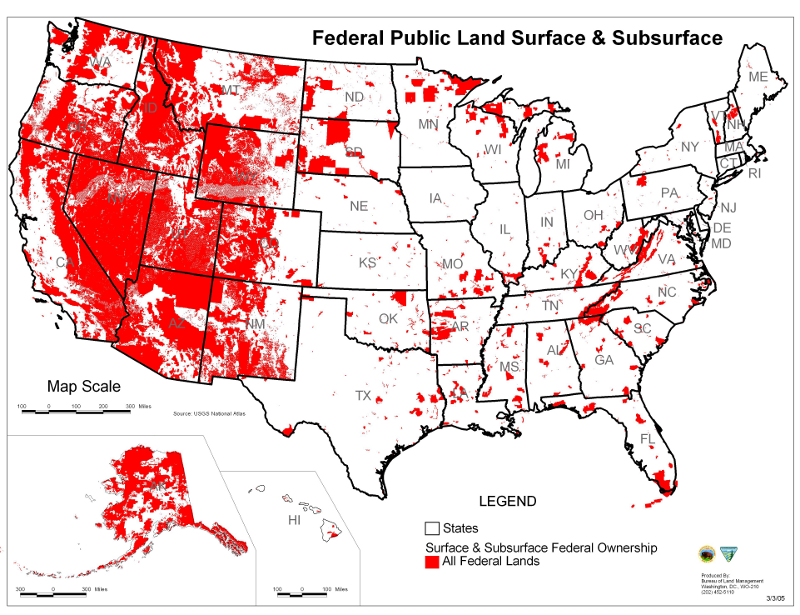
map_fed_owns_the_west

Although the federal government’s retention of Utah State lands is an extremely important and timely issue, let me be the first to admit that if we get too deep into the details and minutia of the legalities involved, eyes can easily begin to gloss over. In fact, all technical legal issues can have that effect on us—and I am no exception. The incalculable hours I’ve spent digging through piles of research that backs one legislative opinion or another cannot be esteemed as ‘golden.’ Yet, on this particular subject—the federal government’s failure to release the State lands temporarily ceded to it during the Western States’ admission to the Union—there is too much at stake to simply roll over and count it as a lesson learned at the hands of the neighborhood bully.

As we illustrated earlier, just a quick glance at the Federal Public Land Surface and Subsurface map on the back cover of this book tells a story of gross imbalance. All of that white area in the eastern two-thirds of the country is land that was restored to those States as Congress was obliged to do in its State Enabling Act Trust Compacts with those states. The State Enabling Act trust Compacts with the Western States, where you see all of that red land, retained by the federal government to this day, were exactly the same as those with the Eastern two-thirds of the States. So what is the difference in the way Congress fulfilled its obligations under the Enabling Acts between the Eastern States and the Western States?

ANSWER: The attitude of the federal government toward the States as the federal government grew and drew power to itself at the expense of the States.

This statement is easily proved by a look at the historical and legislative record. Those to the left on the political spectrum began to take power in the federal government, leaving an imbalance in Congress’ approach to its duties under the Constitution. Around the time the Western States had been admitted to the Union, and Congress was obliged under the State Enabling Act Trust Compacts to reincorporate their ceded lands to the States, as it had already done for the Eastern States, Congress simply decided to retain its own control over all of those lands, using them for members’ own political and social engineering purposes.

Today, when I attend debates about returning the Western States’ land to them, the opposition I encounter is still made up of the same kinds of people and organizations: ‘progressives’ who tell us how much better bureaucrats in Washington, D.C. can manage our land than we can; green extremists who want to keep humans off of as much land as possible; and anti-capitalists who incessantly fight to prevent us from extracting oil, gas, minerals and timber from the lands. We all realize that each of these groups to the left on the political spectrum has its political and social agenda, but their policies have an abhorrent effect on the balance of power between local people and federal bureaucracies, the balance of human harmony with nature, and the balance between using our natural resources to provide work and capital for our citizens and leaving our lands completely untouched. There is no balance, when extremist stances are given priority.

Don’t let my generalization of the types of people who oppose the Western States on this issue give you the wrong idea about me and my personal background. I grew up in a very conservation oriented family and hold strong conservation values. My father was a Forest Ranger for his entire career, spending 30 years in the U.S. Forest Service, obtaining his Master’s Degree in Range Management and devoting his professional life to the preservation of the Western forestlands. From the time I could walk I spent many of my days and years by his side, walking through the woods and scrub, learning firsthand about the ecology of our Western States and how we are stewards of nature. I learned all about the delicate balance between living with nature, and over-exploiting it to the point of destruction. I also watched as my father’s hopes and aspirations for the Western lands and wildlife were dashed on the rocks of federal mismanagement and incompetence at bureaucratic levels. The federal government’s simplistic, unenlightened, centralized, one-size-fits-all top-down bureaucratic policies allowed the bark beetle to devastate Utah’s forests. Due to the imbalance that has occurred between the federal government bureaucracies and the states, the federal government’s policies and incompetence have destroyed wildlife, forests and hundreds of thousands of acres of land, culminating in the closing of parks and recreation areas, and the abandonment of feral horse herds and other animals, and the locking out of millions of acres of land, and so on.


On Equal Footing

What’s wrong with the federal government retaining most of the land contained within the Western States? Under the Constitution, every new State was to be “admitted into the Union on an equal footing with the original States.” The Doctrine of Equal Footing is based on Article IV, Section 3, Clause 1 of the U.S. Constitution, which says:

New States may be admitted by the Congress into this Union; but no new State shall be formed or erected within the Jurisdiction of any other State; nor any State be formed by the Junction of two or more States, or Parts of States, without the Consent of the Legislatures of the States concerned as well as of the Congress.


Additionally, since the admission of Tennessee in 1796, Congress has included in each State’s act of admission a clause providing that the State enters the Union “on an equal footing with the original States in all respects whatever.”

The doctrine of equal footing originated in the Articles of Confederation and Perpetual Union, which specifically addressed the issue of lands within the States. First, Article II is the equivalent of Articles IX and X of our current Bill of Rights:


ARTICLE II—“Each state retains its sovereignty, freedom, and independence, and every power, jurisdiction, and right, which is not by this Confederation expressly delegated to the United States, in Congress assembled.”


By this Article, the States jealously guarded their independent sovereignty. There was no intent to give up to a central “union” any more power of jurisdiction than was thought absolutely necessary. (STATEHOOD, 23)


ARTICLE IX—“. . . no State shall be deprived of territory for the benefit of the United States.”


Could it be any clearer? Under these Articles, no “forests,” for example, could be created within any State by the confederacy of States under the pretense of “national benefit,” nor could any national exigency be cited as justification for occupation of any land within any State without the consent of the affected State. (Ibid.)

At a debate on the subject, an opponent of States’ Land Rights will simply point to the Enabling Act clause where the State cedes its lands to the federal government, and tell you that’s the end of the discussion. I hear it from them every time. The problem with that argument is that nearly all State Enabling Compacts contain that same language, including the Eastern States, and a quick glance at the Federal Lands map on the back cover informs us that the transfer of lands to the federal government was only temporary, as a tool to clear all possible claims against the title of the land, to be followed by the release of those lands back to the States, or to private landholders who would then pay property taxes to the States.

George Washington wrote, “It rests with the states to determine the extent of territory over which the federal will exercise sovereign jurisdiction.” (The Writings of George Washington, 1745-1799, John C. Fitzpatrick, Editor, vol 32) Under the Enclave Clause, the federal government may indeed offer to purchase land from the various States for its own purposes, and if the State Legislature and Executive agree to the purchase, the federal government may establish a military base or other facility on that land. That land so purchased comes under the jurisdiction of the federal government, and Congress is given authority under the Constitution to deal with that land as it sees fit. Lands temporarily ceded to Congress as part of a State’s admission, however, never fall under the general Congressional authorizations under the Constitution, except to the extent that Congress must “dispose” of the lands as provided under the “trust” created by the Enabling Act Compact.


Breaking Trust

A trust is a legal device used to temporarily deposit property into the hands of a third party, who is charged with faithfully disposing of the property of the trust according to the written instructions of the person or entity establishing the trust. If you put your home title, stocks and bonds into a trust that will produce income for your children for the next 30 years, then be liquidated and the proceeds dispersed equally to your grandchildren, the trustee MUST do what you have instructed, or be found on the wrong end of a serious criminal statute. That is how trusts work—and because they are backed up by law, the “trust” aspect rarely comes into question—‘trust’ could be used interchangeably with ‘must.’ The trustee simply MUST follow the terms of the trust, or there are serious legal consequences, in which case the replacement trustee MUST fulfill the terms of the trust when the original trustee has been relieved of duties.

When the United States was first setting up its method of converting territories and other western lands into States, the Congress adopted the Resolution of October 10, 1780, thus committing itself to certain actions with respect to any lands that might be ceded to it by the various States:

(1) “Resolved, That the unappropriated lands that may be ceded or relinquished to the United States, by any particular states, pursuant to the recommendation of Congress of the 6 day of September last, shall be granted and disposed of for the common benefit of all the United States that shall be members of the federal union, (2) and be settled and formed into distinct republican states, (3) which shall become members of the federal union, and have the same rights of sovereignty, freedom and independence, as the other states: that each state which shall be so formed shall contain a suitable extent of territory, not less than one hundred nor more than one hundred and fifty miles square, or as near thereto as circumstances will admit: and that upon such cession being made by any State and approved and accepted by Congress, (4) the United States shall guaranty the remaining territory of the said States respectively. . . . (5) That the said lands shall be granted and settled at such times and under such regulations as shall hereafter be agreed on by the United States in Congress assembled, or any nine or more of them . . . .


This was the first ironclad commitment of Congress to dispose of the lands ceded to it for the creation of future states. It is unambiguous that a) all land so ceded to the U.S. would be “disposed of” by Congress, and that 2) each future State created out of this ceded land would “have the same rights of sovereignty, freedom and independence, as the other states.”

Therefore, all land being deposited into trust in the hands of the Congress was expected to be disposed of in the creation of new States, and Congress extinguishing the federal title therein, and each new State entering on an equal footing with the earlier States. In 1833, the Congress attempted to modify its duties under these trusts by passing The Land Bill. President Jackson vetoed the bill, and chastised Congress for attempting to usurp authority it did not possess, and abrogate its trustee duties to the States. President Jackson wrote:

These solemn compacts, invited by Congress in a resolution declaring the purposes to which the proceeds of these public lands should be applied, originating before the Constitution, and forming the basis on which it was made, bound the United States to a particular course of policy in relation to them by ties as strong as can be invented to secure the faith of nations.


In other words, President Jackson was telling Congress that it had no authority under the Constitution to abrogate its obligations arising under these Trust Compacts it had created to entice the People of States and Territories to cede land for the purposes of admission as States into the Union. President Jackson further explained:


The Constitution . . . did not delegate to Congress the power to abrogate these compacts, on the contrary, by declaring that nothing in it “shall be so construed as to prejudice any claims of the United Sates, or of any particular State,” it virtually provides that these compacts, and the rights they secure, shall remain untouched by the Legislative power which shall make all “needful rules and regulations” for carrying them into effect. All beyond this would seem to be an assumption of undelegated power.


I invite everyone to read the entire text of President Jackson’s Land Bill Veto Message, of December 4, 1833, because it so thoroughly explains the issues involved in the federal government’s duties over temporarily ceded lands to the federal government. The entire text can be found online.

By the time the State of Utah was admitted into the Union in 1896, the specific language of its 1894 Enabling Act had been used and recycled for decades to admit several other states, including Ohio in 1802, Louisiana in 1811, Mississippi in 1817, Alabama in 1819, Michigan in 1836, Arkansas in 1836, Wisconsin in 1846, Minnesota in 1847, and California in 1850. Each Enabling Act Trust Compact required the proposed State to relinquish and “forever disclaim” all right and title to its land in favor of the United States, followed then by the duty of Congress to “dispose” of or “extinguish” its temporary title in that land as part of its trusteeship. Following is the exact Utah Enabling Act language:


Second. That the people inhabiting said proposed State to agree and declare that they forever disclaim all right and title to the unappropriated public lands lying within the boundaries thereof; and to all lands lying within said limits owned or held by any Indian or Indian tribes; and that until the title thereto shall have been extinguished by the United States, the same shall be and remain subject to the disposition of the United States, . . . [Relevant portions of the Utah Enabling Act are attached in the back of this work as Appendix A]


Again referring to the Federal Lands map, we can see that the Congress indeed fulfilled the terms of the Trust Compacts with all of those States in the eastern two-thirds of the country, including all of the states admitted in the Nineteenth Century enumerated above. The only exceptions are the Western States.

On January 4, 1896, President Cleveland executed the proclamation designating Utah as a State, on an equal footing with the other States of the Union.

Shortly thereafter, we began to see a change in the attitude of Congress regarding the lands temporarily ceded in Enabling Acts at the time of admission. In 1905, the National Forest Service was created by combining the General Land Office (the agency created for the purpose of disposing of the ‘public’ land) and the Division of Forestry. Federal agencies, e.g. the Forest Service and Bureau of Reclamation, were then established for the purposes of managing vast tracts of “federal land” and western water resources. Land disposal policies began to be replaced with policies that retained the public lands in federal ownership. In a short span of time, some 234 million acres of ‘federal’ land, or nearly an eighth of the entire United States, were withdrawn from private entry. (Report of Utah’s Transfer of Public Lands Act, H.B. 148, p. 16.)

Utah patiently awaited the actions of the Congress, to fulfill its Constitutional trust mandate and extinguish its temporary possession of the land in Utah. By 1915 it was becoming apparent that the Democratically controlled Congress and Woodrow Wilson’s White House were dragging their feet on many issues of States’ rights, as well as minority rights, and the Utah Legislature proposed a Joint Memorial to the President and both houses of Congress, politely requesting that they execute their Constitutional duties and extinguish the government’s temporary title to Utah’s land. The letter first pointed out the requirements placed upon the federal government and the benefits to the earlier states of fulfilling those requirements:


Rejoicing in the growth and development, the power and prestige of the older states of the union, and recognizing that their advancement was made possible through the beneficent operation of a wise and most generous public land policy on the part of the government, the people of Utah view with alarm and apprehension the national tendency toward the curtailment of the former liberal policies in handling the public domain and disposing of the natural resources, as evidenced in the vast land withdrawals and the pending legislation, calculated to make our coal, our mineral and our water power resources chattels for government exploitation through a system of leasing.


The letter then made a gracious petition to release the land to the State of Utah so that it could enjoy the same benefits of all previous States:


In harmony with the spirit and letter of the land grants to the National government, in perpetuation of a policy that has done more to promote the general welfare than any other policy in our national life, and in conformity with the terms of our Enabling Act, we, the members of the Legislature of the State of Utah, memorialize the President and the Congress of the United States for the speedy return of the former liberal National attitude toward the public domain, and we call attention to the fact that the burden of State and local government in Utah is borne by the taxation of less than one-third the lands of the State, which alone is vested in private or corporate ownership, and we hereby earnestly urge a policy that will afford an opportunity to settle our lands and make use of our resources on terms of equality with the older states, to the benefit and upbuilding of the State and to the strength of the nation.


Of course, those who had seized power in Washington, D.C. had no intention of honoring the terms of the Trust Compact with Utah, or any other Western State. The petition was ignored, and the federal government began tying up major blocks of Western lands by designating new national parks, then wilderness areas, while selling leases for some minerals and oil on the land. In the case of Utah, those leases netted the State only 46 percent of the revenues that the Eastern States were receiving for their gas, mineral, timber and oil leases, and the number of leases allowed by the federal bureaucrats on Utah land were highly restricted.


Separate, But Equal?

There was a time when the federal government made a tepid attempt to make a partial transference of some desert surface land within the State of Utah, but the Democratic Governor at the time, George Dern, went to Congress and told them that their policies and proposal were wholly inadequate. In February of 1932, Dern appeared before the U.S. House Committee on the Public Lands to testify regarding legislation that proposed “to grant vacant, unreserved, unappropriated, nonmineral lands to accepting States.” The legislation would allow the States a 10 year period to determine whether to accept or reject the transfer of these unproductive surface lands, leaving the valuable minerals, gas and oil reserved to the federal government’s use. The Democrat excoriated the federal government for treating Utah and other Western States like adolescents, and told them that Utah did not want the lands on the proposed basis with “everything else taken out that is worth anything at all, so that we will have nothing but the skin of a squeezed lemon.” Good for him!

Since that time things have only gotten much worse for the Western States, and the federal government has dug in its heels, refusing to extinguish its temporary title in our State lands as required by the State Enabling Act Trust Compacts and the Constitution. In the 1960s and 1970s, environmental groups increasingly objected to aspects of federal management of public lands in the West and challenged the financial support extended to Western States and local governments by the federal government and the use of public lands for traditional activities such as grazing, mining, oil and gas exploration and production and timber harvesting. Environmentalists were joined by some eastern state representatives in Congress who sought to protect eastern industry from the threat of growing Western economies and those favoring federal budget cuts. (Ibid. p. 20)


In other words, Eastern States liberal members of the U.S. House and Senate were purposefully limiting Western States’ political power by limiting their access to their own in-state resources—keeping them poor and powerless.


The environmentalists also began to challenge federal support for water and transportation projects. They further called for legislation for the protection and conservation of “public resources.” In 1964, the Wilderness Act was passed. The National Historic Preservation Act followed in 1966. The Wild and Scenic Rivers Act and the National Trails System Act were enacted in 1968. The Endangered Species Conservation Act of 1969, the Wild and Free-roaming Horse and Burro Act in1971 and the Endangered Species Act in 1973 provided for protections to certain endangered species and the promulgation of new regulations (CFR) with which to comply. (Ibid. p. 20-21)

The National Environmental Policy Act (“NEPA”), enacted in 1969, required the study of environmental impacts resulting from federal actions and the receipt and consideration of public comment on any and all such actions. These legislative enactments culminated with the enactment by Congress of the Federal Forest and Rangeland Renewable Resources Planning Act of 1974, the National Forest Management Act of 1976 of the Federal Lands Policy and Management Act of 1976 (“FLPMA”). (Ibid. p. 21)

For those public lands managed by the Bureau of Land Management (BLM), Congress’ FLPMA formally terminated the historic federal public lands policy of disposing of those lands pursuant to the Enabling Act Trust Compacts, in favor of a new formal federal land retention policy dictating that “the public lands be retained in Federal ownership.” The response of the Western States to the passage of FLPMA was a developing antagonism to federal actions, further fueled by the growing view of the federal government that Western needs had shifted away from traditional public land uses (farming, residential, harvesting, etc.), to purely recreation and environmental activities. (Ibid.)

Although Western States’ members of Congress have made various attempts to get the federal government to reverse its unilateral abandonment of its duty to divest itself of our Western lands, it has been to no avail. The federal courts have merely rubber-stamped Congress’ ability to extinguish title when it decides, not based on the precedents set in returning Eastern States’ land, and the expectations of the parties at the time of admission and creation of the Trust Compacts. So the clock ticks, and nothing is happening, and Utah and the other Western States suffer as a result.


Second-Class Citizens

Suffer, you ask? How do these states suffer? As we reviewed briefly above, the States in the Eastern two-thirds of the country utilize over 95 percent of their lands, collecting property taxes on privately owned lands and receiving 100 percent of the income from mineral, timber, gas and oil leases. This enables them to finance their public schools, among other things. Since Utah became a State she has continually struggled to fund public education. In fact, our state comes in dead last in the nation for per pupil educational funding. Our per pupil funding is $5,978 compared with the national average of $10,608, which averages in the other Western States, most of which are likewise strangled for funding for the same reason as Utah. States that enjoy the benefit of having received an extinguishment of federal title to their lands have much, much higher per pupil spending. New York, for instance, enjoys $19,552 per pupil spending. (States Spending the Most (and Least) on Education, Thomas C. Frohlich, 24/7 Wall Street, June 3, 2014)

Not only was Utah promised at the time of statehood—both expressly in its Enabling Act and impliedly by the historical federal policy of honoring its duty to dispose of the trust lands—that its lands would be returned to it or sold so Utah could collect property taxes on the land, the Utah Enabling Act specifically provided,

“That five per centum of the proceeds of the sales of public lands lying within said state, which shall be sold by the United States subsequent to the admission of said State into the Union . . . shall be paid to the said State, to be used as a permanent fund, the interest of which only shall be expended for the support of the common schools within said State.” (Section 9)

The land that the federal government was to dispose of by sale (“shall” according to the specific Enabling Act language) was to result in an educational trust fund, funded with 5 percent of the proceeds of the sales as the principle. Of course, as the federal government failed to follow up on its duties as the trustee of the temporarily ceded lands, no money for the educational trust fund was forthcoming, further damaging the children of the State of Utah.

As a result, the federal government came up with various revenue sharing schemes, payments in lieu of taxes (PILT), etc., amounting to a type of welfare handout system for those Western States relegated to the back of the federal bus, which only partially funds Utah’s educational system and county governments. The funds were considered less than half of what was needed in 1950, and there have been few annual, inflation, or cost-of-living increases in the fund since that time. In fact, PILT payments were removed from the main federal budget recently, and eventually attached to a Farm Bill and used as a negotiation pawn. Surely, no one can deny that Utah and most of the other Western States are treated as second-class citizens of the Union as a result of the federal failure to dispose of their lands as required.


Utah’s H.B. 148

To address the inequity of the federal government’s failure to extinguish title to two-thirds of the lands in the State of Utah, we in the Utah House of Representatives drafted House Bill 148, titled “Transfer of Public Lands Act” (TPLA), which I cosponsored with several other members of the House, and fully supported. The bill was passed by the State House and Senate, and signed by the governor, becoming law on March 23, 2012. The law sets out Utah’s demand that federal title in its land be extinguished pursuant to the U.S. Constitution and the Utah Enabling Act entered into by the State and the federal government at the time of Utah’s admission.

Of course, the TPLA proposes that all federally owned and managed parklands be permanently ceded to the federal government as National Parks. It also sets up a formal systematic transfer scheme, so that the transfers of land to the State are organized and the Utah State departments charged with relevant duties can adequately anticipate and meet the tasks. The TPLA also establishes the Utah Public Lands Commission to manage the multiple use and the sustainable yield of Utah’s abundant natural resources.

By receiving control of Utah’s lands, the State could solve all of its fiscal problems, especially the school funding problem, and greatly relieve the federal government of much of its burden with respect to managing Utah’s land. The federal departments and agencies charged with managing the State’s land, resources and wildlife find themselves constantly embroiled in horrendously costly litigation, which eats up most of their appropriated budgets—money that is not going toward managing the land and wildlife. This litigation is being churned out by the ream by the same groups we scrutinized earlier—environmentalists, anti-capitalists, and similar special interest groups who try to keep the land from being developed or even used by citizens, and who are opposed to using any natural resources like timber, minerals, oil or gas.

The fact that the federal government manages all of the Western States’ lands makes it an easy one-stop target for groups bent on getting their way through the filing of prolific litigation. If each of the States managed its own land, a special interest group would have to file 12 or 13 separate lawsuits per issue, at least one in each state court—possibly one in each affected county in every state. The cost of frivolous litigation would thereby switch to the special interest groups, greatly limiting the amount of damage they can do. As things stand, they simply file one lawsuit against the controlling federal agency, with the knowledge that federal agencies will cease all activity regarding the subject land until the litigated issues are finally resolved in the federal court system. Of course, federal courts are choked with this kind of litigation, and special interest groups know that each lawsuit will tie up the affected lands for several years, if not decades.

In other words, the very act of filing frivolous litigation nets the special interest groups what they seek, without the necessity of winning the litigation on the merits. The longer they string their frivolous cases along, the more they ‘win.’


If the control of these State lands was restored to the States, the financial burden of litigation would be placed on the special interest groups, who must battle their frivolous cases in state courts, with judges and jurors who are very close to the issues involved. The States’ costs of litigation would be much less than the federal government is paying because of the deterrence effect of placing the burdens of litigation where they belong—on the special interest groups.

Utah, like most of the affected Western States, is in a much better position to manage its resources than federal bureaucrats in Washington, D.C. The Bureaucratic method of top-down, one-size-fits-all management is destroying our lands and natural resources. What works in one area, does not necessarily work in another, but federal employees are restricted by the centralized regulations that have been promulgated by the truckload (CFR). If ever there were a clear example of why centralized government distanced from the problems of local people should be minimized, the management of Utah’s resources and wildlife is a perfect example. Employees of the various federal agencies tasked with managing Utah’s lands and resources have their hands tied not only by centralized, ineffective rules and regulations, but by constant budget shortfalls. The problem is not that the federal government does not allocate enough money, but that burgeoning federal bureaucracies and litigation costs rob the actual working employees of necessary personnel and resources.

As of this writing, our federal government is $18 trillion in debt, and 40 cents of every dollar it spends is borrowed, adding to the national debt every moment of every day and night. By the end of the current administration’s current term (December 2016), the national debt will be in excess of $20 trillion. Every day when Americans go to work, the first $1.4 billion they earn must go directly to the federal government just to pay the ‘interest’ on its debt. The federal government is so mismanaged that its continuation at its current pace is unsustainable. It WILL be crushed under its own bloated weight. It is not a question of if, but only when. The lands and resources of the State of Utah contain value in the trillions of dollars—one of our House members estimates minerals on federally retained lands in our state, Colorado and Wyoming at over $150 trillion, with a full one-third being located in Utah. See e.g., Knowledge and Courage: What the West Needs to Take Back Our Public Lands, Ken Ivory, Cascade Commentary. Those resources are being mismanaged and drained by the same government that is destroying our national economy and enslaving our children and their children with current overspending and debt. We do not need the federal government’s ‘help’ any longer in managing our own lands and resources.

States east of Colorado, which appropriately received a federal extinguishment of title in their lands, have resources and opportunities far beyond the reach of Utah and most similarly restricted Western States. We look around the country at states like North Dakota, where financial resources are abundant and educational spending has skyrocketed because they are free to utilize their land and natural resources, without the corruption and mismanagement that accompany federal management—of anything. The TPLA calls for a halt of the federal government’s mismanagement of Utah’s land and resources, and I want to continue working with Western States’ Governors and Legislative leaders until we obtain the lands and resources that are mandated by law and the Constitution to be released to us. The resources that are tied up and mismanaged by federal bureaucrats in the Western States are key to sparking local economies, and providing many billions of dollars in annual revenue to Washington, D.C.

Beyond just the financial reasons to return Western lands to the States, Americans have a very tangible health and environmental reason to do it sooner than later. Because the federal agencies are incapable of managing our forests, not only are we losing them to blight and wildfires, but millions of tons of carbon pollution are being pumped into our atmosphere when catastrophic fires annually light up the West. Where are the environmentalists when that happens? They’re driving their SUVs to protest rallies and ignoring the herculean damage to our lands and air quality created by their own policies.

Utah’s feral horse herds are likewise suffering under federal care. The wild horse problem in western Utah in Delta and Beaver Counties is devastating. The horses are neglected and wild, tearing up grazing land, and destroying livelihoods of local ranchers. The horses are starving to death, dying of disease. It is a horrific, inhumane mess, and those poor animals are suffering, because the feds have no budget to care for them.

In stark contrast, the State of Utah, as many other Western States, has done an exemplary job caring for its portions of the State’s forestlands and wildlife. Our deer, elk and bison populations have thrived under our care, and our state parks are second-to-none.

You may recall that the federal government has demonstrated that caring for our land and wildlife is less than a priority in its eyes. During the federal government impasse in 2013, the feds closed the national parks, to score political PR points in a budgetary saber-rattling contest, costing local businesses millions of dollars. We in State Government leadership reopened those parks with our own state funds—something the federal bureaucrats were unable to do.

The current administration has been legislating by executive fiat, and threatens to permanently tie up millions of acres of Western lands with the stroke of a pen, as other recent pro-centralized government administrations have done. All of this, of course, to further a political agenda—not to benefit the People of the Western States or the lands temporarily ceded to the federal government in State Enabling Act Trust Compacts.

Utah has been the model of excellence in utilizing what few resources we have available for responsible development as a State to provide for the care and welfare of our citizens, including our children. The fact that we have the least (approximately half) of the national average per pupil funding for children’s education, does not put us at the bottom of educational results. In fact, Utah’s children perform somewhere around the middle in most standard categories. Imagine what we could do with a normal per pupil spending budget—or a budget like an older State such as New York—nearly four times our per pupil budget. Utah currently ranks high in such areas as its high school graduation rate and parental employment, income and education levels. For example, last year Utah ranked 11th in the nation for children with at least one parent with a postsecondary degree, 1st in the nation for having the smallest difference in per pupil spending between the highest and lowest spending school districts, and 12th in the nation for its high school graduation rate. These results flow from our dedication to our State and its citizens, and our ability to roll up our sleeves and get a job done despite the obstacles placed before us by the federal government.

Utah’s TPLA is a comprehensive law that puts into place a sweeping mechanism for the State to receive the land that is still being held in trust by the U.S. Congress, and to transfer the management of the State’s lands and resources to local experts who have been educated, trained and prepared for the duties of self-management. I am hopeful that as American citizens become fed up with the disregard of States’ Rights and its incessant draw of power from the States to Washington, D.C., cooler heads will prevail and a more mainstream Congress (ideologically balanced) will execute its mandates under the Constitution and the State Enabling Act Trust Compacts and finally “dispose” of the State lands it is still holding in trust for the States, inuring to the benefit of the People of Utah, the Western States, and the entire nation.

Filed Under: All Stories, Economy, Elections, Entitlement, Ethics, Foreign, Gender, Religion, Sci-Tech

It’s THANKSGIVING, not Turkey Day

November 21, 2016 By Editor Leave a Comment

For many generations Americans have rightly paused on Thanksgiving Day to give thanks to a generous God, who is our Heavenly Father. America was founded on principles of Judeo-Christian ethics, and a shared faith in a personal God, who caringly watches over the affairs of humanity with a concerned eye (while leaving us to exercise free will).

As socialists have struggled to wrestle our personal liberties from us, one of their main tools has been to secularize our society. Indeed, the ACLU and similar leftist organizations have led the fight to remove any mention of God or His Son, Jesus Christ, from the public’s vernacular.

As a result of this attempt to make God and Christ politically incorrect in our nation, we have recently been greeted with “Happy Holidays” instead of “Merry Christmas,” and with “Happy Turkey Day” instead of “Happy Thanksgiving Day.”

We can see why the left would seek to take Christ out of Christmas, but why the shift from Thanksgiving Day to Turkey Day? Because Thanksgiving implies there is a reason to be thankful, and someone to whom we should give thanks–and that’s God.

I for one am careful to wish everyone I meet, at the store, at work, or in other public places, a hearty Happy Thanksgiving and Merry Christmas. As a child of our Heavenly Father, I would much rather offend an anti-American, than offend God.

Happy Thanksgiving Day America, and may God bless us.

By James Thompson

an-obama-thanksgiving

Filed Under: All Stories, Economy, Elections, Entitlement, Ethics, Foreign, Gender, Religion, Sci-Tech

Trump Names 3 – Flynn, Sessions and Pompeo

November 18, 2016 By Editor Leave a Comment

flynn_sessions_pompeo

President-elect Donald Trump has offered top political positions in his administration to three of his most ardent supporters during the election.

Senator Jeff Sessions of Alabama has been offered the position of U.S. Attorney General, and has reportedly accepted that position. Before his service in the Senate, Sessions served for 12 years as a U.S. Attorney in the Southern District of Alabama, then as the state’s  Attorney General.

Ret. Army Lieutenant General Michael Flynn, the former Director of the Defense Intelligence Agency, has been offered the position of White House National Security Advisor. General Flynn has reportedly accepted the offer.

Mr. Trump has picked Kansas Congressman and Tea Party favorite Mike Popeo to head the CIA. Pompeo is a member of the House Select Committee on Intelligence and has been an ardent supporter of the Patriot Act and the National Security Agency’s collection of bulk data.

Governor Mike Huckabee will be visiting with Mr. Trump at Trump Tower later today to talk about a position in the new administration. Governor and former presidential candidate Mitt Romney will be meeting with Mr. Trump as well.

By James Thompson

Filed Under: All Stories, Economy, Elections, Entitlement, Ethics, Foreign, Religion, Sci-Tech

Democrats Look for Answers After Devastating Election

November 16, 2016 By Editor Leave a Comment

trump_protestersHours after the arrest of 17 progressive protesters at a sit-in at New York Sen. Charles “Chuck” Schumer’s office, President Barack Obama said Democrats will be doing some healthy reflection after the pounding the party took in last week’s national election.

The progressive wing of the Democratic party, which backed Vermont Sen. Bernie Sanders’ presidential primary challenge to eventual nominee Hillary Clinton, wants to double down on its agenda. It blames Clinton’s supposed centrist stance and close ties to Wall Street for the loss to Republican Donald Trump on Nov. 8.

Some of this will play out in the coming months in the competition to be the next Democratic National Committee chairman.

The President and Protesters

“When your team loses, everybody gets deflated and it’s hard and it’s challenging and so I think it’s a healthy thing for the Democratic Party to go through some reflection,” Obama, who as president is the outgoing titular leader of his party, said in a press conference Monday. “I think it’s important for me not to be big-footing that conversation. I think we want to see new voices and new ideas emerge.”

“When your team loses, everybody gets deflated,” @POTUS says.

Obama said the Democratic Party can’t waiver from its core beliefs.

“I believe that we have better ideas, but I also believe that good ideas don’t matter if people don’t hear them and one of the issues that Democrats have to be clear on is that, given population distribution across the country, we have to compete everywhere,” Obama said.

Protesters outside likely Senate Democratic leader Schumer’s office had a different view than Obama.

The 45 millennial activists, calling themselves “All of Us 2016,” made two demands: that Democrats vow to never negotiate with President-elect Trump and that Schumer step aside from his designated role and endorse Sanders to be the party’s Senate leader.

“The Democrats cannot negotiate with a racist, fascist President Trump, they must filibuster all day and all night to stop his racist, fascist agenda,” All of Us co-founder Waleed Shahid, 25, of Brooklyn, told The Daily Signal. “It was negotiation that led to calling African-Americans three-fifths of a citizen.”

The protesters sang, “We stand for our future and together we stand strong.” They also chanted, “Our future is on the line, Chuck Schumer, grow a spine.”

“Democrats lost because they couldn’t tell the truth. Schumer is entirely funded by Wall Street,” Shahid said, adding it would have turned out different if Sanders had been the Democratic nominee. “Sanders inspired the American people.”

Various protesters were arrested in groups of one and two, and taken away. This is revealing about Schumer, said Anna Bonomo, 26, of Hermitage, Pennsylvania.

“Charles Schumer decided to have almost 20 millennials arrested instead of meeting with us and talking with us,” Bonomo told The Daily Signal. “I think that just goes to prove that Wall Street Democrats like him are not here for the people they claim to represent.”

Schumer’s office did not respond to inquiries from The Daily Signal.

The Democratic National Committee did not respond to The Daily Signal’s questions about the state of the party. The DNC chair’s leadership role will be elevated with Republicans holding the White House and Congress.

Electing the Next Chairman

Interim DNC Chairwoman Donna Brazile was shouted down last week by a DNC staffer, who blamed the party’s establishment for Trump’s victory and warned of pending doom from climate change, The Huffington Post reported. The DNC staffer told Brazile:

Why should we trust you as chair to lead us through this? You backed a flawed candidate, and your friend [former DNC Chair Debbie Wasserman Schultz] plotted through this to support your own gain and yourself. You are part of the problem. You and your friends will die of old age and I’m going to die from climate change. You and your friends let this happen, which is going to cut 40 years off my life expectancy.

DNC members will choose a successor to Brazile in February.

Both Schumer and Sanders have endorsed Rep. Keith Ellison of Minnesota, co-chairman of the Congressional Progressive Caucus, to be the next chairman of the Democratic National Committee, as has outgoing Senate Democratic leader Harry Reid of Nevada.

But securing the nomination won’t be easy for Ellison, the first Muslim in Congress.

Competition for Leadership

Former Vermont Gov. Howard Dean, who chaired the DNC from 2005 through 2009 when the party retook Congress and the White House, plans to run for the job again. Former Maryland Gov. Martin O’Malley, who ran unsuccessfully for president, has said he’s interested in the job.

Others possibilities are reportedly Labor Secretary Thomas Perez and New Hampshire Democratic Party Chairman Raymond Buckley.

In addition to Trump’s surprising win over Clinton, the Nov. 8 election also saw the GOP hold the House and Senate and make gains among governorships and state legislatures. Trump even won traditionally blue states of Pennsylvania, Wisconsin, and Michigan.

Sanders scolded the Democratic Party in a tweet Monday morning, though he didn’t address the protest group advocating his elevation to Senate Democratic leader.

“I come from the white working class, and I am deeply humiliated that the Democratic Party cannot talk to the people where I came from,” Sanders tweeted.

He later tweeted: “The Democratic Party can no longer be led by the liberal elite. We have to stand up to Wall Street and the greed of corporate America.”

Politico reported that big Democratic donors met with billionaire financier George Soros at the District of Columbia’s elite Mandarin Oriental hotel for a closed-door conference sponsored by the Democracy Alliance, a progressive activist organization. Soros spent millions trying to get Clinton elected. Ellison attended the meeting spanning Sunday through Monday.

Others attending the conference were House Minority Leader Nancy Pelosi of California and Massachusetts Sen. Elizabeth Warren. Soros’ Democracy Alliance has contributed more than $500 million to get Democrats elected and on liberal groups since 2005.

By Fred Lucas / @FredLucasWH /

Filed Under: All Stories, Economy, Elections, Entitlement, Ethics, Foreign, Gender, Religion, Sci-Tech, Uncategorized

Trump Should Reverse Obama’s Executive Actions-7 Areas to Start

November 14, 2016 By Editor Leave a Comment

Obamas-PenUnder the U.S. Constitution, Congress, not the president, creates the laws. Article I of the Constitution grants enumerated legislative powers to Congress. The Constitution assigns the executive the duty to enforce the law, and Article II, Section 3 requires that the president “shall take Care that the Laws be faithfully executed.”

However, throughout the last eight years, we have seen the Obama administration continually abuse the power of the executive branch by issuing unconstitutional, unilateral executive actions to push its agenda. The “old days” of Congress creating our laws have become a distant memory.

President Barack Obama even went so far as to announce his unilateralism, saying, “We’re not just going to be waiting for legislation in order to make sure that we’re providing Americans the kind of help they need. I’ve got a pen and I’ve got a phone.”

Well, it appears that American voters have their own pens, too, and they’ve put them to their ballots now in a stunning and decisive way. On Tuesday, the American people elected Republican outsider Donald J. Trump to serve as the 45th president of the United States.

Now, with control of the presidency, both chambers of Congress, and soon the Supreme Court, conservatives across the country are looking forward to repairing some of the damage Obama has inflicted on our constitutional system.

As long promised, Trump should use the first 100 days of his administration to repeal every illegal executive action the Obama administration has issued while in office.

Here is a list of the seven areas with the most damaging executive actions signed during the Obama administration that must be repealed:

  1. Crony Exemptions to Obamacare. While Trump works with Congress to actually repeal Obamacare, he can start by issuing an order to halt some of Obama’s executive actions that created special exemptions to Obamacare for his favored constituencies.
  2. Executive Amnesty. The new president must repeal Obama’s unilateral changes to our nation’s immigration laws, which exempted certain categories of illegal aliens from being deported. (This bar on deportations was halted by a court order, but the underlying exemption still remains on the books.)
  3. Environmental Protection Agency Overreaches. Trump must repeal Obama’s multiple illegitimate expansions of EPA rules. These new rules have imposed huge costs on society and are crippling the U.S. energy sector.
  4. Appeasement of Iran. Trump must repeal the executive order that single-handedly removed U.S. sanctions on Iran. These sanctions provided key leverage to the U.S. in negotiations with Iran, and their removal has cleared Iran’s path in developing a nuclear weapon.
  5. Climate Change Bureaucracy. Trump must repeal the executive order that purports to “prepare the United States for the impacts of climate change.” This action from Obama created manifold new justifications for government spending based on inconclusive science.
  6. Life and Religious Liberty. Trump should reverse Obamacare’s unprecedented taxpayer funding of abortion. He should also direct the secretary of Health and Human Services to undertake a rulemaking process that will end the mandate for insurance to cover abortion-inducing drugs and contraception, along with “gender transition” therapies and surgeries.
  7. “Gender Identity.” Trump should repeal the Obama administration’s Title IX guidance equating “gender identity” with “biological sex.” The Department of Justice and Department of Education have wielded this guidance to punish educational institutions for “discrimination” under Title IX, simply for having separate showers, locker rooms, and bathrooms for men and women.

By making the repeal of these executive actions a priority, the Trump administration will have an easy opportunity to right some of the wrongs of the past administration.

As Henry Ford once said, “Failure is simply the opportunity to begin again, this time more intelligently.” It’s been a while since conservatives have had an opportunity like this one, and it is imperative we take advantage of it.

By Brad Bishop

Brad Bishop is a senior media associate at The Heritage Foundation.

Filed Under: All Stories, Economy, Elections, Entitlement, Ethics, Foreign, Gender, Religion, Sci-Tech, Uncategorized

President-elect Trump Wants to Pull out of Global Climate Agreement

November 14, 2016 By Editor Leave a Comment

trump_vegasPresident-elect Donald Trump is reportedly looking for avenues to withdraw from a global climate change agreement, Reuters reports.

According to the report, Trump and his transition team are looking for ways withdraw the U.S. from the Paris Agreement, a 2015 pact that plans to further curb greenhouse gas emissions that was ratified by 109 countries, including the U.S. The pact became effective on Nov. 4.

global-warming-lies-heating-up

“It was reckless for the Paris agreement to enter into force before the election,” a Trump adviser told Reuters.

The Trump team is now looking for ways to bypass the agreement’s withdrawal procedures, which would take four years.

More from Reuters:

Alternatives were to send a letter withdrawing from a 1992 Convention that is the parent treaty of the Paris Agreement, voiding U.S. involvement in both in a year’s time, or to issue a presidential order simply deleting the U.S. signature from the Paris accord, he said.

Still, other nations hold out hope that Trump comes around on the deal. However, if he doesn’t and the U.S. pulls out, a Moroccan official said it wouldn’t kill the deal.

“If one party decides to withdraw that it doesn’t call the agreement into question,” said Moroccan Foreign Minister Salaheddine Mezouar.

global_warming_hoaxThe accord seeks to end the world’s dependency on fuel sources that emit greenhouse gases by the second half of the century, which many climate experts around the world say attribute to rising global temperatures.

Trump has said throughout the election and the past that he doesn’t believe in global warming or made-made climate change.

By Chris Enloe

Filed Under: All Stories, Economy, Elections, Entitlement, Ethics, Foreign, Religion, Sci-Tech, Uncategorized

What Mother Jones Doesn’t Get about Mormon Women

November 11, 2016 By Editor 1 Comment

mormon_women
A few feminists have disparaged women like me because we did not say “I’m with her” on Election Day.

A writer for the infamously liberal publication Mother Jones went so far as to suggest that Mormon women did not vote for Hillary Clinton because we are — evidently — oppressed by our faith, uneducated and too afraid to stand for a feminist candidate.

Spouting such fairy tales, Mother Jones might as well be called Mother Goose.

“Utah can be a difficult place to be a woman,” the article says. “The patriarchal culture of the state’s dominant religion is strong. Women aren’t allowed to be ordained as leaders in the LDS Church, and they’re taught to be subordinate to men.”

This kind of condescension toward Utah women is a throwback to anti-Mormon screed depicting Latter-day Saint women — my pioneer ancestors — as brainwashed rubes.

Hillary_ClintonAt the expense of dashing Mother Jones’ feminist fantasy, Clinton’s “women problem” in Utah had little to do with patriarchy and gender but everything to with integrity, authenticity and the fact that Utah’s economy, public policy and communities actually provide more opportunity, more choices and more freedom for women.

While many rightly struggled with the decision of whom to vote for, in Hillary Clinton many Utah women saw a flawed and unimpressive candidate whose policies would ultimately disadvantage and decrease genuine opportunities for themselves, their daughters and granddaughters.

Utah women are not afraid of those who value the freedom and power to choose a full-time professional career. Utah women recognize that their own influence — whether in the community, in the workplace, in the halls of Congress or in the home — plays a far greater role in shaping the future than superficial feminist causes or identity politics.

We know what authentic leadership looks like because we live it.

Although it is still important for more female voices (and male voices) to engage in the world in meaningful ways, Utah is already fostering many extraordinary female entrepreneurs, business people, religious and community leaders, and — equally important — mothers, wives, grandmothers, sisters, aunts and friends.

Utah League of Cities and Towns provides hundreds of gift bags to Midvale homeless shelter

The women from Mother Jones are hardly in position to cast aspersions on the women of Utah. Surely if a man did that, Mother Jones would cry foul.

They represent the great liberal feminist irony — they want all women to feel empowered and able to choose, unless, of course, those women’s choices break with liberals’ views of womanhood.

cannon

State Senator Martha Hughes Cannon

Hillary Clinton was not the candidate for Utah women, and it’s not because we are too suppressed to hold our own politically.

Indeed, Utah women have long been a driving force in shaping the state, whether in the traditional halls of power or in the far more powerful halls of home.

Utah, for example, was the second state in the nation to grant women the right to vote. Utah Latter-day Saint Martha Hughes Cannon became America’s first woman state senator (defeating her own husband).

In 1911, Mary Chamberlain, a Utah Mormon woman, became the first mayor with an all-female town council.

mary_elizabeth_woolley_chamberlain

Mary Chamberlain

More recently, Olene Walker was the state’s lieutenant governor for 10 years before becoming governor. Far more important for Walker, however, was raising seven children. And, before her death last year, Speaker of the House Becky Lockhart provided fearlessly authentic leadership not only in the House but also in the home, where she raised three children.

Congresswoman Mia Love has just been re-elected to the U.S House of Representatives as the first black Republican woman. She, too, is a mother of three. 

SpeakerBeckyLockhart_flag

Utah Speaker of the House, Becky Lockhart

Utah is headquarters to two of the largest women’s organizations in the world, The Church of Jesus Christ of Latter-day Saint’s Young Women’s organization and Relief Society. These groups do more service, leadership training and humanitarian work than can be measured.

Utah women lead in countless ways and we do not judge those who choose a path in politics or business against those who build homes — after all, they aren’t mutually exclusive.

The work of all serves to create a better Beehive State. 

mia_love_official_congressional_photo

Congresswoman Mia Love

The publication Mother Jones is famously named for a noted labor activist who began her political organizing career in earnest after her four children and husband tragically died in the Chicago fire.

Ironically it may have been the lessons learned as a mother and wife that helped her develop the skills and perspectives that made her an effective, authentic and compassionate political leader and earned her the exalted moniker Mother Jones.

On Wednesday, after the election had been called, and while the finger-pointing feminists began their blame-and-shame crusade, an almost unrecognizable woman addressed the nation.

Nearly polar opposite to the harsh, dishonest, power-hungry candidate, Hillary Clinton came across as an authentic leader more concerned about others than herself. She was a leader who encouraged young girls to know they have value, that the country needs to hear their voices and that they can both choose and achieve any dream.

That is the type of woman Utah women may have rallied around. That authentically passionate and sincere woman was who women everywhere needed in a candidate. To Clinton supporters and nonsupporters alike, we all must realize that women’s voices need to be heard and their influence must be felt in the home, in the workplace, in the government and in the community — on their own terms.

By Sarah Matheson
Sarah Matheson is president of The American Agenda, an organization focused on engaging millennials in the pursuit of upward mobility and opportunity for all.

Filed Under: All Stories, Economy, Elections, Entitlement, Ethics, Foreign, Gender, Religion, Sci-Tech, Uncategorized

Harry ‘I Got My Ass Handed to Me in a Gay Love Fight’ Reid Whines About Election

November 11, 2016 By Editor 2 Comments

Senate GOP And Democrats Hold Weekly Policy LuncheonsNancy Pelosi spoke with President-elect Donald Trump by phone to congratulate him on his victory. Hillary Clinton graciously conceded. President Obama called for a “peaceful transfer of power.”

Harry Reid, not so much.

The pugilistic Senate Democratic leader who is retiring this term issued a 473-word statement Friday railing against Trump’s election, saying it has “emboldened the forces of hate and bigotry” as the country is overcome by “tears” and “fear.”

“White nationalists, Vladimir Putin and ISIS are celebrating Donald Trump’s victory, while innocent, law-abiding Americans are wracked with fear – especially African Americans, Hispanic Americans, Muslim Americans, LGBT Americans and Asian Americans. Watching white nationalists celebrate while innocent Americans cry tears of fear does not feel like America,” the retiring Nevada senator said.

Speaking out as protests have sprung up in cities across the country, Reid cited accounts of African Americans being heckled and Hispanic Americans fearful their families “will be torn apart.”

“We as a nation must find a way to move forward without consigning those who Trump has threatened to the shadows. Their fear is entirely rational, because Donald Trump has talked openly about doing terrible things to them,” he said. “Every news piece that breathlessly obsesses over inauguration preparations compounds their fear by normalizing a man who has threatened to tear families apart, who has bragged about sexually assaulting women and who has directed crowds of thousands to intimidate reporters and assault African Americans.”

harry_reid_flips_the_birdTrump indeed has raised deep concerns among Hispanic-Americans over his calls to build a wall along the Southern border and step up deportations, and among Muslims over his widely criticized plan to suspend Muslim immigration – a plan he since backed away from.

But in the hours and days since the election, the candidate who riled up rally crowds and engaged regularly in rhetorical battle with his political foes has struck a more conciliatory tone, as those protesting his election have in some places resorted to violence.

Even his biggest critics – namely President Obama and Hillary Clinton – have urged the country to respect the election results and come together.

Clinton, in her concession speech, said: “We must accept this result, and then look to the future. … Donald Trump is going to be our president. We owe him an open mind and the chance to lead.”

House Democratic Leader Pelosi, D-Calif., spoke with Trump by phone and echoed Obama and Clinton, saying in a statement that the country needs to “come together.”  

“The peaceful transfer of power is the cornerstone of our democracy,” she said, even noting that Congress could work with Trump on an infrastructure bill.

“I congratulate President-elect Trump and his family, and pray for his success,” she said.

Reid ended his statement on a different note. He called Trump a “sexual predator who lost the popular vote and fueled his campaign with bigotry and hate.”

He said: “Winning the electoral college does not absolve Trump of the grave sins he committed against millions of Americans. Donald Trump may not possess the capacity to assuage those fears, but he owes it to this nation to try. If Trump wants to roll back tide of hate he unleashed, he has a tremendous amount of work to do and he must begin immediately.”


Filed Under: All Stories, Economy, Elections, Entitlement, Ethics, Foreign, Gender, Religion, Sci-Tech, Uncategorized

What the Trump Presidency Means for the Constitution

November 11, 2016 By Editor 2 Comments

us-constitutionFollowing one of the biggest upsets in modern political history, The Heritage Foundation convened a panel of experts Thursday to examine what a Donald Trump presidency will mean for the Constitution and conservatism as a whole.

“I frankly think that what just happened in this election may have preserved our constitutional republic,” Heritage Foundation President Jim DeMint said in his opening remarks.

DeMint continued:

We know the intent of [Mrs.] Clinton, and she talked a lot about it and what her belief was of the Constitution. And we know Donald Trump has talked about the importance of the Constitution and the list of Supreme Court justices that he released gave us at least some positive indication … to carry out the original intent of the Constitution.

While the Supreme Court is one of the most important issues for voters, according to an exit poll conducted by ABC News, one panelist pointed out that the court is not the only defender of the Constitution.

“It infuriates me how we have come to the point of where we think the Supreme Court is the only guardian of the Constitution,” said Jonah Goldberg, a senior editor at National Review and fellow at the American Enterprise Institute.

Goldberg explained that politicians as well as citizens must also defend the Constitution.

“[The Supreme Court] is a guardian of the Constitution, and in certain formalistic situations, it is the last guardian of the Constitution. But anyone who swears an oath to uphold the Constitution is a guardian of the Constitution, and, the citizens from whom the Constitution derives its authority are guardians of the Constitution,” Goldberg said.

Instead of relying on the Supreme Court, Goldberg believes that Americans should see themselves as the first line of defense when it comes to preserving constitutional principles.

“[W]e’ve gotten to this place where we just basically say, ‘Anything goes unless the Supreme Court, like a hockey goalie, stops it,’” Goldberg said. “And, that is something that the conservative movement … could do a much better job at in terms of creating that incentive structure for politicians.”

trump_russiaTrump’s opportunity to appoint Supreme Court justices who uphold the Constitution will be a top priority of the new administration.

Byron York, chief political correspondent at the Washington Examiner, is hopeful that conservatives will not have to worry about Trump’s choice of justices. He noted that Trump is sensitive to the reactions of his supporters.

“I think the roots of his approach to [the Supreme Court] go back to the early days of the Republican primary when he is trying to consolidate the support of conservatives,” York said. “And he’s got Ted Cruz, whose argued a bunch of cases before the Supreme Court, he’s got governors, he’s got a lot of people who have experience in government and law running against him, and Trump is extremely sensitive to the reactions of audiences.”

York believes that Trump’s perceptiveness of public opinion will be helpful in keeping him true to his word when it comes to filling Supreme Court seats.

“He loves the rallies. He really notices, ‘Do they go for this?,’ ‘Do they not go for this?,’ ‘Did they sit on their hands when I talked about this?,’ and ‘They went crazy when I talked about this!’”

byron_yorkYork said that Trump picked up on the interest Republicans had in the primary about the future of the Supreme Court. The way he consolidated support, according to York, was to publicly release a list of judges that he said he would appoint.

In May, Trump announced that list, then in September, he released a more extensive list. During the final presidential debate in October, Trump said he would “be appointing pro-life judges.”

Confirming those judicial nominees might pose challenges, however. Even with a Republican president and a Republican-controlled Senate, Democrats could still mount a fight against Trump’s nominees using procedural tactics such as the filibuster.

Michael Mukasey, a former U.S. attorney general under President George W. Bush, is confident that this will not be the case.

“Although it is certainly not unprecedented for a nominee not to be voted on when there is a change in an administration, it is unusual to the point of being unprecedented for them to try to block any confirmation,” Mukasey said. “That is a political loser from their standpoint.”

While the Supreme Court is one of the most important issues facing the Trump administration, John Yoo, professor at the UC Berkeley School of Law and fellow at the American Enterprise Institute, said it’s not the only issue.

“It’s not just Supreme Court justices that are important,” Yoo said. “It is also who the attorney general is [and] how the Trump administration is going to interpret and enforce federal law.”

Yoo said that would “have much more of an immediate importance about the Constitution than who he appoints to the Supreme Court.”

Even though Republicans won big on Election Day, Goldberg urged conservatives to remain vigilant and hold leaders accountable.

“Once the honeymoon is over, conservatives need to be set up in a situation where [Trump] has to deal with us and get our approval on the important things,” Goldberg said.

by Rachel del Guidice

@LRacheldG Rachel del Guidice is a member of the Young Leaders Program at The Heritage Foundation. She is a graduate of Franciscan University of Steubenville and the Forge Leadership Network.

Filed Under: All Stories, Economy, Elections, Entitlement, Ethics, Foreign, Gender, Religion, Sci-Tech, Uncategorized

‘THIS LOSS HURTS’: Clinton Accepts Defeat, but Vows to Continue ‘Fight’

November 9, 2016 By Editor 1 Comment

hillary-clinton-concessionc

Hillary Clinton, in her first public remarks since her stunning defeat overnight to President-elect Donald Trump, urged her millions of supporters to “accept this result” and give her Republican rival a “chance to lead” as she voiced hope the country could move past the divisions of the grueling 2016 campaign.

“This is not the outcome we wanted or we worked so hard for, and I’m sorry we did not win this election … but I feel pride and gratitude for this wonderful campaign that we built together,” Clinton told supporters Wednesday in New York City.

She said “this loss hurts,” but said her campaign “was never about one person or even one election.”

“We must accept this result, and then look to the future,” Clinton said. “Donald Trump is going to be our president. We owe him an open mind and the chance to lead.”

She confirmed that she called Trump to congratulate him overnight and said she hopes “he will be a successful president for all Americans.”

The remarks confirm there will be no question about the legitimacy of Trump’s victory or expected challenges from her campaign, which briefly hinted the night before it was still waiting for key state results.

Running mate Tim Kaine introduced her Wednesday, saying Clinton “has been and is a great history-maker.”

Declaring victory on one front, Kaine said they “won the popular vote of America.” Clinton leads in the popular vote, though returns are still coming in. Because Trump won more than 270 electoral votes, however, Clinton lost the race.

Complementing Clinton’s message, President Obama said shortly afterward in the Rose Garden he has instructed his team to ensure a “successful transition.” He also has invited Trump to the White House on Thursday.

obama_trump_concession“The peaceful transfer of power is one of the hallmarks of our democracy,” Obama said, reminding Americans “we’re actually all on the same team.”

Obama, who aggressively campaigned against Trump during the 2016 race, said “it is no secret that the president-elect and I have some pretty significant differences.”

But he noted he and then-President George W. Bush also had differences eight years ago when he took over. A “sense of unity” is what the country needs, Obama said.

Clinton spoke Wednesday after staying out of the public eye overnight, as it was becoming clear she was poised to lose the race. As a somber mood set in at what was originally planned as her victory party, her campaign chairman John Podesta took the stage early Wednesday morning to declare several states were “too close to call” and the campaign would have nothing more to say at the time, urging supporters to “head home.”

Yet Clinton around that time was calling Trump to congratulate him and concede the race, effectively ending her second bid to be the first female U.S. president. She referenced the historical implications in her public concession Wednesday, saying: “I know we have still not shattered that highest and hardest glass ceiling, but someday someone will.”

Trump briefly mentioned their phone call while speaking to cheering supporters early Wednesday morning at his victory party in New York City. Despite their hard-fought campaign, Trump praised Clinton for her service and said “it is time for us to come together as one united people.”

“I will be president for all Americans,” Trump vowed, after a brief introduction by running mate Mike Pence.

Sounding a call to “reclaim our country’s destiny,” Trump declared: “The forgotten men and women of our country will be forgotten no longer. … America will no longer settle for anything less than the best.”

While his victory stunned the political establishment, his campaign manager credited the phenomenon of “undercover Trump voters” and several other key factors Wednesday morning for their win.

Kellyanne Conway, speaking with “Fox & Friends,” said there was a “small but potent” force all along who didn’t reveal they planned to vote for the Republican nominee.

“It’s not that they’re embarrassed,” she said, but that they were “tired of arguing” about their political preference.

FoxNews.com

Filed Under: All Stories, Economy, Elections, Entitlement, Ethics, Foreign, Gender, Religion, Sci-Tech, Uncategorized

TRUMP Victory — GOP Controls House, Senate and White House

November 9, 2016 By Editor Leave a Comment

trump-winIn a sweeping victory that has stunned the pundits, New York construction billionaire Donald Trump has won the presidency of the United States of America.

Following an 18 month campaign, and an uphill climb against the rushing current of a hostile press, Trump has proved his detractors wrong–again.

For the first time since 1928 the Republican party will take the reigns of the US government, controlling the Congress and the White House, giving the GOP the opportunity to appoint conservative jurists to the US Supreme Court that will influence the course of the nation’s politics for decades to come.

This election is seen as a stinging rebuke against the failed policies of the left and political elitists. It is an act of revolt against government overreach and unresponsive representation.

Mr. Trump will deliver his victory speech from the Hilton in Midtown, Manhattan. Mrs. Clinton failed to attend her headquarters to concede the election, but instead sent John Podesta to send the awaiting crowd home empty handed.

By James Thompson

Filed Under: All Stories, Economy, Elections, Entitlement, Ethics, Foreign, Gender, Religion, Sci-Tech, Uncategorized

YES, it DOES Matter Who You Vote For

November 7, 2016 By Editor Leave a Comment

voteMany Americans feel that neither candidate is a good choice, so it really doesn’t matter which one you vote for. They feel that not voting is as valid as voting. All untrue.

A quick look at the major issues facing our nation, and the candidates’ stand on those issues tells us that this election is extremely important, and we should participate to the highest extent.

Supreme Court Appointments

Donald Trump says that Supreme Court appointments should go to jurists who will interpret the Constitution according to the intent of the Founders, and ensure personal liberty and limited government. Hillary Clinton espouses jurists who will reinterpret the Constitution to align with liberal policies. It is the Supreme Court that allows or disallows encroachments by government on personal liberties, protected originally by the Constitution, and whichever candidate takes the presidency will shape the Court for the next 30 years. I vote for Trump.

Islamic Terrorism

Trump wants to stamp out Islamic Terrorism, and scrutinize people from Islamic countries entering the US to ensure Americans’ safety. Hillary wants to be politically correct and treat foreign Islamists like any other foreigner. She also feels that Obama’s lack of action against ISIS is the proper path. She has taken millions of dollars from regimes that support Islamic Terrorism and the suppression of women and others, and become quiet in criticism of those regimes as a result. I vote for Trump.

Military

Trump supports a strong military, investment in a depleted military resources, and stronger support for military personnel and veterans. Clinton is, and always has been hostile toward our military. I vote for Trump.

Healthcare

Trump feels that Obamacare is a farce, with most people losing their preferred doctors and plans, and costs for premiums skyrocketing, and must be repealed and replaced with a competition-based healthcare system. Hillary merely wants to tweak Obamacare, and move steadily toward a socialized single payer system. I vote for Trump.

Border Enforcement

Trump wants to establish a southern border and control who and what comes into America. Clinton wants open borders, and to flood America with impoverished, poorly educated people from Mexico and Central and South America who will extend the lefts’ permanent underclass, which will always be dependent on Democratic Party handout programs (extending the Democrat power base). I vote for Trump.

Education

Trump wants to revamp our educational system, to eliminate leftist influences (UEA, Common Core) from the classroom and elevate standards through competition (giving school choice to all students), bringing real education to all American children. Clinton wants the status quo. I vote for Trump.

Family

Trump is pro-family, with a father, mother and children, living and learning without government interference. Clinton prefers gay marriage, LGBT, and state intrusions into family relations (It Takes a Village to raise a child). I vote for Trump.

Abortion

Trump is pro-life, and Clinton is pro-abortion, to the point of killing the baby right up to the moment of its natural birth. I vote for Trump.

Individual Liberties

Trump is an avid advocate for individual liberty, including limiting the scope of government and regulations, and preserving the rights enumerated in the Bill of Rights, including free speech, free assembly, the right to keep and bear arms, etc. Clinton advocates bigger government, more regulation, higher taxation, and curtailing rights enumerated in the Bill of Rights, including free speech, free assembly, the right to keep and bear arms, etc. I vote for Trump.

Corruption

Trump has said some regrettable things about some women. Hillary Clinton has taken bribes from foreign governments to the tune of hundreds of millions of dollars, and is the subject of an ongoing FBI investigation for selling political favors while acting as Secretary of State. Hillary also endangered citizens and American operatives by utilizing a secret, private, unsecured email server as Secretary of State for the purpose of avoiding government scrutiny of her bribery activities. I vote for Trump.

By James Thompson

Mr. Thompson’s recent article, Mormons Determined to Give White House to Clinton, and Supreme Court to Left, recently published herein on October 24, 2016, was read by over 200,000 Federalist Press readers, and has been credited with informing Utah voters of the dangers of voting for third party candidates.


Filed Under: All Stories, Economy, Elections, Entitlement, Ethics, Foreign, Gender, Religion, Sci-Tech, Uncategorized

WikiLeaks: Clinton Foundation Helps Children–Clinton Children

November 6, 2016 By Editor 1 Comment

cgi-clintonsFormer President Bill Clinton’s top aide wrote in 2012 that Chelsea Clinton used Clinton Foundation resources “for her wedding and life for a decade” and a top Foundation donor was responsible for “killing” unfavorable press coverage – all as an internal Foundation audit uncovered numerous conflicts of interest and “quid pro quo benefits,” according to emails released Sunday by WikiLeaks.

Doug Band, founder of global strategies company Teneo and Bill Clinton’s personal assistant since the 1990s, wrote the Jan. 4, 2012, email to future Hillary Clinton presidential campaign chair John Podesta and two other Clinton aides after receiving word that Chelsea had told “one of the [President] bush 43 kids” and others about “an internal investigation of money within the foundation.” Band wrote such chatter was “not smart.”

“The investigation into her getting paid for campaigning, using foundation resources for her wedding and life for a decade, taxes on money from her parents….,” Band wrote. “I hope that you will speak to her and end this[.] Once we go down this road….”

The FBI reportedly is looking into The Clinton Foundation, although the extent and focus of the investigation is unclear. Hillary Clinton, the Democratic presidential nominee, had previously said some of the “personal” emails she deleted from her secret, homebrew server – the subject of another FBI probe – were related to Chelsea’s wedding.

Band’s email, which was revealed after Podesta’s Gmail account was hacked and subsequently uploaded to WikiLeaks, came at a time of turmoil and upheaval within The Clinton Foundation. Aside from the internal audit, previous emails show a prolonged effort to untangle Teneo from the Foundation. When Band launched the company in summer 2011, he was still employed by the Foundation and Bill Clinton was listed as a Teneo adviser.

But after much haggling, Clinton’s and Band’s roles were clearly delineated: Band continued on as a personal aide to Clinton and Clinton became a Teneo client. During the back-and-forth that produced the final document spelling out each of the men’s roles, Band on Nov. 12, 2011 wrote an 11-page memo outlining how Teneo was created and how it had helped to enrich Clinton and the Foundation. In that draft of the memo, Band wrote he had “sought to leverage my activities, including my partner role at Teneo, to support and to raise funds for the Foundation.”

“I am sure I have done so imperfectly,” he added.

In another section of the memo, which was later deleted, Band wrote about billionaire hedge fund manager Marc Lasry as a “good example of the complex relationships a friend/supporter can have within the foundation.” Chelsea Clinton worked for Lasry, Lasry held Foundation fundraisers and Band was a paid adviser for Lasry’s firm, Avenue Capital, an investment company whose holding American Media Inc. publishes The National Enquirer.

But fundraisers and jobs weren’t Lasry’s lone contribution to Team Clinton.

“He has been helpful on a number of fronts, including … responding favorably to our requests to use his plane for Foundation and the Clintons’ personal purposes, killing potential unfavorable stories in the Enquirer [of which he owns a controlling share of the debt]…” Band wrote.

Less than a month after Band’s Teneo memo went out, lawyers from Simpson, Thacher & Bartlett LLP, the firm contracted to run the internal Foundation audit, emailed a draft of a governance memorandum and recommendations to Podesta, who was serving as a special adviser to the Foundation, and Bruce Lindsey, then the Foundation’s CEO.

The audit draft noted substantial issues, including a Conflict-of-Interest Policy that had not been implemented, conflicts that were not disclosed in a timely fashion and board members not following the policy when they became aware of conflicts.

“In addition, some interviewees reported conflicts of those raising funds or donors, some of whom may have an expectation of quid pro quo benefits in return for gifts,” according to the Dec. 5, 2011, draft. Another section of the document noted that “interviewees also mentioned instances in which gifts and payments received by staff had not been properly disclosed.”

There were other problems, including 1,298 “complimentary” $20,000 memberships for the Clinton Global Initiative as opposed to just 500 paid memberships. Of the “complimentary” group, “276 were coded ‘discretionary,’” the audit noted.

“Interviewees informed us that there is no transparency into how the comp list is developed,” the document stated.

The lawyers conducting the audit also noticed problems in the Foundation’s IRS Form 990, the tax return document of an organization that is exempt from income tax. While charitable groups are allowed to pay board members and staff a reasonable salary, none of the reasonable compensation calculations identified by the lawyers were ever done, the 990 form showed. The lawyers also wrote the 990 indicated the Foundation had a written conflict-of-interest policy that was enforced.

“However, we did not find evidence of that enforcement,” the memo stated.

Other problems included a “very small” Foundation Board “comprised solely of ‘insiders’”; unsigned Board minutes that “appear to have been cloned from one year to the next; “material weaknesses” in the “segregation of accounting duties, review of journal entries, audit adjustments and financial statement preparation, and lack of Board meetings.”

Published November 06, 2016, FoxNews.com

Filed Under: All Stories, Economy, Elections, Entitlement, Ethics, Foreign, Gender, Religion, Sci-Tech, Uncategorized

Clinton’s Maid: Hillary had Me Print Out Classified Materials

November 6, 2016 By Editor Leave a Comment

mop-secret

As secretary of state, Hillary Clinton routinely asked her maid to print out sensitive government e-mails and documents — including ones containing classified information — from her house in Washington, DC, e-mails and FBI memos show. But the housekeeper lacked the security clearance to handle such material.

In fact, Marina Santos was called on so frequently to receive e-mails that she may hold the secrets to E-mailgate — if only the FBI and Congress would subpoena her and the equipment she used.

Clinton entrusted far more than the care of her DC residence, known as Whitehaven, to Santos. She expected the Filipino immigrant to handle state secrets, further opening the Democratic presidential nominee to criticism that she played fast and loose with national security.

Clinton would first receive highly sensitive e-mails from top aides at the State Department and then request that they, in turn, forward the messages and any attached documents to Santos to print out for her at the home.

Among other things, Clinton requested Santos print out drafts of her speeches, confidential memos and “call sheets” — background information and talking points prepared for the secretary of state in advance of a phone call with a foreign head of state.

“Pls ask Marina to print for me in am,” Clinton e-mailed top aide Huma Abedin regarding a redacted 2011 message marked sensitive but unclassified.

In a classified 2012 e-mail dealing with the new president of Malawi, another Clinton aide, Monica Hanley, advised Clinton, “We can ask Marina to print this.”

“Revisions to the Iran points” was the subject line of a classified April 2012 e-mail to Clinton from Hanley. In it, the text reads, “Marina is trying to print for you.”

Both classified e-mails were marked “confidential,” the tier below “secret” or “top secret.”

Santos also had access to a highly secure room called an SCIF (sensitive compartmented information facility) that diplomatic security agents set up at Whitehaven, according to FBI notes from an interview with Abedin.

From within the SCIF, Santos — who had no clearance — “collected documents from the secure facsimile machine for Clinton,” the FBI notes revealed.

Just how sensitive were the papers Santos presumably handled? The FBI noted Clinton periodically received the Presidential Daily Brief — a top-secret document prepared by the CIA and other US intelligence agencies — via the secure fax.

A 2012 “sensitive” but unclassified e-mail from Hanley to Clinton refers to a fax the staff wanted Clinton “to see before your Netanyahu mtg. Marina will grab for you.”

Yet it appears Clinton was never asked by the FBI in its yearlong investigation to turn over the iMac Santos used to receive the e-mails, or the printer she used to print out the documents, or the printouts themselves.

As The Post first reported, copies of Clinton’s 33,000 allegedly destroyed e-mails still exist in other locations and could be recovered if investigators were turned loose to seize them. Higher-ups at the Justice Department reportedly have blocked them from obtaining search warrants to obtain the evidence.

It also appears the FBI did not formally interview Santos as a key witness in its investigation.

This is a major oversight: Santos may know the whereabouts of a missing Apple MacBook laptop and USB flash drive that contain all of Clinton’s e-mails archived over her four years in office.

In 2013, Hanley downloaded Clinton’s e-mails from her private server to the MacBook and flash drive.

“The two copies of the Clinton e-mail archive (one on the archive laptop and one on the thumb drive) were intended to be stored in Clinton’s Chappaqua and Whitehaven residences,” the FBI said in its case summary.

But Hanley says the devices were “lost,” and the FBI says it “does not have either item in its possession.”

In addition to Abedin, Santos worked closely with Hanley at Whitehaven and could shed light on the mystery — if only she were asked about it.

When a Post reporter confronted Santos at her DC apartment Friday, she would say only, “I don’t speak to reporters.”

According to a 2010 profile in The Philippine Star, close Clinton friend Vernon Jordan recommended Santos to the Clintons after she worked part-time for him.

Bill Clinton gave a speech in Manila as part of his foundation and took time to visit with the family of the “mayordoma [housekeeper] of his Washington, DC, home — Marina Santos.”

He was quoted as describing Santos as the “wonderful woman who runs our home in Washington, without whom Hillary will not be able to serve as secretary of state.” The article ended remarking, without a hint of irony: “Marina now runs his house so that he and his wife can better serve interests higher than their own.”

Santos could turn out to be the Betty Currie of the Clinton e-mail scandal. Currie was the secretary for President Clinton. She also came recommended by Jordan, and became famous as a central witness in the Monica Lewinsky scandal for her handling of gifts given to Clinton’s mistress.

Investigators had sought the gifts, allegedly hidden under Currie’s bed on orders from Clinton, as evidence.

The State Department and Clinton campaign did not respond to requests for comment.

New York Post; Paul Sperry, a former DC bureau chief for Investor’s Business Daily and a Hoover Institution media fellow, is the author of “Infiltration.”

Filed Under: All Stories, Economy, Elections, Entitlement, Ethics, Foreign, Gender, Religion, Sci-Tech, Uncategorized

PAY FOR PLAY – FBI investigation of Clinton Foundation Taken ‘A Very High Priority’

November 2, 2016 By Editor Leave a Comment

Hillary_Bill_Clinton_FoundationThe FBI’s investigation into the Clinton Foundation that has been going on for more than a year has now taken a “very high priority,” separate sources with intimate knowledge of the probe tell Fox News.

FBI agents have interviewed and re-interviewed multiple people on the foundation case, which is looking into possible pay for play interaction between then-Secretary of State Hillary Clinton and the Clinton Foundation. The FBI’s White Collar Crime Division is handling the investigation.

Even before the WikiLeaks dumps of alleged emails linked to the Clinton campaign, FBI agents had collected a great deal of evidence, law enforcement sources tell Fox News.

“There is an avalanche of new information coming in every day,” one source told Fox News, who added some of the new information is coming from the WikiLeaks documents and new emails.

FBI agents are “actively and aggressively pursuing this case,” and will be going back and interviewing the same people again, some for the third time, sources said.

Agents are also going through what Clinton and top aides have said in previous interviews and the FBI 302, documents agents use to report interviews they conduct, to make sure notes line up, according to sources.

Officials from the FBI did not immediately respond Wednesday to requests for comment by Fox News.

The FBI’s investigation into the Clinton Foundation that has been going on for more than a year has now taken a “very high priority,” separate sources with intimate knowledge of the probe tell Fox News.

FBI agents have interviewed and re-interviewed multiple people on the foundation case, which is looking into possible pay for play interaction between then-Secretary of State Hillary Clinton and the Clinton Foundation. The FBI’s White Collar Crime Division is handling the investigation.

Even before the WikiLeaks dumps of alleged emails linked to the Clinton campaign, FBI agents had collected a great deal of evidence, law enforcement sources tell Fox News.

“There is an avalanche of new information coming in every day,” one source told Fox News, who added some of the new information is coming from the WikiLeaks documents and new emails.

FBI agents are “actively and aggressively pursuing this case,” and will be going back and interviewing the same people again, some for the third time, sources said.

Agents are also going through what Clinton and top aides have said in previous interviews and the FBI 302, documents agents use to report interviews they conduct, to make sure notes line up, according to sources.

Officials from the FBI did not immediately respond Wednesday to requests for comment by Fox News.

Fox News’ Bret Baier contributed to this report.

Filed Under: All Stories, Economy, Elections, Entitlement, Ethics, Foreign, Gender, Religion, Sci-Tech, Uncategorized

FBI: Clinton Lying – No Links Between Donald Trump and Russia

November 2, 2016 By Editor Leave a Comment

After a months-long, deep investigation into suspected foreign meddling in the U.S. election, the Federal Bureau of Investigation has determined that Donald Trump has no ties to the Russian government.

trump_russiaFederal officials conducted a wide investigation throughout the summer looking for financial connections between Trump and his operatives and the Russian government in connection with the hacking of Democrat party computers but found nothing, according to The New York Times.

Upon the conclusion of the investigation, the FBI decided that, contrary to claims by Democrats, the hacking may have been aimed at disrupting the election but was not intended to ensure the election of Donald Trump.

The allegations of Trump’s computer ties to the Russian bank were made in an article posted to the liberal Slate.com website.

But news that the FBI is now discounting any such ties coming on the heels of FBI Director Comey’s decision to open another investigation into Hillary Clinton’s email scandal represents a double blow to the Democrats.

As part of the revelations, it was reported that earlier this year the FBI began investigating a possible connection between Trump and Alfa Bank, the largest private commercial bank in Russia. The Bureau was alerted to a series of electronic connections between a server owned by the Trump organization and two servers registered to Alfa Bank. The links were at first thought “questionable,” but after its long investigation the FBI determined, “there could be an innocuous explanation, like a marketing email or spam, for the computer contacts,” the Times reported.

The Trump campaign reiterated that the investigation had proven what they already knew.

Trump campaign press secretary Hope Hicks noted, “First of all, it’s not a secret server. The email server, set up for marketing purposes and operated by a third-party, has not been used since 2010.” Hicks added that the traffic on that server is not used for the sort of email communications that could be employed for any sort of collusion.

Alfa Bank also released a statement denying any ties to Trump.

“Neither Alfa Bank nor its principals, including Mikhail Fridman and Petr Aven, have or have had any contact with Mr. Trump or his organizations,” the statement read. “Fridman and Aven have never met Mr. Trump nor have they or Alfa Bank had any business dealings with him. Neither Alfa nor its officers have sent Mr. Trump or his organizations any emails, information or money. Alfa Bank does not have and has never had any special or exclusive internet connection with Mr. Trump or his entities.”

Now it appears that the FBI has confirmed these statements.

Follow Warner Todd Huston on Twitter @warnerthuston or email the author at igcolonel@hotmail.com.

Filed Under: All Stories, Economy, Elections, Entitlement, Ethics, Foreign, Gender, Religion, Sci-Tech, Uncategorized

« Previous Page
Next Page »

Federalist Press Dispatch

Get breaking political news, investigations, and uncensored analysis delivered directly to your inbox.

Please wait...

Thank you for subscribing to the Federalist Press Dispatch.

Get free info to help your life

Get free info to help your life

Simple bite-sized guides for life, money, civics, and more . . . because some stuff school just didn’t cover.

Brit Axton Mysteries Series

Brit Axton Mysteries Series

Brit Axton Mysteries is a series of young adult adventure novels that lead young Brit Axton and her friends on whirlwind adventures to uncover hidden secrets and long lost treasures.

Byrna Non-lethal Self Protection

Byrna Non-lethal Self Protection

Byrna offers non-lethal self protection at an affordable price. Watch the short video, or click to learn more!

Understanding Cryptocurrency: Essentials for Building Wealth in Digital Currency

Understanding Cryptocurrency: Essentials for Building Wealth in Digital Currency

Understanding Cryptocurrency serves as a definitive guide for novice investors looking to understand the world of cryptocurrency and harness its potential for financial growth and prosperity.

Real Estate Wealth Strategies During High Inflation

Real Estate Wealth Strategies During High Inflation

Real Estate Wealth Strategies During High Inflation is a comprehensive guide on navigating the real estate market, offering strategies and insights for successful investing, during high inflation and interest rates.

Follow us

  • parler
  • welcome-widgets-menus
  • facebook
  • envato

Privacy Policy

Terms of Service

Economy

The “Authoritarian” Narrative vs. Reality: Why Trump’s Positions Are Historically Mainstream

Election Autopsy: What Yesterday’s Results Revealed

Why Is the United States Still Allowing Iran to Threaten the Strait of Hormuz?

Elections

Stephen Colbert’s Final Curtain: When Late Night Became Political Therapy Instead of Comedy

Where Are the Handcuffs?

Skid Row Vote-Buying Case Exposes How Dems Cheat America’s Election System

Foreign

BREAKING: President Trump Orders Devastating Airstrikes on Iran’s Nuclear Weapons Facilities in Historic Preemptive Strike

Jamie Lee Curtis Wept Over Kanye’s Antisemitism—But Where Is Her Outrage Now?

Trump confirms ‘comprehensive’ trade deal with UK

Crime

When Political Rhetoric Becomes a Security Threat—Yet Another Assassination Attempt

Where Are the Handcuffs?

Skid Row Vote-Buying Case Exposes How Dems Cheat America’s Election System

Science Tech

Fed Appeals Court Judge Stayed Silent for Decades. Now Witnesses Beginning to Talk.

Trump’s ISIS Strike in Nigeria Sends a Message: America Can Still Hunt Terrorists Anywhere

Trump’s UFO Disclosure Has Changed the Conversation — But Not Yet Answered the Biggest Question

Reader Responses

  • Linda Livaudais on Trump’s UFO Disclosure Has Changed the Conversation — But Not Yet Answered the Biggest Question
  • T059736 on Trump and Musk Announce Plans to Shut Down USAID
  • C.Josef.D on ‘Pay to Play’ at Clinton Foundation Under Investigation
  • John D Cole on Biden Says ‘You ain’t black’ If You Don’t Vote for Him
  • Ed on U.S. Attorney Huber Moving to Indict Clintons and Others

Copyright © 2026 by Federalist Press · All rights reserved · Website design by RoadRunner CRM · Content Wiriting by GhostWriter · Log in