
• Home
  • Mission
  • Federalist Papers
  • Foundation
  • U.S. Constitution
  • Bill of Rights

Federalist Press | Defending Liberty — Informing America

Breaking News and Political Commentary

  • All Stories
  • Economy
  • Elections
  • Entitlement
  • Ethics
  • Foreign
  • Gender
  • Religion
  • Sci-Tech

The True Champions of American Blacks

March 13, 2013 By Editor Leave a Comment

Under the British system, a system where the king could do no wrong, and all subjects were essentially his private property, indentured servitude and slavery were common. It is how many young people escaped the class poverty of Europe, by indenturing themselves until the age of 18, or later, then receiving their freedom. Others were indentured to repay family debt. Many of these became successful free citizens under the system, while many never escaped the bonds of servitude. Europeans had developed quite a system of slave trading before the foundations of America, and under the British Empire slaves were tasked with working the vast agricultural holdings of the colonies, including those in the New World.

abraham_lincolnMost of the founders were very hostile to the system of servitude, and although they existed within it, they sought to extinguish it. When the founders declared our liberty from Great Britain, they did so with the intent of retaining the new nation’s faith and credit. Huge holdings were offered as guarantee of repayment of war loans, including vast agricultural empires, which included the slaves that worked them. The slavery question was hotly debated in the forming nation, and it is the one failing of the founders that they were unable to win the day against slavery—due mainly to the collateralization of debt issue—but could only “kick the can down the road,” as our current government does daily.

The intent of the founders was to phase out slavery, but agricultural interests in the southern states resisted all attempts. Finally, the Republican Party was formed and at the peril of national civil war, its candidate, Abraham Lincoln, ran on the platform that slavery must finally be abolished. Over a half million Americans lost their lives in the ensuing conflict, but the issue was officially, if not finally settled. In fact, hundreds of Republican whites and blacks were murdered in the South even after the Civil War, during “Reconstruction.”

Republicans in the 1950s and 1960s attempted to enforce voting and civil rights to the descendants of African slaves emancipated during the Civil War, but they were blocked by the Democrats and Southern state “Dixiecrats,” who blocked passage while they blocked black students from entering Southern universities. Who were these Democrats who filibustered and voted against civil rights and voting rights for blacks? John F. Kennedy, Al Gore, Sr., Lyndon B. Johnson, George Wallace, and Senate Majority Leader Robert Byrd, otherwise known as the Kleagle and Exalted Cyclops in the Ku Klux Klan, to name a few.

It was when “progressives” adopted the charlatan policy that they “adopted” African Americans and other “minorities” as their charges. In the name of the oppressed, the disenfranchised and the downtrodden, most of whom were that way because of the old prejudices of the Southern Democrats or have become that way through the taxation and confiscatory policies of the expanded left leaning US government, “progressives” have created a fatherless and helpless nation of minorities in America. Once all left leaning politicians received the Memo that all things were possible in the name of the downtrodden, those very politicians who had so vehemently opposed voting and civil rights for American minorities suddenly became their “champions.”

The Republican voting and civil rights bills were immediately redubbed Democratic legislation, and were passed, with several new powers being given to the federal government in the deal.  The “Great Society” was born and American blacks instantly went from struggling to get into the middle class to dropping directly into the abyss.  American minorities are well on their way to becoming completely dependent on government handouts, and feel beholden to politicians who keep them on the public dole.

Does every American liberal or moderate set out with these leftist results as their goal? No. They are fooled by their leadership, who have their own secret agenda, as recently lamented by Bob Beckel, Liberal Commentator:

“We liberals made a terrible mistake, going back 30 years ago.  We made a dependent society because we thought we were doing the right thing.  We had things like public housing, and we had welfare payments, and all that bred dependence.”

African-Americans would do well to return their support to those who have their collective well-being and personal liberty at heart.

Publius

Filed Under: All Stories, Economy, Elections, Entitlement, Ethics

The $6 Trillion Lie

March 13, 2013 By Editor Leave a Comment

We observed a brief exchange in social media between a liberal and conservative, based on a quote posted by the liberal: “A nation that continues year after year to spend more money on military defense than on programs of social uplift is approaching spiritual death.” Martin Luther King, Jr.

The implication is the same always proffered by the left–that government wastes its revenues on defense spending at the expense of social programs, and should reduce spending on defense and increase spending on social programs.

The argument, on its surface, is one that causes the good-hearted to stop and reflect. Certainly, we all want to assist those in dire circumstances, and as a society we have made a social pact to protect those who have fallen from a secure position in life. We seek to lift up the weak, and to champion the oppressed.

But is it true that we spend more on defense than on social uplift?

As we look at the question, we must first ask ourselves, what is the role of government? For instance, is it the duty of the San Francisco city government to provide aircraft carriers in the Pacific Ocean? We all know it is not. But why is it not? Because different levels of government have different duties to their citizens. With all levels of government working together to provide for the needs of their citizens, so the theory goes, all needs are covered.

So, starting at the top, what is the duty of the federal government to its citizens? The constitution mandates that the federal government be delegated certain duties by the states and their citizens, duties, like national military defense, that cannot be provided by state or local governments very well. Those duties, and powers to fulfill them, are limited by the constitution. These limited powers enable it to provide for the common defense, free the flow of commerce, coin money, establish weights and measures, provide for immigration, bankruptcies, postal services, patents and copyrights, declare wars, establish a Navy and Army, and to establish duties, imposts and excises to pay for the national government’s activities. That’s it.

So if the federal government has no constitutional delegation to provide schools, hospitals or firefighters, how do we get those? We get them from state and local governments. In fact, at the state and local level we find almost all “social uplift” programs. Do states, counties and cities have to provide social uplift programs? No. Do they choose to? Yes.

So how much money do all levels of government spend each year to pay for all levels of government and the services they provide? Here is what we will be spending in the next year:

Federal Gross Spending $3.8 trillion
Intergovernmental $-0.7 trillion
State Direct Spending $1.6 trillion
Local Direct Spending $1.7 trillion
Total Spending $6.4 trillion

Armed with this information we can now make some simple comparisons. For instance–How much is the defense budget? It is $830 billion, or $0.83 trillion. As anyone can see, defense is only 14% of total spending. But how does defense spending stack up to educational spending? In this same time frame we will spend approximately the same amount on each (see our article of June 11, 2012, NEA Report Card: F).

So if America spends around 14% of its annual taxes on defense, and a like amount on education, where does the remaining 72% go? It goes to healthcare ($1.1 trillion), welfare ($0.8 trillion), public employee pensions ($1.1 trillion), etc.

Those on the left have created a myth of government spending that they share among themselves that says that most taxes go to defense spending (which actually pays for the employment of millions of Americans), and social programs get the leftover crumbs. In fact, it is not true at all–it is quite the opposite.

All of those $ trillions are up for grabs to an array of government employee unions, special interests, and administration cronies and contributors, and are funding all manner of social and anti-social programs and movements. This is why Mitt Romney, noting that the federal government borrows 40% of its budget every year (to be paid by a future generation), indicated in the first presidential debate that government spending must be pared back to essentials until the economy returns to full employment.

With all of those fingers in the $6.4 trillion pie (which does not include unfunded obligations), it may be a little difficult for statesmen to serve the American people without offending a few hogs at the trough.

PUBLIUS

Filed Under: All Stories, Economy, Elections, Entitlement, Ethics

Former Administration Insider Skewers Obama National Security Team

March 13, 2013 By Editor Leave a Comment

An administration riven with infighting. A commander-in-chief given to “dithering” on critical wartime decisions. A suspicious and devious White House staff erecting a “Berlin Wall” around a secluded and standoffish president, shielding him from those advisers — particularly at the Department of State — willing to convey unpleasant truths.

barack_obamaIt all sounds rather like the sensational literature that proliferated in the mid-to-late 1970s to chronicle the collapsed presidency of Richard Nixon — including the description of a White House “Berlin Wall,” originally applied, with great fanfare, to those much-maligned (and eventually imprisoned) Nixon aides H.R. Haldeman and John Ehrlichman.

Instead, it is President Obama’s turn to watch as former aides and journalists rush into print — with a warp speed that eluded the insider memoirists of the 1970s — their detailed and dishy accounts of the first Obama term.

A forthcoming book by former foreign policy aide Vali Nasr paints the above portrait, describing a president whose decisions “from start to finish were guided by politics.”

Nasr was a rising academic star, one of the leading scholarly voices on Iran and the Mideast, when the late Richard Holbrooke tapped him, at the dawn of the Obama administration, to join Holbrooke at a newly created office of the State Department: SRAP, short for Special Representative for Afghanistan and Pakistan.

‘The president had a truly disturbing habit of funneling major foreign-policy decisions through a small cabal of relatively inexperienced White House advisors whose turf was strictly politics.’   – Vali Nasr, former foreign policy aide

The voluble, outsized Holbrooke, one of the most celebrated diplomats of his age, always on the short list to become secretary of state but never chosen for the job, was expected to bring his formidable talents — and ego — to bear on the problem of integrating more fully the often contradictory policies applied to the two nations so central to U.S. counterterrorism and national security.

But by the time he died from a ruptured aorta, in December 2010, Holbrooke had been systematically marginalized by the Obama White House, Vasr writes. Due out next month, Vasr’s book “The Dispensable Nation: American Foreign Policy in Retreat” (Doubleday) depicts Holbrooke and his boss, Secretary of State Hillary Clinton, waging an often unsuccessful battle to pierce the “Berlin Wall” and present their views to the president. The book charges that White House aides used targeted leaks and other means to “undermine” Holbrooke — and worked hard to cut Clinton out of critical policymaking, too.

“Those in Obama’s inner circle, veterans of his election campaign, were suspicious of Clinton,” Nasr writes in an excerpt published on ForeignPolicy.com. “Even after Clinton proved she was a team player, they remained concerned about her popularity and feared that she could overshadow the president. … Had it not been for Clinton’s tenacity and the respect she commanded, the State Department would have had no influence on policymaking whatsoever.”

State Department spokesmen pushed back hard against Nasr’s charges. “We have an excellent working relationship with our White House and interagency colleagues,” Patrick Ventrell told reporters at the March 4 press briefing. “So we really stand behind the record of the progress we’ve made in Afghanistan.”

Ventrell’s boss, spokeswoman Victoria Nuland, said at the March 8 briefing that she “would reject … completely” the notion that Holbrooke had been sidelined by the National Security Council. “If you know Richard Holbrooke at all,” she told reporters, “you know that he was a formidable force in that job, as he had been in all previous jobs.”

Perhaps most arresting, however, is Nasr’s portrayal of President Obama. The commander-in-chief is depicted here as “dithering” on key Afghan war decisions, tasking national security aides with the same questions, rephrased in minor ways, over and over. Nasr also casts Obama as quick to abandon foreign policy promises made on the campaign trail and too reliant on individuals unqualified to weigh in on foreign policy.

“The president had a truly disturbing habit,” Nasr writes, “of funneling major foreign-policy decisions through a small cabal of relatively inexperienced White House advisers whose turf was strictly politics. … His actions from start to finish were guided by politics. … It was no surprise that our AfPak policy took one step forward and two steps back.”

Donald Camp, a retired Foreign Service officer who served under three presidents, worked on AfPak policy as both the principal deputy assistant secretary of state for South and Central Asia and as senior director for that region on the Obama National Security Council. Camp told Fox News that the excerpts from Nasr’s book appear to show that the author was perhaps unduly colored by the experiences of his boss, Holbrooke.

“President Obama is very much — was very much involved in those days in making Afghanistan and Pakistan policy,” Camp said in an interview this month. “And I believe that he sought out all views; and there were differing views in the interagency (process), and he made the final decision.”

Camp took specific issue with Nasr’s allegation that then-National Security Adviser Gen. James Jones improperly offered Pakistan a civilian nuclear deal, similar to the kind that the U.S. negotiated with India over several years, in exchange for Islamabad escalating its counter-terrorism efforts. Camp said he traveled with Jones to Islamabad, and that the general knew better than to imagine such a deal could pass muster with the U.S. Congress. “It was just not in the cards,” Camp told Fox News, “and James Jones would not have made that kind of proposal.”

Jones did not respond to requests for comment.

By James Rosen / Published March 12, 2013 / FoxNews.com

Filed Under: All Stories, Elections, Ethics, Foreign

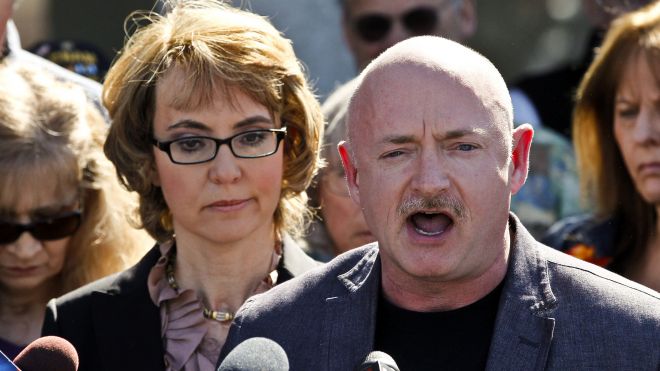
Former Rep. Giffords’ Husband’s Purchase of Rifle Draws Online Criticism

March 13, 2013 By Editor Leave a Comment

PHOENIX –  The husband of former U.S. Rep. Gabrielle Giffords generated nearly 4,000 comments on Facebook from people on both sides of the gun debate after he posted a photo of himself buying a military-style rifle — a purchase he made to demonstrate how easy it is to obtain the kind of firearms he’s lobbying Congress to ban.

Mark_KellyA background check took only a matter of minutes to complete, Mark Kelly said in the Facebook post, adding that it’s scary to think people can buy similar guns without background checks at gun shows or on the Internet.

It didn’t take long for gun-rights supporters to accuse Kelly of being a hypocrite for buying an AR-15-style rifle and a 45.-caliber handgun. Many of the Facebook comments focused on his motivations and the rules for purchasing such guns.

Kelly and Giffords started a gun control advocacy group, Americans for Responsible Solutions, amid the wave of recent mass shootings. They have been touring the country in recent months in support of expanded background checks for gun purchases.

Kelly bought the guns at a Tucson shop the day before he appeared with his wife at the supermarket where she was wounded during a shooting rampage that left six dead and 12 others injured two years ago.

The public event last week was the first time the survivors had come together since the January 2011 shooting.

Giffords resigned from Congress last year as she continues to recover from her injuries.

The AR-15 is among 157 military-style weapons that would be banned under a bill pending before the U.S. Senate Judiciary Committee. Kelly, a former astronaut, said he intends to eventually hand in the rifle to Tucson police.

Doug MacKinlay is the owner of Diamondback Police Supply, the shop where Kelly bought the guns. He said Kelly bought the rifle on March 5 but couldn’t immediately take possession of it because the shop had bought it from a customer. As a result, the store is required by a Tucson ordinance to hold the gun for 20 days to give the city enough time to make sure the weapon wasn’t used in a crime, MacKinlay said.

MacKinlay said Kelly never revealed to the store’s staff why he was buying the guns and added that it would be wrong to refuse to sell a gun to someone because of their personal views.

“He is a U.S. citizen, an Arizona citizen and expressing his Second Amendment right to purchase and own a firearm,” MacKinlay said.

Todd Rathner, a lobbyist for the National Rifle Association’s affiliate in Arizona and a national NRA board member, questioned the point that Kelly was trying to make in buying the guns, saying a model citizen such as Kelly should be able to buy a gun relatively quickly. He also noted that such a purchase could have been a good investment as the value of those types of weapon soars amid heightened demand from gun owners.

“If you believe him, it’s a cheap publicity stunt,” Rathner said. “If you don’t, then he was speculating on the value of the rifle because he knew the prices would be inflated.”

The advocacy group started by Giffords and Kelly had no immediate comment Tuesday on Kelly’s gun buys.

But the group released a statement from Kelly on the Senate Judiciary Committee’s approval Tuesday of a proposal to expand federal firearms background checks to nearly all gun purchases. Kelly said the 10-8 vote was a huge step in keeping guns out of the hands of criminals and mentally ill people. Kelly’s statement didn’t address the controversy over his own gun buys.

Kelly, a former astronaut who plans to keep the handgun, told CNN on Monday that it was important for him to have firsthand information on the ease of buying guns such as the AR-15 and that he looks forward to buying a firearm at a gun show in the future. Kelly and Giffords have long been supporters of gun rights and owned handguns themselves.

Published March 13, 2013 / Associated Press

Filed Under: All Stories, Elections, Ethics

House Republican Plan Aims to Balance Budget in 10 Years, Without Tax Hikes

March 12, 2013 By Editor Leave a Comment

House Republicans unveiled an ambitious cost-cutting plan Tuesday that would balance the budget in 10 years without raising taxes, while repealing ObamaCare and overhauling entitlements — a document Democrats are sure to reject but could be used as a negotiating tool in talks with President Obama.

paul_ryanRep. Paul Ryan, R-Wis., chairman of the House Budget Committee, is sticking by controversial proposals, including one to give future Medicare retirees the option of using government payments for private health care plans.

The plan warns of a looming debt crisis, and endeavors to pay off the debt by 2050.

“It’s not too late,” the plan says. “This budget provides an exit ramp from the current mess.”

Democrats preemptively panned Ryan’s spending plan, with House Democratic Whip Steny Hoyer, D-Md., saying it relies on “spurious budget trickery.”

“His past budgets have included lofty rhetoric about deficit savings, but very few actual details of how those savings are found,” Hoyer said in an op-ed in Politico.

Senate Democrats promise to offer a counterproposal on Wednesday with higher spending on domestic programs and additional tax hikes on top of the higher rates imposed on top-bracket earners in January. It will, in turn, arrive as a dead letter in the GOP-controlled House.

But this year’s dueling GOP and Democratic budget proposals are more about defining political differences than submitting a plan that can pass Congress unchanged.

The exercise comes even as President Obama was to travel to Capitol Hill on Tuesday to meet with Senate Democrats in an attempt to resuscitate his failed efforts for bipartisanship.

Ryan, who became a national GOP figure as the losing vice presidential nominee last year, has for now settled back into his wonkish role as Budget Committee chairman and chief tutor for dozens of relatively junior Republicans. His budget helps to undergird Republican claims that the government does not need to raise taxes in order to bring down the deficit.

The plan would achieve $4.6 trillion in deficit reduction over 10 years. It also aims to simplify the tax code, consolidating the seven income-tax brackets into two, with a top rate of 25 percent.

“We’re introducing a budget that balances in 10 years — without raising taxes,” Ryan said in an op-ed in The Wall Street Journal. “How do we do it? We stop spending money the government doesn’t have.” All told, Ryan’s plan would slash $4.6 trillion in spending over the coming decade.

“On the current path, we’ll spend $46 trillion over the next 10 years. Under our proposal, we’ll spend $41 trillion,” Ryan said. “On the current path, spending will increase by 5 percent each year. Under our proposal, it will increase by 3.4 percent.”

The plan calls for a 10 percent reduction in the federal workforce by 2015, as well as changes to give states more flexibility on Medicaid, the health care program for low-income Americans. It would also repeal the federal health care overhaul, particularly targeting the expansion of Medicaid and government subsidies meant to help millions buy private insurance.

The House Budget Committee has scheduled a vote on the soon-to-be-released measure Wednesday, and the Senate Budget panel is slated to vote Thursday on rival legislation by new Budget Committee Chairwoman Patty Murray, D-Wash., who promises new tax revenues but few cuts from domestic programs like Medicare and Medicaid.

“We are working toward fair and balanced, which is what the American public has said time and time again that they want,” Murray said. “We need to make sure that everybody participates in getting us to a budget that deals with our debt and our deficit responsibly.”

For his part, Ryan has resurrected a controversial Medicare proposal that replaces traditional Medicare for those currently under 55 with a government subsidy to buy health insurance on the open market. Critics of the plan say the subsidies won’t grow with inflation fast enough and would shove thousands of dollars in higher premiums onto seniors before very long.

The House GOP plan again proposes sharp cuts to Medicaid, tighter food stamp eligibility rules and more than $1 trillion in savings over a decade by repealing Obama’s signature overhaul of the U.S. health care system. It seeks to preserve the Pentagon budget, but only at the expense of proposing domestic agency budgets that may prove too low for GOP moderates and the pragmatists atop the Appropriations Committee responsible for guiding them into law.

Even as it proposes repealing ObamaCare, the Ryan plan banks more than $700 billion in the health care law’s cuts to Medicare providers over a decade — just as more than $600 billion in tax hikes on the wealthy enacted in January make it easier for Ryan’s budget to predict balance.

At the White House, Press Secretary Jay Carney was asked about Obama’s failure to submit a budget on time.

“The president has always believed that deficit reduction is not a goal unto itself,” Carney said. “The proposals he’s put forward keep the No. 1 objective in mind, which is economic growth and job creation, not deficit reduction solely for the purpose of reducing the deficit.”

As the two sides battle over future-year budgets, top Senate Democrats and Republicans late Monday released a catchall government funding bill for the ongoing fiscal year that denies Obama new money for implementing signature first-term accomplishments like new regulations on Wall Street and his expansion of government health care subsidies, but provides modest additional funding for domestic priorities like health research and highway projects.

Monday’s measure was the product of bipartisan negotiations and is the legislative vehicle to fund the day-to-day operations of government through Sept. 30 — and prevent a government shutdown when current funding runs out March 27.

It sets a path for government after across-the-board spending cuts that took effect March 1. In most cases the minor changes in agency budgets amount to housekeeping within a trillion-dollar cap for the day-to-day operations of agencies in the current budget year.

Passage in the Senate this week seems routine and could presage an end to a mostly overlooked battle between House Republicans and Obama and his Senate Democratic allies over the annual spending bills required to fund federal agency operations.

Published March 12, 2013  FoxNews.com

The Associated Press contributed to this report.

Filed Under: All Stories, Economy, Elections, Entitlement, Ethics

Cincinnati Poll Worker Charged with Voting Half Dozen Times in November

March 12, 2013 By Editor Leave a Comment

She admitted voting twice in the presidential election last November, and now, Obama supporter Melowese Richardson has been indicted for allegedly voting at least six times. She also is charged with illegal voting in 2008 and 2011.

voter_fraudThe 58-year-old veteran Cincinnati poll worker, indicted Monday, faces eight counts of voter fraud. Two others, one of whom is a nun, have been charged separately.

Richardson had admitted on camera to a local TV station, “Yes, I voted twice,” claiming she was concerned that her vote would not count. She also said there “was no intent on my part to commit any voter fraud.”

“I’ll fight it for Mr. Obama and Mr. Obama’s right to sit as president of the United States,” she proclaimed in the interview.

Officials charged that she voted in her own name by absentee ballot and also in person at the polls, but Hamilton County Prosecuting Attorney Joseph Deters said she also is charged with voting in the name of five other people in various elections.

“This is not North Korea,” Deters said in a statement announcing the indictments. “Elections are a serious business and the foundation of our democracy. In the scheme of things, individual votes may not seem important, but this could not be further from the truth. Every vote is important and every voter and candidate needs to have faith in our system. The charges today should let people know that we take this seriously.”

Richardson made national headlines when the Hamilton County Board of Elections announced that it was investigating whether she voted up to half a dozen times, including on behalf of her granddaughter, India Richardson.

India told Fox News that her grandmother did indeed vote in her name, telling us that “it wasn’t a big deal.”

But voting twice or in another person’s name is illegal.

Prosecutors say the five other people for whom Richardson cast ballots are all relatives.

Sister Marguerite Kloos also faces one count of illegal voting, for allegedly submitting an absentee ballot in the name of a fellow nun, Sister Rose Marie Hewitt, who had died before absentee ballots were sent out. She is accused of opening Sister Hewitt’s ballot, forging her signature and mailing it to the Board of Elections as a vote.

The 54-year-old Kloos has resigned as the dean of the Division of Arts and Humanities at the College of Mount St. Joseph in Cincinnati, where she still serves as an associate professor of religious and pastoral studies.

Kloos was not indicted but faces what is known as an information, because her lawyer contacted prosecutors and she agreed to cooperate and plead guilty.

“As a valued member of the Mount community, our thoughts are with her during this difficult time,” the college said in a written statement. “We respect her privacy and will not comment further on this matter at this time.”

Russell Glassop, 75, also is charged with illegal voting.  He is accused of voting on behalf of his wife, who died before election day.

But it was Richardson’s case, and the possibility of repeated votes, that shocked many. She faces up to 12 years in prison if convicted. Efforts to contact her and her lawyer have been unsuccessful.

The Hamilton County Board of Elections recently held hearings on cases of possible double voting and voter fraud, part of a statewide review ordered by Secretary of State John Husted. He called on all 88 counties to review complaints of fraud, as well as voter disenfranchisement.

“Every voter must play by the rules, and if they don’t they will be held accountable,” Husted, a Republican, said in a written statement. “For voters to have confidence in our elections, we must prosecute every case of voter fraud in Ohio.”

Last month, Husted told Fox News that Richardson’s case was especially troubling, because “it appears she not only attempted to vote more than once, but was actually successful at it and having those additional votes counted.”

“Most attempts are caught by the system. But there are cases that do slip through, as this one does, and we need to make sure that we really send a strong message, that if you do this, you are going to be held accountable,” Husted said. “It might mean fines, it might mean jail time.”

Hamilton County prosecutors are investigating three additional cases of possible voter fraud.

By Eric Shawn / Published March 11, 2013 / FoxNews.com

Filed Under: All Stories, Elections, Ethics

Lawmakers Eye New Taxes on Guns, Ammo in Latest Wave of Legislation

March 11, 2013 By Editor Leave a Comment

If you can’t ban ’em, tax ’em.

Lawmakers looking to more tightly regulate firearms in the wake of the Newtown school shooting and other massacres are moving at the state and federal levels to introduce new taxes on firearms and ammunition.

gun_banThe proposals range from the modest — a proposed 5 percent tax in New Jersey — to the steep — a proposed 50 percent ammo tax in Maryland. The bills follow efforts to ban assault weapons and high-capacity magazines and expand background checks, measures that have had mixed success at the state level.

The taxes — much like so-called “sin taxes,” like those on cigarettes — serve a dual purpose. They can deter buyers, while using the extra revenue for favored programs. In this case, the sponsors want to direct the money toward mental health services, police training and victims’ treatment.

But firearms groups say a “sin tax” on firearms wrongly punishes law-abiding gun owners.

“If anything, gun owners ought to be getting a tax rebate for helping reduce crime,” said Lawrence Keane, senior vice president and general counsel for the National Shooting Sports Foundation.

He said the purpose of the taxes is to “frustrate and limit the exercise of the Second Amendment.” While noting some of the revenue from these taxes and fees would go to victims’ services, Keane said those paying the tax are mostly not those responsible for gun crime.

“We’re obviously extremely opposed to try to tax the lawful exercise of the Second Amendment rights by law-abiding Americans,” he told FoxNews.com.

Firearms manufacturers already pay a federal tax, which goes toward wildlife conservation. A tax on sales would make firearms costlier.

At the federal level, Rep. Linda Sanchez, D-Calif., proposed a bill that would impose a 10 percent tax on “any concealable” firearm. The revenue would be used to help fund a national gun buyback program. The bill is still in committee.

At the state level in California, Democratic state Rep. Roger Dickinson last month introduced a bill to impose a 5-cent tax on every bullet.

“A limited tax on ammunition is a small price to pay for better mental health care for children in our state,” he said in a recent statement. The revenue from the tax would go toward screening young people for mental illness.

Several other states have introduced similar measures. Massachusetts state Rep. David Linsky is pushing a 25 percent sales tax on ammunition and firearms. Maryland state Rep. Jon Cardin has introduced a bill imposing a 50 percent tax on ammo, and an annual $25 gun registration fee.

And according to the Las Vegas Review Journal, Assembly Majority Leader William Horne is pushing a draft bill that would include a $25 per gun sales tax, in addition to a 2-cent tax for every round of ammunition.

The tax proposals are just one element of a multi-front campaign by pro-gun control lawmakers to rein in firearms.

While some states — particularly Colorado — have moved full-steam ahead with new gun regulation, the movement on Capitol Hill has been more restrained. A Senate committee last week voted to enhance penalties on illegal gun buys, but other bills are still on hold.

President Obama, who got the ball rolling on gun legislation but has not said much publicly on the topic since, plans to speak to supporters and donors on Wednesday in Washington — where he is expected to touch on the gun control issue.

By Judson Berger / Published March 11, 2013 / FoxNews.com

Filed Under: All Stories, Elections

Leaked email adds fuel to claims White House playing politics over impact of cuts

March 6, 2013 By Editor Leave a Comment

Reprinted from Foxnews.com, March 06, 2013.

A leaked email from an Agriculture Department field officer adds fuel to claims President Obama’s political strategy is to make the billions in recent federal budget cuts as painful as possible to win the public opinion battle against Republicans.

obama_closeupThe email, circulated around Capitol Hill, was sent Monday by Charles Brown, a director at the agency’s Animal and Plant Health Inspection Service office in Raleigh, N.C. He appears to tell his regional team about a response to his recent question on the amount of latitude he has in making cuts.

According to the partially redacted email, the response came from the Agriculture Department’s budget office and in part states: “However you manage that reduction, you need to make sure you are not contradicting what we said the impact would be.”

The response noted that the administration had already told Congress that the APHIS would “eliminate assistance to producers in 24 states in managing wildlife damage to the aquaculture industry” without additional funds.

Arkansas Republican Rep. Tim Griffin said the administration’s response to Brown’s email shows a bid to undermine efforts to replace the cuts, known as sequester, with less onerous ones.

“This email confirms what many Americans have suspected: The Obama administration is doing everything they can to make sure their worst predictions come true and to maximize the pain of the sequester cuts for political gain,” Griffin said in a statement.

Griffin told Fox News on Wednesday that the bosses effectively said “you can’t do anything that is inconsistent with the negative impact that we’ve told everybody these cuts are going to have.”

Under the 2011 deal reached by Obama and Congress, the cuts are supposed to be across the board, meaning government officials have limited flexibility in moving around money.

The administration in recent weeks has made doomsday predictions about the impact of the cuts. And the White House so far has appeared unwilling to accept a Republican offer to give the president more autonomy in making the cuts, covering $85 billion this fiscal year, to help reduce the impact on some of the most essential or hardest-hit programs or agencies.

Some political strategists say the president hopes the cuts hurt enough to compel Republican lawmakers seeking re-election next year to end them by agreeing to more tax increases.

On Sunday, Gene Sperling, the White House’s top economic adviser, suggested Republicans would indeed make this decision.

“Our hope is, as more Republicans start to see this pain in their own districts, they will choose bipartisan compromise over this absolutist position,” he said.

Agriculture Secretary Tom Vilsack, during a House hearing Tuesday, was asked by South Dakota Republican Rep. Kristi Noem about the Brown e-mail.

Vilsack said he was unaware of the email but denied the administration has a policy of being inflexible and maximizing the cuts’ impact.

“I wouldn’t say that we’ve said no to flexibility,” Vilsack said. “But there are certain circumstances where we don’t have flexibility.”

“I’m hopeful that isn’t an agenda that has been put forward,” Noem said.

Filed Under: All Stories, Economy, Elections, Entitlement, Ethics

White House retreats from doomsday spending cuts predictions, but keeps blame on Republicans

March 4, 2013 By Editor Leave a Comment

Reprinted March 03, 2013 from FoxNews.com

The White House is retreating from its doomsday predictions about the impact of the $85 billion in federal spending cuts as they enter a second week — with Republican leaders appearing at least satisfied about delivering on their promise to limit government spending and hold down taxes.

sperling_geneGene Sperling, the White House’s top economic adviser, repeatedly said Sunday the cuts will not hurt as much on “Day One” as they will over the long haul.

“Nobody ever suggested that this … was going to have all its impact in the first few days,” he told “NBC’s “Meet the Press.” “It is a slow grind.”

His remarks are in contrast to weeks of President Obama and his Cabinet warning that the cuts will result in furloughs or pay cuts for middle-class wage-earners such as teachers, Capitol Hill janitors and air traffic controllers, which they said could cause 90-minute delays at major U.S. airports.

Sperling declined at least twice to directly answer questions about whether the worst-case-scenario rhetoric has hurt the president’s credibility on the issue. He instead stuck to his argument that independent economists forecast the cuts will result in 750,000 fewer jobs and that corporate executives now anticipate slower economic growth.

Senate Republican Leader Mitch McConnell told CNN’s “State of the Union” Americans absorbed similar cuts once already this year.

“This modest reduction of 2.4 percent in spending over the next six months is a little more than the average American experienced just two months ago, when their own pay went down when the payroll tax holiday expired,” the Kentucky Republican said.

Congress agreed to the cuts, known as sequester, in 2011 after failing to agree on more measure reductions — to defense and some domestic spending. However, the cuts were intended to be so drastic that Democrats and Republicans would be forced to compromise before they started.

Still, Sperling rejected several Republican-backed plans and said no compromise would be reached unless the party agrees to tax increases.

Sen. Kelly Ayotte, R-N.H., responded by saying Congress agreed to such increases in January “at the president’s request” and questioned why Obama and other Democrats will not agree to additional spending cuts.

She argued for potential pay freezes for federal employees and reforms to the federal food stamps program.

“There’s a whole host of ideas to cut spending” without jeopardizing security, Ayotte said on ABC’s “This Week.”

However, she also said she would consider tax reform that comes with entitlement reforms. But she would not agree to revenue increases to pay for additional government spending.

Earlier on the show, Sperling said Republican strategy is flawed because the cuts will take resources from several of the party’s most valued positions — including national defense and border security.

“This is not a win for Republicans,” Sperling said. “This cuts into military preparedness.”

He hinted Sunday at Democrats’ likely strategy for retaking the House in 2014.

“Our hope is as more Republicans start to see this pain in their own districts, they will choose bipartisan compromise over this absolutist position,” he said.

Sperling also dismissed a plan backed by at least some Republicans to give the president some flexibility in the cuts.

“It’s like saying you have to cut off three of your fingers but you can choose which ones,” he said.

Sperling also addressed an email sent to Bob Woodward in which he said The Washington Post reporter might “regret” writing a story that said Obama has “moved the goal posts” on sequester.

He told ABC that he and Woodward share a mutual respect and he hopes they can “put this behind us.”

Sen. Lindsey Graham, R-S.C., told CBS’ “Face the Nation” that any tax increases were unacceptable.

“I’m not going to do any more small deals,” he said. “I’m not going to raise taxes to fix sequestration. We don’t need to raise taxes to fund the government.”

All of this comes ahead of a new, March 27 deadline that could spell a government shutdown and a debt-ceiling clash coming in May.

House Speaker John Boehner said his chamber would move this week to pass a measure to keep government open through Sept. 30.

McConnell said a government shutdown was unlikely to come from his side of Capitol Hill. The White House said it would dodge the shutdown and roll back the cuts, which hit domestic and defense spending in equal share.

Sperling said the White House is committed to trying to find a way that Republicans and Democrats can reach a compromise.

The billions in cuts apply to the remainder of fiscal 2013, which ends Sept. 30. But without a deal they will continue slashing government spending by about $1 trillion more over a 10-year period.

Filed Under: All Stories, Economy, Elections, Entitlement, Ethics

Woodward blasts Obama “madness” in handling cuts

March 4, 2013 By Editor Leave a Comment

By Susan Heavey, WASHINGTON | Reprinted from Reuters

Journalist Bob Woodward on Wednesday criticized Barack Obama’s handling of the automatic U.S. budget cuts set to take effect this week, calling the president’s decision to hold back on military deployments “madness.”

arrogance_obamaHis comments continued what has become a running dispute between Woodward, perhaps the country’s best-known print journalist, and the Democratic White House over who is responsible for the across-the-board cuts scheduled to begin on Friday.

Last week, Woodward published an opinion piece in the Washington Post – where he is an associate editor – saying the administration was “wrong” to blame the cuts on Republicans.

That drew retorts from White House press secretary Jay Carney, who in posts on Twitter and later in comments to reporters blamed the budget stalemate on Republican opposition to including increased revenues in any deal to replace the cuts.

The $85 billion across-the-board budget cuts were mandated by Congress and the White House as part of the August 2011 deal to avoid a government default. The reductions are split between defense spending and domestic programs.

Woodward, who first gained fame in the 1970s from exposing the Watergate scandal during the administration of President Richard Nixon, wrote a detailed account in his 2012 book, “The Price of Politics,” of the August 2011 deal that led to the cuts.

On Wednesday he attacked Obama for drawing national security into the budget debate.

“So we now have the president going out (saying) ‘Because of this piece of paper and this agreement, I can’t do what I need to do to protect the country.’ That’s a kind of madness that I haven’t seen in a long time,” Woodward told MSNBC on Wednesday.

On Tuesday, Obama warned of threats to Navy readiness in a visit to the Newport News Shipbuilding shipyard in Virginia, where maintenance to the aircraft carrier USS Abraham Lincoln has been delayed by the budget crisis.

Earlier this month, the Pentagon said it was delaying deployment of another carrier, the USS Harry Truman, to the Middle East because of funding.

Obama’s decision to drag the military into the budget fight likely would not have happened in previous administrations, Republican or Democratic, Woodward added on MSNBC’s “Morning Joe” program.

(Reporting by Susan Heavey; Editing by Fred Barbash and Eric Beech)

Filed Under: All Stories, Economy, Elections, Entitlement, Ethics

Bob Woodward: Obama’s sequester deal-changer

March 2, 2013 By Editor Leave a Comment

Reprinted from The Washington Post: Bob Woodward (woodwardb@washpost.com) is an associate editor of The Post. His latest book is “The Price of Politics.” Evelyn M. Duffy contributed to this column.

Misunderstanding, misstatements and all the classic contortions of partisan message management surround the sequester, the term for the $85 billion in ugly and largely irrational federal spending cuts set by law to begin Friday.

What is the non-budget wonk to make of this? Who is responsible? What really happened?

The finger-pointing began during the third presidential debate last fall, on Oct. 22, when President Obama blamed Congress. “The sequester is not something that I’ve proposed,” Obama said. “It is something that Congress has proposed.”The White House chief of staff at the time, Jack Lew, who had been budget director during the negotiations that set up the sequester in 2011, backed up the president two days later.“There was an insistence on the part of Republicans in Congress for there to be some automatic trigger,” Lew said while campaigning in Florida. It “was very much rooted in the Republican congressional insistence that there be an automatic measure.”

The president and Lew had this wrong. My extensive reporting for my book “The Price of Politics” shows that the automatic spending cuts were initiated by the White House and were the brainchild of Lew and White House congressional relations chief Rob Nabors — probably the foremost experts on budget issues in the senior ranks of the federal government.

Obama personally approved of the plan for Lew and Nabors to propose the sequester to Senate Majority Leader Harry Reid (D-Nev.). They did so at 2:30 p.m. July 27, 2011, according to interviews with two senior White House aides who were directly involved.

Nabors has told others that they checked with the president before going to see Reid. A mandatory sequester was the only action-forcing mechanism they could devise. Nabors has said, “We didn’t actually think it would be that hard to convince them” — Reid and the Republicans — to adopt the sequester. “It really was the only thing we had. There was not a lot of other options left on the table.”

A majority of Republicans did vote for the Budget Control Act that summer, which included the sequester. Key Republican staffers said they didn’t even initially know what a sequester was — because the concept stemmed from the budget wars of the 1980s, when they were not in government.

At the Feb. 13 Senate Finance Committee hearing on Lew’s nomination to become Treasury secretary, Sen. Richard Burr (R-N.C.) asked Lew about the account in my book: “Woodward credits you with originating the plan for sequestration. Was he right or wrong?”

“It’s a little more complicated than that,” Lew responded, “and even in his account, it was a little more complicated than that. We were in a negotiation where the failure would have meant the default of the government of the United States.”

“Did you make the suggestion?” Burr asked.

“Well, what I did was said that with all other options closed, we needed to look for an option where we could agree on how to resolve our differences. And we went back to the 1984 plan that Senator [Phil] Gramm and Senator [Warren] Rudman worked on and said that that would be a basis for having a consequence that would be so unacceptable to everyone that we would be able to get action.”


Filed Under: All Stories, Economy, Elections, Entitlement

Who’s to blame for sequestration frustration?

March 2, 2013 By Editor Leave a Comment

Reprinted from Your World, Neil Cavuto

It’s not me. It’s the GOP.

The president laying the blame for this sequestration frustration, on Republicans blocking everything in creation.

They allowed these cuts to happen, not him, who did everything in his power not to let them happen.

obama_blame_gameThey’re stubborn for not wanting tax hikes, because they’ve already given in on taxes in a prior deal. He’s not stubborn for suddenly wanting to include tax hikes, even though Bob Woodward confirms, they weren’t supposed to be part of this deal.

Republicans are playing games by always bringing these things to the brink. But he’s not by holding a hastily arranged PR meeting with them at the White House on the day we hit the brink.

They’re playing to the press when they all but call the meeting kabuki theater. He’s not when he talks to the press right afterwards to insist a meeting that lasted mere minutes wasn’t kabuki theater.

Look, I understand, each side is entitled to its agenda. But neither side is entitled to its own set of facts. Because the fact is Republicans didn’t come up with sequestration as a back-up plan. The president did. And the fact is Republicans didn’t scare the nation into thinking we’d all be eating horsemeat because beef inspectors would start disappearing. The president did. Even though he knew beef inspectors would not start disappearing.

It just amazes me to hear the president today joke about others who say an apocalypse will come, when he was the guy who all but said the apocalypse was here.

If memory serves me right wasn’t the president the one who said our airport security was hanging in the balance?

Wasn’t he the one who stood in front of firemen and policemen, whose jobs he said were at stake, even though they aren’t paid by the federal government, so they can’t be at stake?

Wasn’t his education secretary the guy who had to take back that, tens of thousands of teachers’ jobs lost line?

And his homeland security secretary the one who said our border security was on the line?

Over the line. Over the top.

It takes two to tango.

I’m just saying, would it kill the media to at least try to be fair? If you’re going to call Republicans intransigent because they only want spending cuts, why is the other side not because they only want tax hikes?

And if you’re going to say republicans won’t compromise, even though they already did on taxes, would it kill you to say the same of Democrats, who have yet to budge on spending?

Leaving aside 85 billion in cuts in a $3.8 trillion budget is chicken feed, hearing this lopsided, one-sided, hopelessly blind-sided approach to facts that is just chicken… fit.

Filed Under: All Stories, Economy, Elections, Entitlement

Lincoln’s Lost Opportunities

March 1, 2013 By Editor Leave a Comment

Trashing red-state values has cost Disney and Fox millions of dollars.

By Mark Joseph, Reprinted from National review Online.

LincolnBy Hollywood standards, Lincoln has done respectable business at the box office and Daniel Day-Lewis’s performance as America’s 16th president is stunning, but a botched marketing campaign and a lack of ideological diversity among those who made the film have left tens, perhaps hundreds of millions of dollars on the table — money that could have lined the coffers of legendary director Steven Spielberg and his partners, Disney and 20th Century Fox.

First, there was the team that brought forth this film about the president who founded the Republican party, a team led by the blue-state heroes Steven Spielberg, screenwriter Tony Kushner, author Doris Kearns Goodwin, and Daniel Day-Lewis. To understand the message that the makeup of this team sent to Lincoln’s natural fan base, one would have to imagine the reaction had the gay community learned that Milk, the biopic about one of the most beloved members of its community, was going to be directed by Clint Eastwood, star Mel Gibson, be based on a book by David Barton, with a screenplay written by Dinesh D’Souza.

And if that lineup of blue-state heroes wasn’t enough to discourage interest from red-state Lincoln fans, Mr. Spielberg probably sealed the deal when he directly insulted them, declaring: “The parties traded political places over the last 150 years. That in itself is a great story, how the Republican party went from a progressive party in 1865, and how the Democrats were represented in the picture, to the way it’s just the opposite today.”

Red-staters didn’t miss the insult: “Did Steven Spielberg say the GOP is just like the slave-holding South?” asked Warner Todd Huston at the conservative BigHollywood.com.

There is another surefire way to keep traditionalist audiences away from a movie, and the makers of Lincoln played that card as well: bad language. According to a Hollywood Reporter poll released last year, it is Lincoln’s natural fan base that is most offended by cursing in movies, with a whopping 79 percent of Republicans saying that American movies feature too many four-letter words.

Traditionalists took Spielberg to task on this front: “Sadly, the movie also contains about 40 obscenities and profanities, including four ‘f’ words and more than 10 GDs,” noted MovieGuide, a site that a good number of traditionalists consult before attending movies. Another reviewer, at Christian Answers, observed: “I was particularly sensitive to the use of the LORD’s name, but there is also a lot of vulgarity, with numerous f***, son of a bi***, da**, cr**, pi**, sh**, he** throughout the movie. There were also uses of the name of Jesus in a profane manner. Mostly, I was very disappointed that there were over 10 uses of ‘g** d***.’”

Declining to give Lincoln its much-sought-after seal of approval, the influential Dove Foundation also questioned the veracity of the cursing, noting that “the language they feature in the film (and this includes Lincoln cursing as well) does not line up with the morals and language of the time period.” Indeed, the historical record casts doubt on the notion that Lincoln cursed the way Spielberg and Kushner imagined. Lincoln personally meted out punishment to his troops who used profanity, on one occasion ordering that Captain Jesse Armstrong be docked a month’s pay for merely calling a fellow soldier a “damned liar” and “damned sh**ass.”

And it’s not only conservatives who have criticized Lincoln’s potty mouth. In an interview after the film’s release, the Civil War historian and Lincoln biographer James McPherson, who met with Spielberg and Kushner to provide background for the screenplay, noted: “Lincoln rarely if ever used profanity, and some of the dialogue calls for him to do that. I thought that was a bit jarring.”

Inserting profanity ahistorically and attempting to tell traditionalist stories even while various cast and crew members insult those who form the film’s natural audience may sound like bad business moves, but they’re common practice in Hollywood, in spite of their box-office consequences. In this case, they surely cost Lincoln some amount of foot traffic, if a 48-year-old named Leigh who posted her concerns at Christian Answers is any indication:

I refuse to pay for and go to a movie where God’s name is taken in vain. There are numerous Web sites out there which will tell you positive and negative aspects of a movie, so that you don’t unknowingly subject yourself or your family to movie content that all Christians should refuse to be a part of. I believe Lincoln would be horrified to know how he was portrayed, and the profanity that Steven Spielberg forced his character to say.

The film’s marketing campaign was equally obtuse as cast and crew members fanned out across mainstream media for appearances on The Charlie Rose Show, Oprah, and various NPR, MSNBC, and PBS programs, while ignoring The O’Reilly Factor, Hannity, Huckabee, Limbaugh, Beck, the 700 Club (of the Christian Broadcasting Network), and other red-state favorites.

Presented with the opportunity to make a film that accurately reflected the morals of Lincoln’s time instead of ours and to develop and market the film in a manner that would appeal to all Americans, center, right, and left, Mr. Spielberg instead chose another path, one that will almost certainly see his film honored at the Oscars, but that will also forfeit big bucks in box-office receipts. The 79 percent of Americans who, according to Gallup, make up the center-right majority of the nation are showing their displeasure with Lincoln by voting with their feet and asking important questions: Why would moviegoers shell out money to see a picture that seems to intentionally offend their core values? Why would traditionalists pay any attention to filmmakers who think their communities are beneath them and not even worth a minimum of outreach?

Lincoln’s box-office numbers are falling short of their potential, which shows — once again — that Hollywood still has a lot of work to do if it wants to better understand its customers.

— Mark Joseph is an author and producer whose most recent book is The Lion, the Professor, and the Movies: Narnia’s Journey to the Big Screen.

Filed Under: All Stories, Elections

Repeal the 17th Amendment!

March 1, 2013 By Editor Leave a Comment

It made the Senate more democratic — and that’s not good.

By Charles C.W. Cooke, Reprinted from National Review Online

In our grubby, unhelpful political lexicon, certain words exist solely to end conversations. The most prominent such word is “racist.” Less popular, but by no means less potent, are “democracy” and “rights.” When welded together as “democratic rights,” the pair becomes all-powerful — strong enough to send grown men spinning for the exits and to render eloquent speakers mute.

SenateFor a good example of this principle in motion, witness the orthodox reaction to anyone who calls for the repeal of the 17th Amendment. (Direct election of senators, if you’re wondering.) Removing this ugly violation from the Constitution it so corrupts is an idea that has long lingered on the fringe (there’s another of those conversation-terminating words) and, until the massive expansion of federal power that marked the past decade and woke up the sleeping libertarians, it seemed destined to remain there in perpetuity. Even now, to declare in public that you think the whole of 1913 was one long, ghastly mistake is to be looked at as if you have just announced that the United States should consider restoring the British monarchy.

Providing what may be the Platonic ideal of such dismissals, Salon’s Alex Seitz-Wald reacted to the renewed interest by declaring in 2012 that, because any increase of democracy was “unquestionably positive,” any modifications were tantamount to “doing away with rights.” America, “we’re told from a young age, is all about democracy,” Seitz-Wald wrote, “and democracy is all about choosing whom you want to be your representative and holding them accountable.” This, he added, “seems like an entirely uncontroversial idea.” I cannot account for Mr. Seitz-Wald’s grasp of America’s history, beyond saying that if he has indeed been told “from a young age” that America is “all about democracy,” then he must be forgiven for believing it. Still, whatever his schools might have told him, the United States is not in fact a democracy but a constitutional republic, and her virtues lie as much in her undemocratic institutions as in her ample provisions for self-rule — more, perhaps.

Doubt it? Look around. Despite the violence that the 17th Amendment did to it, the Senate remains a partially anti-democratic institution; the Supreme Court is an entirely undemocratic institution; the Constitution is undemocratic, too, requiring for any changes to its structure the consent of a supermajority and containing the Bill of Rights, which is as elevated and explicitly counter-majoritarian a component of national law as you will find. The strong American protections of free speech, freedom of religion, the right to bear arms, due process, privacy, and the right to a jury trial are triumphs of minority rights. How about the absence of a state church? Not for nothing did Patrick Henry cry ardently for “liberty or death.” It is liberty, not democracy, that is America’s highest ideal.

Walter Lippmann famously observed that, at some point in their history, “the American people came to believe that their Constitution was a democratic instrument, and treated it as such.” The New York Times’ David Firestone appears to be one of these American people, arguing as he did in 2010 that “a modern appreciation of democracy” makes the idea of directly electing senators “so obvious” that any proposal of change is “unthinkable.” Putting to one side for now the narrow procedural majoritarianism inherent in his definition, Firestone’s thesis runs into two problems: America is not “modern” and it is not a “democracy.” Perish the thought.

Instead, the American system was deliberately designed to balance power between the various branches of government and to guarantee individual rights against majority rule, thus protecting the people from tyranny whether they liked it or not. The United States government was arranged in this way as a permanent bulwark against federal encroachment. “Changing times” was no more a strong justification for the undoing of this system in 1913 than it is now. And whatever the Wilson-era progressives might have held, the federal government was not intended to be a wholly separated layer of government. Instead, it was to be intertwined with the states to such an extent that it could not ride roughshod over their interests without pushback. As James Madison resolved during the debate over the Bill of Rights:

The state legislatures will jealously and closely watch the operations of this Government, and be able to resist with more effect every assumption of power, than any other power on earth can do; and the greatest opponents to a Federal government admit the State Legislatures to be sure guardians of the people’s liberty.

It is exactly here that America’s democracy fetishists go wrong. As Madison makes clear in the Federalist Papers, in order to defend the vertical checks and balances that allow America’s federal system to function, senators would be “elected absolutely and exclusively by state legislatures.” The Senate was not intended to be the people’s representative body, but that of the states. Lest the federal government “swallow up the state legislatures,” George Mason insisted to his fellow convention delegates in Philadelphia, “let the state legislatures appoint the Senate.” The delegates backed him unanimously.

It makes no more sense to argue that to return to this original arrangement would be to “take away” the “rights” of the people than it does to maintain that not being able to vote directly for Supreme Court justices violates their democracy. Everything has its place, and indulging popular sovereignty is simply not what the Senate was designed to do. One could sometimes be forgiven for thinking otherwise, but the states are not regional departments of the federal government. To ensure that they had a working mechanism by which to resist the expansion of federal power, the architects of our Constitution hard-wired the state legislatures into its structure; with the 17th Amendment, progressives pulled out that wiring like punch-drunk Jacobins.

Has there ever been a time when America was more in need of the states’ being represented in Washington? “The People” have their representatives in the House. The nation has its leader in the White House. What of the states? Andrew Napolitano has it right: The 17th Amendment, he gripes, “effectively just gave us another house like the House of Representatives . . . and the states lost their place at the federal table.” This is problematic because, to their great discredit, The People seem not greatly to care how power is structured. Who then is surprised that the abolition of the Senate as the supporting wall of federalism has led inexorably to, as Jefferson warned just before his death, “all government, domestic and foreign, in little as in great things,” being “drawn to Washington as the center of all power”? Returning the selection of senators to state legislatures would help to focus citizens’ eyes locally, where they belong.

“Democracy” may be the cry now. But as Alex Seitz-Wald goes on to acknowledge in his dissent, the primary argument in favor of the 17th Amendment was that it might serve to cut out corruption. Money was said to be rife in politics; direct elections would stamp it out. Lobbying by big business was staining the republic; direct elections would cut the buggers off at the knee. The small constituency that a senator served effectively gave him tenure; an amendment would make the body competitive. Bad behavior among senators was rife; the rigors of direct election would make them moral. And how are things now that the scalpel has been taken to Madison’s handiwork? There is more money in politics than ever before; direct elections have served only to cut out the middleman between lobbyists and politicians; senators rarely lose their seats; and Ted Kennedy killed a woman and got away with it.

In a brilliant Humanitas essay from 1996, C. H. Hoebeke rendered this judgment:

In retrospect, the amendment failed to accomplish what was expected of it, and in most cases failed dismally. Exorbitant expenditures, alliances with well-financed lobby groups, and electioneering sleights-of-hand have continued to characterize Senate campaigns long after the constitutional nostrum was implemented. In fact, such tendencies have grown increasingly problematic.

Americans purchased this dismal failure at the cost of their federal system’s integrity. Like the other two Progressive Era amendments that sit either side, the 17th is a testament to hubris — a parchment admonition of those who would tinker with the permanent in the name of the temporary. Nonetheless, it benefits those who would be required to amend it, which, alas, is a recipe for eternal life in Washington. Repeal is thus almost certainly a dead end; interest in such things is limited. And so the federal titan lumbers on, the states shrinking inexorably in stature. One cheer for democracy, Mr. Wilson.

— Charles C. W. Cooke is an editorial associate at National Review.

Filed Under: All Stories, Economy, Elections, Entitlement, Ethics

The “Mormon Effect”

February 22, 2013 By Editor 345 Comments

During the 2012 presidential campaign, that awesomely deep well of perpetual wisdom, Alec Baldwin, proclaimed that if Barack Obama were not black, his vote total would have been 20 percent higher.

mormon_templePeople of real intelligence realize that the opposite was probably true: if he had been white, his vote total would have been 20 percent lower. The African-American voting bloc combined with enough whites suffering from liberal guilt guaranteed a higher vote total for Obama.

The truth of the matter is, if Mitt Romney had not been a Mormon, his vote total might very well have been significantly higher.
In fact, according to a Gallop poll released in June of last year, while 4 percent of people said they would not vote for a black president, a full 22 percent said they would not vote for a Mormon. In fact, only atheists and gays ranked higher.

So Baldwin probably had it backwards, which he usually does, so that comes as no surprise.

What did come as a surprise to me is why people would have such negative views of Mormons. I have known lots of them in my life, and in most cases they have been hard-working, kind, generous family-oriented people—just the kind of people this country used to value (and maybe that’s the problem right there.)

Mormons have intrigued me ever since Mike Huckabee back in 2007 claimed that Mormons believe that Jesus and Satan are brothers. With the recent election over, I decided to check out Mormons a bit more.

My hope in doing this was to explain to readers who Mormons are and whether or not 22 percent of the people were justified in opposing having a Mormon president.

But instead I’m going to share an intriguing bit of Mormon theology I learned that I think makes them perhaps the most politically wise human beings on the planet. Ironically, this story stems from that Huckabee quote about the relationship between Jesus and the devil, but the lesson to be learned is one that, regardless of our political or religious views, we would all be wise to consider.

So here’s what I learned: Mormons, unlike most other Christian sects, believe that all humans lived a life before mortality. They call this the pre-existence or pre-earth life. At birth a veil is placed over our minds so that we don’t remember it (you’ll see why in a minute).

In this pre-earth life, we were all in the presence of God as His spirit children. Jesus was there—the first-born of God’s spirit children, and a leader in the councils in Heaven. Lucifer was also there, and was another leader among the children of God. He was called a “son of the morning.”

At some point in this existence, the Father called all of His children together to explain how things worked. All of His children would have to leave His presence and come to earth for a period of testing. The goal was to see if we would live a righteous life even when we had to live by faith, as we would no longer be able to remember God or heaven (that’s the reason for the veil).

If we would live a righteous life, we would be given the opportunity to return and live with God forever. Otherwise we would forfeit that chance, because no unclean thing can live in God’s presence. However, God knew that we would all make mistakes, so he would provide a Savior for the world. This Savior would live a sinless life, and because of that, he would qualify to pay for the sins of the world through what would be called the “Atonement.” If people would sincerely repent of their sins, then the Atonement would essentially erase their sins, and they could still return and live with God. The Father called for volunteers to be this savior, and two stepped forward: Jesus and Lucifer.

mormon_conferenceLucifer said that he would be the savior and he would force everybody to live righteously, thus guaranteeing that all of God’s spirit children would return to Him in heaven [and he, Lucifer would receive all the credit/glory]. Jesus said that He would follow the Father’s plan and allow God’s children their free agency [and all the glory would go to God]. They could choose for themselves whether to live righteously and take advantage of the Atonement or whether to live in sin and forfeit the opportunity to return and live with God.

God rejected Lucifer’s plan, causing Lucifer to rebel and declare war on God. One-third of God’s spirit children joined Lucifer in this rebellion. In the end, the rebellion failed and Lucifer and his followers were cast out of heaven. They came to earth without bodies and now, continuing the war they started in heaven, they tempt men to do evil to one another and lose out on the chance to return to God. [Luke 10:18; Revelation 12:9; Isaiah 14:12]

PAY ATTENTION HERE; THIS IS THE GOOD PART

Now, any traditional Christians reading this will see similarities to their own belief system. Most traditional Christians believe that Lucifer lived in heaven as an angel, but then declared war on God and was cast out. However, the causes for that war are not necessarily clear in traditional Christian theology.

That is where Mormon theology is so intriguing. For Mormons, the greatest of all battles, the war in heaven, was fought over LIBERTY—or as they call it, “free agency.”Lucifer wanted to take it away, while God demanded that humans have it.

Although a Mormon might balk at my making comparisons between their religious beliefs and modern politics (and as I said earlier, every Mormon I’ve ever known was a very good person, so I apologize to any I offend), I see a direct correlation here. For a Mormon, the battle for liberty is not unique to this life; it is the core battle of the ages. Lucifer lost the war in heaven (he really thought he could beat God?), but the war continues on earth. So seeing the government become more and more tyrannical is not just a political concern; it’s a fundamental, eternal concern.

I’m inspired by this Mormon theological idea: God intended for humans to be free to make our own choices and live with the consequences of those choices. The Founding Fathers of this country said essentially the same thing in the Declaration of Independence:
We hold these truths to be self-evidence, that all men are created equal, that they are endowed by their creator with certain unalienable Rights, that among these are Life, Liberty and the pursuit of Happiness.

My study of Mormonism has not only given me newfound respect for this people and their religion; it has also made me evaluate my own attitude towards the liberty that seems to be slipping through all of our fingers. Is this just something that is nice to have, and for which I thank the Founding Fathers? Or is it really something that is endowed by God, and that He expects me to fight for. According to Mormon theology, I already fought for this once. The fact that I’m here says that I was on God’s side in the war in heaven, and fought for liberty.

A Mormon might ask, why should any of us be less willing to fight for it here than we were there?

Reprinted from “SMART MORMONS,” By Mike Jensen, January 22, 2013

Readers of this story also find the following stories interesting:

This Easter Morning, Remember

What ‘NOAH’ Movie Gets Wrong, and Right

Christians: Marked For Extinction?

Harry Reid: Worst Human On Earth

British Court Dismisses Case Against LDS Church President

The Tree of Liberty is Dying—Is Civil War Coming?

Is Obama Targeting LDS Canneries?

Mormons and Progressivism: United Order vs. Socialism

The Spirit of Antichrist Permeates Our Nation

AdvertisementsNoah_Enoch_Flood_Ad2

 Let Scottsdale Multimedia write your book. The nation’s premier ghostwriters.>>

Filed Under: All Stories, Economy, Elections, Entitlement, Ethics, Foreign, Gender, Religion

AZ GOP Reverses Dem Deficit

February 5, 2013 By Editor Leave a Comment

brewer_obamaWhen Arizona Governor Janet Napolitano left her post to become the chief of Homeland Security in the Obama administration, she was replaced by a republican,  Jan Brewer.  The incoming governor inherited a budget crisis, which was one of the worst in the nation.

Governor Brewer immediately brought conservative principles to the problems left by the outgoing democrat, and with the republican controlled legislature shrank government to a size the state’s citizens could afford, instituting critical reforms to programs like Medicaid. The state budget went from a $3 billion deficit to an $800 million surplus in just four years.

As a result, Arizona now ranks #1 nationally for business start-ups, according to the Kauffman Index, and CEO Magazine says that Arizona is among the Top 10 states for small business.

At a time when the federal government is pretending to fix an ailing national economy, our national leaders would do well to look to conservative states like Arizona to see how bad economies are really being turned around.

PUBLIUS

Filed Under: All Stories, Economy, Elections

Theater Massacre Foiled By Armed Person

January 2, 2013 By Editor Leave a Comment

December 16, 2012, just two days after the Newton, CT shooting and in the wake of the Aurora, CO theater massacre, a gunman, Jesus Manuel Garcia, entered the China Garden Restaurant in San Antonio, Texas, looking for his girlfriend. He had just sent her a text claiming he was going to shoot somebody.

When Garcia couldn’t find her in the restaurant he fired some shots, hitting one person, causing employees and patrons to flee.

The gunman followed the fleeing employees into the Mayan Palace Theater down the street, and entered shouting and firing shots. As Garcia hunted innocent victims in the theater firing shots at anyone he could find, an armed off-duty County Sheriff’s Deputy named Lisa Castellano heard the shots and pulled her weapon and ran toward the shooting.

When she encountered the gunman Lisa Castellano aimed her pistol at him and told him to drop his weapon. Garcia raised his weapon to fire and she shot him, repeated three more times.

Only one person was shot in the would-be San Antonio theater massacre–the gunman.  Garcia lived. The wounded restaurant patron lived.

So why is the national press ignoring this story? Because it sheds truth on the lie that firearms only cause violence. The presense of a firearm saved lives–perhaps several.

This is a perfect example of why more citizens should carry protection (and I don’t mean the liberal version that fits in your wallet). Indeed, an armed public is a polite public. Death and violence were averted by the presence of a gun.

PUBLIUS

Filed Under: All Stories, Elections, Ethics

A Dark Spirit Broods Over Our Nation

December 14, 2012 By Editor Leave a Comment

school_shootingA few days ago a young Hispanic man from Portland, Oregon stole a semi-automatic rifle and went into a suburban shopping mall to kill as many people as he could. Coward.

Every few weeks or months a similar case occurs, with a psycho nobody who wants to become somebody, if only posthumously, who takes an armload of ammo into a public place where firearms are forbidden, and shoots as many of the innocent and defenseless as he can find. Coward.

Unfolding at this very minute is a similar incident, and authorities are reporting that at least 26 people, including 18 children, were killed this morning when a gunman opened fire inside a Connecticut elementary school.

America had gone from a nation of good people living under a Christian brotherly creed, to a nation of self-absorbed, self-centered, pleasure-seeking, thrill-seeking, lazy, indulgent, indolent slobs.

Our streets and homes are filled with people who care about no one and nothing but themselves, and they don’t care what their own foolishness or indolence costs those around them.  Gimme, gimme, gimme is their creed, and they’ve elected a president who has successfully tapped into that weakness.

Illegal drugs have gripped our nation’s youth for decades, and turned our streets and minority neighborhoods into war zones. Immorality and infidelity has overtaken our national belief in a Creator, and His eminence in our culture and lives. Yet we are told that we must accept the different lifestyle choices of those who are unlike ourselves, and suffer the incursions into our society by the diversity of others.

With much of our nation unemployed due to the policies of those who have fundamentally transformed our country, culture and society, sitting on couches playing video games that promote wandering the streets to murder those they encounter, is it any wonder that we have mindless zombies roaming our streets?

At some point decent, hard-working Americans are going to have to make a choice to take back their streets, take back their lives, and take back their government, and forcefully put down the rebellion of darkness and evil that now overshadows this once-great nation.  For me and mine, that day is today.  We will begin to take our weapons with us, even where the signs tell us they are not welcome.  If we encounter a shooter trying to make a name for himself, we will ensure that he gets no more than a single bullet off before the wrath of the righteous is felt in his bowels.  This is the day we begin to root out this evil.

Are there any decent people left out there?  If so, this would be a good time to speak up.

PUBLIUS

Filed Under: All Stories, Economy, Elections, Ethics, Religion

Susan Rice Drops Out of Running for Secretary of State

December 13, 2012 By Editor Leave a Comment

Embattled U.N. ambassador Susan Rice is dropping out of the running to be the next secretary of state after months of criticism over her repeated misrepresentations about events that led to the deaths of the U.S. Ambassador and others in Benghazi.

“Today, I made the decision that it was the best thing for our country, for the American people that I not continue to be considered by the president for nomination of secretary of state,” Rice said.

Rice has been under intense fire for mischaracterizing the 9/11 assault on the U.S. consulate in Benghazi, Libya, as a spur-of-the-moment response to an anti-Muslim film. “What happened in Benghazi was in fact initially a spontaneous reaction to what had just transpired hours before in Cairo, almost a copycat of the demonstrations against our facility in Cairo, which were prompted, of course, by the video,” Rice had said on NBC’s “Meet the Press” and a number of other news programs five days after the attack.

“Opportunistic extremist elements came to the consulate as this was unfolding. They came with heavy weapons, which unfortunately are readily available in post-revolutionary Libya, and it escalated into a much more violent episode,” she told the American people in the name of the Administration, while she and other authorities were well award that the opposite was true–that the attacks were carried out by Muslim extremist terrorists.

Ambassador Rice will be grilled by congressional committees attempting to get at the truth of the terrorist attack and subsequent coverup over the next several days.

PIBLIUS

Filed Under: All Stories, Economy, Elections, Ethics, Foreign

Should GOP Rethink Abortion Policy?

November 29, 2012 By Editor Leave a Comment

Following one of the worst performances for an American president in this nation’s history, Americans awarded Barack Obama a second term. What was the pitch from the far left that got him re-elected following four years of economic upheaval and government socialization of the medical industry?

The winning formula was 1) convincing voters that an honest business genius who had turned around the failing Olympics and the State of Massachusetts in short terms and had served his fellow humans all his life without fanfare or recognition was a greedy and uncaring monster to be avoided at all costs; 2) that the government should be the only source of one’s hope for prosperity and happiness; and 3) that government supplied birth-control and abortion-on-demand are the only rights worth preserving.

There has been much armchair quarterbacking post-election, and we hear of many in the GOP wringing their hands as they contemplate a strategy to again gain the White House and Senate. Proposals such as caving in on tax increases, ala George “Read My Lips” Bush are bandied about. Or winning strategies like “go along to get along” are being trumpeted by the party’s old guard.

The Federalist Press suggests that the GOP consider adopting a democratic party long-term strategy. Indeed, democrats have exercised control of American government for much of the past 100 years by long-term planning—which became necessary following the beating they took in the Civil War and post-war reconstruction, as republicans freed the slaves and passed and enforced the civil rights amendments.

Democrats have had 4 simple strategies for reacquiring power. 1) Class warfare, promulgated by taxing citizens at different rates—taking from some and giving to others. 2) Spending escalation, making the government the provider of goodies. 3) Create dependent underclass by impoverishing minorities and opening borders, making over ½ of voters dependent on government handouts. 4) Re-educating population through leftist takeover of media and education systems, to believe that socialism is the fairest system of government.

It’s that simple. So, can the GOP learn anything from the left?  Perhaps, but these tactics are naturally repugnant to those who espouse personal liberty, so it is doubtful.

What is in the abortion issue that could help the GOP, if as polls indicate, it is minorities who are voting in extremely high percentages for Democrats? Let’s revisit the founding of the birth control and abortion movement, and see what is behind it.

Planned Parenthood was founded by Margaret Sanger, and like-minded racists, like Dr. S. Adolphus Knopf and Lothrop Stoddard, a Harvard graduate and the author of The Rising Tide of Color against White Supremacy. Margaret Sanger was an ardent proponent of sterilizing those she considered “unfit,” which would be the “salvation of American civilization.” Who was unfit? Those of African descent.

Margaret Sanger and her followers were the regents of Western Eugenics, the practice of improving the human gene pool by eliminating undesirable DNA. She and her associates admired the Aryan dreams of the Nationalist Socialists (Nazis) in Germany, and like their counterparts, thought that exterminating lower life forms (Jews, Blacks) was a service to God and country. For those who might doubt that the founder of Planned Parenthood held these beliefs, please refer to some of her many articles and speeches on the subject such as “Some Moral Aspects of Eugenics” (June 1920), “The Eugenic Conscience” (February 1921), “The purpose of Eugenics” (December 1924), “Birth Control and Positive Eugenics” (July 1925), “Birth Control: The True Eugenics” (August 1928), and many others.

Indeed, as a direct result of the Sanger movement, even today, American black children suffer death by the millions at the hands of abortionists. Planned Parenthood is the largest abortion provider in America, with 78% of their clinics in minority communities. Although blacks make up only 12% of the population, 35% of all the abortions in America are black babies.

So when it comes to the political parties’ struggle for dominance in America, where should the parties come down on the abortion issue? With Democrats clamoring for dependent minority voters, they should be the ones who immediately outlaw the practice of murdering minority babies.  They would have at least 13,000,000 more black voters on the rolls if they had not killed them all.

Where does that leave the GOP on the abortion issue? Should they embrace the practice of killing minority babies to purify the voting gene pool?

That’s right America. This is who we’ve become. Embrace the left.

PUBLIUS

Filed Under: All Stories, Economy, Elections, Entitlement, Ethics, Gender, Religion

« Previous Page
Next Page »

Federalist Press Dispatch

Get breaking political news, investigations, and uncensored analysis delivered directly to your inbox.

Please wait...

Thank you for subscribing to the Federalist Press Dispatch.

Get free info to help your life

Get free info to help your life

Simple bite-sized guides for life, money, civics, and more . . . because some stuff school just didn’t cover.

Brit Axton Mysteries Series

Brit Axton Mysteries Series

Brit Axton Mysteries is a series of young adult adventure novels that lead young Brit Axton and her friends on whirlwind adventures to uncover hidden secrets and long lost treasures.

Byrna Non-lethal Self Protection

Byrna Non-lethal Self Protection

Byrna offers non-lethal self protection at an affordable price. Watch the short video, or click to learn more!

Understanding Cryptocurrency: Essentials for Building Wealth in Digital Currency

Understanding Cryptocurrency: Essentials for Building Wealth in Digital Currency

Understanding Cryptocurrency serves as a definitive guide for novice investors looking to understand the world of cryptocurrency and harness its potential for financial growth and prosperity.

Real Estate Wealth Strategies During High Inflation

Real Estate Wealth Strategies During High Inflation

Real Estate Wealth Strategies During High Inflation is a comprehensive guide on navigating the real estate market, offering strategies and insights for successful investing, during high inflation and interest rates.

Follow us

  • parler
  • welcome-widgets-menus
  • facebook
  • envato

Privacy Policy

Terms of Service

Economy

The “Authoritarian” Narrative vs. Reality: Why Trump’s Positions Are Historically Mainstream

Election Autopsy: What Yesterday’s Results Revealed

Why Is the United States Still Allowing Iran to Threaten the Strait of Hormuz?

Elections

Stephen Colbert’s Final Curtain: When Late Night Became Political Therapy Instead of Comedy

Where Are the Handcuffs?

Skid Row Vote-Buying Case Exposes How Dems Cheat America’s Election System

Foreign

BREAKING: President Trump Orders Devastating Airstrikes on Iran’s Nuclear Weapons Facilities in Historic Preemptive Strike

Jamie Lee Curtis Wept Over Kanye’s Antisemitism—But Where Is Her Outrage Now?

Trump confirms ‘comprehensive’ trade deal with UK

Crime

When Political Rhetoric Becomes a Security Threat—Yet Another Assassination Attempt

Where Are the Handcuffs?

Skid Row Vote-Buying Case Exposes How Dems Cheat America’s Election System

Science Tech

Fed Appeals Court Judge Stayed Silent for Decades. Now Witnesses Beginning to Talk.

Trump’s ISIS Strike in Nigeria Sends a Message: America Can Still Hunt Terrorists Anywhere

Trump’s UFO Disclosure Has Changed the Conversation — But Not Yet Answered the Biggest Question

Reader Responses

  • Linda Livaudais on Trump’s UFO Disclosure Has Changed the Conversation — But Not Yet Answered the Biggest Question
  • T059736 on Trump and Musk Announce Plans to Shut Down USAID
  • C.Josef.D on ‘Pay to Play’ at Clinton Foundation Under Investigation
  • John D Cole on Biden Says ‘You ain’t black’ If You Don’t Vote for Him
  • Ed on U.S. Attorney Huber Moving to Indict Clintons and Others

Copyright © 2026 by Federalist Press · All rights reserved · Website design by RoadRunner CRM · Content Wiriting by GhostWriter · Log in