
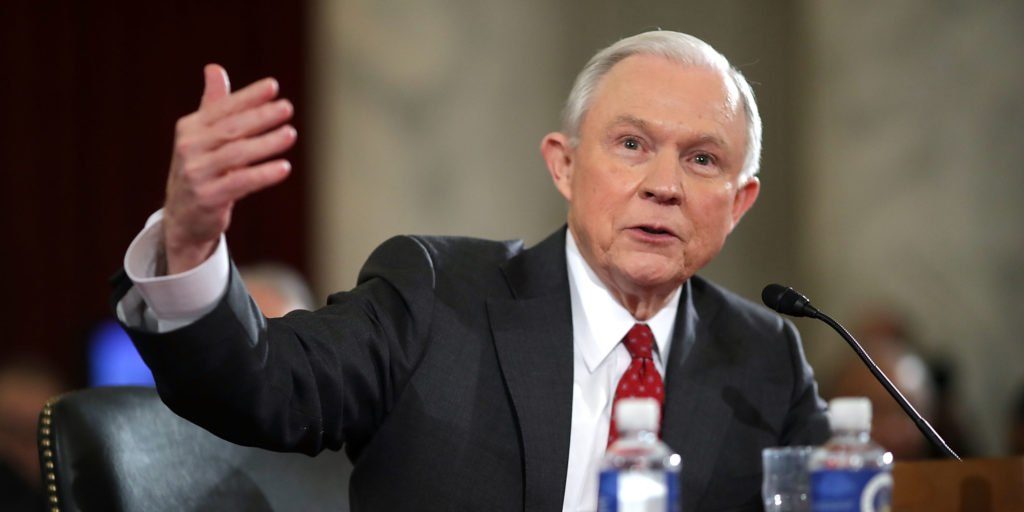
Attorney General Jeff Sessions, in dramatic Senate testimony, on Tuesday decried suggestions he colluded with Russian officials during the 2016 campaign as an “appalling and detestable lie” — while staunchly defending his role in the firing of former FBI Director James Comey.
“I have never met with or had any conversations with any Russians or any foreign officials concerning any type of interference with any campaign or election,” Sessions told the Senate Intelligence Committee. “I have no knowledge of any such conversations by anyone connected to the Trump campaign.”
The attorney general addressed the same Senate panel that heard last week from Comey, becoming the highest-ranking official to testify in the Russia investigation.
Democrats used the forum to pepper Sessions with tough questions, at times accusing him of “stonewalling” and impeding the congressional probe.
The normally reserved Sessions showed his feisty side in response, pushing back on what he called the “secret innuendo” being leaked about his contact with Russians and challenging portions of Comey’s testimony.
In a fiery opening statement, Sessions specifically contradicted Comey’s claims that he remained silent when the former FBI director expressed his concerns over a meeting with President Trump.
“I responded to his comment by agreeing that the FBI and Department of Justice needed to be careful to follow Department policies regarding appropriate contacts with the White House,” Sessions said, adding he was confident that Comey understood the rules on communicating with the White House about ongoing investigations.
Sessions had earlier recused himself from all matters relating to the Russia investigation after it was reported he had failed to disclose two meetings with Russian Ambassador Sergey Kislyak.
Oregon Democratic Sen. Ron Wyden asked Sessions about conflicting accounts rising from Comey’s testimony and claims that there was something “problematic” about Sessions’ role before his recusal.
Asked what issues might be problematic, Sessions raised his voice: “Why don’t you tell me? There are none, Senator Wyden, there are none … This is a secret innuendo being leaked out there about me, and I don’t appreciate it.”
Democrats appeared to be looking for evidence that Sessions’ contact with Russian officials was more significant than previously thought. Sessions has said neither of the two disclosed encounters had anything to with the Trump campaign in 2016 and that the meetings took place in his role as a lawmaker.
Sessions flatly denied a third meeting with the Russian liaison at the Mayflower Hotel in Washington during a campaign event in April.
“I did not have any private meetings nor do I recall any conversations with any Russian officials at the Mayflower Hotel,” he said. “I did not attend any meetings at that event. Prior to the speech, I attended a reception with my staff that included at least two dozen people and President Trump. Though I do recall several conversations I had during that pre-speech reception, I do not have any recollection of meeting or talking to the Russian ambassador or any other Russian officials.”
Tuesday was Sessions’ first time in the witness seat since his confirmation hearing in February.
Sessions’ testimony came on the heels of Comey’s explosive testimony last week on Russia’s medding in U.S. elections and allegations that Trump tried to kill a related investigation.
During Comey’s hearing, he hinted at Sessions’ role in the controversy.
“We were also aware of facts that I cannot discuss in an open setting that would make his continued engagement in a Russia investigation problematic,” Comey said.
The Justice Department and Sessions himself have pushed back on such suggestions. Sessions also has faced questions from Democrats about why he was involved in recommending Comey’s firing even after he recused himself from the Russia investigation. However, Sessions said Tuesday he had a duty to oversee the Justice Department and FBI, and a “fresh start” was needed at the FBI.
He also said he has the right to defend himself.
“I recused myself from any investigation into the campaign for president. I did not recuse myself from defending my honor against scurrilous and false allegations,” he said.
Unlike Comey, who bluntly said he tried to avoid one-on-one encounters with Trump and began documenting their interactions, Sessions is a staunch supporter of the president.
Sessions was one of the first members of Congress to endorse Trump and was then-candidate Trump’s adviser on almost every major decision and policy proposal pushed on the campaign trail.
Florida Sen. Marco Rubio asked Sessions whether Trump had recorded conversations he had in the White House with Comey – something Trump hinted he had done then walked back.
Comey said last week that he hopes there are tapes and encouraged the White House to release them.
“I do not [know],” Sessions said when asked whether he knows whether the president records his conversations.
Comey had also said that Sessions had lingered in the Oval Office following a group meeting, just before the private encounter during which Comey has said Trump asked him to pull back on his investigation of former National Security Adviser Michael Flynn. As Trump tried to shoo everyone out to talk alone with Comey, Sessions lingered, in Comey’s account. Comey suggested this indicated the attorney general’s awareness that it was improper for Trump and Comey to meet alone together, given the specter of the Department of Justice’s investigation into Russia’s election meddling and possible ties with the Trump campaign.
But Sessions disputed that was why he lingered, suggesting there was really nothing to it.
“I do recall being one of the last ones to leave, I don’t know how that occurred,” Sessions said. “I eventually left.”
The Associated Press contributed to this report.
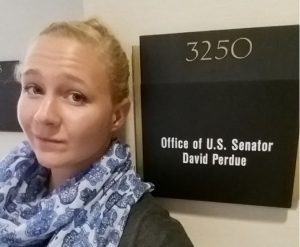 The alleged leaker accused of feeding a classified report to an online news site has a colorful history on social media that lays bare her political leanings as an environmentalist who wanted to “resist” President Trump.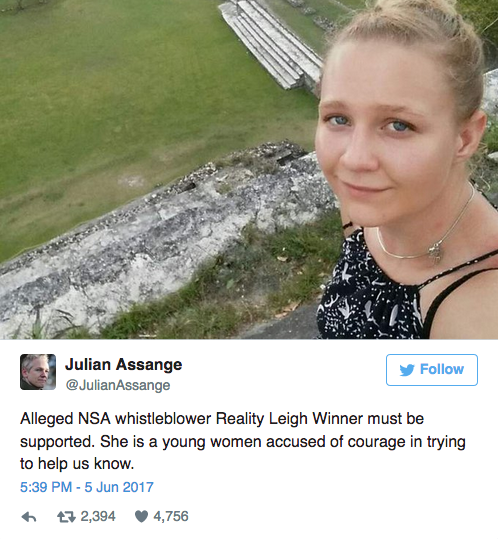
 Jared Kushner, President Donald Trump’s son-in-law and one of the senior advisers in the Trump administration, was seeking a private communications channel with the Kremlin, according to a new report in
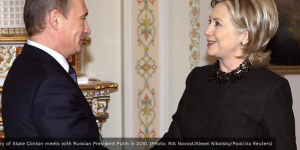 The Democrats and old-guard news media (forgive the redundancy) are pathologically obsessed with the hypothesis that Team Trump and Russia rigged last November’s presidential election. If Donald J. Trump so much as played Tchaikovsky’s Marche Slav on his stereo, these leftists deduce, he was in cahoots with the Kremlin.


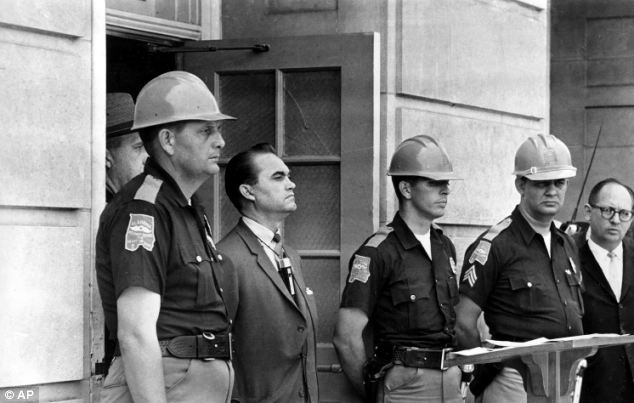
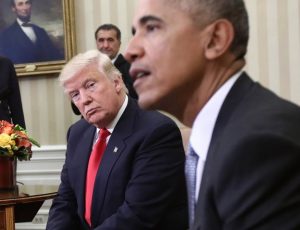 The Obama Administration struggled through one Congressional investigation after another, with the Departments of State, Justice, Treasury, Homeland Security, and Agriculture all getting their turn on the hot seat. Interestingly, the public never really connected these scandals to Obama, instead associating Lois Lerner, Janet Napolitano, Eric Holder, Hillary Clinton, and other career bureaucrats with the various investigations. When President Obama first took office, his administration focused on placing political appointees in various government positions of influence. Performance may have suffered when someone unqualified individual took over a powerful agency, but concern for the average citizen was not on the list of priorities. In some instances, persons were appointed to certain positions for specific purposes. Leon Panetta, whose intelligence experience was limited to two years as an Intelligence Officer in the Army from 1964 to 1966, was appointed Director of the CIA in 2009. Panetta spent two years as CIA Director, which was more than enough time to conduct an internal investigation into the interrogation practices of the agency under the Bush Administration. Lerner, Napolitano, Holder, and Clinton closely followed the script, as none of the scandals involving these agencies were ever connected to Obama.
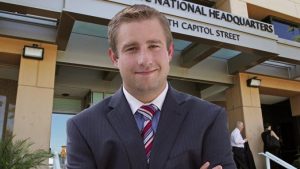 The family of Seth Rich, the Democratic National Committee staffer who was shot and killed in Washington last summer has denied the report that their son leaked more than 44,000 emails to WikiLeaks before his death.
 President Trump’s seemingly abrupt decision Tuesday to fire FBI Director James Comey was made at the recommendation of top Justice Department officials who claimed that his controversial handling of the Hillary Clinton email case last year rendered him unfit for the position.
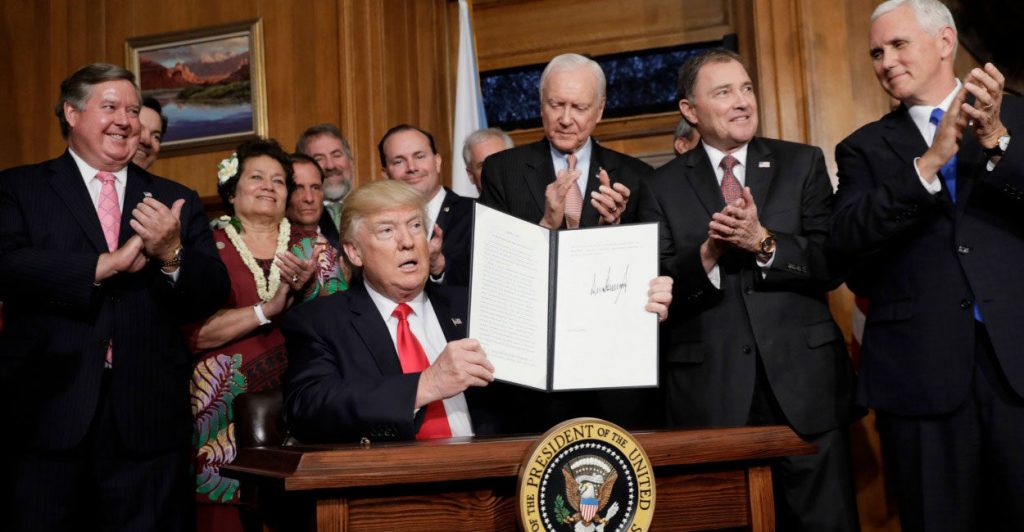
 When Neil Gorsuch won long-overdue confirmation this month to serve on the United States Supreme Court, Republicans in turn won control of judiciary. This meant they led all three branches of the federal government – at least the three envisioned by our Founding Fathers – for the first time in a decade.
 The education problem has been growing in America for decades, as the costs of educating our children skyrocket and students are churned out of the public education system and universities with less and less actual education.
 This will replace the current Student Loan program, which essentially supports a bloated, ineffective higher education system that is little more than a propaganda arm of the global leftist movement. It will also eliminate the current juggernaut of student debt, hanged around the neck of most graduat
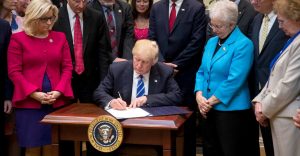 A good place to start is President Donald Trump’s executive order, which calls for a review of national monument designations—a tool long used by presidents to unilaterally restrict land use. Also, see our article of November 21, 2016,
 A U.S. Navy destroyer had another close encounter with an Iranian Revolutionary Guard “fast attack craft” in the Persian Gulf Monday.
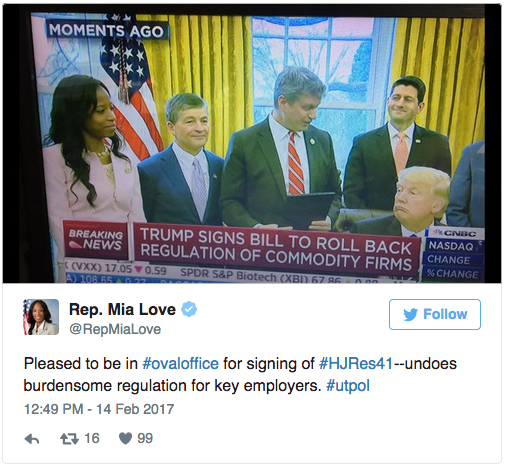
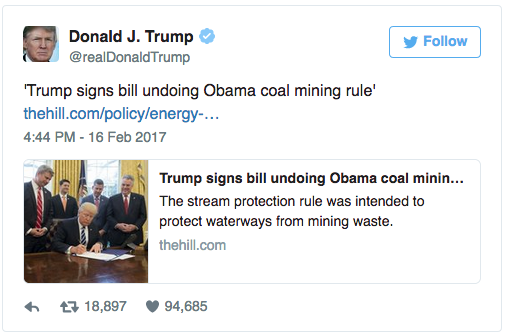
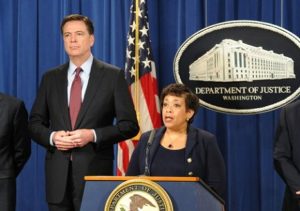 FBI Director James Comey distrusted former Attorney General Loretta Lynch and senior officials at the Justice Department, believing they might provide
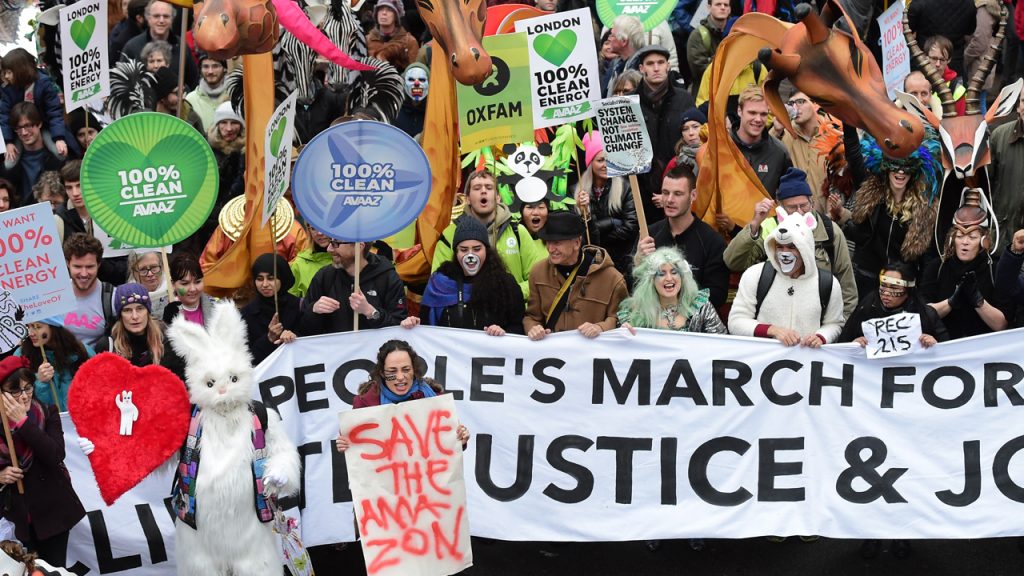
Let’s take a look at past predictions to determine just how much confidence we can have in today’s environmentalists’ predictions.
In 1970, when Earth Day was conceived, the late George Wald, a Nobel laureate biology professor at Harvard University, predicted, “Civilization will end within 15 or 30 years unless immediate action is taken against problems facing mankind.”
Also in 1970, Paul Ehrlich, a Stanford University biologist and best-selling author of “The Population Bomb,” declared that the world’s population would soon outstrip food supplies.
In an article for The Progressive, he predicted, “The death rate will increase until at least 100-200 million people per year will be starving to death during the next 10 years.”
He gave this warning in 1969 to Britain’s Institute of Biology: “If I were a gambler, I would take even money that England will not exist in the year 2000.”
On the first Earth Day, Ehrlich warned, “In 10 years, all important animal life in the sea will be extinct.”
Despite such predictions, Ehrlich has won no fewer than 16 awards, including the 1990 Crafoord Prize, the Royal Swedish Academy of Sciences’ highest award.
In International Wildlife (July 1975), Nigel Calder warned, “The threat of a new ice age must now stand alongside nuclear war as a likely source of wholesale death and misery for mankind.”
In Science News (1975), C.C. Wallen of the World Meteorological Organization is reported as saying, “The cooling since 1940 has been large enough and consistent enough that it will not soon be reversed.”
In 2000, climate researcher David Viner told The Independent, a British newspaper, that within “a few years,” snowfall would become “a very rare and exciting event” in Britain. “Children just aren’t going to know what snow is,” he said. “Snowfalls are now just a thing of the past.”
In the following years, the U.K. saw some of its largest snowfalls and lowest temperatures since records started being kept in 1914.
In 1970, ecologist Kenneth Watt told a Swarthmore College audience:
Also in 1970, Sen. Gaylord Nelson, D-Wis., wrote in Look magazine: “Dr. S. Dillon Ripley, secretary of the Smithsonian (Institution), believes that in 25 years, somewhere between 75 and 80 percent of all the species of living animals will be extinct.”
Scientist Harrison Brown published a chart in Scientific American that year estimating that mankind would run out of copper shortly after 2000. Lead, zinc, tin, gold, and silver were to disappear before 1990.
Erroneous predictions didn’t start with Earth Day.
In 1939, the U.S. Department of the Interior said American oil supplies would last for only another 13 years. In 1949, the secretary of the interior said the end of U.S. oil supplies was in sight.
Having learned nothing from its earlier erroneous claims, in 1974 the U.S. Geological Survey said the U.S. had only a 10-year supply of natural gas.
The fact of the matter, according to the U.S. Energy Information Administration, is that as of 2014, we had 2.47 quadrillion cubic feet of natural gas, which should last about a century.
Hoodwinking Americans is part of the environmentalist agenda. Environmental activist Stephen Schneider told Discover magazine in 1989:
In 1988, then-Sen. Timothy Wirth, D-Colo., said: “We’ve got to … try to ride the global warming issue. Even if the theory of global warming is wrong … we will be doing the right thing anyway in terms of economic policy and environmental policy.”
Americans have paid a steep price for buying into environmental deception and lies.
By Walter E. Williams